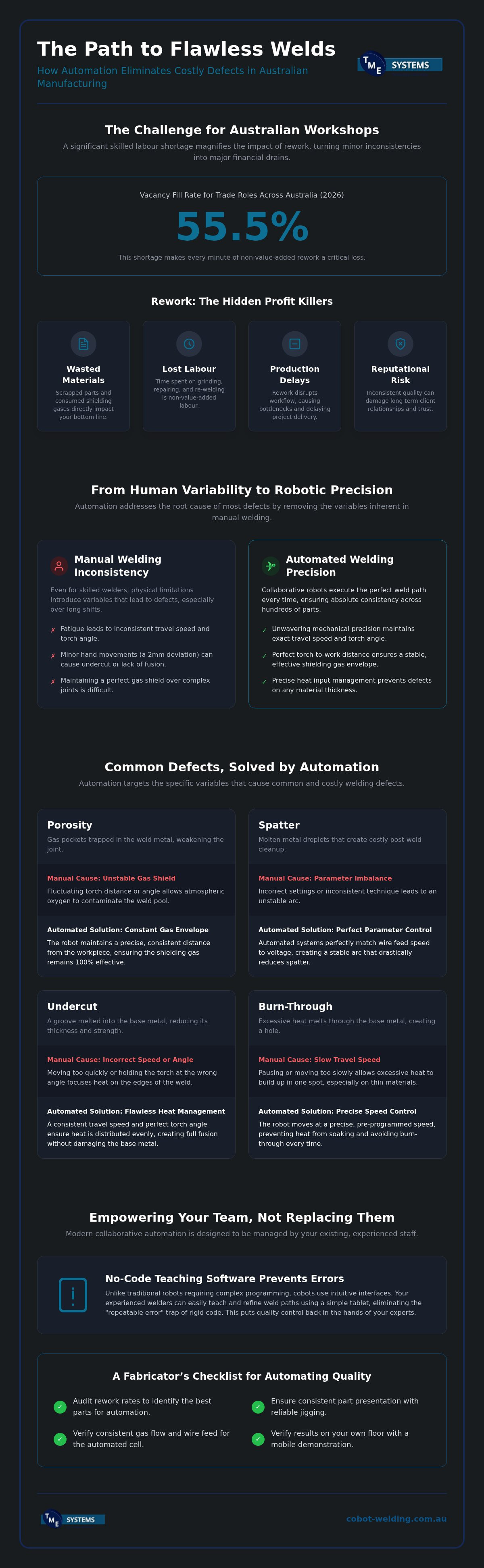

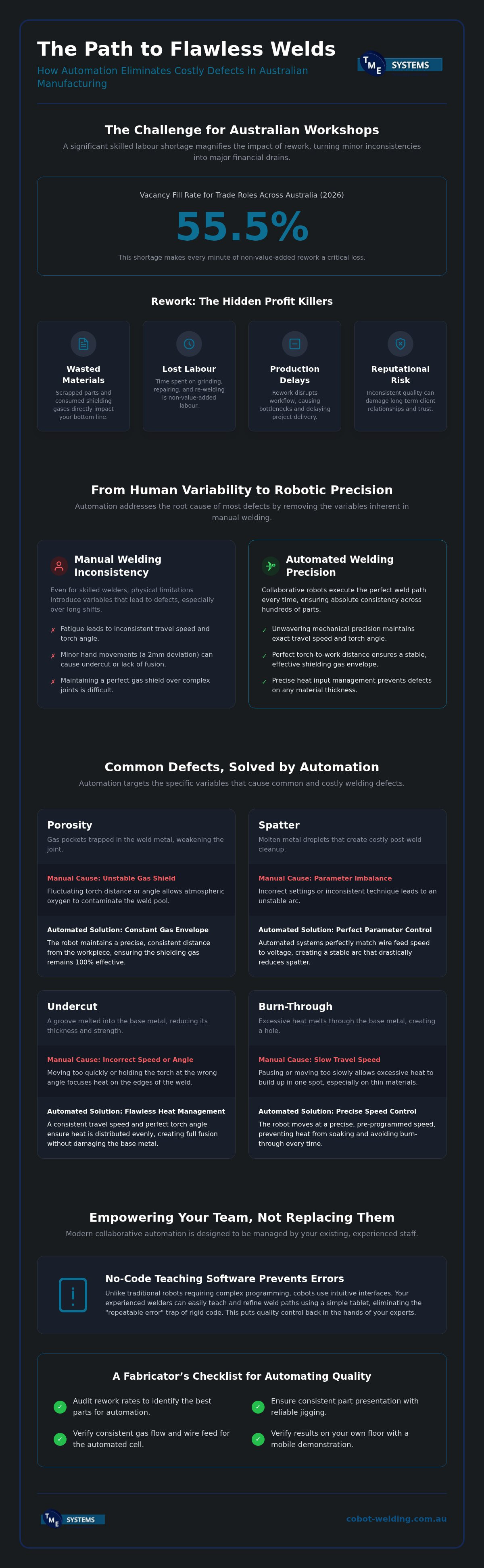
Did you know that in 2026, the vacancy fill rate for trade roles across Australia is sitting at just 55.5%? This shortage makes it incredibly difficult to maintain a steady output, especially when you're also battling the high cost of scrap and material waste. You've likely felt the frustration of seeing inconsistent weld quality across different shifts, leading to expensive rework that eats into your margins. It's a common hurdle, but it doesn't have to be the standard for your workshop floor.
This guide explores how to reduce welding defects with automation by using collaborative technology to stabilise the variables that lead to errors. You'll discover how collaborative automation eliminates the root causes of rework and helps your team achieve consistent, high-quality finishes every time. We will look at how no-code teaching software empowers your existing staff to manage automated cells and why seeing a mobile demo is the most practical way to start your transition toward faster production cycles and a more empowered workforce.
Key Takeaways
- Learn how to reduce welding defects with automation by removing human variability from travel speeds, torch angles, and arc stability.
- Discover how no-code teaching software allows your experienced welders to refine automated paths without needing to learn complex programming languages.
- Identify the "profit killers" in your workshop by auditing rework rates and material waste to find the best parts for your first automated cell.
- Understand the critical workshop factors, such as consistent jigging and gas flow, that ensure your collaborative robot delivers a high-quality finish every time.
- Find out how to verify results on your own floor using a mobile demonstration system to ensure the technology meets your specific production standards.
The Real Cost of Welding Defects in Australian Manufacturing
In any Australian workshop, rework is the hidden profit killer. It's the silent expense that eats away at your margins before the job even leaves the floor. When a weld fails inspection, the costs go far beyond the initial time spent on the torch. You're looking at wasted materials, expensive shielding gases, and the significant labour required for secondary grinding and repair. This non-value-added time is a major drain on productivity. One of the most effective ways to reduce welding defects with automation is to address these human variables directly, turning what was once a variable cost into a predictable outcome.
Beyond the immediate financial hit, there's the reputational risk. Delivering inconsistent quality to a long-term client can damage a relationship that took years to build. In a manual environment, defects are often random and hard to track. However, as workshops transition, they must also understand "systematic defects." These occur when a process is fundamentally flawed, leading to the same error being repeated across an entire batch. Managing this transition requires a shift in how your team views quality control.
Why Manual Welding Variability Leads to Rework
Human factors are the primary cause of inconsistency. Even the most skilled tradesperson faces fatigue toward the end of an eight-hour shift. It's simply not possible for a human to maintain the same torch angle and travel speed for hundreds of components in a row. A deviation of just 2mm in torch position can be the difference between a perfect bead and a lack of fusion or undercut. These small, unintended movements are often the root cause of the scrap pile, and they are nearly impossible to eliminate through manual training alone.
The "Repeatable Error" Trap in Traditional Automation
While Robot welding is designed to increase repeatability, traditional industrial systems can sometimes lead to a "repeatable error" trap. These systems often rely on complex, rigid code. If the initial program has a slight misalignment, or if a jig shifts slightly, the machine will repeat that same mistake with perfect, devastating consistency. This "set and forget" mentality in complex coding environments can actually increase your scrap rate if your staff can't easily jump in to refine the path.
While traditional industrial robots rely on rigid, complex code that can be difficult to adjust on the fly, cobots use intuitive interfaces that allow operators to refine paths instantly, preventing small errors from becoming large-scale scrap runs.
Common Weld Defects and How Automation Solves Them
Instead of relying on a welder's ability to hold a steady hand for hours, automation provides a mechanical precision that doesn't waver. This consistency is the foundation for high-quality finishes. When you reduce welding defects with automation, you're essentially stabilising the physical environment of the arc. This includes maintaining a perfect gas shield and managing heat input with a level of accuracy that manual welding can't match. By locking in the torch angle and distance, you eliminate the micro-adjustments that often lead to inconsistent beads; to learn about the design of these custom robotic manufacturing systems, read more about how precision engineering transforms production.
Consistency in travel speed is particularly vital for heat management. A robot doesn't speed up or slow down based on fatigue or distraction. It follows the exact path at the exact speed every time. This level of control is a key part of how to improve welding productivity with cobots, as it removes the guesswork from the production line and ensures every component meets the same high standard.
Eliminating Porosity and Spatter
Porosity often stems from an unstable gas envelope. If the torch-to-work distance fluctuates even slightly, oxygen can contaminate the weld pool. Automated cells keep this distance constant, ensuring the shielding gas remains effective throughout the entire bead. Beyond this, modern systems use automated parameter control to match wire feed speed to voltage perfectly. This precise balance significantly reduces spatter. Less spatter means your team spends less time on post-weld clean-up and grinding, allowing them to focus on higher-value tasks. By refining these settings once, you ensure that every subsequent weld is clean and requires minimal finishing.
Preventing Undercut and Burn-Through
For those requiring high-precision internal repairs, you can discover Bore Repair Systems, Inc. and their specialised automated welding technology designed to eliminate defects in cylindrical components.
For specialist fabricators like Donewright Stainless, this reduction in spatter and post-weld finishing is critical for maintaining both the aesthetic appeal and structural integrity of high-end metalwork.
Managing heat is a delicate act, especially on thin-gauge materials like aluminium or stainless steel. Automation solves this by maintaining a precise travel speed that prevents heat from soaking too long in one spot. This avoids the common issue of burn-through, where the arc blows through the base metal. At the same time, it ensures deep, consistent penetration without causing undercut at the edges of the weld. By ensuring the arc moves at a steady pace, you can achieve a zero-defect finish that looks as good as it performs. If you're looking to upgrade your workshop's capabilities, Cobot Welding Australia provides the tools and training to make this transition seamless.
Reducing Programming Errors with No-Code Software
When automated welding fails, the culprit is rarely the hardware. Most often, complex code is the root cause of defects. Traditional industrial robots require specialised programming knowledge, creating a gap between the person who knows how to weld and the person telling the machine what to do. If a programmer doesn't understand the nuances of arc voltage or torch lead angles, the resulting code will be fundamentally flawed. This disconnect leads to "translation errors" that manifest as poor penetration or inconsistent beads. To truly reduce welding defects with automation, we have to remove the barrier of complex syntax and put the control back into the hands of the tradespeople who understand the metal.
Modern collaborative systems solve this by using intuitive interfaces. Instead of typing lines of logic, operators use a "teach by touch" method to set the weld path. This shift from coding to teaching is a game-changer for local workshops. For a deeper look at how this works in practice, check out our no-code robot welding software guide, which explains how accessible technology is reshaping Australian fabrication.
Why Intuitive Path Teaching Prevents Defects
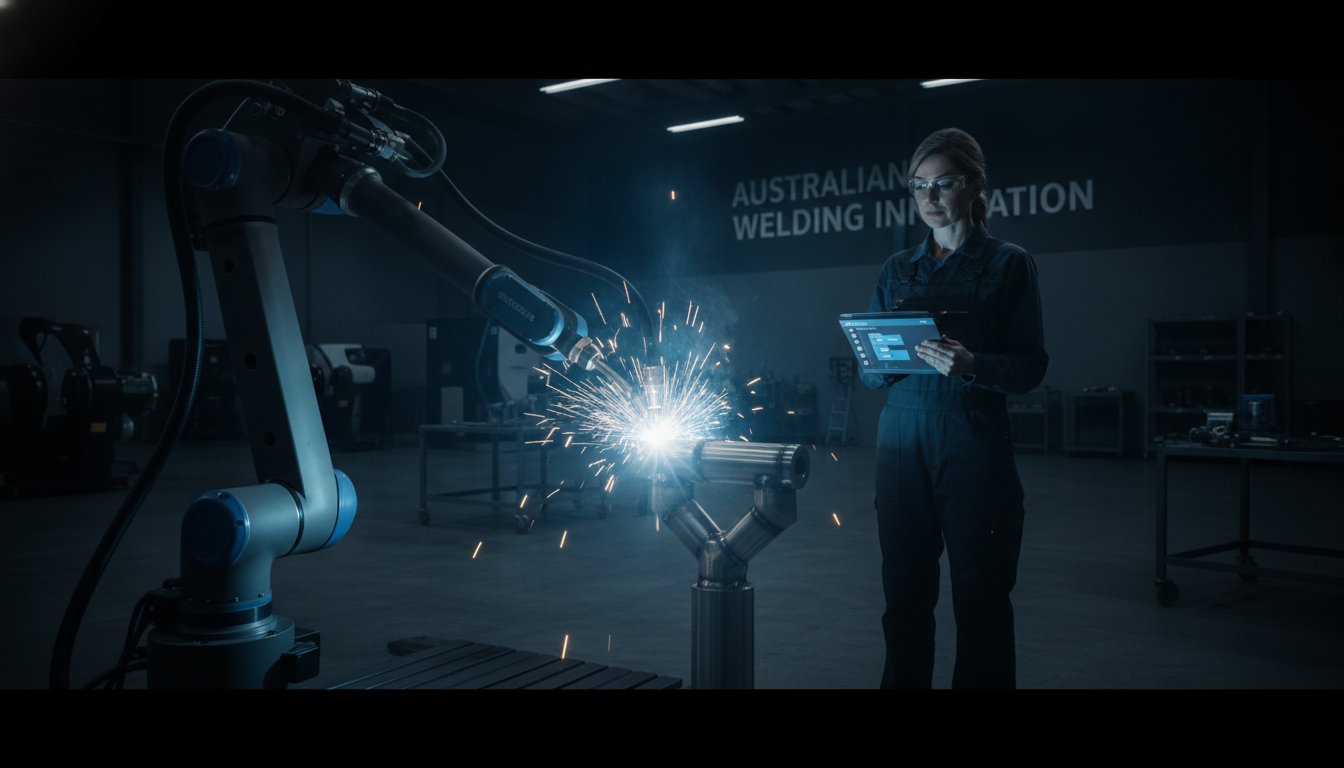
The beauty of no-code software lies in its physical simplicity. An experienced welder can physically move the robot arm to the exact start and end points of a joint, ensuring the path is spot-on from the beginning. You aren't guessing coordinates on a screen; you're setting them on the workpiece. This allows for real-time adjustment of weld parameters without touching a single line of code. If the arc looks too hot or the travel speed seems sluggish during a dry run, the operator can refine the settings instantly on a tablet. Once a program is perfected, it can be "copy-pasted" across identical parts, ensuring the first weld is just as good as the hundredth. This level of precision is how you reduce welding defects with automation while maintaining high throughput.
Empowering the Tradesperson, Not the Programmer
By using no-code software, you keep the "welder's eye" in the process. A professional tradesperson can spot potential issues during setup, such as poor fit-up or heat sink problems, that a dedicated programmer might miss. This removes the risk of errors being "lost in translation" between departments. The person responsible for the quality of the finish is the same person who sets the robot's path. Because you can program a new part in minutes rather than hours, no-code software becomes the ultimate quality control tool for small batches, ensuring even a run of five parts is as perfect as a run of five hundred. It's about giving your best staff a tool that amplifies their existing skills rather than replacing them with a computer expert. However, for businesses requiring more complex digital integration, Sydney-based 4mation offers custom software and AI development to help bridge the gap between factory floor data and enterprise-level management.
Moving from manual processes to an automated cell isn't just about buying new gear. It's about auditing your current workflow to ensure the machine has the best chance of success. To reduce welding defects with automation, you need to be proactive. If you automate a messy process, you'll simply produce scrap at a faster rate. Successful integration starts with a clear-eyed look at your workshop floor and identifying where human variability is currently costing you the most money. For many, this includes ensuring that the components being welded are manufactured to exact specifications, a standard maintained by precision specialists like Velocity Sheet Metal.
Start by looking at your production data. Which parts are currently hogging the grinding station? These components are your prime candidates for automation. You should prioritise repetitive joints where human fatigue typically sets in during the middle of a shift. When a welder gets tired, torch angles slip and travel speeds become inconsistent. You also need to assess the part's geometry. Most standard tasks are well-suited for a 6-axis cobot arm, but you must ensure the torch can reach every joint at the required angle. If the geometry is too cramped for a mechanical arm, automation might not be the right fix for that specific defect.
Step 2: Optimise Your Fit-Up and Jigs
A robot is only as good as the jig holding the part. In a manual setup, a skilled welder can compensate for a 1mm gap or a slightly misaligned plate. A robot won't do that; it will follow the path it was taught. If your fit-up is sloppy, the robot will end up welding "air" or missing the root of the joint entirely. You need repeatable positioning so that every single part sits in the exact same spot. This is a core concept we explore in our collaborative robot welding cells guide. Consistent jigs are the only way to ensure the gas envelope and arc length remain stable from the first part to the last.
Don't ignore the wider workshop environment. With the Australian Workplace Exposure Standard for welding fumes dropping to 1mg/m³ in December 2026, your automated cell should be integrated with proper extraction to keep the air clear. Finally, ensure your team is trained to maintain the cell. They don't need to be computer scientists, but they do need to understand how to keep the sensors clean and the wire feeding smoothly. If you're ready to see how these checks apply to your specific components, you can book a mobile demo with TME Systems to test the technology on your own workshop floor.
Achieving Zero-Defect Production with TME Systems
Transitioning from manual fabrication to an automated workshop can feel like a massive leap. TME Systems acts as the bridge for Australian fabricators, providing the local expertise needed to make this shift without the usual headaches. We understand that the goal isn't just to buy a machine; it's to reduce welding defects with automation and protect your bottom line. By focusing on practical, turnkey solutions, we help you integrate collaborative technology that works from day one, ensuring your staff feel supported rather than replaced.
Our approach is grounded in the reality of the workshop floor. We don't just ship a box and leave you to it. Instead, we work as a trusted partner to ensure your specific production hurdles are cleared. Whether you're dealing with the shortage of experienced tradespeople or the rising costs of material waste, we provide the tools and training to turn those challenges into a competitive advantage.
See the Difference with a Mobile Demonstration
The best way to understand how a cobot will perform in your environment is to see it in action on your own parts. TME Systems offers a mobile demonstration system that brings the technology directly to your workshop. This isn't a generic pitch; it's a hands-on proof of concept where we test your actual materials and joints. You'll get immediate feedback on how the system handles your high-rework parts and see exactly how it stabilises the arc to eliminate spatter and porosity. To see this technology on your floor, you can book a mobile welding robot demonstration to verify the results before making a commitment.
Integration and Training for Long-Term Success
Buying the equipment is only half the battle. Long-term quality comes from how well your team can manage the automated cell. We provide custom integration that fits into your existing workflow, followed by comprehensive operator onboarding. Our training focuses on the "welder's eye," teaching your staff how to use our no-code software to refine paths and control weld parameters. When your team is confident in path teaching, they can reduce welding defects with automation across every new job that comes through the door. For a detailed look at our process, our on-site cobot welder training guide outlines how we empower your tradespeople to become expert operators. With ongoing local support, TME Systems ensures your production line maintains peak quality and consistency for years to come.
Future-Proofing Your Workshop with Automated Quality
Integrating collaborative technology isn't about replacing your skilled tradespeople; it's about giving them the tools to succeed in a demanding market. By stabilising the physical environment of the arc and removing the fatigue-related errors that plague manual shifts, you can significantly reduce welding defects with automation. We've seen how no-code software and precise fit-up turn rework from a daily headache into a rare exception, allowing your team to focus on high-value production rather than secondary grinding.
As Australian-owned automation specialists, TME Systems is here to help you navigate this transition with confidence. Our turnkey cells and intuitive software are designed specifically for the realities of the workshop floor, offering proven payback periods of 12 to 24 months. You don't need to be a programmer to achieve high-quality finishes; you just need a practical partner who understands your trade.
Ready to take the next step? Book a Mobile Welding Robot Demonstration to see zero-defect production in action on your own floor. Let's work together to make rework a thing of the past and get your production cycles moving faster than ever.
Frequently Asked Questions
Can automation really reduce defects in small-batch welding?
Yes, collaborative automation is specifically designed for high-mix, low-volume work. Because you can program new parts in minutes using no-code software, even a run of five pieces benefits from the same arc stability as a mass-produced batch. This precision ensures that the first part is just as accurate as the last, effectively allowing you to reduce welding defects with automation across your entire product range.
Will I need to hire a programmer to reduce defects with a robot?
No, you don't need a dedicated coder to operate a modern cobot. TME Systems provides intuitive no-code teaching software that allows your existing welders to set the path by physically moving the arm. This keeps the "welder's eye" in the process. Your tradespeople already understand heat and penetration; they just need a tool that follows their lead without the barrier of complex computer languages.
What is the most common welding defect that automation can fix?
Porosity and spatter are the most common issues solved by automation. These often occur in manual welding due to inconsistent torch-to-work distances or fluctuating travel speeds. A robot maintains a perfect, steady height and speed, ensuring the gas envelope remains intact. This stability removes the variables that cause contamination, resulting in a clean finish that requires far less grinding or secondary clean-up.
Does robotic welding require better part fit-up than manual welding?
Yes, consistent fit-up is vital because a robot follows a programmed path rather than reacting to gaps like a human welder. While a person can weave to fill a 2mm gap, a robot expects the metal to be in the same spot every time. Investing in reliable jigs and precise cutting, such as the services provided by CNC Cut to Size, ensures the robot hits the root of every joint, which is a key way to reduce welding defects with automation.
While savings vary based on your current scrap rates, most Australian workshops see a significant reduction in non-value-added labour. By eliminating the need for secondary grinding and repair, you can reallocate staff to more productive tasks. When combined with reduced material waste and lower consumable use, many fabricators report that their collaborative welding cells pay for themselves within a 12 to 24 month period.
Can a cobot weld aluminium without causing distortion or burn-through?
Cobots are excellent for aluminium because they manage heat input with extreme precision. Burn-through usually happens when a manual welder moves too slowly or pauses. A robot maintains a high, consistent travel speed that prevents heat from soaking into the base metal. This control minimises distortion on thin-gauge materials, allowing you to achieve deep penetration without compromising the structural integrity or appearance of the part.
What happens if the robot makes a mistake during the weld path?
If you notice a misalignment during setup, you can pause the system and adjust the path instantly. Because our software is no-code, your operator doesn't have to rewrite a program to fix a mistake. They simply move the arm to the correct position and save the new point. This immediate correction prevents a small setup error from turning into a batch of scrap parts.
Is it easy to adjust weld parameters if I see a defect forming?
Adjusting parameters is straightforward using the tablet interface. If an operator sees that a weld is running too hot or needs more wire, they can refine the voltage or feed speed in real time. This flexibility ensures that you aren't locked into a "bad" program. It empowers your tradespeople to use their professional judgement to fine-tune the machine for the best possible finish.