
What if the best person to program your new welding robot isn't a software engineer, but the experienced welder who has been on your workshop floor for a decade? Many Australian fabricators worry that robot programming for welders requires a degree in computer science or an expensive specialist who doesn't understand how to lay a clean bead. It's a common frustration; you need to increase output to combat the chronic shortage of tradespeople, but the thought of adding "fiddly" technology to a high-pressure environment feels like a recipe for downtime.
We agree that automation should be a tool for the tradesman, not a burden for the business. This guide explains how no-code software allows your existing staff to become proficient robot operators without any traditional coding knowledge. You'll learn how collaborative robot cells can help your workshop maintain high weld quality and boost throughput by simplifying the teaching process. We'll show you how these systems turn your skilled welders into the masters of automation, ensuring your workshop stays productive and your team feels empowered with the latest tools.
Key Takeaways
- Learn how no-code software is redefining robot programming for welders by replacing complex G-code with simple, manual teaching movements.
- Discover the mechanics of lead-through programming, which lets your team set weld paths and waypoints by hand instead of using a pendant keyboard.
- Understand how intuitive teaching makes automation profitable for small-batch runs, reducing setup times from hours down to just a few minutes.
- Find out how to empower your current staff through practical on-site training that focuses on their welding skills rather than computer science.
- Learn why local Australian support and mobile proof-of-concept demonstrations are vital for avoiding technical hurdles and ensuring a smooth integration.
What is Robot Programming for Welders in 2026?
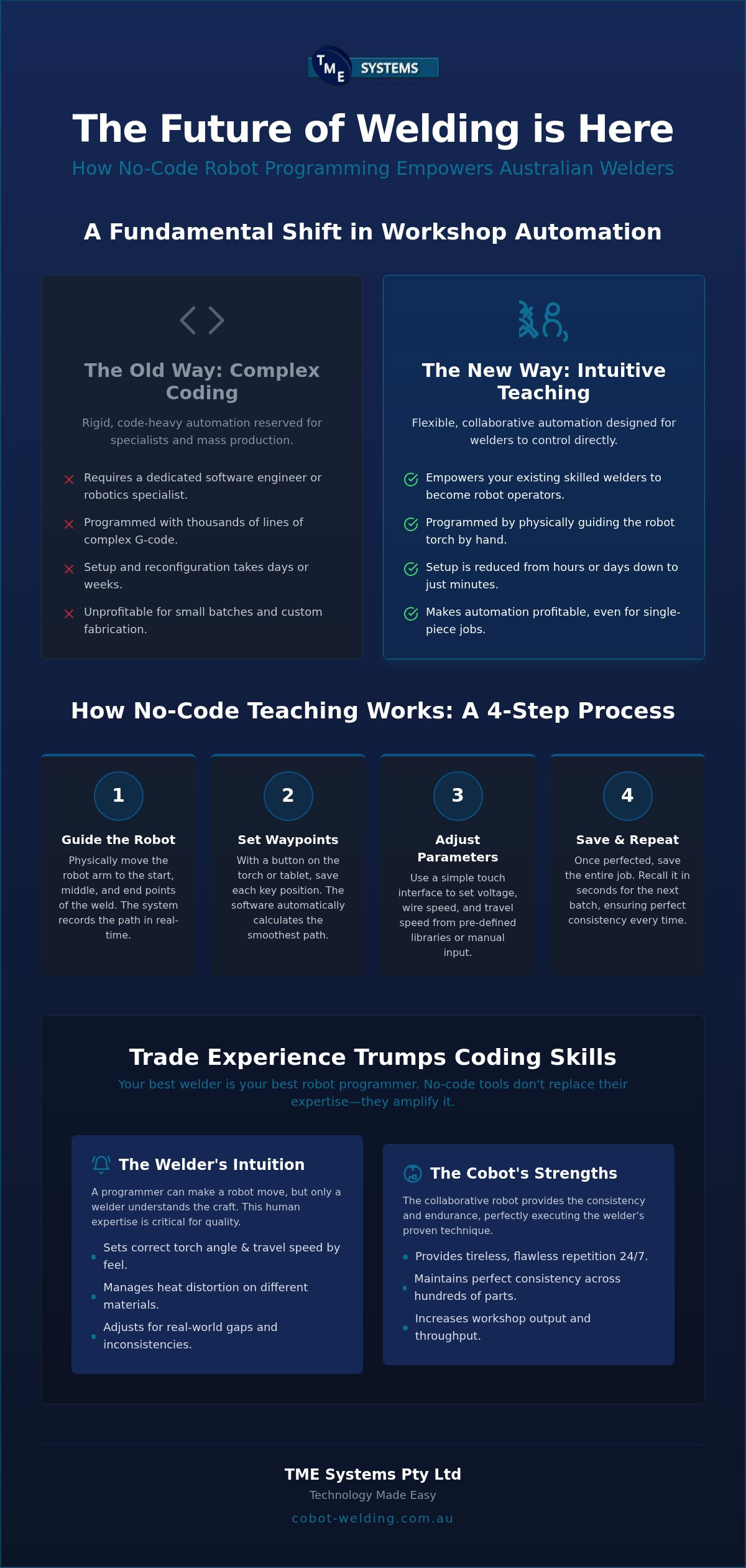
Traditional automation used to be a dark art. You needed a specialist to sit down and write thousands of lines of code before a single spark flew. In 2026, the definition of robot programming for welders has shifted entirely. It is no longer about syntax or software architecture; it's about teaching a tool. For Australian fabricators, this shift is a necessity. With a persistent shortage of skilled tradespeople across the country, workshops can't afford to have their best staff sidelined by complex tech. No-code software acts as the bridge, allowing a welder to transfer their years of "arc time" directly to a machine without typing a single character.
The Evolution of Workshop Automation
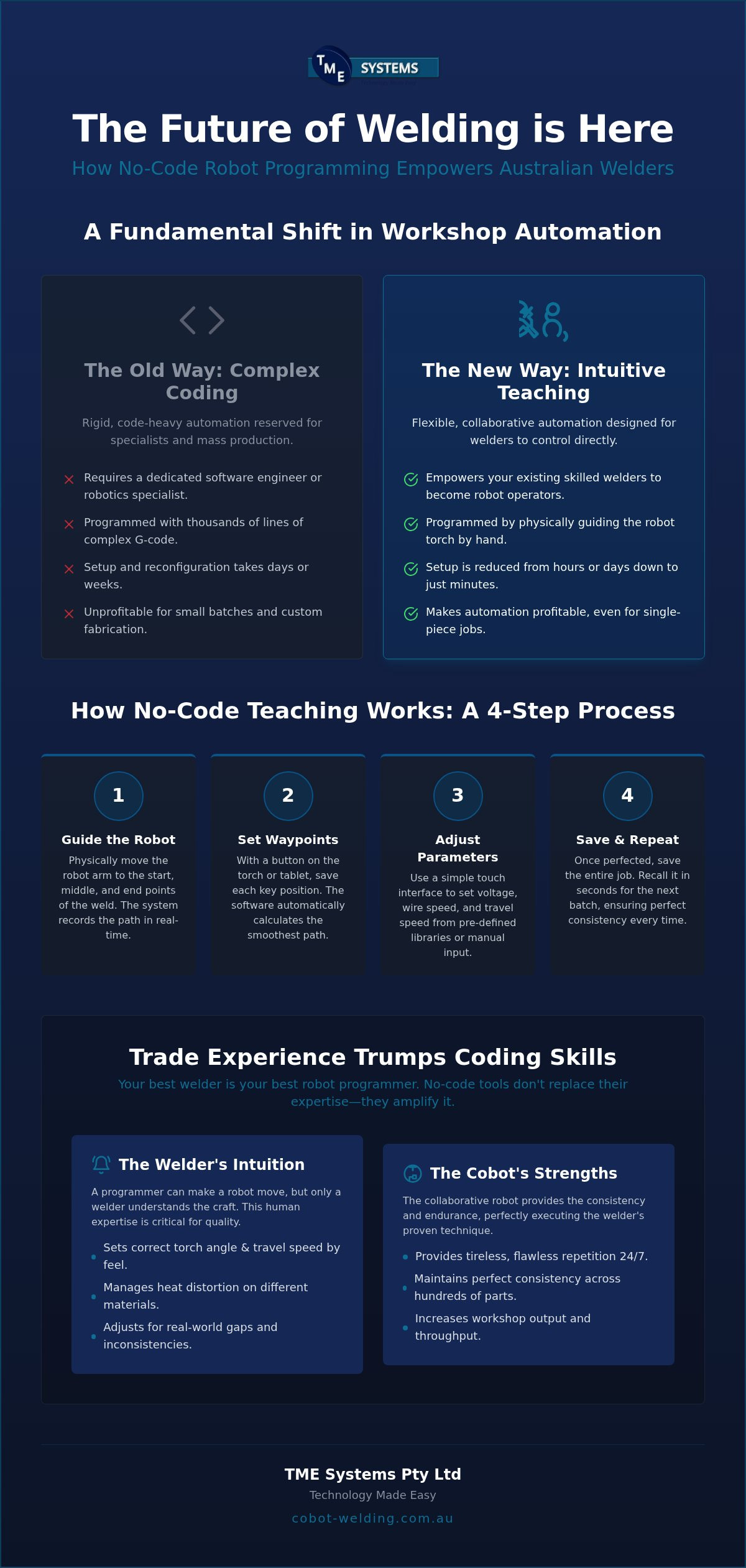
Historical Robot welding systems were often fixed, high-volume installations that took weeks to reconfigure. These were great for car factories but a nightmare for the average Aussie job shop doing small batches. Modern automation has evolved into flexible, collaborative systems. We've moved away from rigid G-code toward the "Lead-Through" method. This means you physically move the robot arm to the start point, middle, and end of a joint. The software records these positions instantly. It turns a month-long integration project into a morning's work, making automation viable for even the smallest production runs.
Why Trade Experience Trumps Coding Skills
A software engineer might know how to make a robot move in a perfect line, but they don't understand how metal behaves. They don't know how to adjust for a slightly inconsistent gap or how to manage heat distortion on a thin aluminium plate. This is why trade experience is the most valuable asset in modern robot programming for welders. A skilled operator has the intuition to set the right torch angle and travel speed by feel. No-code tools don't replace this expertise; they amplify it. Instead of spending hours explaining a weld procedure to a programmer, the welder simply shows the cobot what a good bead looks like. The machine provides the consistency, while the human provides the craft. It's a partnership that keeps the focus on quality fabrication rather than troubleshooting software.
How No-Code Teaching Software Works
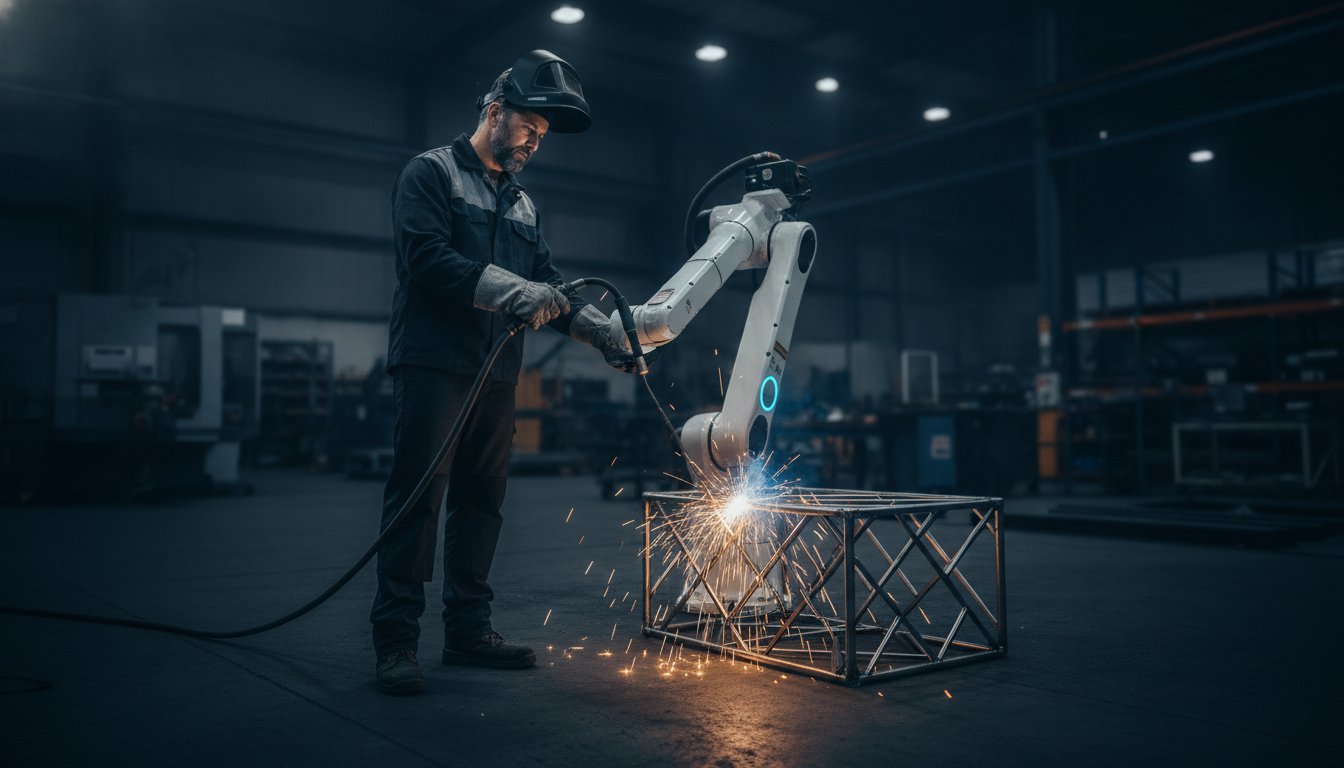
Understanding the mechanics of modern robot programming for welders starts with the physical interface. Instead of a computer terminal, the welder uses the robot itself as the input device. This lead-through approach relies on high-resolution torque sensors that allow the operator to move the arm by hand as if it were a standard MIG torch. By guiding the robot through the required motion, the software records the spatial coordinates in real time. This replaces the old method of typing in X, Y, and Z coordinates; it makes the transition from manual to automated welding feel like a natural extension of the trade. While some high-end R&D systems require massive computing power for AI tasks, these workshop-ready tools focus on practical, tactile input.
Teaching Paths Without a Keyboard
To define a weld path, the operator simply moves the arm to the start point and hits a button on the torch head or a tablet screen to save a waypoint. They then move to the end of the joint and save another. The software automatically calculates the straightest or most efficient path between these points. For complex curves or circular welds, the operator can save multiple points along the arc. The system then smooths these transitions to ensure a consistent bead appearance, removing the jerky movements often associated with manual pathing. This is the core benefit of simplified 'no-code' platforms; they focus on the final weld quality rather than the underlying syntax. It allows robot programming for welders to happen in minutes, not days.
Integrating Welding Parameters
Once the path is set, the operator adjusts the welding variables via a touch interface. You don't need to be a software engineer to set the voltage, wire feed speed, or travel speed. Most systems include a library of pre-defined weld schedules for common materials like mild steel or aluminium. If the bead looks too cold or the penetration isn't quite right, the welder can nudge the settings on the screen mid-run, just as they would on a standard power source. You can also define weaving patterns or stitch welds with a few taps on the tablet. No-code teaching is a visual, hands-on process where the operator guides the machine through its tasks without writing a single line of script. This record and playback workflow means that once a job is perfected, it can be saved and recalled in seconds for the next batch. If you want to see how this feels in a workshop environment, you can explore our range of collaborative robot welding cells designed for Aussie fabricators.
Traditional Programming vs. Intuitive Teaching
Choosing between traditional industrial robots and modern cobots usually comes down to one question: who is going to run the machine? Traditional robot programming for welders often involves cryptic languages like Python or C++. While these are powerful, they are cost-prohibitive for most Australian job shops. Hiring a dedicated industrial programmer can cost significantly more than upskilling your current team. If that programmer leaves, your automation investment becomes a very expensive paperweight. By contrast, intuitive teaching puts the power back into the hands of the people who actually know how to weld.
The "Small Batch" test is the ultimate decider for profitability. In a traditional setup, coding a path might take four hours for a part that only takes ten minutes to weld. That doesn't make sense for a run of five or ten units. With intuitive teaching, that same path takes ten minutes to set up. Now, automation is profitable even for small runs. This shift allows you to maintain high quality without needing a massive backlog of identical parts to justify the tech.
The Problem with Traditional Pendants
Traditional teach pendants are cluttered with complex menus and sub-directories. They often lead to operator frustration and long periods of downtime while waiting for a specialist to "fix the code." By using no-code robot welding software, you democratise the technology. Every welder on the floor can understand the interface. If a part changes slightly, the person standing right there can adjust the path in seconds. They don't need a degree; they just need their existing trade knowledge and a few taps on a screen.
Flexibility for High-Mix, Low-Volume Jobs
Most Australian fabricators don't make 10,000 of the same thing. They make 50 of one thing today and 20 of another tomorrow. To stay competitive against overseas imports, local shops must reduce the cost of changeover. This is where intuitive systems shine. As noted in this Introduction to Welding Robots and Cobots, the goal is to make the machine adapt to the workshop, not the other way around. Consider the difference in efficiency:
- Traditional Coding: 4+ hours for a new part setup.
- No-Code Teaching: 10-15 minutes for a new part setup.
- Maintenance: Handled by the welder, not a software engineer.
Imagine a 10-minute setup for a 5-minute weld. That speed allows you to say yes to more jobs without blowing out your lead times. It turns robot programming for welders from a technical hurdle into a daily workshop tool that keeps your floor moving.
Transitioning Your Staff to Robotic Welding
Transitioning your workshop to automation is as much about people as it is about power sources. Many managers make the mistake of looking for a computer whiz to run their new cell. In reality, your best candidate is likely the welder who has spent years on the tools. They already understand heat management, joint preparation, and how metal reacts to the arc. Modern robot programming for welders is designed to meet these tradespeople where they are, using their existing skills rather than forcing them to learn a new language. To ensure a smooth transition, a structured on-site cobot welder training program is essential. This approach demystifies the tech and proves that the robot is a partner, not a replacement.
Safety is another critical pillar of a successful transition. In Australia, collaborative robots must meet specific standards to operate without safety cages. This involves setting force and speed limits that protect the operator while allowing them to work side-by-side with the machine. Addressing "technophobia" early by showing these built-in safety features helps build trust across the workshop floor. When a welder sees that the machine stops instantly upon contact, the fear of the "fiddly" or dangerous machine disappears.
The First 48 Hours of Integration
The first two days are about building momentum. After unpacking the cell and completing a basic orientation, the focus should be on the first "hand-guided" weld. Seeing the machine follow their lead for the first time usually converts even the most sceptical tradesman. It's important to set realistic goals during this first week. Don't expect peak throughput on day one. Instead, focus on the operator becoming comfortable with the touch interface and path teaching. Once they realise they can't "break" the software by trying different settings, their confidence and speed will grow naturally.
Upskilling for the Future
Introducing cobots allows you to turn a manual welder into an Automation Lead. This shift has massive implications for staff retention and workshop morale. Welding is physically demanding work that takes a toll on the body over decades. By offloading repetitive, high-volume tasks to the robot, you reduce the risk of long-term injuries and physical strain on your team. Your skilled staff can then focus on more complex, bespoke fabrication that requires a human touch. This makes the job more engaging and less exhausting, which is a major win for keeping your best people in the business. If you're ready to see how your team reacts to this technology, you can explore our operator onboarding and training services to start your automation journey.
Getting Started with Cobot Welding in Australia
Starting an automation journey in Australia requires more than just buying hardware off a shelf. Many businesses fall into the trap of importing units only to find that shipping, duties, and a lack of local technical help turn their investment into a dormant asset. For robot programming for welders to be successful, you need a partner who understands the local manufacturing environment. TME Systems Pty Ltd organises the end-to-end integration process, ensuring that the technology fits your specific workshop flow rather than forcing you to change how you work. We look at your existing processes and identify where a cobot can add the most value from day one.
The Proof of Concept
You should never buy a welding robot without seeing it weld your actual components. A mobile welding robot demonstration is the most effective way to validate the tech on your own workshop floor. This on-site proof of concept allows you to identify "low-hanging fruit"; these are the repetitive parts that currently consume too much of your skilled welders' time. To get the most out of a demo, have your standard jigs and a few sets of cleaned parts ready to go. Seeing your own staff take the lead during robot programming for welders proves that the software is as intuitive as we claim. It replaces theoretical promises with practical, physical results you can inspect immediately.
Partnering with Integration Specialists
There is a significant difference between a box-mover and an integration partner. A box-mover leaves you to figure out the power requirements and floor layout on your own. A partner evaluates your specific collaborative robot welding cells for your floor plan, ensuring you have the right clearance and utility access. We help you prepare your power supply and organise the workspace for maximum efficiency. TME Systems Pty Ltd provides national support for every cell they integrate, giving you peace of mind that expert help is always available within your own time zone. This is about more than just a transaction; it's about building a long-term relationship where we act as a practical mentor for your team. This collaborative approach ensures that the transition to automation is steady, predictable, and ultimately profitable for your business.
Empowering Your Workshop with Accessible Automation
The transition to automation doesn't have to be intimidating or overly technical. The shift toward no-code software has fundamentally changed robot programming for welders, moving it away from complex scripts and back into the hands of skilled tradespeople. By adopting collaborative systems, Australian fabricators can overcome the persistent labour shortage while maintaining the high weld quality their clients expect. We've seen that the most successful integrations happen when the technology adapts to the welder, not the other way around. With national support and training tailored for the reality of the workshop floor, these tools offer a proven ROI for small-to-medium shops looking to stay competitive in a changing market.
If you're ready to see how this technology fits into your daily operations, Book a Mobile Demo to see no-code welding in action on your workshop floor. It's an opportunity to prove the concept on your own parts and give your team the tools they need to lead your business into a more productive future.
Frequently Asked Questions
Do I need to know how to code to use a welding cobot?
No, you don't need any coding or software engineering knowledge to operate these systems. Modern robot programming for welders uses a "no-code" approach where you physically guide the robot arm through the required path. The software records your movements and translates them into machine instructions automatically. This allows your best welders to focus on their trade skills rather than learning a new computer language or troubleshooting complex syntax.
How long does it take for a welder to learn the software?
Most experienced welders become comfortable with the basic interface in just a few hours. A structured on-site training program usually takes one to two days to cover setup, path teaching, and parameter adjustment. Because the system uses a visual touch interface rather than text-based coding, operators are often running production parts by the end of their first week. It's a much faster learning curve than traditional industrial robotics systems.
Can I adjust the weld path if the fit-up of the parts is slightly off?
Yes, you can easily "nudge" or adjust individual waypoints via the touch interface if your part fit-up varies. If a joint isn't lining up perfectly, the operator simply moves the robot to the new position and saves the updated point. This flexibility is critical for Australian job shops where material consistency might vary. It ensures you can maintain high weld quality without needing to call in a specialist for minor path corrections.
Is the software compatible with both MIG and TIG welding processes?
The software is fully compatible with both MIG and TIG welding processes. You can integrate different power sources and adjust specific parameters like gas pre-flow, amperage, and wire feed speed directly through the robot's interface. While TIG often requires more precise pathing and torch angles, the lead-through teaching method allows the welder to set these complex positions manually to ensure the best possible results on every joint.
What happens if the robot hits an obstruction during a programmed path?
Collaborative robots are equipped with sensitive torque sensors in every joint that detect unexpected resistance. If the arm hits an obstruction or a person, it stops instantly to prevent injury or equipment damage. This built-in safety allows these units to operate in shared workspaces without the need for traditional safety cages. Once the obstruction is cleared, the operator can simply reset the path and continue the job safely.
Do these robots work with existing welding power sources?
Yes, these systems are designed to integrate with most modern digital welding power sources. Whether you're using a Fronius, Kemppi, or Miller unit, we can usually establish a communication link that allows the robot to control the arc. This means you don't necessarily have to buy a completely new welder to start using automation. We assess your current equipment during the integration process to ensure seamless compatibility and control.
How much does the software cost compared to traditional programming?
While we don't quote specific prices without assessing your needs, the cost of no-code software is significantly lower when you consider the total cost of ownership. Traditional industrial robots often require expensive external consultants or dedicated staff to write code. With no-code tools, your existing team handles the programming. This eliminates recurring service fees and reduces the "cost of changeover" for every new part you bring into production.
Can I save and reuse programs for jobs that come back every few months?
Absolutely, you can save every job into a digital library for instant recall. If a customer returns with the same batch of parts six months later, you simply reload the saved program and set your jigs. This makes robot programming for welders an asset that builds value over time. It ensures that your setup time for repeat work is virtually zero, allowing you to get through small-batch jobs much faster.