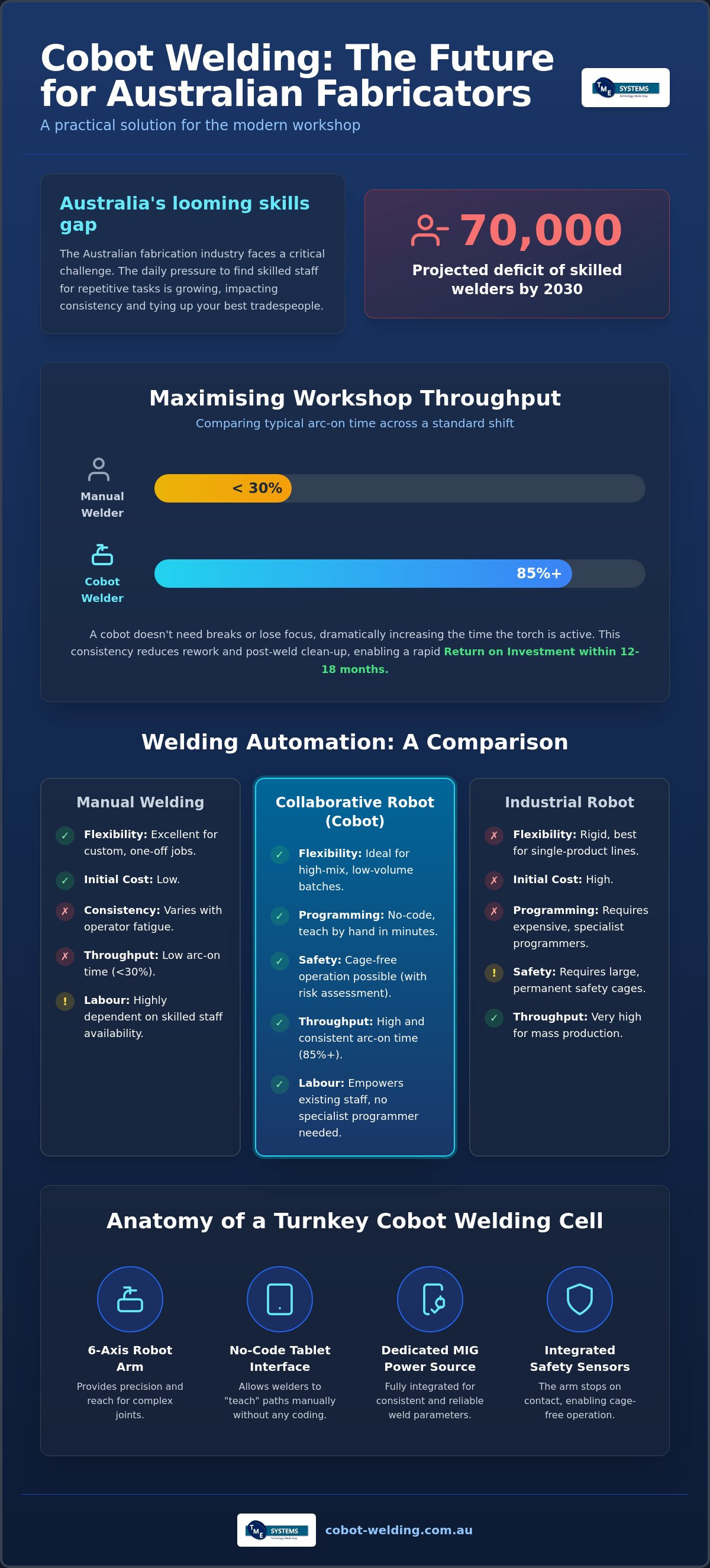

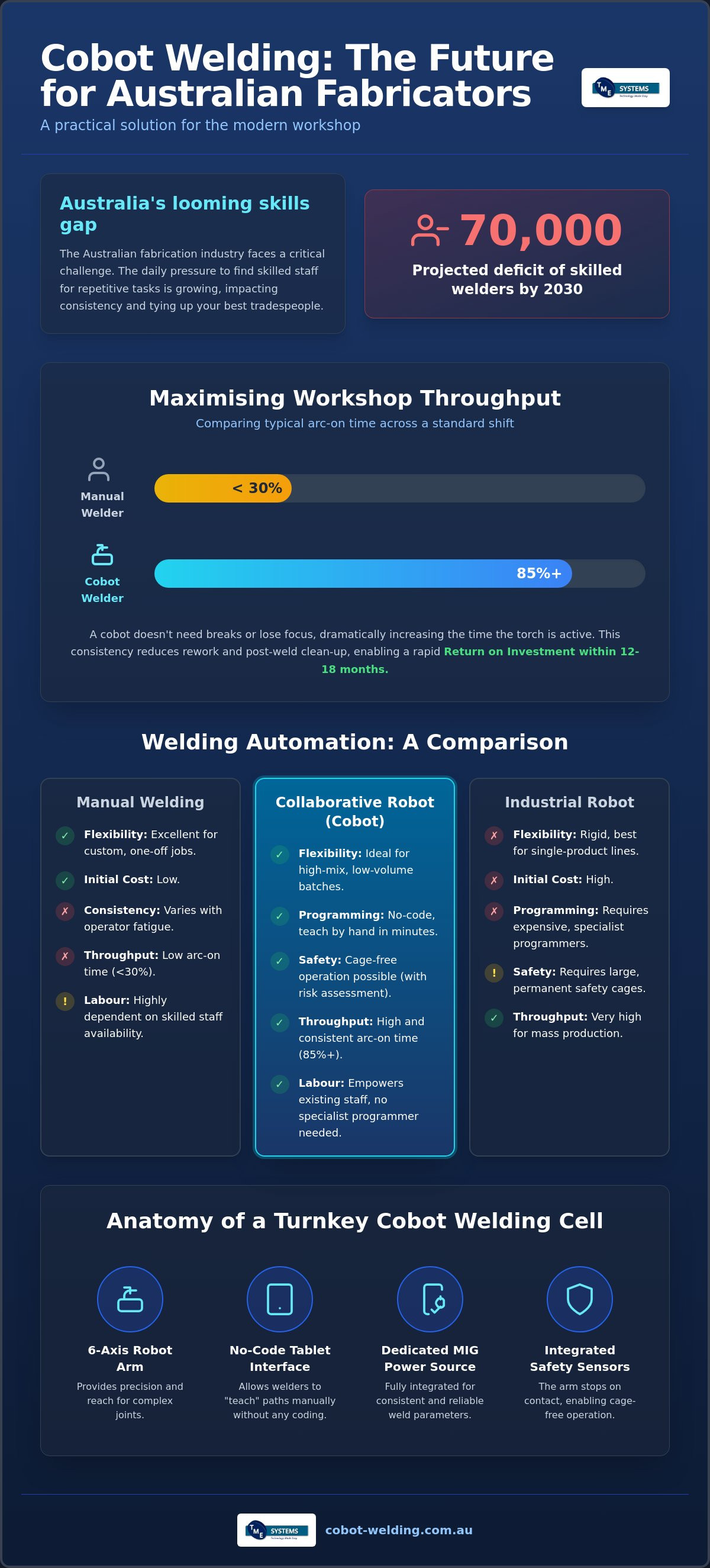
With Australia projected to face a deficit of 70,000 skilled welders by 2030, the pressure on local workshops to maintain output has never been more intense. You likely feel the daily strain of finding reliable staff to handle repetitive sub-assemblies, only to find that manual consistency often wavers as fatigue sets in. It's a common frustration to see your best tradespeople tied up with basic tasks when they should be focused on high-value custom projects. Many owners worry that automation is out of reach, fearing the high costs and complex programming traditionally associated with industrial systems.
This is where cobot mig welding for fabricators provides a practical way forward. This guide explains how collaborative welding cells empower your existing team to automate small-batch production and achieve a return on investment within 12 to 18 months. You'll discover how no-code teaching software removes the need for specialist programmers, allowing your staff to "teach" the robot new paths in minutes. We will look at how these turnkey systems solve labour shortages, reduce post-weld clean-up, and help your business meet the strict new workplace exposure limits for welding fumes arriving in December 2026.
Key Takeaways
- Learn why collaborative systems succeed in small-batch job shops where traditional industrial robots are often too rigid and expensive to reprogramme.
- Discover how cobot mig welding for fabricators uses no-code interfaces to let your experienced tradespeople "teach" the robot new paths without any software expertise.
- Compare arc-on time across a standard Australian shift to see how automation can boost daily output while achieving a 12 to 18-month return on investment.
- Use our step-by-step guide to identify the "low-hanging fruit" in your production line and prepare your workshop floor for its first automated cell.
- Understand how mobile demonstrations and operator training can de-risk your transition and ensure your team feels confident using the new technology.
Why Australian Fabricators are Adopting Robotic MIG Welding
The Australian fabrication landscape has moved away from the era of massive, single-product production lines. Most local workshops now thrive on high-mix, low-volume orders. In this environment, traditional industrial robots often fail the test. They are typically too rigid, requiring permanent safety cages and expensive specialist programmers every time a part changes. This makes them a poor fit for a shop that might switch between five different jobs in a single week.
Modern cobot mig welding for fabricators addresses this gap by offering a flexible alternative. Instead of replacing your team, these systems act as a force multiplier. They take over the repetitive, straight-line welds that eat up a tradesperson's day, leaving your experienced staff free to focus on the complex, multi-pass joints that require true human skill. For those looking for a broad Robotic welding overview, it is helpful to see how the technology has pivoted from static factory fixtures to portable workshop tools that sit right next to the operator.
Solving the Skilled Labour Shortage
The projected 70,000-person welder deficit by 2030 isn't just a statistic; it's a daily reality for workshop managers. Finding a qualified MIG welder is hard enough, but keeping them engaged is another challenge. By automating the "boring" welds, you reduce the physical strain and OHS risks that lead to burnout. It also helps with recruitment. Younger apprentices are often more excited to join a workshop that uses modern tech, seeing it as a way to upskill in both fabrication and automation simultaneously.
Maximising Throughput in Custom Fabrication
In a typical Australian workshop, a manual welder might only achieve an arc-on time of less than 30% per shift. The rest of the time is spent on material handling, jigging, and managing fatigue. Implementing automated welding for job shops changes this dynamic. A cobot doesn't need to stop for a break or lose focus on the hundredth identical bracket, meaning the torch stays active for much longer periods.
This consistency is vital for small-batch profitability. When you can rely on cobot mig welding for fabricators to deliver perfect penetration and bead appearance every time, you drastically reduce rework and post-weld clean-up. It allows your workshop to maintain a steady rhythm, ensuring that custom fabrication remains a high-margin process rather than a race against the clock. By letting the machine handle the repetition, you ensure your best people are always working on the projects that actually need their expertise.
The Anatomy of a Collaborative MIG Welding Cell
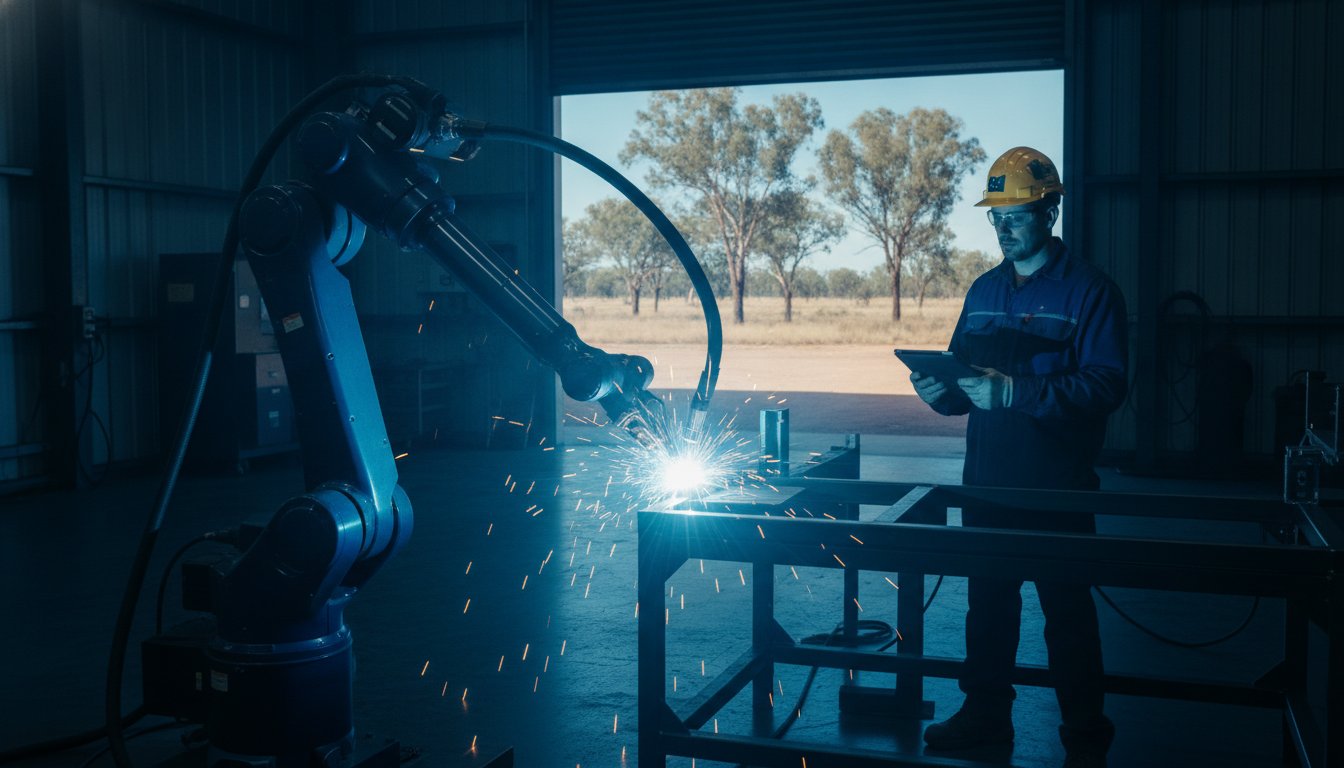
A turnkey cell isn't just a robot arm bolted to a bench. It's a synchronised system designed to work alongside your team. This typically includes the six-axis robot arm, a dedicated MIG power source, a specialised torch, and a heavy-duty welding table. The cobot mig welding for fabricators model is built around the idea that the machine should adapt to the workshop, not the other way around. Unlike traditional industrial robots that require massive safety perimeters, these cells are designed with internal sensors that detect resistance. If the arm touches an operator, it stops instantly.
In most Australian workshop scenarios, this means you can ditch the expensive safety cages. Under the AS 4024.3303:2017 standard, a proper risk assessment is still required, but the cage-free operation allows the cell to sit right in the middle of your production flow. The Benefits of collaborative robots are particularly clear for small-to-medium workshops where floor space is at a premium. You get the precision of automation without losing the ability to walk up and check a part mid-weld.
No-Code Software: The Brains of the Operation
The real shift in modern automation is the move away from complex coding. Older systems used "teach pendants" that looked like 1990s video game controllers and required thousands of lines of code. Modern no-code robot welding software uses a simple tablet interface. Your best welder can simply grab the robot arm, move it to the start of the joint, click a button, and move it to the end. The software handles the complex mathematics of the path, allowing a tradesperson to set up a new job in minutes rather than hours.
MIG Power Sources and Torch Integration
A cobot is only as good as the weld it produces. High-quality cells integrate seamlessly with industry-standard power sources like Miller, Fronius, or OTC. This integration is critical because the robot needs to control wire feed speed, voltage, and gas flow on the fly. For high duty-cycle fabrication, you might opt for a water-cooled torch to prevent overheating during long runs, though air-cooled torches remain the standard for most light-to-medium jobs. If you're wondering which configuration fits your specific parts, exploring the turnkey options at cobot-welding.com.au is a great place to start your research.
By combining these components into a single package, cobot mig welding for fabricators removes the guesswork. You aren't trying to make different brands of hardware talk to each other. Instead, you get a system that's ready to weld the moment it's powered up and calibrated to your workshop floor.
Manual MIG vs Cobot vs Industrial Robots: A Comparison
Deciding how to scale your workshop usually leads to three distinct paths: hiring more staff, installing traditional industrial automation, or adopting cobot mig welding for fabricators. Each option carries different implications for your floor space, your budget, and your ability to respond to urgent customer requests. While manual welding offers the most flexibility for one-off repairs, it struggles to compete with the sheer output of a machine when you have fifty identical baseplates sitting on the bench.
Traditional industrial robots are the undisputed kings of mass production, but they require a "set and forget" environment. They need permanent safety fencing, 3-phase power upgrades, and a dedicated programmer to make even minor adjustments. For the average Australian job shop, this rigidity is a deal-breaker. Recent Global robotics industry trends show a clear shift toward collaborative systems because they occupy a fraction of the space and don't require your workshop to be rebuilt around them.
Arc-on Time and Duty Cycle Advantages
The most significant difference between these methods is "arc-on time." In a standard eight-hour shift, a manual welder typically achieves an arc-on time of 20% to 30%. The rest of the day is consumed by cleaning spatter, jigging parts, and managing physical fatigue, especially during a harsh Australian summer. A cobot doesn't suffer from heat exhaustion or "Monday morning fatigue" and can easily maintain an arc-on time exceeding 70%.
Consistency is where the machine truly shines. While a manual welder might produce slight variations in bead width or penetration across a fifty-part run, the cobot maintains an identical 6mm fillet from the first bracket to the last without a single deviation. This level of repeatability means your senior tradespeople spend less time grinding back poor welds and more time on high-level fabrication tasks.
The ROI of Collaborative Automation
When calculating your return on investment, it's easy to focus solely on the initial purchase. However, the real value lies in improving welding productivity with cobots through reduced rework and material savings. Because the robot follows a precise path with optimised parameters, you'll notice a sharp drop in shielding gas and wire wastage compared to manual processes.
Most Australian fabricators find that a cobot mig welding for fabricators system pays for itself within 12 to 18 months. This payback period is driven by the fact that you're essentially adding a tireless "second shift" to your existing floor space without increasing your headcount. By removing the "low-hanging fruit" jobs from your manual welding bays, you unlock capacity that was previously tied up in repetitive, low-margin work.
Integrating a MIG Cobot into Your Workshop Workflow
Successful implementation of cobot mig welding for fabricators doesn't happen by accident. It requires a methodical approach that respects your existing shop floor culture while introducing new efficiencies. The transition is less about a massive overhaul and more about identifying where the machine can best support your human workers. Most Australian workshops find success by starting small, proving the concept on a single high-volume part, and then scaling across the business.
Physical preparation is usually straightforward. Unlike industrial robots that need heavy-duty concrete foundations and massive electrical upgrades, most cobot controllers run on standard 240V power. You will still need your usual 3-phase connection for the MIG power source itself, but the compact footprint means you can often tuck the cell into an existing welding bay. The goal is to keep the robot close to the action so your operators can easily monitor the work without walking across the factory.
Choosing the Right Parts to Automate First
The "low-hanging fruit" for automation are repetitive sub-assemblies with long, accessible weld paths. Think of baseplates, brackets, or simple frames where the weld is identical every time. If you are cobot welding stainless steel, you'll find the consistent travel speed of the robot particularly useful for managing heat input and reducing distortion. However, automation reveals any flaws in your upstream processes. For the robot to succeed, your laser cutting and folding tolerances must be spot on; if the gap varies by 3mm on every second part, the robot will struggle to compensate without human intervention.
Australian Safety Standards (AS/NZS)
Safety compliance is a critical step in the integration process. In Australia, the primary standard for robot safety is AS 4024.3303:2017. While the term "collaborative" implies the robot is safe to touch, you must still conduct a thorough risk assessment of the entire application. The robot arm might be safe, but the welding arc and the hot wire are still hazards. You also need to consider the new Workplace Exposure Limits for welding fumes, which drop to 1 mg/m3 on December 1, 2026. Proper extraction is no longer just a good idea; it is a regulatory necessity.
Turning your best tradespeople into "Robot Supervisors" is the final piece of the puzzle. When staff see the technology as a tool that handles the "grunt work" rather than a threat to their jobs, adoption happens quickly. Investing in on-site cobot welder training ensures your team knows how to perform basic maintenance and troubleshoot paths independently. To see how this technology fits into your specific workshop layout, you can request a mobile demonstration to test the system on your own parts.
Future-Proofing Your Fabrication Business with TME Systems Pty Ltd
Adopting cobot mig welding for fabricators is a strategic move that positions your workshop as a leader in a competitive local market. While many businesses wait for the "perfect time" to automate, early adopters are already capturing higher margins and solving their labour challenges today. At TME Systems Pty Ltd, we don't view ourselves as just a hardware supplier. We act as a practical mentor, helping you navigate the shift from purely manual processes to a modern, automated production line that grows with your business.
The transition to automation is often more of a cultural shift than a technical one. It requires your team to trust the machine and your management to rethink how jobs are scheduled. By starting with a single collaborative cell, you can refine your upstream tolerances and prove the ROI before scaling to a multi-cell environment. This incremental approach de-risks the investment and allows your staff to adapt at a manageable pace, ensuring that the technology becomes a permanent part of your workshop's success.
The TME Mobile Demo: Seeing is Believing
We understand that every workshop has unique challenges, which is why we don't expect you to make a decision based on a brochure. Our Mobile Demo System brings a complete, ready-to-weld collaborative cell directly to your workshop floor. This allows your team to test the system on your actual parts, using your specific materials and jigging setups. There is a distinct lightbulb moment for most fabricators when they first hand-guide the arm and realise they can set a complex path in seconds without any engineering background. This hands-on trial removes the mystery and proves the technology's value in your specific environment.
Ongoing Support and Australian Partnership
Choosing a local partner means you aren't left waiting for technical support from overseas time zones. TME Systems Pty Ltd provides an Australian-based integration and support team that understands the local manufacturing landscape and AS/NZS requirements. We stock local spare parts and provide continuous software updates that add new welding patterns and features as the technology evolves. Our commitment to operator training and onboarding ensures that your staff remain the experts, with the robot acting as a tireless tool under their supervision.
If you're ready to see how automation can transform your daily output and reduce the pressure on your welding team, it's time to take the next step. You can book your mobile welding robot demonstration today and see exactly how cobot mig welding for fabricators fits into your workshop's future. We'll show you how to turn repetitive sub-assemblies into a high-speed, high-margin part of your production line.
Secure Your Workshop's Future with Practical Automation
The Australian fabrication industry is changing rapidly. With the skilled labour shortage tightening and new safety standards arriving in late 2026; waiting to automate is no longer a viable strategy for growth. You've seen how cobot mig welding for fabricators bridges the gap between manual craftsmanship and industrial efficiency without the need for complex coding or expensive safety cages. By empowering your existing team to "teach" robots, you turn repetitive tasks into a high-margin part of your business while keeping your best welders focused on the work that actually requires their expertise.
TME Systems Pty Ltd is here to act as your practical mentor throughout this transition. Our Australian-based integration specialists provide the ongoing support and training your team needs to succeed from day one. You don't have to guess if the technology works for your specific parts; we bring the equipment to you. Book a Mobile Demo and See the Cobot Welder in Action to experience the no-code interface on your own workshop floor. Taking this first step ensures your business remains competitive, productive, and ready for whatever the 2026 manufacturing landscape brings.
Frequently Asked Questions
Do I need to know how to code to run a MIG welding cobot?
No, you don't need any programming or coding experience to operate our systems. The no-code software is designed specifically for tradespeople, allowing you to hand-guide the robot arm to the start and end points of a weld. This "click-and-teach" method turns your experienced welders into supervisors who can manage the automation without ever looking at a line of code. It's about empowering your team with tools they can master in a single afternoon.
Can a cobot handle different materials like aluminium and stainless steel?
Yes, a cobot is highly versatile and can weld various materials including aluminium and stainless steel. The key is in the power source integration and the selection of the correct shielding gas and wire. Because cobot mig welding for fabricators provides such precise control over travel speed and heat input, you'll often see a significant reduction in distortion on thin-gauge stainless steel parts compared to manual processes.
What is the typical ROI period for a robotic MIG welding cell in Australia?
Most Australian fabricators see a full return on investment within 12 to 18 months of commissioning their cell. This payback period is driven by increased arc-on time and a sharp reduction in rework and post-weld grinding. For workshops running multiple shifts or handling high-volume repetitive parts, the ROI can be even faster. It's a pragmatic way to add capacity without the overhead of additional headcount or the cost of traditional industrial robots.
How long does it take to "teach" a new welding job to the robot?
Teaching a new weld path typically takes only a few minutes once the part is jigged. For a simple straight-line fillet, an operator can set the start and end points and adjust the parameters on the tablet in under five minutes. This speed is what makes cobot mig welding for fabricators so effective for small-batch work. You don't need to spend hours debugging code; you just move the arm and start welding.
Do I need a safety cage for a collaborative welding robot in my workshop?
In many cases, you don't need a traditional safety cage, but you must still complete a risk assessment under AS 4024.3303:2017. The collaborative nature of the arm allows it to work in open areas; however, you must still manage hazards like arc flash and welding fumes. Some workshops choose to use light curtains or simple welding screens to define the work area while maintaining the compact, accessible footprint of the cell.
What happens if the robot hits something or someone during operation?
The robot is equipped with sensitive force-torque sensors that cause it to stop immediately upon detecting an unexpected obstruction. This safety feature is designed to protect both your staff and your equipment from damage. If the arm makes contact with an operator or a misplaced jig, it enters a safety stop mode. The operator can then clear the obstruction and restart the sequence easily, ensuring the workshop remains safe without sacrificing productivity.
Can I use my existing MIG welder with a TME Systems Pty Ltd cobot cell?
We can often integrate existing digital MIG welders into a new cobot cell, but it depends on the specific make and model of your power source. To achieve the best results, the robot controller needs a clean communication interface with the welder to manage wire feed and voltage on the fly. We recommend a quick technical review of your current gear during a mobile demo with TME Systems Pty Ltd to see if it's compatible or if a turnkey package is a better fit.
Is there local technical support available if the system goes down?
Yes, we provide full local technical support from our Australian-based team. We understand that downtime on the workshop floor is costly, so we maintain a stock of local spare parts and have integration specialists ready to assist. You won't be stuck waiting for a response from an overseas time zone. Our goal is to be a long-term partner in your success, providing the training and support needed to keep your production line moving.