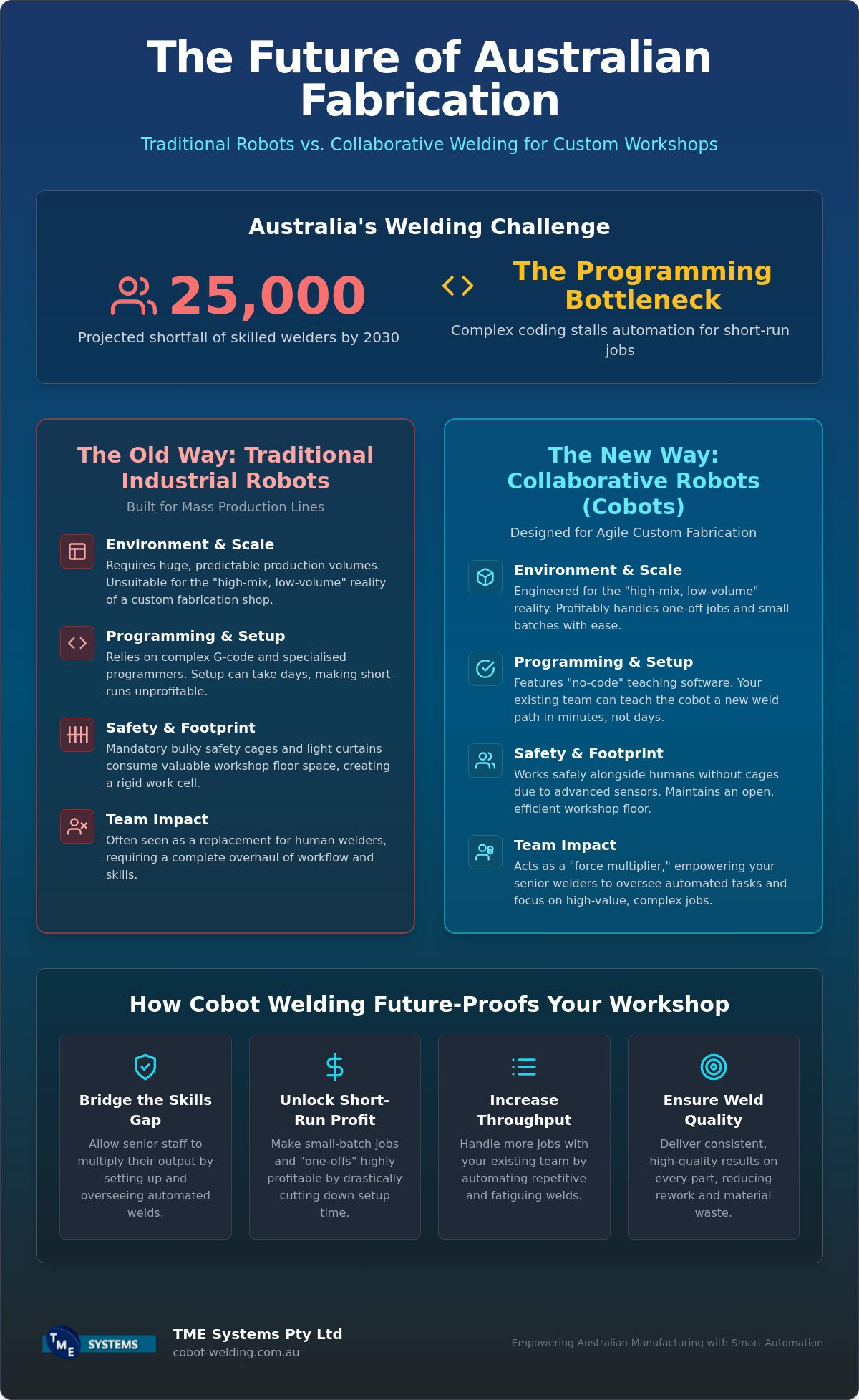

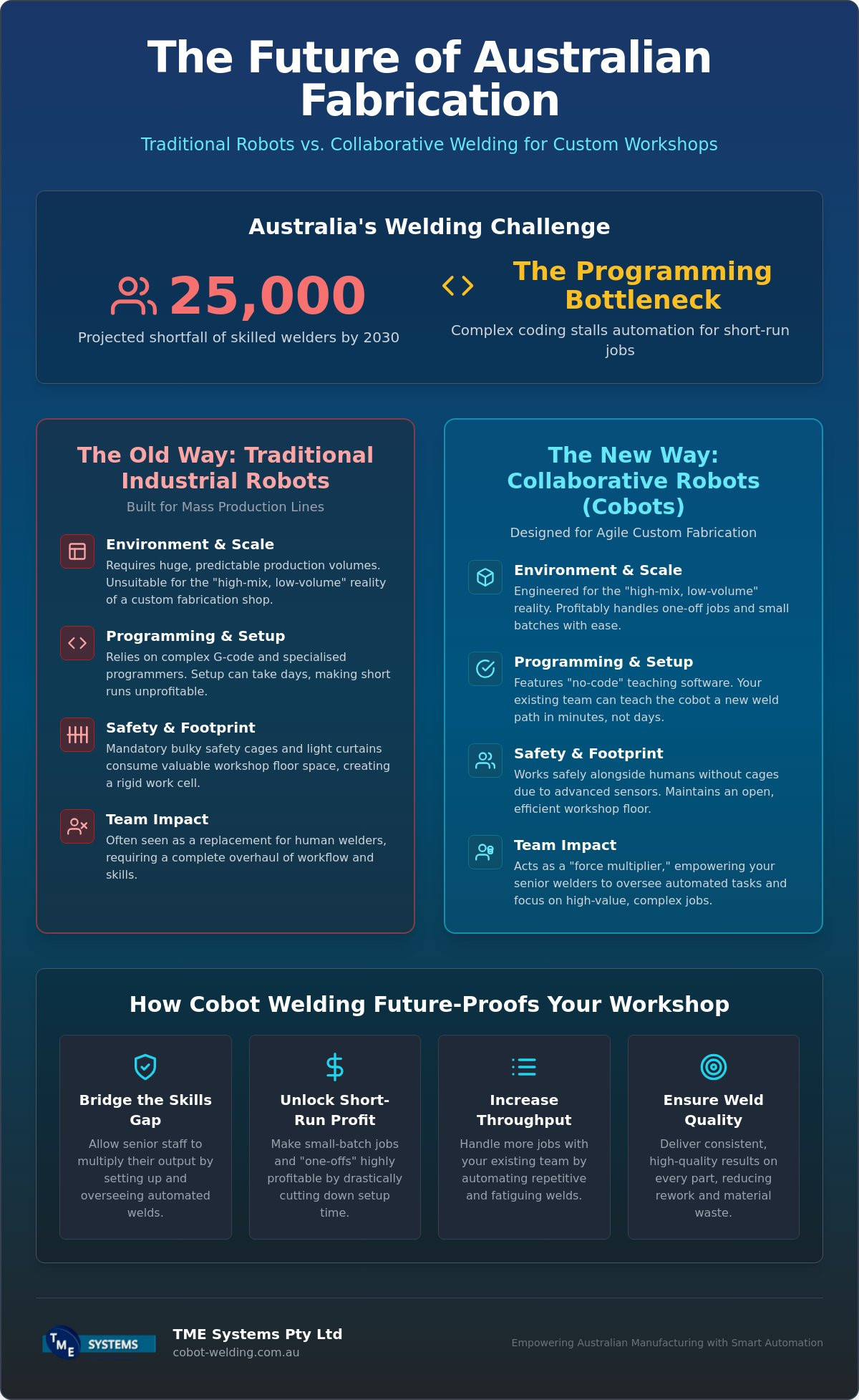
With Australia facing a projected shortfall of 25,000 skilled welders by 2030, the pressure on local job shops to maintain output has never been higher. You likely feel this strain every day as you struggle to find qualified staff while watching your senior tradespeople lose hours to repetitive, simple welds. It's a common frustration to see profit margins eaten away by manual rework or the high cost of traditional automation that simply doesn't suit short runs.
This article shows you how cobot welding for custom fabrication is bridging that gap. You'll discover how collaborative robots allow your workshop to automate small-batch production profitably, all without the need for complex programming or dedicated engineers. We'll examine how no-code teaching software empowers your existing team to increase throughput and maintain high weld quality, finally freeing up your best welders for the bespoke, high-value work they do best.
Key Takeaways
- Learn the fundamental differences between traditional caged robots and flexible collaborative systems designed for open-plan workshops.
- Discover how "no-code" teaching software removes the programming bottleneck, letting your existing team automate new parts in minutes.
- Explore how cobot welding for custom fabrication enables profitable automation for short-run backlogs and complex geometries that were previously too slow to program.
- Identify the specific "bottleneck parts" in your production line that will deliver the fastest return on investment when automated.
- Understand how to assess your workshop’s floor space and power requirements to ensure a seamless transition to a mobile or fixed welding cell.
What is Automated Welding for Custom Fabrication?
For decades, Australian fabricators viewed automation as a luxury reserved for automotive assembly lines or massive production facilities. That changed in 2026. With the push for sovereign capability and the support of the A$15 billion National Reconstruction Fund, local workshops are finding that cobot welding for custom fabrication is no longer a futuristic concept but a practical necessity. Unlike traditional industrial robots that require extensive safety guarding and weeks of complex coding, these systems are designed to be nimble and responsive to the daily changes of a busy shop floor.
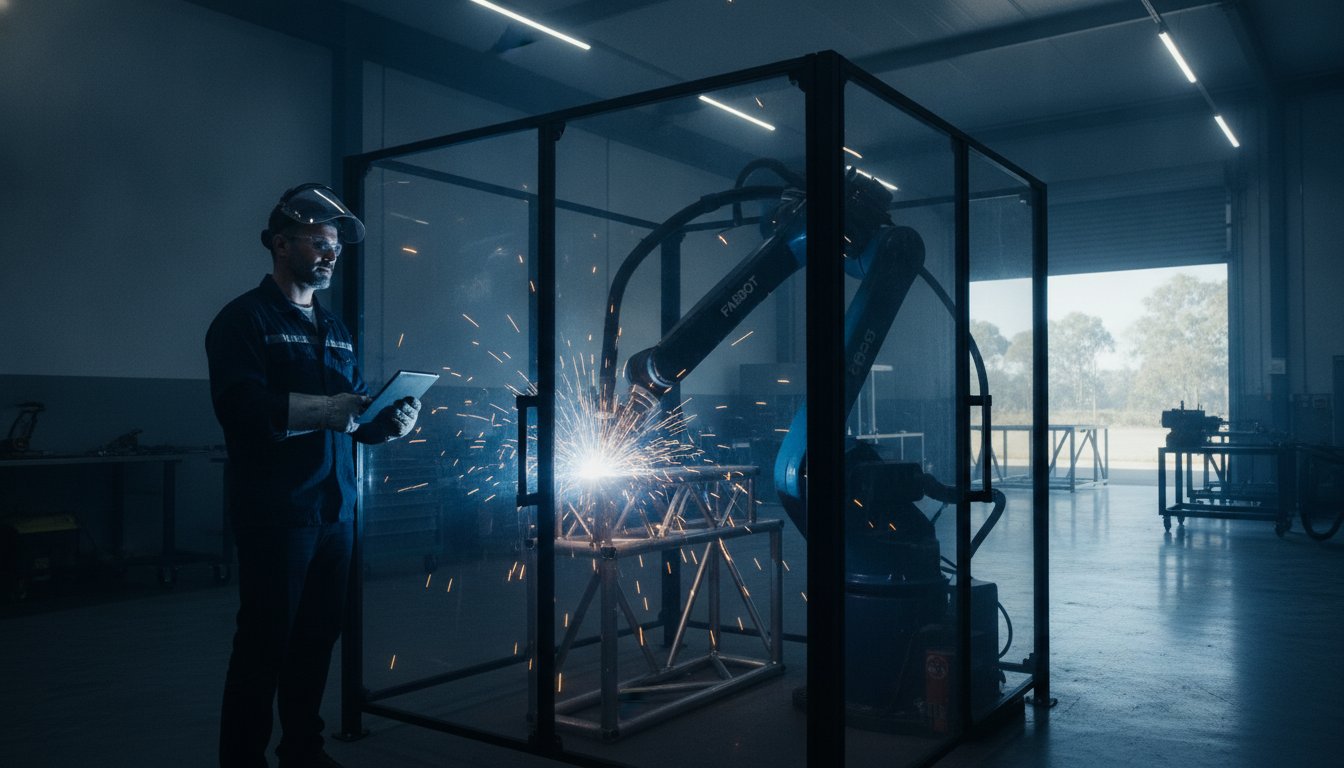
At its core, a collaborative robot (cobot) is a precision tool that works alongside your staff rather than being locked away in a cage. Automated welding for job shops is the ability to switch between different custom parts in minutes rather than hours. This flexibility allows a shop to move from a run of stainless steel brackets to a set of aluminium frames without losing half a day to setup and programming. It marks a shift from rigid, high-volume automation to a versatile system that mimics the adaptability of a manual welder.
The High-Mix, Low-Volume Reality
Traditional automation often failed the average Australian workshop because it was built for "set and forget" mass production. If you're a custom fabricator, your bread and butter is the bespoke batch run where no two weeks look the same. Cobots are specifically engineered for this high-mix, low-volume reality. They handle the "one-off" or small batch orders that used to be too expensive to automate. Instead of needing a specialised robotics engineer to spend days writing code for a twenty-part run, your existing team can teach the robot a new path on the fly. This allows you to maintain a competitive edge even on short-run contracts that were previously bogged down by high labour costs.
Collaborative Safety Without the Cages
One of the biggest hurdles for local shops is floor space. Traditional robots require bulky safety fencing and light curtains that consume valuable real estate. Cobots solve this with advanced internal sensors that detect resistance and stop movement instantly if they touch an operator. This technology allows you to maintain an open-plan, efficient workshop centre while still meeting the Australian safety standard AS 4024.3301:2017. By removing the cages, you're not just saving space; you're creating a collaborative environment where the machine supports the welder's skill. It's about making the technology fit your workshop, not forcing your workshop to fit the technology.
The Problem: Why Traditional Robots Stalled in Small Workshops
Many Australian workshop owners have looked at industrial robots and walked away. The reason is simple. Traditional automation was never built for the reality of a job shop where every week brings a different set of drawings. For a custom fabricator, the biggest hurdle isn't the physical welding; it's the "Programming Bottleneck". If it takes two days to program a robot for a job that only takes four hours to weld manually, the maths simply doesn't add up.
This inefficiency creates a psychological barrier. It’s easy to assume your work is "too custom" for a machine, fearing that any slight variation in part geometry will break the system. When you factor in the high cost of downtime during changeovers and the need for complex jig setups, traditional robots often feel like more trouble than they're worth for small batches.
The Programming Overhead Trap
Traditional industrial robots rely on complex teach pendants and G-code. This requires a specialised robotic programmer, a role that commands a high salary and is incredibly hard to find in the local market. For a batch of 10 to 50 units, the setup time often exceeds the profit margin of the job. Smaller firms need to harness the potential of collaborative robots to avoid this trap. High variety usually means high downtime during changeovers, which leaves expensive equipment sitting idle while your team struggles with lines of code. It's a cycle of frustration that has kept many shops stuck in manual mode for years.
Addressing the Australian Skills Shortage
Australia's manufacturing sector is currently facing a massive skills gap. With fewer apprentices entering the trade, finding a senior welder who can produce consistent, high-quality results is a constant battle. This is where cobot welding for custom fabrication changes the conversation. Instead of trying to replace the expertise of your best tradespeople, these systems act as a force multiplier. A senior welder can set the parameters, while the cobot handles the repetitive, fatiguing runs. This also makes your workshop more attractive to younger talent. Modern apprentices expect digital tools and intuitive interfaces, and offering them the chance to work with advanced tech can be a deciding factor in recruitment. If you're curious about how this fits your specific floor plan, you can explore our collaborative robot welding cells to see the difference in setup speed.
The "No-Code" Revolution: How Custom Shops Pivot Daily
The real magic of modern automation isn't found in the hardware; it's in the interface. For a long time, the barrier to entry for small shops was the code. Now, the "no-code" revolution has arrived on the workshop floor. This allows your team to use a "Teach by Touch" method, where a welder physically moves the robot arm to the start and end points of a weld. It's intuitive. You can literally program a new part in under 10 minutes. This speed is what makes cobot welding for custom fabrication viable for the everyday jobs that land on your desk.
Consider a few common scenarios. First, there’s the repetitive bracket run. You might have 200 units sitting in a corner, a job that usually bores your best staff and leads to fatigue-related errors. With a cobot, you can set up the first part, hit "go", and clear that backlog in half the time. Second, for complex geometries, you aren't stuck guessing coordinates. By using no-code robot welding software, you can teach the path on the fly, following curves and angles as easily as you would with a torch in hand. Finally, tricky materials like aluminium and stainless steel often require a steady hand to avoid burn-through or warping. A cobot maintains the exact travel speed and distance required for a perfect finish every time.
Batch Processing for Diverse Materials
Adapting to different metals is a daily requirement in Australian job shops. Managing heat input is critical, especially when moving between cobot welding for aluminium and mild steel. The software allows you to bring the power of Industry 4.0 to SMEs by precisely controlling the arc parameters for each material. For those focusing on high-end aesthetic finishes, cobot welding stainless steel provides the consistency needed to eliminate hours of post-weld grinding. Many shops now use the same arm to switch between MIG and TIG applications, providing a level of versatility that traditional robots can't match.
Rapid Changeover Techniques
Success in a high-mix environment depends on how fast you can swap jobs. Using modular fixturing and clever jigging allows you to change parts in seconds. You don't have to start from scratch every time a recurring monthly order comes back through the door. You simply store the "recipe" in the software for instant recall. This ensures that the weld quality on the fiftieth batch is identical to the first. Because the system is so easy to manage, it's common for one operator to oversee two cobot cells simultaneously. This effectively doubles your throughput without needing to hire extra staff in a tight labour market.
Evaluating Your Workshop: Is Your Custom Shop Ready?
Deciding to invest in automation is a significant step for any small business. It's not just about the machinery; it's about whether your current workflow and team are ready to adapt. To determine if cobot welding for custom fabrication is the right fit for your floor, you need to look at your production through a practical lens. Start by identifying your "bottleneck" parts. These are usually the repetitive, high-volume components that tie up your most skilled staff on tasks they find mundane. If a job is boring for a senior welder, it's a prime candidate for automation.
Preparation involves five key steps:
- Step 1: Audit your job history to find parts with consistent geometries.
- Step 2: Check your floor space. A compact cell requires far less room than a traditional robot, but you still need clear access.
- Step 3: Talk to your team. Their willingness to "teach" the robot is vital for a smooth rollout.
- Step 4: Run the numbers on your "arc-on time" versus time spent on manual rework.
- Step 5: Plan your cobot welding integration to ensure the new tech talks to your existing power sources.
Calculating Your ROI (The Aussie Way)
When calculating return on investment, look beyond simple hourly labour rates. In a busy Australian shop, the real savings often come from reducing gas wastage, grinding time, and manual rework. Precision welding means less time spent with a flapper disc and more time shipping finished products. There's also the "opportunity cost" to consider. How many custom contracts have you turned away because you didn't have the staff to handle the volume? Industry data suggests that a typical investment in a MIG cell can see a payback period of 18 to 24 months for a single-shift operation, though this can be much faster if you're running multiple shifts or high-margin bespoke work.
Technical Requirements for Australian Shops
You don't necessarily need a total equipment overhaul to get started. Most collaborative robot welding cells are designed to be compatible with your existing high-quality MIG or TIG power sources. This modularity keeps initial costs down and allows for a more familiar setup for your operators. Before committing, consider why a mobile demo is a smart move. It allows you to test the reach and fitment within your specific workshop centre, ensuring the robot can handle your largest part geometries without hitting obstructions. If you want to see how this technology handles your specific parts, you can book a mobile demo system session to see the results first-hand.
Future-Proofing Your Business with TME Systems Pty Ltd
Moving from being "automation curious" to "automation active" is a significant shift for any Australian job shop. It requires more than just purchasing a new piece of equipment; it’s about finding a partner who understands that a robot is only as good as the person operating it. TME Systems Pty Ltd focuses on bridging the gap between traditional craftsmanship and digital precision. We provide the integration expertise needed to ensure cobot welding for custom fabrication becomes a seamless, profitable part of your daily operations. Our approach is grounded in the reality of the workshop floor, focusing on practical results rather than tech-heavy jargon.
By supporting the national Australian manufacturing sector with local integration and ongoing care, TME Systems Pty Ltd helps shops build the sovereign capability needed to stay competitive. We know that every workshop has its own unique hurdles, from tight floor real estate to specific material requirements. Having a local partner means you aren't just buying a machine and being left to figure it out yourself. You’re gaining a collaborator invested in your long-term throughput and the professional growth of your tradespeople.
Operator Onboarding: Training Your Team
A common misconception is that "no-code" technology makes a welder’s skill redundant. In reality, the opposite is true. The welder’s knowledge of heat management, wire speed, and joint preparation is exactly what makes the automation successful. Our operator-centric training and onboarding process at TME Systems Pty Ltd is designed to value that expertise. We don't expect your team to become software engineers; we show them how to use the cobot as a high-precision digital torch. A typical training timeline is remarkably fast. Most shops move from unboxing the cell to striking their first automated arc in under 48 hours. This rapid deployment is backed by ongoing technical support and software updates specifically tailored for Australian fabrication conditions.
Book a Mobile Demonstration
The most effective way to demystify automation is to see it work on your actual custom parts, in your own environment. A mobile demonstration removes the guesswork. It allows you to see exactly how the system handles your specific geometries and jigging setups before you make a commitment. To get the most value from a session, we suggest preparing a few of your most common "bottleneck" parts. When you see the cobot clearing a backlog that usually takes days in just a few hours, the path forward becomes clear. It’s a hands-on, practical way to evaluate the technology without any obligation.
Book your mobile welding robot demonstration today and see how easy it is to bring the next generation of fabrication to your workshop floor.
Take the Next Step Toward Smarter Fabrication
The shift toward automation doesn't have to be an intimidating leap into complex coding. By adopting cobot welding for custom fabrication, your workshop can finally address the repetitive backlogs that drain your skilled labour and profit margins. We have seen how no-code software, designed specifically for tradespeople, allows your existing team to stay in control of the weld quality while the machine handles the monotony. This isn't about replacing your senior welders; it's about giving them a precision tool that amplifies their output and keeps your shop competitive in a tight market.
Success depends on having a partner who understands the unique pressures of the Australian manufacturing landscape. TME Systems Pty Ltd provides national Australian support and system integration to ensure your transition is seamless from day one. If you want to see exactly how this fits into your workflow, our mobile demo units come directly to your workshop to prove the results on your actual parts. It is a practical, low-risk way to see if your shop is ready for the future.
See the tech in action: Book a Mobile Demonstration
Frequently Asked Questions
Is automated welding for job shops too expensive for a small business?
Automated welding is now more accessible than ever, with entry-level MIG cells offering a typical payback period of 18 to 24 months for single-shift operations. While the initial investment is higher than a manual torch, the reduction in grinding time and gas wastage makes it a viable tool for small businesses. It is an investment in throughput that allows you to take on larger contracts without increasing your headcount.
Do I need a robotic programmer to run a welding cobot in my custom shop?
No, you don't need a specialised robotic programmer or any knowledge of G-code to operate these systems. The no-code teaching software allows your existing tradespeople to program new parts by physically moving the robot arm to the required points. If your team can weld, they can learn to manage the cobot in a very short amount of time using an interface designed for the workshop floor.
Can a cobot weld aluminium and stainless steel as well as a human?
Yes, cobots provide a level of consistency on tricky materials that is hard to match manually over a long shift. Because the system maintains a constant travel speed and torch angle, it manages heat input with extreme precision. This is particularly useful for cobot welding for custom fabrication when working with thin stainless steel or aluminium to prevent warping and burn-through.
How much floor space does a collaborative welding cell actually need?
A collaborative welding cell typically requires a footprint of only a few square metres, making it ideal for tight workshops. Because they don't require bulky safety cages or light curtains, they can be integrated directly into your existing production line. You can even opt for a mobile cell that fits into the same space as a standard welding bench, preserving your open-plan layout.
What happens if the cobot hits something or someone during operation?
If a cobot detects any resistance or makes contact with an operator, it stops its movement instantly. Built-in force-limiting sensors ensure the system is safe to work alongside humans without physical barriers. This safety feature allows you to maintain an efficient workshop while complying with Australian safety standards like AS 4024.3301:2017.
Can I use my existing welding power source with a new cobot arm?
Yes, most collaborative systems are designed to integrate seamlessly with your current professional-grade MIG or TIG power sources. You don't have to overhaul your entire workshop to start automating. This compatibility allows you to leverage the equipment you already trust while adding the precision and repeatability of a robotic arm to your workflow.
How long does it take for a standard welder to learn the no-code teaching software?
A standard welder can typically learn to use no-code teaching software and start their first automated arc in under 48 hours. The interface is designed to be intuitive and uses terminology that tradespeople already understand. This rapid onboarding ensures that your investment starts delivering value almost immediately after the system is unboxed and integrated.
Is there government support or grants for Australian fabricators adopting automation in 2026?
Yes, the Australian government is actively supporting the adoption of advanced manufacturing through initiatives like the A$15 billion National Reconstruction Fund. These policies are designed to build sovereign capability and help local fabricators invest in cobot welding for custom fabrication. It's worth checking current regional grants and tax incentives that support small businesses upgrading their technological capabilities.