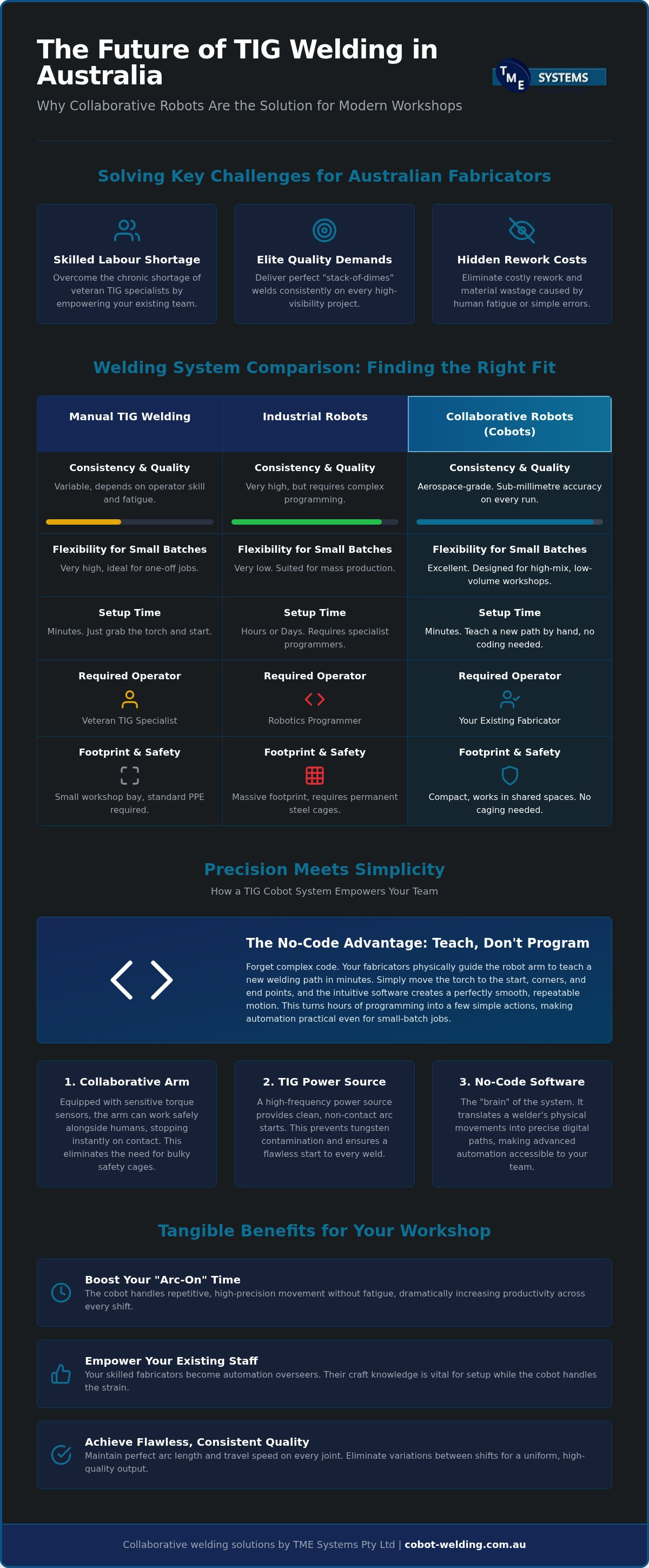

What if your workshop could produce a perfect "stack-of-dimes" weld on every single stainless steel joint, even without a veteran TIG specialist on the floor? Integrating a robotic tig welding system might seem like a leap, but it's becoming the practical answer to Australia's chronic shortage of skilled labour. You've likely felt the pressure of maintaining elite aesthetics on high-visibility projects while watching the costs of rework on expensive materials eat into your margins.
We believe that precision automation should support your team rather than complicate their day. By using collaborative robots and no-code software, your existing staff can achieve aerospace-grade quality without needing a degree in computer science. This guide will walk you through how these systems deliver consistent results on small-to-medium production runs and help you move away from the constant struggle of finding specialist welders. We'll also look at how to keep your workshop compliant with the latest Australian safety standards for fume exposure and hot work, ensuring your transition to automation is as smooth as the welds it produces.
Key Takeaways
- Discover how no-code software empowers your fabricators to lead a robotic tig welding system by hand, making complex programming a thing of the past.
- Learn to identify which parts of your production are ripe for automation by conducting a simple needs analysis of your current workflow and floor space.
- Explore why collaborative cobots are better suited for the high-mix, low-volume nature of Australian workshops than traditional caged industrial robots.
- Find out how to boost your "arc-on" time and maintain consistent, elite quality across every shift, regardless of operator fatigue or skill level.
What is a Robotic TIG Welding System and Why Go Collaborative?
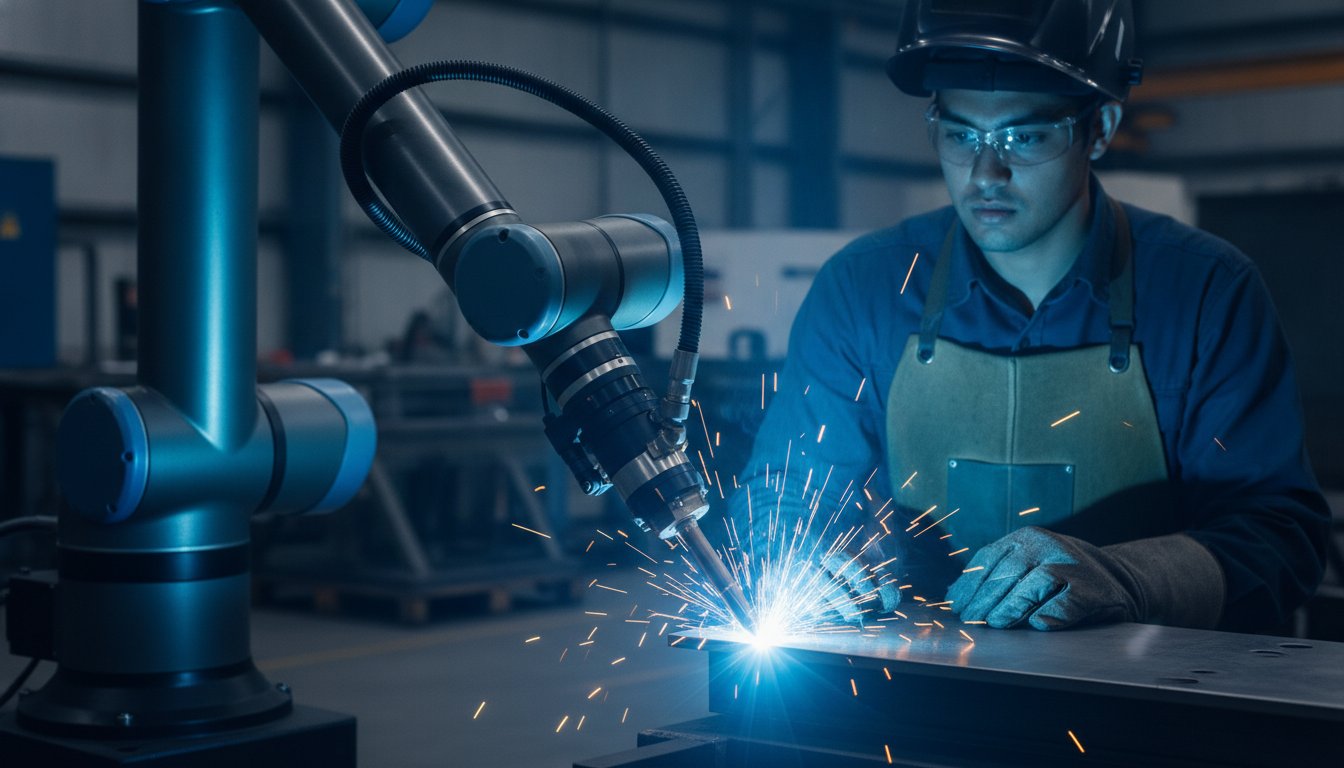
A robotic tig welding system is more than just a mechanical arm holding a torch. It's a sophisticated integration of a collaborative robot (cobot) and a high-precision TIG power source, designed to work alongside human operators. While Robot welding has been around for decades, the technology was traditionally reserved for massive automotive lines. In Australia, we're seeing a significant shift. Local workshops are moving away from those large, caged industrial systems toward flexible cobots that fit into existing floor plans without the need for massive capital infrastructure.
TIG welding demands a level of finesse that MIG or MAG processes simply don't require. Maintaining a consistent arc length and managing the heat input on thin stainless steel requires sub-millimetre accuracy. A robotic system provides this consistency, eliminating the natural tremors or fatigue that affect even the best manual welders during a long shift. This doesn't mean the welder is being replaced. Instead, the human operator becomes the expert overseer, using their craft knowledge to set the parameters while the robot handles the repetitive, high-precision movement.
The Components of a Modern TIG Cobot Cell
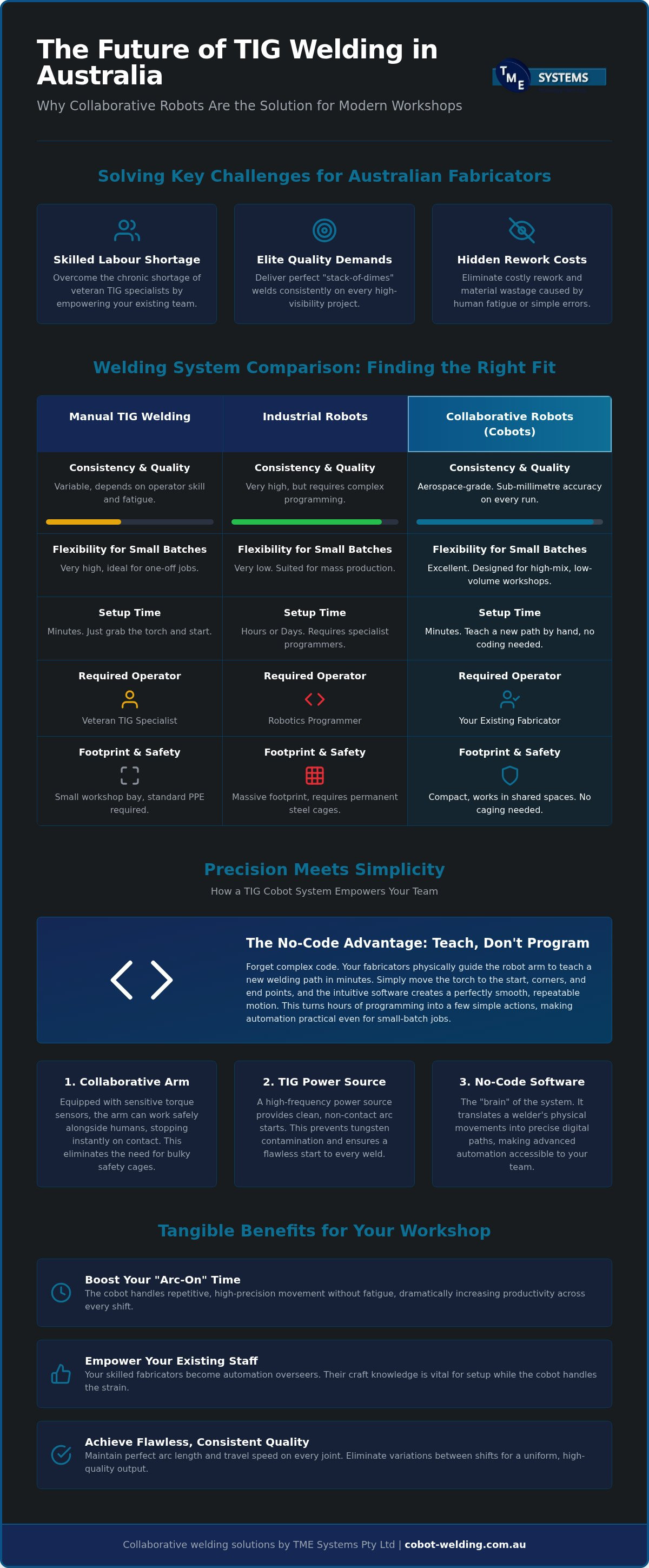
A modern TIG cobot cell relies on three main pillars. First, the collaborative arm itself is equipped with sensitive torque sensors. These allow it to stop instantly if it makes contact with a person, which is why they can often operate without the heavy fencing required by industrial robots. Second, you need a high-frequency TIG power source. This ensures clean, non-contact arc starts, which are vital for preventing tungsten contamination. Finally, the no-code software acts as the brain. It translates a fabricator's movements into precise digital paths, making the technology accessible to the people who actually know how to weld rather than just computer scientists.
Collaborative vs Industrial: Finding the Right Fit
The choice between a cobot and an industrial robot usually comes down to the reality of your workshop floor. Industrial robots are built for high-speed production in a fixed position, but they require a massive safety footprint and complex guarding. In contrast, a collaborative robotic tig welding system is designed for the varied nature of Australian job shops.
- Safety: Cobots are designed to work in shared spaces, often requiring only a standard risk assessment and appropriate PPE rather than a permanent steel cage.
- Footprint: You can tuck a cobot cell into a small corner or move it between work centres as your production schedule changes.
- Flexibility: Because the software is designed for fabricators, you don't need a dedicated programmer to change a job. You can lead the arm through a new path and be ready for a different production run in minutes.
Precision Meets Simplicity: How the TIG Cobot System Works
The real magic of a modern robotic tig welding system lies in how it bridges the gap between expert craftsmanship and mechanical repeatability. For years, automation felt like a "black box" that only specialists could touch. Today, the interface is designed for the person already holding the torch. You can adjust travel speed and wire feed rates on the fly, fine-tuning the arc as if you were doing it by hand, but with the added benefit of a machine that never gets a shaky wrist or a sore back.
This consistency is what allows the system to handle complex geometries that usually require a high level of manual skill. Whether you're working on saddle joints, radiator tanks, or intricate corner welds on thin-walled tubing, the robot maintains the perfect tungsten-to-workpiece distance. It tracks the joint with sub-millimetre precision, ensuring the arc length stays constant even as the torch moves through difficult angles. If you're looking to refine your workshop's output, exploring a collaborative welding cell could be the next logical step.
Teaching Without Coding: The No-Code Advantage
Instead of typing lines of code or learning Python, your operators can "teach" the robot by physically leading the arm. You simply grab the torch, move it to the start point, click a button to save it, and do the same for corners and end points. The software handles the complex math required to create a smooth, linear path. This shift reduces setup time from several hours down to just a few minutes, making automation viable even for small-batch production runs. While the software is easy to use, maintaining high standards is still vital, and many workshops look to the American Welding Society (AWS) certification guidelines to ensure their operators are grounded in the best practices of robotic arc control. It empowers your best welders to become supervisors of multiple machines rather than being tied to a single bench all day.
Material Versatility: Stainless, Aluminium, and More
Managing heat is the primary challenge with thin-gauge stainless steel. Too much heat leads to warping and "sugar" on the back of the weld; too little results in poor penetration. A robotic tig welding system provides the exact heat input required every time, delivering that elusive "stack-of-dimes" aesthetic that high-visibility architectural projects demand. This level of control is equally beneficial for aluminium. The system manages the notoriously difficult oxide layer and high thermal conductivity of the material with ease, providing clean, structural welds that are difficult to replicate manually at speed. By removing the "Monday morning vs Friday afternoon" variance in human performance, you ensure every part leaves the shop in top condition.
Comparing Manual TIG to Robotic Systems: Consistency, Speed, and ROI
Manual TIG is an art form, but even the best artist has off days. When you look at the "Arc-On" time of a manual welder, it's often interrupted by fatigue, heat stress, and the natural need for breaks to maintain focus. A robotic tig welding system doesn't face these human limitations. It can maintain a steady arc for hours on end, leading to a productivity increase of 4 to 8 times compared to manual welding in a production environment. This isn't about replacing the welder; it's about removing the bottlenecks that slow down your output.
The consistency of a robot removes the "Monday morning versus Friday afternoon" variance that often plagues quality control. While a manual welder's defect rate typically sits between 3% and 5%, a robotic system can achieve a defect rate as low as 0.1%. For Australian fabricators working with expensive alloys, this precision translates directly to material savings. Precise filler wire control means you aren't over-welding or wasting costly consumables, which helps drive down the total cost per part and keeps your margins healthy.
Quality Control and Rework Reduction
In the world of high-spec fabrication, a single bad weld on a stainless steel tank can kill your profit margin. The time spent grinding out a defect and re-welding often costs more than the original job was worth. By eliminating human error in repetitive tasks, you significantly reduce the risk of rework. Modern systems also offer digital traceability, logging weld data for every joint. This is a massive advantage for shops working in medical or food-grade sectors, where compliance and immutable audit trails are becoming the standard for insurance and safety regulators.
Addressing the Australian Skills Shortage
We all know how hard it is to find a qualified TIG specialist in the current market. A collaborative robotic tig welding system allows you to bridge this gap by empowering your existing team. Instead of searching for a "unicorn" welder, you can upskill your current staff to manage the system. This moves them from manual labour to high-value system management, which is a great way to retain your best people. It also makes your workshop a more attractive place for younger talent who are looking for a tech-forward environment. When you factor in the labour savings and increased throughput, most medium-to-high volume shops see a payback period of 18 to 36 months, making the investment a pragmatic choice for long-term growth.
Practical Steps to Integrate a Robotic TIG System into Your Workshop
Integrating a robotic tig welding system isn't just about bolting an arm to the floor. It starts with a pragmatic needs analysis. You should look for parts in your production that involve high repetition but require the elite finish only TIG can provide. These are your best candidates for automation. We suggest starting with jobs that have consistent joint fit-up, as this allows the system to perform at its peak without constant manual intervention.
You also need to consider your physical workshop environment. While cobots have a small footprint, they still require reliable utilities. Most cells need a stable power supply and a consistent gas flow, often involving high-purity argon for those clean stainless finishes. Opting for a turnkey solution is usually the safest bet for local shops. It ensures the power source, arm, and software are already talking to each other before the system arrives. If you're ready to see how this fits your floor, you can book a mobile demo to test the system on your own parts.
The Integration Timeline
A successful rollout usually follows a structured path. It begins with an initial assessment and proof of concept, where we use a mobile demo system to verify the robot can handle your specific parts. Once confirmed, we customise the cell for your jigs and fixtures. This ensures the robotic tig welding system integrates seamlessly into your existing workflow. The final stage is on-site installation and calibration, where the arm is fine-tuned for your specific material thicknesses and joint types.
Operator Training and Onboarding
The most critical part of the journey is staff onboarding. It's common for tradespeople to feel a bit of "robot anxiety" at first. Our goal is to move them from a "fear of robots" to becoming a "master of the machine". This involves hands-on training where they learn to use the no-code software to refine weld paths. They also learn best practices for ongoing maintenance, such as managing tungsten electrodes and gas shroud health. For more detail on this process, read our guide on On-site cobot welder training. Empowering your team to own the technology is what ensures long-term success.
Why a Collaborative TIG System is the Logical Choice for Local Job Shops
Australian manufacturing has shifted toward a "High Mix, Low Volume" model. Most local job shops aren't churning out thousands of the same bracket every day. Instead, they're handling a wide variety of complex, high-spec projects that change week to week. In this environment, a traditional industrial robotic tig welding system often fails because it's too rigid. A collaborative system, however, thrives on this variety. It allows you to pivot between different materials and geometries without needing a dedicated team of programmers on standby.
The "secret sauce" for small-to-medium Australian businesses is no-code software. It removes the technical barrier that has kept many fabricators away from automation for years. You don't need an IT department to get the best out of your equipment. When you combine this ease of use with the support of local integration specialists, you're not just buying a machine; you're gaining a partner who understands the specific hurdles of the Australian market. This approach helps you future-proof your business against rising labour costs and the pressure of global competition, ensuring your workshop remains profitable and productive.
The TME Systems Advantage
We take a pragmatic, workshop-first approach to every installation. We know that technology only works if it's actually used by the people on the floor. That's why we focus heavily on the power of no-code robot welding software. It's designed to be intuitive, allowing your best welders to refine their craft through a digital interface rather than a keyboard. For a broader look at how this technology is being adopted across the country, check out our Australian guide to collaborative robot welding cells. We're here to help you demystify the process and make automation feel like a natural extension of your team's existing skills.
See it in Action: The Mobile Demo
Reading about precision is one thing, but seeing a robot handle your own specific parts is the best way to build confidence. We offer a mobile demo system that brings the technology directly to your workshop floor. This "proof of concept" stage allows your team to interact with the robotic tig welding system and see the results on your own materials before making a commitment. It's an opportunity to ask questions and get a feel for the no-code interface in a familiar environment. If you're ready to explore how automation can support your growth, you can book a mobile welding robot demonstration today. Reach out to us for a tailored assessment of your workshop needs. We're ready to help you take that next step toward precision automation.
Future-Proofing Your Workshop with Precision Automation
Adopting a robotic tig welding system is about empowering your existing team to achieve elite results without the technical headaches of traditional coding. We've seen how no-code software allows fabricators to lead the machine by hand, turning years of craft knowledge into repeatable, high-quality production runs. This shift not only addresses the local skills shortage but also ensures your workshop can handle the high-mix, low-volume work that defines the Australian industry.
We're here to support your transition with local integration expertise and technical training tailored for the workshop floor. If you're ready to see these results for yourself, you can book a mobile demo to see a robotic TIG system in your own workshop. It's the most practical way to verify the quality on your own parts and build confidence among your staff.
Taking the first step toward automation doesn't have to be intimidating. With the right tools and a trusted local partner, you can refine your output and keep your business at the forefront of precision fabrication.
Frequently Asked Questions
Is robotic TIG welding as good as manual TIG welding?
Yes, a robotic tig welding system produces results that match or exceed the highest manual standards because it eliminates human fatigue. The robot maintains a perfect tungsten-to-workpiece distance and travel speed, ensuring that "stack-of-dimes" appearance every time. While a manual welder might have a "bad day," the robot achieves a defect rate as low as 0.1%. This makes it ideal for high-spec architectural or food-grade stainless steel projects where consistency is vital.
How long does it take to learn how to programme a TIG cobot?
You can learn the basics of teaching a weld path in just a few hours. Because modern systems use no-code software, there's no need to learn complex programming languages or have an IT background. Most operators are comfortable setting up new jobs within a single shift. Within a few days of hands-on practice, your fabricators will be able to manage complex geometries and fine-tune parameters with total confidence.
Can a TIG welding robot handle aluminium and stainless steel?
Yes, these systems are specifically designed to handle materials like aluminium and stainless steel where heat management is critical. The precise control over the arc and filler wire helps prevent warping on thin-gauge stainless and manages the high thermal conductivity of aluminium. This level of repeatability is difficult to maintain manually, especially during long production runs where heat soak becomes a major issue for a human operator.
What is the difference between a welding cobot and an industrial robot?
The main differences are safety, footprint, and ease of use. Industrial robots typically require large safety cages and specialized programmers to operate. In contrast, a collaborative robot (cobot) uses built-in sensors to work safely alongside humans and fits into a much smaller floor area. This makes cobots far more practical for the high-mix, low-volume production schedules common in many Australian job shops.
Do I need a specialized programmer to run a robotic TIG system?
No, you don't need a computer scientist or a specialized programmer to run our systems. The no-code software is designed specifically for fabricators, allowing them to lead the robot arm through a weld path by hand. This empowers your best welders to use their existing craft knowledge to supervise the machine. It turns a manual task into a high-value management role without the need for an IT degree.
What is the typical ROI for a robotic TIG welding system in Australia?
Most Australian workshops see a full return on investment within 18 to 36 months. This calculation is based on a 4 to 8 times increase in productivity compared to manual welding and a significant reduction in rework costs. By achieving a 0.1% defect rate, you save money on expensive alloys and consumables. When you factor in the current shortage of skilled specialists, the financial case for automation becomes even stronger.
How much floor space does a collaborative TIG welding cell require?
A collaborative TIG welding cell is remarkably compact and often fits within a standard 2.4m x 2.4m welding bay. Because these systems often don't require the massive safety enclosures used for industrial robots, they can be tucked into existing corners of your workshop. This small footprint is a major advantage for local factories where floor space is at a premium and production layouts need to stay flexible.
Can I use my existing TIG power source with a robotic system?
It is possible to integrate some existing power sources, but we generally recommend a turnkey robotic tig welding system for the best results. A turnkey cell ensures that the robot and the high-frequency power source are fully synchronized for stable arc starts and clean finishes. This level of integration is vital for avoiding tungsten contamination and ensuring the software can accurately control all welding parameters in real time.