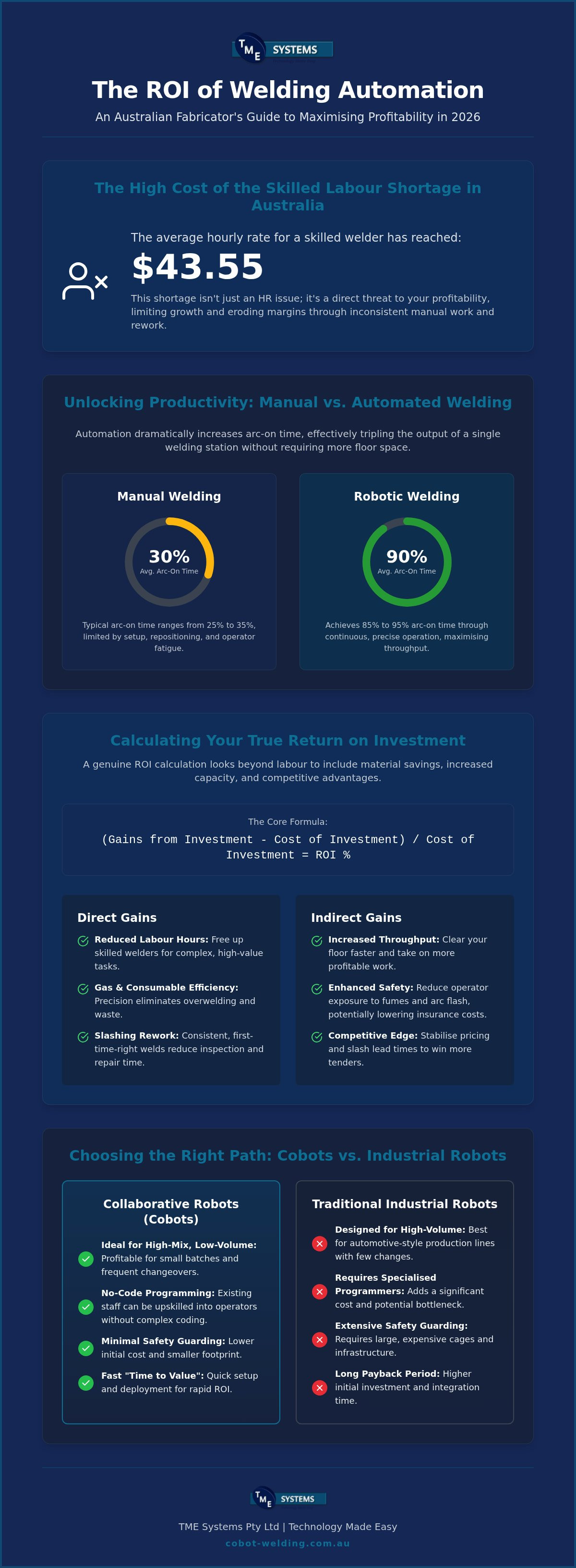

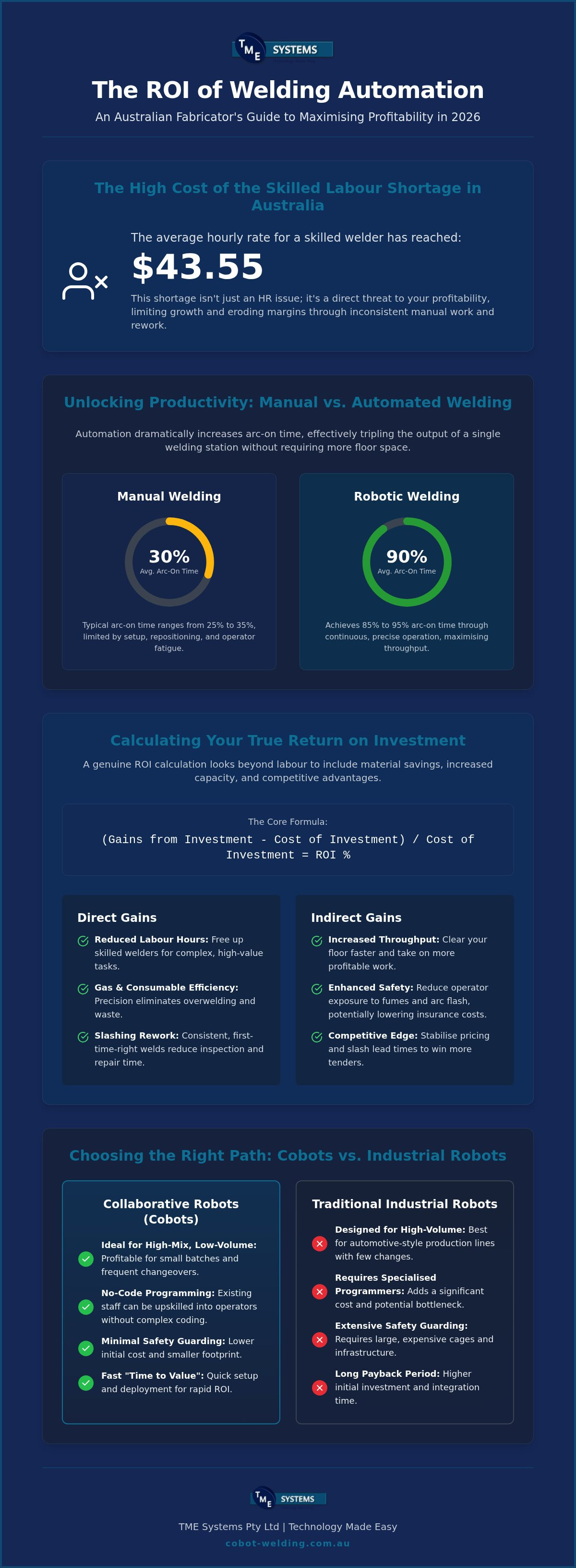
Why are some Australian fabrication shops still battling a six-month backlog while their neighbours are clearing the floor by Friday afternoon? It isn't just about working harder; it's about making a clear-eyed assessment of your welding automation ROI in a market where skilled labour is both scarce and expensive. You've likely felt the pressure of turning away profitable work because you simply can't find enough qualified welders to staff the bench. With the average hourly rate for a skilled welder in Australia now reaching $43.55, the old "wait and see" approach to technology is becoming a risk to your margins.
We understand that justifying a major equipment purchase feels daunting, especially when your work involves small batches rather than thousands of identical parts. This guide will show you how to calculate and maximise your return on investment, specifically tailored for the 2026 Australian manufacturing landscape. We'll provide a clear ROI framework, explain how no-code cobots make high-mix production profitable, and share a plan to upskill your current staff into robot operators without complex coding. By the end, you'll have the confidence to turn your workshop into a more efficient, competitive, and profitable operation.
Key Takeaways
- Learn the specific formula to calculate your welding automation ROI, looking beyond simple labour savings to include gas and consumable efficiency.
- Compare the total cost of ownership between cobots and industrial robots, including the hidden expenses of safety guarding and specialised programming.
- Discover how no-code teaching software removes the programmer bottleneck, making even small-batch fabrication jobs profitable for automation.
- Identify the best first projects to automate in your workshop to ensure a fast payback and a smooth transition for your existing team.
- Understand how professional welding system integration and operator training protect your investment and ensure long-term equipment uptime.
Understanding the ROI of Welding Automation in Australia
For most Australian fabricators, welding automation ROI is often misunderstood as a simple calculation of machine cost versus man-hours. In reality, it's a measure of how effectively you can utilise your floor space, your gas, and your most expensive asset: your people. In 2026, the Australian manufacturing sector faces a distinct set of hurdles. With the average hourly rate for skilled welders sitting at $43.55, every minute spent on a simple fillet weld that could be automated is a minute of profit lost. Traditional ROI models often fail here because they were built for massive automotive lines. Modern robotic welding technology, particularly collaborative robots, focuses on "Time to Value". This means looking at how quickly a system can be unboxed, set up, and start finishing jobs, rather than waiting years for a payback that might never come.
Understanding your welding automation ROI requires a shift in perspective from pure speed to total workshop flexibility. In a high-mix, low-volume environment, the value isn't just in how fast the torch moves. It's in how quickly you can switch from one job to the next without needing a specialised programmer on the payroll.
The Real Cost of the Skilled Labour Shortage
Finding a qualified welder in Australia has never been harder. This isn't just an HR headache; it's a direct hit to your bottom line. When you can't find staff, you can't bid on new contracts, which limits your growth. Even when you do have a full team, the cost of rework and inconsistent quality in manual processes can quietly erode your margins. Automation doesn't replace your best staff; it actually helps you keep them. By offloading the repetitive, "grunt work" to a robot, your skilled tradespeople can focus on complex assemblies that require their real expertise. This improves job satisfaction and reduces the physical strain that often leads to staff turnover.
Shifting from Manual to Automated: The Strategic Why
We need to move past the myth that robots are here to steal jobs. In a local workshop, a cobot is simply another tool in a tradesperson's kit, much like a high-end power source or a CNC plasma cutter. Adopting this technology allows Australian shops to compete with high-volume overseas manufacturers by slashing lead times and guaranteeing consistency. There's also a significant safety benefit. With the updated ISO 10218:2025 standards in place, modern systems are safer than ever to work alongside. Improving workshop safety isn't just good for your team; it can lead to lower insurance premiums and a reduction in long-term costs associated with workplace injuries.
Calculating Your Return: Beyond Just Labour Savings
To get a true picture of your welding automation ROI, you need to look past the sticker price and the hourly wage of your staff. The standard formula is straightforward: (Gains from Investment - Cost of Investment) divided by the Cost of Investment. While this provides a percentage, the real story lies in the variables you choose to include in your welding automation ROI calculation. Direct savings like reduced labour hours are easy to spot, but precision-driven gains in gas and consumable efficiency often fly under the radar. A robot doesn't over-weld or leave the shielding gas running during a chat, which leads to significant savings over a single shift.
Indirect gains are equally vital for a modern workshop. Increased throughput allows you to clear your floor faster, while the compact footprint of a cobot means you don't need to extend your workshop to add capacity. We also have to consider the opportunity cost. If your competitors are automating to stabilise their prices while you're still absorbing the rising costs of manual labour, you risk being priced out of the next big tender. Clearing a production backlog isn't just about speed; it's about being ready for the next profitable job that comes through the door.
Direct vs. Indirect ROI Factors
Precision is the enemy of waste. By maintaining a perfect arc length and travel speed, automated systems use exactly the amount of wire and gas required by the weld procedure. This consistency also means your welds are first-time-right, which slashes the hours spent on inspection and rework. Robotic welding typically operates at 85 to 95 percent arc-on time compared to just 25 to 35 percent for manual welding. This massive jump in duty cycle is the primary engine behind your return, as it effectively triples the output of a single welding station without adding extra floor space.
The Payback Period: What is Realistic for a Local Shop?
In the Australian market, most fabricators see a full payback within 12 to 18 months. This timeline assumes you've accounted for the initial on-site cobot welder training required to get your team up to speed. A solid welding automation implementation strategy ensures that your first-year costs include these essential setup phases rather than treating them as unexpected hurdles. When you project these returns over a five-year equipment lifespan, the cumulative profit often outweighs the initial capital outlay several times over. If you're ready to see how these numbers apply to your specific jobs, viewing a collaborative welding cell in action can clarify the potential for your workshop floor.
Cobots vs. Industrial Robots: Choosing the ROI Path
Choosing the right hardware is the next critical step in securing your welding automation ROI. While a traditional industrial robotic arm might look like a bargain on a quote, the upfront capital expenditure (CAPEX) is often just the tip of the iceberg. Collaborative robot welding cells are purpose-built for the reality of the Australian workshop floor, where space is at a premium and job requirements change by the day. Unlike industrial robots that require permanent fixtures, cobots offer a path to profitability that doesn't involve tearing up your workshop layout or hiring a team of software engineers.
The decision between these two paths usually comes down to your typical batch size and the physical constraints of your shop. If you're running the same part for three years straight, an industrial robot makes sense. But for the average Australian fabricator handling a mix of structural steel, brackets, and custom frames, the flexibility of a collaborative system provides a much more resilient return on investment.
Total Cost of Ownership (TCO) Comparison
It's a common industry rule of thumb that the "sticker price" of a traditional industrial robot represents only about 30% of the total integration cost. The remaining 70% is swallowed up by hidden expenses. You'll need to pay for heavy-duty safety fencing, light curtains, and specialized interlocks to meet safety standards. You also have to consider the cost of floor space; once an industrial robot is caged off, that area is effectively dead to any other use. Collaborative systems eliminate these hurdles by working safely alongside your tradespeople, allowing for a "plug-and-play" integration that avoids expensive workshop redesigns and keeps your overheads low.
Flexibility: The Secret to Small-Batch ROI
Traditional industrial robots often fail the ROI test for runs of under 50 parts because the time required for complex programming outweighs the production gains. If your machine sits idle while you wait for a programmer to arrive, it isn't earning its keep. Cobots solve this by being easy to re-deploy across different projects in a single shift. You can move the cell from one bay to another, swap the jigging, and have it running a new project in minutes rather than days. Improving welding productivity with cobots hinges on setup speed, ensuring that even your smallest batches contribute to a healthier bottom line. This ability to keep the torch moving, regardless of the job size, is what makes the technology so accessible for local shops.
The No-Code Advantage: How Software Accelerates Payback
If your welding cell sits idle while a technician taps away at a laptop, your welding automation ROI is taking a hit every minute. The correlation between programming time and job profitability is direct. In the past, the "Programmer Bottleneck" meant that only high-volume jobs could justify the cost of hiring a specialist to write complex code. For a local job shop, this was a deal-breaker. However, no-code robot welding software has changed the math by removing the need for traditional programming entirely. By shifting the responsibility from a computer scientist to your existing tradespeople, you ensure the machine starts earning its keep immediately.
The real financial engine here is "Teaching by Demonstration." Instead of typing coordinates, a welder physically moves the robot arm to the start and end points of a seam. This reduces the setup time for a new part from several hours to just a few minutes. When you can program a new jig in the time it takes to have a smoko, the barrier for small-batch automation disappears. This empowerment of your current team is a massive cost-benefit win; upskilling a loyal staff member who already understands weld pools and travel angles is far more effective than trying to recruit a dedicated robotics engineer in a tight market.
Reducing the "Time-to-Weld" for New Parts
No-code interfaces allow for rapid job changeovers that fit the Australian job shop model perfectly. A welder can "teach" the robot a new path, save the program, and be ready to run a batch of ten brackets before the morning is out. This speed is essential because it protects your margins on the diverse range of work typical in local manufacturing. You don't need a PhD to run these systems. You just need the practical knowledge your team already possesses. This shift ensures that your capital stays productive, rather than being tied up in lengthy software configurations that eat into your weekly output.
Lowering the Barrier to Entry
Intuitive software does more than just save time; it reduces the "fear factor" that often stalls technology adoption on the workshop floor. When the team sees that the software is as easy to use as a smartphone, the robot becomes a tool they actually want to use. This high utilisation rate is a key driver of your return. If a machine is too complex, it eventually sits idle in a corner, which is the quickest way to kill your investment. By choosing software that evolves with your production needs and offers a shallow learning curve, you secure a long-term ROI that supports your workshop's growth. If you want to see how this simplicity translates to your floor, exploring no-code teaching software is the logical next step for your business.
Implementing Your Automated Welding Strategy
Success in automation isn't about the robot itself; it's about the strategy you wrap around it. To truly maximise your welding automation ROI, you need to treat the technology as an amplification of your existing team's skills rather than a simple replacement for them. The first step involves selecting the right pilot project. While high-volume jobs are the traditional choice, many Australian shops find success by targeting high-tedium tasks. These are the repetitive, boring welds that drain your team's energy and lead to inconsistency. By automating these first, you prove the concept while immediately improving workshop morale.
Professional welding system integration is the bridge between a machine sitting in a crate and a productive cell. A specialist helps you align the robot with your power source and jigging, ensuring a seamless rollout from day one. In the first 90 days, you should track specific KPIs to measure success. Focus on arc-on time, rework rates, and the time it takes for your team to set up a new part. These metrics will give you a clear picture of how the system is performing against your initial projections.
Phase 1: The Proof of Concept
Theory is fine, but nothing beats seeing the torch move on your own parts. A mobile welding robot demonstration is critical for calculating your real-world welding automation ROI. It allows you to test your specific jigs and materials before making a full commitment. This stage isn't just about technical validation; it's about cultural buy-in. When your operators see the system in action and realise it's a tool they can control, the fear factor disappears. This involvement ensures that your staff feel supported rather than sidelined by the new technology.
Scaling Your Investment
Once the first cell is humming, the return on a second unit often exceeds the first. This is the multiplier effect. Your team already knows the software, your integration hurdles are solved, and your workshop workflow is already adapted to automated throughput. You can then use the data from your first cell to refine your floor flow, identifying bottlenecks in prep or finishing that the robot has highlighted. Partnering with TME Systems Pty Ltd ensures you have ongoing support and technical optimisation. This moves the relationship from a one-off purchase toward a collaborative partnership that scales with your long-term business goals.
Future-Proofing Your Workshop Floor
Investing in new technology shouldn't feel like a gamble for your business. By focusing on flexible cobot cells and no-code software, you're not just buying a machine; you're giving your tradespeople a tool that multiplies their output. We've seen how a strategic approach to welding automation ROI covers everything from shielding gas savings to clearing stubborn production backlogs. These gains are the most reliable way to stay competitive as labour costs rise across the country.
You don't have to navigate this transition alone. With on-site proof of concept available nationally and full integration support included, we help you close the gap between theory and a productive floor. Our no-code software is designed specifically for Australian tradespeople to ensure your team is up and running without complex training. Ready to see the numbers for yourself? Book a Mobile Welding Robot Demonstration to see your ROI in action and discover how accessible automation can transform your capacity. It's time to stop turning away work and start scaling with confidence.
Frequently Asked Questions
How long does it typically take to see a full ROI on a welding cobot?
A typical robotic welding system pays for itself in 8 to 18 months. This timeline depends on your current labour costs and how many shifts the cell operates. With the average hourly rate for skilled welders in Australia at $43.55, the savings on wages alone drive a rapid return. Most local fabricators find that the jump from 30 percent to 90 percent arc-on time makes the investment profitable within the first year.
Can small-batch welding really be profitable with automation?
Small-batch welding is highly profitable when using collaborative robots equipped with no-code software. Unlike traditional industrial robots that require hours of coding, a cobot can be taught a new path in minutes. This rapid changeover means you can automate runs as small as ten parts while still maintaining a positive welding automation ROI. It allows your workshop to handle high-mix work with the same efficiency usually reserved for mass production.
What are the hidden costs of welding automation I should plan for?
While the robot arm is the main expense, you should also budget for the welding power source, custom jigging, and initial integration labour. Traditional industrial systems often require expensive safety fencing and light curtains, which can double the total cost. Collaborative systems avoid most of these guarding costs. You'll also need to account for operator training and onboarding to ensure your team is confident using the new cell from day one.
Do I need to hire a robot programmer to get a good ROI?
You don't need to hire a specialist programmer if you choose a system with no-code teaching software. These interfaces allow your existing tradespeople to move the robot arm manually to set weld points. This removes the need for expensive external contractors or new staff members with computer science degrees. By upskilling your current welders, you keep your overheads low and ensure the robot is always productive on the workshop floor.
How does welding automation affect my workshop’s electricity and consumable costs?
Automation typically reduces your total consumable and gas costs through extreme precision. Robots maintain a perfect arc length and travel speed, which eliminates over-welding and reduces wire waste. While your electricity usage per hour might increase slightly due to higher arc-on time, the cost per part usually drops significantly. You're producing three times as much work in the same timeframe, which spreads your fixed workshop overheads across a larger volume.
Is there government assistance or tax incentives for Australian manufacturers automating in 2026?
Australian small businesses with a turnover up to $10 million can access a permanent $20,000 instant asset write-off from 1 July 2026. Eligible SMEs may also benefit from the R&D Tax Incentive, which offers a 43.5 percent refundable tax offset on qualifying expenditure. Additionally, the Loss Carry Back provisions allow companies to claim refunds on tax paid in previous years. We recommend speaking with your accountant to see how these incentives impact your welding automation ROI.
What happens to the ROI if my production mix changes frequently?
Your ROI remains strong even with a changing production mix because collaborative robots are designed for high flexibility. If you switch from structural brackets to custom frames, you simply teach the robot the new paths using the no-code interface. There's no need to wait for a programmer or scrap your previous setup. This plug-and-play nature ensures your equipment doesn't sit idle when your customer orders change, protecting your long-term capital investment.
How do I compare the ROI of a turnkey cell versus a custom-built system?
Turnkey cells generally offer a faster ROI because they are pre-engineered for rapid deployment. A custom-built system often involves months of design, bespoke integration, and higher troubleshooting costs, which delays your time to value. For most Australian fabricators, a standardised collaborative cell provides the best balance of performance and price. It allows you to start welding within days of delivery rather than weeks, ensuring your payback period starts as early as possible.