
Most fabricators believe the most profitable welding robot for job shops is the one with the highest travel speed, but in a high-mix environment, raw speed is often secondary to setup time. If it takes your best operator four hours to program a part that only takes twenty minutes to weld by hand, the maths simply doesn't stack up. You've likely felt the pressure of a growing backlog while your senior welders are tied up with repetitive, low-value components instead of the complex bespoke work they excel at.
We understand that traditional automation often feels out of reach when your batch sizes are small and your floor space is at a premium. This guide will show you how to transform your fabrication business using collaborative welding robots that your team can learn to operate in minutes. You'll discover how no-code teaching software and mobile demo systems can help you increase throughput and maintain consistent weld quality across every shift. We will walk through the practical steps to integrate these systems so you can finally free up your skilled staff for the high-margin projects that actually grow your business.
Key Takeaways
- Learn why a collaborative welding robot for job shops is the ideal solution for high-mix, low-volume production where setup speed matters more than raw cycle time.
- Understand how no-code teaching software allows your existing staff to program new weld paths in minutes, removing the need for specialist coding skills.
- Discover how to free up your senior welders for complex, high-value projects by delegating repetitive tasks to a reliable robotic partner.
- Get practical advice on workshop organisation, including power requirements and the essential role of jigging in ensuring repeatable weld quality.
- Explore the benefits of an on-site mobile demo to see exactly how automation fits into your specific workflow before making a commitment.
Why Australian Job Shops are Switching to Collaborative Welding Robots
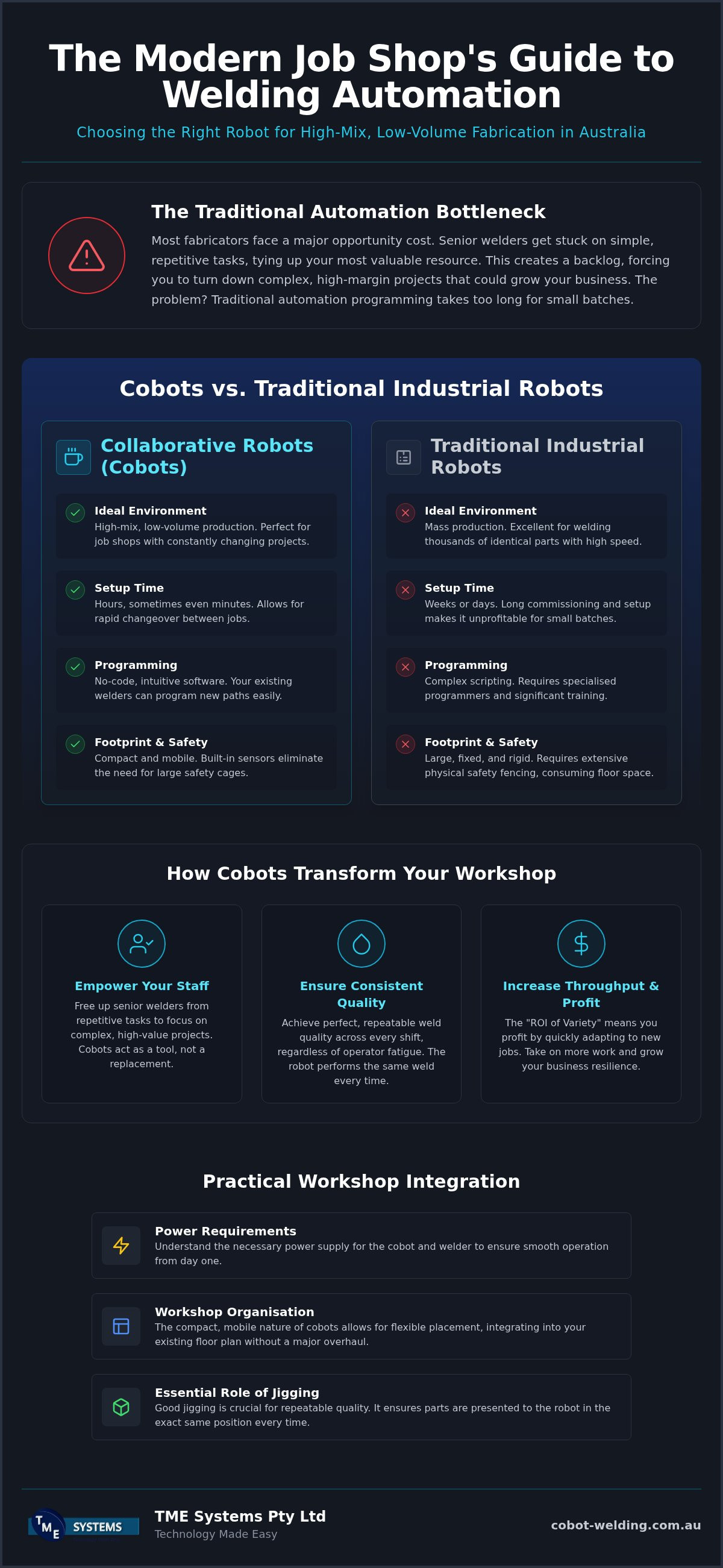
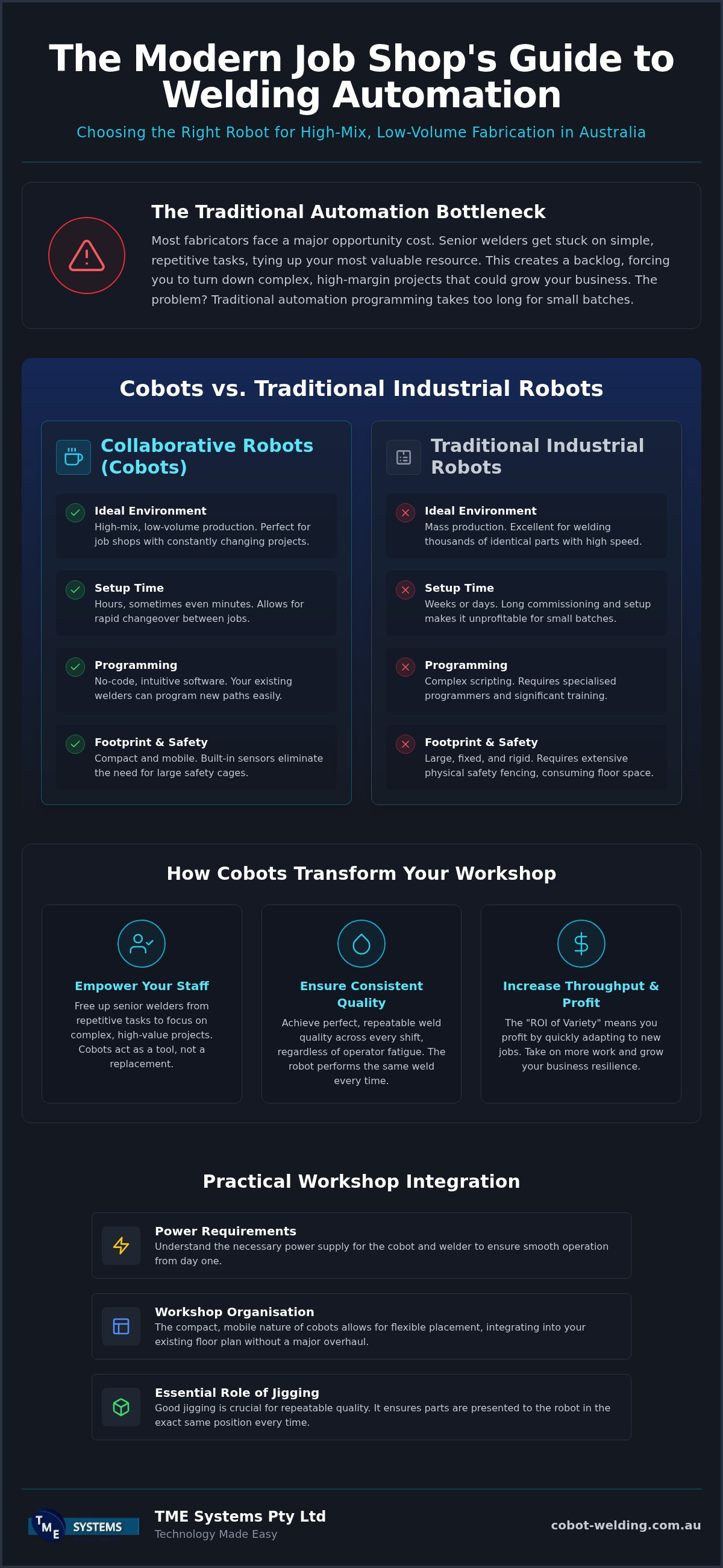
The Australian manufacturing landscape has changed. We aren't making millions of identical brackets anymore; we're doing high-mix, low-volume work that requires constant adaptation. In this environment, a welding robot for job shops needs to handle variety rather than just raw speed. Collaborative robots, or cobots, are the missing link between manual skill and automated consistency. Unlike traditional industrial robots that live behind safety cages, cobots are designed to work right alongside your team, acting as a sophisticated power tool rather than a replacement for a tradesperson.
The Job Shop Dilemma: Small Batches vs. Automation
Traditional automation was built for the automotive industry. It's brilliant if you're making 50,000 of the same chassis, but it's a nightmare for a local shop doing 20 stainless tanks today and 15 mild steel frames tomorrow. The programming time usually kills the profit on small batches. If it takes a week to set up a robot for a job that only lasts two days, you're better off doing it by hand.
Most owners face a massive opportunity cost. You've likely got senior welders spending half their day on simple, repetitive fillet welds. That's a waste of their talent. While they're stuck on low-value work, you're forced to turn down the complex, high-margin bespoke jobs because your best people are flat out doing the basics. It's a bottleneck that limits your growth without adding any real value to the workshop floor.
Cobots as the Practical Solution
Cobots solve this problem by being approachable and compact. They feature built-in force sensors that stop the arm instantly if it touches a person, allowing them to sit right next to your existing benches. You don't need to rebuild the workshop or sacrifice precious floor space to a yellow perimeter fence. This small footprint makes them easy to move and reconfigure as your project list changes.
We believe in a "Practical Mentor" philosophy. We don't view the robot as a standalone system, but as a tool that empowers the welder. By automating the boring, repetitive bits, you free up your staff to focus on the technical challenges that require their years of experience. This doesn't just increase throughput; it improves morale by letting your team do the work they actually enjoy.
In 2026, the real profit is in the "ROI of Variety." A welding robot for job shops pays for itself by being ready for the next job in minutes, not days. When you can switch from a small bracket to a large frame with a few clicks, your business becomes more resilient. You can take on more work, maintain perfect consistency across every shift, and finally get your senior welders back onto the jobs that matter.
Cobots vs. Traditional Industrial Robots: Which Suits Your Workshop?
Choosing the right welding robot for job shops often comes down to one question: how often do your parts change? Traditional industrial robots are the workhorses of mass production. They're incredibly fast and can handle heavy payloads, but they're also rigid. Setting one up usually involves weeks of specialised commissioning, safety fencing, and complex scripting that requires a dedicated programmer. For a local job shop, this rigidity is a profit killer.
In contrast, cobots are designed for agility. Because they use internal force sensors to detect contact, they don't need the heavy physical guarding that eats up your workshop floor. This allows for the deployment of collaborative robot welding cells that are often mounted on wheels. You can literally roll the robot to the work, plug it in, and start welding. The difference in setup time is stark; we're talking about hours instead of weeks.
When to Stick with Traditional Industrial Robots
There are still scenarios where a traditional robot is the better investment. If your contract involves welding thousands of identical parts over several months, the high-speed cycle times of an industrial arm will win out. These machines are also necessary if you're handling extremely heavy components or require high-speed movements where human proximity would be dangerous regardless of sensors. In these cases, the long setup time is offset by the sheer volume of production. If your shop functions more like a factory line than a custom fabrication house, the traditional route remains the standard.
Why Cobots Win in the High-Mix Environment
For most Australian fabricators, the work is far more varied. Cobots win here because they offer rapid changeovers. You can switch from welding small brackets to large frames in minutes. There's no need for complex scripting; instead, you use no-code interfaces that feel more like using a smartphone than a computer. This ease of use is the primary reason a welding robot for job shops has become such a viable tool recently.
The barrier to entry is also much lower. You don't need to dig up your floor to install mounting plates or rewire your entire electrical board for a massive controller. This flexibility means you can experiment with automation on a small scale and scale up as you see results. If you're unsure which path fits your specific floor plan, exploring integrated welding solutions can help clarify the best fit for your team.
The No-Code Revolution: Empowering Your Existing Welders
The biggest hesitation most workshop owners have when considering a welding robot for job shops isn't the capital outlay; it's the perceived complexity. There is a persistent myth that introducing automation requires a computer science degree or a dedicated software engineer on the payroll. In reality, the "no-code" revolution has completely flipped this script. Modern no-code robot welding software uses intuitive, point-and-click interfaces that feel more like using a modern smartphone than a piece of industrial equipment.
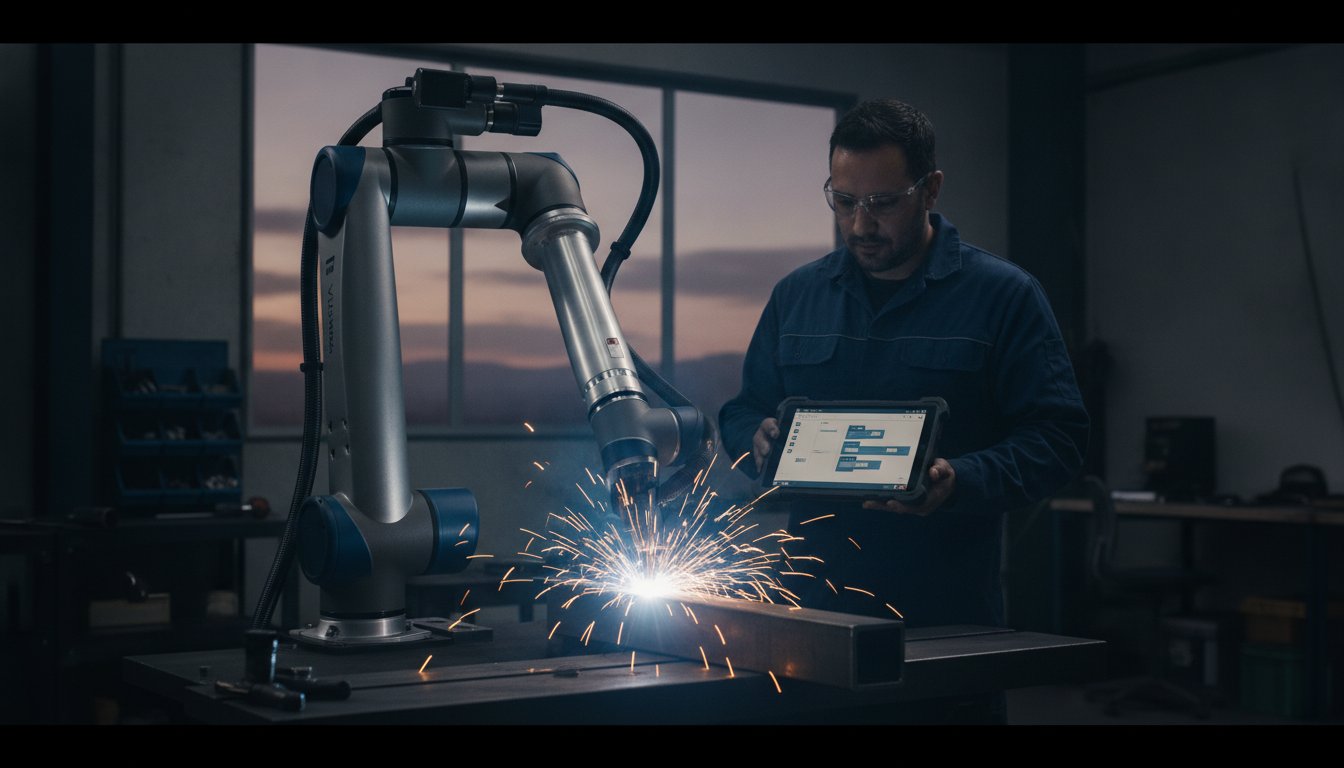
Instead of typing coordinates into a terminal, your team uses the "lead-through" method. This involves physically grabbing the robot arm and guiding it through the desired weld path. The system records these movements in real-time, allowing the operator to set start points, end points, and waypoints with a simple button press. If the weld needs a slight adjustment for heat or penetration, you can fine-tune the parameters on the fly without stopping the cycle. This immediate feedback loop ensures that the first part is as good as the last.
From Welder to Robot Operator
This software doesn't replace the welder's expertise; it amplifies it. Your senior fabricators still decide the torch angle, the travel speed, and the wire feed rate based on their years of experience. The robot simply becomes an extension of their skill, providing the steady hand that never tires. By focusing on skill transfer rather than coding, the learning curve is reduced from months to a single afternoon. We've seen senior tradespeople master path teaching in under 30 minutes, allowing them to oversee multiple robot cells simultaneously.
Managing Small Batches Profitably
In a high-mix environment, the "5-Minute Rule" is the key to making a welding robot for job shops pay its way. If you can set up a new job in five minutes, even a batch of five or ten pieces becomes highly profitable. Intuitive visual interfaces eliminate "programming fatigue" by keeping the process grounded in the physical reality of the workshop. Programs for recurring jobs are stored and recalled instantly, meaning that a bespoke order from last year can be back in production in seconds, maintaining perfect consistency every time it returns.
Integrating a Welding Robot into Your Workshop Workflow
Successful automation isn't just about the machine; it's about the space and the processes surrounding it. When you introduce a welding robot for job shops, you don't need to overhaul your entire facility, but you do need to think about spatial organisation. Most collaborative units run on standard single-phase power, making them far easier to place than industrial robots that require heavy-duty three-phase upgrades. The goal is to create a cell where the operator can load parts safely while the robot is working, ensuring the arc stays on for as much of the shift as possible.
Repeatability is the foundation of robotic success. While a human welder can adjust for a slightly oversized gap or a misaligned tack, a robot expects the part to be in the exact same position every time. This makes high-quality jigging and fixturing essential. By investing in modular welding tables and precise clamps, you ensure that the robot hits its marks without constant manual intervention. Learning how to improve welding productivity with cobots often starts with these small, physical adjustments to your prep work.
Organising Your Shop for Automation
Efficiency depends on material flow. If your robot is sitting idle because the next batch of parts is still at the laser cutter, you aren't seeing the full return on your investment. We recommend a "low-hanging fruit" strategy for your first few weeks. Start with your most common, repetitive components, even if they're simple. This allows your team to get comfortable with the cell while seeing immediate gains in throughput. Standardising your weld prep, such as ensuring parts are clean and consistently tacked, will significantly reduce robotic errors and rework rates.
Collaborating with Integration Specialists
While cobots are approachable, achieving a seamless setup often requires a bit of expert guidance. Professional cobot welding integration ensures the torch, wire feeder, and power source are all communicating perfectly. It's about more than just "plug and play"; it's about refining the system to suit your specific material needs, whether you're working with thin-gauge stainless or heavy mild steel. A reliable partner helps you avoid the "expensive paperweight" syndrome by providing the operator training and onboarding needed to keep the system running long-term.
Safety is the final piece of the puzzle. Every installation should undergo a risk assessment to ensure compliance with Australian collaborative robot standards. This includes checking for pinch points and ensuring the force-limiting settings are correctly calibrated for your specific environment. If you're ready to see how these systems handle your specific parts, we recommend exploring our Collaborative Robot Welding Cells to find a configuration that fits your floor.
Future-Proofing Your Fabrication Business with TME Systems
TME Systems doesn't just deliver a box to your door and leave you to it. We know the reality of the workshop floor because we're on it every day. When you're looking for a welding robot for job shops, you need more than a machine; you need a partner who understands Australian manufacturing standards and the specific pressures of a high-mix workload. Our approach is built on steady confidence and clear, actionable support that takes the mystery out of automation.
We start by bringing the technology to you. A mobile welding robot demonstration on your own floor is the best way to prove the concept. You can see how the arm handles your actual parts, not just a perfect sample from a showroom. This removes the risk of the unknown and lets your team see exactly how easy the teaching process really is. It's a hands-on experience that builds trust before you commit to a full installation.
Our Onboarding and Training Process
We've refined our integration into three distinct phases to ensure long-term success. First, we assess your current jobs to find the parts most suitable for automation. This isn't about automating everything at once; it's about finding the "low-hanging fruit" that delivers immediate results. We look for parts with repetitive welds that currently consume too much of your skilled labour's time.
Second, we provide comprehensive on-site cobot welder training. We don't train your IT department; we train your welders. Our focus is on the practical skills they need to teach paths and adjust parameters using no-code software. Finally, we offer ongoing technical support to help you refine your processes as your production needs evolve. We're here to help you scale from a single cell to a fully automated shop when you're ready.
Ready to See it in Action?
Investing in a welding robot for job shops is a significant step, but it doesn't have to be an intimidating one. By seeing a proof-of-concept demonstration in your own environment, you can make an informed decision based on real-world results. It's about giving your business the tools to compete in 2026 and beyond. If you're ready to see how collaborative automation can transform your throughput and free up your best tradespeople, Book a mobile demonstration at your workshop today.
Empowering Your Workshop for the Road Ahead
Integrating a welding robot for job shops isn't about replacing the craft of a skilled fabricator; it's about giving them a more capable tool to handle the repetitive grind. By choosing collaborative systems, you gain the flexibility to tackle small batches without the massive setup times of traditional automation. You've seen how no-code software keeps the control in the hands of your tradespeople, ensuring that your years of experience are translated directly into every weld path.
TME Systems is here to act as your practical mentor throughout this transition. We provide national Australian support and turnkey integration that respects the reality of your production schedule. If you want to see how this technology handles your specific parts, we can bring the proof of concept directly to your floor. Our mobile demo units are designed to show you exactly how these cells fit into your existing workflow.
Book a Mobile Welding Robot Demonstration for Your Workshop to see the results for yourself. It's time to clear your backlog, reduce rework, and let your senior welders focus on the complex projects they were trained for. We're ready to help you build a more resilient, profitable future.
Frequently Asked Questions
Is a welding robot really suitable for small batches of 5-10 pieces?
Yes, a collaborative welding robot for job shops is perfectly suited for batches as small as five pieces. The key is the no-code teaching method which allows you to program a new path in roughly five minutes. If your setup time is shorter than the manual welding time, the batch is profitable. This flexibility means you don't need to wait for massive production runs to see the benefits of automation on your workshop floor.
Do I need to hire a programmer to operate a welding cobot?
You don't need to hire a specialised programmer or someone with a computer science degree. We've designed the system so your existing tradespeople can lead the process. Using the lead-through teaching method, a senior welder can physically move the arm and set the path themselves. It's about empowering the staff you already have rather than adding overhead with non-welding personnel who don't understand the nuances of a good bead.
What safety precautions are required when using a collaborative robot in Australia?
Australian safety standards require a thorough risk assessment for every robotic installation. While cobots feature force-limiting sensors that stop the arm on contact, you still need to consider the welding arc and hot work hazards. Protective screening is usually required to shield other workers from flash. We help you navigate these requirements to ensure your cell complies with local regulations while maintaining the open, accessible feel of a collaborative workspace.
Can a welding robot handle different materials like aluminium and stainless steel?
Absolutely. The robot is essentially a high-precision torch carrier, so it can handle any material your power source is capable of welding. Whether you're working with thin-gauge stainless steel or structural aluminium, the no-code software allows you to store specific parameters for each material. You can switch between different wire types and gas mixes quickly, making it a highly versatile welding robot for job shops that deal with diverse client requests.
How much floor space does a typical collaborative welding cell require?
One of the biggest advantages is the small footprint. A typical cell occupies roughly the same space as a standard manual welding bench, often around two square metres. Because they don't require bulky safety cages or perimeter fencing, you can tuck them into existing bays without moving half your machinery. Many of our systems are even mounted on heavy-duty wheels, allowing you to move the robot to wherever the work is located.
What happens if the robot hits a snag or the weld quality drops?
If the robot detects an obstruction, its force sensors trigger an immediate stop to prevent damage or injury. Regarding weld quality, the operator can make real-time adjustments to the travel speed or wire feed rate via the pendant. If you notice a drop in consistency, it's often due to part fit-up or jigging issues. The software makes it easy to refine the path slightly to account for these minor variations in the fabrication process.
Does TME Systems provide training for my existing staff?
We provide comprehensive on-site onboarding and operator training as part of our integration service. We focus on teaching your actual welders how to use the no-code software and maintain the cell. Our goal is to ensure your team feels confident and capable from day one. We stay involved after the initial setup to provide technical support and help you refine your workflows as you take on more complex automated projects.
How long does it typically take to see a return on investment for a welding robot?
While every shop is different, many fabricators report a return on investment within 12 to 18 months. This is achieved by increasing your total throughput without adding to your headcount and by freeing up senior staff for high-margin bespoke work. By reducing rework rates and ensuring consistent quality across every shift, the system pays for itself through improved efficiency and the ability to take on contracts that were previously out of reach.