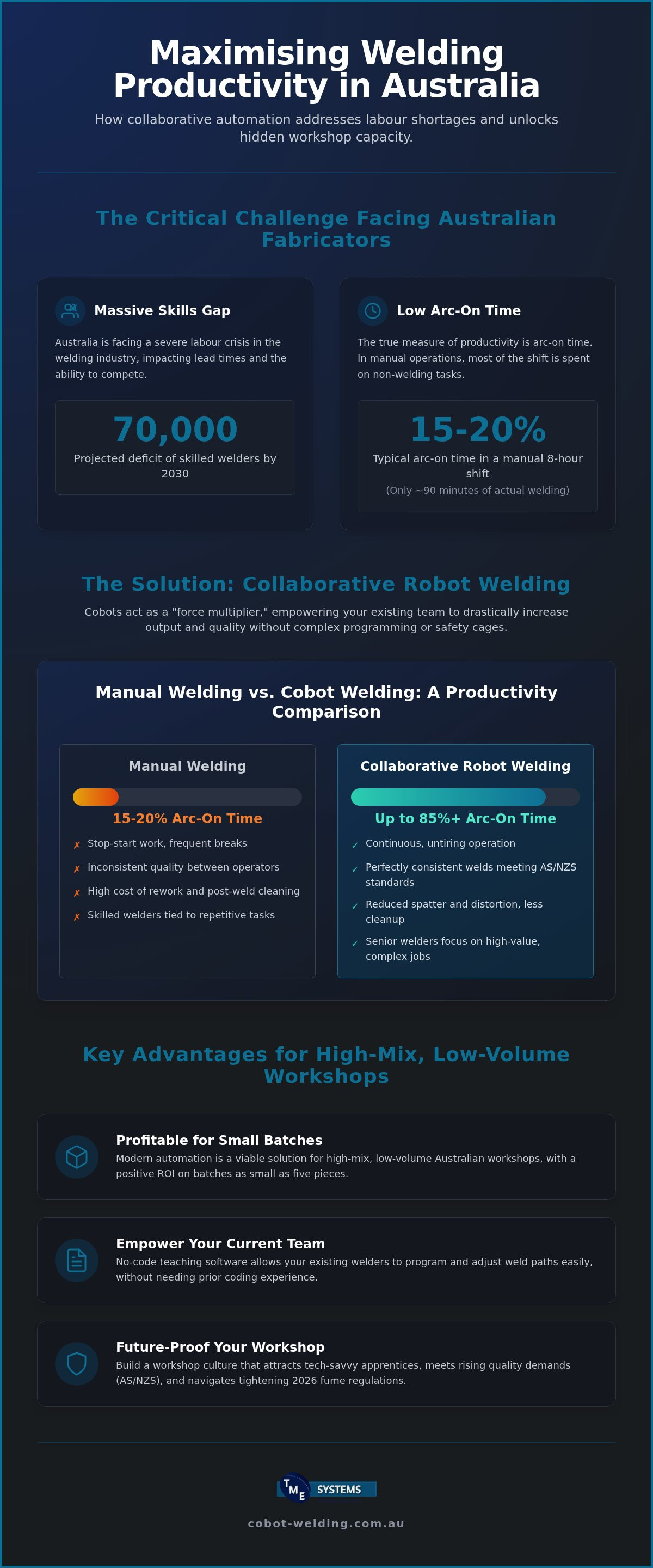

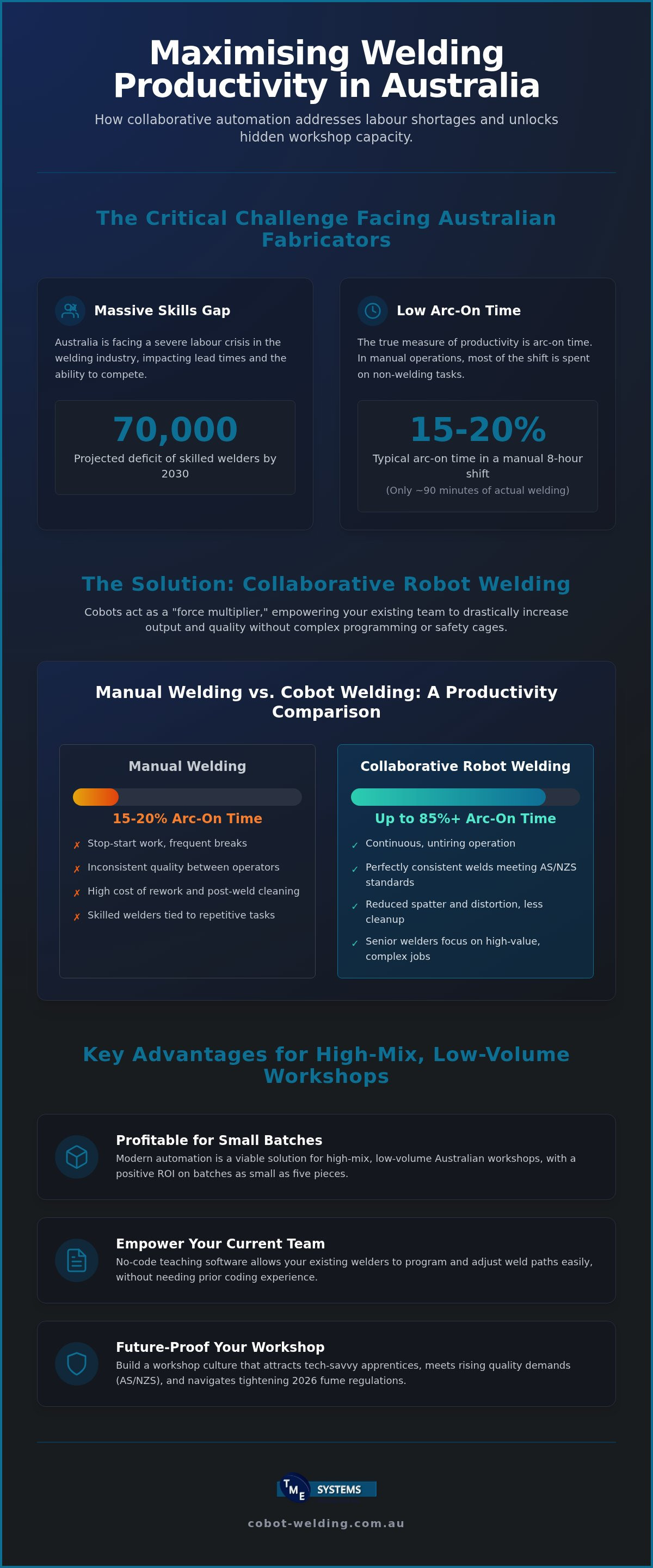
With Australia facing a projected deficit of 70,000 skilled welders by 2030, the pressure on local fabrication shops has never been higher. You're likely feeling the squeeze of losing contracts to overseas competitors while your best tradespeople spend half their shift on repetitive, boring components. Boosting robotic welding productivity isn't about replacing your team with machines; it's about giving your senior welders a "force multiplier" to handle the routine work so they can focus on complex, high-value projects.
We understand that the transition to automation can feel daunting, especially when you need to maintain strict AS/NZS quality standards and navigate the tighter 2026 fume exposure regulations. This guide will show you how to maximise your workshop output and solve labour shortages using collaborative tools tailored for the Australian market. We'll look at everything from no-code teaching software to turnkey cells that fit right into your existing floor plan, ensuring your investment pays for itself through reduced rework and significantly increased arc-on time.
Key Takeaways
- Learn how to measure workshop success by tracking total arc-on time against shift hours to uncover hidden production capacity.
- Discover how collaborative systems boost robotic welding productivity by handling routine components so your senior welders can focus on high-value work.
- See why modern automation is profitable for batches as small as five pieces, making it a viable solution for high-mix, low-volume Australian workshops.
- Understand how no-code teaching software empowers your current team to program and adjust weld paths without needing any prior coding experience.
- Find out how specialised on-site training helps build a workshop culture that attracts tech-savvy apprentices and future-proofs your business.
What Does Robotic Welding Productivity Mean for Australian Fabricators?
For most Australian workshops, the traditional definition of productivity focuses on wire feed speeds or how quickly a single part is finished. In 2026, this perspective is too narrow. True robotic welding productivity is measured by total arc-on time compared to total shift hours. While the technical definition of What is Robotic Welding? covers the mechanics of the arm and power source, for a local business owner, the definition is purely operational. It's about how much of your expensive labour is spent actually fusing metal rather than moving parts or grinding spatter.
The Australian manufacturing landscape is currently defined by a massive skills gap, with a projected deficit of 70,000 skilled welders by 2030. This shortage doesn't just make hiring harder; it blows out your lead times. When your best ticketed welders are stuck on repetitive, low-value components, your high-margin custom projects sit in the queue. True productivity means reclaiming that wasted time. It also means addressing the hidden drains on your margins, such as over-welding to "be safe" or the endless hours spent on post-weld cleaning that shouldn't be necessary in a controlled process.
Arc-On Time: The Metric That Drives Profitability
Manual welding is naturally stop-start work. Between flipping the workpiece, changing consumables, and checking drawings, most manual shops find their actual arc-on time is often as low as 15-20%. This means for every eight-hour shift, the torch is only live for about 90 minutes. By using collaborative automation, you can significantly increase this capacity. Cobots don't get distracted or fatigued, allowing you to reduce the time spent on non-welding tasks. This shift also reduces downstream processing; consistent automated heat input means less distortion and less time spent in the grinding bay before painting or galvanising.
Standardising Quality Across Every Shift
Inconsistency is a silent killer of robotic welding productivity. A "good enough" weld that fails inspection or requires heavy rework creates a bottleneck that stops the entire floor. By automating repetitive paths, you achieve consistent penetration and throat thickness regardless of which operator is on the tools that day. This standardisation is vital for meeting AS/NZS requirements consistently. It turns your production schedule into something predictable. You no longer have to worry about a "Monday morning" weld affecting your reputation or your bottom line, as the system delivers the same high-quality result every single time.
Maximising Output with Collaborative Robot Welding Cells
Traditional industrial robots are often too rigid and complex for the average Aussie job shop. They require massive safety cages, specialised programmers, and a permanent footprint that many workshops simply don't have. In contrast, collaborative robot welding cells are designed to function as a versatile workshop tool. They act as an "extra pair of hands" for your senior team, taking on the repetitive work while your skilled welders focus on high-value tasks. This shift is a vital part of Future-Proofing Your Workshop against the growing national skills shortage.
The beauty of a cobot lies in its ability to work safely alongside people without the need for perimeter fencing. Advanced sensors allow the arm to stop instantly if it detects an obstruction, meaning you can integrate automation directly into your existing floor plan. This accessibility significantly boosts robotic welding productivity by reducing the physical strain on your operators. By handing off awkward or high-repetition welds to the machine, you reduce the fatigue that often leads to late-shift errors and inconsistent quality.
Turnkey Solutions vs Custom Integration
For many local fabricators, the fastest route to a return on investment is through pre-configured, turnkey cells. These systems are designed for rapid deployment, often getting you up and running in a matter of days rather than months. You don't need to reinvent your entire process; these cells can typically integrate with your current MIG or TIG power sources. Partnering with local cobot welding integration experts ensures that the setup is tailored to your specific workshop layout and production goals. If you want to see how these systems handle your specific parts, a mobile demo system can provide a practical on-site proof of concept.
Eliminating the "Grind" Through Precision
A major boost to robotic welding productivity comes from what happens after the weld is finished. In a manual shop, spatter removal and grinding can eat up hours of every shift. Cobots eliminate this bottleneck by maintaining perfect travel speeds and torch angles every time. This precision results in clean, consistent beads that meet strict AS/NZS requirements without the need for heavy finishing. When you're working on complex infrastructure projects with tight tolerances, this level of automated accuracy ensures you hit your deadlines without blowing out your labour costs in the grinding bay.
Solving the High-Mix, Low-Volume Productivity Puzzle
A common misconception in local workshops is that automation only pays off for massive production runs. While traditional industrial robots thrive on repeating the same task thousands of times, the reality for most Aussie fabricators is a "high-mix, low-volume" workload. You're likely dealing with batches of 5 to 10 pieces rather than 5,000. In this environment, robotic welding productivity isn't defined by how fast the arm moves, but by how quickly you can switch between different jobs.
Cobots excel in this "job shop" reality because they are inherently flexible. By using modular jigging and repeatable positioning systems, you can reduce part loading times to a fraction of what they'd be in a manual setup. Instead of spending hours recalibrating a machine for a new task, your team can swap out a fixture and be ready to weld a completely different component in minutes. This agility allows you to take on diverse contracts without the downtime that usually kills your margins.
Rapid Job Setup and Program Recall
The key to making small batches profitable is reducing the "first-off" setup time. Quick-release tooling and standardised table layouts allow operators to mount jigs with high precision every time. Once a weld program is created for a specific customer order, it's saved in the system. When that customer returns six months later for another ten pieces, you simply recall the program and start welding immediately. Digital path simulation further boosts robotic welding productivity by allowing you to test the torch's reach and angles before the first arc is struck, virtually eliminating scrap and wasted material.
Managing Complexity Without the Fatigue
Diverse task lists often involve complex geometries that are physically taxing for manual welders. Working at odd angles or maintaining a steady hand through long, circular seams leads to fatigue and, eventually, a drop in quality. Collaborative robots handle these diverse task lists better than traditional systems because they are easier to reposition and adapt. This capability is becoming increasingly important as the Australian market for welding robots grows to meet demand in sectors like energy and defence. By automating the physically demanding paths, you significantly improve lead times for bespoke Australian fabrication contracts while keeping your best workers fresh for the tasks that truly require their expertise.
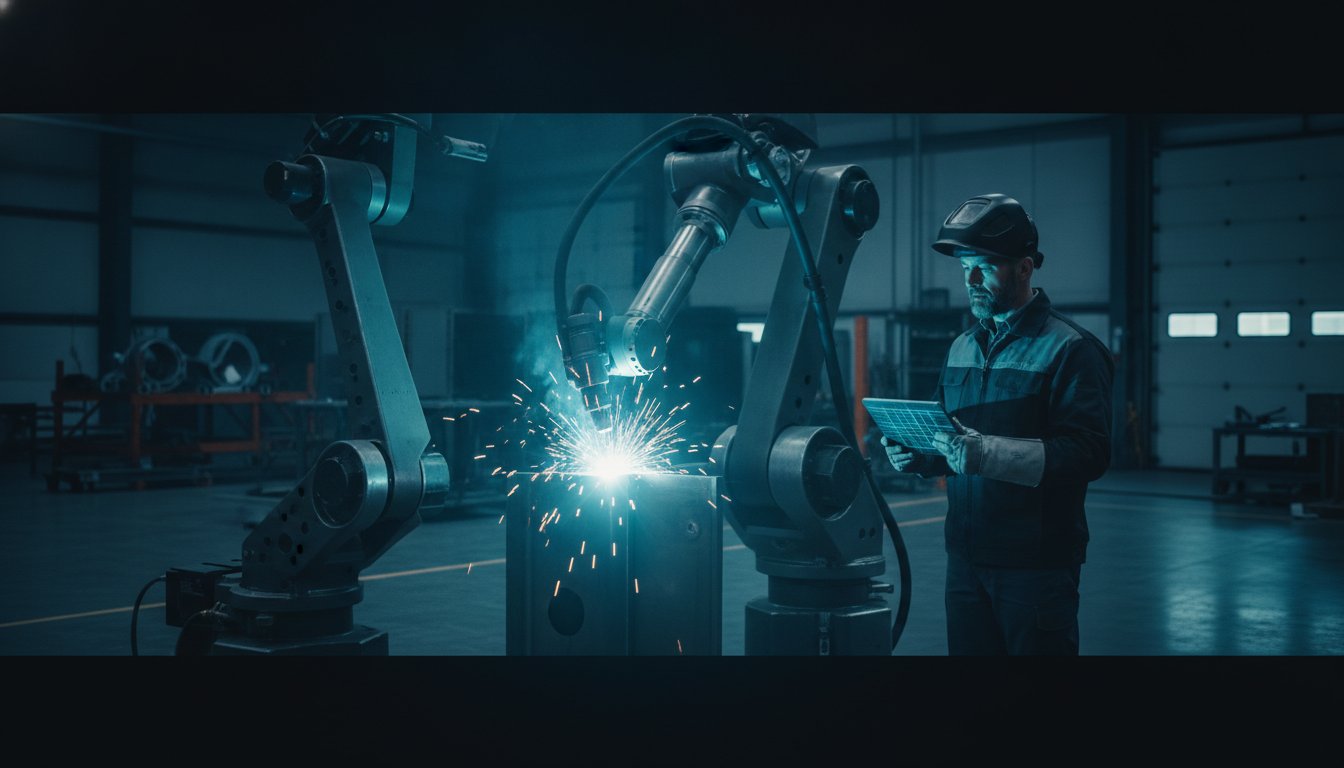
Removing Technical Barriers with No-Code Teaching Software
The biggest hurdle for Aussie shops isn't usually the cost of the hardware; it's the perceived complexity of the software. Traditional industrial robots often require a specialist programmer to type thousands of lines of code. This creates a bottleneck and disconnects the machine from the tradesperson's expertise. Using no-code robot welding software flips this model. It allows your best ticketed welders to become the automation leads, using their decades of experience to guide the machine rather than relying on an IT department. This shift is fundamental to maintaining high robotic welding productivity across different shifts.
The "hand-guided" method is a practical game-changer for the workshop floor. Instead of typing coordinates into a pendant, an operator simply moves the robot arm physically through the desired weld path. They hit a button to save a waypoint, and the system remembers the exact movement. This tactile approach respects the welder's craft and allows you to go from a bare table to a finished, repeatable weld in under 10 minutes. It's a tool that adapts to the user, not the other way around.
Teaching Paths Without a Single Line of Code
Veteran welders often have a healthy scepticism toward tech-heavy solutions that feel overly corporate or fragile. Intuitive tablet interfaces remove this friction by mirroring the way a tradesperson actually thinks about a joint. You aren't adjusting abstract axes; you're adjusting travel speed, torch angle, and wire feed. This simplicity reduces the technology fear factor and empowers your senior staff to teach the machine routine jobs. As we've discussed, this is the most effective way to free up your skilled labour for high-value custom work.
Fine-Tuning Welds for Australian Standards
Achieving robotic welding productivity doesn't mean cutting corners on quality or compliance. Modern software allows for precise control over weave patterns and stitch welds through a touch-screen interface. This is critical for ensuring penetration meets local AS/NZS compliance codes for structural steel. You can adjust volts and wire speed on the fly, refining the arc until it's perfect for the specific material at hand. Additionally, software logs provide a digital record of every weld. This traceability is a massive asset for quality assurance on critical infrastructure jobs, providing a level of proof that manual logs simply can't match. To see how your team takes to this technology, you can request a mobile demo and test the no-code interface in your own workshop.
Future-Proofing Your Workshop with TME Systems
Adopting automation is a significant step, but the technology is only as effective as the team behind it. Long-term success relies on more than just a successful installation; it requires a shift in workshop culture. This is where on-site cobot welder training becomes essential. By training your team in their own environment, you ensure the system is integrated into your specific workflows. TME Systems Pty Ltd acts as a local partner, providing ongoing technical support tailored to the unique pressures of the Australian manufacturing sector.
Seeing is believing on a busy production line. Before committing to a permanent setup, a mobile welding robot demonstration allows you to see the equipment in action on your own parts. This practical proof of concept is the most reliable way to verify how a cobot will impact your robotic welding productivity. It removes the guesswork and provides a clear picture of how the system handles your specific material grades and joint configurations.
Attracting and Retaining Skilled Staff
The national welder shortage isn't just about a lack of people; it's about the changing expectations of the workforce. Modern apprentices are often drawn to "tech-forward" trades. By introducing collaborative robots, you position your workshop as an innovative place to work. This helps attract younger talent who see automation as a tool to master rather than a threat. For your veteran staff, the benefits are equally clear. Automating the repetitive, awkward welds reduces the physical toll on their bodies, potentially extending their careers by years. It frees them up to focus on the bespoke craftsmanship that requires a human eye, which is far more rewarding than welding the same bracket five hundred times a week.
Your Next Steps Toward Automation
To start improving robotic welding productivity, you don't need to automate every station at once. Look for the "low-hanging fruit"—those simple, high-repetition jobs that currently tie up your best staff. Calculate your ROI by looking at the labour hours saved and the increase in daily throughput. When you factor in the reduction in rework and post-weld grinding, the payback period is often much shorter than expected. Ready to see the difference for yourself? Book a mobile demonstration today and take the first step toward a more productive, future-proof workshop.
Securing Your Place in Australia's Manufacturing Future
Navigating the national skilled labour shortage doesn't have to mean turning away contracts or accepting lower margins. By shifting your focus toward robotic welding productivity, you can transform your workshop into a more efficient, tech-forward environment. Collaborative automation handles the repetitive, boring components that cause bottlenecks, allowing your senior welders to apply their craftsmanship where it matters most. Whether you're managing small 10-piece batches or complex infrastructure projects, the right tools make innovation feel like a natural progression rather than a daunting hurdle.
As an Australian-owned and operated partner, TME Systems provides the turnkey solutions and specialised support you need for immediate gains. Our no-code software is designed specifically for tradespeople, ensuring your team can take control of the technology from day one without needing any IT expertise. If you're ready to see how these systems perform on your own shop floor, it's time to take the next step. Boost your workshop output-Book a mobile cobot demo now and discover how accessible automation can strengthen your business for years to come.
Frequently Asked Questions
How much does a cobot welding system actually improve productivity?
A collaborative system can deliver a 30% to 50% increase in throughput compared to manual operations. By automating the repetitive arc-on tasks, a single system can often handle the workload equivalent to several manual stations. This shift significantly boosts robotic welding productivity by allowing your ticketed staff to focus on complex fit-ups. It also reduces the time spent on downstream processes like grinding, as the automated beads are more consistent and spatter-free.
Do my welders need to know how to code to use these robots?
No, your team won't need to learn C++ or complex programming languages. TME Systems provides specialised no-code teaching software that allows welders to program paths using their hands. By physically moving the robot arm to the start and end points, the operator teaches the machine the required path. The intuitive tablet interface mirrors the way a tradesperson thinks, focusing on volts, wire speed, and travel angle rather than abstract lines of code.
Is collaborative welding safe to use without a safety cage in my workshop?
Collaborative robots are designed to work safely alongside humans without the bulky perimeter fencing required by traditional industrial robots. These systems comply with international safety standards like ISO/TS 15066 and feature advanced sensors that stop the arm instantly upon contact. While a risk assessment is always necessary for your specific workshop layout, many fabricators successfully integrate these cells into open floor plans, saving valuable space and allowing for a more flexible production flow.
Can a cobot handle TIG welding or is it just for MIG applications?
While MIG welding is the most common application due to its speed, cobot systems are increasingly capable of high-quality TIG welding. Collaborative cells can be integrated with your existing TIG power sources to handle the precise torch angles and steady travel speeds required for stainless steel or aluminium work. This versatility allows you to automate a wider range of jobs, from heavy structural components to thin-gauge aesthetic pieces, without needing multiple specialised robotic systems.
What is the typical ROI period for an Australian fabrication shop in 2026?
Most Australian fabrication shops see a full return on their investment within 12 to 24 months. This timeline depends on your current labour costs and the volume of repetitive work you can hand off to the machine. By reducing weld defect rates to below 1% and eliminating hours of post-weld grinding, the savings add up quickly. Higher throughput and the ability to win more local contracts further accelerate the payback period for 2026 workshop owners.
Can we use our existing welding power sources with a new cobot cell?
Yes, you can typically integrate your current MIG or TIG power sources with a new collaborative cell. TME Systems specialises in welding system integration, ensuring that your existing equipment works seamlessly with the robotic arm. This approach lowers the initial capital requirement and allows you to keep using the brands and consumables your team is already comfortable with. It's a pragmatic way to upgrade your workshop's robotic welding productivity without a complete overhaul of your tool shed.
How long does it take to train an operator to use a no-code system?
Training a tradesperson to use a no-code system is remarkably fast, often taking less than a day for full proficiency. Because the interface is designed to be intuitive, a welder can go from a bare table to a finished, repeatable weld in under 10 minutes. TME Systems provides comprehensive operator training and onboarding to ensure your staff feel confident. This rapid learning curve means your new cell starts contributing to workshop output almost immediately after installation.
Is it worth using a robot for a batch of only 5 or 10 parts?
Automation is absolutely viable for runs as small as 5 or 10 pieces. The key is the ability to recall saved programs and use modular jigging for fast changeovers. Once you've taught the robot a path for a specific job, you can save it and bring it back in seconds the next time that customer places an order. This flexibility removes the old high-volume only barrier, making automation a profitable tool for the typical Australian job shop.