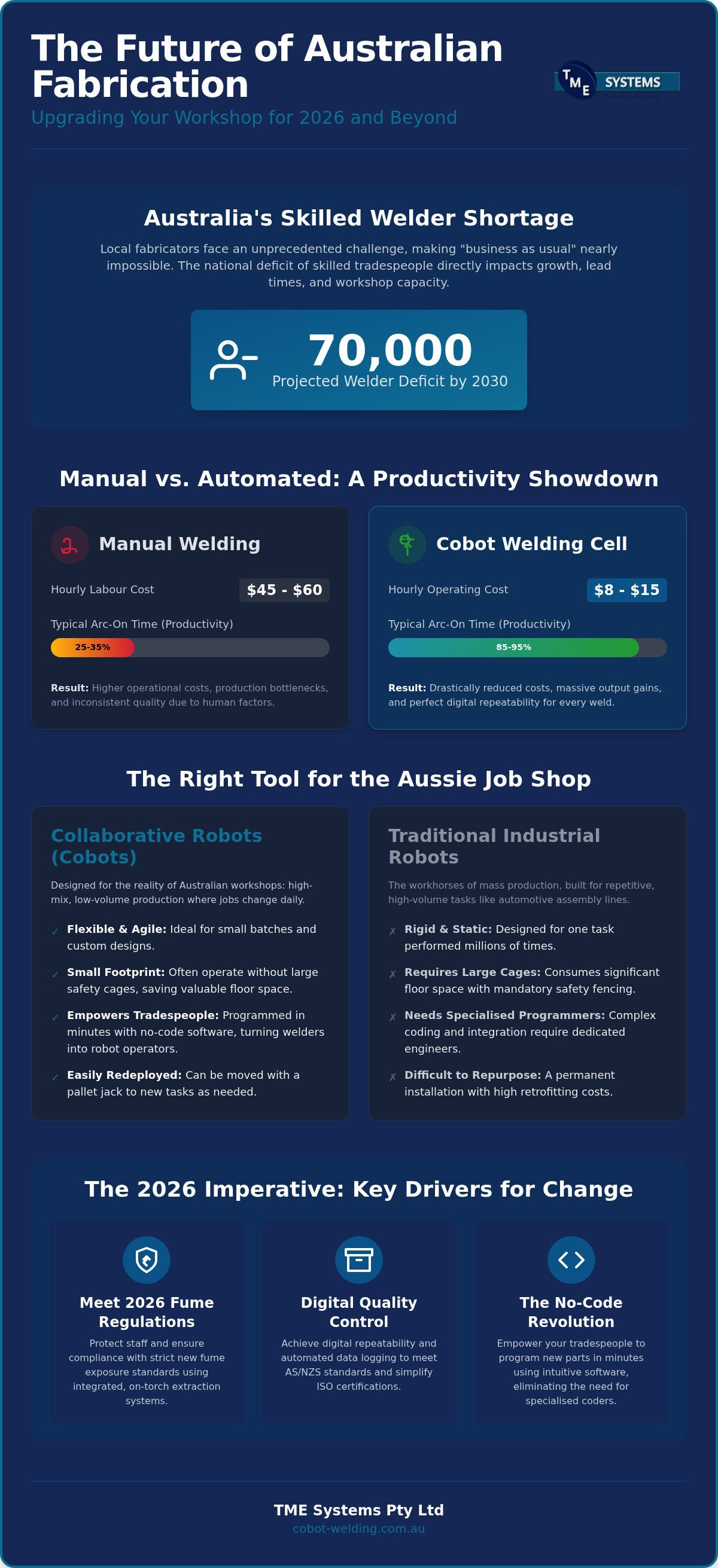

Australia is currently staring down a projected deficit of 70,000 welders by 2030, a figure that makes "business as usual" feel increasingly impossible for local fabricators. You probably know the frustration of turning away work or dealing with expensive rework on manual batch jobs because your best hands are stretched too thin. It's common to worry that a robotic welding workshop upgrade is too complex or only for the "big end of town," but the latest shift in technology is designed specifically for the reality of the Australian shop floor.
In this guide, you'll discover how to modernise your operations using collaborative robots and no-code software to boost your daily output without hiring a single programmer. We'll walk through the practical steps of integrating these systems to ensure consistent quality that passes inspection every time. You'll also learn how these tools help your business stay ahead of the strict new 2026 fume exposure regulations while creating a modern work environment that actually attracts the next generation of apprentices. By treating automation as a tool for the tradesperson rather than a replacement, you can transform your workshop's productivity and long-term viability.
Key Takeaways
- Learn how to address the national skilled welder shortage by empowering your current tradespeople to manage automated systems.
- Understand why collaborative robots are often a better fit for high-mix, low-volume Australian workshops than traditional industrial robots.
- Discover how a robotic welding workshop upgrade using no-code software allows you to program new parts in minutes without specialised coding skills.
- Follow a practical roadmap for assessing your floor space, power requirements, and compliance with the latest 2026 fume extraction standards.
- Find out how to verify your return on investment through on-site mobile demos that prove the technology works with your specific production parts.
Why 2026 is the Year for a Robotic Welding Workshop Upgrade
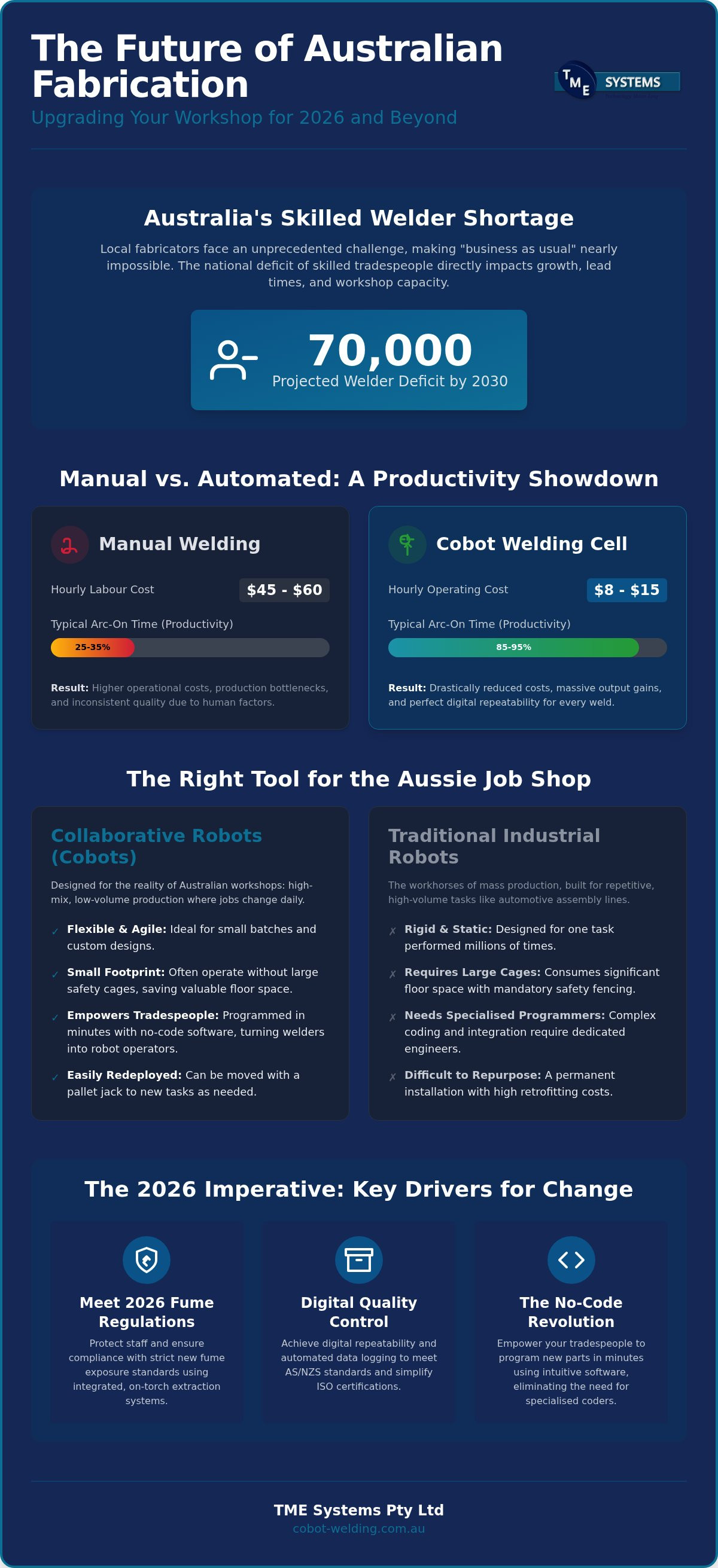
The pressure on Australian workshops has reached a tipping point. With a projected deficit of 70,000 welders nationwide by 2030, finding and keeping skilled staff isn't just a challenge; it's a bottleneck for growth. Many local businesses are finding that manual labour costs, often ranging between $45 and $60 per hour, make it difficult to maintain margins while competing with overseas imports. This is why a robotic welding workshop upgrade has shifted from a luxury to a strategic necessity in 2026.
The concept of Robot welding has been around for decades, but the barrier to entry has finally dropped for small to medium enterprises (SMEs). We're seeing a massive move away from rigid production lines toward "mass customisation." Customers now want smaller batches and bespoke designs delivered yesterday. Collaborative robots, or cobots, provide the flexibility to handle these high-mix jobs without the massive footprint or complex safety cages required by traditional industrial arms. They act as a tool for your existing team, not a replacement for their expertise.
The Cost of Doing Nothing: Manual vs Automated
Relying solely on manual processes often hides the true cost of production. Think about the time spent on grinding back messy welds or the scrap metal wasted when a part doesn't pass inspection. By improving welding productivity with cobots, you're not just speeding up the process. You're ensuring that every pass is identical. While a manual welder might achieve 25-35% arc-on time, a well-integrated cobot cell can push that toward 85-95%. When you consider the hourly operating cost of a robotic cell is between $8 and $15, the impact on your bottom line is immediate.
Meeting Australian Quality Standards in 2026
Quality control is becoming more rigorous across the country. In 2026, many government and commercial contracts require detailed data logging to prove every joint meets AS/NZS 4024.1 and related structural standards. A robotic welding workshop upgrade allows for digital repeatability that manual records simply can't match. This level of precision makes achieving ISO certifications more straightforward. It also helps your workshop stay ahead of the strict new 2026 fume exposure regulations, as automated cells can be more easily fitted with integrated, on-torch extraction systems to protect your staff and maintain compliance.
Cobots vs Industrial Robots: Choosing the Right Gear
Deciding on the right hardware for your robotic welding workshop upgrade depends entirely on your production mix. Traditional industrial robots are the workhorses of the automotive world, built for high-speed, high-volume repetition inside large safety cages. However, for most Australian job shops handling small batches of structural steel or custom sheet metal, these rigid systems often create more hurdles than they clear. They require significant floor space and specialised programmers, which doesn't always suit a fast-paced local environment where jobs change daily.
Collaborative robots, or cobots, represent a shift in how we think about automation. Instead of replacing the tradesperson, they act as a high-precision tool that supports them. This distinction is vital for SMEs that need to stay agile while maintaining the high quality expected in the Australian market.
The Collaborative Advantage for Local Shops
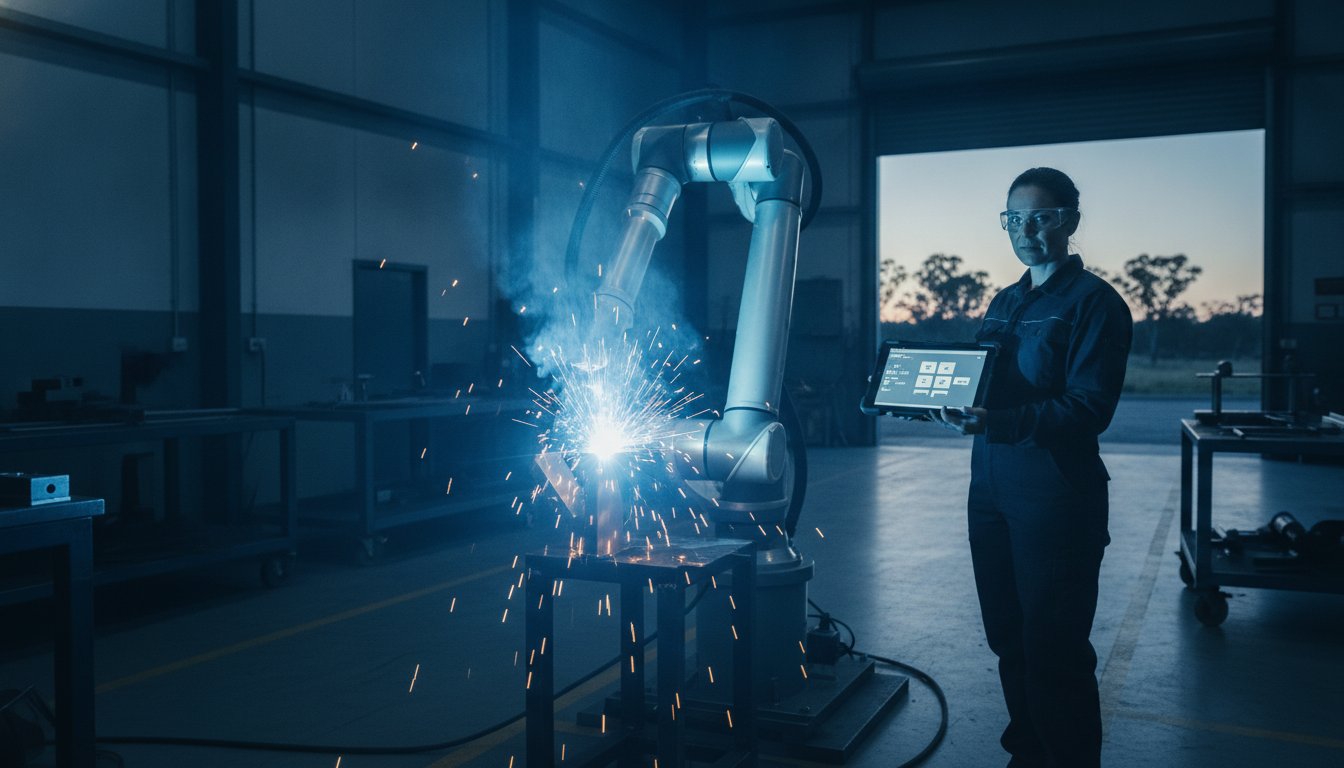
Collaborative robots are designed to work safely alongside your team. Because they feature force-limiting technology and advanced safety sensors, they can often operate without the bulky fencing that eats up valuable workshop real estate. This "fenceless" setup makes collaborative robot welding cells easy to integrate into existing work centres. If your production needs change, these units are typically light enough to be moved with a pallet jack and redeployed elsewhere in the shop within hours.
When considering a cobot, payload and reach are your primary metrics. Most Australian structural work involves heavy torches and long weld paths, so you'll want a system that doesn't sacrifice stability for flexibility. Training your existing staff is also a key part of the transition. Referencing international standards like the robotic arc welding personnel qualification can help you benchmark the skills your team needs to develop as they move from manual welding to managing these automated tools.
When to Stick with Traditional Industrial Robots
While cobots are the accessible entry point for many, traditional industrial robots still lead in specific scenarios. If your workshop handles thousands of identical parts every month, the higher travel speeds and heavier payloads of an industrial arm may offer a better long-term result. These systems generally involve a higher initial capital expenditure and more complex installation. They're best suited for static, high-output tasks where the robot can be locked away in a dedicated cell.
Before signing a purchase order, it's vital to conduct a thorough needs analysis. Are you looking for raw speed, or do you need the ability to swap between different jobs three times a shift? Most fabricators find that the versatility of a cobot provides a faster path to a successful robotic welding workshop upgrade because it adapts to the welder. If you aren't sure which path fits your floor, you can always explore our range of collaborative solutions to see how they handle real-world fabrication tasks.
The No-Code Revolution: Simplifying Workshop Automation
The biggest hurdle for any Australian shop considering a robotic welding workshop upgrade isn't the cost of the arm; it's the fear of the code. Traditional industrial systems required a specialised programmer to spend hours, or even days, punching syntax into a clunky teach pendant. In a high-mix job shop, that downtime kills your margins. No-code teaching changes this by moving the logic into an intuitive, visual interface that looks more like a tablet app than a computer terminal.
Instead of typing lines of command, your welders can simply "hand-guide" the robot. By physically moving the arm to the start and end points of a joint, the operator teaches the path in seconds. This allows no-code robot welding software to capture the tradesperson's intent and convert it into precise machine movements. It keeps the focus on the weld quality rather than the software syntax. It's about making the technology work for the welder, not the other way around.
From Blueprints to Welds Without a Programmer
Modern no-code interfaces handle the heavy lifting of complex parameters automatically. Whether you need to adjust the weave pattern for a heavy structural joint or set a specific offset for thin sheet metal, the software suggests the best settings based on the material. You can store these settings as "recipes." When a recurring small-batch job comes back into the shop six months later, you simply recall the recipe and start welding. This drastically reduces the "first-off" part time because you aren't starting from scratch. Digital simulation also lets you check for torch collisions on screen before the arm even moves; this saves your gear from expensive mistakes and gives the operator confidence during the first run.
Future-Proofing Your Software Stack
Your workshop needs to stay current as welding technology evolves. Modern systems use over-the-air updates to add new welding modes or improve path-planning algorithms without a technician visiting your site. These platforms also integrate with your office CAD/CAM workflows, allowing your drafting team to send part geometries directly to the workshop floor to streamline production. No-code software is the bridge between trade skill and digital precision.
Planning Your Integration: A Step-by-Step Workshop Roadmap
A successful robotic welding workshop upgrade doesn't happen by accident. It requires a methodical approach that balances technical readiness with team buy-in. Transitioning from a purely manual shop to an automated one is a journey, and the most successful Australian fabricators follow a clear roadmap to ensure their investment pays off quickly.
Step 1: Identify the low-hanging fruit. Don't start with your most complex, bespoke project. Look for repetitive parts with long weld runs or high-volume batches. These offer the quickest wins and provide a clear proof of concept for your team. Step 2: Audit your shop floor. Check that you have the required 3-phase power near the proposed cell location and measure the available floor space. While cobots are compact, they still need room for the operator and efficient material flow. You must also ensure your fume extraction meets the strict 2026 standards mentioned earlier. Step 3: Partner with specialists. Working with cobot welding integration experts ensures your power source, wire feeder, and robot communicate perfectly from day one. Step 4: The Go-Live. Plan your installation to minimise disruption. A turnkey cell can often be deployed and running within a single shift if the site is prepared correctly.
Preparing the Factory Floor
Automation thrives on consistency. If your parts vary by several millimetres because of poor upstream cutting, the robot will struggle to maintain quality. You need to standardise your jigs and fixtures to ensure repeatability. Modular welding tables are a massive advantage here; they allow you to set up precise, repeatable clamping positions that can be swapped out quickly for different jobs. This level of organisation ensures that when the robot starts its cycle, the part is exactly where the software expects it to be.
Upskilling Your Team: The Training Phase
The human element is often the most overlooked part of an upgrade. It's natural for senior tradespeople to feel some anxiety about the machine replacing their hard-earned skills. Address this early by framing the cobot as a tool that takes away the dull and repetitive work, leaving the high-skill tasks for the human welder. This is why on-site cobot welder training is critical for your ROI. By identifying an "Automation Champion"—a team member keen to learn and mentor others—you create an internal leader who can drive the transition. Ready to see how this fits your shop? Contact our integration team to discuss your specific workshop layout and production goals.
Maximising ROI: Proof of Concept with TME Systems Pty Ltd
Calculating the real return on a robotic welding workshop upgrade goes beyond comparing hourly labour rates. To see the true impact on your bottom line, you must account for the total cost of production, including the thousands of dollars currently lost to weld spatter, over-welding, and the secondary grinding required on manual jobs. While we have already touched on the productivity gains of increased arc-on time, the financial advantage of TME Systems Pty Ltd technology lies in its ability to produce "first-time-right" components. This precision significantly lowers your cost per part and allows you to bid more competitively on larger structural and sheet metal contracts.
The "Mobile Demo System" offered by TME Systems Pty Ltd serves as the ultimate de-risking tool for Australian fabricators. Instead of making a significant capital investment based on a brochure or a video, you can see the collaborative robot weld your actual production parts on your own workshop floor. This hands-on session allows your team to interact with the no-code software and verify that the system handles your specific material thicknesses and joint geometries. It provides a clear, documented proof of concept that justifies the upgrade to stakeholders before any long-term commitment is made.
The TME Systems Pty Ltd Support Ecosystem
A successful upgrade is defined by its long-term reliability, not just the first day of operation. TME Systems Pty Ltd provides a national support network designed to keep your cells running at peak performance. This ecosystem includes scheduled preventative maintenance and priority technical support to ensure your production schedules remain on track. As an active partner in your workshop’s growth, TME Systems Pty Ltd also provides your team with ongoing access to updated welding libraries and new software features, ensuring your technology remains current as fabrication standards evolve.
Take the First Step Toward a Modern Workshop
Transitioning to automation is most effective when you adopt a "crawl, walk, run" strategy. Start by identifying a single high-repetition part and let the technology prove its worth. As your tradespeople gain confidence with the intuitive controls, you can gradually expand the robot’s duties to more complex assemblies. This measured approach protects your cash flow and ensures your staff feels supported throughout the transition. A robotic welding workshop upgrade is the most practical way to future-proof your business against labour shortages and rising operational costs.
Ready to see the results for yourself? Book a mobile welding robot demonstration today and let TME Systems Pty Ltd show you how collaborative automation can transform your production line.
Take Command of Your Workshop's Future
The shift toward automation doesn't have to mean losing the trade skills that built your business. By choosing a robotic welding workshop upgrade focused on collaborative technology, you're giving your team a tool that enhances their expertise rather than replacing it. We've seen how no-code software keeps your experienced welders in the driver's seat, while turnkey integration ensures you meet the strict 2026 safety and fume standards without the typical headaches of complex programming.
The best way to de-risk this transition is to see the results on your own floor. Our mobile demo system brings the technology directly to you, allowing you to test your specific parts and get real-world answers from our specialised Australian support team. It's about making innovation feel attainable and practical for every local fabricator. Book your on-site Mobile Welding Robot Demonstration here to see the difference for yourself. Your workshop is ready for the next level; let's get to work.
Frequently Asked Questions
How much does a robotic welding workshop upgrade typically cost in Australia?
The cost of a robotic welding workshop upgrade varies significantly depending on the reach, payload, and the specific welding processes you need to automate. While industry prices for hardware range from entry-level MIG setups to high-specification gantry systems, the total investment also includes integration and training. We recommend a site-specific assessment to determine the most cost-effective configuration for your production volume and workshop layout.
Do I need to hire a robot programmer to run a cobot welder?
No, you don't need to hire a specialist programmer to manage a collaborative system. Modern no-code teaching software is designed so that your existing tradespeople can hand-guide the robot and set weld paths in minutes. This approach eliminates the need for complex coding knowledge and keeps the control of the weld quality in the hands of your most experienced fabricators.
Will a robotic welding cell fit in a small workshop with limited space?
Yes, collaborative robots are specifically designed for workshops where floor space is at a premium. Unlike traditional industrial robots that require large, permanent safety cages, cobots have a compact footprint and can often operate in fenceless environments after a proper risk assessment. This makes them an ideal choice for a robotic welding workshop upgrade in smaller Australian job shops.
Can a cobot welder handle both MIG and TIG welding applications?
Collaborative systems are highly versatile and can be integrated with power sources for both MIG and TIG welding. While MIG is common for high-speed structural work, TIG integration is increasingly popular for precision stainless or aluminium jobs. The flexibility of the robotic arm allows it to maintain the consistent torch angles and travel speeds required for high-quality, repeatable TIG passes.
What is the typical ROI period for a collaborative welding cell?
Most Australian fabricators see a full return on investment within 12 to 24 months. This rapid return is driven by a dramatic increase in arc-on time, which typically jumps from around 30% with manual welding to over 85% with a robotic system. When you factor in the reduction in rework and the ability to run longer shifts without fatigue, the payback period remains remarkably consistent.
How long does it take to train a manual welder to use no-code software?
Most experienced welders can learn the basics of no-code programming within a few hours. Because the interface is visual and intuitive, the learning curve is much shorter than traditional robotic systems. A day or two of hands-on training is usually enough for a tradesperson to feel confident setting up new parts and managing the cell's daily production independently.
Does the robot work with my existing welding power source?
In many cases, yes. While turnkey cells often come with a dedicated power source, integration specialists can often adapt the robot to work with your current high-end welding equipment. This can help lower the initial cost of your upgrade by utilising assets you already have on the floor, provided they are compatible with modern digital communication standards.
What safety standards must a robotic welding workshop upgrade meet in Australia?
All robotic installations in Australia must comply with the AS/NZS 4024.1 safety standard for machinery. This standard is a critical part of the national Work Health and Safety framework and is used by regulators to assess workshop safety. It's important to remember that compliance is the responsibility of the workshop owner, so working with an experienced integrator is vital to ensure the entire cell meets legal requirements.