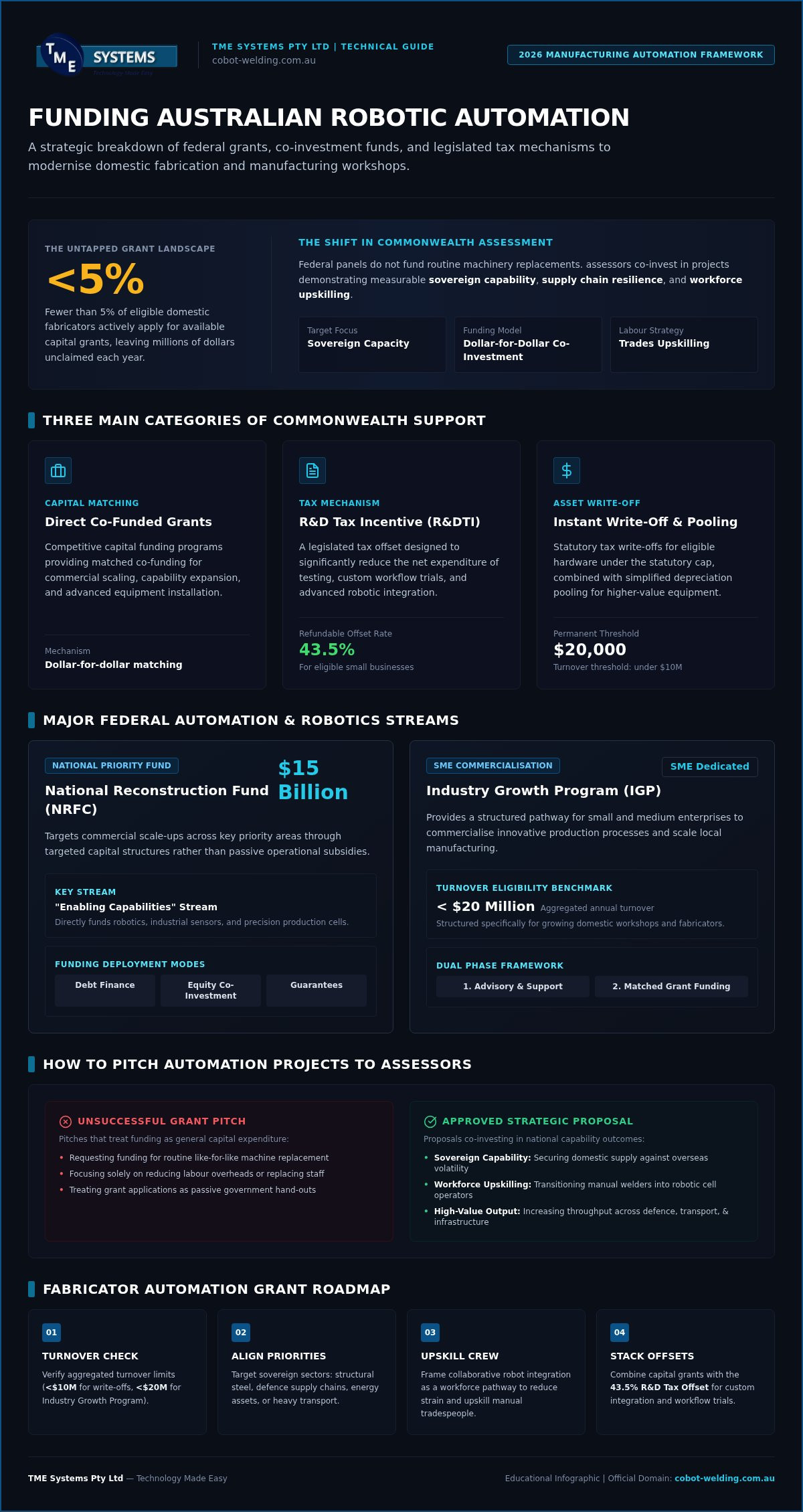

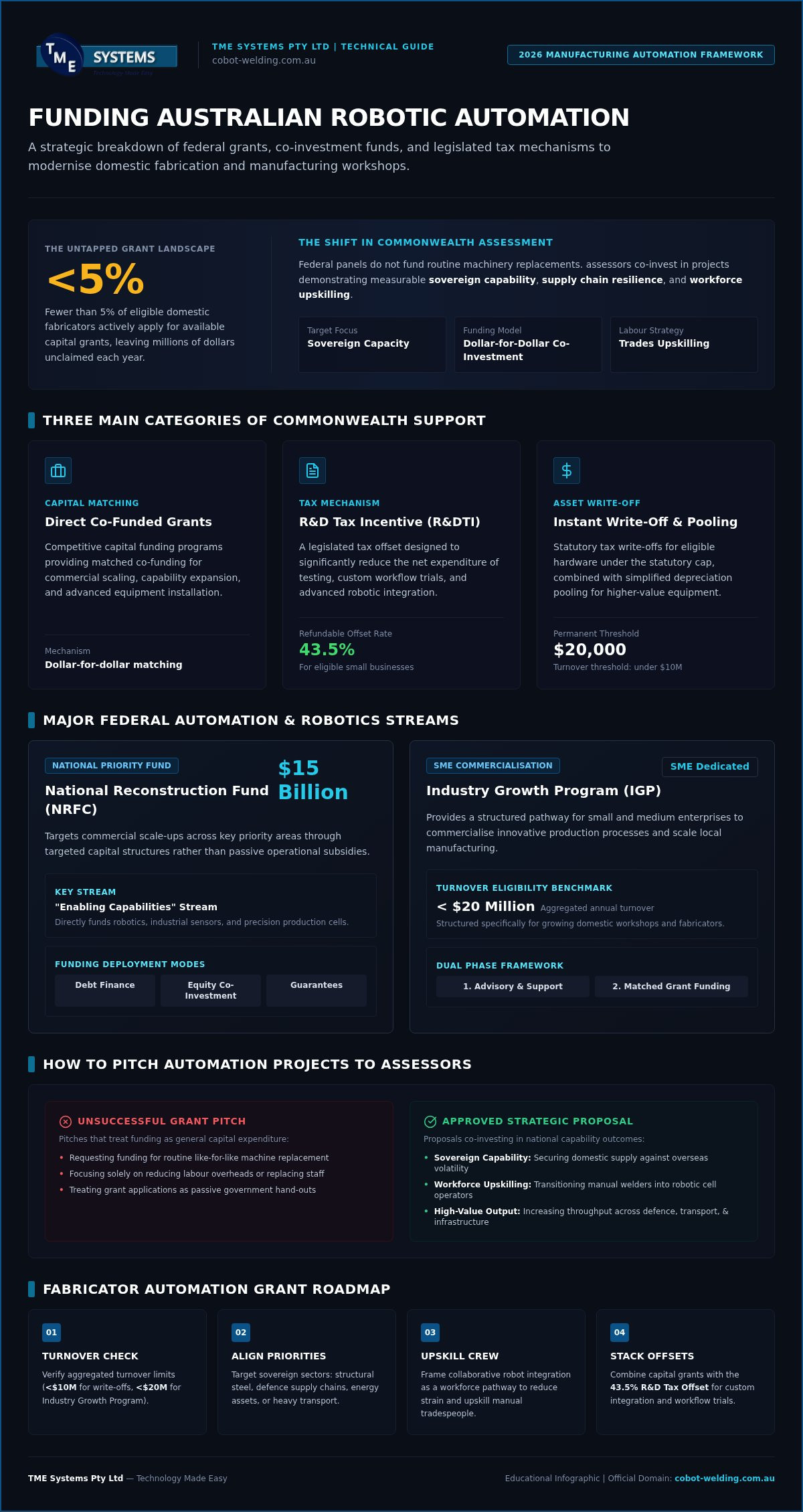
Fewer than 5% of eligible domestic fabricators actively apply for capital grants, leaving millions of dollars unclaimed each year. While securing government incentives for manufacturing automation Australia offers can feel like wading through bureaucratic red tape, the real hurdle is usually how the project is pitched. Federal assessors don't fund hardware simply to replace older machinery; they co-invest in measurable sovereign capability, domestic supply chain resilience, and workforce upskilling.
When running a busy workshop during tight economic conditions, you don't have thirty spare hours to decipher department jargon or guess whether a turnkey robotic cell qualifies for capital co-funding. You know automation protects margins and helps your tradespeople do their best work, but upfront capital expenditure remains a genuine hurdle. This guide outlines how Australian fabricators can access federal grants, commercialisation programs, and legislated tax write-offs to fund smart automation. We'll examine current 2026 co-funding ratios, clarify eligibility thresholds, and share a repeatable framework to justify your investment to grant assessors.
Key Takeaways
- Explore how current government incentives for manufacturing automation Australia provides target sovereign capability, productivity gains, and workforce resilience rather than routine machinery swaps.
- Unpack major national initiatives, including the National Reconstruction Fund and the Industry Growth Program, to identify matching capital streams for advanced robotics.
- Learn the critical eligibility benchmarks, technological readiness levels, and turnover caps needed to separate viable applications from automatic rejections.
- Discover practical methods to present automated welding cells and intuitive no-code tools as direct upskilling pathways for your existing workshop crew.
- Bridge the gap between grant approval and shop-floor return on investment by pairing modular hardware with local integration and tailored operator training.
Australian Manufacturing Automation Incentives Overview for 2026
Rising power tariffs, tight labour markets, and international supply disruptions continue to squeeze domestic fabricators. Historically, the evolution of manufacturing in Australia relied on tariffs and broad industrial subsidies, but modern Commonwealth funding targets high-tech, precision capabilities. Current government incentives for manufacturing automation Australia provides focus firmly on self-reliance, high-value output, and shop-floor productivity rather than underwriting business-as-usual expenses.
Federal programs aren't set up as passive hand-outs. Instead, they operate as a co-investment framework designed to modernise workshop workflows across small-to-medium enterprises. When fabricators combine competitive grants, debt facilities, and legislated tax write-offs, adopting advanced industrial automation becomes far more attainable.
The Strategic Shift Toward Sovereign Domestic Manufacturing
Recent policy initiatives prioritise sovereign capability. Government assessment panels actively favour capital projects that insulate domestic supply chains against overseas volatility. Deploying collaborative robot welding cells directly strengthens critical infrastructure, defence, transport, and structural steel fabrication by keeping production local.
Robotics also addresses ongoing trade shortages. Rather than sidelining skilled fabricators, modern systems empower existing welders to produce consistent, high-volume runs with less physical strain. Assessors look favourably on proposals that upskill manual trades into automation operators, turning labour constraints into measurable workforce growth.
Categories of Australian Government Support Available
Funding mechanisms generally fall into three distinct practical categories:
- Direct Co-Funded Capital Grants: Competitive programs that provide dollar-for-dollar funding for projects targeting commercial scaling, advanced equipment installation, and capability expansion.
- The Research and Development Tax Incentive (R&DTI): A 43.5% refundable tax offset for eligible small businesses, helping offset trial and integration costs for custom automation workflows.
- Instant Asset Write-Off and Simplified Depreciation: A permanent $20,000 threshold for businesses with turnover under $10 million, alongside small business depreciation pooling for capital equipment exceeding that cap.
Navigating these options requires understanding how each program functions. Tying your operational upgrade to broader economic objectives makes accessing government incentives for manufacturing automation Australia offers a transparent, practical process.
Major Federal Programs Supporting Industrial Automation and Robotics
Getting capital projects across the line requires choosing funding vehicles tailored to your workshop's growth stage. Commonwealth initiatives no longer distribute general subsidies. Instead, government incentives for manufacturing automation Australia provides focus on targeted matched grants, concessional co-investment, and statutory tax mechanisms designed to uplift domestic manufacturing capability.
National Reconstruction Fund and Advanced Manufacturing
The $15 billion National Reconstruction Fund Corporation (NRFC) targets commercial scale-ups across critical national priority areas. Under its "Enabling capabilities" stream, robotics, industrial sensors, and advanced production systems receive direct backing. Rather than offering traditional handouts, the NRFC deploys debt, equity, and guarantees for major plant expansions and supply chain infrastructure.
Fabricators scaling high-volume output across heavy transport, structural steel, or energy projects can leverage this support to integrate advanced collaborative robot welding cells into existing lines, securing production capacity without overextending internal reserves.
Industry Growth Program and Early-Stage Advisory
For small and medium enterprises with aggregated turnover under $20 million, the Industry Growth Program offers a practical pathway to commercialise innovative production processes. Applicants first complete an independent advisory service engagement before unlocking 50% matched cash funding.
Grant allocations range from $50,000 to $250,000 for early-stage commercialisation projects, and up to $5 million for broader commercial growth. This matched funding helps fabricators automate repetitive fabrication cycles, improve cycle consistency, and build sovereign manufacturing capability for demanding supply contracts.
R&D Tax Incentive and Equipment Depreciation Mechanisms
Workshops developing custom jigs, novel sensor integrations, or proprietary automation workflows can access the Research and Development Tax Incentive (R&DTI). For businesses under the $20 million turnover threshold, the scheme provides a 43.5% refundable tax offset for eligible experimental development expenditure.
Alongside R&D offsets, the permanent $20,000 instant asset write-off and small business depreciation pools help manage balance sheets when acquiring hardware. Always verify specific deduction thresholds with a registered tax agent. If you're assessing how automated systems perform before applying for capital funding, running an on-site trial through a mobile demo system helps validate cycle times and weld quality directly on your own workshop floor.
Assessing Capital Equipment Eligibility and Co-Funding Criteria
Securing capital support requires meeting strict administrative and technical benchmarks before submitting an application. While many workshops assume any machinery purchase qualifies, assessors screen out generic equipment upgrades immediately. Knowing how program guidelines define eligible expenditure ensures your application for government incentives for manufacturing automation Australia provides stands on solid commercial ground.
Core Business and Technical Eligibility Rules
Applicants must be trading Australian entities registered for GST with a proven operating history. Financial solvency is non-negotiable; you need to demonstrate the balance-sheet strength to fund your matched share of the project.
Technical maturity matters just as much. For major deployment grants and co-investment models like the National Reconstruction Fund Corporation, projects must involve proven commercial technology at a high Technology Readiness Level (TRL 7 or above). Funding bodies rarely back unproven experimental prototypes in standard capital expansion streams. Assessors expect reliable, turnkey solutions that deliver immediate production improvements.
Distinguishing Eligible Capital Costs from Operating Expenses
Grant budgets require clear separation between capital assets and ordinary running overheads. Blurring these lines leads to immediate budget cuts during review.
- Eligible Capital Expenditure: Procuring robotic hardware, power sources, specialised positioners, initial freight, mechanical commissioning, and safety fencing. Software licenses required to program the system also qualify.
- Ineligible Operating Costs: Day-to-day workshop rent, routine maintenance, electricity consumption, and standard wages for existing tradespeople doing business-as-usual work.
- Eligible Labour Adjustments: Time allocated by technical personnel specifically for initial system integration or specialised staff onboarding can often be claimed when properly documented.
Navigating Matched Funding and Cash Flow Requirements
Most competitive programs operate on a strict 50% matched cash basis. In-kind contributions, such as donating workshop space or unbilled internal hours, cannot replace your cash commitment. If a modernisation project totals $300,000, your business must supply $150,000 in unencumbered private cash reserves or approved commercial lending.
Grant funding is paid in arrears against verified operational milestones. You must procure, install, and commission the equipment before submitting paid invoices for reimbursement. Managing short-term working capital or securing bridging facilities ensures your project progresses smoothly without disrupting routine workshop cash flow.
Building a Strong Business Case for Automation Grants
Assessors evaluate hundreds of grant submissions, but technical specifications alone won't secure capital funding. Committees want to see a compelling commercial narrative that proves a clear public return on co-investment. When targeting government incentives for manufacturing automation Australia provides, your application must articulate how modern technology solves operational bottlenecks while lifting staff capability and domestic resilience.
Demonstrating Measurable Productivity and Quality Uplift
Focus on concrete shop-floor metrics. Clearly define current throughput constraints, such as structural joint cycle delays or excessive manual grinding. Explaining how improving welding productivity with cobots stabilises deposition rates and slashes rework provides assessors with the hard data they require.
- Throughput baselines: Detail current arc-on percentage versus projected automated production cycles.
- Rework reduction: Quantify expected reductions in weld defects, spatter, and post-weld cleanup labour.
- Consumable savings: Measure scrap reductions achieved through consistent travel speeds and optimal heat input.
Addressing Workforce Retention and Human-Centric Upskilling
Federal panels routinely reject proposals that suggest displacing local jobs. Frame automation as a human-centric tool designed to keep qualified tradespeople safe and productive. Robotic cells remove welders from repetitive strain, intense arc radiation, and toxic weld fumes.
Highlighting structured on-site cobot welder training proves you are upgrading workforce skills. By using intuitive no-code teaching software, your existing boilermakers and apprentices can hand-guide the torch or program complex weld paths without writing code or hiring dedicated software engineers.
Quantifying Sovereign Capability and Domestic Economic Impact
Connect your project directly to national capability priorities. Show how automated throughput enables your workshop to compete against cheap imports and retain domestic fabrication contracts. Quantify the ripple effects across domestic supply chains, from increased local steel procurement to partnering with local engineering suppliers.
A credible application also features a tight risk mitigation plan covering installation, safety guarding, and operator onboarding. To build an airtight submission that leverages government incentives for manufacturing automation Australia provides, speak with our technical team to benchmark realistic project metrics before you apply.
Maximising Investment Returns with Local Integration and Training
Securing grant approval provides welcome relief for capital budgets, but the real return on investment happens on the workshop floor. Installing automated equipment without adequate integration or staff buy-in risks leaving valuable machinery underutilised. To truly capitalise on government incentives for manufacturing automation Australia provides, fabricators must bridge the gap between capital approval and daily production through local engineering, hands-on training, and thorough operational de-risking.
De-Risking Capital Proposals Through Pre-Purchase Trials
Guessing cycle times or weld quality introduces unnecessary risk to both your project budget and your grant proposal. Assessors favour applications supported by empirical shop-floor data rather than speculative claims. You can arrange a mobile welding robot demonstration to trial automation on your actual production parts. Capturing real weld data, cycle durations, and deposition rates prior to procurement builds an unshakeable justification for capital assessors while confirming the system fits your existing workshop floor.
Professional Integration and Australian Standards Compliance
A robotic cell is only as dependable as the physical setup supporting it. Seamless deployment requires welding system integration that ties mechanical fixtures, power sources, and safety interlocking into a unified workstation. Aligning cell safety with AS/NZS machinery safety standards protects both operators and workshop compliance records. Partnering with experienced local specialists ensures your tooling communicates cleanly with power sources, avoiding costly troubleshooting delays and maintaining steady arc-on time.
Next Steps: Evaluating Your Automation Business Case
Transforming grant opportunities into operational capability starts with a clear, methodical plan:
- Audit production bottlenecks: Pinpoint sub-assemblies with repetitive welding passes where collaborative cells can relieve skilled tradespeople for complex custom fabrication.
- Validate hardware compatibility: Ensure proposed robotic packages interface smoothly with your current shop-floor tooling and power supplies.
- Engage qualified advisors: Review program funding schedules, assess cash flow requirements, and confirm capital depreciation treatment with your accountant.
Taking this structured approach ensures your workshop leverages government incentives for manufacturing automation Australia offers to achieve lasting commercial growth and sovereign manufacturing resilience.
Taking the Next Step Toward Modernising Your Workshop
Securing government incentives for manufacturing automation Australia offers isn't about chasing speculative funding; it's about backing your workshop with proven, productive tools. When you align capital investments with sovereign capability priorities, upskill your manual trades, and de-risk your deployment through empirical testing, grant assessors take notice.
Modern fabrication doesn't require dedicated software coders. With turnkey collaborative welding cells designed for Australian workshop conditions, accessible no-code teaching software lets tradespeople program repeatable passes in minutes. Backing that setup with an on-site mobile demonstration lets you verify cycle times and return on investment long before lodging paperwork.
Explore how collaborative robot welding systems streamline workshop operations and strengthen capital grant proposals. With the right integration partner and structured co-investment in place, modernising your workshop floor has never been more achievable.
Frequently Asked Questions
Can Australian manufacturing grants be used to purchase collaborative welding robots?
Yes, provided the equipment forms part of a broader capability upgrade rather than routine machine replacement. Programs supporting advanced manufacturing recognise collaborative robot welding cells as enabling technologies. Assessors evaluate how the system lifts throughput, addresses skilled labour constraints, or secures local supply contracts. When applying for government incentives for manufacturing automation Australia provides, framing the cobot as a tool to upskill tradespeople strengthens your case.
Do small fabrication workshops qualify for the National Reconstruction Fund?
Small workshops rarely qualify for direct NRFC investment due to its commercial ticket size. The fund typically deploys debt and equity structures starting at $5 million for large-scale industrial projects. Smaller fabricators achieve much better outcomes by targeting programs like the Industry Growth Program. These tailored schemes offer matched grants from $50,000 to $5 million specifically for businesses with annual turnover under $20 million modernising their production lines.
What is the standard co-funding ratio required for Australian manufacturing grants?
Most federal manufacturing grants require a 50% matched cash contribution from the applicant. For every dollar the government commits, your business must invest an equivalent dollar from unencumbered private cash reserves or approved finance facilities. Non-cash or in-kind contributions, such as internal labour or floor space, generally don't satisfy co-funding quotas. Maintaining adequate working capital ensures you can comfortably cover procurement milestones before claiming reimbursement in arrears.
Can I claim the R&D Tax Incentive for installing off-the-shelf automation machinery?
Standard installation of turnkey machinery doesn't qualify for the R&D Tax Incentive. The scheme requires eligible experimental activities aimed at generating new technical knowledge. However, developing novel custom end-effectors, proprietary sensor integration, or resolving unknown technical challenges during bespoke system configuration may qualify. Fabricators acquiring standard hardware should instead look at the permanent $20,000 instant asset write-off or small business depreciation pooling alongside registered tax counsel.
Are software licenses and operator training eligible expenses under federal grant programs?
Yes, software licensing and workforce training directly connected to commissioning automated systems are generally eligible. Program administrators actively encourage technology adoption paired with genuine skills development. Covering intuitive no-code teaching software and structured operator training within your project budget shows assessors that your tradespeople will operate the cell safely and proficiently, ensuring lasting productivity gains long after the capital installation phase finishes.
How long does the assessment process typically take for Australian automation grants?
Assessment timelines generally range from three to six months following the close of an application round. Two-stage initiatives, such as the Industry Growth Program, require completing an initial advisory engagement before submitting a matched funding application. Because grant agreements don't cover retrospective purchases, you must wait until formal approval is executed before placing equipment orders or paying deposits to maintain expenditure eligibility.
What evidence is needed to prove an automation project supports sovereign capability?
Proving sovereign capability requires demonstrating how automation keeps fabrication onshore and bolsters domestic supply chains. Strong submissions include supply contracts for critical infrastructure, letters of intent from local clients, or records of work previously lost to overseas competitors. Showing how government incentives for manufacturing automation Australia administers will increase domestic production throughput and protect local supply continuity gives assessment panels the verified strategic justification they expect.