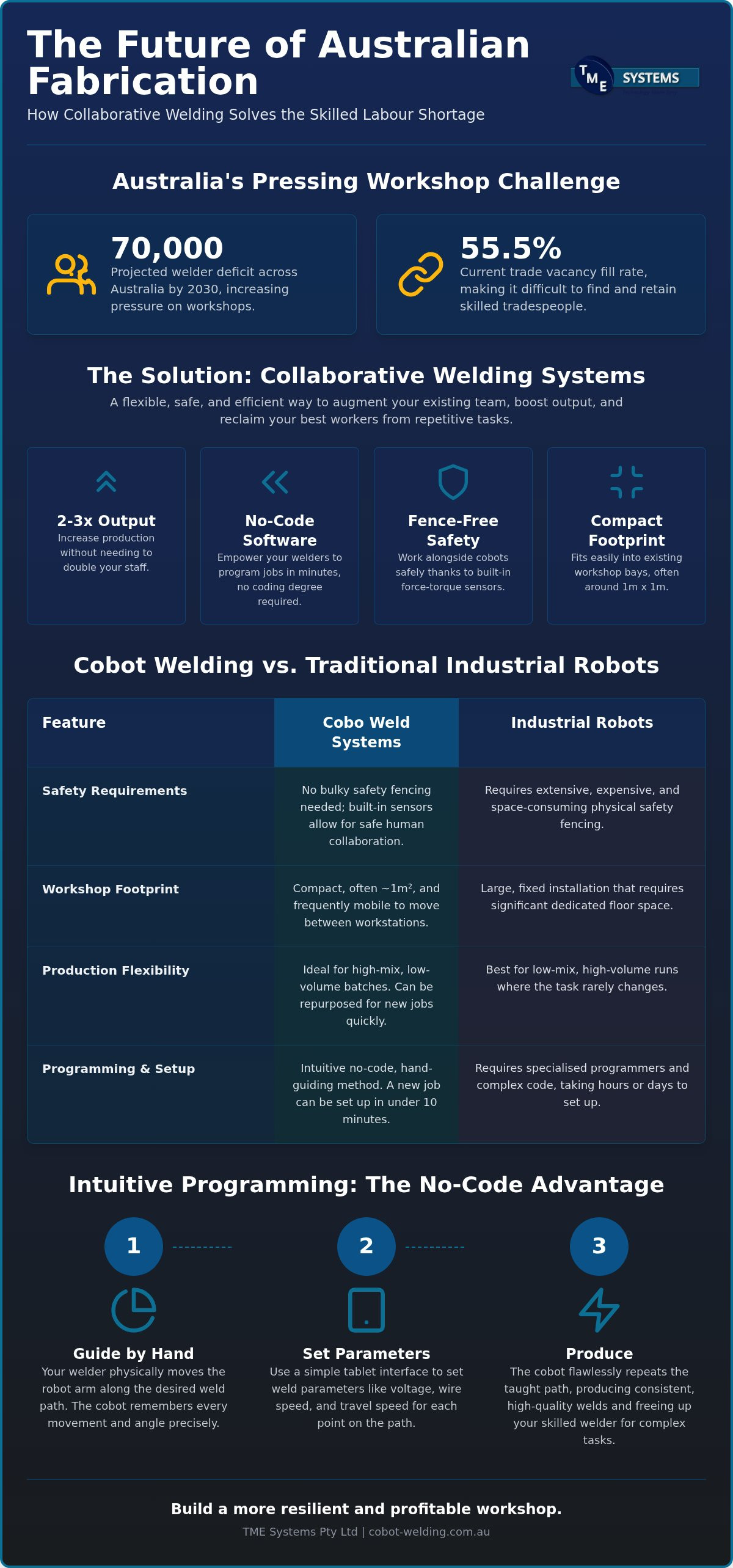

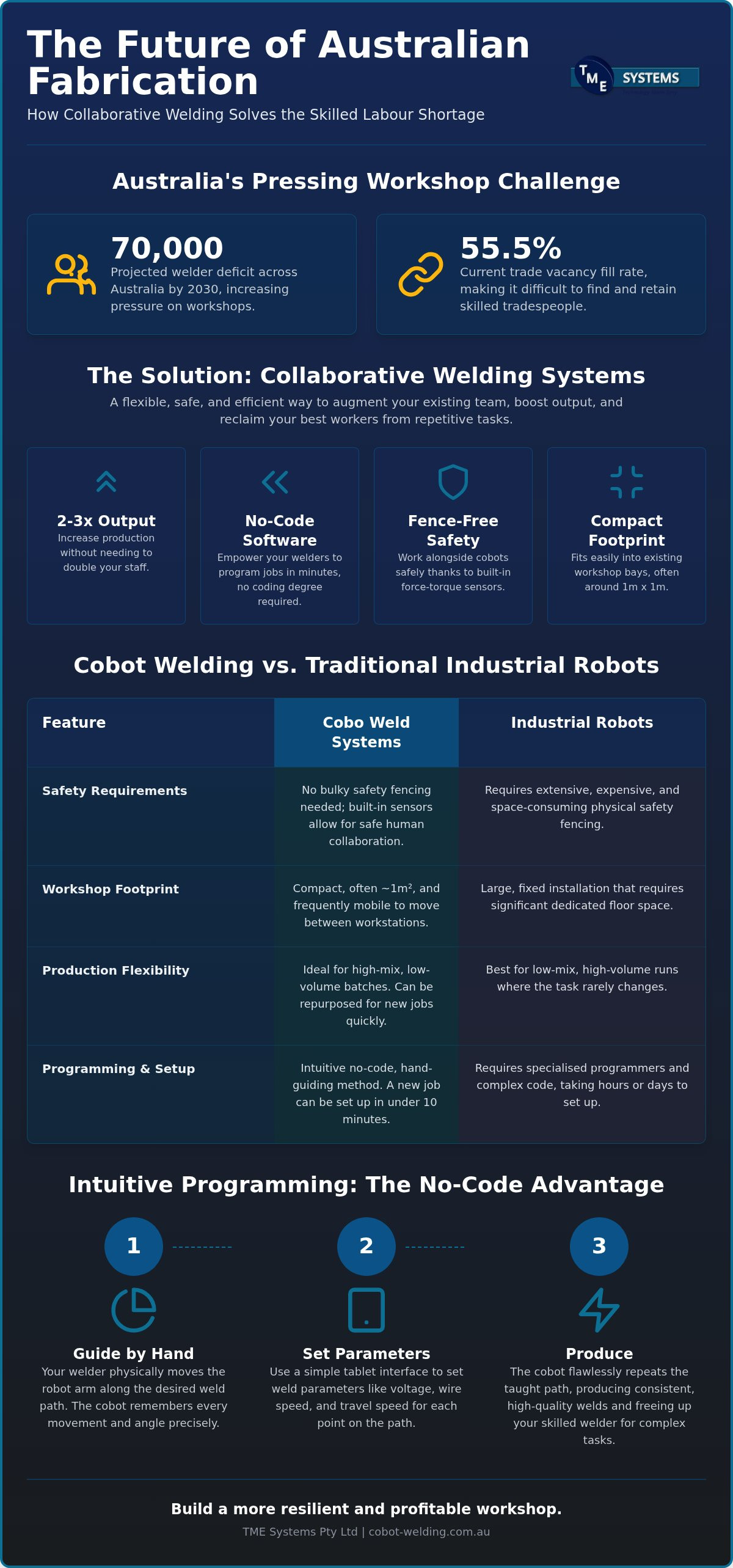
With a projected deficit of at least 70,000 welders across Australia by 2030, the pressure on your workshop floor has never been more intense. You’ve likely noticed that finding skilled tradespeople is getting harder, with trade vacancy fill rates currently sitting at a low 55.5 per cent. It’s a common frustration to see your best workers tied up with repetitive batch work when they could be tackling complex, high-value jobs. You want to grow. However, the fear of expensive, rigid automation that requires a degree in robotics often keeps the status quo in place. Integrating a cobo weld system shouldn't feel like a gamble; it should feel like adding a reliable, tireless partner to your team.
We understand that Australian fabricators need solutions that are practical, not just high-tech. This guide explores how collaborative welding automation allows you to increase production output by two or three times without sacrificing the craftsmanship your business is known for. We will show you how no-code teaching software removes the barrier of complex programming, making it easy for your current crew to set up new jobs in minutes. From meeting the latest AS/NZS ISO 21904 fume standards to maximising small floor spaces, you'll discover how to build a more resilient and profitable workshop for 2026.
Key Takeaways
- Understand how collaborative robots integrate with existing MIG or TIG power sources to work safely alongside your team without the need for bulky safety fencing.
- Learn how no-code software allows your current tradespeople to teach weld paths manually, eliminating the requirement for specialised programming knowledge.
- Discover why a compact cobo weld system is the most efficient choice for Australian workshops managing high-mix, low-volume production batches.
- Navigate the essential Australian safety standards and risk assessment requirements to ensure your new automation setup remains fully compliant in 2026.
- Identify how to scale your workshop output by two or three times through rapid operator onboarding and flexible integration strategies.
What is a Cobo Weld System and Why Does it Matter?
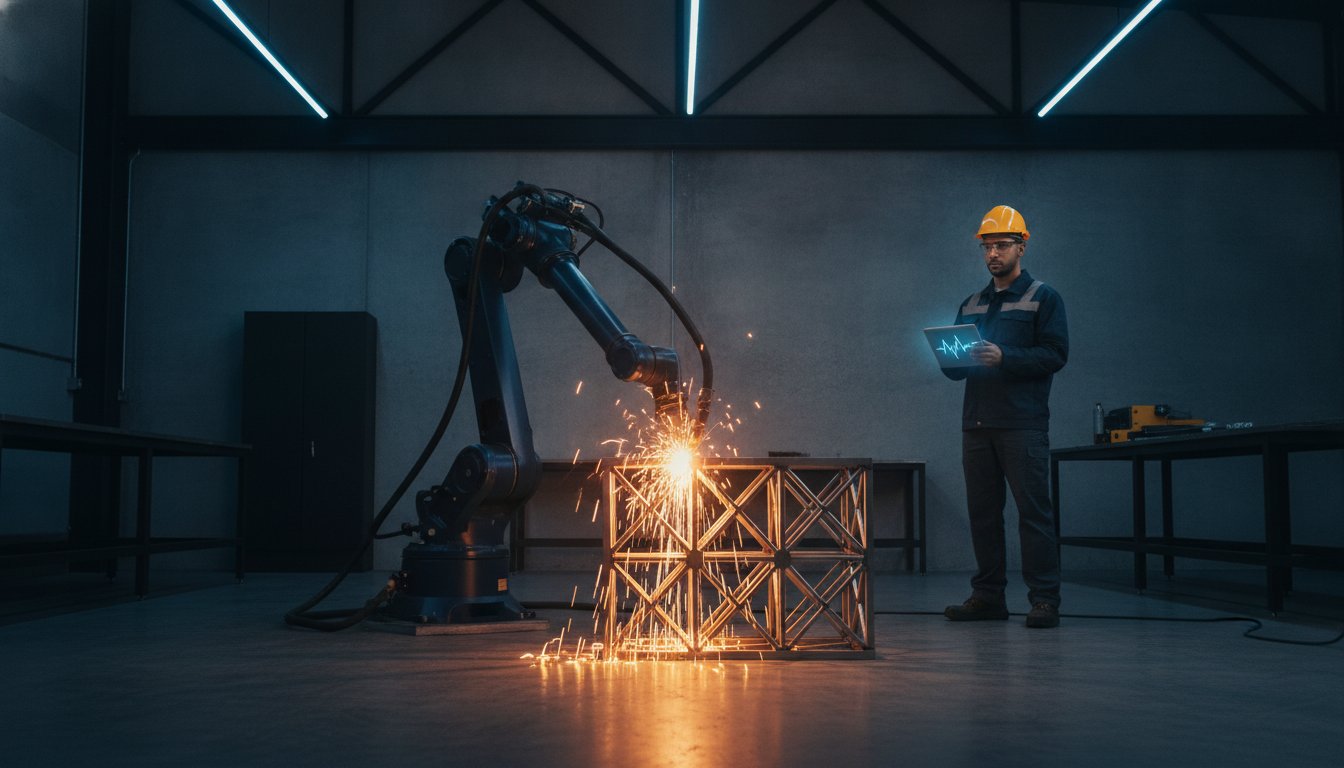
A cobo weld system is a collaborative robot, or "cobot," specifically integrated with a professional MIG or TIG welding power source. Unlike the heavy, high-speed robots found in automotive assembly lines, these systems are designed to work in close proximity to your team. They act as an extra set of hands that never tires, handling the repetitive, monotonous runs that often lead to fatigue or inconsistent quality. For Australian fabricators, this technology represents a shift from rigid automation to a flexible tool that supports the existing workforce.
The "collaborative" part of the name is the most important distinction. These units are equipped with sensitive force-torque sensors that detect any resistance. If a person or an object enters the robot's path, the system stops immediately. This built-in safety allows for a workspace without the bulky, expensive safety fencing required by traditional Robot welding cells. By removing these physical barriers, you can maintain a fluid workshop layout where humans and machines contribute to the same production goal safely.
Key Components of a Collaborative Welding Cell
The core of the system is the robotic arm, which provides the precision movement and reach needed to access various join types. It's paired with a dedicated welding package that includes the power source, wire feeder, and a specialised torch designed for robotic use. While the hardware handles the physical work, the software interface is the real brain of the operation. Modern systems use intuitive, no-code platforms that allow a skilled welder to guide the arm by hand, teaching it the required path without writing a single line of complex computer code.
The Shift from Industrial Robots to Cobots
For many years, automation was only viable for massive companies with huge budgets and plenty of floor space. Traditional industrial robots are often fixed in place and require significant infrastructure. In contrast, a cobo weld unit typically occupies a small footprint, often around 1m x 1m, fitting easily into existing workshop bays. This space-saving design is a game changer for local shops that need to increase capacity without moving to a larger facility.
Flexibility is another major advantage over older industrial models. These units are often mounted on mobile bases, allowing you to move the robot between different workstations as your project mix changes. When you consider the lower total cost of ownership and the ability to repurpose the system for new jobs in minutes, it's clear why this tech is becoming the standard for high-mix, low-volume Australian fabrication. It's a practical way to combat the local skills gap, helping you manage a projected deficit of 70,000 welders by 2030 while keeping your production lines moving.
The Power of No-Code Software in Collaborative Welding
The biggest hurdle for most Australian workshops isn't the cost of the hardware; it's the perceived complexity of the software. Traditional automation often requires a dedicated programmer to write thousands of lines of code. With a modern cobo weld system, that barrier is gone. No-code software allows your most experienced welders to take charge of the technology without needing a background in computer science. They already understand the weld pool, the travel speed, and the torch angle; the software simply gives them a way to communicate that expertise to the robot.
This transition is made possible through the 'Lead-Through' method. Instead of typing coordinates into a terminal, the operator manually moves the robot arm along the desired weld path. The robot remembers every twist and turn of the wrist. This intuitive approach means you can set up a new job or switch between different parts in under 10 minutes. It turns a complex technical task into a simple physical one, ensuring your production stays fluid even with high-mix, low-volume batches.
Teaching Robot Paths Without Coding
While some systems still offer a teach pendant for precise coordinate entry, most operators prefer hand-guiding the torch directly. It feels natural and allows for immediate feedback. You can set specific parameters like voltage and wire speed through a clean, visual interface on a tablet or screen. No-code robot welding software is a visual interface that translates human movement into precise machine instructions. This means your team spends less time troubleshooting scripts and more time producing high-quality components. If you're concerned about the transition, Implementing Cobot Welding: Safety and workspace preparation are vital steps to ensure your team feels confident from day one.
Adjusting Weld Parameters on the Fly
Every job is different, and the ability to fine-tune settings is essential for consistent results. You can easily adjust the weave pattern, travel speed, and torch angle to suit different material thicknesses or joint configurations. Once a job is perfected, the settings are saved as a 'weld recipe' that can be recalled instantly for future batches. No-code robot welding software is the key to this flexibility, allowing your workshop to remain agile. This empowerment shifts the role of the welder from manual labourer to a supervisor of a high-output cell. If you want to see how this works in a real workshop environment, you can book a mobile demo to experience the interface firsthand.
Cobo Weld vs. Industrial Robots: Which Suits Your Production?
Choosing the right level of automation depends entirely on your specific workflow. While traditional industrial robots are the workhorses of high-volume manufacturing, they often fall short in the typical Australian fabrication shop. These large-scale systems require massive upfront investment and months of bespoke engineering to integrate. In contrast, a cobo weld system is designed for agility. It occupies a compact 1m x 1m footprint, fitting into existing workshop bays where space is at a premium. Unlike fenced-off industrial cells, these units are turnkey solutions that can be operational in days rather than months.
The decision usually comes down to batch size. Industrial robots excel when you are welding thousands of identical parts. However, if your business manages high-mix, low-volume production, the time spent re-programming an industrial robot would kill your margins. This is where American Welding Society (AWS) data regarding the global trade shortage becomes relevant; as skilled labour becomes scarcer, shops must find ways to produce more with fewer people. A collaborative system augments your skilled tradespeople, allowing them to oversee the machine while it handles the repetitive runs, effectively doubling or tripling their individual output.
When to Stick with Manual Welding
There are still times when a human welder is the only choice. For one-off bespoke jobs or unique repairs, the time taken to set up even the simplest automation might exceed the actual weld time. Extremely complex geometries or tight internal joins often require the dexterity and real-time intuition that only a person can provide. We often suggest using manual welding as an initial proof of concept for new product lines. Once the design is finalised and you move into repeat production, that's the moment to look at a cobo weld solution.
When to Scale to a Collaborative Cell
It's time to scale when repetitive sub-assemblies start causing production bottlenecks. If your best welders are spending half their shift on simple bracketry or base plates, you are losing money on their expertise. Moving these tasks to collaborative robot welding cells ensures high consistency and reduces the time wasted on rework or grinding. By automating these "bread and butter" jobs, you free up your team to focus on the high-value, complex fabrication that keeps your business competitive in the local market.
Implementing Cobot Welding: Safety, Integration, and ROI
Successfully commissioning a cobo weld system in an Australian workshop requires a clear focus on safety and compliance. While these robots are designed to be collaborative, they must still align with ISO 10218-1/2 and ISO/TS 15066 standards. A common misconception is that "collaborative" means you can skip safety guarding entirely. In reality, while the robot itself is built to stop on contact, the welding torch and the hot metal parts pose their own risks. A thorough risk assessment is essential to determine if you need additional screens or light curtains to protect your crew from arc flash or heat.
Integrating this technology doesn't mean you have to scrap your current setup. Most systems are designed to work with your existing MIG or TIG power sources, acting as a bridge between manual skill and automated precision. When you calculate the return on investment, look beyond just labour costs. You'll see significant savings in gas and wire due to the machine's consistent travel speed and reduced rework. With typical payback periods ranging from 12 to 24 months, the financial case for a cobo weld solution is stronger than ever in 2026.
Ensuring Workshop Safety and Compliance
Modern systems rely on advanced collision detection and force-limiting features. If the arm touches an obstacle, it stops instantly to prevent injury. However, the application dictates the final safety requirements. For instance, welding heavy plate at high currents requires different protection than light gauge assembly. Working with welding system integration specialists ensures your cell meets all local requirements, including the 2026 national standards for fume extraction. They help you navigate the transition from workplace exposure standards to the updated workplace exposure limits effectively.
The Path to Productivity Gains
The real value of automation lies in reducing arc-off time. While the robot handles a repetitive weld, your operator can prep the next jig or perform quality checks on finished parts. This parallel workflow is how many local fabricators achieve a 2x increase in throughput within their first month of operation. It's about working smarter by refining your existing processes. To see how these changes can transform your workshop floor, you can Improve welding productivity with cobots through better workflow optimisation. If you're ready to see the gear in action, get in touch for a mobile demonstration at your site.
Scaling Your Workshop with TME Systems Solutions
Adopting automation is a significant step for any fabrication business, but it shouldn't be a journey you take alone. TME Systems Pty Ltd focuses on providing turnkey collaborative welding cells that are ready for rapid deployment across Australian workshops. These systems are designed to bridge the gap between traditional manual skills and modern production demands. By choosing a local partner, you gain access to integration specialists who understand the specific hurdles of the domestic market, from labour shortages to strict safety compliance. Our goal is to ensure that your investment in a cobo weld system delivers measurable results from the first week of operation.
Success with automation depends on how well the technology fits into your existing team's workflow. We don't just drop off a robot and leave you to figure it out. Our approach centres on long-term partnership, providing the technical support and training necessary to keep your production lines moving. Whether you need remote troubleshooting for a new weld recipe or on-site maintenance to keep your hardware in peak condition, TME Systems Pty Ltd provides a steady hand to guide your transition into automated fabrication.
Practical Training and Onboarding
The real power of no-code software is only realised when your team feels confident using it. We focus on building that internal confidence through on-site cobot welder training that is hands-on and grounded in workshop reality. Your welders will learn how to set up jobs, adjust parameters, and manage the cell independently. This empowerment ensures that the technology is seen as a tool for improvement rather than a replacement for their expertise. We offer various support levels to suit your needs, ensuring that help is always available as your workshop grows and your projects become more complex.
Booking Your On-Site Demonstration
It's one thing to read about automation, but it's another to see a cobo weld system running your specific parts. Our mobile demo system allows us to bring the technology directly to your floor for a practical proof of concept. This is the most effective way to identify which of your current sub-assemblies are the best candidates for automation. You'll be able to see the weld quality firsthand and get a realistic sense of the throughput gains you can expect. Don't leave your productivity to chance; Book a mobile welding robot demonstration today to see the ROI for yourself and start scaling your output with confidence.
Future-Proofing Your Fabrication Workshop
The landscape of Australian manufacturing is shifting toward smarter, more flexible tools. With the trade shortage tightening its grip, the transition to automation is no longer a luxury reserved for large-scale operations; it is a practical necessity for any shop looking to maintain its competitive edge. By integrating a cobo weld system, you aren't replacing the skill of your tradespeople. Instead, you are providing them with a tool that handles the repetitive heavy lifting, allowing your team to focus on the high-value work that requires human intuition and years of experience.
Success in 2026 comes down to flexibility and efficiency. No-code software and compact equipment footprints mean that even smaller workshops can now achieve consistent, high-quality results without hiring specialised programmers. TME Systems Pty Ltd provides national support and training, ensuring you have a local partner every step of the way. The most effective way to understand how this technology fits your specific production goals is to see it in action on your own workshop floor.
Book a Mobile Demonstration for Your Workshop today to see how accessible automation can transform your output. Let's build a more productive and resilient future for your business together.
Frequently Asked Questions
Is a Cobo Weld system hard to learn for an experienced welder?
A cobo weld system is specifically designed to be intuitive for experienced tradespeople who already understand weld pools and torch angles. Instead of learning complex programming, your welders use no-code software to hand-guide the robot through the required path. Most operators feel confident managing the cell after just a few hours of hands-on training. This approach ensures that your team's existing fabrication expertise remains the most important factor in your production quality.
What welding processes can be automated with a cobot?
Collaborative robots are highly versatile and can automate various processes including MIG (GMAW), TIG (GTAW), and even plasma cutting. The system integrates with professional-grade power sources to handle diverse materials like mild steel, stainless steel, and aluminium. Whether you are performing simple fillet welds or more complex multi-pass joins, the robot maintains consistent travel speeds and torch angles. This versatility makes it a practical solution for most general fabrication tasks found in Australian workshops.
Do I need a safety cage for a collaborative welding robot in Australia?
You do not always need a full safety cage; however, a formal risk assessment is mandatory under Australian standards. While the robot has built-in force-limiting sensors to prevent crush injuries, the welding process itself creates arc flash, heat, and fumes. Depending on your specific application, you might use transparent welding screens, light curtains, or area scanners instead of traditional heavy fencing. This flexibility allows the system to fit into tighter spaces while keeping your team safe.
How long does it take to set up a new welding job on the robot?
Setting up a new job typically takes less than 10 minutes once your team is familiar with the no-code interface. For recurring work, you can recall saved weld recipes instantly, reducing the setup time to just a few seconds for jig alignment. This rapid changeover capability is what makes collaborative automation viable for small batches. It ensures that the machine spends more time welding and less time sitting idle during production transitions.
Can a cobot handle TIG welding as well as MIG?
Yes, collaborative robots are excellent for TIG welding because they can maintain the precise arc length and steady travel speed required for high-quality finishes. The robot's precision is particularly useful for thin-gauge stainless steel or aluminium parts where manual consistency can be difficult to maintain over long shifts. By automating the torch movement, your skilled TIG welders can focus on the critical setup and parameter tuning rather than the physical strain of manual torch control.
What is the typical ROI for a collaborative welding cell in a small shop?
Most Australian fabricators see a full return on investment within 12 to 24 months, though high-utilisation shops often achieve this sooner. The ROI for a cobo weld cell comes from a combination of factors, including a two to three times increase in throughput and significant reductions in wire and gas waste. You also save on hidden costs like rework and post-weld grinding. By freeing up your best welders for complex jobs, you increase workshop earning potential.
Do I need to hire a robot programmer to run these systems?
You do not need to hire a specialised programmer or a computer scientist to operate a collaborative welding cell. The no-code software is designed to be managed by your existing welding staff after a short onboarding period. This removes the overhead costs associated with traditional industrial automation and ensures that your workshop remains self-sufficient. Your current team becomes cobot operators, using their trade knowledge to refine the robot's performance without ever typing a line of code.
Can the cobot be moved between different welding bays?
Yes, one of the primary benefits of this technology is its mobility. Most collaborative welding cells are mounted on heavy-duty casters or integrated into compact, portable skids that can be moved with a pallet jack. This allows you to shift the unit between different bays as your production requirements change. Because the system has a small footprint and doesn't require permanent safety fencing, it can be redeployed quickly to wherever it provides the most value.