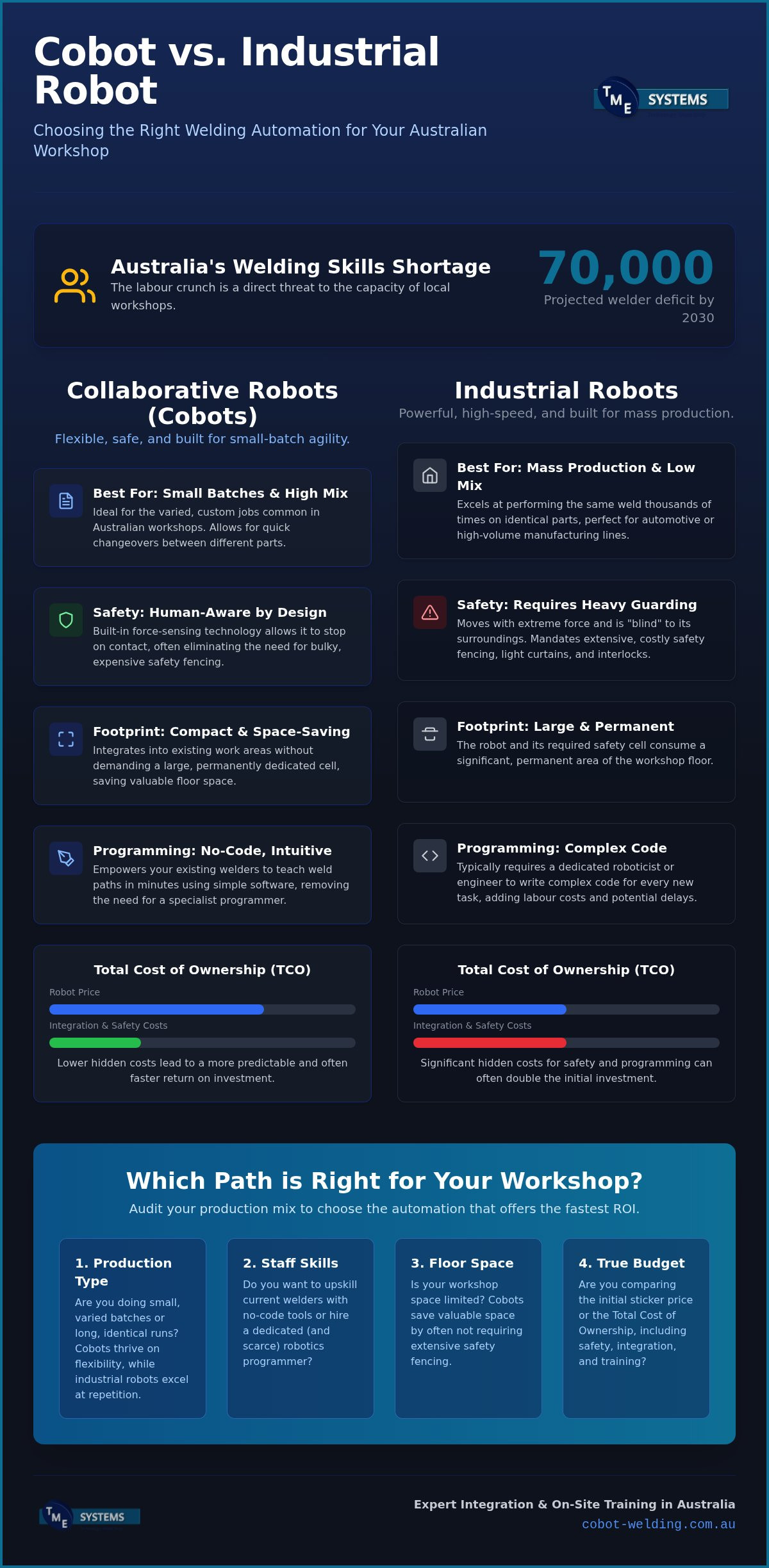

You’ve likely felt the pinch of the national skills shortage, where finding a reliable MIG or TIG welder feels harder than winning the lotto. With Australia projected to face a deficit of 70,000 welders by 2030, many workshops are operating well below capacity simply because they can't find the hands to do the work. It’s a common frustration to watch labour costs climb while your small-batch fabrication becomes less competitive, yet the thought of automation often brings its own set of worries. No one wants to invest in a complex machine that sits idle because the shop floor lacks a dedicated robotic programmer.
We understand that for a local workshop, technology has to be a practical tool, not a burden. Choosing between a cobot vs industrial robot for welding isn't about which machine is "better" in a lab; it's about which one suits your existing staff and your specific production goals. In this guide, we’ll explore the real-world differences in safety, setup, and ease of use. You’ll discover how the right choice can help you improve weld consistency across every shift, reduce your reliance on specialised coding through no-code solutions, and finally achieve the ROI your business needs to grow.
Key Takeaways
- Understand the core technical differences in a cobot vs industrial robot for welding to determine if your shop needs high-speed mass production or flexible, small-batch agility.
- Discover how no-code software empowers your existing team to teach new weld paths in minutes, removing the need for a dedicated roboticist on the payroll.
- Learn how to evaluate your floor space and safety needs, comparing the heavy guarding of industrial cells with the space-saving, human-aware design of cobots.
- Follow a practical decision framework to audit your production mix and choose the automation path that offers the fastest return on investment for your workshop.
- Recognise why expert integration and on-site training are essential to ensure your new system becomes a productive tool rather than an expensive paperweight.
The Automation Crossroads: Why the Choice Matters for Australian Shops
Australian fabrication is at a turning point. We're facing a projected deficit of at least 70,000 welders by 2030, which isn't just a headache for HR; it's a direct threat to the capacity of local workshops. When you're deciding between a collaborative robot (cobot) and a traditional industrial robot, you're really deciding how your business will survive this labour crunch. The right choice allows you to take on more complex contracts that you might currently be knocking back due to a lack of hands.
For decades, automation meant "set and forget" lines designed for massive production runs. That worked for car factories, but it rarely fits the typical Australian job shop doing varied, small-batch work. The choice between a cobot vs industrial robot for welding often comes down to how much flexibility you need to finish today's job and quote for tomorrow's. One path offers raw speed, while the other offers a partnership between man and machine.
The Reality of the Australian Skills Gap
It's nearly impossible to find a qualified MIG or TIG welder who also happens to be a fluent computer programmer. If you buy a system that requires a dedicated roboticist, you've just traded one hiring problem for another. Modern automation should act as a force multiplier for the tradespeople you already have on the floor. It allows your best welders to focus on the complex, high-value joins while the robot handles the repetitive runs. This shift toward accessible automation means small to medium enterprises (SMEs) can finally compete with larger firms without needing a massive IT department.
Total Cost of Ownership (TCO) vs Initial Price
A common mistake is looking only at the sticker price of the robot arm. Industrial robots are fast and powerful, but they are also dangerous. To meet Australian safety standards, they require extensive safety guarding, light curtains, and interlocked fencing. These hidden costs can double your initial investment before the first weld is even struck. When calculating TCO, Australian shops should account for:
- Safety fencing and physical floor space requirements.
- Professional integration and permanent floor mounting.
- On-site training for existing staff.
- Future programming costs for every new part or batch change.
Cobots generally offer a more predictable, all-in cost because they are designed to work safely alongside people. Since they don't always require heavy fencing, they save valuable floor space. Because they are easier to adjust, your team can handle part changes in-house. This ensures the machine stays productive instead of sitting idle while you wait for an expensive external consultant to arrive. Understanding the cobot vs industrial robot for welding debate is about knowing which system your team can actually keep running.
Technical Breakdown: Cobot vs Industrial Robot for Welding
When you look at the raw specifications, industrial robots are the heavy lifters of the manufacturing world. They offer massive payloads and impressive reach, but for the majority of welding applications, you're only moving a torch and a wire feeder. A standard cobot payload of 10kg to 12kg is more than enough for most MIG or TIG setups. In the technical debate of a cobot vs industrial robot for welding, repeatability is often a draw; both systems provide the millimetre-perfect precision required for high-quality, consistent beads.
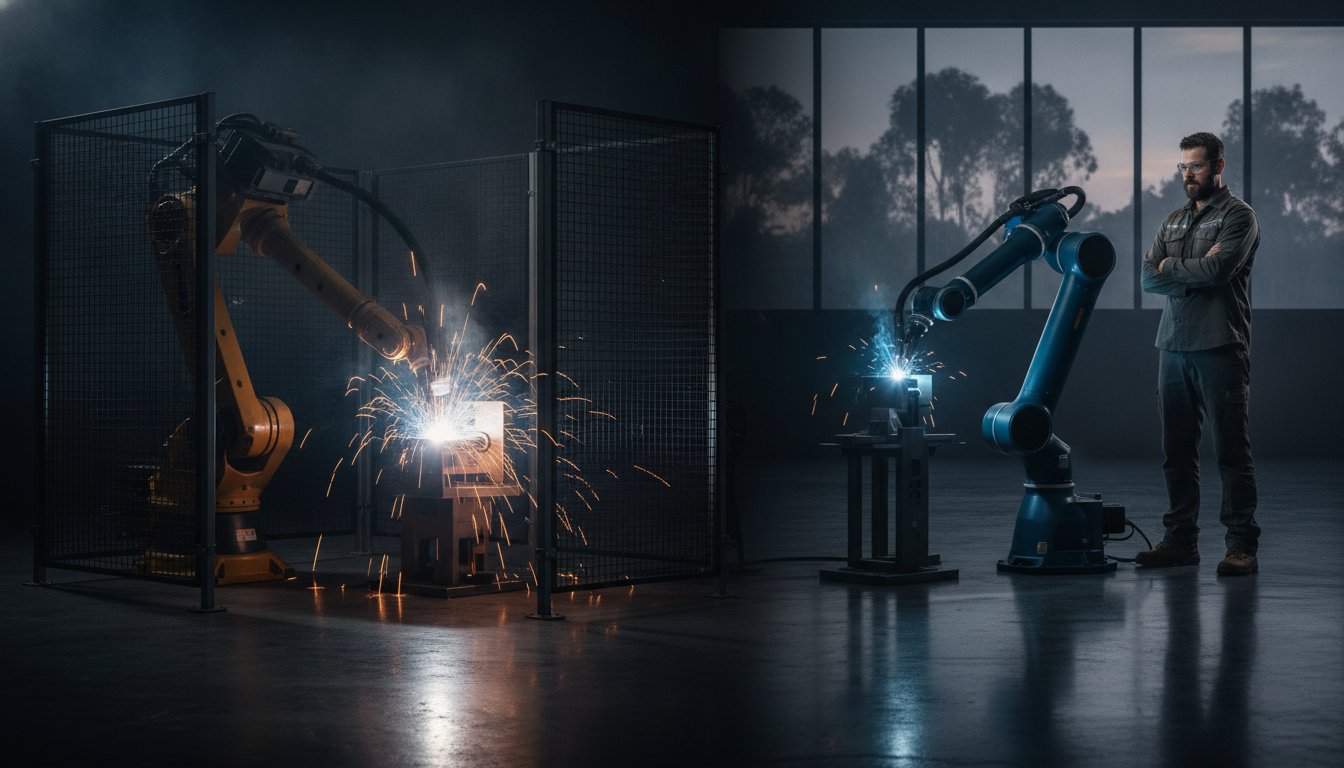
The real difference lies in how these machines occupy your workshop. Industrial robots are "blind" to their surroundings and move with enough force to cause serious injury. This necessitates a "fenced-in" approach, using light curtains and physical steel barriers to keep staff safe. Cobots, however, are built with force-sensing technology. They are designed to stop instantly if they encounter an unexpected obstacle, allowing for a "human-aware" cell that doesn't always require heavy guarding.
Safety Standards and Guarding
Australian workshops must navigate strict safety requirements. While international OSHA robotic safety standards offer a global foundation, local fabricators need to align with AS/NZS ISO 10218-1 and -2. For an industrial robot, compliance often means a permanent, expensive footprint of safety fencing and interlocks. For a cobot, the safety assessment is often simpler, allowing the machine to sit on a smaller footprint. This makes cobots ideal for Australian shops where floor space is at a premium and you need your team to work near the automation without fear.
Programming and Path Teaching
Traditional industrial robots rely on a "teach pendant," a code-heavy interface that usually requires weeks of specialised training or an external consultant to operate. If you're running 10,000 identical parts, this setup time is a minor hurdle. But for a local job shop doing varied, small-run batches, that programming time kills your profit margin.
Collaborative systems favour "lead-through" teaching. This allows a welder to physically move the robot arm along the desired weld path, recording points with the click of a button. It turns the robot into a tool that your existing tradespeople can control. If you want to see how this works on your own parts, you can arrange a mobile demo system to visit your site. This intuitive approach ensures that the cobot vs industrial robot for welding choice results in a machine that actually stays busy, rather than one that sits idle because no one knows how to code it.
The "No-Code" Advantage: Why Software is the Real Game Changer
The hardware is only half the story. While the physical differences in a cobot vs industrial robot for welding are significant, the software is where the real day-to-day battle is won or lost. Traditional industrial robots are tethered to a teach pendant, a handheld device that requires you to enter coordinates and logic strings. It's a slow, cumbersome process that often leaves the machine sitting idle while a programmer tries to debug a line of code. For a workshop that has never touched a robot before, this complexity is the biggest barrier to entry.
No-code software changes this dynamic by putting control back into the hands of the person who actually knows how to weld. Instead of writing scripts, your team uses a "Teach by Doing" approach. This involves physically guiding the robot arm to the start and end points of a seam. The software handles the complex math in the background, allowing the welder to focus on the job at hand. This accessibility is a primary driver for improving welding productivity with cobots across Australian job shops.
Adjusting Parameters on the Fly
Experienced welders have a "feel" for the arc. They can tell by the sound and the look of the puddle if the settings are slightly off. With an industrial robot, changing those parameters often requires stopping the cycle and digging through menus. No-code interfaces allow for instant Weld Setting Optimization, where wire speed and voltage can be adjusted via a simple touchscreen. No-Code Teaching Software is a tool that translates physical movements into robot commands without manual script entry. This intuitive layout means your best tradespeople don't need to become IT experts to get a perfect bead every time. They stay in the welding mindset rather than getting bogged down in computer logic.
From CAD to Torch: Simplifying the Workflow
Modern workshops often start with a digital design. No-code software helps bridge the gap between a CAD drawing and the finished metalwork. By using precise digital pathing, you can reduce rework and ensure that every part in a batch is identical. This is particularly useful for complex geometries where manual consistency might slip over an eight-hour shift. If you're looking for a deeper dive into these tools, our No-Code Robot Welding Software guide breaks down exactly what to look for. By removing the coding barrier, you're not just buying a machine; you're giving your team a way to compete on a global scale while keeping production local. The choice in the cobot vs industrial robot for welding debate becomes clear when you prioritise the people using the tool.
Decision Framework: How to Justify Buying a Welding Robot
Investing in automation is a significant step for any Australian fabricator. It’s not just about the hardware; it’s about making a business case that stands up to scrutiny on the workshop floor. To decide between a cobot vs industrial robot for welding, you need a clear framework that looks at your specific production reality rather than just the latest tech trends.
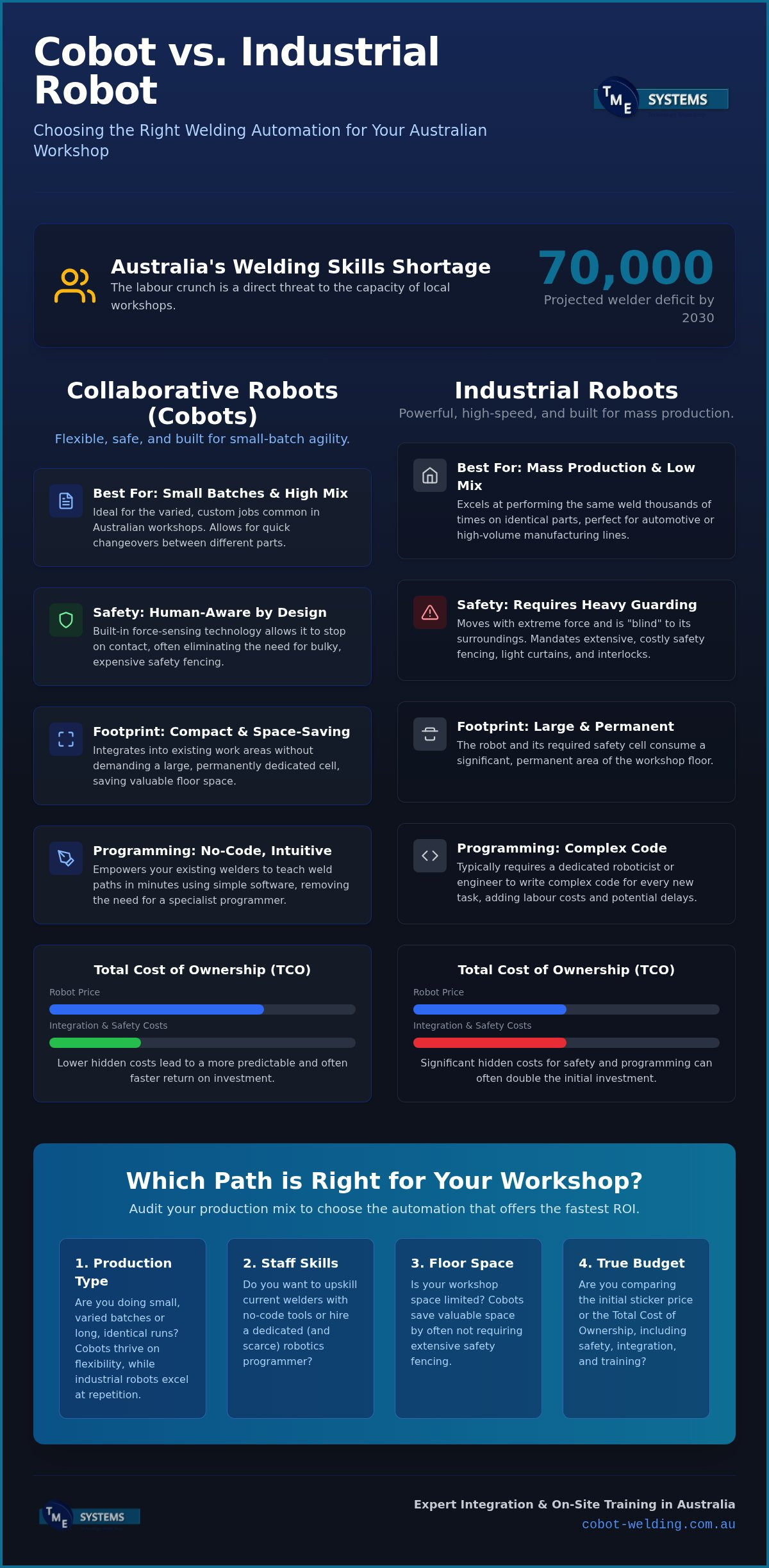
Step 1: Audit your production mix. Are you pumping out 10,000 identical parts, or is your schedule a mix of small batches? Industrial robots excel at high-speed, high-volume repetition. Cobots are built for the flexibility required in a job shop environment. If your work changes every week, the cobot vs industrial robot for welding choice usually leans toward the collaborative side.
Step 2: Assess floor space and safety. Measure your available area. An industrial cell needs permanent steel fencing and a large safety zone to comply with local standards. If your floor space is tight, a cobot’s smaller, human-aware footprint is often the deciding factor.
Step 3: Evaluate your team. Do you have staff who can manage complex G-code, or do you have talented tradespeople who want to focus on the art of welding? If you want your existing welders to run the machine, a no-code path is essential to avoid the robot sitting idle.
Step 4: The cost of doing nothing. Calculate the impact of missed contracts, rework, and high labour turnover. With many Australian workshops operating below capacity due to skills shortages, an empty welding bay is a massive drain on your bottom line. Automation fills that gap.
Step 5: Determine your ROI timeline. While industrial systems have high upfront integration costs, cobots often pay for themselves in under 12 months. This is due to faster deployment and the lack of expensive, permanent safety cages.
Small Batch Profitability
Job shops are the backbone of Australian manufacturing. Cobots are the "job shop heroes" because they handle runs of 10 to 50 parts efficiently. You can switch between different jobs in minutes rather than hours. This agility allows you to quote on smaller, high-margin projects that were previously too labour-intensive to be profitable. It turns your workshop into a flexible production hub that can pivot as fast as the market demands.
Future-Proofing Your Business
Scaling your business shouldn't depend on finding ten new welders in a dry market. By integrating collaborative robot welding cells, you create a workshop that scales through technology. It also serves as a marketing advantage. Telling clients you use precision robotic welding builds trust in your consistency. It even helps attract younger talent who are eager to work with modern, tech-driven tools. To see how these systems fit into your specific workflow, you can explore our turnkey welding solutions today.
Partnering for Success: Integration and Training in Australia
Buying the robot arm is only the first step. The real success of any automation project depends on how well that machine fits into your daily operations. A robot that isn't set up correctly for your specific jigs and parts is just expensive floor weight. This is where the choice between a cobot vs industrial robot for welding becomes a matter of long-term partnership. You need a system that fits your existing workflow without requiring a total workshop overhaul.
Expert integration ensures that your new cell is productive from day one. It involves more than just bolting a base to the floor; it's about refining the interface between your skilled tradespeople and the new technology. Ongoing support is equally vital. As your jobs change and new contracts come in, having a local partner to assist with adjustments ensures your investment continues to perform at its peak.
The Integration Roadmap
Specialists help you organise your workflow to accommodate the new robot cell without disrupting current production. This roadmap includes customising the cell for your specific MIG, TIG, or plasma applications. It also ensures full compliance with Australian safety and electrical standards, giving you peace of mind that your workshop remains a safe environment. By tailoring the integration to your shop's unique layout, you can maximise the efficiency of the cobot vs industrial robot for welding setup you've chosen.
Training is the next essential pillar. Providing on-site cobot welder training ensures your team feels confident and capable. It’s about empowering your existing welders to use the robot as a sophisticated tool, rather than feeling replaced by it. When your team understands the "why" behind the automation, they become the biggest advocates for its success.
Booking Your Proof of Concept
One of the best ways to de-risk your investment is to see the technology in action on your own workshop floor. You can prepare for a mobile welding robot demonstration to see how the system handles your actual parts. This "hands-on" testing is invaluable for your welding team. It allows them to feel the intuitive nature of no-code teaching and see the weld quality firsthand before any final decisions are made.
Transitioning your workshop to robotic automation doesn't have to be intimidating. With the right integration, proper training, and a solid proof of concept, you can turn a complex technical shift into a smooth operational upgrade. This collaborative approach ensures that your workshop remains competitive, productive, and ready for the future of Australian manufacturing.
Future-Proofing Your Fabrication Shop
Deciding between a cobot vs industrial robot for welding is one of the most important moves your business can make to stay competitive. While industrial robots offer high-speed volume, the collaborative approach provides the flexibility that modern Australian job shops need to handle varied batches without hiring specialised programmers. By choosing a system that prioritises ease of use, you're not just buying a machine; you're giving your existing team a tool that enhances their craft.
Our national team of integration specialists is ready to support you with turnkey cells and on-site training. With no-code software that any experienced welder can learn in just a few hours, the transition to automation is simpler than you might think. We believe the best way to understand the value is to see it for yourself on your own workshop floor. It’s about making innovation feel attainable rather than intimidating.
Book a Mobile Demo to see a Cobot weld your parts on-site and discover how accessible automation can transform your production goals. We're here to help you refine your process and build a more resilient, profitable workshop. Let’s get your production moving forward with confidence.
Frequently Asked Questions
Do I need a specialised programmer to run a welding cobot?
No, you don't need a specialised roboticist on the payroll to manage a collaborative system. Our no-code software is designed so that an experienced tradesperson can teach a new weld path in minutes. By physically moving the arm and recording points, the welder remains the expert in control. This accessibility is a major factor when comparing a cobot vs industrial robot for welding, as it removes the need for expensive external coding consultants.
Can a cobot weld as fast as a traditional industrial robot?
In terms of raw travel speed between welds, industrial robots are generally faster. However, for a typical Australian job shop, "speed" is better measured by how quickly you can get the first part finished. Cobots often win here because the setup and programming time is significantly shorter. If you are doing small batches of 20 to 50 parts, the reduced downtime between jobs often results in higher overall daily output.
Is a collaborative robot safe enough to work without a cage?
Cobots are designed to work safely alongside people thanks to built-in force-sensing technology. If the arm encounters an unexpected obstacle, it stops instantly to prevent injury. While a risk assessment is always required under Australian standards, many workshops find they can operate without the heavy steel cages needed for industrial robots. This "human-aware" design saves valuable floor space and allows your team to work more naturally within the production line.
What is the typical ROI for a welding cobot in an Australian workshop?
Many Australian fabricators see a full return on their investment in under 12 months. This ROI is driven by three main factors: reduced rework, better weld consistency across shifts, and the ability to operate at full capacity despite the welder shortage. Because there are fewer hidden costs for safety fencing and complex integration, the "all-in" price is more predictable. It allows small businesses to compete for larger contracts with confidence.
Can cobots handle heavy-duty MIG welding on thick plate?
Yes, cobots are more than capable of handling heavy-duty MIG welding on thick plate. The robot itself is simply the tool-carrier; it integrates with high-performance power sources that you likely already use in your shop. Whether you are running multi-pass welds on structural steel or intricate beads on aluminium, the system maintains consistent torch angles and travel speeds. This ensures deep penetration and high-quality results that meet strict Australian structural standards.
What happens if my welding jobs change frequently—can the robot adapt?
Rapid adaptation is the primary advantage of a collaborative system. If your production mix changes from day to day, your team can re-program the robot for a new part in the time it takes to have a smoko. You aren't locked into one high-volume part for months. This flexibility makes the cobot vs industrial robot for welding debate easy for job shops that need to pivot quickly between different client orders.
Do I need to upgrade my workshop’s electrical system for a robot cell?
Most collaborative robot cells are designed to be "plug and play" with your existing workshop infrastructure. They typically run on standard single-phase 240V or three-phase 415V power, depending on the specific welding power source you choose. Because they don't require the massive safety interlocks and light curtains of industrial cells, the electrical integration is much simpler. We recommend a quick site audit to ensure your current circuit capacity matches your production goals.
How much training does my existing staff need to operate a no-code system?
Your existing staff can typically learn to operate a no-code system in just a few hours. Because the software uses an intuitive, visual interface rather than complex script entry, there is no steep learning curve. After a single day of on-site training, a qualified welder will be comfortable teaching paths and adjusting parameters like wire speed and voltage. This fast onboarding ensures your new automation starts paying for itself from the very first shift.