
If you're still trying to solve the skilled labour shortage by simply offering higher hourly rates, you're fighting a losing battle against the Australian market. Most workshop owners agree that finding and keeping qualified welders has never been more difficult or expensive. While you know that automation is the logical next step, the lack of transparency around cobot welding cell pricing australia often makes the transition feel like a financial gamble rather than a strategic move. It's frustrating to see the potential for growth but feel held back by the uncertainty of hidden software fees or complex integration costs.
This 2026 guide is designed to remove that guesswork by providing a grounded look at the total investment required for collaborative automation. You'll learn exactly what a turnkey system includes, from the hardware on your floor to the no-code software that empowers your existing team. We'll break down the different price tiers available to local fabricators and explore how to calculate a realistic ROI, even for small batches. We'll move from broad operational goals to the specific financial details that dictate your workshop's long-term profitability and success.
Key Takeaways
- Gain a clear breakdown of how hardware, software, and integration services combine to determine the total cost of ownership for your workshop.
- Understand the specific factors influencing cobot welding cell pricing australia, helping you budget accurately for both upfront costs and ongoing licencing.
- Learn how no-code teaching software removes the barrier of expensive external programming, allowing your current team to manage the system.
- Discover why investing in operator training and Australian safety standards is the most reliable way to secure a faster return on investment.
- Compare the practical differences between fixed-price turnkey cells and custom-engineered integrations to find the right solution for your batch sizes.
Understanding the Investment: Cobot Welding Cell Pricing in Australia
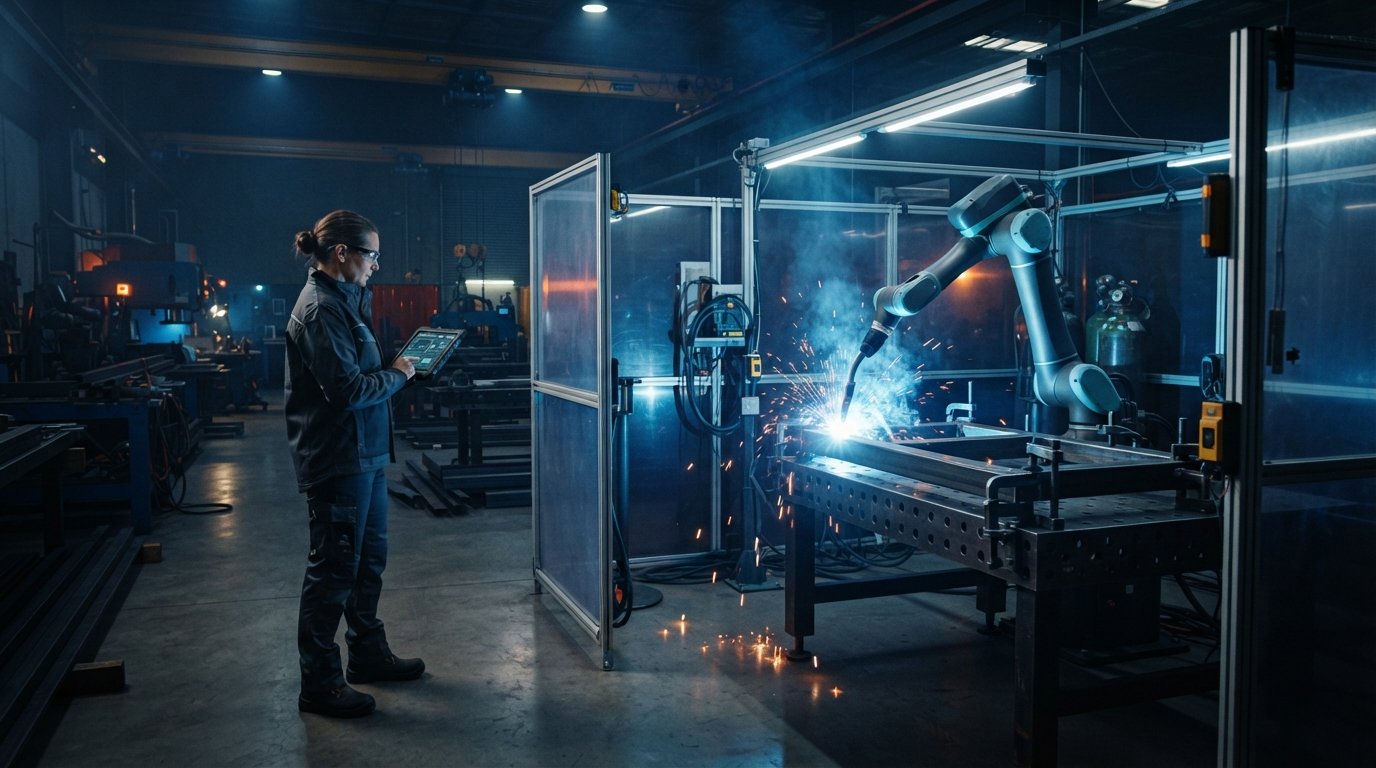
Think of a collaborative welding cell as a cohesive ecosystem rather than a single piece of hardware. It brings together the robot arm, the welding power source, safety sensors, and the interface that allows your team to control it all. For decades, industrial automation was restricted to high-volume manufacturing due to massive capital requirements and complex programming needs. Today, collaborative robots (cobots) have changed that equation for Australian small to medium enterprises (SMEs). You'll likely see "Price on Application" across the industry because the final figure depends on your specific workshop needs, such as reach requirements or the complexity of your typical weld paths. Investing in a cell is a direct response to the rising cost of skilled labour; it's about making your existing welders more productive rather than replacing their expertise.
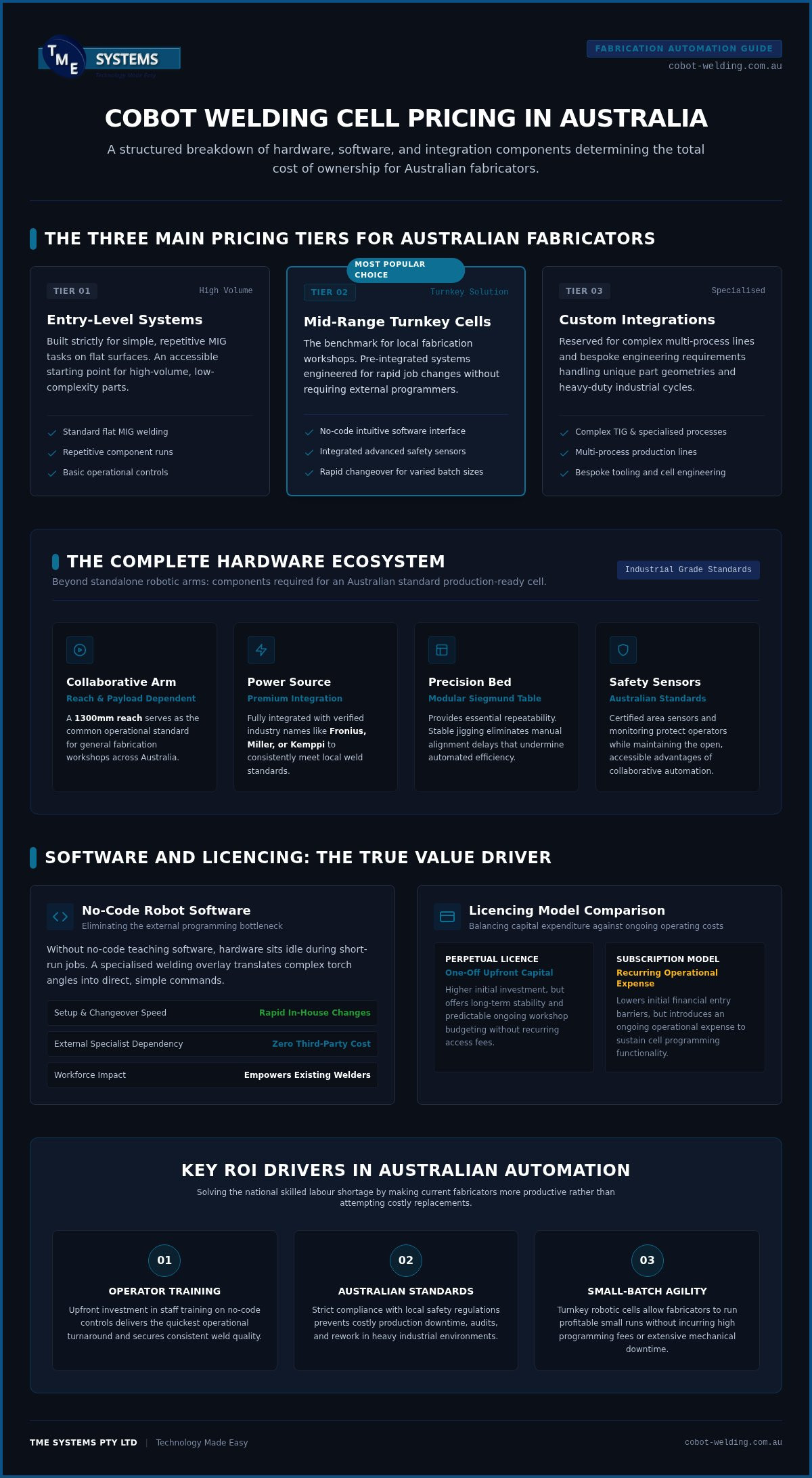
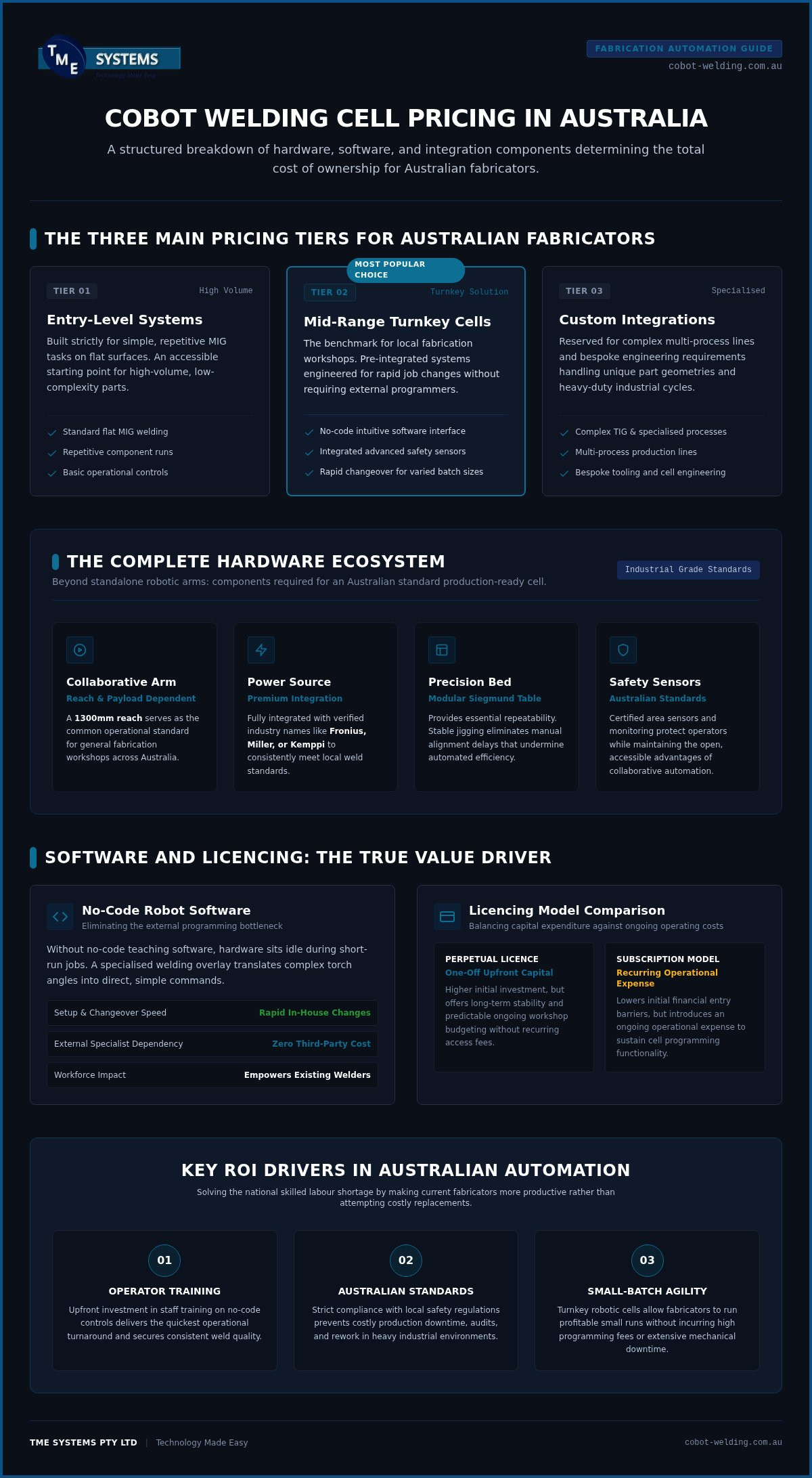
The Three Main Pricing Tiers for Australian Fabricators
Most systems in the local market fall into three distinct categories based on their capability and intended workload. Entry-level systems are built for simple, repetitive MIG tasks on flat surfaces. They provide a reliable starting point for workshops with high-volume, low-complexity parts. Mid-range turnkey cells are currently the most popular choice for Australian fabricators. These systems include advanced sensors, integrated safety features, and no-code software that allows for rapid job changes without deep technical knowledge. High-end custom integrations are reserved for complex TIG requirements or multi-process lines that need bespoke engineering to handle unique part geometries or heavy-duty industrial cycles.
Hardware vs. Software: Where is the Value?
While the physical robot arm and the welding power source represent a significant portion of the upfront cost, they aren't the only variables that matter. The real value often lies in the software interface. If your team can't program the robot quickly, the hardware will sit idle during short-run jobs. This is why no-code robot welding software is such a critical factor in cobot welding cell pricing australia. It reduces the time spent on setup and removes the need for expensive external programmers.
When evaluating different systems, you should also consider whether the software uses a perpetual licence or a subscription model. A perpetual licence might mean a higher initial cost but offers long-term stability for your budget. Conversely, subscription models might lower the entry price but add a recurring operational expense. Balancing these factors alongside the hardware specs ensures that the system you choose provides a genuine return on investment over its entire service life.
Breaking Down the Bill: Hardware, Software, and Integration Costs
Understanding the real-world components of cobot welding cell pricing australia helps you avoid the "sticker shock" that often comes with poorly defined quotes. While some online listings might show a low price for a standalone robot arm, a functional cell requires several high-performance layers to be production-ready. You aren't just buying a machine; you're investing in a system that needs to be as reliable as your best human welder. This means looking at the hardware, the software, and the professional services required to get the system running on your floor.
The Hardware Package: More Than Just a Robot
The physical package starts with the cobot arm, where reach and payload are the primary cost drivers. For most Australian workshops, a reach of 1300mm is a common requirement for general fabrication. However, the arm is only as good as the power source it controls. Integrating premium brands like Fronius, Miller, or Kemppi ensures that the weld quality meets Australian standards, but these high-end units carry a higher price tag than basic alternatives. Don't overlook the foundation of the cell either. A precision welding table, such as a Siegmund system, is essential for the repeatability that makes automation profitable. Without a stable, modular jigging surface, you'll spend more on manual adjustments than you save in welding time.
Software and Licencing Fees
Software is where many fabricators find unexpected costs. Most systems require a specialised welding overlay to translate complex movements into simple commands. In the Australian market, you'll typically choose between a perpetual licence, which you own outright, or a subscription model that requires ongoing annual fees. Choosing collaborative robot welding cells with pre-installed no-code tech can significantly lower your long-term costs. This approach removes the need for recurring payments to external programmers every time you want to change a part run. It also ensures that your technical support and updates are handled by a local partner who understands your specific operational rhythm.
Finally, consider the integration services and consumables that influence cobot welding cell pricing australia. Making the robot "talk" to your existing workshop equipment requires professional setup to ensure safety signals and gas flow are perfectly synchronised. You'll also need to budget for specialised torch mounts and high-quality wire feeders that can withstand the duty cycles of an automated system. If you want to see how these components work together on your own workshop floor, you might consider a mobile demo system to validate the setup before committing to a full purchase.
Beyond the Sticker Price: Training, Safety, and ROI Calculations
The real cost of a system isn't just what you pay the day the truck arrives; it's what it costs to keep it running at peak efficiency. When evaluating cobot welding cell pricing australia, you need to account for the total cost of ownership, which includes training, safety compliance, and ongoing support. A system that sits idle because no one knows how to use it is an expensive ornament. Conversely, a well-integrated cell starts paying for itself through increased arc-on time and a massive reduction in rework from the very first week. It's about moving from a capital expense to a productive asset as quickly as possible.
Operator Training and Onboarding Costs
Training is where the distinction between no-code systems and traditional industrial robots becomes clear. Traditional robots often require weeks of off-site training or expensive specialist programmers. In contrast, no-code software allows your existing welders to take control of the machine within hours. Investing in on-site cobot welder training is the most effective way to ensure rapid adoption. It empowers your team to see the technology as a tool that supports their craftsmanship rather than something that replaces it. This approach keeps your labour costs stable while significantly increasing your workshop output.
Safety and Australian Standards
Safety is a non-negotiable part of the investment. While cobots are designed to work alongside humans, you still need to conduct a thorough risk assessment for your specific application. This might include safety guarding or light curtains depending on the speed and the welding process involved. The AS 4024.1 standard provides the essential framework for the safety of machinery and industrial robots within Australian workplaces. Meeting these standards ensures you protect your workers and your business from liability. Factoring these safety components into your initial budget prevents unexpected costs during the commissioning phase.
Calculating the Real Return on Investment
To find the true ROI, look past the initial capital outlay. Calculate how much you currently spend on rework and how many hours your welders spend on repetitive, low-value joins. An automated cell can run continuously, increasing your arc-on time from a typical 20-30% for manual welding to over 70-80% for automated runs. When you factor in the current Australian labour rates and the ability to take on more complex projects, the payback period for a well-utilised cell is often shorter than most fabricators expect. Local support and readily available spare parts further protect this investment, ensuring that minor issues don't turn into costly downtime and negatively impact your cobot welding cell pricing australia calculations.
Tailoring the Tech: Turnkey Cells vs. Custom Integrations
Choosing between a pre-configured turnkey cell and a bespoke custom integration is one of the most significant decisions affecting cobot welding cell pricing australia. For many workshops, the choice isn't just about the initial invoice; it's about how quickly the system can start producing parts. Turnkey solutions offer a path of least resistance with predictable costs, while custom builds provide the precision required for complex, high-stakes fabrication. Understanding which model fits your production volume is the key to avoiding over-investment or under-performance.
Is a Turnkey Welding Unit Right for You?
Turnkey cells are designed for rapid deployment. They arrive as a complete package with a fixed price, often including the robot, power source, and a standard safety enclosure. These units are ideal for workshops focused on standard MIG/MAG processes where part sizes are relatively consistent. While they offer lower upfront costs and simplified maintenance, they do have limitations in flexibility. If your parts vary wildly in size or require complex multi-axis rotations, a standard unit might struggle to reach every joint without manual intervention. For the majority of Australian fabricators, however, the standardisation of a turnkey unit provides the fastest route to profitability.
The Custom Integration Path
When your projects involve specialised jigs, heavy-duty positioning, or the coordination of multiple robots, a standard cell won't suffice. This is where cobot welding integration experts become essential. A custom build involves bespoke engineering to solve specific production bottlenecks, such as integrating the robot with existing rotary tables or designing unique torch mounts for tight clearances. While the capital expenditure is higher, the efficiency gains for high-volume lines or complex geometries often justify the additional cost. It's a matter of matching the technology to the complexity of your output and ensuring the system can grow with your business.
Batch size is the ultimate decider in this equation. If you're running small batches of varying parts, the flexibility of a turnkey system with no-code software is usually the most profitable route. For those running the same high-volume parts 24/7, a custom-engineered line might be the better long-term play. If you're unsure which path makes sense for your specific workshop floor, a mobile demo is a low-risk way to validate the setup. You can see the technology in action on your own parts before committing to a final purchase. To get started, you can book a mobile demo system to see how these units handle your specific fabrication challenges and get a clearer picture of the total investment required.
Investing in Australian Fabrication: The TME Systems Approach
TME Systems Pty Ltd simplifies the transition to automation by removing the ambiguity often associated with cobot welding cell pricing australia. We focus on providing comprehensive turnkey solutions that bundle hardware, software, and training into a single, transparent investment. This approach ensures you aren't surprised by hidden integration fees or the need for external consultants three months into your journey. By positioning ourselves as a trusted local partner, we help you move away from the high capital risks of traditional industrial robots toward a more accessible, supportive model of fabrication.
One of the most significant cost-saving factors we offer is the use of no-code teaching software. In traditional automation, every new part requires a specialised programmer, often costing hundreds of dollars per hour in contractor fees. Our software empowers your existing welding team to teach the robot new paths in minutes. This shift from "programming" to "teaching" fundamentally changes the financial viability of automation for small batches, as it eliminates the ongoing expense of external software experts and keeps your production moving without interruption.
Maximising Productivity with Local Support
A cobot is only as valuable as the time it spends welding. We prioritise improving welding productivity with cobots by providing national support that understands the realities of the Australian workshop floor. Whether it's accessing spare parts or receiving technical assistance, our local team ensures you don't face the international delays common with overseas providers. This steady, reliable presence means your investment is always supported, ensuring your arc-on time remains high and your downtime is kept to an absolute minimum.
Proof of Concept: The Mobile Demo
We understand that every workshop has unique parts and specific floor space constraints. To remove the guesswork from your investment, we offer a mobile welding robot demonstration that brings the technology directly to you. This on-site proof of concept allows you to test your own parts and verify cycle times before signing any contracts. It's a pragmatic way to validate the ROI and clarify your specific integration needs, giving you the confidence that the system will perform exactly as required in your real-world environment.
Securing the Future of Your Fabrication Business
Understanding cobot welding cell pricing australia doesn't have to be a guessing game. By looking beyond the initial sticker price and focusing on the total cost of ownership, you can select a system that truly scales with your workshop. The combination of reliable hardware and no-code software ensures that your investment starts paying for itself through increased output and reduced rework from day one. This strategic move builds long-term resilience against rising labour costs and local skills shortages.
As Australian-owned automation specialists, TME Systems provides the national on-site training and support you need to ensure your team feels confident. We're committed to being a partner in your progress. Our technical assistance is always grounded in the reality of the workshop floor. If you're ready to see how these systems handle your specific parts, Request a Personalised Quote or Book a Mobile Demo today. Let's work together to make your transition to automation both predictable and profitable.
Frequently Asked Questions
What is the average price range for a cobot welding cell in Australia in 2026?
Specific pricing varies based on your workshop's reach, payload, and power source requirements. While industrial robot cells often require massive capital, cobot welding cell pricing australia is more accessible for local SMEs. Most fabricators find that the total investment depends on the level of customisation and the choice between perpetual or subscription software licences. To get an accurate figure for your specific parts, it's best to request a tailored quote that reflects your production volume.
Do I need to hire a programmer to run a collaborative welding robot?
You don't need to hire a specialised programmer if you choose a system equipped with no-code teaching software. This technology allows your existing welders to teach the robot new paths by physically moving the arm or using a simple tablet interface. It eliminates the need for expensive external contractors and ensures your team remains in control of the weld quality. This accessibility is a primary reason why many Australian workshops are adopting collaborative automation.
How long does it typically take to see a return on investment (ROI)?
Many Australian fabricators report a return on investment within 12 to 24 months, depending on their arc-on time and labour savings. By increasing the percentage of time the torch is actually welding, you can significantly boost workshop output without increasing headcount. The ROI is further accelerated by the reduction in rework and the ability to reallocate your skilled welders to more complex, high-value projects while the cobot handles repetitive joins.
Are there Australian government grants available for welding automation?
Yes, there are several federal and state-based grants designed to support Australian manufacturers in adopting advanced automation technologies. Programs such as the Industry Growth Program or the R&D Tax Incentive may provide financial support for eligible workshops. These initiatives aim to improve the competitiveness of local fabrication. It's recommended to consult with a specialist grant advisor to identify which specific funding pools are currently open for applications in the manufacturing sector.
Can a cobot welding cell handle both MIG and TIG processes?
A collaborative welding cell can be integrated to handle both MIG and TIG processes, though the setup requirements differ. MIG is the most common choice for high-speed, repetitive production due to its simplicity in automation. TIG integration is possible but often requires more sophisticated sensors and precise part fit-up to manage the arc effectively. The choice depends on your material thickness and the required aesthetic finish of the final weld for your customers.
What are the hidden costs of robotic welding integration?
The primary costs beyond the initial purchase include specialised jigging, safety compliance assessments, and high-quality consumables. You should budget for modular welding tables and custom fixtures to ensure part repeatability. Additionally, conducting a thorough risk assessment to meet Australian safety standards is essential for a collaborative workspace. While these factors influence the total cobot welding cell pricing australia, they are necessary investments to ensure the system's long-term productivity and safety on your floor.
How much space does a standard welding cobot cell require?
A standard cobot welding cell is remarkably compact, typically requiring about the same floor space as a manual welding bay. Unlike traditional industrial robots that need large safety cages, cobots are designed to work in closer proximity to humans. This small footprint makes them ideal for workshops where floor space is at a premium. Most turnkey units are mounted on mobile bases, allowing you to move the automation to where it's needed most.
Is it cheaper to buy a turnkey cell or build my own system?
For most fabricators, buying a turnkey cell is more cost-effective than trying to build a system from individual components. Turnkey solutions offer fixed pricing and are pre-integrated to ensure the robot, power source, and software work together seamlessly from day one. Building your own system often leads to unexpected costs in engineering time and technical troubleshooting. A turnkey approach provides a faster path to production and a more predictable return on your investment.