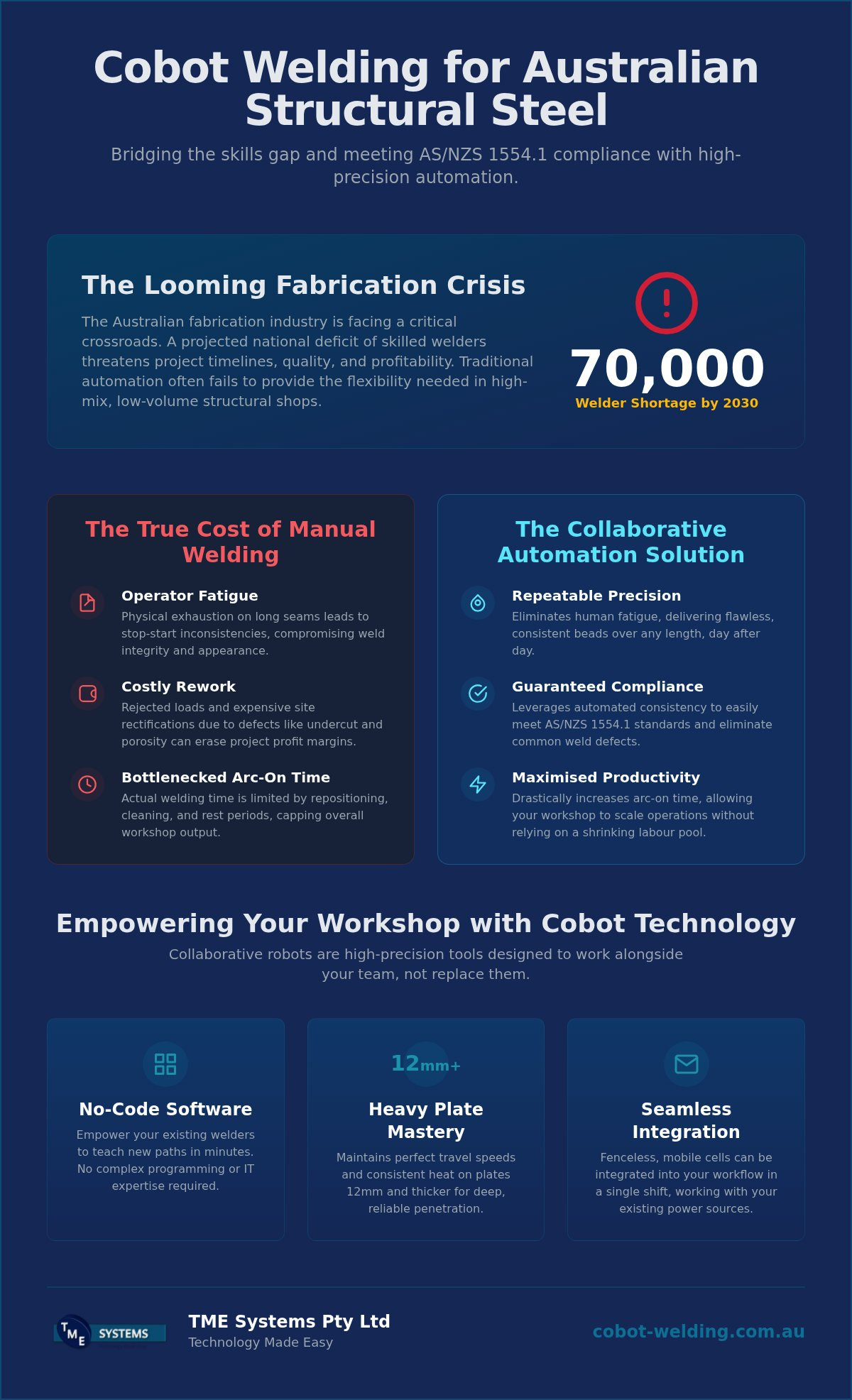

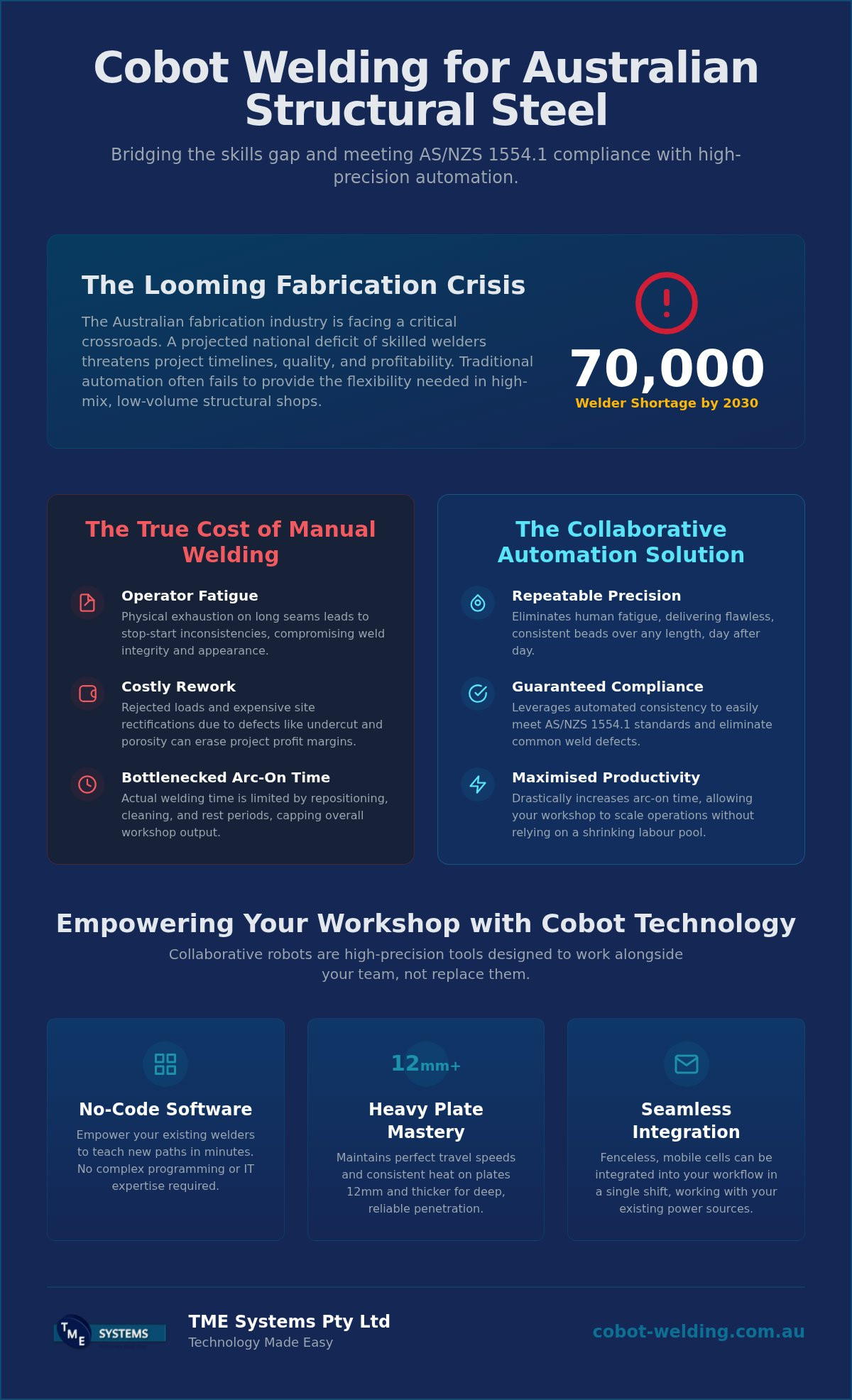
With a projected deficit of 70,000 welders looming over the Australian industry by 2030, the pressure to maintain output without compromising on quality has never been higher. It's a reality most local workshop owners live every day; you have the contracts lined up, but finding and keeping certified staff to lay down consistent beads on heavy plate is a constant battle. This guide looks at how cobot welding for structural steel bridges that gap, allowing your current team to handle long, repetitive seams and meet AS/NZS 1554.1 compliance with ease. We'll show you how collaborative automation isn't about replacing your tradespeople, but rather giving them a tool to eliminate fatigue and costly rework.
You'll discover how no-code teaching software and mobile demo systems are making it possible to integrate these cells into your workflow in a single shift. We will also break down the practicalities of handling heavy structural beams and why 2026 is the year to transition from traditional cages to flexible, human-centric automation. By the end of this guide, you'll see how to maintain high output despite the national labour shortage and achieve code-quality welds on every single beam.
Key Takeaways
- Address the national welder shortage by automating the "grunt work" of long structural seams to reduce operator fatigue and rework.
- Master heavy fabrication techniques, including how cobot welding for structural steel maintains consistent travel speeds on plates 12mm and thicker.
- Ensure your workshop remains compliant with AS/NZS 1554.1 by leveraging repeatable precision to eliminate common defects like undercut and porosity.
- Plan a seamless workshop integration by assessing the ideal batch sizes and infrastructure requirements for fenceless, mobile welding cells.
- Empower your current team to operate advanced automation in a single shift using no-code software that removes the need for complex programming.
The State of Structural Fabrication: Why Automation is No Longer Optional
The Australian fabrication industry is at a crossroads. By 2030, our national deficit of skilled welders is projected to hit 70,000 workers. In 2026, this isn't just a distant statistic; it's a daily operational hurdle for workshops across the country. Finding a certified welder who can consistently meet AS/NZS 1554.1 standards is difficult, but keeping them in a highly competitive market is even harder.
Project timelines are shrinking while the cost of compliance continues to climb. Traditional industrial robots once seemed like the answer, but they often fail in the high-mix, low-volume reality of a structural shop. Their massive safety cages, requirement for specialised programmers, and permanent footprints simply don't align with the need to move large beams and varied sections through a busy floor. This is where cobot welding for structural steel provides a pragmatic alternative that fits into your existing workflow.
The True Cost of Manual Fatigue in Heavy Fabrication
Manual welding on long structural sections is physically punishing. Even the most skilled tradesperson faces fatigue after hours of maintaining a steady hand on 12-metre seams. This exhaustion leads to stop-start inconsistencies that can compromise weld integrity and appearance. The financial drain of a rejected load or the need for expensive site-rectification work can quickly erase the profit margin of a project. In this context, "arc-on time" acts as the primary bottleneck in structural output. It measures the actual duration the torch is active compared to the total time spent on repositioning, cleaning, or resting. Improving this metric is the only way to scale your operations without relying on a non-existent pool of new labour.
Bridging the Skills Gap with Collaborative Technology
It's time to shift how we view automation on the workshop floor. A collaborative robot (cobot) is essentially a high-precision power tool designed to work alongside your existing team. It allows your best welders to focus their expertise on complex joins and critical setups while the machine handles the kilometres of repetitive fillet welds. When paired with no-code robot welding software, your staff can teach new paths in minutes. They don't need to be IT experts; they just need their existing trade knowledge to guide the arm. By reducing the physical toll of the job, you aren't just increasing your daily output. You are actively improving staff retention by making the workshop a more sustainable environment for long-term careers.
High-Deposition MIG: How Cobots Master Heavy Plate and Beams
Welding heavy structural sections requires more than just a steady hand; it demands absolute consistency over long durations. When working with plate 12mm and thicker, a manual operator must manage significant heat while maintaining a precise travel speed. Any variation can lead to uneven penetration or structural distortion. In 2026, cobot welding for structural steel has matured to handle these heavy-duty requirements by integrating directly with industry-standard power sources like Fronius, Kemppi, and Miller. This technical synergy allows the cobot to communicate with the welder in real time, adjusting parameters instantaneously to ensure a stable arc.
According to the American Welding Society, this precision represents the future of automated manufacturing. By automating the torch movement, workshops can achieve deep, reliable penetration on base plates and thick-walled RHS that manual processes struggle to match. If you want to see how these systems integrate with your specific workshop power source, booking a mobile demonstration is the most practical first step.
Optimising Weld Parameters for Structural Sections
Achieving code-quality welds on a 6-metre beam run requires rigorous control over wire feed speeds and voltage. Cobots excel here because they don't suffer from the physical fatigue that leads to "weaving" inconsistencies in manual MIG. You can program specific weave patterns into the software to ensure the weld pool ties in perfectly to both faces of a heavy fillet. This level of control is vital for preventing lack of fusion in deep-groove preparations. Because the cobot maintains a constant torch angle and stand-off distance, the heat input remains predictable, which is the best defence against the warping of large structural members.
Multi-Pass Capability for Heavy Fillets
Large structural joins often require multiple passes to achieve the specified leg length. Modern collaborative robot welding cells use no-code software to simplify this layering process. Instead of programming every individual bead, the operator can define the joint geometry and let the system calculate the necessary offsets for each pass. This ensures inter-pass cleanliness and allows the operator to monitor temperature control without being stuck under a hood for hours. High-deposition rate refers to the weight of weld metal added to the joint per hour; a metric that cobots maximise by maintaining consistent arc-on time without the pauses required by manual operators. This efficiency allows a single cell to produce the output of multiple manual bays while maintaining a defect rate near zero.
Meeting AS/NZS 1554.1 Standards with Automated Consistency
For any Australian fabricator, AS/NZS 1554.1 isn't just a guideline; it's a legal and professional requirement. Achieving "qualified" status for structural joints requires rigorous adherence to proven procedures. Manual welding introduces variables that can lead to non-conformance, but cobot welding for structural steel provides a level of process control that manual bays struggle to replicate. By locking in travel speeds and torch angles, you eliminate the human errors that cause undercut, porosity, and lack of fusion.
Your Welding Supervisor plays a critical role in this ecosystem. Professional cobot welding integration isn't about bypassing the supervisor; it's about providing them with a more reliable tool. The system ensures that the parameters set in the Welding Procedure Specification (WPS) are followed to the letter, every single time. This shifts the supervisor's focus from constant fire-fighting and rework to high-level quality assurance and production planning.
Repeatability as a Quality Benchmark
In a manual workshop, the 100th weld on a Friday afternoon rarely looks like the first weld on a Monday morning. Fatigue and environmental factors inevitably creep in. Cobots don't have bad days. This inherent repeatability becomes your primary benchmark for quality, particularly when meeting the stringent requirements of Structural Purpose (SP) categories. While General Purpose (GP) welds might allow for slight variances, SP category work demands perfection. Automated consistency reduces the reliance on subjective visual inspections because the process itself is controlled at the source.
The Digital Weld Log and Compliance
One of the most significant advantages of modern automation is the ability to create a transparent paper trail. The system captures voltage, current, and travel speed data in real-time for every centimetre of the weld. This digital log simplifies the handover for third-party inspectors, providing hard evidence that each join meets the project's specifications. Instead of relying on a welder's memory or manual logbooks, you have a data-driven record. You can use this information to refine your WPS over time, identifying the exact "sweet spot" for penetration and heat input on specific beam profiles. This data-backed approach to cobot welding for structural steel transforms compliance from a stressful hurdle into a routine part of your production cycle.
Planning Your Shop Floor for Structural Cobot Integration
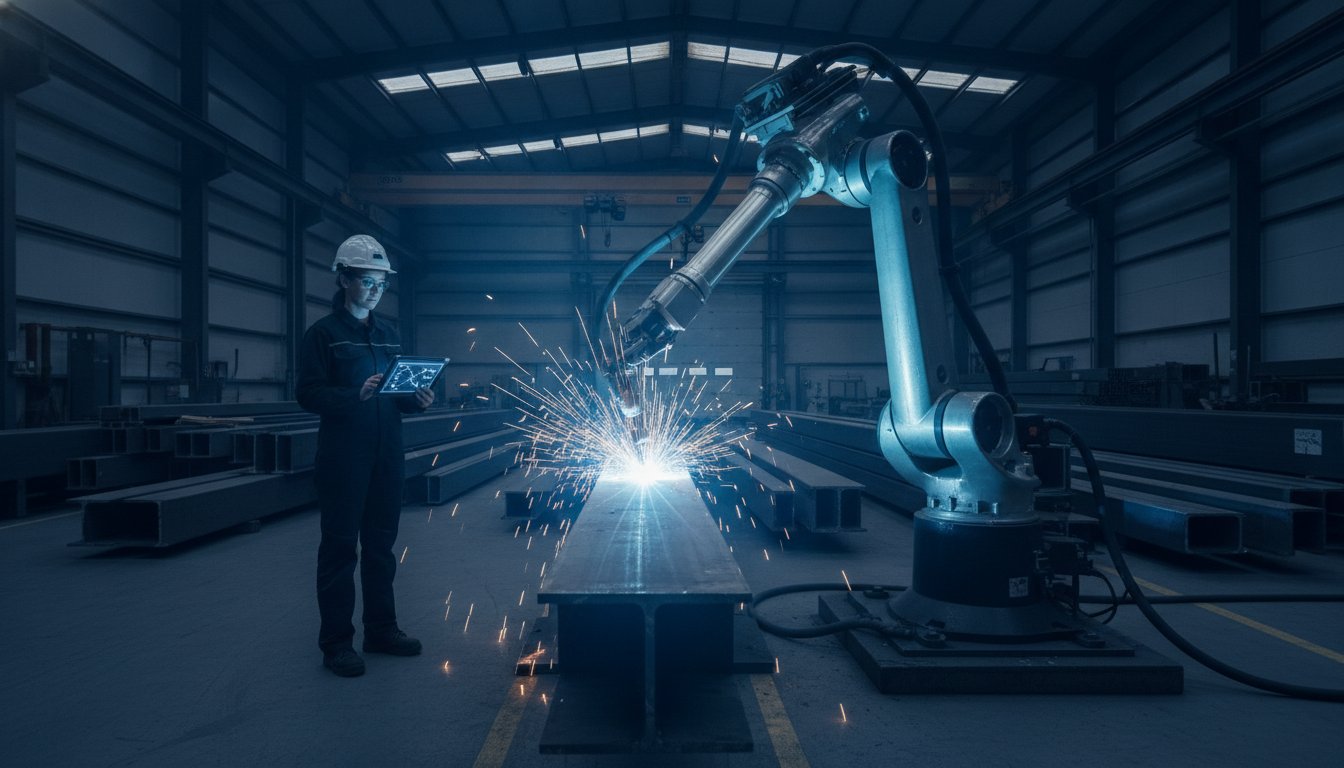
Integrating a new system into a busy structural shop requires more than just floor space. It requires a rethink of how work moves from the saw to the dispatch bay. Successful cobot welding for structural steel depends on placing the technology where it can actually reduce the logjam of fit-up and finishing. Unlike traditional industrial robots that demand permanent, fenced-off zones, a cobot cell can often be integrated into your existing welding bays. This flexibility allows your tradespeople to remain "in the loop," handling the complex fit-up and tacking before handing the repetitive welding over to the machine.
Before the system arrives, you need to consider your workshop infrastructure. Most collaborative cells are designed for rapid integration, but they still require stable power and a consistent gas supply. You should also map your workflow to ensure the cobot sits logically between the fit-up station and the finish-grind area. The goal is to create a continuous loop where the operator prepares one beam while the cobot welds another. To see these benefits quickly, investing in on-site cobot welder training is essential. It ensures your team isn't just watching the machine, but actively managing it to hit production targets. If you're ready to see how a cell fits into your specific floor plan, you can request a workshop layout consultation today.
Step 1: Joint and Batch Analysis
Not every joint is a candidate for automation. To get the best ROI, you should identify high-volume, low-complexity tasks like base plates, gussets, and cleats. These are the "grunt work" items that consume hours of a skilled welder's time. You need to calculate the setup time versus the actual arc-on time. If a structural run involves 20 or more similar beams, the cobot will significantly outperform manual welding. However, for one-off, highly complex joints with restricted access, your experienced tradespeople are still the best choice. The machine doesn't replace their skill; it just frees them from the boring stuff.
Step 2: Safety and Fenceless Operation
One of the primary appeals of a cobot is the ability to work without massive safety cages. However, "collaborative" doesn't mean "risk-free." You must still adhere to Australian safety standards for collaborative workspaces. This involves conducting a specific risk assessment for your workshop layout. While the cobot itself has built-in sensors to stop on contact, the welding arc and hot spatter remain hazards. Integrating light curtains or area scanners allows the system to operate at higher speeds when no one is nearby, slowing down only when an operator enters the immediate zone. This balance ensures both high output and a safe environment for your team.
Partnering with TME Systems for Scalable Heavy Fabrication
Choosing to implement automation is a significant step, but the long-term success of the project often rests on the support you receive after the initial install. TME Systems operates as a local partner that understands the specific hurdles of the Australian manufacturing sector. We don't just drop off a box; we provide a methodical approach that starts with an audit of your current output and ends with a team that feels confident at the controls. Learning how to improve welding productivity with cobots is a journey that requires the right technical backing to ensure you hit your ROI targets without the usual teething issues.
Partnering with a local integrator means you aren't waiting on overseas time zones when you need a technical adjustment. TME Systems provides a supportive framework that covers everything from initial system integration to operator onboarding. We know that cobot welding for structural steel only works if your team actually uses the machine. That's why our process is built around demystifying the technology and making it a standard part of your workshop kit. The path to successful cobot welding for structural steel starts with a clear understanding of your shop's unique requirements.
Turnkey Solutions vs. Custom Integration
Some workshops need to hit the ground running with a pre-configured cell. These turnkey solutions are ideal for standard parts and rapid deployment. However, we also recognise that structural projects often involve oversized members or unique floor constraints. TME Systems can customise your setup to ensure the reach and payload capacity match your heaviest beams. A partner who understands the Australian fabrication floor will help you avoid the common mistake of buying a system that's too small for your future contracts. We focus on providing a system that scales with your business, not one that limits your potential.
The Mobile Demonstration: Seeing is Believing
The biggest barrier to adoption is often the "will it work for us?" question. We answer this by bringing a mobile welding robot demonstration directly to your workshop. This isn't a generic pitch. You can test your own parts and Welding Procedure Specifications (WPS) on the system. It's the most effective way to get buy-in from your welding team. When they see how easily the no-code software handles a heavy fillet, the machine stops being a threat and starts being a tool they want to use. This on-site proof of concept removes the risk and allows you to make an informed decision based on your own production realities.
Future-Proofing Your Structural Workshop
The shift toward automation is no longer about staying ahead of the curve; it's about maintaining a sustainable business in a market with a shrinking labour pool. By integrating cobot welding for structural steel, you can ensure that your workshop delivers consistent, code-compliant results without the high costs of rework or operator fatigue. You've seen how these systems handle heavy plate and provide the digital logging required for AS/NZS 1554.1, all while fitting seamlessly into your existing floor plan.
TME Systems is an Australian-owned and operated integration specialist dedicated to supporting local fabricators. Our specialised no-code software is designed specifically for tradespeople, ensuring your team can master the technology in a single shift. With on-site training and national technical support, we stay with you long after the initial setup. The best way to understand the impact on your specific projects is to see the system in action. You can book a mobile welding robot demonstration at your workshop to test your own parts and prove the concept on your own floor. It's a practical, risk-free step toward a more productive and reliable production line.
Frequently Asked Questions
Does cobot welding for structural steel require a qualified programmer?
No, your current tradespeople can operate the system without any background in computer programming. The use of specialised no-code teaching software means a welder simply moves the robot arm to the start and end points of a joint. The software then calculates the path and parameters automatically. This approach ensures that your most experienced staff keep their hands on the quality control rather than being stuck behind a screen.
Can a cobot handle the 10mm to 20mm plate thickness common in structural work?
Yes, cobots are highly effective on heavy plate when integrated with high-performance power sources. By using multi-pass techniques and high-deposition MIG settings, a cobot can maintain the consistent travel speeds required for deep penetration on 20mm sections. Unlike manual welding, where heat management on thick plate is physically exhausting, the cobot maintains a steady arc and torch angle for the entire duration of the weld.
How long does it take to switch between different beam-to-column connections?
Switching between different structural jobs typically takes only a few minutes. Because the no-code interface allows for rapid path teaching, an operator can adjust for a new beam size or connection type without restarting the entire program. This speed makes cobot welding for structural steel viable even for small batches or one-off structural members that would usually be too time-consuming to automate with traditional industrial robots.
Will a cobot welder meet the AS/NZS 1554.1 structural welding standard?
Yes, cobot systems are designed to produce the repeatable, high-quality beads required for AS/NZS 1554.1 compliance. The system eliminates human variables like unsteady travel speeds that often lead to defects. By implementing cobot welding for structural steel, you also gain a digital log of parameters for your Welding Supervisor. This data-driven approach ensures every structural joint meets the specific categories required for your project.
What is the typical ROI for an Australian structural steel workshop?
Return on investment is usually driven by the increase in arc-on time and the reduction in rework costs. While every workshop is different, most Australian fabricators see a significant boost in productivity by moving their skilled welders from repetitive seams to complex fit-ups. By doubling or tripling the daily output of a single welding bay, the system often pays for itself through increased contract capacity and lower labour overheads.
Do I need to change my existing MIG power source to use a cobot?
In many cases, you can keep your existing high-end power source. Integration specialists can often configure the cobot to work with established brands like Fronius, Kemppi, or Miller. This allows you to leverage your existing investment in heavy-duty welding gear while adding the precision of automation. We assess your current equipment during the integration phase to ensure seamless communication between the robot controller and your welding machine.
What happens if the fit-up is slightly inconsistent on my structural beams?
Inconsistent fit-up is a reality of structural work, and the software is designed to handle it. Operators can use the no-code interface to quickly adjust the weld path or weave parameters to bridge slightly wider gaps. While the cobot provides the consistency, the human operator provides the trade expertise to recognise and compensate for prep variations. This ensures that even imperfect joints are welded to a high standard.
Is it safe for a cobot to weld in a workshop without safety cages?
Yes, cobots are specifically designed to work safely alongside humans without the need for traditional industrial cages. They feature built-in force-sensing technology that stops the arm instantly upon contact. However, a site-specific risk assessment is still required to manage hazards like the welding arc and hot spatter. We often integrate additional safety measures, such as light curtains or area scanners, to ensure the highest safety standards in your workshop.