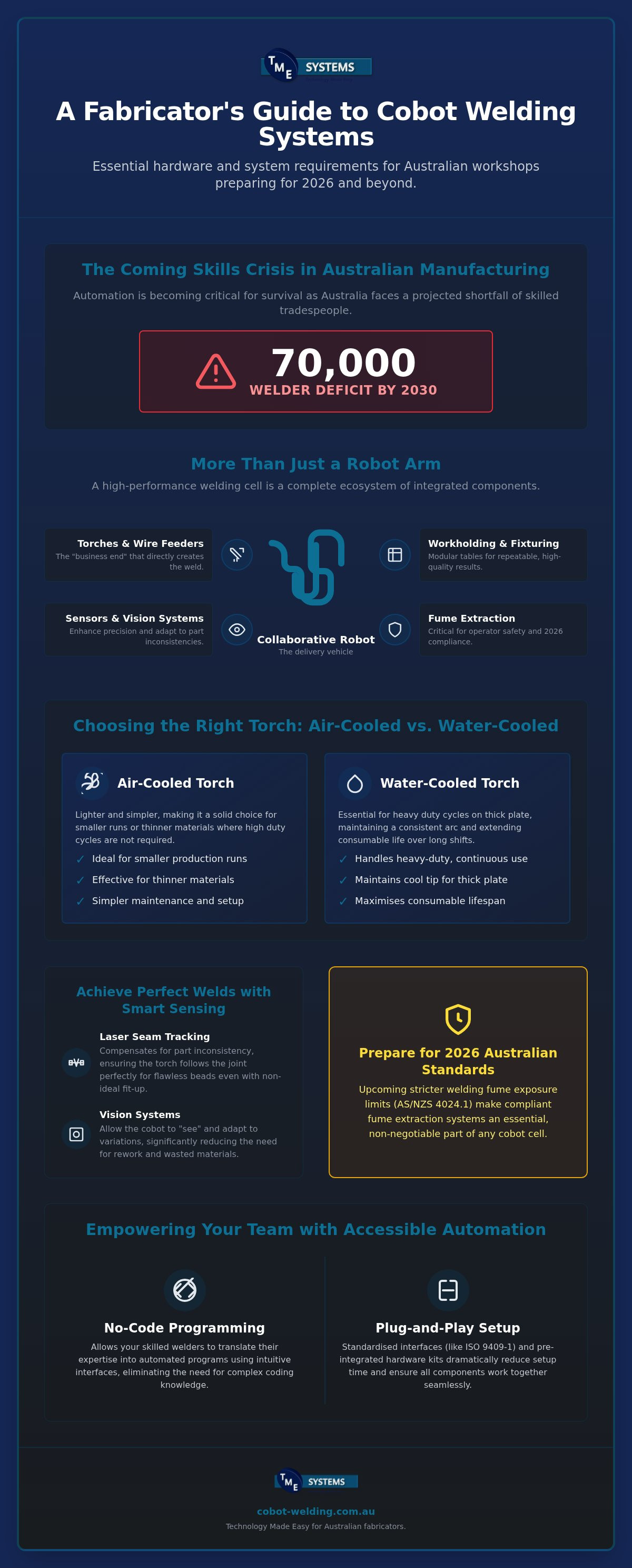

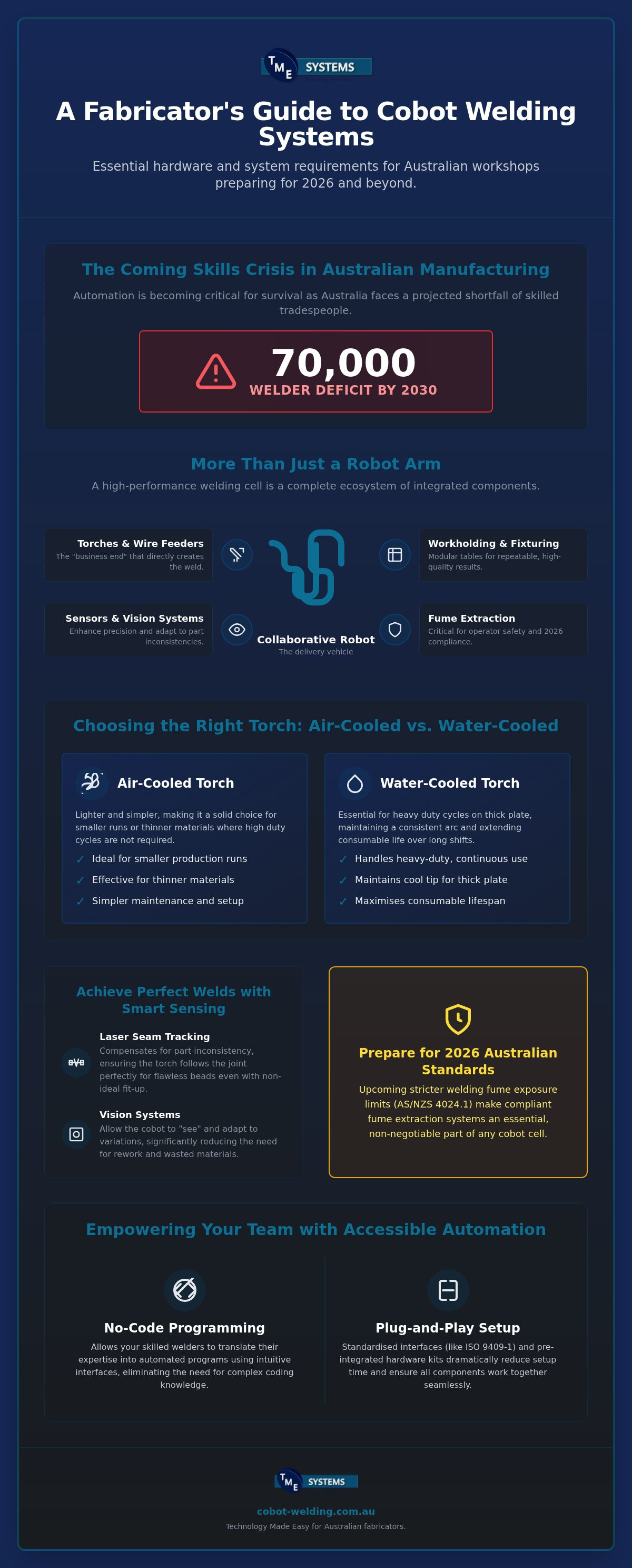
Australia is projected to face a deficit of 70,000 welders by 2030, making the shift toward automation a matter of long-term survival for local fabricators. You've likely experienced the frustration of high rework rates on repetitive parts, yet the fear of buying a system that is too hard to program often stalls progress. Understanding the specific cobot welding system requirements for your workshop floor is the first step toward reclaiming your margins and supporting your skilled tradespeople with better tools.
We agree that automation should be a practical partner rather than a technical burden. This guide promises to detail the essential hardware and accessory requirements that transform a standard cobot into a high-performance welding tool. We'll preview the necessary hardware for 2026, explain how accessories like sensors improve weld quality, and outline a setup that operators can use without any coding knowledge. It's time to make innovation feel attainable on the workshop floor.
Key Takeaways
- Learn how to select the right "business end" hardware, including the differences between air-cooled and water-cooled torches for high-duty cycles.
- Understand the fundamental cobot welding system requirements, from choosing the correct wire feeder tension to selecting modular 16mm or 28mm welding tables.
- Discover how laser seam tracking and vision systems can compensate for part inconsistency, ensuring perfect beads even when fit-up isn't ideal.
- Prepare for the stricter 2026 Australian welding fume exposure limits by integrating compliant extraction systems into your collaborative cell.
- See how no-code software removes the barrier of complex programming, allowing your skilled welders to control advanced accessories without writing a single line of code.
The Ecosystem of Collaborative Robot Welding Accessories
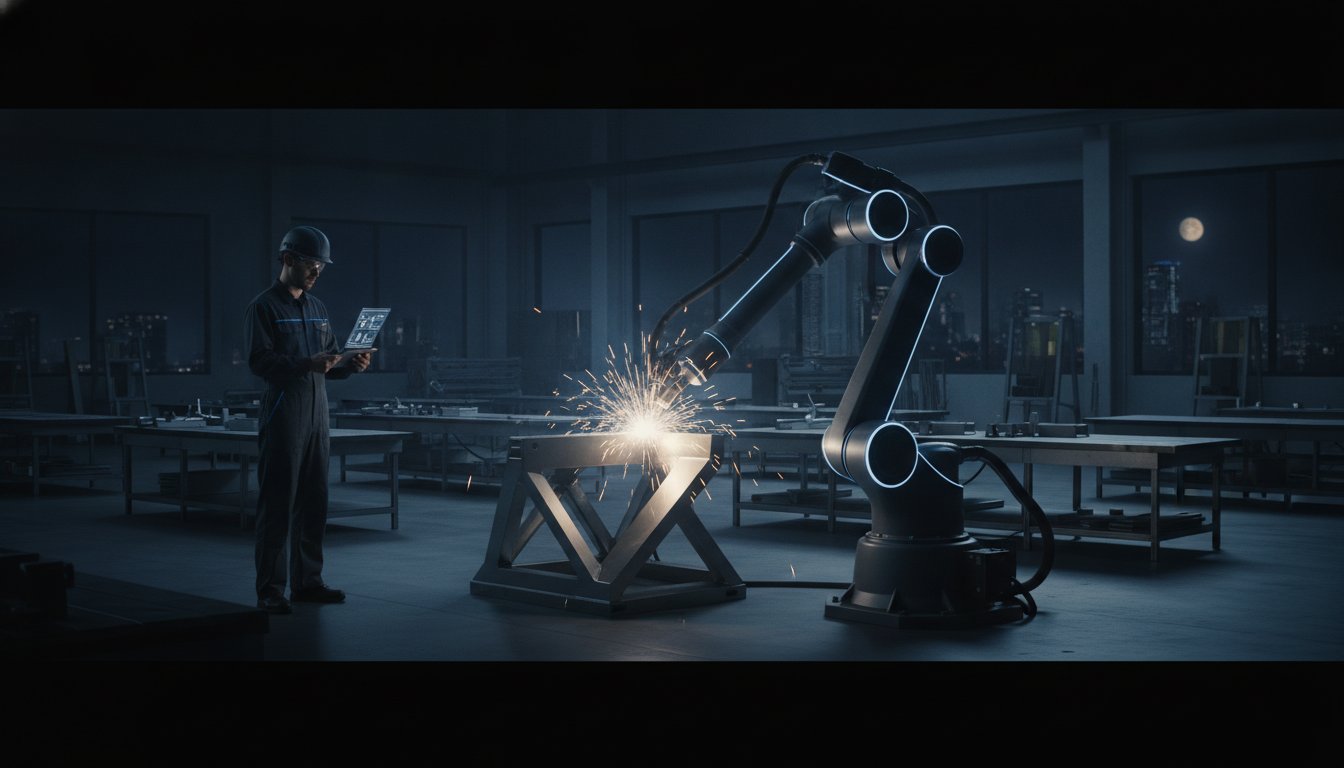
A collaborative robot (cobot) is often seen as the star of the show, but it's really just the delivery vehicle for the tool. Think of the arm as the arm of a human welder; it provides the reach and the steady hand, but the torch, the wire feeder, and the gas delivery are what actually create the weld. We treat the collaborative welding cell as a complete ecosystem where every part must work in unison. These accessories are the "business end" of your robotic automation, directly impacting the quality of your finish and the speed of your production.
The industry has moved away from the days of custom-engineered, one-off parts that required a dedicated engineer to install. Today's workshops benefit from modular, off-the-shelf kits designed for rapid deployment. This modularity is a core pillar of modern cobot welding system requirements. It ensures that your hardware is ready to sync with no-code robot welding software. When the hardware and software are pre-integrated, your operators can focus on welding logic rather than troubleshooting communication errors between the arm and the torch.
Standardised Interfaces and Plug-and-Play Setup
The introduction of standardised mounting interfaces, like ISO 9409-1, has changed the game for high-mix fabrication. You're no longer locked into a single setup for the life of the machine. By choosing accessories designed specifically for cobots, you gain a plug-and-play experience that mirrors modern consumer tech. Quick-change tool systems are particularly effective for Australian shops handling diverse job lots. They allow you to swap between different torch angles or specialised sensors without recalibrating the entire system, which keeps your downtime to an absolute minimum.
Meeting Australian Workshop Standards in 2026
Local workshops operate under some of the world's strictest safety and environmental regulations. In 2026, meeting cobot welding system requirements means more than just having a working torch; it means full compliance with AS/NZS 4024.1. Accessories must be built to handle the unique stresses of the Australian floor, from high ambient temperatures to heavy-duty duty cycles. We've seen "cheap" international imports fail because they aren't rated for the continuous use or the electrical standards required here. Investing in robust, locally compliant hardware ensures your cell stays operational and your team stays safe.
The Business End: Torches, Wire Feeders, and Consumables
The torch and wire feeder are where the actual work happens. While the robotic arm provides the movement and reach, these components dictate the arc stability and weld integrity. Selecting the right hardware is a vital part of your cobot welding system requirements. If you pick a torch that can't handle your specific duty cycle, you'll face constant overheating and unnecessary downtime. Matching the tool to the task ensures the machine works as hard as your best welder.
For many local fabricators, the choice between air-cooled and water-cooled torches depends on production volume. Air-cooled torches are lighter and simpler to maintain, making them a solid choice for smaller runs or thinner materials. However, if you're running heavy duty cycles on thick plate, a water-cooled system is often essential. It keeps the contact tip cool, which extends consumable life and maintains a consistent arc over long shifts. This consistency separates a profitable cell from one that requires constant manual intervention.
High-Performance Torches for Cobot Cells
Neck angles and reach are often overlooked until the arm is already on the workshop floor. A standard 45-degree neck might work for flat fillets, but complex joint geometries often require specialised 22-degree or 60-degree necks to avoid collisions with the workpiece. Integrated "smart" torches are also becoming standard in 2026. These allow the operator to adjust wire speed or trim directly from the torch handle during the teaching phase. This operator-centric design aligns with research-based safety guidelines that emphasise the importance of ergonomic and intuitive controls to protect workers in automated environments.
Precision Wire Management Systems
Consistent wire tension is the secret to smooth beads and reduced spatter. High-torque feeder motors prevent "bird-nesting" at the drive rolls, which is a common headache in robotic MIG setups. Industry data suggests that robotic welding can use 15-25% less wire per metre compared to manual welding because the travel speed and arc length are so tightly controlled. To capture these savings, you need drive rolls and liners tailored to your specific wire type. For example, U-groove rolls are a must for aluminium to avoid crushing the soft wire. If you're unsure which setup fits your material, you can explore integrated welding cells that come pre-configured for your specific applications.
Managing consumables is the final piece of the puzzle. It's not just about having enough tips in the drawer; it's about using high-quality liners that reduce friction and prevent unplanned stoppages. In a high-volume shop, a single contact tip failing can halt a high-value system. We recommend a proactive replacement schedule based on arc-on time to keep your production moving without surprises. This pragmatic approach to maintenance ensures your investment continues to pay for itself shift after shift.
Enhancing Precision with Sensors and Vision Systems
Part inconsistency is the primary enemy of robotic welding. While a human welder naturally adjusts their hand to compensate for a slightly wider gap or a warped plate, a standard robot follows a fixed path regardless of what's underneath it. If your parts aren't identical every single time, you'll end up with rework that eats into your profit margins. This is why advanced sensing technology has become one of the most critical cobot welding system requirements for modern Australian workshops.
To overcome these variations, we look to touch sensing and vision systems. Touch sensing is a pragmatic starting point; it uses the welding wire or the gas nozzle to physically probe the workpiece before the arc strikes. By finding the exact location of the joint in 3D space, the system can shift its entire programmed path to match the part's actual position. It's a simple, reliable way to handle the realities of workshop tolerances without needing to invest in aerospace-grade machining for every component.
Laser Seam Tracking and Adaptive Welding
For long structural welds where heat distortion is a factor, real-time adjustment is necessary. Laser seam tracking acts as the "eyes" of the weld path. Unlike pre-weld sensing, real-time tracking stays just ahead of the arc, measuring the joint geometry as the weld progresses. If the heat from the arc causes the metal to pull or bow, the system detects the shift and adjusts the torch position and welding parameters instantly. This level of control is vital for maintaining compliance with cobot welding safety standards, as it ensures the weld stays exactly where it's supposed to be, reducing the risk of structural failure or hazardous spatter.
Vision Systems for Automated Part Recognition
One of the biggest hurdles in automation is the cost of high-precision jigs. Vision systems change the math by allowing the cobot to recognise different parts in a high-mix run. Instead of building a custom fixture for every job, a camera can identify which part is on the table and trigger the correct program automatically. This flexibility is a core part of successful cobot welding integration, as it lets your team spend less time on setup and more time on production.
The best part about modern vision technology is that it no longer requires a computer science degree to operate. We focus on integrating these cameras into the same no-code interface your welders already use. Teaching the system to recognise a new part is often as simple as taking a few photos and defining the weld paths. This grounded approach to technology ensures that your most experienced tradespeople remain in control of the process, using sensors as a tool to enhance their own craftsmanship rather than being intimidated by complex "tech-heavy" hardware.
Workshop Essentials: Workholding, Fixturing, and Fume Extraction
Standard G-clamps and magnetic squares are staples of the manual welding bay, but they often fail when introduced to a robotic environment. A robot is only as good as the consistency of the parts it's given. If a part is bumped just 2mm out of place during clamping, the programmed path becomes useless, leading to the very rework you're trying to avoid. Ensuring your workholding is rigid and repeatable is a core pillar of cobot welding system requirements that many shops overlook until the arm is already on the floor.
The foundation of a successful setup is almost always a modular welding table. Choosing between a 16mm system for lighter components or a 28mm system for heavy plate gives you a precision grid to work from. These tables allow you to "lock in" your setup so that the first part of the day is in the exact same position as the last. When planning your collaborative robot welding cells, consider how the table height and accessibility affect the operator's ability to load and unload parts without straining against the robot's reach.
Modular Fixturing for Small-Batch Success
In a high-mix Australian shop, you can't afford to spend hours building custom jigs for every job. Modular fixturing allows you to build a repeatable setup in under 30 minutes using a combination of stop blocks, pins, and toggle clamps. This approach turns your welding table into a flexible production line. The ROI on high-quality modular components is found in the lack of rework and the speed of changeover. Instead of "eyeballing" the fit-up, your operators can trust the fixture, allowing them to focus on managing multiple cells or performing higher-value tasks while the cobot handles the repetitive beads.
Fume Control and Local Workshop Safety
Air quality is no longer just a "best practice" issue; it's a legal necessity. New Australian Workplace Exposure Limits (WELs) for welding fumes come into full effect on December 1, 2026, following the 2024 reduction of the general limit to 1 mg/m³. In a collaborative space where operators work closely with the machine, on-torch fume extraction is often the most pragmatic solution. It captures the smoke at the source, moving with the cobot arm to ensure consistent air quality without obstructing the operator's view.
Safety doesn't stop at the air you breathe. While cobots are designed to stop on contact, you must still manage risks from arc flash and hot parts. Depending on your risk assessment, you might need safety scanners or light curtains to slow the robot when a person enters the immediate work zone. This balanced approach to safety ensures you comply with AS/NZS 4024.1 while maintaining the "open" feel of a collaborative workshop. If you're ready to see how these elements fit into your specific floor plan, you can book a mobile demo to test a setup in your own environment.
Optimising Your Setup with No-Code Integration and Support
Buying a robot arm is only half the battle. The real challenge lies in making that arm talk to your power source, wire feeder, and sensors. We focus on turning these individual components into a seamless turnkey solution. We handle the technical heavy lifting of integration so you can focus on what you do best: producing high-quality fabricated parts. This integrated approach ensures that your cobot welding system requirements are met without your team needing to become IT experts.
A major part of modern automation is the ability for the software to "see" and control every accessory in the cell. If your software can't adjust the gas flow or wire speed on the fly, you're missing out on the primary benefits of robotic precision. Our setup ensures that your hardware and software are perfectly synced, removing the friction that often comes with multi-brand setups. When the system works as one, your operators can refine the welding process rather than troubleshooting communication errors between the machine and the torch.
Software Compatibility: Teaching Accessories without Coding
Traditional industrial robots require lines of code to change a simple weave pattern or travel speed. Our no-code interface replaces that complexity with intuitive sliders and touch-screen controls. You can store specific accessory settings for repeat jobs, ensuring that the weld parameters for a 10mm fillet remain consistent every time the job returns to the floor. No-code software is the bridge between human skill and robotic precision. It allows your best welders to transfer their years of knowledge into the machine without ever typing a line of code.
National Support and Operator Onboarding
Even the most advanced system is only as good as the support behind it. Because we operate across Australia, we ensure you have rapid access to spare parts for torches, feeders, and liners. You won't be waiting weeks for a specialised part to arrive from overseas while your cell sits idle. We also prioritise on-site cobot welder training to ensure your team feels confident and capable from day one. This onboarding is designed to be hands-on, focusing on the practical realities of your specific workshop floor.
We understand that seeing is believing in the fabrication industry. If you're still weighing up how these accessories fit into your workflow, booking a mobile welding robot demonstration is the most pragmatic way to find out. Our team brings the system to you, allowing you to test the no-code interface and hardware integration on your own parts. This hands-on proof of concept removes the guesswork and helps you build a business case based on real-world workshop results.
Future-Proofing Your Workshop Floor
Modernising your workshop doesn't have to be an intimidating leap into the unknown. By focusing on the right hardware and accessories, you turn a complex piece of technology into a practical tool that your team can master. We've explored how high-performance torches and modular fixturing create the repeatability needed for robotic success, while no-code integration ensures your investment stays productive without requiring computer science expertise.
Navigating the specific cobot welding system requirements for your floor is the first step toward solving the skilled welder shortage and reducing costly rework. TME Systems Pty Ltd acts as your local partner, providing turnkey cells and the training your operators need to hit the ground running on day one. Our national integration and training support ensure that you're never left to figure out the technical details on your own.
If you're ready to see how this technology adapts to your specific parts and production flow, the next step is simple. Book a mobile demonstration to see our cobot accessories in your workshop and discover how accessible automation has become. Your own workshop floor is the best place to prove what's possible for your business.
Frequently Asked Questions
What are the most essential accessories for a new cobot welding cell?
The most essential accessories include a high-quality welding torch, a precision wire feeder, and a modular welding table. You'll also need a compliant fume extraction system to meet the 2026 Australian exposure limits. These components form the core cobot welding system requirements for any shop looking to achieve repeatable, high-quality results from day one. Ensuring these parts are integrated correctly is what allows the system to function as a single, reliable tool.
Can I use my existing MIG power source with a new cobot?
You can often use an existing MIG power source, but it depends on its communication capabilities. Digital power sources with standardised interfaces are much easier to integrate for full control over welding parameters via the cobot's interface. If your current machine is an older analogue model, you might be limited to simple on/off triggers. We recommend checking compatibility early to ensure you can actually leverage the precision of robotic automation.
How does no-code software handle complex accessories like seam trackers?
No-code software handles complex accessories by translating technical data into a visual, user-friendly interface. Instead of writing scripts for a laser seam tracker, the operator uses touch-screen controls to set the tracking sensitivity and path offsets. This approach ensures that your skilled welders can manage advanced sensors without needing a background in computer programming. It keeps the focus on the weld quality rather than the underlying software code.
Is water-cooling necessary for robotic welding torches?
Water-cooling is necessary if you're running high-duty cycles or welding thick materials that generate significant heat. For lighter fabrication or shorter runs, an air-cooled torch is usually sufficient and easier to maintain. However, robotic systems can often outpace human welders in "arc-on" time. If your production schedule involves continuous welding for several hours, water-cooling protects your consumables and prevents the torch from overheating during long shifts.
What kind of maintenance do cobot welding accessories require?
Maintenance for cobot accessories focuses on the "wear parts" and sensor accuracy. You'll need to regularly replace contact tips and liners to prevent wire feed issues. Drive rolls should be checked for wear, and sensors like laser trackers need occasional cleaning to ensure the "eyes" of the system stay clear. A proactive schedule prevents unplanned stoppages and ensures the hardware continues to meet the necessary cobot welding system requirements for precision.
Do I need specialised safety guarding for collaborative welding accessories?
Specialised safety guarding depends entirely on your specific risk assessment under AS/NZS 4024.1. While the cobot arm is collaborative, the welding arc and hot spatter are not. You may need safety scanners, light curtains, or physical screens to protect bystanders from arc flash and heat. The goal is to create a setup that protects your team while maintaining the accessibility and floor efficiency that makes collaborative robots so effective.
How do modular welding tables improve robotic welding productivity?
Modular welding tables improve productivity by providing a perfectly flat, repeatable grid for your fixtures. They allow you to swap between different jobs in minutes rather than hours. By using standardised pins and clamps, you ensure that every part is loaded in the exact same position. This repeatability is vital for robotic cells, as it eliminates the need for the operator to manually adjust the program for every new workpiece.
Are vision systems worth the investment for small-batch fabrication?
Vision systems are often highly valuable for small-batch fabrication because they reduce the need for expensive, job-specific jigs. A camera can identify different parts on the table and tell the cobot which program to run. This flexibility allows you to handle a high mix of work without building a mountain of custom fixtures. It's a pragmatic way to increase the versatility of your cell and keep your production moving through varied job lots.