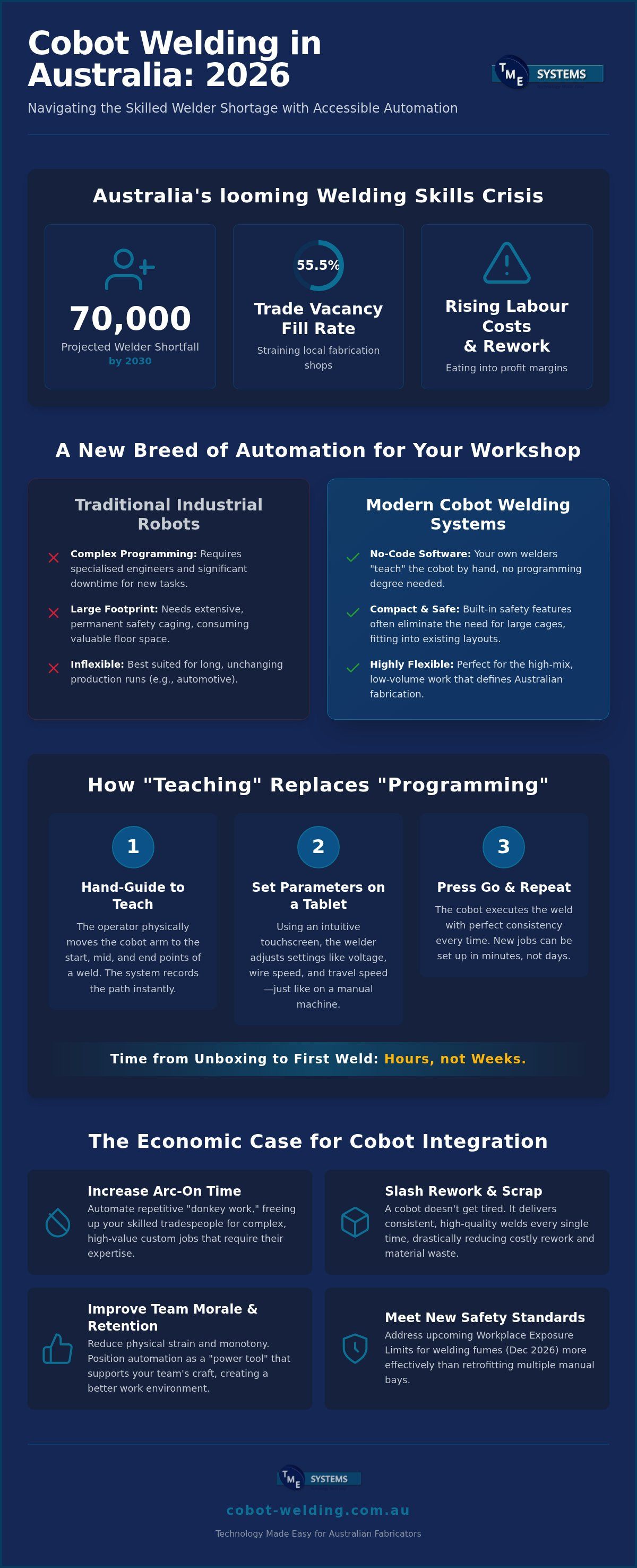

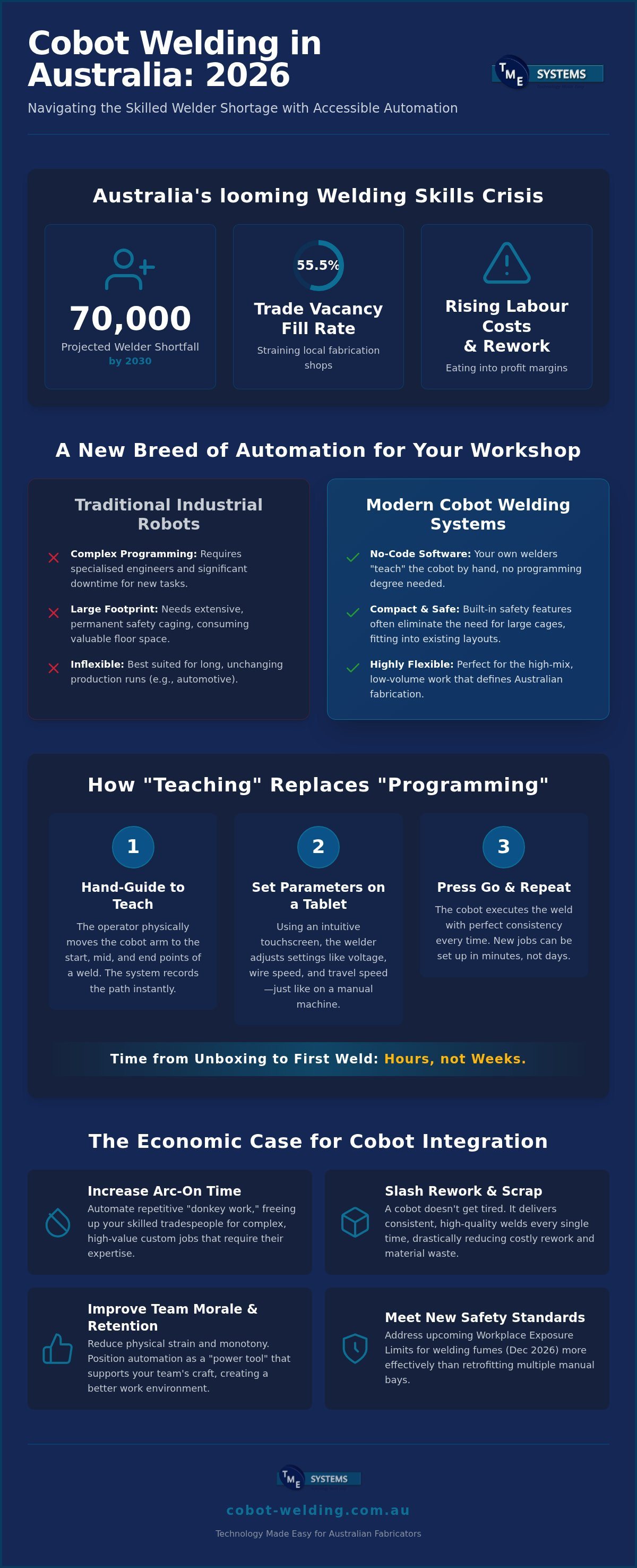
With Australia projected to face a shortfall of 70,000 welders by 2030, the pressure on local fabrication shops has never been higher. You've likely felt the strain of trying to find ticketed staff just to keep the lights on, only to see your best tradespeople bogged down by repetitive, soul-destroying runs. It's a common frustration, and it's natural to worry that automation is too complex or expensive for a smaller workshop. We agree that technology should support the trade, not replace the craftsman.
This guide explores how cobot welding systems Australia are changing that narrative, providing a practical way to boost throughput without needing a degree in robotics. You'll discover how no-code software puts the power back in the hands of your welders, ensuring consistent quality and freeing up your team for the high-value custom work that keeps them engaged. We'll preview the steps to making your floor more efficient and show you how accessible automation can help you retain your most skilled staff while optimising your production line for 2026 and beyond.
Key Takeaways
- Discover how no-code teaching software allows your tradespeople to "teach" the robot by hand-guiding the arm, making complex programming a thing of the past.
- Learn why the compact footprint and safety features of cobot welding systems australia make them the perfect fit for busy workshops without the need for massive safety cages.
- Identify which repetitive jobs in your current workflow are the best candidates for automation to help you significantly increase your daily arc-on time.
- Find out how a mobile demo and on-site proof of concept can verify weld quality on your actual materials before you make any investment.
- Understand the role of operator onboarding in ensuring your team views automation as a "power tool" that supports their craft rather than a replacement.
The State of Cobot Welding Systems in Australia for 2026
The Australian fabrication landscape is changing fast. In 2026, the industry is hitting a critical juncture where waiting to automate is no longer a viable strategy for many workshops. Labour costs are rising, and the trade vacancy fill rate has dropped to just 55.5%. For many owners, the struggle isn't just about finding staff; it's about staying competitive while rework costs on repetitive parts eat into margins. This is where cobot welding systems australia are making a real difference. Unlike the massive, caged robots of the past, these flexible cells are designed for the high-mix, low-volume work that defines the local market.
Robotic welding has historically been the domain of automotive giants, but today's technology is far more accessible. We're seeing a steady shift toward reshoring manufacturing tasks that were previously sent overseas. By using collaborative automation, local shops can handle smaller batches profitably right here at home. It's about regaining control over your production timeline and ensuring that "Made in Australia" remains a badge of quality and efficiency.
Addressing the Skilled Welder Shortage
Australia's projected shortfall of 70,000 welders by 2030 means your best tradespeople are stretched thin. It doesn't make sense to have a highly skilled welder spending eight hours a day on simple, repetitive fillet welds. Cobots can take over this "donkey work," allowing your team to focus on complex joins and high-value custom projects that actually require their years of experience.
This shift does more than just boost output. It improves workshop morale. By reducing the physical strain and the monotony of repetitive runs, you create a better working environment. It's about giving your team a sophisticated tool that makes their job easier, rather than replacing their expertise. When the machine handles the boring stuff, your staff can focus on the craftsmanship that keeps them engaged.
The Economic Case for Local Automation
The financial argument for automation has shifted. In 2026, the focus isn't just on the initial investment, but on the massive reduction in rework and scrap. A cobot doesn't get tired or lose concentration late in the afternoon. It delivers consistent weld quality every single time, which slashes your cost per weld on medium-sized batches. Consistent quality means fewer rejected parts and a more predictable bottom line.
With new Workplace Exposure Limits for welding fumes coming into full effect in December 2026, many shops are using this as the catalyst to modernise. Integrating a cobot cell often makes more financial sense than retrofitting old manual stations with extensive extraction systems. When you factor in various government incentives for manufacturing modernisation, the path to a more productive workshop becomes much clearer. It's a pragmatic investment in the long-term survival of your business.
What is No-Code Robot Welding Software?
For years, the primary barrier to automation wasn't the cost of the hardware; it was the technical expertise required to operate it. Traditional industrial robots rely on complex programming languages that require specialised training and hours of keyboard work. No-code software changes this by acting as a bridge between the welder's skill and the machine's precision. No-code software is a visual interface for complex kinematics. It allows your tradespeople to control the robot using logic they already understand, rather than lines of code they have to learn from scratch.
This shift marks the end of the traditional "teach pendant," those bulky, button-heavy controllers that felt more like a 1980s computer than a modern tool. Today, cobot welding systems australia utilise intuitive touchscreens and tablet interfaces. According to a recent global robotics report, the push for simplified programming is a major factor in the record-high adoption of robots across manufacturing sectors. When the software is easy to use, the time from unboxing to the first weld is measured in hours, not weeks.
You can adjust critical parameters like voltage, wire feed speed, and travel speed in real time through a simple touch interface. If the weld pool looks too hot or the travel is too slow, you make the adjustment on the screen just as you would tweak the dials on a manual power source. It's a pragmatic approach that keeps the welder in control of the process.
How "Teaching" Replaces "Programming"
The "lead-through" method is the heart of no-code systems. Instead of typing in coordinates, the operator simply grabs the robot arm and moves it by hand to the start and end points of the weld. You can visually plan the weld path on a tablet and see exactly where the torch will travel before the arc even strikes. This prevents expensive crashes and wasted material. Once a job is set, you save it to a library. Recalling that specific setup for a repeat batch next month takes only a few minutes, which significantly slashes your setup times for small-run jobs.
Software Features for Australian Fabricators
Modern software is designed with the reality of a busy workshop in mind. The interfaces use intuitive icons and clear Australian English, making staff adoption much smoother. These systems are built to integrate with the MIG and TIG units you already have on your floor. Furthermore, cloud updates ensure your no-code robot welding software stays current with the latest safety protocols and feature sets without manual intervention. If you want to see how this interface feels in a real-world setting, our mobile demo system is a great way to let your team try it for themselves.
Cobots vs. Industrial Robots: Choosing the Right System
Choosing between a traditional industrial robot and a collaborative robot (cobot) is a critical decision for any fabrication business. While both aim to automate the welding process, they serve very different operational needs. Traditional industrial robots are built for raw speed and high-volume output. They require fixed positions and substantial safety guarding to protect workers from their high-speed movements. For a large-scale automotive line, they're the obvious choice. However, for the typical Australian job shop, the sheer footprint and complexity of these systems can be a major drawback.
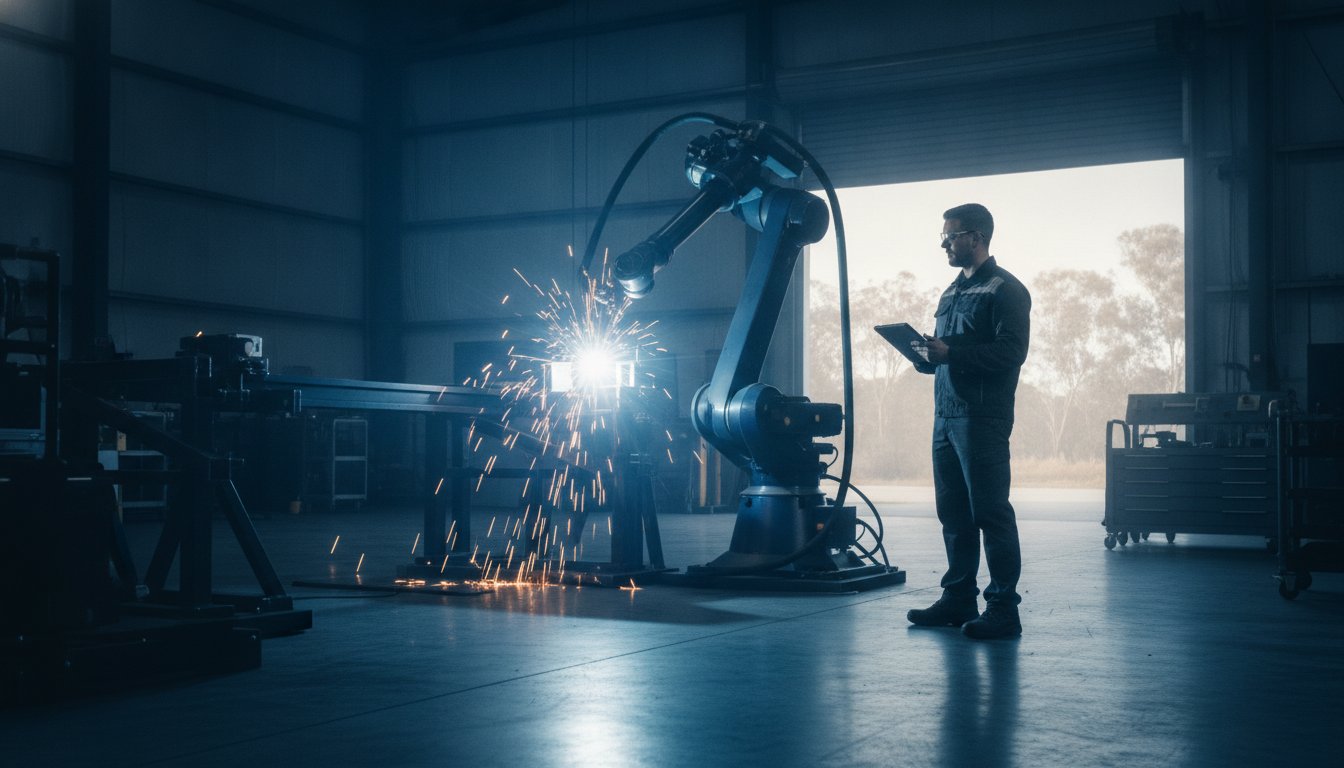
In contrast, cobot welding systems australia are designed to work alongside your team. They don't need a massive, dedicated cage because they're built with safety at their core. This makes them much easier to integrate into a crowded workshop where space is already tight. You can even move a cobot between different workbenches as your production needs change, giving you a level of agility that fixed automation simply can't match.
Space and Safety Requirements
The primary difference lies in how these machines handle safety. Cobots are equipped with force-limiting sensors that detect any physical contact. If the arm bumps into an operator or an obstruction, it stops instantly. This inherent safety, supported by research from the Australian Cobotics Centre, allows for a much more open workshop layout. You won't need to spend thousands on expensive light curtains or physical fencing that blocks access to your floor. While you still need to conduct a risk assessment to comply with Australian safety standards, the barrier to entry is significantly lower.
Batch Size and Mix Flexibility
If your workshop handles a wide variety of parts in small quantities, cobots are the superior option. They excel at high-mix, low-volume production because the setup time is so low. You can switch from one job to another in about 10 minutes. Compare this to traditional industrial robots, where re-programming and re-tooling can take several hours or even days. This flexibility means you can profitably automate batches as small as five or ten units. To help you weigh up the technical specs of different models, we've put together the Australian guide to collaborative robot welding cells. It's a pragmatic resource for anyone trying to determine which hardware will actually deliver a return on the workshop floor.
Integrating a Welding Cobot into Your Workshop
Integrating cobot welding systems australia into your floor shouldn't feel like a massive engineering overhaul. It's a practical, step-by-step process that starts with a simple assessment of your current workflow. Look for the "boring" jobs first. The best candidates for automation are high-volume parts with simple linear or circular welds that currently tie up your best tradespeople. Once you've identified these parts, you can prepare your floor. Most cobot cells have a compact footprint, but you'll still need to ensure stable power and a reliable gas supply are within reach of the new workstation.
The biggest hurdle often isn't the technology; it's the culture. Introduce the cobot as a "new mate" that's here to handle the repetitive donkey work. When your team sees that the robot is there to take the physical strain off their backs, rather than replace their expertise, the transition is much smoother. Working with cobot welding integration specialists ensures that the hardware and software are tailored to your specific workshop conditions from day one.
Operator Training and Onboarding
It's a common misconception that you need an IT expert to run a cobot. In reality, your best manual welders make the best operators. They already understand weld pools, heat input, and wire speeds. A structured training and onboarding programme can build this confidence in three days or less. We focus on the hands-on "teaching" method, ensuring your staff know how to register points and recall jobs. By the end of the first week, your team should be able to troubleshoot basic issues like wire feed hitches independently, keeping the cell running without constant supervision.
Maximising Productivity from Day One
Don't chase peak performance in your first forty-eight hours. Set realistic KPIs for the first month, focusing on consistency and weld quality over raw speed. The secret to long-term welding productivity often lies in your jigging and fixturing. If your parts aren't held in the same position every time, the robot can't deliver repeatable results. Spend time refining your jigs early on. This small investment in preparation ensures that once the arc is on, every part comes off the line perfect. If you're ready to see how this fits into your specific workshop, our welding system integration team can help you map out the best path forward.
Proof of Concept: The TME Systems Approach
Deciding to invest in cobot welding systems australia is a significant move for any fabrication business, and we understand that watching a generic video isn't the same as seeing a machine run on your own floor. While some suppliers rely on pre-recorded clips, we believe you need to see the weld quality on your actual materials to be certain. The approach at TME Systems Pty Ltd is built on transparency and practical proof. We offer a turnkey solution that combines collaborative robot welding cells, no-code software, and operator training into a single package designed specifically for the realities of Australian workshops.
The goal is to move you from curiosity to a functional welding cell with zero guesswork. We don't just provide the hardware; we partner with you to ensure the system is refining your production from day one. This end-to-end support is what makes the transition to automation feel attainable rather than intimidating. By focusing on a "proof of concept" model, we ensure the technology adapts to your needs, not the other way around.
Booking a Mobile Demonstration
The most effective way to evaluate this technology is through a mobile welding robot demonstration. TME Systems Pty Ltd brings the system directly to your site, allowing your team to see the technology in their own working environment. This isn't just for the management team; we actively encourage your welders to try the no-code interface themselves. When a tradesman sees how easy it is to "teach" the arm, the fear of complex technology disappears. During this visit, we also help you gather specific production data to provide a firm ROI estimate based on your specific parts and batch sizes.
Long-term Partnership and Support
The relationship with TME Systems Pty Ltd doesn't end once the cell is installed. We provide Australian-based technical support and maintain a local stock of spare parts to minimise any potential downtime. As your business grows, our software updates ensure your system stays current, adding new welding patterns and features that help you tackle even more complex jobs. Many of our clients start with a single cell to handle their most repetitive runs and then scale their automation by adding a second or third cell as they see the productivity gains. We're here to support that growth, acting as a trusted local partner for the long haul as you modernise your floor.
Future-Proof Your Fabrication Shop
The transition toward automation in 2026 isn't about replacing the skilled hands of a welder; it's about supporting them. By integrating cobot welding systems australia, you're giving your team a sophisticated power tool that handles the repetitive, low-value runs that currently drain your workshop resources. You've seen how no-code software removes the technical barriers, allowing your best tradespeople to lead the process with logic they already understand. This shift keeps your most experienced staff engaged with high-value custom work while your throughput stays consistent and your rework costs drop.
We believe the best way to move forward is with total confidence. Our mobile demo units are available to prove the weld quality on your actual parts, and we include full operator onboarding to ensure your staff are comfortable from the very first arc. Ready to see the difference for yourself? Book a Mobile Welding Robot Demonstration for your workshop and start refining your production line today. Taking that first step toward a more efficient floor is a practical investment in the long-term success of your business. We're here to help you get started.
Frequently Asked Questions
Do I need a computer programmer to run a welding cobot?
You don't need a computer programmer or IT expert to operate these systems. Modern cobot welding systems australia use no-code software designed specifically for tradespeople. Your welders simply hand-guide the robot arm to the start and end points of the join. If they can operate a smartphone or a modern digital power source, they have the technical skills required to program and refine robotic weld paths independently.
What types of welding can a cobot handle (MIG, TIG, etc.)?
These systems are highly versatile and can handle most common processes, including MIG and TIG welding. Because the software allows for precise control over travel speed and torch angle, you can achieve high-quality results on various joint types. We integrate the cobot cell with your preferred power source, ensuring the machine adapts to your existing workshop standards rather than forcing you to change your established consumables or gases.
Is a cobot safe to use without a safety cage in my workshop?
Most collaborative systems are designed to operate without the bulky safety cages required by traditional industrial robots. They use force-limiting sensors to stop the arm instantly if it makes contact with an obstacle or a person. While you must still conduct a workshop risk assessment to comply with Australian safety standards, the compact footprint and inherent safety of a cobot make it much easier to fit into a busy production line.
How long does it take to train an experienced welder to use a cobot?
An experienced welder can typically learn to operate a cobot and program new jobs in three days or less. Since they already understand the fundamentals of weld pools and heat input, they're only learning a new way to move the torch. Our operator training and onboarding process focuses on hands-on "teaching," which builds confidence quickly and ensures your team sees the technology as a helpful tool rather than a threat.
Can a cobot welding system work with aluminium and stainless steel?
Yes, cobots are excellent for working with heat-sensitive materials like aluminium and stainless steel. The precision of the robotic movement allows for consistent travel speeds, which is critical for managing heat input and preventing distortion on thinner gauges. By refining the weld parameters through the touch interface, you can achieve the same high-standard finish on every part, significantly reducing the cost of rework and scrap in your workshop.
What is the typical return on investment for a welding cobot in Australia?
The return on investment depends on your specific production mix, but many shops see significant gains through increased arc-on time and reduced rework. By automating repetitive runs, you free up your skilled staff for high-value custom projects. While we don't quote fixed prices for cobot welding systems australia, the reduction in manual labour costs and the ability to handle larger batches often lead to a pragmatic payback period for local fabricators.
What happens if the robot hits something or someone during operation?
If the robot arm encounters an obstruction or makes contact with an operator, the internal sensors detect the resistance and stop the machine immediately. This force-limiting technology is a core feature of collaborative design. Once the path is clear, the operator can reset the system and resume the job. This safety mechanism is what allows the machine to work in close proximity to your team without the need for traditional physical barriers.
Do I need special jigs or fixtures for robotic welding?
Repeatability is the key to successful automation, so you will need jigs or fixtures to ensure parts are held in the exact same position every time. If the part moves, the robot will still follow its programmed path, which leads to inconsistent results. Investing time in simple, robust fixturing allows the cobot to deliver the precision it's built for. We can provide advice on optimising your jigs during the integration process.