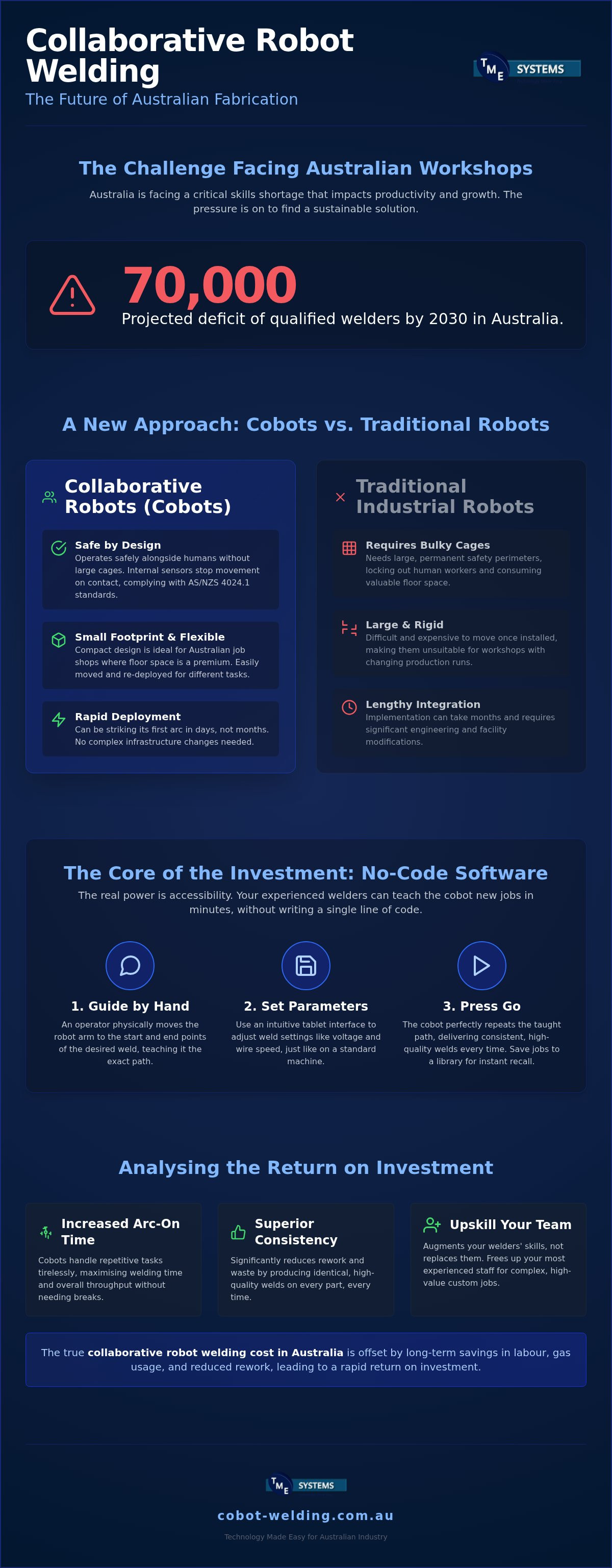

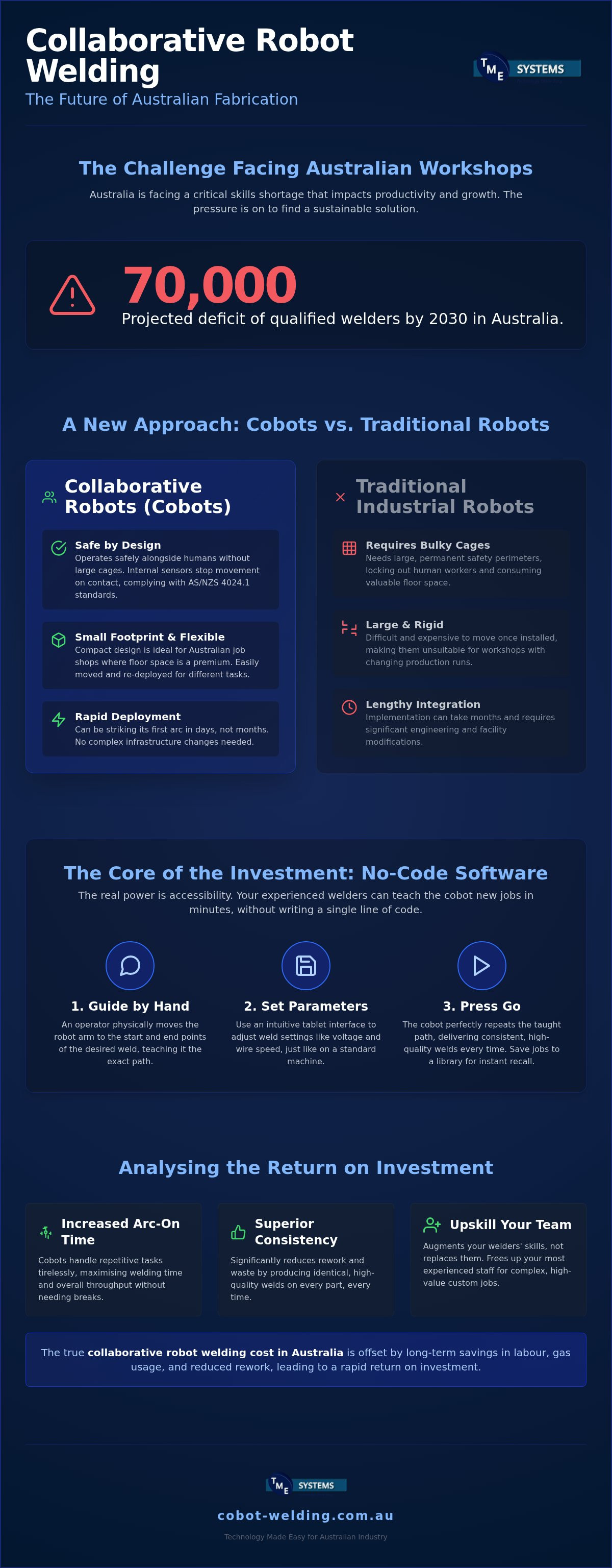
By 2030, Australia is projected to face a deficit of 70,000 qualified welders, a reality that's already squeezing the margins of local fabrication shops. You've likely felt the pressure of searching for specialised MIG or TIG staff while watching rework costs climb due to inconsistent manual welds. It's easy to assume that automation is a luxury reserved for the biggest players or that it's simply too complex for your small-batch runs. When investigating collaborative robot welding cost australia, it's vital to look beyond the initial investment and focus on how these systems integrate with your current workshop team.
We understand that your success relies on practical results, not tech-heavy jargon. This 2026 guide will show you how no-code teaching software and collaborative arc welding robots allow your existing staff to boost productivity without needing any programming expertise. You'll learn how to overcome the skills shortage and increase arc-on time while maintaining the high standards your clients expect. We'll provide a clear overview of the investment landscape, current safety standards like AS/NZS 4024.1, and how to achieve a rapid return on investment through faster throughput and significantly reduced rework.
Key Takeaways
- Understand how collaborative robots operate safely alongside your team without bulky safety cages, allowing you to maintain a flexible and efficient workshop layout.
- Discover how no-code software removes the barrier of complex programming, letting your experienced tradespeople set up new jobs by simply leading the robot arm by hand.
- Evaluate the true collaborative robot welding cost australia by comparing the initial investment against long-term savings in labour, gas usage, and reduced rework.
- Identify the high-repetition parts in your production line that will deliver the fastest return on investment and learn why on-site training is critical for staff buy-in.
- Learn how to arrange a mobile on-site demonstration to provide a practical proof of concept for your specific projects before committing to full deployment.
What Is a Collaborative Arc Welding Robot?
A Collaborative Robot (Cobot) is a machine designed to share a workspace with human operators. Unlike older systems that require massive safety perimeters, these units are built with internal sensors that detect contact and stop movement instantly. In a welding context, this means your team can work right next to the machine, loading parts or checking progress without being locked out by a physical cage. It's a significant shift for the Australian manufacturing sector, where the "skills gap" is no longer just a headline but a daily operational hurdle. With a projected deficit of 70,000 welders by 2030, workshops are looking for ways to maintain output without relying solely on a dwindling pool of qualified tradespeople.
This is where "no-code" teaching comes in. It acts as the essential link between traditional craftsmanship and modern technology. Instead of typing lines of complex code, a welder simply moves the robot arm by hand to define the weld path. It transforms the robot from a complex piece of IT equipment into a high-precision tool that any experienced fabricator can master in a few hours. When you consider the collaborative robot welding cost australia, this reduction in specialised programming labour is a major part of the savings.
Cobots vs. Traditional Industrial Robots
The primary difference lies in safety and flexibility. Traditional industrial robots are powerful but "blind," requiring heavy guarding to protect staff. Cobots use power and force-limiting sensors, meeting current safety standards like AS/NZS 4024.1:2019. This allows for a much smaller footprint, which is perfect for the typical Aussie job shop where floor space is at a premium. You can often deploy a cobot cell and have it striking its first arc in a matter of days rather than months.
Why "Collaborative" Is the Right Fit for Aussie Workshops
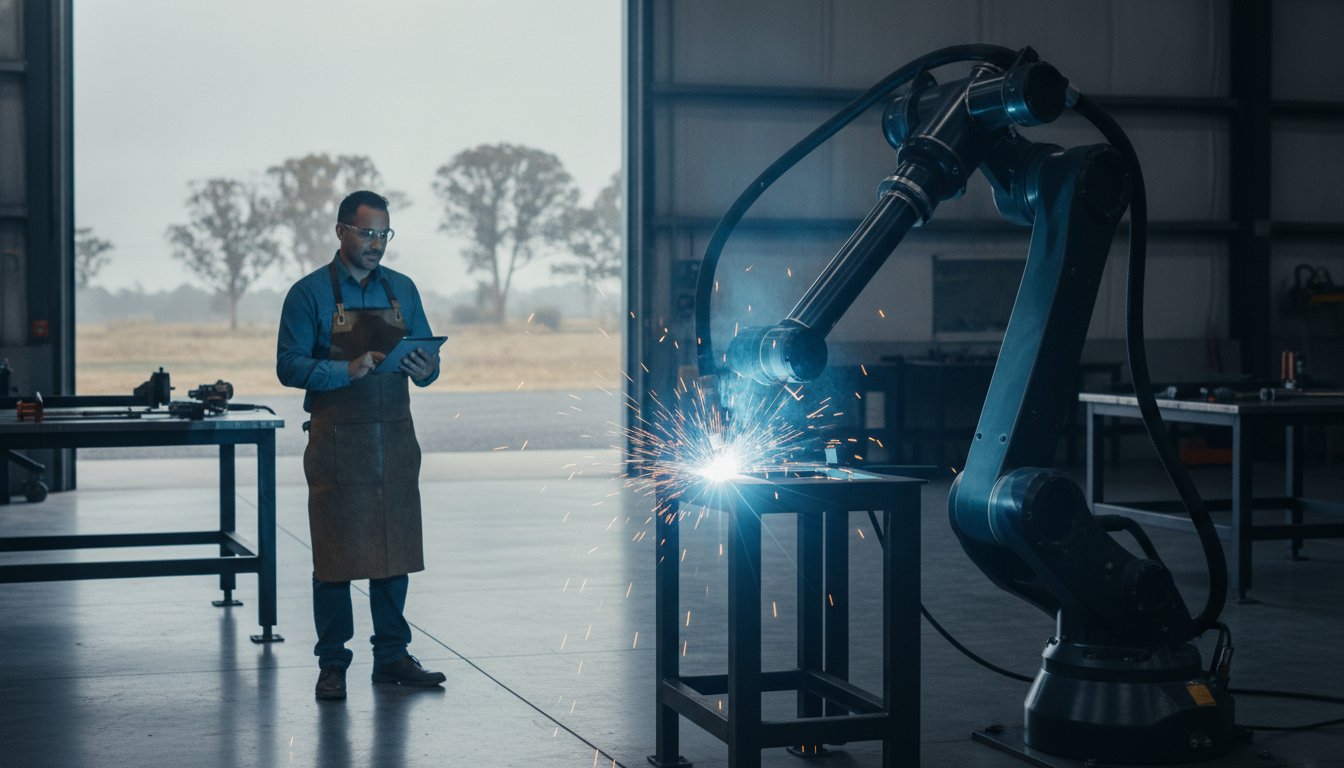
Automation shouldn't be about replacing your team; it's about augmenting their skills. Cobots excel at the repetitive "grunt work" like long straight seams or circular welds on pipe flanges. By handing these tasks to the robot, you free up your most experienced MIG and TIG welders for complex, high-value custom work that requires a human touch. It's a pragmatic way to increase "arc-on" time while upskilling your current staff to manage robotic cells. This collaborative approach ensures that your workshop stays competitive and productive, even when qualified labour is hard to find.
The Core of the Investment: No-Code Teaching Software
When you evaluate the collaborative robot welding cost australia, the hardware is only one side of the coin. The true value lies in the no-code robot welding software that drives the system. Traditional automation required a dedicated programmer to write complex syntax, often creating a bottleneck in small-batch environments. No-code systems replace this with an "operator-first" design. This means your best welders can manage the machine using an intuitive interface designed for people with dirty hands, not IT degrees. An International Federation of Robotics report highlights how this ease of use is driving adoption across global manufacturing. It allows for the adjustment of critical parameters like voltage and wire speed on the fly, ensuring the machine adapts to the material just as a human would.
Teaching Paths Without a Single Line of Code
Setting up a new job relies on lead-through teaching. You physically move the robot arm to the start of the joint, press a button to save the point, move to the end, and save again. It's a simple, logical workflow that mirrors the way a human approaches a weldment. Operators can organise and save a library of common parts, making it possible to switch between different production runs in minutes. This accessibility reduces the "fear factor" often felt by veteran welders. Instead of feeling replaced by a computer, they see the cobot as a high-precision tool they can master. This shift in mindset is crucial for long-term success on the workshop floor.
Why the Software Interface Is More Important Than the Robot Arm
A premium robot arm is ineffective if the software creates a barrier to entry. No-code software is the essential translator between welder intent and robot motion. High-quality systems include "wizards" and templates for standard joints like fillets, butts, and laps. These templates take the guesswork out of the setup by suggesting travel speeds and angles based on material thickness. This allows the operator to refine the process rather than fighting with code. Because these interfaces are built for the production line, they typically feature large, glove-friendly buttons and clear visual feedback. Understanding how these features impact the collaborative robot welding cost australia helps in justifying the move to automation. If you want to see how these tools can fit into your workflow, you can arrange a hands-on trial to test the ease of use yourself.
Analysing the ROI of Collaborative Robot Welding Cells
Calculating the true collaborative robot welding cost australia requires a hard look at your current manual operations. While the initial investment is a visible figure, the hidden costs of manual welding often go unmeasured. Labour is the obvious factor, but you also need to account for gas and wire wastage, along with the 5-10% rework rate typical in many Australian job shops. According to Weld Australia, the industry's peak body, adopting automation is a critical step for staying competitive as the domestic skills shortage deepens. By deploying collaborative robot welding cells, you can achieve a level of consistency that manual welding simply can't match, striking an arc that is identical every single time.
The primary driver of ROI is the increase in "arc-on" time. In a manual setup, a welder spends a large portion of their shift positioning parts, cleaning spatter, and taking necessary breaks. A cobot doesn't experience fatigue or distraction. It maintains a steady pace throughout the shift, allowing you to get more through the door without adding headcount. This is particularly effective for "High-Mix, Low-Volume" (HMLV) work, which represents the bulk of Australian fabrication. Instead of letting small jobs sit in a backlog, you can process them quickly and move on to the next project.
Productivity Gains in Small-Batch Australian Environments
Traditional industrial automation historically failed Aussie workshops because the setup time for a 10-part run often took longer than welding it by hand. Cobots have changed this equation. Because changeovers are fast and intuitive, even a 5-part run becomes profitable. You don't need to wait for a specialist programmer to arrive. Your team can swap jigs and load a pre-saved program in minutes. For a deeper look at these metrics, see our guide on improving welding productivity with cobots.
The Hidden ROI: WHS and Staff Retention
There's a significant human element to the ROI calculation. Welding exposes staff to harmful fumes, UV radiation, and intense heat. By handing repetitive seams to a robot, you reduce your team's exposure to these hazards and lower the risk of repetitive strain injuries. This directly impacts your WHS profile and can lead to lower insurance premiums and fewer claims. Furthermore, upskilling a manual welder to manage a robotic cell improves job satisfaction. They aren't just doing the "grunt work" anymore. They're becoming robotics technicians, which makes them more valuable to your business and more likely to stay long-term.
Integrating a Cobot Into Your Australian Workshop
Successful integration begins with a methodical needs analysis rather than just unboxing new hardware. A practical starting point is the 80/20 rule. Identify the 20% of your parts that consume 80% of your team's welding time. These high-volume or highly repetitive jobs are the ideal candidates for automation, providing the clearest path to justifying the collaborative robot welding cost australia. Once you've selected your pilot parts, you need to prepare the physical environment. This involves ensuring stable power, a consistent shielding gas supply, and adequate fume extraction that meets modern Australian workshop standards. Automation thrives on repeatability, so your existing infrastructure, including jigs and welding tables, must be flat and accurate to ensure the robot hits its marks every time.
The human element is the most critical factor in this transition. Providing on-site cobot welder training ensures your staff see the technology as a tool for their benefit rather than a threat to their roles. When your experienced welders understand how to refine the robot's path and adjust parameters, they take ownership of the cell's productivity. This hands-on onboarding process bridges the gap between traditional craft and robotic precision.
Partnering with Australian Integration Specialists
Working with a local cobot welding integration partner is vital for minimising downtime. Local specialists understand Australian power requirements and gas fitting standards, ensuring your setup is compliant from day one. If a technical issue arises or a sensor needs recalibrating, having support in your own time zone prevents minor hiccups from stalling your production schedule. They can also help you evaluate if your current jigs are suitable for robotic use or if minor adjustments are needed to improve repeatability.
Safety and Compliance in the 2026 Landscape
Safety requirements for collaborative robots in Australia are governed by the AS/NZS 4024.1:2019 standards and comprehensive guidelines from Safe Work Australia. While the robot itself is designed to be force-limiting, the welding process introduces hazards like hot spatter and intense UV radiation. You must conduct a thorough risk assessment for your specific workshop layout to manage these risks effectively. Pay close attention to "end-effector" safety, which focuses on the torch and the arc. Safety compliance is a shared responsibility between the integrator and the workshop owner. To ensure your floor meets these requirements while boosting output, book a workshop readiness assessment with our technical team.
Getting Started: From Mobile Demos to Full Deployment
Starting the journey into automation can feel like a major leap, but it's best approached as a series of deliberate, manageable steps. When you're weighing up the collaborative robot welding cost australia, the most effective way to mitigate risk is to start with a clear, small-scale success. This begins with selecting a "pilot" project. You should look for a specific part or assembly that's repetitive enough to benefit from automation but simple enough to ensure a win within the first week. By securing an early victory, you build confidence among your staff and provide immediate evidence of the system's value on your own floor.
The onboarding process should focus on your most experienced lead welders first. By training them to manage the cell, you create internal "automation champions" who can mentor others and refine the workflow. This isn't just about technical operation; it's about shifting the workshop culture to see the cobot as a high-performance tool in their arsenal. TME Systems Pty Ltd acts as your pragmatic partner throughout this transition, ensuring you have the right training and support to turn that first pilot project into a standard, profitable part of your production line.
The Value of an On-Site Proof of Concept
Theoretical benefits are one thing, but seeing a robot strike an arc on your actual parts is what truly demystifies the process. Booking a mobile welding robot demonstration allows you to test the system using your existing jigs and tables right on your own floor. This step is vital for identifying potential production hurdles, such as tight access points or material inconsistencies, before you commit to a full capital investment. It also gives your operators the chance to provide immediate feedback. When they see how easy the no-code interface is to use, the transition from manual to automated welding becomes much smoother and more collaborative.
Ongoing Support and Future-Proofing Your Shop
A successful automation strategy requires a relationship that extends far beyond the initial installation. Once your first welding cell is bolted down and running, the focus shifts to refinement and long-term performance. Regular software updates are a key part of this process. These updates often unlock new no-code features and improve the robot's pathing capabilities, ensuring your equipment stays current with industry trends. As your team's expertise grows, you can begin planning for your second and third cells to handle different product lines. This methodical approach ensures that your workshop remains competitive and adaptable to changing market demands. By treating automation as an ongoing partnership rather than a one-off purchase, you ensure the collaborative robot welding cost australia delivers a return that compounds over the long term.
Securing the Future of Your Workshop
Transitioning to automation is a practical response to the persistent skills gap in the Australian market. By adopting no-code software designed specifically for tradespeople, you empower your existing team to handle repetitive tasks while maintaining the quality your clients expect. This shift doesn't just improve your output; it transforms your workshop into a more efficient, safer, and highly competitive operation. The technology is ready.
When you evaluate the collaborative robot welding cost australia, it's clear that the return on investment comes from reduced rework and significantly higher arc-on time. We provide Australian-based integration and ongoing technical support to ensure your transition is seamless and profitable. You don't have to guess how these systems will perform on your specific parts since we bring the proof directly to your floor.
Take the first step toward modernising your production. Book a Mobile Welding Robot Demonstration for Your Workshop to see the results firsthand with your own jigs and materials. We're ready to help you build a stronger, more productive future for your business.
Frequently Asked Questions
Do I need to know how to code to use a collaborative welding robot?
No, you don't need any programming or coding experience to operate our systems. The no-code teaching software allows your experienced welders to set paths by physically moving the robot arm to the required points. This lead-through method is intuitive and designed specifically for tradespeople. It removes the technical barrier of traditional automation, letting your team focus on their welding expertise rather than learning a new computer language from scratch.
Is a collaborative robot safe to use without a cage in my workshop?
Collaborative robots are designed with power and force-limiting sensors that allow them to work safely alongside humans. Unlike traditional industrial robots, they don't always require bulky safety cages. However, a thorough risk assessment is mandatory for every workshop installation to comply with AS/NZS 4024.1:2019 standards. This assessment considers factors like the welding arc, hot spatter, and potential pinch points to ensure a safe working environment for all staff across the production floor.
How long does it take to teach a new weld path to a cobot?
Teaching a new weld path typically doesn't take more than a few minutes once the operator is familiar with the interface. For a simple straight seam or a circular weld, you can often have the program ready in under five minutes. This speed is what makes the collaborative robot welding cost australia justifiable for small-batch runs. Once a job is saved in the library, recalling it for future production takes seconds, making changeovers incredibly efficient for your team.
What types of welding can a cobot perform (MIG, TIG, etc.)?
Our collaborative cells are highly versatile and can perform both MIG and TIG welding applications. They're excellent at repetitive tasks like long seams, fillets, and circular welds on various materials including mild steel, stainless steel, and aluminium. By integrating specialised torches and feeders, the robot maintains a consistent travel speed and torch angle. This precision ensures high-quality results that match or exceed manual welding, especially during long production shifts where human fatigue is a factor.
Can I use my existing welding power source with a cobot cell?
Yes, in many cases we can integrate the collaborative cell with your existing high-quality welding power source. Our integration specialists evaluate your current equipment to ensure it can communicate effectively with the robot's control system. This approach helps manage the initial collaborative robot welding cost australia by leveraging assets you already own. If your current power source isn't compatible, we can supply a turnkey solution that includes a modern, digitally controlled welding unit for better results.
How much space does a typical collaborative welding cell require?
A typical collaborative welding cell requires a very compact footprint, often no larger than a standard manual welding bench. Because these systems frequently operate without large safety enclosures, they fit easily into existing workshop layouts. Most cells don't occupy more space than approximately two by two metres, including the robot pedestal and welding table. This small footprint makes them ideal for Australian job shops where floor space is limited and needs to remain flexible for different projects.
What is the typical return on investment (ROI) for an Australian fabricator?
You'll typically see a full return on investment for a collaborative welder within 12 to 24 months. For workshops running multiple shifts or high-volume parts, this payback period can be as short as six to 12 months. The ROI is driven by increased arc-on time, reduced rework, and lower consumable wastage. By upskilling existing staff to manage the robotic cell, you also mitigate the high costs associated with the chronic shortage of qualified tradespeople in the market.
What happens if the robot breaks down? Is there local Australian support?
We provide comprehensive technical support and maintenance services nationwide to minimise any potential downtime. If a technical issue occurs, our local integration specialists are available for troubleshooting and repairs. We also offer regular software updates and operator training to keep your system running at peak performance. Because we are an Australian-based partner, you don't have to wait for international time zones to get the help you need on your own production line.