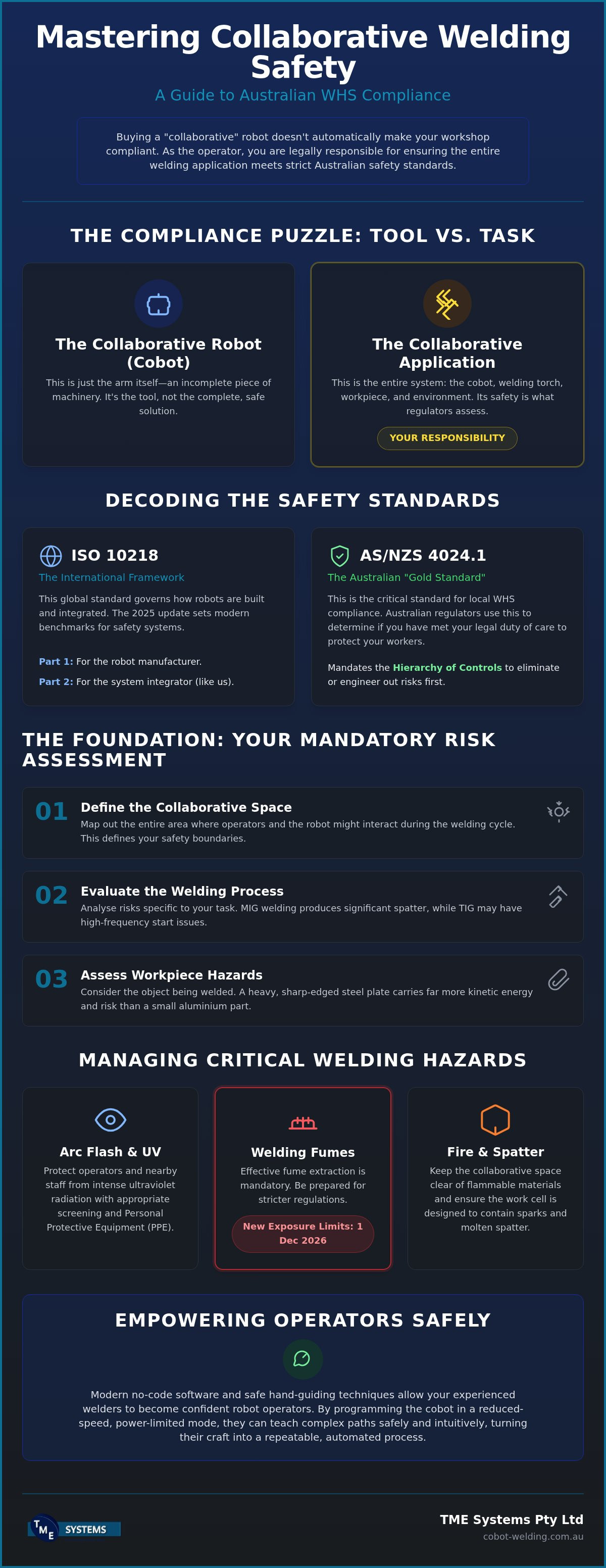

Buying a "collaborative" robot doesn't automatically make your workshop compliant with Australian law. Many local fabricators assume that because a cobot is designed to work alongside humans, it is safe right out of the box. However, these units are technically incomplete systems, which means the responsibility for meeting collaborative welding safety standards falls squarely on you as the operator or integrator. Whether you're worried about a WorkSafe audit or feeling confused by the gap between the 2025 ISO updates and our local AS/NZS 4024.1 requirements, the pressure to maintain a legal shop floor is a common challenge in today's manufacturing climate.
We know you want a workshop where innovation supports your team rather than creating new regulatory risks. This guide will help you master the safety standards and risk assessment protocols needed to run a productive, compliant welding cell. You'll learn exactly how to handle the new welding fume exposure limits arriving on 1 December 2026 and whether your specific application truly allows for a fence-free environment. We're providing the roadmap you need to build a safe workspace that your staff trust and a business that stands up to any inspection.
Key Takeaways
- Learn how to align international ISO 10218 updates with local AS/NZS 4024.1 requirements to ensure your workshop meets Australian WHS legal obligations.
- Understand why a task-based risk assessment is the foundation of any safe installation, helping you define the "collaborative space" where humans and machines interact.
- Discover how Power and Force Limiting (PFL) sensors allow for a fence-free environment by ensuring the robot reacts instantly to any physical contact.
- Master the collaborative welding safety standards for managing specific hazards like arc flash and the strict new 2026 welding fume exposure limits.
- See how no-code teaching software empowers your team, using safe hand-guiding techniques to turn experienced welders into confident robot operators.
Understanding the Australian Safety Landscape: AS/NZS 4024.1 and ISO 10218
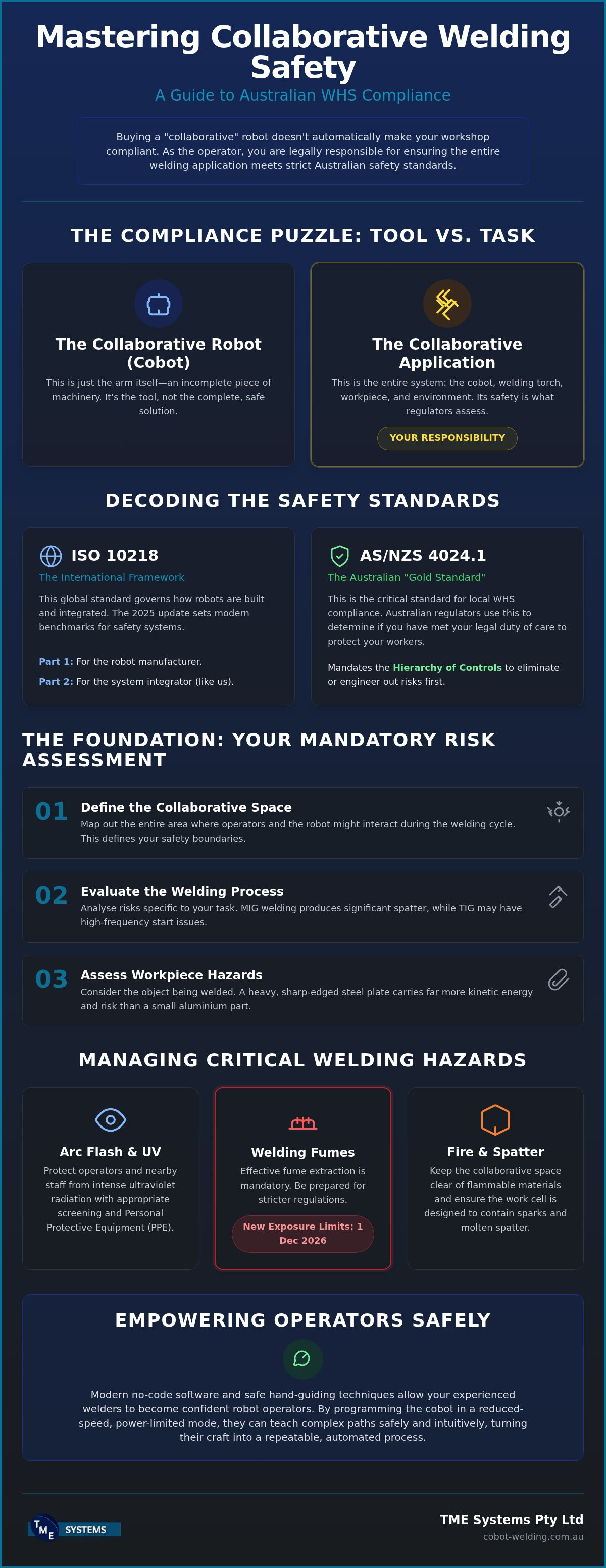
Compliance in an Aussie workshop isn't as simple as checking a box on a datasheet. To run a legal and safe operation, you have to look at collaborative welding safety standards as a two-part puzzle. The first piece is the international framework that governs how the robot is built. The second, and arguably more important piece for a local business owner, is the Australian framework that dictates how that robot is used on your floor. Under national Work Health and Safety (WHS) laws, following these standards isn't just a suggestion; it's your primary defence against liability and the best way to ensure your insurance remains valid if something goes wrong.
It's vital to distinguish between a collaborative robot (cobot) and a collaborative application. A cobot is just the arm itself. It might have sensors that stop it on contact, but that doesn't make the whole process safe. Once you add a live welding torch, heat, and UV radiation, you've created an "application." The safety of that application is what WorkSafe inspectors actually care about. If your system doesn't meet the combined requirements of international and local standards, you're essentially running an uncertified piece of heavy machinery.
The Role of ISO 10218 in Modern Fabrication
The international benchmark for robotics was significantly updated in early 2025. ISO 10218 is split into two parts. Part 1 focuses on the robot manufacturers, ensuring the arm's internal systems are reliable. Part 2 focuses on the integrators, the people who actually set up the cell in your workshop. At TME Systems Pty Ltd, we handle the heavy lifting of Part 2 compliance during our integration process. While many robots arrive with a European CE mark, that mark alone doesn't guarantee compliance with Australian law. We ensure the hardware meets these 2025 global benchmarks while specifically tuning the system for the Australian environment.
AS/NZS 4024.1: The Australian Safety of Machinery Standard
If ISO is the global guide, AS/NZS 4024.1 is the local "gold standard." This is the document that Australian regulators use to determine if you've done enough to protect your workers. It relies heavily on the hierarchy of controls. You can't just slap a "danger" sign on a robot and call it a day. You have to prove you've tried to eliminate or engineer out the risks first. When we design collaborative robot welding cells, we use this standard to justify every safety feature, from the speed of the arm to the placement of the screens. This ensures your investment is fit for purpose and provides a paper trail that proves you've met your "duty of care" under the WHS Act.
Conducting a Mandatory Risk Assessment for Your Welding Cell
A risk assessment isn't just a bit of paperwork to file away; it's the absolute foundation of your workshop's safety strategy. When you're implementing collaborative welding safety standards, you need to look beyond the robot's technical specs and focus on the actual environment where the work happens. This starts with identifying the "Collaborative Space," which is the area where the operator and the robot can potentially interact. You need to map out exactly how close your staff will be during the welding cycle and what tasks they'll perform while the arm is in motion.
The next step involves evaluating the specific welding process. MIG and TIG welding present very different risk profiles. For instance, MIG welding produces significant spatter and requires careful management of wire feed speeds to prevent puncture injuries. TIG welding might involve high-frequency starts that can interfere with other electronic equipment. When managing welding-specific hazards, you must also account for the physical nature of the workpieces. A heavy, sharp-edged steel plate moving at speed carries more kinetic energy and risk than a small, rounded aluminium bracket. Documenting these findings is essential to satisfy local SafeWork inspectors and prove that you've done the due diligence required by law.
Hazard Identification Beyond the Robot Arm
It's easy to focus on the robot, but the robot is often the safest part of the cell. The real dangers usually come from the tools and the process. The welding wire itself can act like a needle, creating a puncture hazard if the robot moves toward an operator. You also have to consider the intense heat and spatter generated during the automated cycle. These factors don't just disappear because the robot is "collaborative." A thorough assessment identifies these secondary risks, ensuring that your safety controls, like sensors and light curtains, are tuned to the reality of the fabrication process.
The TME Systems Pty Ltd Approach to Integration Safety
Our cobot welding integration specialists don't just drop off a machine and leave you to it. We help you identify hazards specific to your workshop layout, from narrow walkways to existing power supply limitations. We then tailor the safety logic of the cell so it reacts exactly how your team needs it to. A system risk assessment is the comprehensive evaluation of the entire welding application, including the robot, the torch, and the environment, to ensure the final setup is legally compliant. If you're unsure how these standards apply to your floor, booking a mobile demo is a great way to see how our systems adapt to your specific workshop constraints.
Collaborative Safety Functions: Power, Force, and Speed Limiting
Power and Force Limiting (PFL) is the core technology that makes a cobot truly collaborative. Unlike traditional industrial robots that will drive through an obstruction, a PFL-equipped arm uses internal sensors to monitor the torque in every joint. If the robot encounters resistance that exceeds a pre-set limit, it stops instantly. This function is the cornerstone of collaborative welding safety standards, as it ensures the robot cannot exert enough force to cause a serious injury during a collision. It's the difference between a machine that is aware of its surroundings and one that blindly follows a path.
There is always a practical trade-off between production speed and collaborative safety. To operate without physical fencing, the robot's speed must be limited so that any potential impact force stays below the thresholds defined in the latest safety standards. If your production targets require the robot to move at high industrial speeds, the system may no longer be considered "collaborative" in that specific phase of the cycle. We manage this by setting safety planes and restricted zones within the robot software. These digital boundaries act as virtual walls, preventing the arm from swinging into walkways or loading areas where operators are likely to be standing.
Configuring Safety Limits for Welding Tasks
Setting up these limits requires a bit of finesse. You have to adjust the force thresholds to account for the "payload," which includes the weight of the welding torch and the drag of the lead. If the settings are too sensitive, the robot might trigger a false stop just from its own momentum. We also use speed-limiting functions during the "approach" and "retract" phases, where the robot is most likely to encounter a human operator. During the path-teaching process, the use of an enabling device, often called a dead-man switch, ensures the robot only moves when the operator is actively and safely in control of the software.
When is Physical Guarding Still Necessary?
Even with advanced sensors, physical guarding isn't always avoidable. If your specific task requires high-speed movements that exceed collaborative limits, you might need to install light curtains or laser scanners. These devices can slow the robot down when someone enters the area and stop it completely if they get too close. Beyond physical impact, you must also protect passers-by from arc flash. Mobile welding screens or tinted curtains are standard requirements for any open workshop floor to prevent eye injuries to non-operators. If you're unsure where your application sits, it's best to consult with Australian robotic welding experts to ensure your setup is both productive and compliant with local WHS laws.
Managing Welding-Specific Hazards: Arc Flash, Fumes, and Fire
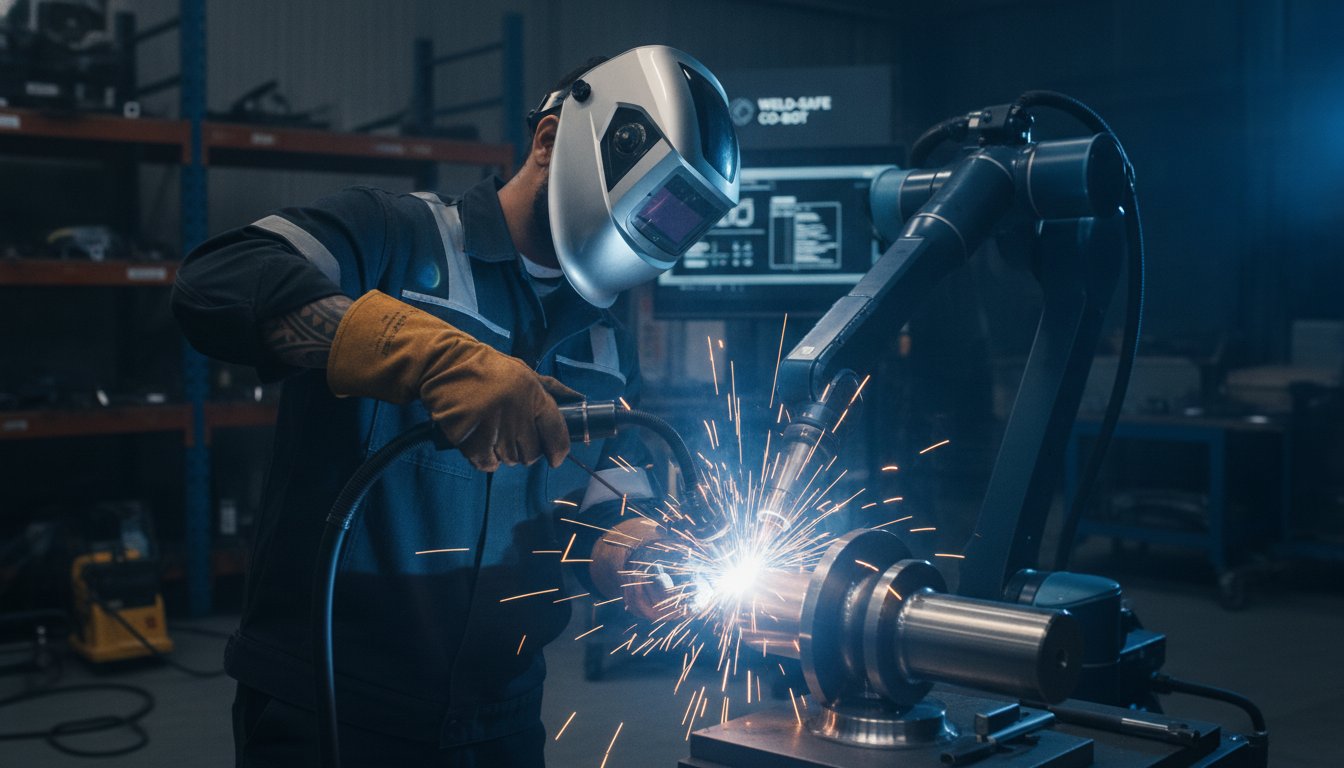
While the mechanical movement of the arm is governed by software, the welding arc introduces a separate set of environmental risks. In a collaborative setup, you often lack the luxury of a fully enclosed steel booth to contain light, heat, and spatter. Adhering to collaborative welding safety standards means looking at the air your team breathes and the light they see just as closely as the robot’s path. Arc flash protection is a primary concern in open-plan workshops. Using mobile welding screens allows you to create a temporary, non-reflective barrier that protects non-operators and passers-by from "arc eye" without permanent floor fixings.
Fire prevention and cable management are equally vital for a safe cell. Automated welding produces consistent spatter and hot slag that can accumulate differently than in manual operations. You must ensure the collaborative zone is free of flammable materials and that the floor surface can handle the heat. Managing the "umbilical" of the welding torch is also a safety priority. If leads are left trailing across the floor, they become trip hazards that could force an operator into the path of the robot. Organising these cables within the cell’s structure keeps the workspace tidy and reduces the risk of accidental snags during the robot’s cycle.
Fume Extraction and Air Quality Compliance
The regulatory landscape for air quality is shifting rapidly. On 1 December 2026, Australia will officially replace Workplace Exposure Standards with stricter Workplace Exposure Limits (WELs). This change significantly reduces the allowable exposure for substances like manganese and general welding fumes, which was already lowered to 1 mg/m³ in 2024. To stay compliant, your cell needs high-efficiency local exhaust ventilation. We integrate extraction units that trigger automatically the moment the robot strikes an arc, ensuring that fumes are captured at the source before they can migrate across your shop floor. Following the AS/NZS ISO 21904 standard, adopted in March 2026, is now the expected benchmark for any new extraction setup.
Workshop Layout and Floor Space Optimisation
A safe cell is an organised cell. You need to position your equipment to maintain clear thoroughfares for forklifts and staff, ensuring the robot doesn't become an obstacle in a high-traffic area. Many Aussie workshops benefit from compact, mobile cells that can be moved as production needs change. This flexibility is a major advantage, but it requires a fresh look at your floor plan every time the unit is relocated. For detailed advice on how to balance safety with efficiency, you can refer to our guide on how to improve welding productivity with cobots. If you want to see how a compliant cell fits into your specific floor plan, book a mobile demo to test the system in your own workshop.
Empowering Operators Through Safe No-Code Teaching
Automation shouldn't feel like a "black box" that only a software engineer can unlock. In the past, the complexity of robot programming was a safety risk in itself, as a single line of incorrect code could lead to an unpredictable and dangerous machine movement. Modern no-code robot welding software changes this dynamic by putting control back into the hands of the tradesperson. By using intuitive interfaces and physical hand-guiding, your welders can teach the robot a path simply by moving the arm to the start and end points. This "teaching" mode is governed by strict collaborative welding safety standards, ensuring the robot only moves at a reduced, safe speed while the operator is within the collaborative zone.
This hands-on approach does more than just save time. It builds a deeper level of trust between the staff and the technology. When a welder can physically guide the arm, they gain a practical understanding of the robot's reach and limitations. However, even the most intuitive system requires a foundation of knowledge. Structured on-site cobot welder training is essential to ensure every team member understands how to set safety boundaries and when to use the enabling device. This training turns a piece of high-tech hardware into a familiar workshop tool that respects the expertise of the human operator.
Reducing Human Error with Intuitive Software
Visual, icon-based interfaces are a major leap forward for workshop safety. Instead of scrolling through thousands of lines of text, operators use a "What You See Is What You Get" (WYSIWYG) approach to define weld paths and parameters. This significantly reduces the chance of a programming mistake that could cause a torch collision or an accidental arc-on event. By removing the need for syntax-heavy coding, no-code software acts as a safety buffer that prevents logic errors from turning into physical collisions on the workshop floor. It allows the welder to focus on the quality of the joint rather than the mechanics of the software.
The Human-Centric Safety Culture
A truly safe workshop is built on a culture where technology empowers the worker rather than replacing them. Every operator should feel confident in their ability to manage the cell, which includes a thorough understanding of emergency stop locations and reset procedures. We believe that seeing is believing. Booking a mobile welding robot demonstration is the best way to see these collaborative welding safety standards in action on your own floor. It gives your team the chance to interact with the system in a familiar environment, proving that safety and productivity can go hand-in-hand when the right protocols are in place.
Securing Your Workshop's Future with Compliant Automation
Adopting robotic automation is a major step for any Australian fabrication business. It's clear that success depends on more than just the hardware. By aligning your workshop with the latest collaborative welding safety standards, you're doing more than just ticking a compliance box for WorkSafe; you're creating a high-productivity centre where your staff can work with total confidence. We've seen how the combination of proper risk assessments, advanced fume extraction, and intuitive safety functions like Power and Force Limiting can transform a traditional floor into a modern manufacturing powerhouse.
The transition doesn't have to be intimidating. Every TME Systems Pty Ltd cell includes expert training and onboarding to ensure your team is ready from day one. Our no-code software makes safety settings and path teaching intuitive for every welder, removing the fear of complex programming errors. If you're ready to see how these safety protocols work in your specific environment, we're here to help. Request a Mobile Demo to See Collaborative Safety in Action and discover how a safe, compliant welding cell can support your business growth. Your team's skill is your greatest asset; let's give them the tools to use it safely.
Frequently Asked Questions
Do collaborative welding robots in Australia require safety fencing?
Not necessarily, but the answer depends entirely on your specific risk assessment. If your robot operates within the power and force limiting (PFL) thresholds defined by collaborative welding safety standards, you can often run a fence-free cell. However, you may still need mobile screens or light curtains to protect other staff from secondary hazards like arc flash or high-speed movements during non-collaborative phases of the cycle.
What is the difference between ISO 10218 and AS/NZS 4024.1?
ISO 10218 is the international benchmark for robot design and integration, which saw significant updates in early 2025. AS/NZS 4024.1 is the Australian "Safety of Machinery" standard that holds legal weight under our national Work Health and Safety (WHS) framework. While ISO provides the technical global guidelines, complying with the Australian Standard is what ensures you meet your legal duty of care in a local workshop.
Is a formal risk assessment legally required for a cobot welder?
Yes, a formal, documented risk assessment is a mandatory requirement under Australian law. Because most cobots are sold as "incomplete systems," the responsibility falls on the owner to prove that the final application is safe. You must document how you've identified hazards like torch collisions or fume exposure and explain the specific controls you've put in place to protect your operators and passers-by.
Can a cobot really be safe without a cage if it’s welding at high temperatures?
A cobot is safe without a cage only when the entire "application" is managed correctly. While the robot arm itself won't cause crushing injuries due to its sensors, the welding arc remains a hazard. Safety is achieved by combining the robot's internal force-sensing with external controls like local exhaust ventilation and tinted welding curtains. This holistic approach ensures the collaborative welding safety standards are met for the whole process, not just the arm.
What PPE does an operator need when working alongside a welding cobot?
Operators must still wear standard welding personal protective equipment (PPE) even when a robot is doing the heavy lifting. This includes an auto-darkening welding helmet, flame-resistant clothing, leather gloves, and safety boots. While the cobot reduces the physical strain and repetitive motion of the job, the operator is still exposed to UV radiation and heat during the path-teaching and monitoring phases of production.
How often should safety systems on a welding cobot be inspected?
Safety systems require a mix of daily checks and periodic formal inspections. Operators should test the emergency stop buttons and any enabling devices at the start of every shift to ensure they are functioning correctly. A more thorough audit of the safety logic, sensor calibration, and cable integrity should be conducted as part of your workshop’s regular preventative maintenance schedule, typically every six to twelve months.
Does the no-code software include built-in safety limits?
Yes, our no-code software allows you to define digital safety boundaries directly within the interface. You can set "safety planes" that act as virtual walls, preventing the robot from swinging into walkways. You can also configure specific speed and force limits for different tasks, ensuring the robot automatically slows down when it moves into a zone where human interaction is more likely to occur.
Who is responsible for the safety of a robotic welding cell: the manufacturer or the owner?
The owner of the workshop is ultimately responsible for the safety of the robotic cell. While the manufacturer is responsible for ensuring the robot arm meets design standards, the owner must ensure the final setup is safe for their specific environment. This includes conducting the risk assessment, providing operator training, and ensuring the cell is integrated correctly to meet Australian WHS requirements.