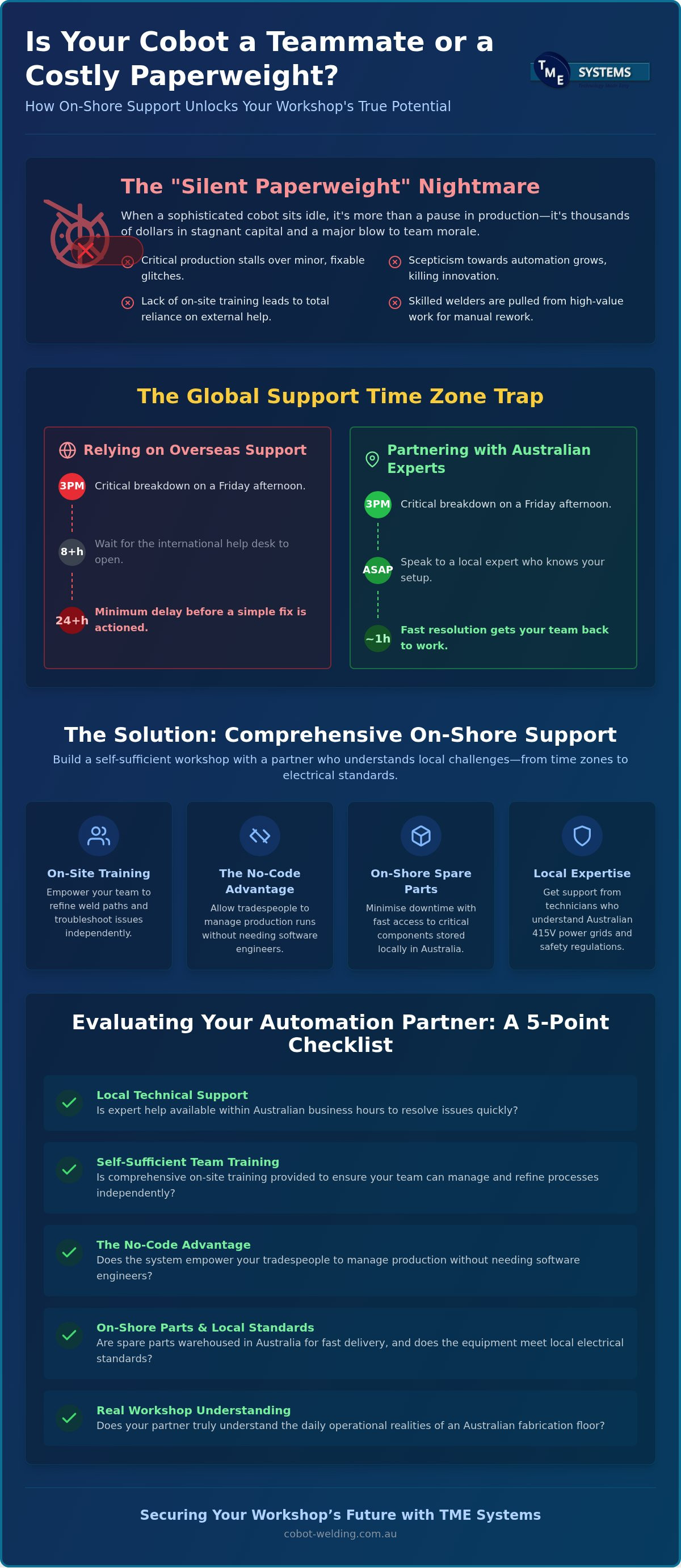

Imagine it’s late on a Friday afternoon and a critical production run stalls because of a technical glitch, but the only person who can help is currently asleep in a different time zone. For many Australian fabricators, the fear of a high-tech "silent paperweight" sitting in the corner of the workshop is what prevents them from investing in on-site cobot welding training Australia wide. You know that keeping your arc-on time high is the only way to stay competitive, especially as the industry prepares for the new 1mg/m³ welding fume exposure standards. It’s frustrating when technology that’s supposed to simplify your life ends up causing more downtime than it prevents.
This guide, brought to you by TME Systems Pty Ltd, shows you how to take back control of your workshop floor. You’ll discover how to eliminate costly delays and keep your production line moving with reliable, on-shore technical support and no-code automation that your team can master in days. We will look at how to build a self-sufficient workshop, ensure fast access to local expertise, and choose systems that empower your tradespeople rather than replacing them. By the end of this guide, you’ll have a clear roadmap for integrating robotic cells that work for your staff, not the other way around.
Key Takeaways
- Learn how local technical support prevents equipment from becoming a "silent paperweight" by providing expert assistance within Australian time zones.
- Understand why on-site cobot welding training australia wide is essential for building a self-sufficient team capable of refining weld paths independently.
- Discover the no-code advantage that empowers your tradespeople to manage production runs without relying on external software engineers.
- Identify the critical local factors for maximum uptime, including fast access to on-shore spare parts and expertise in Australian electrical standards.
- Use a practical 5-point checklist to evaluate whether an automation partner truly understands the daily realities of an Australian workshop floor.
The Real Cost of Downtime: Why Local Support is Non-Negotiable
In the fabrication industry, local support is often misunderstood as a simple help desk. True local support means having on-shore technical assistance that operates within Australian time zones and adheres to our specific industry standards. When you invest in robotic welding technology, you aren't just buying a machine; you're integrated into a workflow that requires constant movement to remain profitable. If that movement stops, the financial repercussions extend far beyond the lost labour hours of a single operator.
The "silent paperweight" is the nightmare scenario for any workshop manager. This happens when a sophisticated collaborative robot sits idle because of a minor software glitch or a missing sensor that no one on-site knows how to fix. An idle robot doesn't just represent a pause in production; it represents thousands of dollars in stagnant capital expenditure. Without accessible on-site cobot welding training australia wide, your staff may lack the confidence to troubleshoot basic issues, leading to a total reliance on external help that might be thousands of kilometres away.
Poor support also has a devastating psychological impact on the workshop floor. When tradespeople see a high-tech tool sitting unused for weeks, morale drops and skepticism toward automation grows. This frustration can kill future innovation, making it much harder to implement the next stage of your workshop's growth. Local support acts as a productivity insurance policy for AU workshops, ensuring that technology remains a tool for empowerment rather than a source of stress.
Calculating the Hourly Cost of an Idle Robot
When a robot goes offline, the costs stack up quickly. For many Australian fabricators, the most immediate hit comes from missed contract deadlines and the resulting liquidated damages. These penalties are often written into commercial contracts to ensure timely delivery, and a two-day delay can wipe out the profit margin of an entire job. Additionally, there is the "lost opportunity" cost. When your robot is down, your most skilled welders are often pulled away from high-value projects to perform manual rework or cover the robot's shift. This shift in resources slows down your entire pipeline and prevents you from taking on new, lucrative work.
The Time Zone Trap: Why "Global" Support Often Fails Australians
There is nothing more frustrating than a 3:00 PM Friday breakdown, only to realise that the "global" support office won't open for another eight hours. Relying on overseas time zones usually leads to a 24-hour delay for even the simplest software fixes. Email-only support is fundamentally insufficient for high-output fabrication environments where every hour counts. Speaking to a local expert who understands Australian workshop conditions, such as our specific 415V power grid requirements and safety regulations, is the only way to ensure a fast resolution. Local expertise ensures your team gets back to work while the rest of the world is still asleep.
What Comprehensive Local Robotic Welding Support Actually Includes
Many global vendors promise "lifetime support," but for an Australian fabricator, that promise often falls short when parts are stuck in international customs. Real support means having a partner who understands the local manufacturing environment and the pressures of the skilled welding shortage currently affecting our industry. It's about ensuring your system isn't just a piece of hardware, but a functional part of your workflow that meets specific local requirements. This includes seamless integration with your existing workshop gear, whether you're using Australian-made welding power sources or established international brands that are already familiar to your team.
Hardware Reliability and Spare Parts Logistics
Keeping critical components on-shore is vital for national manufacturers who cannot afford to wait weeks for a replacement circuit board or motor. When you deploy collaborative robot welding cells, you need the peace of mind that comes with fast-tracked access to local spare parts. This logistics chain should also include the use of standard, locally available consumables. If you can buy your welding tips and liners from your regular local supplier, you're far less likely to face an unexpected stoppage. Local integrators also ensure your system is built to withstand the unique heat and dust of AU workshops, where ambient temperatures can easily exceed 40 degrees in summer. This rugged approach stops the clock on avoidable hardware failure.
Compliance with Australian Safety Standards
Navigating AS/NZS standards for collaborative robot safety in 2026 requires more than a generic manual. A local support partner plays a critical role in conducting on-site risk assessments tailored to your specific floor layout and production needs. They ensure your on-site cobot welding training australia program covers the necessary safety protocols to meet WorkSafe or SafeWork requirements in your specific state. This includes verifying that the technical integration accounts for the Australian 415V power grid and any local electrical standards that overseas manufacturers might overlook. Safe operation is non-negotiable, and local expertise ensures you remain compliant without sacrificing productivity.
Beyond hardware and safety, comprehensive support includes regular software updates that reflect the feedback of local manufacturers. It's about a continuous improvement loop where your experiences on the floor help refine the tools you use every day. If you want to see how these systems fit into your specific operation, you can book a mobile demo to test the hardware on your own terms and see the difference local expertise makes.
The No-Code Advantage: Solving Problems on the Workshop Floor
Traditional automation often required a dedicated software engineer just to change a simple weld path. For an Australian SME, this reliance creates a bottleneck that can stall production for days. The introduction of no-code robot welding software has changed this dynamic by putting the control back into the hands of the people who actually understand the trade. Instead of typing lines of code, operators use intuitive touchscreens or physically guide the robot arm to teach it the required movements. This shift from complex programming to direct teaching means your workshop stays agile and ready for fast job changeovers without waiting for an external specialist.
Operator-Led Troubleshooting: The First Line of Defence
Your best welders already have the "eye" for a perfect bead. When you provide them with automated welding path adjustment tools, they can use that expertise to refine the robot's performance in real-time. This approach significantly reduces the "fear factor" often associated with new technology. When a tradesperson realises they can adjust a torch angle or modify a speed setting with a few taps on a screen, the cobot becomes a helpful tool rather than an intimidating machine.
Comprehensive on-site cobot welding training australia wide focuses on this empowerment. By training your staff to be their own first line of defence, you minimise the need for outside intervention. This self-sufficiency is what transforms a workshop from a reactive environment into a proactive production powerhouse. Operators can troubleshoot minor deviations and refine paths independently, keeping the production line moving during peak periods when every hour of arc-on time is critical.
Remote Assistance vs. On-Site Visits
While hands-on skills are vital, there are times when a technical hurdle requires a deeper look. Modern systems allow local experts to log in remotely to your cell for instant software diagnostics. A 10-minute remote session can often solve a configuration issue that would otherwise require a two-day site visit and significant travel costs. This speed is a major advantage for AU fabricators operating in remote or rural areas where physical call-outs can be expensive and slow.
However, it’s important to know when a remote fix isn't enough. While software can be refined from a distance, hardware adjustments or complex system integrations often benefit from a "hands-on" specialist. Having a local partner who can offer both remote speed and physical presence ensures your workshop never remains at a standstill for long. This dual approach provides a safety net that covers everything from minor software tweaks to major mechanical adjustments.
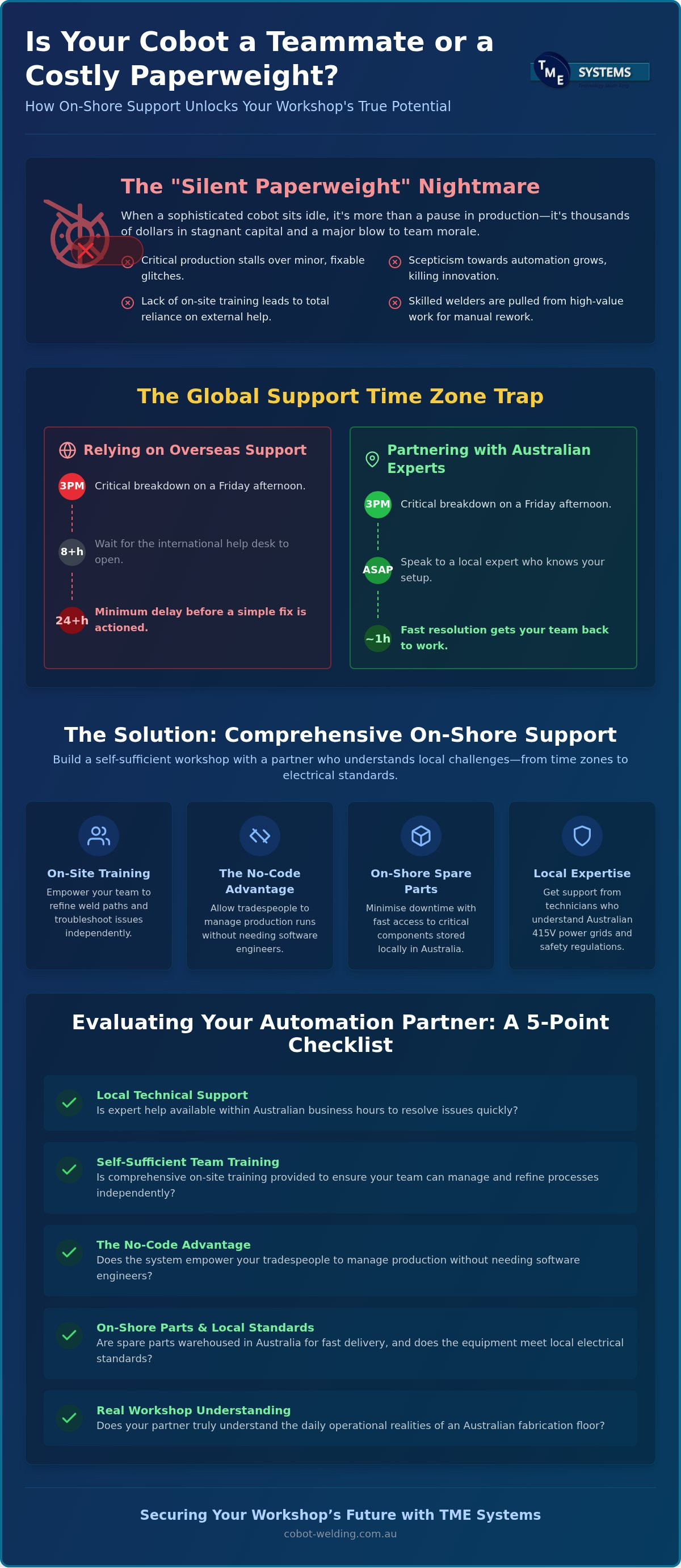
Evaluating Your Support Partner: A 5-Point Australian Checklist
Choosing an automation partner is a long-term commitment that determines the success of your investment. In a market where the trade role vacancy fill rate was just 55.5% in 2026, you can't afford a system that your remaining staff find impossible to use. When you look for on-site cobot welding training australia wide, you aren't just buying a manual; you're buying a relationship that should keep your workshop running through peak periods. Use this 5-point checklist to ensure your partner is built for the realities of Australian fabrication:
- Trade Expertise: Do they employ expert welders who understand the nuances of MIG and TIG, or just IT technicians who know how to navigate a menu?
- Response Times: What is their guaranteed response time for a critical production stop on a Friday afternoon?
- Staff Empowerment: Do they offer on-site cobot welder training specifically tailored to your team's current skill levels?
- Software Provenance: Is their software no-code and locally supported, or are you paying for a third-party overseas license that limits your flexibility?
- Proof of Concept: Can they provide a mobile welding robot demonstration to prove the system handles your specific parts on your own workshop floor?
Testing the 'Support Loop' Before You Buy
The best time to test a partner's support is during the sales process. Ask for a real-world demonstration of their remote support capabilities before you sign any contracts. A reliable partner should be able to show you exactly how they log in to a system to troubleshoot a software issue. Check if they have a dedicated Australian helpdesk staffed by people who understand our local workshop conditions. It’s also wise to verify their track record by asking for references from other local fabricators who have integrated similar systems.
The "Practical Mentor" Model vs. Transactional Sales
You need a partner who acts as a practical mentor rather than a simple hardware vendor. Trade knowledge matters more than coding skills; your support contact should understand weld penetration and gas flow, not just C++ or Python. This mentorship is vital for ongoing onboarding as you hire new staff or expand your fleet of robots. Avoid transactional relationships or "lock-in" contracts that charge for every minor phone call. Instead, look for a collaborative partner who is invested in your long-term uptime. If you're ready to see how a local partner can support your growth, contact us to discuss your integration needs.
Securing Your Workshop’s Future with TME Systems
TME Systems Pty Ltd operates on a simple principle: technology should adapt to the person, not the other way around. By centring the human operator within a technical context, we ensure that automation becomes an extension of a welder's existing skill set rather than a replacement for it. This philosophy is what transforms a robotic cell from a complex machine into a reliable workshop tool. Our cobot welding integration services are designed to bridge the gap between sophisticated hardware and high-quality production output. We don't just drop off a box and leave; we work alongside you to build a genuine production capability that lasts for the long term.
A partnership with a local specialist means you have a practical mentor in your corner. We understand that the pressure of a production line doesn't stop just because a new piece of technology has arrived. Our role is to ensure that the transition to automation is seamless, grounded in reality, and focused on immediate results. Whether you are refining a current process or starting from scratch, we provide the steady confidence and reassurance needed to make innovation feel attainable for every member of your team.
Tailored Training for Australian Tradespeople
Every workshop has its own unique challenges, from specific metal types and joint configurations to varying production volumes. We customise our onboarding process to suit these realities, ensuring your team feels a sense of ownership over the new system from day one. This hands-on approach is critical for driving long-term adoption and maintaining high workshop morale. We believe there is no substitute for training your staff on their own equipment using real production parts to ensure the skills learned are immediately applicable to your daily workflow. This focused on-site cobot welding training australia wide ensures your team is ready for any job that comes through the door, regardless of complexity.
Your Next Steps Toward Reliable Automation
Securing your workshop's future starts with a clear integration plan and realistic ROI goals. We help you map out exactly how a collaborative robot will fit into your current floor layout and which jobs are best suited for automation. When you request a quote, it includes comprehensive local support and dedicated training, so there are no hidden surprises down the track. This transparency is vital for building trust and ensuring that your investment delivers the maximum possible uptime.
If you're ready to see how this technology performs in your own environment, you can book a national mobile demonstration. This allows you to see a proof of concept on your own floor, using your own jigs and parts, before making a final decision. It’s the most practical way to demystify the process and see the benefits of on-site cobot welding training australia first-hand. Reach out to us today to start a direct conversation with an Australian specialist about refining your production line and protecting your business from the skilled labour shortage.
Future-Proofing Your Fabrication Workshop
Transitioning to automation doesn't have to be an intimidating leap into the unknown. By choosing a partner that prioritises local support, you ensure that your investment remains a productive asset rather than a "silent paperweight." We've explored how no-code software puts the power back into the hands of your tradespeople, allowing them to refine weld paths without needing an IT degree. This shift toward self-sufficiency is reinforced by on-site cobot welding training australia wide, ensuring your team has the confidence to troubleshoot and adapt as production demands change.
TME Systems is committed to your long-term success with an Australian-owned and operated support team that understands the local manufacturing landscape. Our national mobile demonstration units are ready to prove these results on your own workshop floor. Don't let the fear of downtime hold your business back from the next stage of growth. Book a Mobile Demo to see our local support in action and discover how practical, human-centric automation can keep your production line moving with steady confidence.
Frequently Asked Questions
What is the typical response time for local robotic welding support in Australia?
Local support ensures you receive technical assistance within your own time zone, typically during standard Australian business hours. TME Systems aims for rapid response times to prevent critical production stops, ensuring you don't have to wait for overseas offices to open. This national approach minimises downtime and keeps your workshop productive. We prioritise urgent technical queries to ensure your arc-on time remains high and your production deadlines are met without delay.
Do I need a software engineer on staff to maintain a welding cobot?
You don't need a software engineer on staff when using our No-Code Teaching Software. This technology is designed for tradespeople, allowing your existing welders to program and adjust paths by physically guiding the robot arm. It removes the complexity of traditional coding, making the system easy to maintain internally. Your team can handle job changeovers and path refinements independently, which reduces your reliance on external specialists and keeps your operational costs lower.
Can local support help with welding issues like porosity or spatter, not just robot errors?
Yes, local support includes troubleshooting actual welding quality issues like porosity or spatter. Because our team includes expert welders who understand the trade, we can help you refine gas flow, wire speed, and torch angles. This practical mentorship ensures that your on-site cobot welding training australia wide covers more than just basic operation. We focus on helping you achieve high-quality beads and consistent results that meet your specific workshop standards and job requirements.
Are spare parts for robotic welding cells kept in stock within Australia?
We maintain a stock of critical spare parts within Australia to avoid the lengthy delays often associated with international shipping and customs. Using standard, locally available consumables also ensures you can source everyday items from your regular suppliers without hassle. Keeping these components on-shore is a vital part of our commitment to national reliability. It means a minor hardware failure won't result in weeks of lost production for your fabrication business.
What happens if the no-code software needs an update or a bug fix?
If your no-code software requires an update or a bug fix, our local team handles this through remote diagnostic tools or direct on-site visits. We can often log in to your system to resolve software glitches in minutes, saving you the cost and delay of a physical call-out. These updates are tailored to the specific needs of local manufacturers, ensuring the technology continues to meet the evolving standards of the Australian fabrication industry.
Is on-site training included in the initial integration of the welding system?
Comprehensive operator training and onboarding are core parts of our initial integration process. We believe that on-site cobot welding training australia is the most effective way to ensure your staff are confident and proficient with the new technology. This training is conducted on your own equipment using your actual production parts. This hands-on approach ensures that the skills learned are immediately applicable and that your team feels a genuine sense of ownership.
How do Australian safety standards affect the type of support I need?
Australian safety standards, such as AS/NZS 4024, require a thorough risk assessment for every unique floor layout and application. Local support is essential here because we understand the specific compliance requirements of WorkSafe and SafeWork across the country. We help you navigate these regulations to ensure your collaborative robot cell is safe for your operators. This includes verifying that the technical integration meets local electrical standards and 415V power grid requirements for national workshops.
Can I get support for a robotic welding system I did not originally buy from you?
We primarily provide support and training for systems that we have integrated ourselves to ensure the highest quality of service and safety. However, we can often provide professional operator training or general advice for shops looking to improve their existing automation. If you have a system from another vendor that isn't performing as expected, we can discuss a consultation to see if our no-code software or integration expertise can help get your production moving.