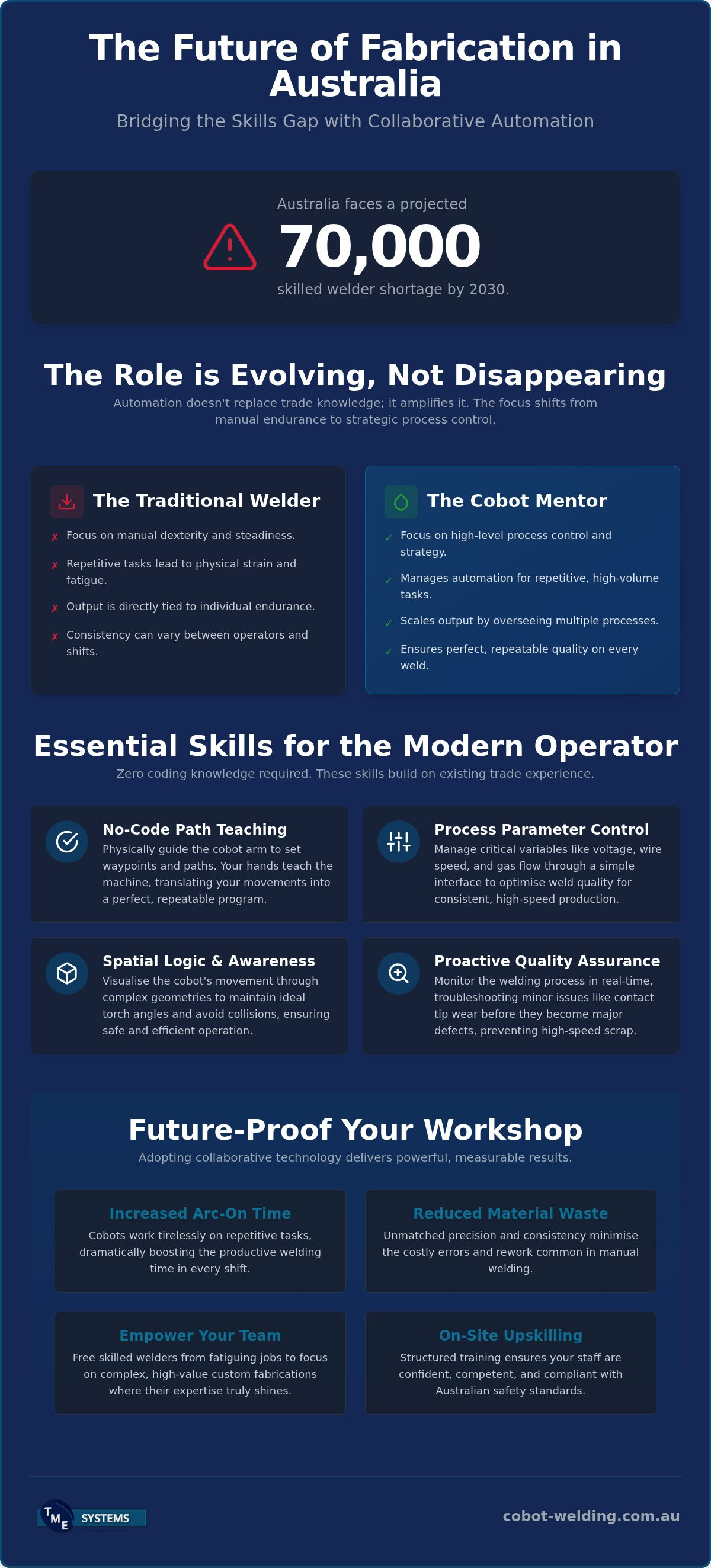

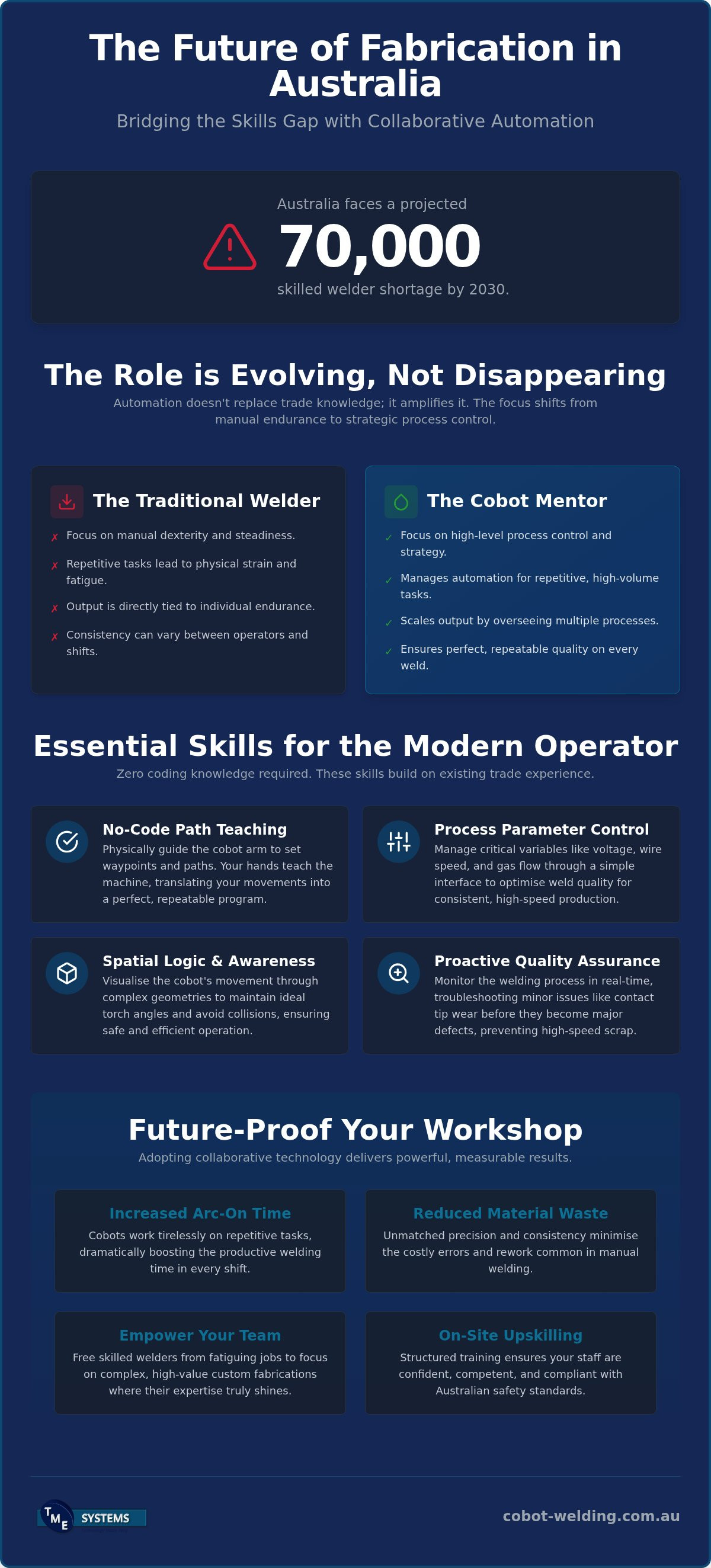
Did you know that Australia is projected to face a shortage of 70,000 skilled welders by 2030? It is a confronting figure for any fabricator trying to keep up with a busy production schedule. You have likely spent months searching for reliable tradespeople, only to find the market is tighter than ever. At the same time, the idea of introducing robots can feel like a gamble. You might worry that the technology is too complex for the workshop floor or that your best welders will resist a machine they think is there to replace them.
The reality is that the most successful automation does not replace trade experience; it amplifies it. We agree that your team's existing knowledge is your greatest asset. This guide will show you how to transition from manual work to collaborative automation by mastering specific welding cobot operator skills that require zero coding knowledge. You will discover a clear training roadmap to help your staff become confident "cobot mentors." We will also explore how these tools help you organise a more productive workshop and achieve consistent weld quality, ensuring your business stays competitive as the industry evolves.
Key Takeaways
- Trade knowledge remains the foundation of success, as the best operators are experienced welders who understand how metal behaves under heat.
- You can quickly develop essential welding cobot operator skills using no-code teaching software that allows you to lead the robot through paths by hand.
- Modern automation shifts your team's focus from manual dexterity to high-level process control, managing parameters like voltage and wire speed through a simple interface.
- A practical upskilling strategy involves structured, on-site training to ensure your staff are confident and compliant with the latest Australian safety standards.
- Adopting collaborative technology helps future-proof your workshop by significantly increasing arc-on time and reducing the waste associated with manual errors.
The Evolving Role of the Australian Welder in 2026
The skilled labour shortage isn't just a headline; it's a daily struggle on the workshop floor. If you have tried to hire an experienced fabricator recently, you know how tight the market has become. By 2030, Australia expects a gap of 70,000 skilled welders. This pressure is fundamentally changing the trade. We used to view the automated welding process as something reserved for massive car factories, but it's now a necessity for local workshops. It's not about choosing between a person or a machine. It's about using technology to keep our local manufacturing competitive against overseas imports.
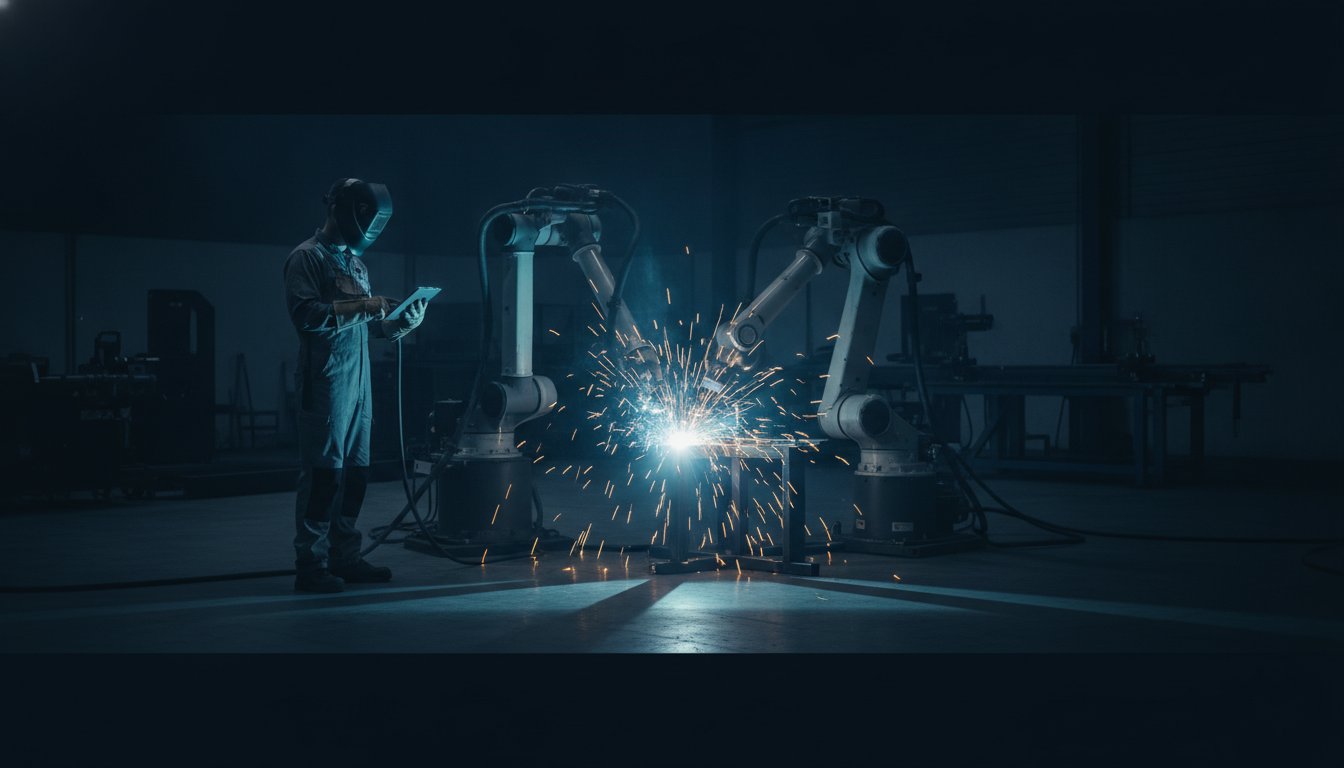
We are seeing the rise of the "Welding Orchestrator." This isn't a computer scientist or an IT graduate. It's a tradesperson who uses their deep knowledge of heat, metal, and gas to oversee a fleet of collaborative tools. They don't spend eight hours a day under a hood doing repetitive runs that strain the eyes and back. Instead, they set the strategy, refine the parameters, and ensure every output meets Australian standards. This shift requires a specific set of welding cobot operator skills, focusing on process management rather than just manual steadiness.
Addressing the Skills Gap with Accessible Automation
Finding a traditional robot programmer is like finding a needle in a haystack. Even if you find one, they are expensive to retain and often lack actual welding experience. This is where "no-code" teaching software changes the game for small-to-medium enterprises. It allows your existing team to take control without writing a single line of code. Senior welders can now "record" their best techniques into process presets. This allows junior staff to produce high-quality welds under supervision, effectively using the cobot as a bridge to transfer years of trade wisdom to the next generation.
The Psychological Transition: From Tool to Partner
It's natural for experienced staff to feel uneasy when a robot arrives in the bay. The fear that a machine will take their job is real, but it's often based on old industrial models. In a collaborative setup, the cobot is a labour-saving partner. It handles the high-volume, repetitive tasks that cause fatigue. This frees up your best people for complex, custom fabrications where trade intuition is irreplaceable. Developing welding cobot operator skills allows a fabricator to scale their output without burning out. When a welder sees the cobot as a tool that saves their body, the resistance fades. They stop being just a manual worker and start being a process leader.
Essential Skills for Modern Welding Cobot Operators
Transitioning from manual welding to automation doesn't mean leaving your trade behind. It simply changes how you apply it. The core welding cobot operator skills required today focus on spatial logic and process control. An operator needs to visualise how the arm moves through complex geometries to avoid collisions while maintaining the ideal torch angle. This spatial awareness is a vital part of bridging the welding skills gap in local workshops, as it allows experienced staff to translate their physical movements into robotic paths.
Understanding weld parameters remains the backbone of the job. While the robot handles the steady hand, the operator must still decide on the voltage, wire speed, and gas flow. In a robotic context, these settings behave differently because the travel speed is perfectly consistent. You aren't just welding; you are managing a high-precision system. Proficiency with no-code robot welding software is the key here. It allows you to adjust these variables on the fly without needing a degree in computer science. If you want to see these tools in action on your own floor, organising a mobile demo is a great way to start.
Quality assurance also takes on a new look. Instead of just checking a finished bead, an operator monitors the process in real-time. You will need to troubleshoot basic issues, such as contact tip wear or wire feed tension, before they cause defects. This proactive approach ensures that the high-speed output of the cobot doesn't lead to high-speed scrap.
Mastering No-Code Path Teaching
Modern "lead-through" programming allows you to physically move the cobot arm to set waypoints. This is a far cry from old-school coding. You can set stand-off distances and torch angles by hand, recording each point with a button press. The real skill lies in organising your job libraries. By saving these paths, you can switch between small batches in minutes. This rapid changeover capability is what makes automation viable for Australian fabricators who don't just do mass production.
Process Monitoring and Parameter Tuning
A cobot is only as good as the parts you give it. Operators must develop an eye for consistent jigging and part positioning. If the gap varies, the robot won't instinctively "fill" it like a human would unless you have tuned the parameters for it. You will need to recognise how heat input changes when the robot maintains a perfect travel speed over a long run. Fine-tuning wire tension and gas coverage ensures that robotic consistency results in a perfect bead every time, shift after shift.
Manual Craftsmanship vs. Robotic Process Control
A common mistake in automation is thinking the robot does the welding. In reality, the cobot is simply a high-precision torch carrier. It has no "feel" for the metal and cannot hear the arc. This is why a non-welder rarely makes a successful operator. Trade knowledge remains the absolute foundation of the process. While we are addressing a critical skills shortage across the country, we cannot bypass the need for traditional expertise. An operator still needs to understand how a puddle behaves and how gas coverage affects the final bead.
The primary shift is moving from manual dexterity to high-level process observation. Instead of focusing on keeping a steady hand for hours, the operator manages the "arc-on" time. In a manual setup, a welder might only be arcing for 20 to 30 per cent of their shift due to fatigue and setup needs. A cobot cell can increase this arc-on time to nearly 85 per cent. This changes the physical demands of the job significantly. You move away from the strained postures and heavy lifting, focusing instead on workflow logistics and ensuring the machine has a steady supply of parts to process.
Why Your Best Manual Welder is Your Best Cobot Candidate
Your most experienced tradespeople possess an "eye" for a good weld that cannot be programmed. They understand penetration, bead profile, and how thermal distortion will pull a joint out of alignment. When these veterans develop welding cobot operator skills, they use that experience to optimise robotic sequences. They know where to start a run to manage heat and where to add a pause for better fusion. They aren't just pushing buttons; they are applying years of fabrication wisdom to a more efficient tool.
The Skills Translation Matrix
Transitioning to automation is about mapping your existing trade strengths to new robotic equivalents. Consider these direct translations:
- Manual: Maintaining a steady hand and rhythm. Robotic: Defining an optimised path and consistent travel speed settings.
- Manual: Real-time torch angle adjustments based on the puddle. Robotic: Managing parameter offsets to account for part variations.
- Manual: Physical endurance for long runs in difficult positions. Robotic: Strategic workflow and logistics management to keep the cell running.
This matrix shows that the core logic of the trade stays the same. The operator simply uses different welding cobot operator skills to achieve the same high-quality result, but with much greater repeatability and less physical wear on their body.
Implementing a Practical Cobot Upskilling Strategy
Building a team with the right welding cobot operator skills doesn't happen by accident. It requires a structured approach that respects the rhythms of an Australian workshop. We suggest starting by identifying a "super-user" within your team. This person should be an experienced welder who is open to technology and can lead the transition for others. Their role is to become the internal expert, troubleshooting minor issues and helping peers gain confidence. This peer-to-peer mentoring is often more effective than a top-down management directive.
Success is measured through clear KPIs. You should track operator proficiency by monitoring the complexity of the jobs they can set up independently. On the production side, keep a close eye on cell output and arc-on time. A successful implementation should see a steady reduction in rework and scrap. If you want to accelerate this process, you can book an operator training session to get your staff certified and productive in days rather than months.
Safety Standards and Collaborative Workspaces
Safety is the foundation of any automated workspace. You must ensure your setup complies with the relevant AS/NZS standards for collaborative robot operation. While cobots are designed to stop upon contact, a thorough risk assessment is still mandatory. Depending on your specific application, you may need to integrate additional sensors, light curtains, or speed limitations, especially when working with sharp workpieces. Operators must be fluent in emergency stop protocols and know exactly how to recover the system after a safety event without losing their progress on a weld.
The First 30 Days: From Setup to Production
A structured on-site cobot welder training programme should follow a logical progression to avoid overwhelming your staff. We recommend breaking the first month into three distinct phases:
- Days 1-5: Focus on basic orientation. Operators should practice moving the arm and performing simple straight-line welds on non-critical scrap.
- Days 6-20: Move on to more complex geometries. This is the time to tackle multi-run welds, circular paths, and weaving patterns.
- Days 21-30: Shift the focus to optimisation. Operators should learn how to refine cycle times and manage multiple parts in a single jigging setup to maximise throughput.
By following this timeline, your team builds confidence through small wins. They move from "just making it work" to truly mastering the process, ensuring your investment pays off through consistent, high-quality output.
Future-Proofing Your Workshop with Accessible Automation
Investing in technology is about more than just the first few weeks of production. It's about ensuring your business can handle larger contracts and tighter deadlines without a massive increase in overheads. Collaborative robot welding cells are designed to scale with your workshop. You might start with a single cell for a specific repetitive job, but as your team develops advanced welding cobot operator skills, you can quickly adapt the system to new product lines. This flexibility is what allows small Australian fabricators to punch above their weight on the national stage.
One of the biggest wins for long-term growth is the drastic reduction in rework. Human fatigue is the enemy of consistency. A cobot doesn't get tired or distracted during a long shift. By maintaining a perfect arc and travel speed every single time, you virtually eliminate the scrap that eats into your margins. When you improve welding productivity with cobots, you aren't just working faster; you are working smarter. You are building a reputation for reliability that wins repeat business.
Seeing is Believing: The On-Site Demonstration
It is one thing to read about automation, but it is another to see it run your own parts. A mobile welding robot demonstration is the most practical way to evaluate if the technology fits your specific needs. It gives your staff a chance to get hands-on with the no-code software and see how their existing trade knowledge translates to the machine. Engaging your team early in this process is vital. When they see how easy it is to teach a path, the fear of the unknown disappears. They start to imagine how the tool can help them, rather than worrying about it replacing them.
Choosing a Practical Integration Partner
The success of your automation journey depends heavily on who you choose to walk it with. You need an integration partner who understands the "dirty" reality of a fabrication shop. It isn't a clean-room environment. It is a place of heat, dust, and varying tolerances. Local Australian support is non-negotiable for ongoing operator success. Whether you opt for a turnkey solution that is ready to go or a more tailored integration, you need someone who can provide on-site training and rapid troubleshooting. A partner who treats automation as a collaborative effort will ensure your team continues to refine their welding cobot operator skills long after the initial setup is complete.
Empowering Your Team for the Next Generation of Fabrication
The shift toward automation is no longer a distant possibility; it is a practical necessity for staying competitive in the Australian market. We have seen that the most effective welding cobot operator skills aren't found in a computer lab, but on your own workshop floor. By leveraging no-code software, your existing team can start welding in hours rather than weeks, keeping their deep trade knowledge at the centre of every project. This approach ensures that your most valuable asset, your people, remains the driving force behind your production.
Transitioning to collaborative technology allows you to maximise arc-on time and virtually eliminate the scrap caused by manual fatigue. With local Australian technical support and proven productivity gains, the path to a more efficient workshop is clear and attainable. It is about giving your tradespeople better tools to do what they already do best while protecting your business from the ongoing labour shortage. If you are ready to see how this technology fits your specific jobs, Book a Mobile Welding Robot Demonstration for your workshop. We will bring the system to you, so your team can experience the future of fabrication firsthand.
Frequently Asked Questions
Do my welders need to know how to code to operate a cobot?
No, your team does not need any programming or coding experience to run a modern system. We use no-code teaching software that allows a tradesperson to physically lead the robot arm through the required welding path. By using buttons on the torch head to set waypoints, the operator "teaches" the machine rather than typing lines of script. This ensures your existing staff can apply their trade knowledge directly to the automation.
How long does it take to train an experienced welder to use a cobot?
Most experienced fabricators can learn the basics of path teaching in just a few hours. While full mastery of complex geometries takes longer, a structured on-site training programme usually has a team production-ready within three to five days. Because the system relies on existing trade intuition rather than new IT skills, the learning curve is significantly shorter than traditional industrial robotics. This rapid onboarding helps you maintain workshop momentum.
Is it safe for operators to work right next to a welding cobot?
Yes, cobots are designed specifically for collaborative workspaces where people and machines work side-by-side. They feature sensitive force-torque sensors that trigger an immediate stop if they detect any contact. However, your workshop must still comply with current AS/NZS safety standards. This involves conducting a thorough risk assessment of your specific application, taking into account factors like welding fumes, arc flash, and the sharp edges of your workpieces.
Can a cobot handle small batch runs and custom fabrication?
Absolutely. The ability to handle small batch runs is one of the primary reasons Australian workshops adopt this technology. Because you can save every "taught" path into a digital job library, switching between different parts takes only a few minutes. This makes collaborative automation a viable tool for custom fabrication shops that don't have the high-volume requirements typically associated with traditional robotic systems found in large automotive factories.
What happens if the weld quality drops during an automated run?
If quality drops, the operator uses their welding cobot operator skills to intervene in real-time. Unlike older systems that blindly follow a path, a cobot allows the operator to pause the run and adjust parameters like travel speed or wire tension. Most issues stem from part fit-up or contact tip wear. Because the operator is right there at the cell, they can identify and correct these defects before a whole batch is ruined.
Does adopting cobots mean I need fewer skilled welders?
Not at all. With Australia facing a projected shortage of 70,000 skilled welders by 2030, the goal is to make your current team more productive. A cobot handles the repetitive, high-volume tasks that cause physical strain and fatigue. This frees up your best tradespeople to focus on complex, high-value custom work that requires human intuition. It is about augmenting your workforce to keep local manufacturing competitive, not reducing your headcount.
What is the most difficult skill for a manual welder to unlearn?
The hardest habit to break is often the physical urge to manually steady the torch or move the workpiece during the arc. Manual welding is a whole-body experience, but cobot operation requires a shift to process observation. An operator must refine their welding cobot operator skills by learning to trust the machine's travel speed and focus instead on the broader variables. It is a transition from being the "hands" to being the "brains."
Are there specific Australian safety certifications required for cobot operators?
There is no single "cobot operator licence" required by law in Australia. However, employers have a legal obligation to ensure staff are competent and that the equipment meets AS/NZS safety standards. We provide structured operator training and onboarding to document this proficiency. This ensures your team understands emergency stop protocols and safe interaction limits, which is essential for maintaining a compliant and safe collaborative workspace on your production line.