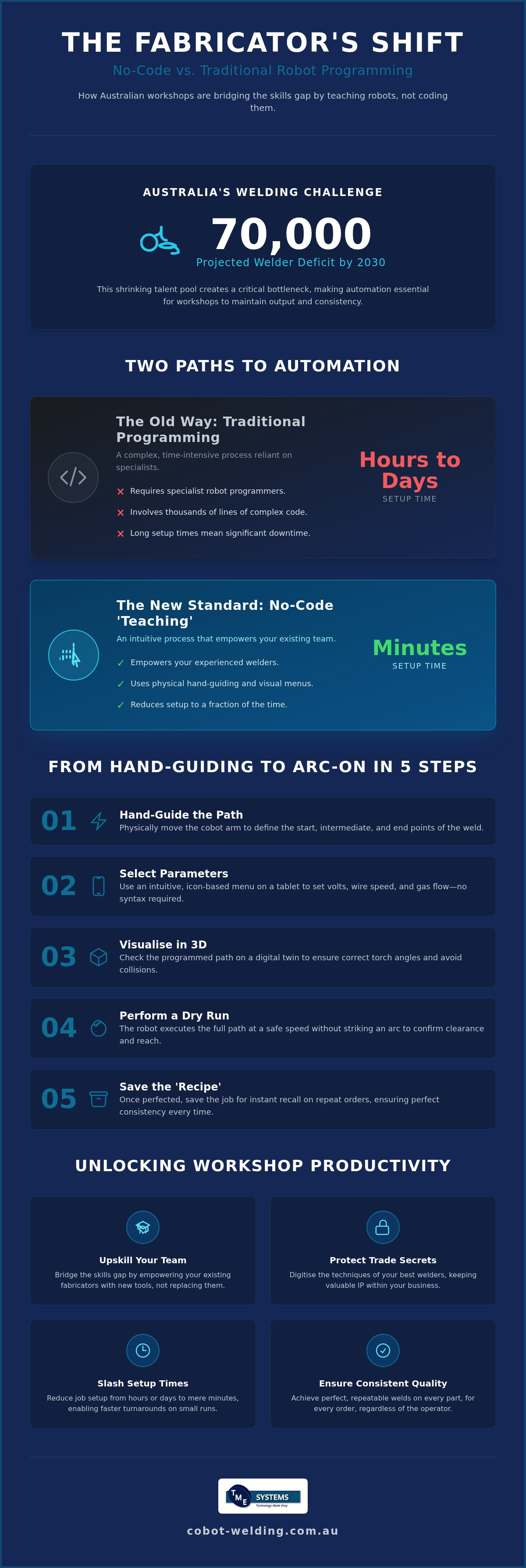

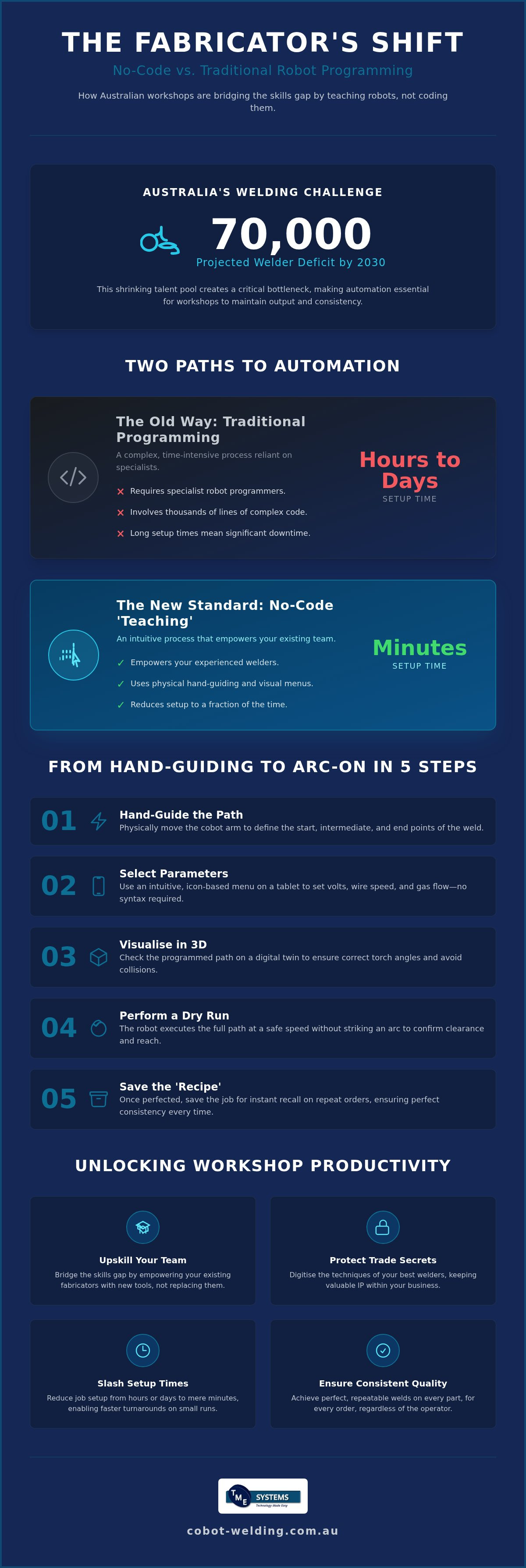
What if your most experienced fabricator could program a complex weld path in ten minutes without typing a single line of code? It sounds like a stretch, but for many Australian workshops, the debate over no-code vs traditional robot programming for welding is already settled. With a projected deficit of 70,000 welders across the country by 2030, you likely feel the squeeze of a shrinking talent pool every time a new order hits the desk. You want the consistency of automation, but you can't justify the downtime or the expense of a specialist programmer for small production runs.
We understand that technology only works if it actually simplifies the job on the workshop floor. This guide shows you how teaching a robot is replacing traditional coding, allowing your best tradies to automate production in minutes rather than days. We'll cover the practicalities of meeting Australia's 2026 safety and fume extraction standards, while ensuring your team has the tools to deliver faster turnarounds on repeat orders. By the end, you'll see how modern cobots serve as a digital extension of a welder's hands, helping you scale your output without the overhead of a traditional factory setup.
Key Takeaways
- Learn how the shift from complex syntax to hand-guiding allows your existing team to "teach" a robot trade secrets without touching a keyboard.
- Understand the practical differences between no-code vs traditional robot programming for welding, specifically how setup times for new parts drop from hours to mere minutes.
- Master the two-step process of defining weld paths through physical movement and selecting parameters from intuitive, icon-based menus.
- Discover how to bridge the local skills shortage by upskilling your current fabricators through practical, on-site training rather than hiring specialised computer programmers.
- See how professional system integration ensures your welding cell meets 2026 Australian safety standards while delivering immediate consistency on repeat orders.
Defining No-Code Robot Welding in the Modern Workshop
In a busy Australian fabrication shop, the bottleneck isn't usually the welding itself; it's the time spent setting up the machine. Traditional Robot welding systems often require a specialist programmer to write thousands of lines of syntax just to join two pieces of steel. No-code technology flips this script. It provides an interface that translates a fabricator's physical movements or visual icons directly into robot commands. You don't need to understand Python or C++; you just need to know how to lay a good bead.
This represents the fundamental shift in no-code vs traditional robot programming for welding. You're no longer "coding" a computer; you're "teaching" a workshop apprentice. It bridges the gap between the decades of experience held by your senior tradies and the precision of modern industrial automation. By empowering your best welders to use these tools, you're directly addressing the national skills gap without needing to hunt for rare, expensive software engineers. It turns automation into a tool that supports the worker rather than a complex project that replaces them.
The Core Components of a No-Code System
A no-code setup replaces the cryptic "green screen" teach pendants of the past with tools designed for the reality of the workshop floor. Lead-through teaching is the centerpiece of this system. A welder simply holds the robot arm and physically guides the torch along the desired path, setting start and end points with the press of a button. This is supported by an intuitive tablet-based interface where parameters like volts, wire speed, and gas flow are selected from visual menus. Pre-built "weld recipes" standardise these settings for common MIG and TIG tasks, ensuring that even a junior operator can achieve a high-quality finish on Day 1 without guessing the settings.
Why No-Code is the New Standard for 2026
By 2026, the move toward operator-led automation has become essential for survival in the Australian market. Implementing no-code robot welding software does more than just speed up production. It protects your workshop's intellectual property by digitising the "trade secrets" of your best staff. Instead of those techniques leaving the business when a staff member retires, they stay in your digital library for future use. This significantly lowers the entry cost for small-to-medium enterprises (SMEs), making automation a practical reality that pays for itself through faster turnarounds and consistent quality.
How the Teaching Process Works: From Hand-Guiding to Arc-On
Moving from a manual torch to an automated system often feels like learning a new language. However, the teaching process for a no-code system is designed to mimic the way a senior fabricator trains an apprentice. Instead of typing coordinates into a terminal, the operator uses their own hands to show the robot exactly where the weld needs to be. This tactile approach is the primary reason why the debate between no-code vs traditional robot programming for welding is shifting in favour of the workshop floor.
The workflow typically follows five practical steps:
- Step 1: Hand-guiding. You physically move the cobot arm to the start point, any intermediate curve points, and the final stop. The robot records these positions in real time.
- Step 2: Setting parameters. Using an icon-based menu on a tablet, you select your volts, wire speed, and gas flow. There is no syntax to memorise.
- Step 3: 3D Visualisation. You check the path on a digital twin to ensure torch angles are correct and the shroud won't hit any clamps or jigs.
- Step 4: The Dry Run. The robot performs the entire movement at a safe speed without striking an arc. This confirms the path is clear and the reach is sufficient.
- Step 5: Saving the Recipe. Once the first part is perfect, you save the job. This "recipe" can be recalled instantly for the next batch, whether that's in ten minutes or six months.
The Power of Lead-Through Teaching
Physical guidance is far more intuitive for a tradie than navigating the complexities of Automated Offline Programming (AOLP). Inside the cobot arm, high-resolution force-torque sensors make the equipment feel almost weightless. As you move the arm, the sensors detect your intent and assist the motion, allowing for incredibly fine adjustments to the torch angle. The robot doesn't just learn a path; it learns the specific speed and orientation that an experienced welder knows is required for a clean penetration. It turns a complex computer task into a simple demonstration of skill.
Managing Your Weld Libraries
One of the biggest hurdles in a busy shop is maintaining consistency across different shifts. By using no-code software, you can build a validated library of weld parameters that every operator can access. If the material thickness varies slightly between batches, you can adjust the settings on the fly without rewriting the entire programme. This ensures that every part meets the "gold standard" set by your best welder. If you want to see this process in action on your own workshop floor, you can book a mobile demo to test your specific parts.
No-Code vs Traditional Robot Programming: The Fabricator's Verdict
For most Australian workshop owners, the decision to automate usually stalls when they look at the programming requirements. Traditional industrial robots are often sold on the promise of speed, but they come with a significant hidden cost: the time it takes to get that first weld done. When comparing no-code vs traditional robot programming for welding, the difference is stark. A traditional setup for a new part can take hours or even days of offline coding, whereas a no-code system allows a fabricator to be arc-on in under fifteen minutes.
The skill requirements tell a similar story. Traditional systems often demand a specialised computer degree or extensive certification, as seen in the units listed on the National Training Register. In contrast, your existing team can become proficient through a few hours of on-site cobot welder training. This approach doesn't just save money on hiring; it empowers your tradies to own the process. If you have to pay a dedicated programmer a six-figure salary just to keep the robot moving, the Total Cost of Ownership (TCO) quickly outweighs the productivity gains for a smaller shop.
When is Traditional Programming Still Useful?
Traditional coding still has its place in high-volume, low-mix environments. If you're running an automotive assembly line where a robot performs the exact same weld a million times a year, the upfront cost of complex, multi-robot coordination makes sense. These massive factories require precision down to the fraction of a millimetre across coordinated movements that no-code systems aren't designed for. However, for the average general fabricator in Australia, these scenarios are rare. Most local shops deal with variety, not just volume.
The 'High-Mix, Low-Volume' Sweet Spot
No-code technology thrives in the high-mix, low-volume reality of modern manufacturing. It makes automating batches of five or ten parts finally profitable because the setup time no longer eats the margin. You're no longer stuck with a bottleneck where only one person knows how to talk to the robot. Instead, any welder on the floor can adjust for material variations or change production schedules without waiting for external support. This flexibility ensures your investment doesn't sit idle when the custom jobs come through the door. If you're curious about how this fits into your current workflow, you can request a mobile demo to see the software in action on your floor.
Maximising Productivity in the Australian Workshop
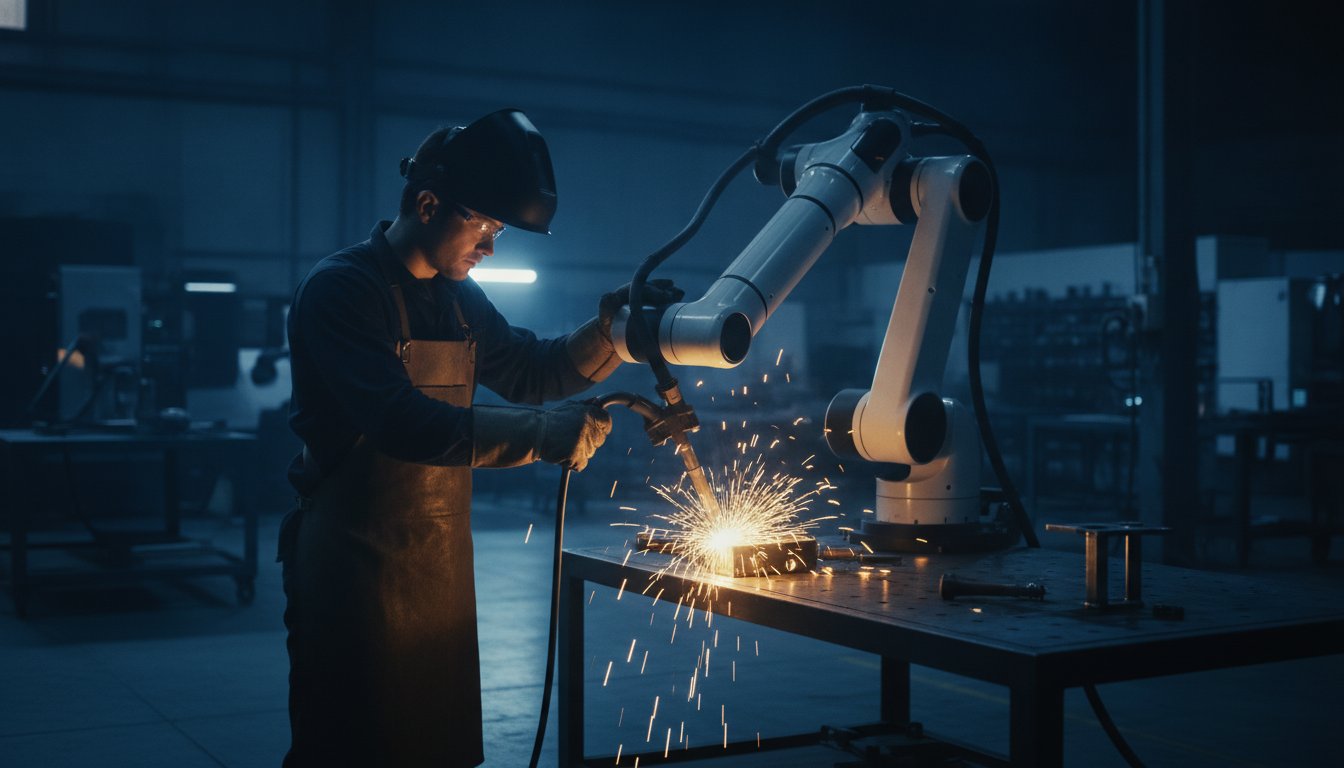
Integrating no-code software with collaborative robot welding cells creates a turnkey solution that works from the moment it lands on your workshop floor. For many Australian fabricators, the real value of no-code vs traditional robot programming for welding isn't just about the software; it's about how that software makes the hardware more accessible. By removing the need for a keyboard, you allow your most experienced staff to focus on the quality of the weld rather than the syntax of the machine.
You can improve welding productivity with cobots by targeting the long, repetitive MIG runs that usually tie up your best tradies for hours. When you weigh up no-code vs traditional robot programming for welding, the ability to pivot between these jobs without a specialist is a major advantage. While the robot handles the dull, monotonous welds, your team can focus on complex tacking or custom fabrication that requires a human touch. This shift also delivers immediate ergonomic benefits. Additionally, the software provides exact cycle times, allowing you to quote more competitively on tenders because you know precisely how long each part takes to produce.
Upskilling Your Best Welders
Rather than replacing staff, this technology turns senior tradespeople into 'Cobot Supervisors'. It allows them to oversee multiple production lines and share their trade secrets through the digital 'recipes' we discussed earlier. This upskilling often improves staff retention; tradies feel more valued when they're empowered to use advanced tools that reduce physical strain and boredom. It builds a culture of innovation on the workshop floor where the team looks for new ways to refine the process rather than just grinding through the day.
Organising Your Shop for Rapid Changeovers
To get the most out of a no-code environment, you need to think about your shop layout. Modular jigging and standardised fixtures are essential. They allow for a workflow where a new job can be 'taught' on a second table while the previous batch is still cooling. Some Australian workshops have reported reducing their lead times by up to 60% by adopting this parallel approach. It ensures the robot is arc-on for the maximum amount of time each shift. To see how these systems fit into your current floor plan, you can book a mobile demonstration to test your own parts and fixtures.
Getting Started: The TME Systems Pty Ltd Integration Roadmap
Success in automation depends on more than just a slick interface. While the debate of no-code vs traditional robot programming for welding highlights ease of use, the software is ultimately only as good as the welding system integration behind it. A robot that cannot communicate with your existing power source or doesn't fit your current workflow becomes an expensive ornament. We focus on a "practical mentor" approach, working alongside your team to ensure they are arc-on and productive from the first shift. This includes comprehensive operator training and onboarding that demystifies the tech for your entire crew.
Local support is a non-negotiable factor for Australian workshops. You need a partner who understands the local manufacturing reality and can provide technical support within your own time zone. Ongoing software updates ensure your system stays relevant as new welding techniques emerge, keeping your shop at the forefront of the industry. It is about building an ongoing partnership rather than just completing a transaction.
Tailoring the System to Your Specific Needs
Every workshop has a different speciality. Whether you focus on heavy MIG fabrication or precision TIG work, the system must be tailored to suit your specific output. We assess your current part types and welding processes to customise the no-code interface, ensuring it matches your existing power sources and wire feeders perfectly. Safety is equally critical. Every installation we support is designed to comply with the AS/NZS 4024.1 safety standard for machinery, ensuring your collaborative workspace protects your staff while they work alongside the cobot.
Calculating Your Return on Investment (ROI)
The numbers need to stack up before you make the leap into automation. When you factor in labour savings, a significant reduction in rework, and increased throughput, the financial benefits become clear. Most Australian fabricators find that these no-code systems typically pay for themselves within the first 12 to 18 months. This rapid ROI is driven by the fact that you don't need to hire a specialised computer programmer. Instead, you are upskilling your current team, creating a flexible and future-proof automation strategy that can adapt to whatever jobs come through the door next.
If you're ready to see how this technology handles your specific parts, you can book a mobile welding robot demonstration. We bring the system to your floor for an on-site proof of concept, allowing you to see the difference for yourself before committing to a full integration.
Future-Proofing Your Fabrication Shop with Accessible Automation
The shift toward intuitive automation is no longer a luxury for Australian workshops; it's a practical necessity to stay competitive. By choosing no-code vs traditional robot programming for welding, you're investing in a tool that respects the craftsmanship of your existing tradies. Hand-guiding reduces setup times from hours to minutes, making even small batches profitable. This approach ensures your workshop remains agile while meeting the strict safety and fume standards required in 2026.
Success on the workshop floor comes down to having tools that work as hard as your staff do. We provide turnkey welding cells that are ready for immediate deployment, backed by local Australian integration and technical support. Our no-code software is designed specifically for fabricators, not IT experts; this means you can focus on production rather than troubleshooting code.
If you're ready to see how these systems can transform your throughput, Request a No-Code Welding Software Demo for Your Shop today. We're here to help you bridge the skills gap and take the next step in your automation journey with confidence.
Frequently Asked Questions
Do my welders need any prior computer programming experience?
No computer programming experience is required to operate our systems. The primary benefit of no-code vs traditional robot programming for welding is that it uses a visual, tablet-based interface. Your tradies use their existing knowledge of weld pools and torch angles to "teach" the robot by moving the arm physically. If they can use a smartphone, they can learn to set up a collaborative welding cell.
Can no-code software handle complex weld paths like circles or weaves?
Yes, the software handles complex paths including circles, offsets, and weaving patterns with ease. You don't need to calculate coordinates; you simply select the weave type from an icon-based menu and set the amplitude. The robot then executes the pattern consistently along the path you've taught it. This allows for high-quality penetration on joints that would otherwise require a manual touch.
How long does it take to teach a robot a new part using this method?
Teaching a new part usually takes between five and fifteen minutes depending on the complexity of the weld. Unlike traditional industrial robots that require hours of offline coding, this method allows you to be arc-on almost immediately. This rapid turnaround makes it profitable to automate small batches of ten or twenty parts, which was previously impossible for most Australian general fabricators.
Is no-code software compatible with my existing MIG or TIG welder?
Our no-code software and collaborative cells are designed to integrate with most professional MIG and TIG power sources. Through our welding system integration service, we ensure the robot communicates seamlessly with your existing wire feeders and gas controllers. This means you don't necessarily need to buy a brand new welder to start benefiting from automation on your workshop floor.
What happens if the physical part doesn't perfectly match the CAD drawing?
Mismatches between CAD drawings and physical parts aren't a problem because you teach the robot using the actual workpiece. Traditional programming relies on perfect digital models, but no-code allows you to hand-guide the torch to the real-world start and end points. This flexibility is vital in workshops where material variations or slight jigging offsets are a daily reality.
Is it safe for a welder to stand next to the robot while it's working?
Yes, it is safe to work alongside the robot. Collaborative robots are equipped with sensitive force-torque sensors that stop the machine instantly if they detect an obstruction. Every system we integrate complies with the AS/NZS 4024.1 safety standard for machinery. While standard welding safety gear like helmets and fume extraction is still mandatory, the robot is built specifically for shared workspaces.
Can I save and backup my weld programs for use on other machines?
You can save every job as a digital "recipe" for instant recall. These programs are stored on the controller and can be backed up to a USB or cloud storage for use across other compatible machines in your shop. This feature protects your workshop's intellectual property, ensuring that the specific techniques used by your best welders stay within the business.
Does TME Systems provide training for our staff on our own workshop floor?
TME Systems provides comprehensive operator training and onboarding directly on your workshop floor. We believe that training is most effective when it's done using your own parts and jigs in your actual production environment. Our team stays with your staff until they are confident and productive, ensuring you get the maximum return on your investment from Day 1.