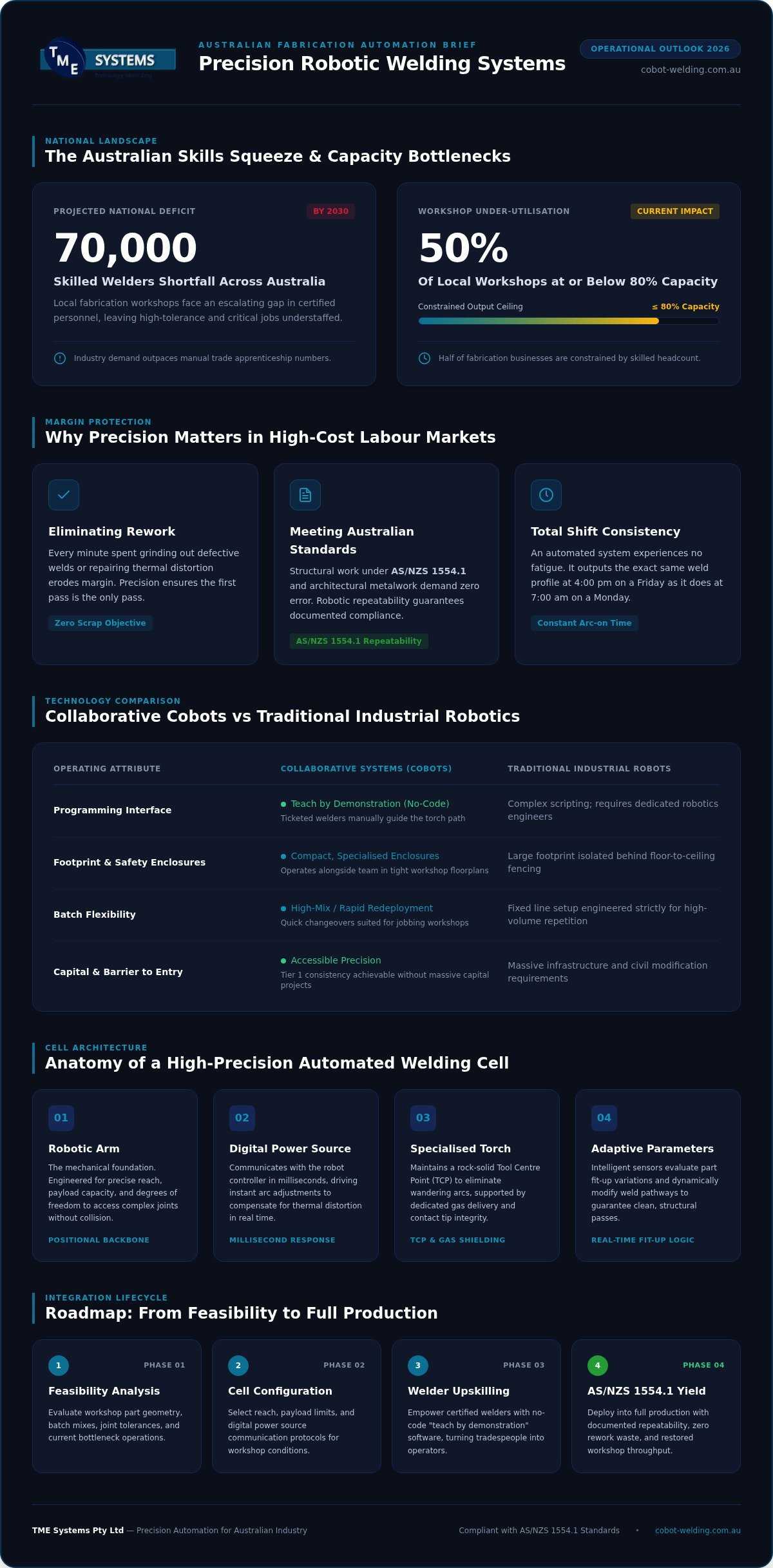

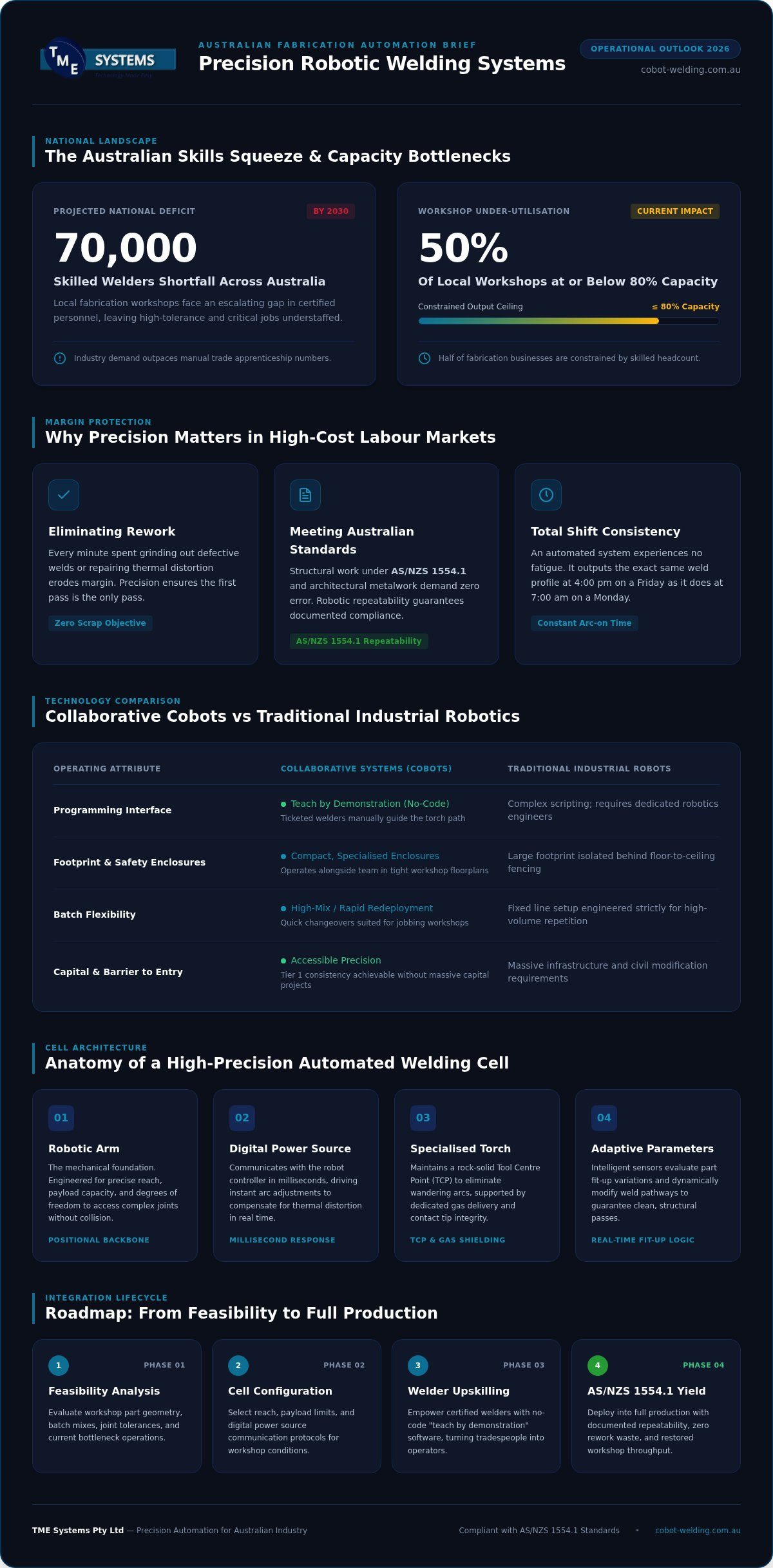
With a projected shortfall of 70,000 skilled welders across Australia by 2030, it's no surprise that half of our local fabrication workshops are currently operating at or below 80% capacity. You've likely felt the sting of this labour squeeze firsthand, perhaps while staring at a pile of costly rework or wondering how to quote on high-tolerance projects when your most experienced staff are already flat out. It’s a frustrating position to be in, but the solution isn't found in waiting for a new generation of manual tradespeople to appear. Instead, forward-thinking businesses are turning to precision robotic welding systems to bridge the gap.
At TME Systems Pty Ltd, we understand that the leap to automation can feel intimidating, especially if you're worried about complex programming or alienating your existing team. This guide will show you how modern, no-code technology transforms these machines into accessible tools that empower your current staff rather than replacing them. You'll discover how to achieve consistent, high-quality welds and significantly increase your throughput without the need for a dedicated robotics engineer on the shop floor. From navigating the latest safety standards to understanding the real-world operational realities for 2026, we're laying out a practical roadmap for the future of Australian fabrication.
Key Takeaways
- Learn how modern precision robotic welding systems combine high-accuracy hardware with adaptive software to handle the variables found in a typical Australian workshop.
- Discover how "teach by demonstration" software empowers your current ticketed welders to program complex paths manually without needing any coding expertise.
- Understand the role of specialised enclosures and integrated components in creating a safe, controlled environment that maintains weld consistency.
- Compare the footprint and changeover speeds of cobots versus traditional industrial robots to find the right fit for your workshop's production goals.
- Follow a practical roadmap for successful integration, focusing on how to move from initial feasibility to full production with the help of experienced specialists.
Defining Precision Robotic Welding Systems in the Modern Australian Workshop
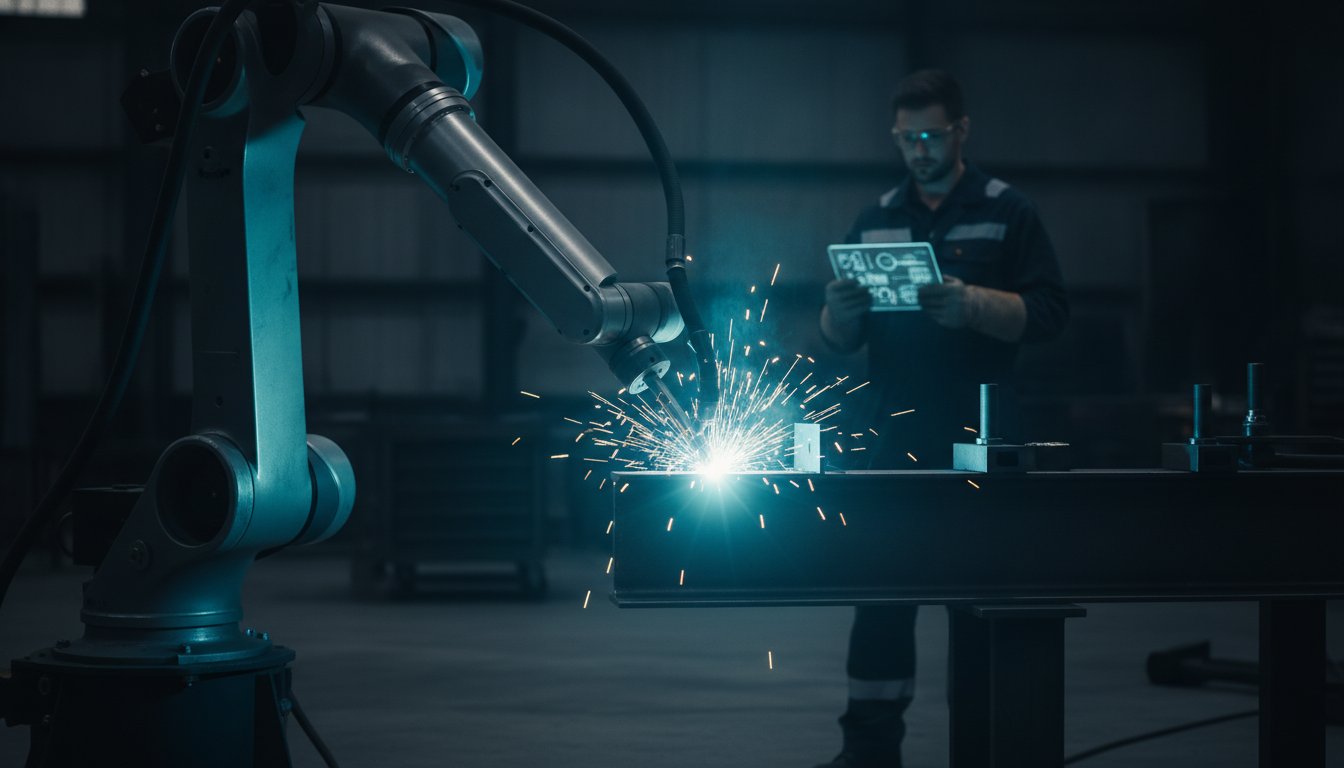
A precision robotic welding system is no longer just a mechanical arm bolted to a factory floor. In the modern Australian workshop, these systems represent a sophisticated handshake between high-accuracy hardware and intuitive control software. While robotic welding was historically reserved for high-volume automotive plants, the technology has moved into the local jobbing shop. It's now a tool designed to help ticketed welders achieve perfection on every joint, regardless of the batch size.
By 2026, the definition of precision has expanded. It's no longer enough for a robot to simply repeat the same movement a thousand times. True precision robotic welding systems now incorporate adaptive parameters. This means the system can sense variations in part fit-up and adjust the weld path or power settings in real time. For an Australian fabricator dealing with slightly inconsistent base materials or thermal distortion, this adaptability is the difference between a clean pass and a costly pile of scrap.
We've seen a clear shift away from the traditional model of complex industrial cages. Modern systems are increasingly collaborative and accessible. Instead of being locked behind floor-to-ceiling fencing, these units are designed to work alongside your team. They fit into tighter floor plans and can be redeployed between different workstations as your production schedule changes.
The Evolution from Industrial Robots to Collaborative Systems
Traditional industrial robots were built for one thing: high-speed repetition on fixed production lines. They're powerful, but they often require specialized engineers to program and maintain. Collaborative robots, or cobots, have matured to close the quality gap. They now offer the same industrial-grade weld consistency but with a much smaller footprint. This "accessible precision" means a small workshop can produce work that meets the same high standards as a Tier 1 manufacturer without needing a massive capital works project to get started.
Why Precision Matters for Small-to-Medium Fabricators
In our high-cost labour market, efficiency is your best defence. Precision systems help you protect your margins by addressing three specific areas:
- Reducing Rework: Every minute spent grinding out a bad weld or fixing a distorted part is profit out the door. Precision automation ensures the first pass is the only pass.
- Meeting Australian Standards: Whether it's structural work under AS/NZS 1554.1 or architectural metalwork, the tolerance for error is zero. Automation provides the documented repeatability required for compliance.
- Shift Consistency: A precision system doesn't get tired. It delivers the same quality at 4:00 pm on a Friday as it does at 7:00 am on a Monday, keeping your output steady across different operators.
The Core Components of a High-Precision Welding Cell
A successful installation relies on more than just buying a robot. It requires a synchronised ecosystem where every part, from the power source to the gas delivery system, works in unison. For precision robotic welding systems to deliver on their promise, the hardware must be rugged enough for the heat and dust of an Australian workshop while remaining sensitive enough for fine adjustments.
Hardware: The Mechanical Foundation of Accuracy
The robotic arm serves as the physical backbone. When selecting an arm, you need to consider reach, payload, and degrees of freedom to ensure it can access every joint without colliding with the workpiece. Modern digital power sources are equally critical. These units communicate with the robot controller in milliseconds, allowing for instant adjustments to the arc. This level of control is one of the key advantages and trade-offs of robotic welding, as it compensates for variables that might stump a less integrated system.
The welding torch itself must be specialised for automation. It needs a consistent tool centre point to ensure the wire always hits the mark. Even the best arm cannot fix a wandering arc caused by a worn-out contact tip or poor gas coverage. High-quality filler metals and precise gas delivery are non-negotiable for true precision. Without high-grade shielding gas, even the most expensive robot will produce porous, inconsistent beads.
Software: The Brains Behind the Bead
While the hardware provides the muscle, the software provides the intelligence. Modern precision robotic welding systems rely on a software-first approach to remain flexible. In 2026, the industry has shifted away from cryptic lines of code that require a computer science degree to understand. The introduction of no-code robot welding software has fundamentally changed how fabricators interact with their machines.
Instead of typing commands, your best welders can now use "teach by demonstration" methods. They simply move the robot arm by hand to the start and end points of a weld. The software then calculates the path and parameters automatically. This allows your team to focus on their trade knowledge, such as puddle control and heat management, instead of learning a new programming language. It empowers the people who already know what a good weld looks like to scale their expertise.
Finally, the "cell" or enclosure brings everything together. It isn't just a safety fence; it is a controlled environment that protects the process from draughts that can disturb shielding gas and shields your staff from UV radiation and toxic fumes. If you want to see how these components fit together in person, TME Systems Pty Ltd provides a mobile demonstration system that can bring a functional cell directly to your workshop floor.
Cobots vs. Traditional Industrial Robots: Choosing the Right Fit
Choosing the right foundation for your automation journey often comes down to the nature of your daily workload. While traditional industrial robots have dominated large-scale manufacturing for decades, the Australian landscape is unique. Most of our local businesses don't have the luxury of runs in the tens of thousands. Instead, we deal with "high-mix, low-volume" production. This is where the distinction between traditional machines and modern precision robotic welding systems becomes clear.
Traditional robots are built for speed and immense scale. If you're producing the same bracket for years on end, the time spent on complex programming and rigid safety guarding is a justifiable investment. However, for a jobbing shop, that overhead is often a deal-breaker. The "time-to-first-weld" on a traditional system can take days or even weeks of engineering time. In contrast, a collaborative system allows you to go from a CAD drawing to a finished bead in a matter of hours, making it a viable tool for the smaller batches that define our industry.
Batch Size and the Flexibility Factor
The reality for most Australian fabricators is that today's priority might be a run of 50 stainless tanks, while next week requires 20 custom structural beams. Cobots are designed for this exact scenario. They offer the flexibility to switch between jobs with virtually zero downtime. Research into Australian digital manufacturing and automation highlights that this adaptability is essential for staying competitive against overseas imports. By choosing collaborative robot welding cells, you can automate smaller batches that were previously only viable for manual welding, ensuring your ticketed welders aren't tied up with repetitive, low-value tasks.
Safety and Space Constraints
Space is at a premium in most workshops. Traditional robots require heavy physical guarding and interlocked gates to keep operators safe, often doubling or tripling the required floor space. Cobots change this dynamic through integrated force-torque sensors. These sensors allow the machine to stop instantly if it makes contact with a person, which reduces the need for expansive industrial cages.
While cobots are inherently safer, they don't exempt you from Australian safety standards. Under AS/NZS 4024 and the latest ISO 10218-2:2025 guidelines, a formal risk assessment is still mandatory. You must consider the welding process itself, including UV flash and fumes, not just the movement of the arm. However, because these precision robotic welding systems don't always require massive cages, you can integrate them into your existing layout without a complete workshop redesign. This makes automation an attainable goal for businesses that previously thought they were too small or too cramped to innovate.
Solving the Skills Gap: How No-Code Software Empowers Your Best Welders
The acute shortage of qualified welders across Australia has forced many workshops to turn away work. You can't simply hire your way out of this problem anymore. Instead, precision robotic welding systems act as a force multiplier. They allow your most experienced staff to set up a job and then let the machine handle the repetitive trigger time. This isn't about replacing the welder. It's about freeing them from the "grunt work" so they can focus on complex assemblies that require a human touch.
The "Teach by Demonstration" method is central to this shift. Your welder doesn't need to sit at a computer and type lines of code. They simply grab the robot arm and physically guide it through the weld path. The software records these movements and translates them into a precise program. It's a tactile, hands-on process that feels familiar to anyone who has spent years behind a mask. Because the welder is still the one choosing the angles and travel speeds, their trade expertise remains the core of every joint.
From Manual Welding to Robot Teaching
Transitioning from a manual torch to a robot pendant shouldn't be a months-long ordeal. With the right approach, on-site cobot welder training can have your team comfortable with the system in just a few days. This rapid onboarding is possible because no-code software removes the technical jargon that usually creates a barrier to entry. Your team builds confidence by doing, not by studying manuals. They see immediate results, which reduces the natural hesitation many tradespeople feel toward new technology.
The Human-Machine Interface (HMI)
The interface is the bridge between the welder's expertise and the machine's precision. Modern precision robotic welding systems use intuitive tablet-style pendants with visual icons. Instead of adjusting complex variables in a text editor, the operator can tweak travel speed, voltage, and weave patterns on a touch screen. It's as simple as using a smartphone. This simplified HMI allows for on-the-fly adjustments. If the welder notices a slight gap in the fit-up, they can refine the parameters instantly without calling in a specialist programmer.
By making the technology accessible, you empower your staff to take ownership of the automation. They stop seeing the robot as a threat and start seeing it as the most useful tool in their kit. If you're ready to see how your team reacts to this technology, you can book a mobile demonstration to experience the no-code interface firsthand in your own workshop.
Transitioning to Automation: Your Roadmap to Integration and ROI
Moving from curiosity to a fully functional production line requires a methodical approach. You shouldn't just buy a robot and hope for the best. A successful rollout starts with a feasibility study to identify which parts of your workflow are ready for automation. This is where working with cobot welding integration specialists becomes invaluable. These experts help you map out your shop floor, select the right fixtures, and ensure your precision robotic welding systems are configured for your specific material types and production volumes.
Before committing to a purchase, it's often best to see the technology in action on your own turf. A mobile welding robot demonstration provides a low-risk proof of concept. It allows your team to interact with the interface and see how the machine handles your actual workpieces. This step removes the guesswork and builds immediate buy-in from the people who will be using the equipment every day.
Calculating the Real Cost of Automation
When you're looking at the bottom line, it's easy to focus solely on the initial price tag. However, a true ROI calculation needs to be more comprehensive. You have to account for consumables, power, and the minimal floor space these units occupy compared to traditional caged systems. The real savings often hide in the reduction of rework. In the Australian market, where labour costs for ticketed welders are among the highest in the world, every hour spent fixing a defect is a significant drain on your profits.
You should also consider the "hidden" cost of manual welder turnover. Finding and onboarding new staff is expensive and time-consuming. By automating the repetitive jobs, you improve the working conditions for your team, which helps with retention. Learning how to improve welding productivity with cobots allows you to pay off the system faster by increasing your total workshop output without adding to your headcount.
The Long-Term Partnership: Support and Maintenance
Automation isn't a "set and forget" purchase. It's the start of a long-term partnership. Local Australian support is critical because you can't afford to have a cell sitting idle while waiting for advice from a different time zone. You need a partner who understands our local standards and can provide ongoing training as your workshop's needs evolve. This support ensures that your precision robotic welding systems continue to deliver high-quality results as you take on more complex projects. It's about future-proofing your business and making sure your workshop remains a competitive force in the local manufacturing landscape.
Future-Proofing Your Workshop with Accessible Automation
The shift toward automation doesn't have to be a leap into the unknown. By focusing on precision robotic welding systems that prioritise the operator, you can bridge the skills gap while maintaining the high standards your clients expect. We've explored how no-code software removes the traditional barriers to entry, allowing your existing team to lead the transition. This isn't just about adding a machine to the floor; it's about giving your ticketed welders a tool that scales their expertise across every shift.
Success in 2026 relies on making pragmatic choices that fit the high-mix, low-volume reality of Australian fabrication. With national support and integration specialists ready to assist, you have a clear roadmap to increased throughput and reduced rework. The best way to understand the impact on your specific workflow is to see the technology in action. We provide pragmatic, no-nonsense advice to ensure your investment delivers a real return.
Book a Mobile Welding Robot Demonstration for Your Workshop to see how these tools adapt to your production needs. It's time to empower your team and secure your workshop's place in the future of manufacturing.
Frequently Asked Questions
What is the difference between a cobot and a traditional welding robot?
The primary difference is safety and flexibility. Cobots feature force-torque sensors that allow them to stop on contact, whereas traditional robots require physical cages to protect workers. Traditional robots are built for high-speed, high-volume production lines. Cobots are better suited for the high-mix, low-volume work common in Australian shops. They allow for faster changeovers and can be programmed by your existing team without deep technical expertise or complex engineering backgrounds.
Do I need a computer programmer to run a precision robotic welding system?
You don't need a specialist programmer to operate modern precision robotic welding systems. Our no-code teaching software allows your best manual welders to take charge of the automation. They use a tablet-style interface or hand-guide the arm to set points. This approach keeps the trade knowledge on the workshop floor. It ensures the person who understands puddle control and heat management is the one directing the machine, rather than a computer technician.
How long does it take to teach a new weld path to a cobot?
Teaching a new weld path to a cobot typically takes between 10 and 20 minutes for most standard parts. Because you move the arm physically to the start and end points, there's no need to write complex code. This speed makes automation viable for batches as small as five or ten units. It's a significant improvement over traditional systems that might require days of engineering time for a single new part, allowing your shop to remain agile.
Are collaborative welding robots safe to use without a cage in Australia?
While cobots are designed to work alongside humans, the welding process itself creates hazards. You must still manage UV radiation, sparks, and toxic fumes. Under Australian standards like AS/NZS 4024 and ISO 10218-2:2025, a formal risk assessment is mandatory. You'll likely need flash curtains and automated fume extraction. However, because the arm is collaborative, you can often avoid the massive, fixed industrial cages used for traditional robots, saving valuable floor space.
What materials can be welded using these precision systems?
These systems are highly versatile and can weld mild steel, stainless steel, and aluminium with industrial consistency. The key is the integration between the arm and a high-quality power source. Precision robotic welding systems can handle different plate thicknesses and complex geometries by adjusting parameters like weave patterns and travel speeds on the fly. This adaptability ensures high-quality results across a wide range of architectural and structural metalwork projects that require repeatable, high-end precision.
How much floor space does a typical welding cobot cell require?
A typical collaborative welding cell requires a footprint of roughly 2.25 to 4 square metres. This compact size allows you to integrate automation into your existing workshop layout without a major overhaul. Because these systems don't always require expansive physical fencing, they can be tucked into corners or placed between existing workstations. This small footprint is a major advantage for local fabricators working in tight urban workshops where every square metre is at a premium.
What is the expected ROI timeframe for an Australian fabrication shop?
Most Australian fabrication shops target an ROI timeframe of 12 to 24 months. This calculation factors in the immediate reduction in rework and the ability to quote on higher-volume contracts. While the initial capital outlay is a consideration, the increase in workshop capacity often pays for the system quickly. Reducing the "hidden" costs of welder turnover and grinding time significantly accelerates your return on investment, making automation a viable long-term strategy for business growth.
Can I use my existing welding power source with a new robotic arm?
It's often possible to integrate your existing welding power source with a new robotic arm, provided the machine has a suitable digital interface. However, modern digital inverter sources provide better millisecond communication with the robot controller. This level of integration is essential for achieving the highest levels of precision and arc stability. We can assess your current equipment during a feasibility study to determine the most cost-effective path for your workshop's transition to automation.