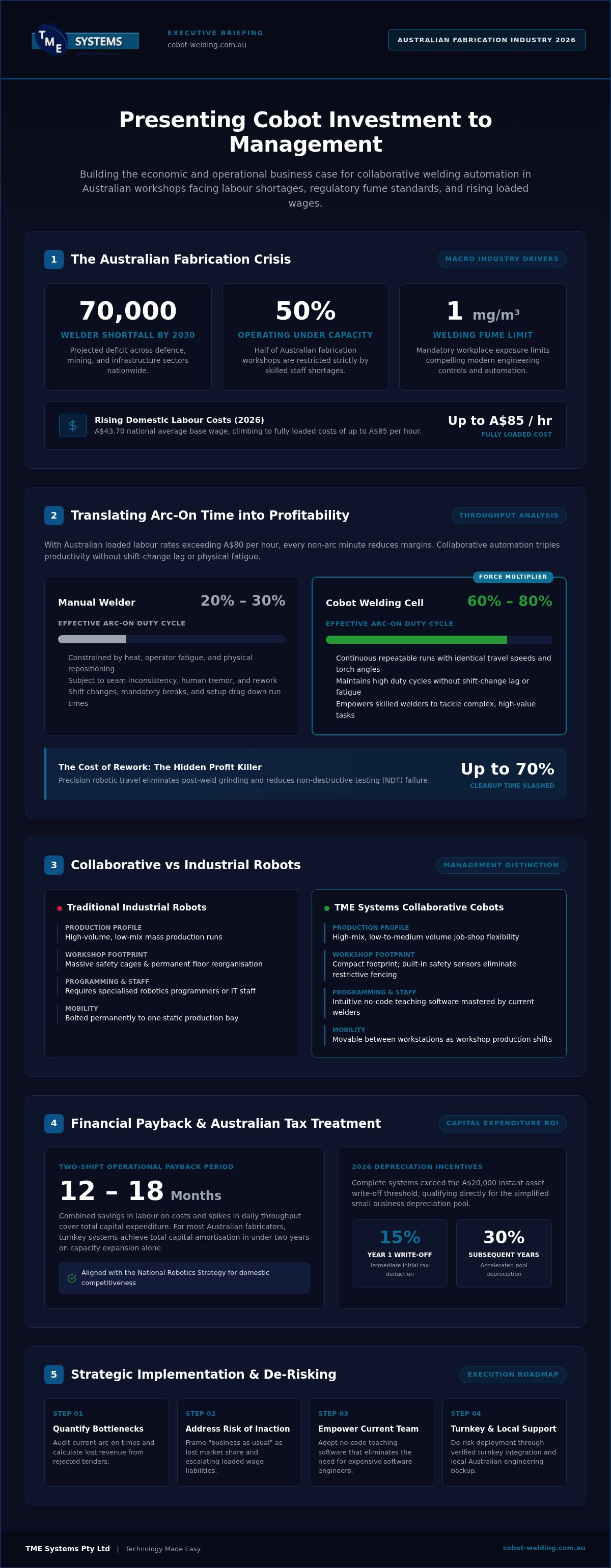

By 2030, Australia is forecast to face a shortfall of at least 70,000 qualified welders across the defence, mining, and infrastructure sectors. If you are feeling the pinch on the workshop floor, you know that finding skilled staff is no longer just a challenge; it is becoming a threat to your operations. You have likely identified automation as the solution, but the real hurdle is often presenting cobot investment to management in a way that resonates with the front office. Decision makers often view robotics as overly complex or too expensive for a local job shop, focusing on the upfront cost rather than the long term capacity.
We understand the pressure of trying to modernise a workshop while keeping an eye on the bottom line. You need more than technical specs to win over a sceptical boss. This guide will show you how to build a bulletproof business case that turns management hesitation into a green light for welding automation. We will walk through a clear ROI roadmap, a strategy for staff adoption, and the regulatory pressures, such as the new 1 mg/m³ welding fume limits, that make this investment essential. You will learn how to frame a cobot as a practical tool that empowers your existing team and secures the future of your business.
Key Takeaways
- Learn how to translate manual arc-on time into clear financial gains to prove the true value of automation for your workshop.
- Discover how no-code teaching software allows your current team to master automation without needing specialised IT or programming staff.
- Master a proven five-step framework for presenting cobot investment to management that addresses both production bottlenecks and long-term risk.
- Understand how turnkey solutions and local Australian support de-risk your transition and ensure ongoing production uptime.
The Business Case for Cobot Welding in the Australian Landscape
In 2026, the Australian fabrication industry isn't just fighting for contracts; it's fighting for hands. With a national average base wage for welders sitting at A$43.70, and fully loaded costs reaching up to A$85 per hour, the financial pressure is immense. When you are presenting cobot investment to management, it's vital to frame the technology as a solution to these rising costs rather than just a shiny new tool. In a climate where 50% of workshops are operating below capacity due to staff shortages, a cobot acts as a force multiplier for your best tradespeople.
Traditional industrial robots often fail in the typical Australian job shop because they are designed for high-volume, low-mix production. They require permanent floor space and complex programming that most small teams don't have. In contrast, collaborative robots are built for flexibility. They allow your experienced welders to focus on complex, high-value joins while the machine handles the repetitive, monotonous runs. This shift doesn't replace your staff; it empowers them to produce more without the physical strain or the risk of burnout.
Why "Business as Usual" is the Biggest Risk
The most significant cost to an Australian workshop isn't the price of equipment; it is the cost of turning down work. If you can't bid on a project because your lead times are too long, you are losing more than just that contract. You are losing market share to competitors who use automation to lower their tender prices. Relying on "business as usual" also risks your reputation. Manual welding over long shifts inevitably leads to inconsistencies in quality. A single batch of rejected parts can wipe out the profit margin of an entire project, making the case for a more reliable, automated process even stronger.
Collaborative vs. Industrial: The Management Distinction
When presenting cobot investment to management, highlight the practical differences in floor layout and safety. Traditional robots require massive safety cages and a total factory reorganisation, which is a significant hidden cost. Cobots have a much smaller footprint. Because they are designed with built-in safety sensors to work alongside humans, they often eliminate the need for restrictive fencing. This flexibility means you can move the unit between different workstations as your production needs change, ensuring the machine is always working where it adds the most value.
Translating Arc Time into Bottom-Line Australian Dollars
Management often views the workshop floor through a spreadsheet rather than a welding mask. To bridge this gap, you must translate technical advantages into financial outcomes. The "True Cost of a Weld" involves more than just wire and gas; it's heavily weighted by labour and rework. With fully loaded labour rates in Australia often exceeding A$80 per hour, every minute the arc isn't running is a drain on profitability. While a manual welder might achieve 20% to 30% arc-on time due to fatigue and setup, a cobot maintains 60% to 80% duty cycles without breaks or shift-change lag. This alignment with the National Robotics Strategy highlights how automation is becoming the standard for maintaining national manufacturing competitiveness.
In the context of a two-shift operation, ROI is achieved when the combined savings in labour on-costs and the spike in daily throughput cover the total capital expenditure within 12 to 18 months.
The ROI Framework for Capital Expenditure
When presenting cobot investment to management, focus on the simple payback period. For most Australian fabricators, a turnkey system pays for itself in under two years through increased capacity alone. Beyond throughput, mention the 2026 tax environment. While complete systems usually exceed the A$20,000 instant asset write-off threshold for small businesses, they still qualify for significant depreciation through the simplified small business pool. This allows for a 15% write-off in the first year and 30% in each subsequent year, providing a tangible tax benefit that improves the initial cash flow position.
The Cost of Rework: The Hidden Profit Killer
Consistency is the enemy of waste. Manual welding over long seams introduces human tremor and heat variability, often leading to post-weld grinding or expensive scrap. Cobots deliver identical travel speeds and torch angles every time, which slashes cleanup time by up to 70%. This reliability reduces the need for non-destructive testing (NDT) and ensures you can improve welding productivity with cobots by shifting your skilled staff to higher-margin, complex structural work. If you want to see these numbers in action on your own floor, a mobile demo system can provide the proof of concept your CFO needs.
Solving the Skills Gap Without Hiring Programmers
One of the biggest roadblocks when presenting cobot investment to management is the fear of technical complexity. Decision-makers often assume that adding a robot means adding a high-salaried software engineer to the payroll. In reality, the shift to "no-code" teaching has completely changed the game for the workshop floor. Instead of writing lines of code, your best tradespeople simply lead the robot arm by hand to define the weld path. If your team can use a smartphone, they can run a cobot. This ensures that your welding intellectual property stays where it belongs: with your experienced boilermakers, not an external consultant.
By transforming a welder into a "Cobot Supervisor," you aren't just automating a process; you're upskilling your workforce. The machine handles the repetitive, precision-heavy tasks, while the human operator applies their years of metallurgical knowledge to perfect the settings. This partnership keeps the craft at the centre of the production line. It's a pragmatic way to scale your output without the headache of a global talent search for specialised robotics experts.
Empowering the "Old Guard" and Attracting the New
Cobots handle the "dull, dirty, and dangerous" tasks that lead to chronic welder fatigue and long-term injury. For your veteran staff, this means less time spent in awkward positions and more time overseeing quality control. For the younger generation, automation is a powerful recruitment tool. Modern apprentices are drawn to workshops that embrace technology. They see it as a way to enhance their trade rather than replace it. Reducing the physical strain on your team helps you retain your most valuable staff while making your shop a more attractive place for new talent to start their careers.
The No-Code Advantage in High-Mix Environments
In a typical Australian job shop, production schedules change by the hour. Traditional automation often fails here because setup takes too long to justify for small runs. A NIST analysis on cobot adoption highlights that high-mix, low-volume environments are the perfect fit for collaborative systems. Using no-code robot welding software, you can reduce setup times from days to mere minutes. This flexibility is a key point when presenting cobot investment to management, as it allows you to remain profitable even on small batches of five or ten parts. You can switch between different jobs quickly, ensuring the machine stays busy and productive throughout the entire shift.
The Presentation Framework: A 5-Step Pitch for Management
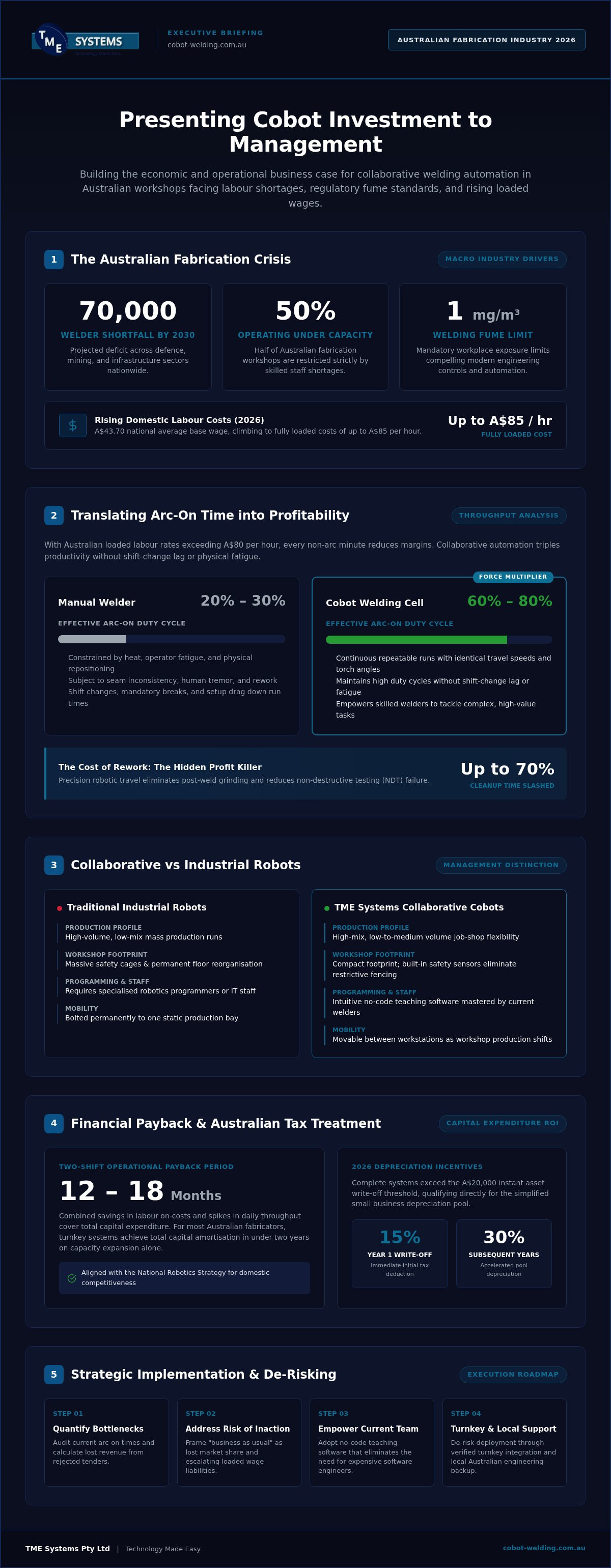
Winning approval for new technology requires a structured approach that speaks the language of the boardroom. When presenting cobot investment to management, you need to move beyond technical features and focus on operational stability. This 5-step framework is designed to address the specific concerns of Australian decision-makers, from the factory floor to the finance office.
- Step 1: Identify the "Burning Platform": Start with the immediate problem. Whether it's a backlog of orders, the national 70,000-welder shortfall, or the upcoming 1 December 2026 deadline for new fume exposure limits, define the cost of doing nothing.
- Step 2: Present the Solution: Detail the complete package. This includes the collaborative arm, the no-code software, and the full cell integration. Management needs to see this as a turnkey tool, not a DIY project.
- Step 3: Show the Proof: Use data from a mobile demonstration. Showing a part welded in your shop, using your own power source and materials, removes the "will it work for us?" variable.
- Step 4: The Financials: Reiterate the 12 to 18-month payback period. Focus on how moving from 20% to 60% arc-on time increases your monthly tonnage without adding to your headcount.
- Step 5: The De-Risking Plan: Outline the training schedule and the availability of local Australian support. This proves you have a plan for long-term success, not just a one-off purchase.
Preparing for the "Yeah, But..." Questions
Anticipating objections is a critical part of presenting cobot investment to management. You'll likely face questions about safety and Australian standards like AS/NZS 4024.1. Explain that cobots are designed for power and force limiting, which often removes the need for expensive safety cages. Address concerns about floor space by highlighting the small footprint and the ability to run on standard workshop power. Working with cobot welding integration experts ensures that these technical hurdles are handled before the unit even arrives on site.
The Value of a Physical Proof of Concept
Technical drawings and brochures rarely close a deal. Management needs to see the spark in person to truly understand the ease of use. You can book a mobile welding robot demonstration to bring the technology directly to your workshop floor. Before the demo, set clear success metrics, such as cycle time reduction or weld consistency on a specific part family. This turns a "cool tech demo" into a data-driven business case that's hard to ignore. To get started on your own proof of concept, arrange a site visit with our specialists.
Implementation and De-Risking: The TME Systems Approach
Management's biggest worry after the price tag is the "shelfware" risk. They don't want a machine that sits idle because it's too hard to set up or program. Presenting cobot investment to management is more effective when you can show a clear path from delivery to the first production weld. A DIY approach, where you buy an arm and try to integrate it yourself, often leads to hidden costs and extended downtime. By choosing a turnkey solution from TME Systems Pty Ltd, you ensure that the hardware, software, and safety protocols are ready to work from day one.
When you are presenting cobot investment to management, highlighting the availability of local spare parts and technical support is a powerful way to mitigate the fear of technical failure. Relying on overseas support can lead to weeks of lost production. Our approach at TME Systems Pty Ltd focuses on building a long-term partnership that keeps your workshop evolving as the industry changes.
Turnkey Collaborative Robot Welding Cells
A collaborative robot welding cell isn't just an arm on a table. It's a pre-configured environment that includes the power source interface, the no-code teaching software, and the necessary fume extraction to meet the latest Australian safety standards. This setup reduces the "time to first arc" significantly. You don't need to spend weeks troubleshooting communication between the robot and the welder. Whether you're running high-precision TIG on stainless or high-volume MIG on structural steel, the system is customised to your specific wire and gas requirements before it leaves the warehouse.
Ongoing Support and Training
The real value of automation is found in its long-term reliability. Our on-site cobot welder training roadmap ensures your team feels ownership of the technology. We don't just drop off a box. We work with your tradespeople to program their first production parts and ensure they're confident in the process. Because the software is no-code, your team can easily adjust the robot as your product range evolves. Having local Australian technical support means that if a question arises, you aren't waiting for a response from a different time zone. This ongoing partnership turns a one-time purchase into a strategy for continuous workshop improvement.
Ready to take the next step? We can help you gather the specific data and proof points you need for your pitch. Let's work together to turn that management scepticism into a green light for your shop floor. Contact us today to start your implementation plan.
Secure the Future of Your Workshop Floor
Modernising your workshop is no longer about chasing high-tech trends; it is about building resilience against a shrinking labour pool. By focusing on the tangible return on investment and the ease of no-code teaching, you can turn a complex technical pitch into a clear business decision. Remember that presenting cobot investment to management is most effective when you show how automation empowers your current tradespeople rather than replacing them. You are offering a way to triple arc-on time while meeting the strict new safety standards that are now a reality for Australian fabricators.
Our turnkey solutions are designed specifically for the local market, ensuring you have the support and spare parts needed to maintain uptime. We know that seeing is believing, which is why our mobile demonstration brings the technology directly to your floor. This allows your decision-makers to witness the consistency and speed of a cobot cell on your actual production parts. When you are ready to move from a proposal to a practical solution, we are here to help you lead the transition. Book a Mobile Demo to Show Management the Future of Your Shop and take the first step toward a more productive, competitive workshop.
Frequently Asked Questions
How much does a welding cobot typically cost in Australia?
The total cost depends on your specific requirements, such as the arm's reach, the power source, and the level of integration needed. When you are presenting cobot investment to management, it's better to focus on the total cost of ownership. This includes the hardware, no-code software, and professional onboarding. Most Australian fabricators treat this as a capital investment that qualifies for long-term depreciation and significantly increases workshop capacity without adding to the monthly wage bill.
Is a cobot safe to use in a busy workshop without a cage?
Yes, cobots are designed with internal sensors that detect resistance and stop movement immediately upon contact. This makes them safe for collaborative environments under Australian safety standards like AS/NZS 4024.1. While they don't require the massive safety cages used for traditional industrial robots, you still need to manage standard welding hazards. This includes using appropriate flash screens and fume extraction to protect your team from the arc and airborne contaminants.
Do we need a dedicated programmer to run the welding robot?
You don't need a software engineer or a specialised programmer to operate our systems. We provide no-code teaching software that allows your existing welders to "teach" the robot by physically guiding the arm along the weld path. If your staff can use a modern smartphone, they can learn to set up a new job in minutes. This ensures your tradespeople remain the experts in charge of the welding process and quality control.
What is the average payback period for a welding cobot investment?
Most Australian workshops see a full return on their investment within 12 to 18 months. This rapid payback is driven by the machine's ability to maintain a 60% to 80% arc-on time, which is often triple the duty cycle of a manual welder. By reducing rework and slashing post-weld grinding time, the system pays for itself through increased throughput and lower consumable waste. It's a highly predictable way to scale your operations.
Can a cobot handle small batches and one-off jobs profitably?
Cobots excel in high-mix, low-volume environments because they are incredibly fast to set up. Unlike traditional robots that require days of complex coding, a no-code system allows you to switch between different part families in a matter of minutes. This flexibility makes it profitable to automate runs as small as five or ten units. You can maintain high productivity even when your production schedule changes daily to meet customer demands.
What kind of maintenance does a collaborative welding cell require?
Maintenance for a collaborative cell is straightforward and similar to your existing welding equipment. You'll need to perform regular checks on consumables like contact tips, shrouds, and liners to ensure weld quality remains high. The robotic arm itself is a low-maintenance industrial tool that requires periodic software updates and simple joint inspections. Because we provide turnkey solutions with local Australian support, getting spare parts or technical advice is a quick and simple process.
Does a cobot replace our existing welders?
A cobot is a force multiplier, not a replacement for skilled tradespeople. It handles the repetitive, monotonous seams that cause fatigue, which allows your qualified welders to focus on complex structural joins and high-value custom work. This is a vital point when presenting cobot investment to management; the technology solves the chronic labour shortage by making your current team more productive. It helps you grow your business without the constant struggle of finding new staff.
What Australian standards apply to collaborative robot welding?
The primary standard is AS/NZS 4024.1, which covers the safety of machinery in Australian workplaces. This is harmonised with international standards like ISO 10218 and ISO/TS 15066, which specifically govern collaborative robot operation and power-limiting safety functions. Your installation must also comply with welding-specific standards such as AS/NZS 1554.1 for structural steel. Our integration process ensures that your turnkey cell meets these requirements, providing a safe and compliant environment for your entire team.