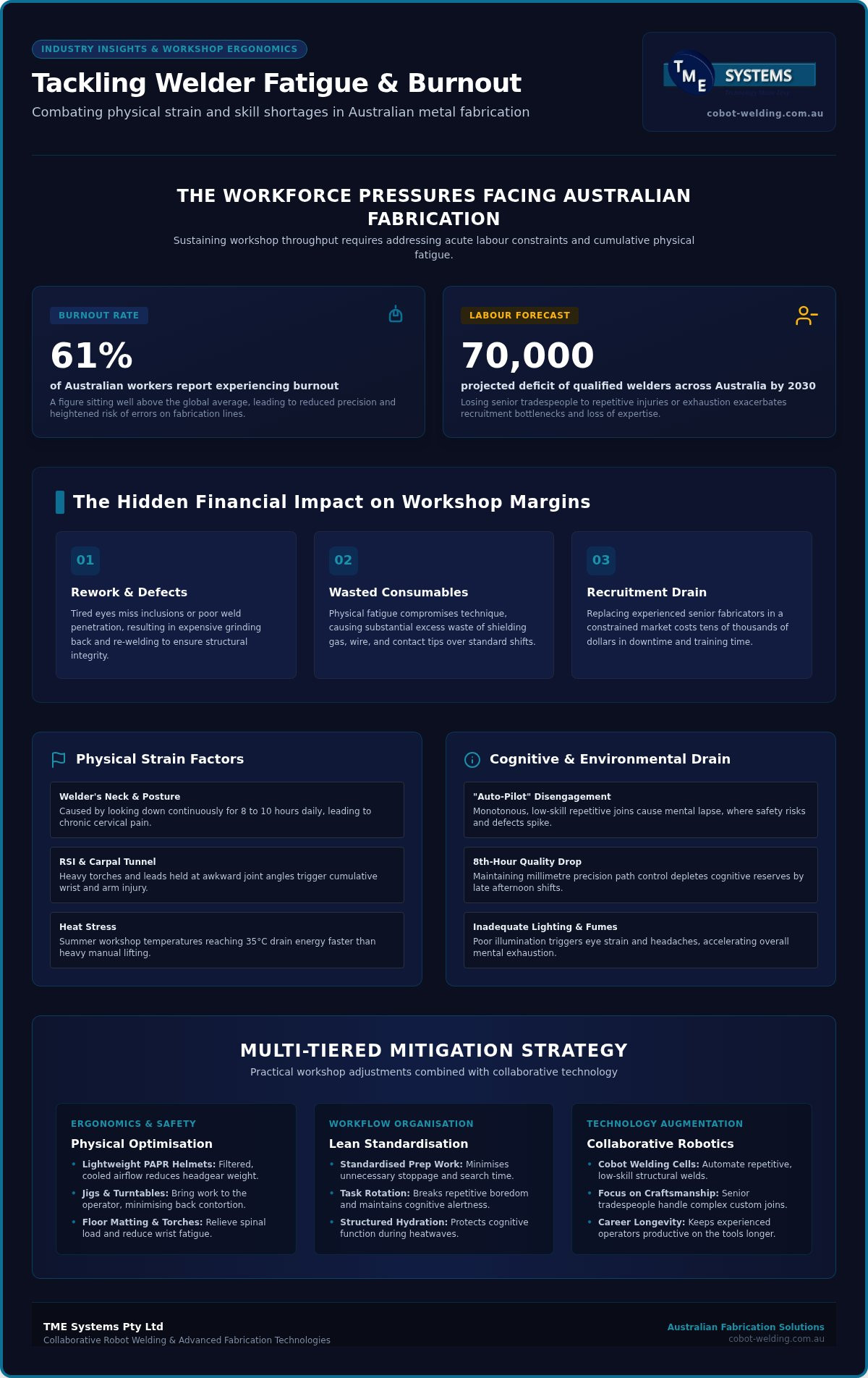

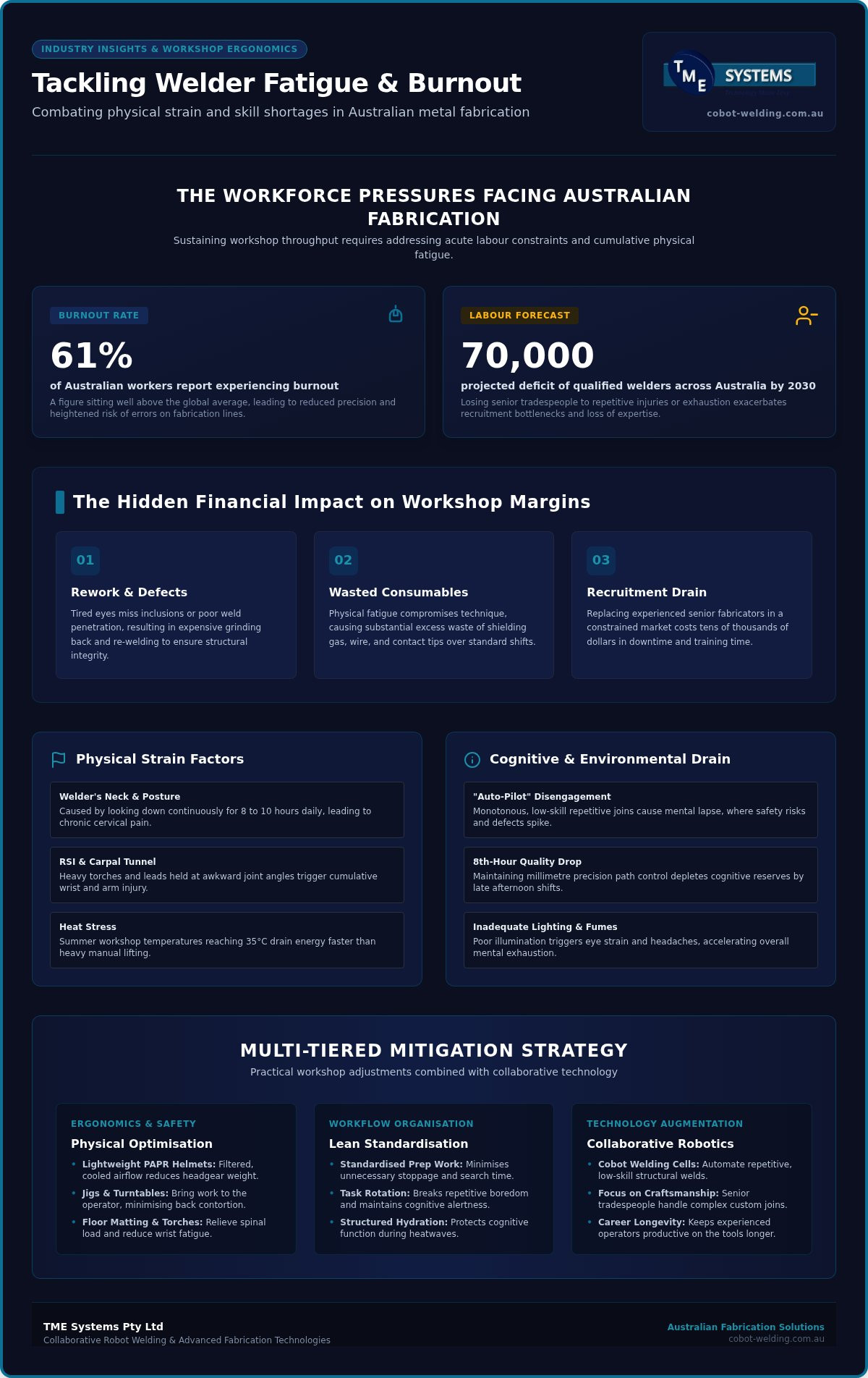
Did you know that 61% of Australian workers report experiencing burnout, a figure that sits well above the global average? In the fabrication industry, this exhaustion isn't just a HR concern; it's a direct threat to your workshop’s bottom line. You have likely felt the pressure of a tightening labour market, especially with a projected deficit of 70,000 qualified welders across Australia by 2030. It is frustrating to watch your most experienced staff battle repetitive strain injuries or see weld consistency drop during those long afternoon shifts.
We understand that keeping your team healthy and your workshop productive is a delicate balancing act. You want a stable, happy workforce where your senior tradespeople can stay on the tools longer without wearing out their bodies. This article will show you how to reduce welder burnout and fatigue by combining practical workshop adjustments with modern collaborative technology. We will explore how to shift the heavy, repetitive grunt work away from your operators, allowing them to focus on the high-value craftsmanship they were actually trained for.
Key Takeaways
- Understand the hidden financial impact of worker exhaustion, including the rising costs of rework and staff turnover in a competitive labour market.
- Discover how to reduce welder burnout and fatigue by using collaborative robot welding cells to automate repetitive, low-skill tasks.
- Optimise workshop ergonomics and invest in lightweight PPE to significantly lower the daily physical drain on your senior operators.
- Implement lean principles and standardised prep work to ensure your skilled welders spend more time performing high-value craftsmanship.
- Learn how task variety and mental engagement help maintain consistent weld quality from the start of the morning until the end of the shift.
Understanding the True Cost of Welder Fatigue in Australian Workshops
Welder fatigue is a physiological state that reduces a fabricator's ability to perform skilled tasks safely. It is more than just feeling tired after a Friday afternoon shift. In a busy workshop, this often manifests as occupational burnout, which is a combination of deep physical exhaustion and mental disengagement. When a skilled operator reaches this point, they aren't just slower; they're less precise and more prone to errors that compromise the structural integrity of a build.
The Australian manufacturing sector is under unique pressure in 2026. With a projected deficit of 70,000 qualified welders by 2030, the cost of losing a single staff member is immense. Beyond the recruitment fees, the "hidden" costs of fatigue eat into your margins every day. These include:
- Rework and Defects: Tired eyes miss inclusions or poor penetration, leading to costly grinding and re-welding.
- Wasted Consumables: Fatigue leads to poor technique, which increases the waste of shielding gas, wire, and tips.
- Recruitment Strain: Replacing a senior welder in a tight labour market can cost tens of thousands in lost productivity and training time.
Understanding how to reduce welder burnout and fatigue is no longer just a "nice to have" for staff morale; it's a critical strategy for workshop survival.
The Physical vs. Mental Toll of Fabrication
Fabrication requires a rare mix of physical stamina and intense cognitive load. While muscle fatigue from holding a torch at awkward angles is obvious, the mental drain of maintaining high-precision paths is often overlooked. When a welder spends hours on repetitive, low-skill joins, they often switch to "auto-pilot." This mental disengagement is where safety risks spike and weld consistency drops. By the eighth hour of a shift, the cognitive energy required to maintain a steady hand simply isn't there, leading to a noticeable dip in quality control.
Why 'Toughing it Out' is a Failing Strategy
The traditional workshop culture of "hard yakka" and "toughing it out" is a failing strategy in the modern era. Today, successful fabricators prioritise longevity over short-term grit. If a senior welder is constantly battling RSI or chronic back pain, they won't stay in the trade. Acknowledging that physical comfort is linked to long-term retention helps bridge the skills gap. By implementing strategies for how to reduce welder burnout and fatigue, you ensure your most experienced operators can stay on the tools for years, rather than burning out in their prime.
Tackling Physical Strain: Ergonomics and the Workshop Environment
Welding is a trade where physical grit is often worn as a badge of honour, but the human body has its limits. If your workshop floor still operates on a "just get it done" mentality, you're likely seeing a rise in RSI claims and sick leave. Optimising the height and angle of welding benches is a foundational step in how to reduce welder burnout and fatigue. By preventing "welder's neck," a chronic condition caused by looking down for 8 to 10 hours a day, you protect your most valuable assets: your people.
In the peak of an Australian summer, heat stress becomes a major safety hazard that drains energy faster than any heavy lift. Proper ventilation and structured hydration strategies are essential to keep the team sharp when the mercury hits 35 degrees. High-quality, lightweight PPE, such as PAPR helmets, might seem like a larger upfront investment, but they reduce the physical burden of heavy headgear while providing cooled, filtered air. Learning to handle job burnout starts with these environmental basics.
Positioning for Success
Jigs and turntables are simple yet effective tools to bring the work to the welder, rather than forcing the operator to contort around a fixed frame. When a fabricator can stand upright on supportive floor matting, the cumulative strain on their lower back is reduced significantly. It's also vital to consider the weight of torches and leads. Heavy equipment leads to wrist strain and carpal tunnel issues over time. Switching to lighter, ergonomic torches makes a noticeable difference by the end of a long production run. If you're looking to upgrade your workshop, exploring modern fabrication tools can help automate the most strenuous positions.
Environmental Factors You Can Control
Poor lighting causes eye strain and headaches, which are often the first signs of mental fatigue. Similarly, effective fume extraction is about more than just compliance with the 1 mg/m³ exposure standard; it's about keeping the air clear so operators can focus. A cluttered workspace that requires constant lifting and reaching adds unnecessary physical drain. By organising the workshop to minimise wasted movement, you help your team preserve their energy for the actual weld. Implementing scheduled "micro-breaks" every hour allows welders to reset their posture and stretch, which is a key part of how to reduce welder burnout and fatigue.
Combatting Mental Fatigue and Repetitive Task Boredom
While physical strain is often the first thing fabricators notice, mental fatigue is a silent productivity killer. "Grunt work," those endless runs of simple fillets on hundreds of identical brackets, is a primary drain on morale. Skilled tradespeople didn't spend years mastering their craft to act like a human jig. When a welder is bored, their focus naturally wanders. This mental disengagement is a major factor in how to reduce welder burnout and fatigue, as it directly impacts the precision of every join.
Giving your team more autonomy over their workflow is a powerful way to combat this. When welders have a say in their job rotation or task order, they feel more invested in the outcome. A multi-skilled team that rotates between complex custom builds and process management stays sharper for longer. This variety re-centres their focus, ensuring that quality doesn't dip during the final hours of a long production run.
The Burden of High-Volume, Low-Complexity Jobs
Skilled welders lose interest quickly when faced with massive batches of low-complexity joins. There's a clear correlation between this boredom and an increase in weld defects. When the mind isn't engaged, the hand follows suit. Mental fatigue often leads to operators "cutting corners" on essential steps like joint prep or final finishing, simply because the repetition has become soul-crushing. Providing task variety isn't just about keeping people happy; it's a quality control strategy that ensures every bead meets Australian standards.
Upskilling as a Cure for Burnout
Moving an operator from manual labour to process management is one of the most effective ways to revitalise a career. Instead of performing the repetitive work themselves, the welder becomes the instructor. Accessing on-site cobot welder training allows your team to master new technology, shifting their role from "doing" to "teaching." This increases their value to the business and their own job satisfaction. Learning to manage a collaborative system keeps the operator in control, making innovation feel like a tool for empowerment rather than a threat. This shift in perspective is a vital component of how to reduce welder burnout and fatigue in a modern workshop.
Practical Strategies to Optimise Your Fabrication Workflow
Optimising your workshop workflow is about removing the friction that makes an 8-hour shift feel like a 12-hour one. A chaotic floor plan doesn't just slow down production; it actively contributes to physical exhaustion. When you look at how to reduce welder burnout and fatigue, the solution often lies in the minutes lost between welds. By refining your processes, you allow your team to stay focused on the task at hand rather than fighting a disorganised environment.
Clear communication is equally vital. When production targets are unrealistic or poorly defined, the resulting stress leads to mental exhaustion. Setting achievable goals and maintaining a steady pace helps prevent the "afternoon slump" where quality often dips. By using technology to improve welding productivity with cobots, you can offload the most repetitive tasks, ensuring your team isn't squeezed by high-volume demands.
Pre-Weld Preparation: Reducing the Load
Skilled welders should spend as much time as possible "under the hood." If they're constantly hunting for parts or fixing poor fit-ups, their frustration levels rise along with their physical fatigue. Implementing a kitting system ensures every component is cleaned and ready before the torch is even picked up. Accurate tacking might seem like a small detail, but it prevents the mid-weld stress of bridging gaps or dealing with misalignment. This level of standardisation keeps the operator in a steady, productive rhythm and is a core part of how to reduce welder burnout and fatigue.
Streamlining the Production Line
Lean principles on a fabrication floor are simply about reducing wasted movement. Identifying bottlenecks that cause "stop-start" fatigue is essential for a smooth day. If a welder is frequently waiting on a crane or a shared grinder, their momentum breaks, which is mentally draining. Setting up dedicated stations for different stages of the build reduces the need for unnecessary lifting and reaching. Instead of just tracking hours on the clock, measure success by arc-on time. This shift in focus quickly highlights where the workflow is failing the operator. If you're ready to refine your workshop floor, you can explore our collaborative welding solutions to see how they fit into a lean, high-output production line.
How Collaborative Automation Supports Your Skilled Workforce
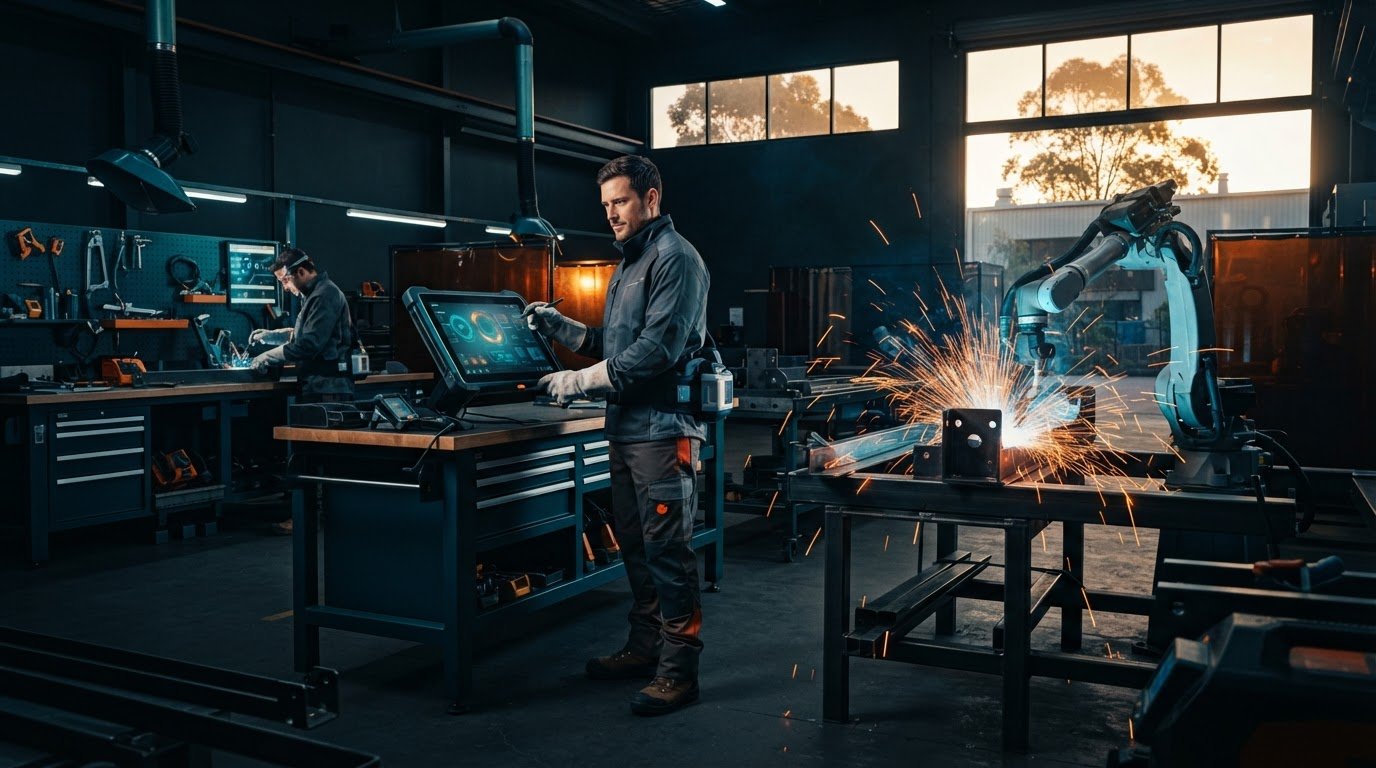
Collaborative automation is often misunderstood as a replacement for human skill. In reality, collaborative robot welding cells act as a team member that handles the tasks humans shouldn't have to do. By taking over the "dull, dirty, and dangerous" aspects of fabrication, these systems directly address how to reduce welder burnout and fatigue. Instead of an operator spending four hours in a static, hunched position to complete a 50-unit batch of brackets, they can set the cobot to handle the repetitive runs while they prepare the next jig or focus on a more complex, custom weld.
This shift doesn't just save time; it preserves the physical health of your team. The repetitive motion required for high-volume batches is a leading cause of long-term strain. When a cobot takes on that burden, the operator's daily physical drain drops significantly. This practical approach to automation ensures that your workshop remains productive without sacrificing the well-being of your tradespeople. It's about working smarter, not harder, to maintain high standards across every shift.
The Welder as the Operator, Not the Coder
Many fabricators worry that automation requires complex programming skills. However, no-code robot welding software ensures the welder stays in total control. Teaching a robot is now as simple as hand-guiding the torch along the desired path. The welder's expertise remains the most important part of the process, as they define the angles and speeds that ensure a quality bead. This hands-on involvement removes the "fear factor" of new technology, turning the robot into a trusted tool that empowers the worker rather than intimidating them.
Long-Term Benefits: Retention and Reliability
Investing in collaborative tools is a powerful recruitment and retention strategy. Modern workshops that embrace technology are far more attractive to younger talent who expect to work with contemporary tools. For your senior staff, this technology offers a way to stay in the industry longer by reducing the physical toll of the trade. They can move away from the "grunt work" and apply their years of experience to high-value, technical joins that require a human touch. This balance is key to how to reduce welder burnout and fatigue while building a more resilient business. Ready to see it in action? You can book a mobile welding robot demonstration at your workshop to see the benefits for your team first-hand.
Future-Proofing Your Workshop Floor
Protecting your team from the physical and mental toll of high-volume fabrication is essential for maintaining a competitive edge. Addressing how to reduce welder burnout and fatigue requires a practical combination of ergonomic improvements, streamlined workflows, and targeted automation. By shifting repetitive grunt work away from your operators, you protect their health and ensure consistent weld quality across every single shift.
Collaborative technology is designed to support your tradespeople, not replace them. Our turnkey cells feature no-code teaching software for rapid setup, allowing your welders to remain in complete control of the process. Backed by national Australian support and integration, these systems deliver immediate productivity gains while keeping your most experienced staff on the tools longer without wearing out their bodies.
If you are ready to see how this technology adapts to your team, you can book a mobile welding robot demonstration to experience these benefits firsthand on your own workshop floor. Taking this step empowers your workforce and secures the long-term reliability of your business.
Frequently Asked Questions
What are the first signs of welder burnout I should look for?
The first signs usually appear as a combination of physical fatigue and subtle changes in workplace behaviour. You might notice a sharp rise in minor weld defects during the final hours of an afternoon shift. Operators may also show signs of mental disengagement, such as taking longer to complete routine setups or showing less interest in quality control. Physical indicators include frequent stretching, complaints of neck stiffness, or an increase in brief, unscheduled breaks to rest their wrists.
How does physical fatigue actually affect weld quality?
Physical fatigue directly compromises an operator's fine motor skills and spatial awareness. As muscles tire from holding a torch in static positions, maintaining a consistent arc length and travel angle becomes incredibly difficult. This physical drain often results in poor penetration, erratic beads, and increased spatter. When fabricators are exhausted, they are also more likely to rush through essential joint preparation and post-weld cleaning, which introduces defects into the finished product.
Will my experienced welders resist using a cobot?
Experienced tradespeople rarely resist collaborative tools once they realise the technology is designed to support them rather than replace their skills. Initial hesitation usually disappears when they see how the system handles the strenuous, high-volume grunt work. By framing the technology as an assistant that takes over the dull, repetitive runs, senior welders quickly understand that it preserves their physical health and allows them to focus their craftsmanship on complex, custom fabrication tasks.
Can a cobot really handle small batches without wasting time on setup?
Yes, collaborative systems are highly efficient for low-volume production because they eliminate the lengthy programming times associated with traditional industrial robots. Modern setups allow an operator to adjust for a new part in just a few minutes. This rapid changeover makes it highly practical to automate batches as small as ten or twenty units. Implementing these flexible workflows is a highly effective strategy for how to reduce welder burnout and fatigue on the workshop floor.
What is 'no-code' welding software and is it easy to learn?
No-code teaching software is an intuitive interface that allows fabricators to program a robot without writing a single line of computer code. Instead of using a complex pendant, the welder simply guides the robot arm by hand along the required path and records the points. The software captures the path instantly. It is designed specifically for tradespeople, meaning any skilled welder can master the basic operation after just a few hours of hands-on onboarding.
How much floor space does a collaborative welding cell actually take up?
A collaborative welding cell features a remarkably compact footprint compared to traditional industrial robotic enclosures. Because they are designed to operate safely alongside humans without massive perimeter fencing, they generally fit into a standard welding bay. Most turnkey cells occupy a space roughly equivalent to a standard workbench setup. This small footprint allows local fabricators to introduce automation without reorganising their entire workshop layout or sacrificing valuable floor space.
Are there Australian safety standards specifically for welding cobots?
Yes, collaborative robot installations must comply with specific safety standards to operate without traditional guarding. The relevant standard is ISO/TS 15066, which outlines the safety requirements for collaborative industrial robot systems and the work environment. A proper integration requires a thorough risk assessment of the specific torch, workspace, and materials. Ensuring compliance with these guidelines is a vital part of understanding how to reduce welder burnout and fatigue while maintaining a legally compliant workshop.
Does automation actually help with staff retention in small workshops?
Modern automation significantly improves staff retention by eliminating the repetitive physical strain that drives skilled tradespeople away from the tools. When smaller workshops invest in collaborative systems, they create a cleaner, safer, and less exhausting work environment. This investment shows the team that the business values their health and longevity. It also aids recruitment, as younger apprentices are naturally drawn to forward-thinking businesses that utilise contemporary manufacturing technologies.