
What if your workshop could produce a perfect "stack of dimes" weld on every single stainless steel joint, even when your most experienced TIG specialist is off the tools? You're likely feeling the squeeze of a tight labour market where finding skilled operators feels like a constant uphill battle. It's frustrating when high-precision jobs for aluminium or stainless steel result in high reject rates because the consistency just isn't there. You might even think that a robotic tig welding system is a luxury reserved for massive car factories, but the reality on the ground in 2026 has changed.
We understand the pressure to maintain premium quality while trying to get more out the door with fewer hands. This guide shows you how modern robotic TIG systems combine the finesse of a manual welder with the relentless consistency of automation to transform your productivity. We'll look at how no-code software allows you to upskill your existing staff to manage these cells, ensuring you can increase throughput on repetitive precision jobs without losing that hand-crafted finish. From meeting the latest safety standards to calculating your return on investment, we've got the practical details you need to move forward with confidence.
Key Takeaways
- Understand how a robotic tig welding system replicates the precision of a skilled tradesperson while delivering unmatched consistency across high-volume stainless and aluminium projects.
- Discover why collaborative robots are often the superior choice for Australian workshops, offering a smaller footprint and easier integration than traditional industrial setups.
- Learn how no-code teaching software removes the technical barrier to automation, allowing your best welders to program paths simply by hand-guiding the robot arm.
- Identify the specific materials and aesthetic requirements where automated TIG provides a clear advantage over MIG, particularly for thin-gauge and high-visibility joints.
- Explore the practical steps for a successful rollout, from initial assessment and mobile demos to specialised operator training that upskills your existing workforce.
Understanding Robotic TIG Welding: Precision Meets Automation
Robotic TIG welding is the automation of the Tungsten Inert Gas process, where a robotic arm takes over the torch manipulation that usually requires a master tradesperson's steady hand. While Robot welding has been around for decades, TIG was traditionally the hardest to automate because of the tight tolerances and arc control required. In 2026, the shift from massive, complex industrial cells to accessible, workshop-ready units has made this precision available to local job shops. A robotic tig welding system is now the gold standard for clean, high-strength welds on thin materials like stainless steel and aluminium.
Unlike robotic MIG systems that prioritise speed and deposition, TIG automation focuses on the integrity and appearance of the joint. It's about getting the heat right and ensuring the bead is perfect every time. This makes it the ideal choice for industries where a weld failure isn't just a nuisance but a critical safety risk.
The Core Components of a Robotic TIG System
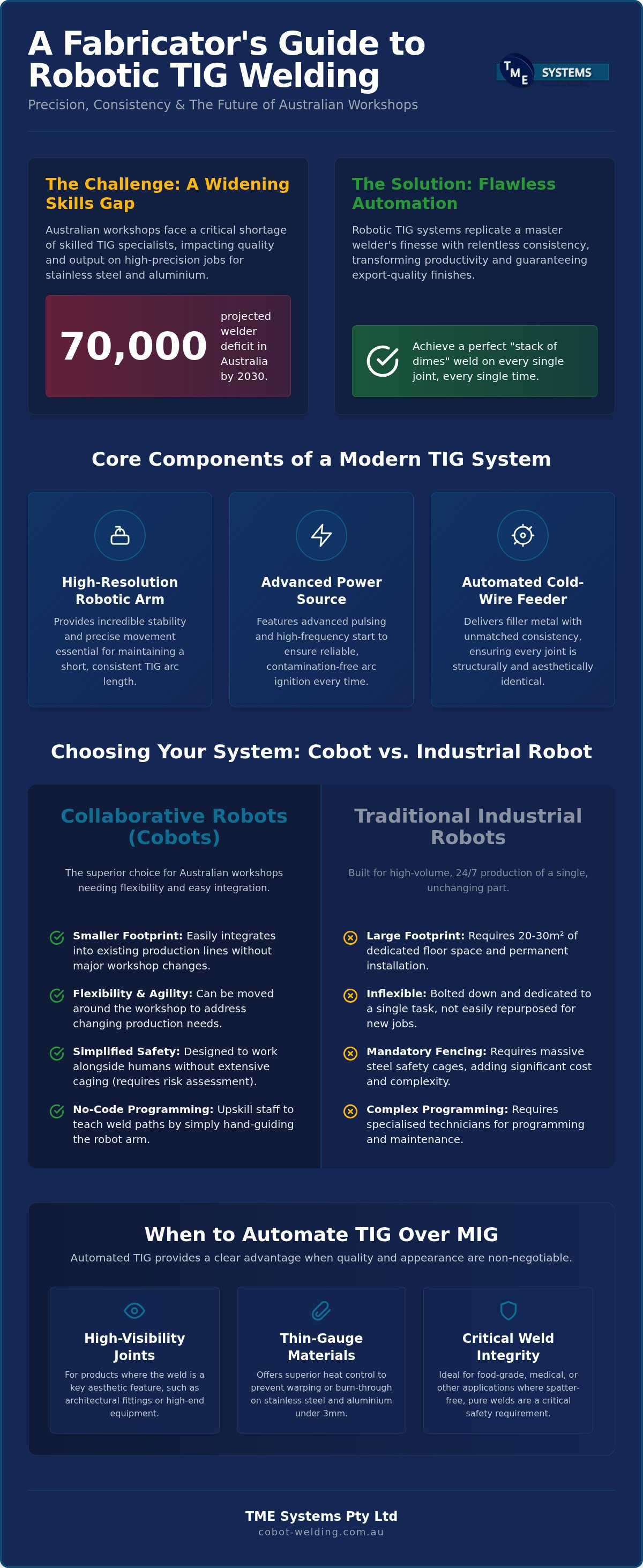
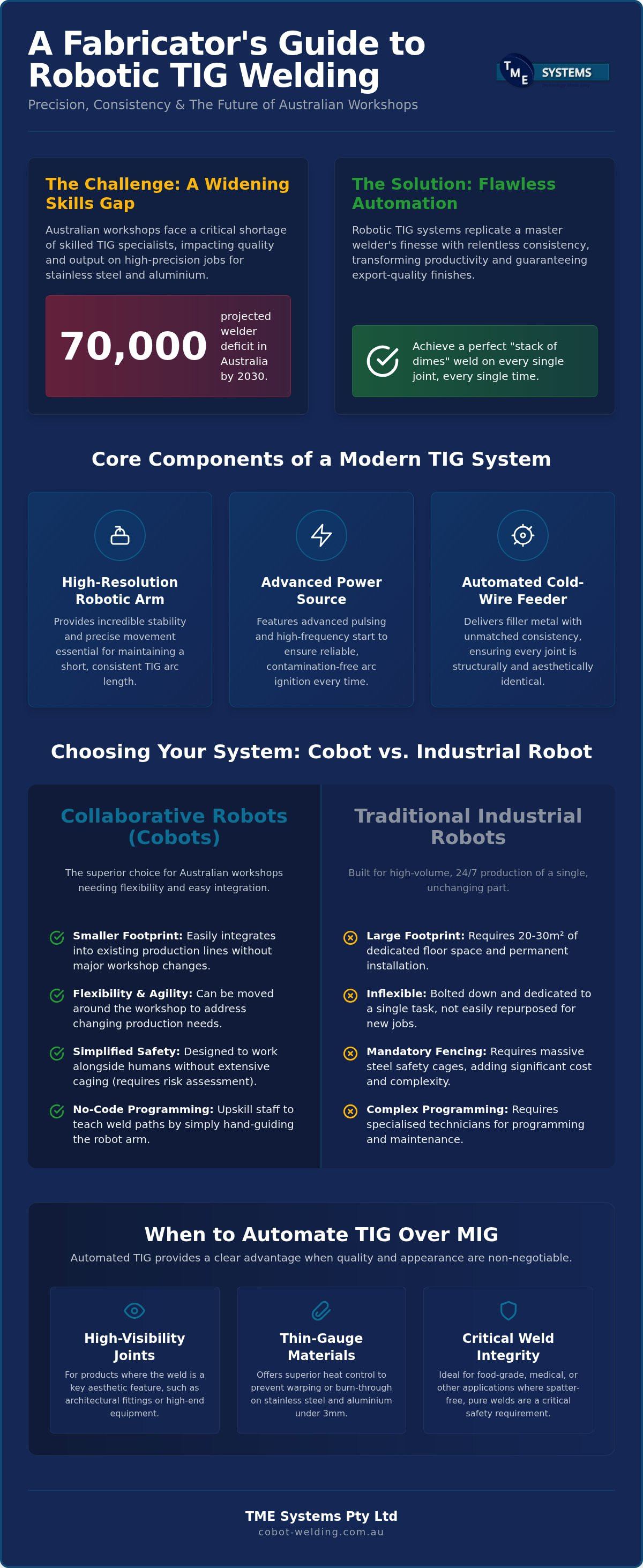
A functional cell relies on three specific pillars to deliver results. First, the robotic arm must offer high-resolution movement. Because TIG requires a very short, consistent arc length, the arm needs to be incredibly stable. Second, the power source needs advanced pulsing and high-frequency start capabilities. This ensures the arc ignites reliably without the tungsten touching the workpiece, which prevents contamination. Finally, a robotic tig welding system uses an automated cold-wire feeder. This device delivers filler metal with a consistency that a human operator simply cannot match over an eight-hour shift, ensuring every joint looks identical.
Why Australian Fabricators are Automating TIG Now
The primary driver for this shift is the local skilled labour shortage. With Australia facing a projected deficit of 70,000 welders by 2030, shops can't find enough TIG specialists to keep up with demand. Automation allows you to amplify the output of your existing staff. Instead of being hunched over a single bench, your experienced welders can oversee multiple robotic arcs.
There is also a growing demand for export-quality finishes. Whether you are producing food-grade equipment or medical-grade stainless steel, the aesthetic and structural requirements are higher than ever. Beyond the business case, automation reduces the physical strain on your team. TIG is a punishing process on the neck, back, and eyes. By moving the operator away from the immediate hazard zone, you create a safer, more sustainable workshop environment while maintaining a premium output.
Cobots vs. Industrial Robots: Choosing the Right TIG System
The decision between a traditional industrial robot and a collaborative robot (cobot) is often the most significant choice you'll make when investing in a robotic tig welding system. For decades, the industry standard was a high-speed industrial arm bolted inside a massive steel cage. While these systems are incredibly fast, they require a significant amount of floor space and permanent safety fencing to comply with Australian standards. In a crowded workshop, finding an extra 20 or 30 square metres for a single machine isn't always possible.
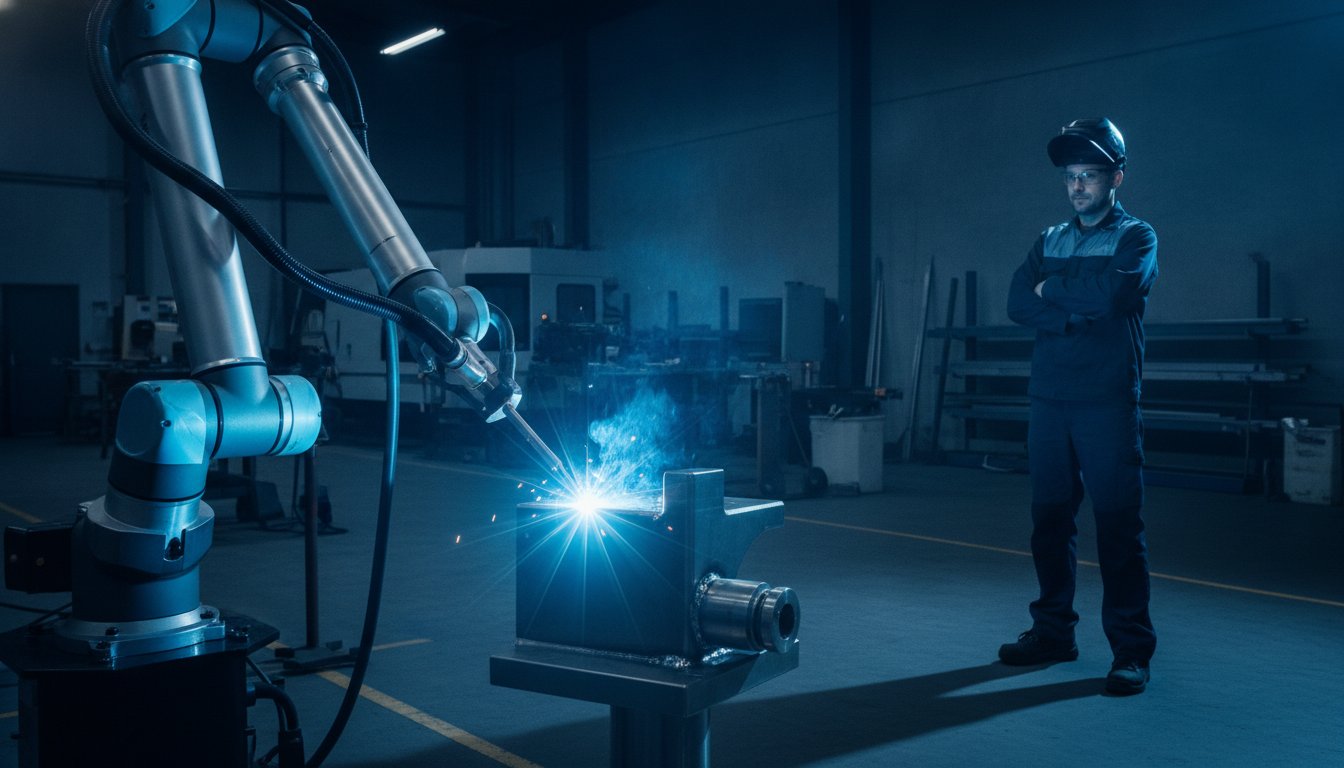
Collaborative robots offer a different path toward full automation in TIG welding. These machines are designed to work alongside humans without the need for extensive physical barriers, provided a proper safety risk assessment is completed. This reduced footprint makes them much easier to integrate into existing production lines. Because they don't require fixed fencing, they can often be moved around the workshop as your production needs change, providing a level of agility that traditional robots can't match.
When to Choose an Industrial Robot
If your business runs the same part 24 hours a day, an industrial robot is likely your best bet. These systems excel in high-volume production where every second of cycle time matters. They are built for heavy-duty applications that might require a massive reach or the ability to handle heavy payloads. However, the cost of guarding and the lack of flexibility mean they aren't always the right fit for a job shop environment. They are permanent, unchanging production lines that require dedicated safety enclosures and specialised technicians to maintain.
The Case for Collaborative Robot Welding Cells
For the typical Australian fabricator dealing with small to medium batch runs, Collaborative Robot Welding Cells offer far better ROI. Because these robots can be re-taught quickly, you don't need to commit to a single part for months on end. You can weld a batch of stainless tanks in the morning and switch to aluminium frames in the afternoon. This flexibility is vital when part variety is high and you need to respond quickly to customer demands.
The safety requirements for cobots are also less intrusive. While you still need to follow AS/NZS 4024.1, the absence of expensive, permanent fencing significantly reduces the initial setup cost. This makes the entry point for automation much more attainable for smaller businesses. If you're unsure which path fits your floor plan, you might find it helpful to see a mobile demo system in action at your own site. This hands-on approach helps demystify how a robotic tig welding system fits into your specific workflow without the guesswork. It allows you to see exactly how the technology interacts with your team before making a long-term commitment.
The No-Code Revolution: Teaching Your TIG Robot Without Coding
"I'm a welder, not a computer programmer." This is the most common concern we hear from Australian fabricators when they first look at automation. It's a fair point. For years, industrial robots required thousands of lines of complex script just to move a torch in a straight line. However, the arrival of No-Code Teaching Software has completely changed the game. Instead of typing commands into a terminal, you simply take the robot by the hand.
In a modern robotic tig welding system, teaching a path is as intuitive as showing a new apprentice how to hold a torch. You physically move the arm to the start point, press a button on the handle to save the position, and then guide it to the end. The software handles the complex trajectory mathematics in the background. This lead-through teaching method ensures your best tradespeople remain the ones in control of the process, rather than an IT department or an external consultant.
Adjusting the weld itself is just as straightforward. Most systems now use a tablet interface that feels more like a smartphone app than a piece of industrial machinery. You can refine your amps, travel speed, and wire feed rates with a few taps. This accessibility removes the technical barrier that previously kept automation out of smaller job shops.
How No-Code Software Empowers the Tradesperson
The real value of this technology isn't just about avoiding code; it's about saving time. Traditional programming could take days to set up for a new part, which made automation useless for small batches. With No-Code Robot Welding Software: The Fabricator’s Guide, you can reduce that setup time from days to mere minutes. This allows your welders to retain total control over the "craft" of the weld while the robot handles the repetitive labour. It turns the machine into a powerful tool that supports the worker rather than replacing them.
Visual Programming and Real-Time Adjustments
Before you strike an arc, you can use 3D visualisations on the tablet screen to check the weld paths and ensure there are no torch collisions. This digital dry run saves on scrap and prevents damage to expensive consumables. Material variations are a reality in every workshop. Perhaps a batch of stainless steel is slightly warped or the fit-up isn't quite perfect. Intuitive interfaces allow for on-the-fly adjustments, letting you tweak parameters during the run to handle these real-world inconsistencies. This level of flexibility is the key to high adoption rates on the workshop floor.
Key Applications: When to Automate TIG Over MIG
Choosing between MIG and TIG automation usually involves a trade-off between speed and finesse. While MIG is excellent for heavy structural steel where deposition rates matter most, a robotic tig welding system is the superior choice for precision work on thin-gauge materials. For many Australian fabricators, TIG is non-negotiable when working with stainless steel, aluminium, or exotic alloys. The primary advantage is the level of control over the weld pool. This allows for high-strength joints without the mess of spatter or the risk of structural defects.
One of the biggest hidden costs in a workshop is post-weld processing. MIG welding often requires significant time spent grinding and polishing to achieve a presentable finish. In contrast, TIG produces a clean, aesthetic result straight off the torch. If your customers demand a "stack of dimes" appearance on visible joints, automation ensures you can deliver that look every single time. It eliminates the inconsistencies that come with manual operator fatigue, ensuring the thousandth weld looks identical to the first.
Stainless Steel Fabrication
In sectors like food and beverage or medical equipment, weld integrity and hygiene are paramount. Any porosity or undercut can become a breeding ground for bacteria. Robotic TIG provides the consistent penetration needed for these high-stakes applications. It also solves the issue of burn-through on thin sheets. By maintaining a perfect travel speed and arc length, the robot prevents the excessive heat build-up that often ruins expensive stainless components during manual welding. This is particularly valuable for architectural stainless steel where the weld is a visible design feature that cannot be hidden by paint.
Aluminium and Heat Management
Aluminium is notoriously difficult to weld because of its high thermal conductivity. It acts like a heat sink. It draws energy away from the joint until the metal suddenly reaches its melting point and collapses. A robotic tig welding system manages this through precise pulsing. By rapidly switching between peak and background currents, the system maintains a stable weld pool while minimising the overall heat input. This significantly reduces distortion in large aluminium frames. When combined with automated wire feeding, you get a perfect fillet that is structurally sound and visually consistent.
If you want to see how these systems handle your specific material challenges, you can book a mobile demo system to visit your workshop floor and prove the concept on your own parts.
Implementing Robotic TIG: Integration, Training, and ROI
Adopting a robotic tig welding system is a strategic shift that requires more than just unboxing new hardware. To ensure a smooth transition, we follow a methodical five-step process: Assessment, Demonstration, Integration, Training, and Support. It begins by identifying your most repetitive, high-value precision jobs where consistency is currently a struggle. Once these parts are selected, a "Proof of Concept" via a Mobile Demo System brings the technology directly to your workshop floor. This step is vital because it proves the system can handle your specific material and fit-up realities before you commit to a permanent installation.
Calculating your return on investment requires looking past the initial purchase toward the Total Cost of Ownership (TCO). In the Australian market, manual labour costs for skilled welders typically range between $45 and $60 per hour. In contrast, the hourly operating cost of a robotic cell sits between $8 and $15. The real gains, however, come from throughput. While a manual welder might achieve an arc-on time of 25% to 35% due to setup and fatigue, a well-integrated system can push that to 85% or 95%. When you factor in the massive reduction in rework and rejects on expensive stainless steel jobs, most local fabricators see a full return on investment within 12 to 24 months.
The Integration Process for Australian Shops
Successful implementation relies on syncing the robot with your existing workshop workflows. Welding System Integration specialists play a vital role here, particularly in customising jigs and fixtures. If the robot cannot access the joint repeatably because of poor work-holding, the automation will fail to deliver. You can find more detail on this in our Welding System Integration Specialists: A Guide. Safety is the other non-negotiable pillar. Every installation must be verified against current Australian safety standards, specifically AS/NZS 4024.1, to ensure a compliant and productive collaborative workspace.
Training and Onboarding Your Team
Operator buy-in is the single most important factor in robotic success. If your team views the robot as a threat, it will likely sit idle in a corner. If they view it as a tool that takes the physical strain out of long, repetitive runs, it becomes their best asset. We focus on upskilling your existing tradespeople to become robot operators. Our On-Site Cobot Welder Training: A Practical Guide outlines how we bridge the gap between traditional craftsmanship and modern output. Ongoing technical support ensures that once the system is live, you have a local partner to help keep the "spindle turning" and resolve any teething issues quickly.
Modernising Your Workshop for 2026 and Beyond
The transition to automation no longer requires a background in computer science or a massive factory floor. By adopting a robotic tig welding system, you are empowering your existing tradespeople with a tool that handles the repetitive labour while they retain control over the craft. We've seen how no-code software and collaborative cells allow even small job shops to produce export-quality stainless and aluminium work with unmatched consistency. It's a practical solution to the skilled labour shortage that pays for itself through reduced rework and significantly higher throughput.
You don't have to guess how this technology fits into your specific workflow. You can see it in action on your own floor with our Mobile Demo System, supported by specialist Australian support and integration for local manufacturers. Our no-code software is designed for tradespeople, not programmers, to ensure your team is confident from day one. If you're ready to see the results for yourself, you can book a mobile welding robot demonstration for your workshop today. Taking this step ensures your business remains competitive while your team stays focused on what they do best.
Frequently Asked Questions
Is a robotic TIG welding system harder to set up than a MIG system?
TIG automation is naturally more detailed than MIG because of the precision required for arc starts and gas coverage. A robotic tig welding system needs careful management of pre-flow and pulse settings to get the best results. However, modern software has simplified the robot's movement. Once you've established your weld schedules, the setup for new parts is straightforward, ensuring you get the same high-quality finish every time without the manual struggle.
Can a TIG cobot weld aluminium as well as a human?
Yes, and it often provides better consistency on long production runs. Aluminium is tricky because it's a massive heat sink, but a robotic system uses precise pulsing and automated cold-wire feeding to manage heat input perfectly. While a human tradesperson is better at "reading" a puddle on a complex one-off job, the robot doesn't suffer from the physical fatigue or shaky hands that can affect manual aluminium TIG over a full shift.
What is the typical ROI timeframe for a robotic TIG welding cell in Australia?
Most Australian fabricators see a full return on investment within 12 to 24 months. This calculation is based on moving from manual labour costs of $45 to $60 per hour to robotic operating costs of $8 to $15 per hour. When you factor in the jump in arc-on time from 30% to over 85%, the productivity gains are significant. Reducing rework on expensive materials like stainless steel also helps pay off the system faster.
Do I need a specialised programmer to run a robotic TIG system?
No, you don't need a computer scientist or an IT expert on the tools. Modern No-Code Teaching Software allows your existing welders to program the robot by physically guiding the arm to the required points. They can adjust parameters like travel speed or amperage using a tablet interface that's as easy to use as a smartphone. This keeps the welding expertise with your tradespeople while removing the barrier of complex coding.
How does a robotic TIG system handle variations in part fit-up?
Consistency in your fit-up is vital for successful automation because a robot won't naturally "see" a gap like a human does. We address this by refining your jigs and fixtures during the integration phase to ensure repeatable access. If there are minor inconsistencies in the material, operators can use the software to make quick adjustments. This ensures the robotic tig welding system maintains a stable arc and proper penetration even if the fit-up isn't 100% perfect.
Can I use my existing TIG power source with a robotic system?
It depends on whether your current power source has the digital communication capabilities required to talk to the robot. While some high-end units can be integrated, we usually recommend a dedicated power source that's fully compatible with the robotic arm. This gives the system total control over pulsing and high-frequency starts. A seamless connection between the robot and the power source is essential for achieving a perfect, repeatable weld finish.
What safety guarding is required for a collaborative TIG welder?
Collaborative robots are designed to work near people, but they still require a safety risk assessment to comply with AS/NZS 4024.1. You won't always need the massive steel cages used for industrial robots, but you'll likely need light curtains or area scanners. You also need to consider localised shielding to protect your team from arc flash and fumes. The specific setup depends on your workshop layout and the types of parts you're welding.
Is robotic TIG welding suitable for small-batch "job shop" work?
Absolutely, it's actually one of the best applications for this technology. Because No-Code Teaching Software allows you to re-program the robot in minutes, automation is now viable for batches as small as ten or twenty parts. You can switch between different jobs throughout the day without long downtime. This flexibility allows Australian job shops to handle a high mix of low-volume precision work while staying competitive against larger manufacturers.