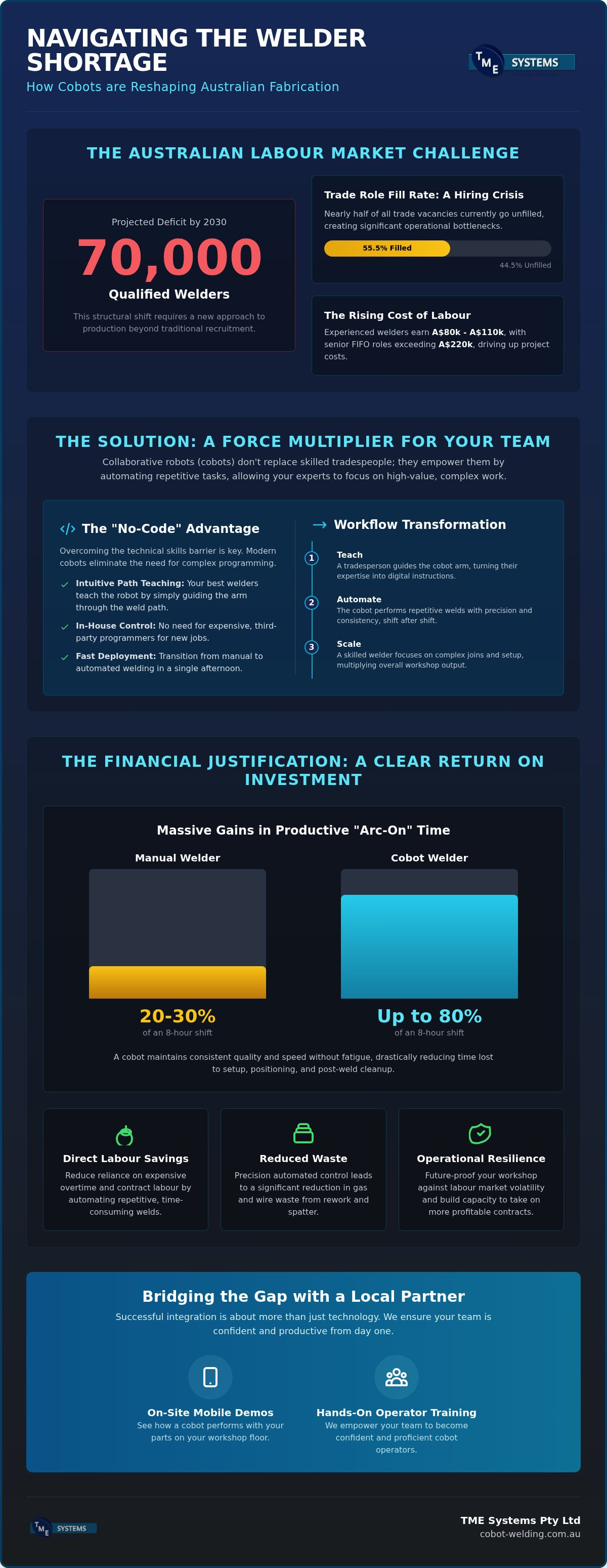

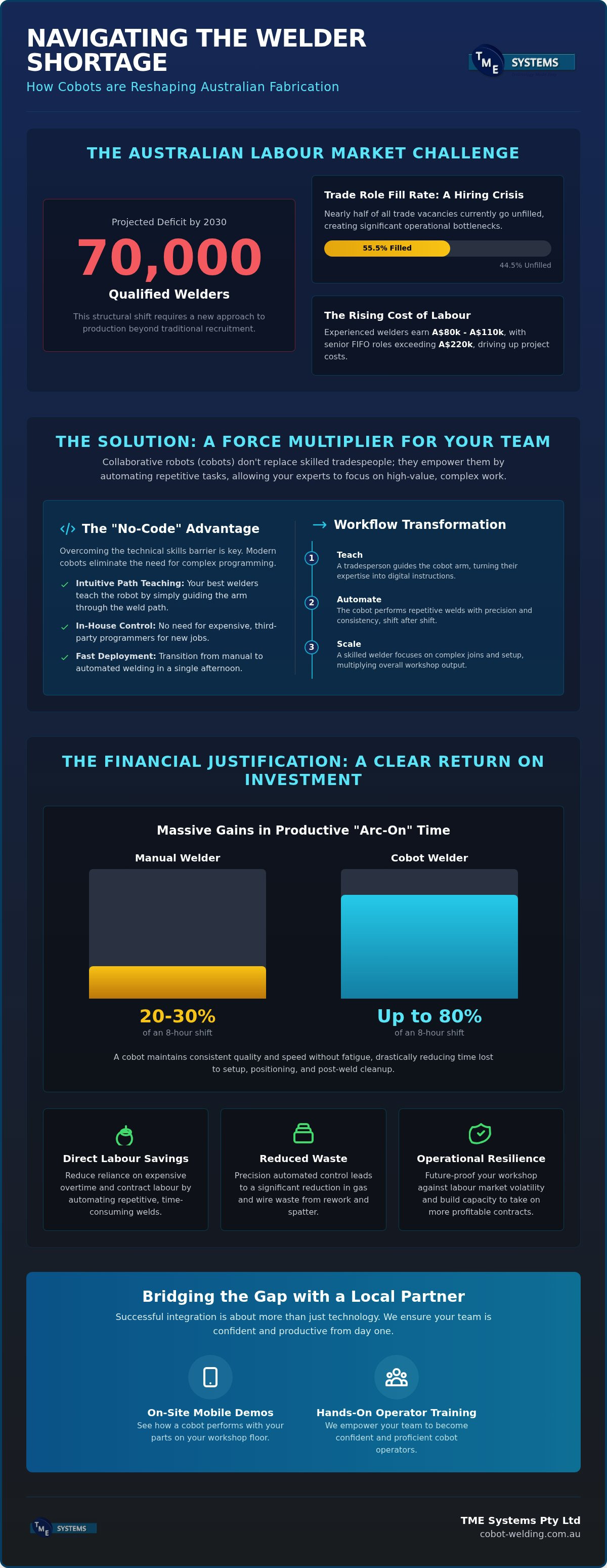
Did you know that by 2030, Australian industry is projected to face a deficit of at least 70,000 qualified welders? With trade role fill rates currently sitting at just 55.5 per cent, you’ve likely felt the pressure of turning down profitable contracts simply because you can’t find the ticketed staff to man the torches. It’s a tough position to be in, watching your workshop capacity hit a ceiling while the cost of rework and inconsistent quality eats into your margins.
We agree that the traditional answer of "just hire more people" is no longer a viable strategy in this climate. This guide explores how addressing welder shortage with cobots provides a pragmatic path forward, allowing your existing team to scale their output without needing a degree in robotics. You’ll discover how to justify the investment through a clear return on investment timeline, improve your daily throughput, and build a resilient operation that isn't at the mercy of labour market volatility. We will walk through the 2026 landscape of collaborative automation and how no-code technology is finally making high-end fabrication accessible for every Australian workshop floor.
Key Takeaways
- Recognise that the Australian welder drought is a structural shift requiring a move toward operational resilience rather than just traditional recruitment.
- Discover how addressing welder shortage with cobots is achievable using no-code software that lets your current tradespeople teach the robot without any prior programming experience.
- Learn to justify the investment by calculating direct labour savings and the significant reduction in gas and wire waste through precision automated control.
- Identify which production bottlenecks are best suited for automation to ensure a smooth integration with a minimal safety footprint on your workshop floor.
- Understand the value of a local partner who provides on-site mobile demos and operator training to ensure your team is confident and productive from day one.
Understanding the Business Case for Welding Automation in Australia
Investment in technology on the workshop floor shouldn't be about chasing the latest trend. For Australian fabricators, the business case for automation has shifted from a "nice-to-have" luxury to a fundamental requirement for operational resilience. We aren't just looking at "cool tech" anymore; we are looking at how a business survives when the local talent pool is bone dry. The reality is that the current welder drought isn't a temporary hurdle. It is a permanent structural shift in our national labour market that requires a different approach to production.
By 2030, Australia is projected to face a deficit of at least 70,000 welders. In 2026, the fill rate for trade roles has dropped to just 55.5 per cent, meaning nearly half of all vacancies go unfilled. When you can't find ticketed staff, the status quo becomes incredibly expensive. You end up paying massive overtime rates to your core team, or worse, you start turning down profitable tenders because you simply don't have the capacity to deliver on time. For many local fabrication shops, addressing welder shortage with cobots has become the most practical way to future-proof their operations against these market pressures.
The Australian Labour Market Challenge
The rising cost of skilled trades is a significant factor in tender competitiveness. With experienced welders in Australia now earning between A$80,000 and A$110,000, and senior FIFO roles exceeding A$220,000, the labour component of your quotes is likely higher than ever. Addressing welder shortage with cobots allows you to break this cycle by automating the repetitive tasks that eat up your skilled workers' time. Integrating a collaborative robot (cobot) into your workflow acts as a force multiplier for your existing team. It doesn't replace your skilled tradespeople; it frees them up to focus on complex, high-value joins while the machine handles the straight runs and repetitive components.
Manual Welding vs. Automated Throughput
Manual welding involves far more than just laying beads. A significant portion of a tradesperson's day is spent on setup, part positioning, and the inevitable post-weld clean-up of spatter. These hidden drains on manual hours can be drastically reduced with precision automated control. While a manual welder might struggle with fatigue over an eight-hour shift, a collaborative cell maintains consistent quality from the first part to the last. While a manual welder typically achieves an arc-on time of 20 to 30 per cent during a standard shift, a cobot can maintain arc-on time for up to 80 per cent of that same period.
With such a significant increase in arc-on time, managing the resulting fumes becomes a priority. Integrating robust extraction systems from F.A. Maker ensures your workshop environment remains safe and compliant as your production capacity grows.
Traditional industrial robots were built for the automotive assembly line, requiring dedicated rooms and specialised programmers. For the average Australian fabrication shop, that model was never going to work. Right now, as we face a projected shortfall of 70,000 welders by 2030, the focus has shifted toward technology that supports the people you already have. Addressing welder shortage with cobots isn't about replacing the human element; it's about removing the technical friction that kept automation out of reach for smaller workshops.
The "No-Code" revolution means you don't need a computer scientist or a third-party integrator to get your torch moving. Instead of typing lines of code, your best tradespeople can teach the robot by simply moving the arm through the required weld path. This intuitive interface empowers your existing staff to become cobot operators, turning their years of welding experience into digital instructions in minutes rather than hours.
Eliminating the Programming Barrier
In the past, the high cost of programming meant that automation only made sense for massive production runs. Modern no-code robot welding software changes this financial equation entirely. By allowing your team to perform in-house path teaching, you eliminate the need for expensive external consultants every time a new part comes through the door. It's now possible to transition from manual fabrication to automated output in a single afternoon. If you're curious about how this fits your specific floor, you might consider how a collaborative welding cell can be tailored to your current workflow.
Flexibility for High-Mix, Low-Volume Work
Most Australian workshops don't make 10,000 of the same bracket. They handle high-mix, low-volume work that requires constant adjustment. Traditional automation failed here because the setup time for a new part often took longer than the job itself. Addressing welder shortage with cobots works because lead-through programming and hand-guiding allow for rapid job changeovers. You can teach a complex weld path for a small batch and have the torch moving on the next run before the billy has even boiled. This level of flexibility ensures even your smallest contracts remain profitable and consistent.
Calculating ROI: The Financial Justification for Australian Fabricators
Moving from manual processes to automation is a significant step for any workshop. While the technology is impressive, the decision ultimately rests on the balance sheet. Addressing welder shortage with cobots is a financial strategy designed to lower your total cost-per-weld while increasing your annual turnover. When you consider that experienced welders in Australia now command salaries between A$80,000 and A$110,000, the cost of every idle torch or wasted hour becomes a direct hit to your profitability. This isn't just a local observation; the official record on the national skills needs of Australia confirms that the shortage of metal trades is a systemic issue affecting the entire country's manufacturing output.
The financial gains start with material efficiency. Precision automated control reduces wire and gas waste by ensuring the torch follows the exact path required without the over-welding common in manual work. You also eliminate the high cost of rework. In a high-pressure workshop, a single failed weld on a complex part can wipe out the profit margin for that entire job. Cobots deliver "First Time Right" fabrication, ensuring that every part meets the specification without the need for grinding or repair.
The Payback Period Analysis
Most Australian fabricators find that collaborative robot welding cells offer a typical payback period of between 12 and 24 months. For shops running multi-shift operations or high-utilization lines, this return can often be achieved in as little as 6 to 12 months. It's not uncommon to witness a "Single Order Payback" event, where the ability to fulfil one high-volume contract that was previously impossible to staff pays for the entire system in a single run. Beyond direct production, you should also discuss with your accountant how current federal tax incentives and accelerated depreciation schedules for manufacturing equipment can further offset the initial capital outlay.
Soft Benefits that Impact the Bottom Line
There are also "soft" savings that don't always appear in a standard spreadsheet but heavily impact your yearly results. Improving workplace safety by delegating repetitive or ergonomically straining tasks to a machine can lead to a reduction in WorkCover claims and lower insurance premiums over time. Employee retention is another critical factor. When you provide your senior welders with advanced tools, you reduce the physical monotony of their roles, making them more likely to stay with your business. Finally, having a modern, automated facility improves your brand reputation, making it easier to win tenders from major contractors who require proof of advanced technological capability and consistent quality control.
Assessing Workshop Readiness and Implementation Planning
Identifying the right place to start is often the biggest hurdle for local fabrication managers. You don't need to automate your entire catalogue on day one. Instead, focus on the primary production bottleneck that consistently slows down your throughput. Addressing welder shortage with cobots is most effective when you select parts that are repetitive and high-volume, allowing your skilled team to focus on the complex, custom work that requires a human touch.
Workshop floor layout is another practical consideration that often surprises first-time users. Because collaborative robots are designed with force-sensing sensors, they don't require the massive safety cages associated with traditional industrial robots. This smaller footprint means you can often integrate them into your existing workflow without a complete factory redesign. When selecting your first automated pilot, ensure you choose a welding power source that is compatible with your current fleet to keep maintenance simple and spare parts accessible.
The 'Start Small' Strategy
Maintaining an organised workspace is equally important for efficiency, and many Australian workshops rely on DymoOnline for professional labelling solutions to track parts and equipment during the transition to automation.
We recommend a "walk before you run" approach. Your first automated part should be simple, repetitive, and high-volume. This builds confidence among your staff and provides a clear win for the business. Success isn't just about the number of beads laid; it's about measuring key performance indicators over the first 90 days. Look for improvements in arc-on time, a reduction in scrap rates, and more consistent weld quality. Once the first cell is performing well, scaling to a fully integrated automated fleet becomes a logical and less intimidating next step.
The Role of an Integration Partner
While modern software is intuitive, successful cobot welding integration is vital for long-term workshop success. A local partner ensures that your system is fully compliant with Australian safety standards and provides the technical support needed to minimise downtime. This relationship includes on-site cobot welder training, which is essential for getting your tradespeople comfortable with the new interface. Having local Australian maintenance and support means you aren't waiting for a technician to fly in from overseas when you need a quick adjustment. If you want to see how these systems handle your specific parts, you can book a mobile demo to see the technology in action on your own floor.
Bridging the Gap with TME Systems Pty Ltd: A Collaborative Partnership
Success in modern fabrication isn't just about owning the right hardware. It's about how that hardware is integrated into your daily operations and supported over the long term. TME Systems Pty Ltd focuses on building the resilience of the Australian fabrication industry by providing more than just equipment. We provide a partnership that starts with understanding your specific workshop challenges. Whether you're dealing with complex part geometry or specialised materials, our customised integration plans are designed to ensure your transition to automation is seamless and practical.
Addressing welder shortage with cobots requires a hands-on approach that respects the skills of your current workforce. We don't believe in "set and forget" solutions. Our team provides ongoing training and support to ensure your operators remain proficient as the technology evolves. This commitment to operator onboarding means your staff see the cobot as a tool that empowers them, rather than a threat to their trade. By focusing on the interface between person and machine, TME Systems Pty Ltd helps you maintain the high standards of craftsmanship that define Australian manufacturing.
The Mobile Demonstration Advantage
We understand that investing in automation is a big decision for any workshop owner. That's why we offer a Proof of Concept phase that removes the guesswork from the process. You can book a mobile welding robot demonstration to see exactly how the system handles your actual production parts on your own workshop floor. This isn't a canned showroom demo; it's a real-world test using your jigs, your power sources, and your materials. Getting buy-in from your workshop team is much easier when they can get hands-on with the torch and see the results for themselves before a single bolt is turned in a permanent installation.
Future-Proofing Your Business
As we move through 2026 and beyond, the ability to scale without adding headcount will be the defining characteristic of successful fabrication businesses. Learning how to improve welding productivity with cobots allows you to stay ahead of the competition in an increasingly tech-driven global market. On a global level, specialists like EdNex Automation are at the forefront of this shift, providing advanced robotic solutions that empower industrial sectors to overcome similar labour and productivity challenges. Addressing welder shortage with cobots isn't just a fix for today's hiring headaches. It's a long-term strategy for excellence. By adopting these collaborative tools now, you are preparing your business for the next decade of Australian manufacturing, ensuring you have the capacity to win and deliver on the most ambitious contracts in the country.
The path to a more resilient workshop starts with acknowledging that the national labour market has fundamentally shifted. By addressing welder shortage with cobots, you aren't just filling a vacancy; you're equipping your business with a scalable tool that empowers your existing team. We've explored how no-code software removes the need for specialised programmers, allowing your ticketed welders to lead the transition. With a clear ROI and the ability to win larger tenders through consistent quality, the business case for automation is stronger than ever.
TME Systems Pty Ltd is proud to support Australian manufacturers with expert on-site training and local integration. We don't just sell technology; we partner with you to ensure your workshop remains competitive as global standards evolve. It's time to move beyond the hiring struggle and start focusing on genuine throughput. As integration specialists, we're committed to making this transition as simple and practical as possible for your team.
Book an on-site mobile welding robot demonstration today and see exactly how this technology fits into your daily operations. We look forward to helping you build a stronger, more productive future for your workshop.
Frequently Asked Questions
How much does it cost to automate welding in a small Australian workshop?
The investment varies based on the complexity of the cell and your specific integration needs. While the initial capital outlay is a consideration, most Australian fabricators focus on the total cost of ownership and the speed of implementation. Addressing welder shortage with cobots becomes more affordable when you factor in the lack of expensive third-party programming fees. Turnkey systems are designed to be integrated into your current floor without massive infrastructure changes.
Can a cobot really handle small batch runs of different parts effectively?
Yes, cobots excel at high-mix, low-volume work because of their rapid changeover capabilities. Unlike traditional industrial robots that require hours of reprogramming, a collaborative system can be taught a new part in minutes. This flexibility makes it practical to automate batches of as few as ten or twenty parts. You simply guide the arm through the new path, save the job, and start production immediately.
Do I need a specialised programmer to operate a welding cobot daily?
You don't need a specialised programmer or a computer scientist on your payroll to run these systems daily. The no-code teaching software is designed specifically for tradespeople who understand welding but have no coding experience. Your existing welders use their knowledge of torch angles and travel speeds to "teach" the robot by hand. This keeps the control of the weld quality in the hands of your skilled staff.
What is the typical ROI period for a collaborative welding cell in Australia?
The typical payback period for a collaborative welding cell in an Australian workshop is between 12 and 24 months. For operations running multiple shifts or handling high-volume contracts, this can drop to as little as 6 to 12 months. Addressing welder shortage with cobots often leads to a "single order payback" scenario. This happens when the increased capacity allows you to win one major contract that covers the equipment cost.
How does welding automation affect the safety of my workshop staff?
Collaborative robots are equipped with high-sensitivity force-sensing sensors that allow them to work safely alongside your team. If the arm encounters an unexpected obstacle, it stops instantly to prevent injury. This technology eliminates the need for the large, expensive safety cages required by traditional automation. By handling the repetitive, ergonomically straining tasks, the system also reduces the risk of long-term physical strain on your senior welders.
Will a cobot work with my existing MIG or TIG welding power source?
Most collaborative cells are designed to be brand-agnostic and can be integrated with your existing MIG or TIG welding power sources. This allows you to maintain consistency in your welding procedures and use the consumables you already stock. An integration specialist will handle the communication between the robot controller and your welder, ensuring that parameters like voltage and wire feed speed are managed precisely through the interface.
How much floor space is required for a turnkey collaborative welding cell?
A turnkey collaborative welding cell typically requires a footprint similar to a standard manual welding bench. Because they don't require extensive safety fencing, they can be tucked into existing production lines or moved around the workshop as needed. This compact design is ideal for Australian workshops where floor space is at a premium. It allows you to add automated capacity without needing to expand your physical factory footprint.
What kind of training does my team need to start using a cobot safely?
Your team will require basic operator training, which usually takes just a few hours to a couple of days. This training focuses on safe operation, part positioning, and using the no-code interface to teach new paths. Since the system relies on the welder's existing trade knowledge rather than programming logic, the learning curve is very shallow. On-site onboarding ensures that your staff feel confident and capable from the very first shift.