
What if the most expensive part of your new welding robot isn't the invoice you pay today, but the specialist programmer you have to hire tomorrow? Many Australian workshop owners hesitate to automate because they're terrified of buying a "white elephant" that sits idle while skilled labour costs continue to climb. With the national welder deficit projected to hit 70,000 by 2030, understanding the total cost of ownership robotic welding involves much more than just the initial sticker price. It's about looking at the long-term reality of your production floor and how technology fits your existing team.
We know you're feeling the pressure of rising wages and the constant struggle to find reliable staff for repetitive tasks. This 2026 guide is designed to give you a clear financial framework to justify the investment to your stakeholders while ensuring you don't get stung by hidden fees. we'll walk through everything from capital expenditure and Australian safety standards to the operational savings found in no-code software and reduced rework. By the end, you'll have a roadmap to minimise running costs and turn a complex technical transition into a practical, profitable tool for your workshop.
Key Takeaways
- Understand how to calculate the total cost of ownership robotic welding by looking beyond the initial purchase price to account for long-term operational expenses.
- Learn how no-code teaching software removes the "programmer tax" by allowing your current welding team to set up and adjust weld paths without external help.
- Compare the capital and safety requirements of cobots against industrial robots to see which setup offers the best return for small-to-medium Australian shops.
- Discover a practical 5-year modelling framework that accounts for Australian depreciation rates and consumable costs to help justify the spend to stakeholders.
- Identify how local integration and operator onboarding ensure your new system is productive from day one rather than sitting idle on the workshop floor.
Defining Total Cost of Ownership (TCO) for Australian Fabricators
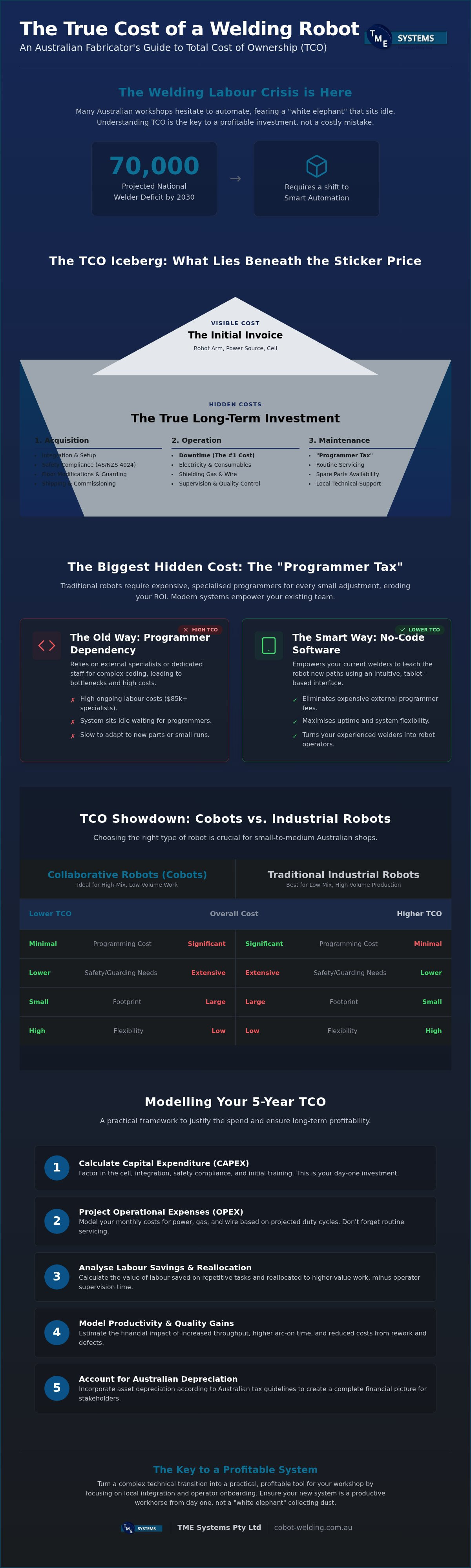
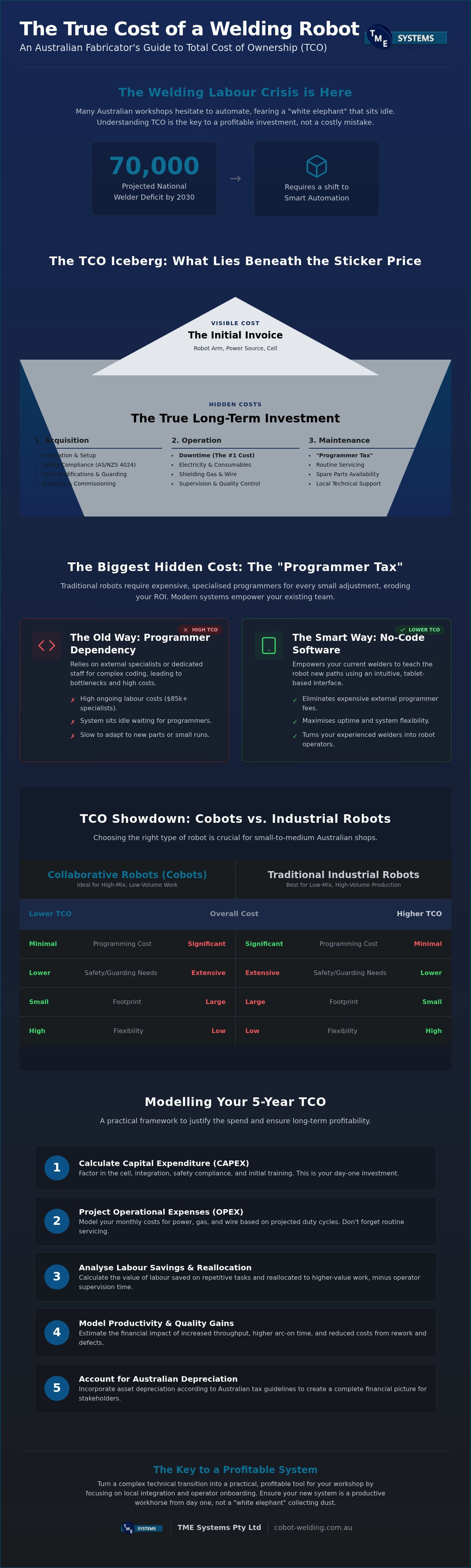
When you look at a quote for a new welding cell, it's easy to focus on the bottom line of that single invoice. However, for a workshop manager in Australia, that figure is just the starting point. The Total Cost of Ownership (TCO) represents the complete financial picture of an asset from the moment it lands on your dock until the day it's decommissioned. In the 2026 manufacturing environment, where the national welder deficit is nearing 70,000, getting this calculation right is the difference between a profitable investment and a costly mistake.
The sticker price of a robot is often described as the "tip of the iceberg". Under the surface lies a complex layer of expenses that can either erode your margins or be managed through smart planning. We categorise these into three main pillars: acquisition, operation, and maintenance. If you only account for the machine itself, you're ignoring the very factors that determine your long-term success. Understanding the total cost of ownership robotic welding allows you to see the real impact on your cash flow over five or ten years.
Acquisition Costs: Beyond the Welding Cell
Acquisition costs encompass the total expenditure required to get the system onto your floor, including shipping, initial setup, and the hardware itself. To navigate the logistics of importing such equipment, you can check out MTF Logistics for expert customs brokerage and freight services. Beyond the cell, you need to factor in integration services that ensure the robot actually talks to your existing workflow. In Australia, compliance with safety standards like AS/NZS 4024 is non-negotiable. This might involve floor modifications or specific guarding that adds to your initial outlay. Skipping these details doesn't save money; it just defers a larger bill for non-compliance or rework later.
Once the system is running, your focus shifts to operational expenditure. Electricity, shielding gas, and wire consumables are the obvious ones. However, the most expensive operational cost isn't a consumable; it's downtime. If a system is too complex for your team to troubleshoot, or if spare parts aren't locally available, a minor glitch can halt your entire production line. Routine servicing is a necessary investment to prevent these bottlenecks. By planning for the total cost of ownership robotic welding, you can ensure the machine remains a productive member of your team rather than a financial drain. Reliable local support and a clear understanding of your duty cycles will keep these running costs predictable and manageable. For businesses looking to scale their technical infrastructure, you can discover Torch Services and their expertise in managed technology solutions.
The Hidden Costs of Welding Automation: Beyond the Sticker Price
While the initial capital outlay is the most visible figure, the true total cost of ownership robotic welding is often decided by what happens after the machine is bolted to the floor. In the Australian market, the biggest hidden hurdle isn't the hardware; it's the ongoing cost of keeping that hardware productive. If you buy a system that requires a specialised programmer for every minor adjustment, you're essentially adding a permanent consultant's fee to your production costs. With local welder salaries already averaging between $75,000 and $85,000, and specialists commanding much more, the "programmer tax" can quickly erode your expected return on investment.
The Programming Burden
Traditional industrial robots often sit idle because the person who knows how to code them is off-site or too expensive to call in for a small run. This creates a financial risk where the system becomes a "white elephant" rather than a workhorse. Transitioning your existing team is a much more pragmatic approach. By using no-code robot welding software, you empower your experienced tradespeople to teach the robot themselves. This eliminates the need for external contractors and ensures that your automation remains as flexible as your manual welders. If you're curious about how this looks in a real workshop, you can explore our welding system integration options to see how accessible these tools have become.
Space and Infrastructure Requirements
Floor space in an Australian workshop is valuable real estate. When calculating your TCO, you must consider the "rent" of the area the robot occupies. Large industrial units require extensive safety guarding and light curtains to comply with AS/NZS 4024 standards, which can double the footprint of the cell. You might also face unexpected costs in workshop electrical upgrades if the unit has high power draw requirements. In contrast, compact and mobile units often plug into standard outlets and require far less dedicated space. This flexibility is vital for job shops that need to move equipment around to accommodate different projects.
Finally, don't overlook the "invisible" savings found in scrap and rework reduction. An Economic analysis of automated welding shows that consistency is the primary driver of long-term profitability. When a robot delivers the same high-quality bead every single time, your costs for grinding, re-welding, and wasted material drop significantly. These savings might not show up on a quote, but they are a fundamental part of mastering the financial side of automation.
Cobots vs Industrial Robots: A TCO Comparison for Small-to-Medium Shops
For a small-to-medium enterprise (SME) in Australia, the choice between a traditional industrial robot and a collaborative robot (cobot) is where the total cost of ownership robotic welding calculation really gets interesting. On paper, an industrial unit might seem like a powerhouse of speed. However, the capital expenditure (CAPEX) for an industrial robot is only the beginning. You have to account for the massive safety cages, light curtains, and dedicated floor space required to meet Australian safety standards like AS/NZS 4024. These additions can easily add 30% to 50% to your initial costs before you've even struck an arc.
Cobots change this dynamic significantly. Because they're designed to work safely alongside people, they often eliminate the need for expensive, bulky guarding. This lowers both your CAPEX and your long-term operational expenditure (OPEX) by keeping your workshop footprint small. More importantly, cobots solve the "small batch" problem. Traditional robots typically require high-volume, repetitive work to justify their setup time. If your shop handles varied jobs, the time spent reprogramming an industrial unit for a new part will kill your margins. A cobot allows a first-class welder to teach a new path in minutes, making even small runs profitable.
Collaborative Flexibility and the Skills Gap
The real win for SMEs lies in how collaborative robot welding cells address the local skills gap. Instead of hiring an expensive robot operator who might leave for a higher-paying mining job, you can use your existing first-class welders to manage the cell. There is immense financial value in "teaching" a robot by physically moving its arm rather than "programming" it with lines of code. This approach reduces turnover costs because your staff feel empowered by the technology rather than replaced by it. It turns the robot into a high-performance tool that supports their craftsmanship rather than a complex machine that alienates them.
Integration and Deployment Speed
Time is money on a production floor. An industrial system often takes weeks or even months to integrate, debug, and commission. During that time, your floor is disrupted and your production capacity is limited. Cobots, by comparison, are frequently up and running in a matter of days. This speed significantly reduces the opportunity cost of automation. If you're unsure if a system will work for your specific parts, a mobile demo system allows for a low-risk proof of concept right in your own workshop. This "hands-on" validation ensures you aren't buying a machine that won't fit your workflow, further protecting your total cost of ownership robotic welding by ensuring immediate utility.
Modelling Your 5-Year TCO: Asset Planning and Depreciation
Viewing a robotic cell as a five-year asset rather than a one-off purchase is the only way to get an accurate grip on your margins. While the initial capital might seem high, the average payback period for a robotic cell in a medium-volume Australian workshop is between 18 and 36 months. After this point, the system effectively prints money by operating at a lower cost than manual labour. To master the total cost of ownership robotic welding, you must account for the asset's effective life and the depreciation rates set by the ATO for industrial machinery, which typically spans five to ten years depending on your specific business structure.
Your financial model should also include the cost of software updates and technical support cycles. In 2026, automation isn't a "set and forget" investment. It requires periodic refining to stay efficient. Budgeting for annual maintenance and support ensures you don't face unexpected hurdles that stall production. When you factor in the projected annual running costs of $12,000 to $25,000 for a single-shift operation, including electricity and shielding gas, the long-term value of the machine becomes much clearer than the initial sticker price suggests.
Consumables and Wear Parts
High-duty cycles mean your robot will go through MIG tips, liners, and shrouds much faster than a manual welder simply because it spends more time with the arc on. You should project these costs based on your expected shift patterns to avoid "budget creep" later in the year. The consistency of a robotic arm also has a massive impact on your shielding gas and wire usage by eliminating the over-welding often seen in manual processes. Improving welding productivity with cobots reduces material waste by ensuring every millimetre of wire is placed exactly where it's needed with zero excess. This precision directly lowers your total cost of ownership robotic welding over the life of the machine.
Future-Proofing and Resale Value
A common fear is buying a system that becomes obsolete in three years. To mitigate this, look for modular hardware that allows for easy torch replacements or software upgrades as technology evolves. The residual value of a well-maintained welding cell after five years remains significant in the Australian second-hand market, often fetching between $40,000 and $80,000. This resale potential acts as a safety net for your investment. Having access to local Australian expertise for technical support is another vital pillar of future-proofing; it ensures that any troubleshooting happens in hours, not weeks. If you want to see how these systems perform in a real-world environment before committing, you can book a mobile demo to test the hardware on your own parts.
Reducing TCO with No-Code Software and Local Integration
Driving down the total cost of ownership robotic welding requires a shift in how we view the relationship between the operator and the machine. In the past, industrial automation often felt like a closed box that only a specialist could open. Today, the most effective way to protect your margins is to remove that barrier. By working with welding system integration specialists who understand the local Australian market, you can design a cell that fits your specific workflow rather than forcing your workshop to adapt to the robot.
Operational errors are another significant TCO driver that many shops overlook. A single misaligned jig or a wrongly programmed path can lead to a bin full of scrap. This is where on-site cobot welder training becomes a vital investment. When your team understands the "why" behind the robot's movements, they can prevent errors before they happen. Local support means you aren't waiting for a technician to fly in from overseas; it means having a partner who can troubleshoot a problem over the phone or be on your floor the next day.
The "No-Code" Revolution in Fabrication
The transition to no-code software is perhaps the biggest financial game-changer for Australian job shops. It empowers your existing welders to adjust paths and refine parameters without waiting for an external coder. This drastically reduces the time-to-first-weld for new parts, which is essential when you're dealing with high-mix, low-volume production. User-friendly interfaces also simplify troubleshooting. If the robot stops, your team can look at the tablet, identify the issue, and get back to work in minutes. This level of autonomy is what keeps your total cost of ownership robotic welding low and your productivity high. The principle of using remote technology to empower users and improve training outcomes is also found in other precision-focussed industries; for example, you can learn more about Educator Collars and their advanced training systems.
Choosing a robot shouldn't feel like a gamble. A mobile welding robot demonstration is a practical way to validate your TCO assumptions before you sign a contract. It allows you to see the machine work on your actual parts, giving you a realistic view of cycle times and setup requirements. This "Total Partnership" model moves away from a one-off transaction and toward an ongoing relationship where we support your growth through every shift and every new project.
Ultimately, cobots are the pragmatic choice for Australian fabricators because they respect the value of human skill. They don't replace your tradespeople; they give them a more efficient way to work. By minimising integration friction and embracing intuitive software, you can ensure that your investment in automation remains a profitable pillar of your workshop for years to come.
Future-Proofing Your Workshop with Smart Investment
Navigating the transition to automation doesn't have to be a leap into the unknown. By shifting your focus from the initial sticker price to the total cost of ownership robotic welding, you can make a decision that supports your bottom line for years to come. We've seen that the real value lies in empowering your existing team with no-code software. This approach effectively reduces labour overheads and ensures your equipment doesn't sit idle while waiting for an external specialist.
Our turnkey solutions are designed specifically for local fabricators, backed by national Australian integration and support to keep your production moving. If you're ready to see how these numbers stack up for your specific jobs, book a mobile welding robot demonstration to see the real-world ROI for your workshop. Taking the first step toward automation is about making your business more resilient and competitive in an evolving market. We're here to help you get it right.
Frequently Asked Questions
How much does a robotic welding cell cost per hour to operate in Australia?
The hourly running cost typically ranges from $6 to $12 based on annual operational expenses between $12,000 and $25,000 for a single-shift workshop. This figure covers electricity, shielding gas, wire consumables, and routine maintenance parts. It's a fraction of the cost of manual labour, which often sits between $45 and $60 per hour. These lower operating costs are a primary driver in reducing the total cost of ownership robotic welding over several years.
What is the typical payback period for a welding cobot?
Most Australian fabricators achieve a full return on investment within 18 to 36 months in a production environment. For a medium-volume shop running a single shift, a $100,000 MIG cell can often pay for itself in as little as 18 to 24 months. This timeline is supported by productivity increases of 4 to 8 times compared to manual processes. The reduction in rework and scrap also helps accelerate this break-even point.
Do I need a specialised engineer to maintain a robotic welding cell?
You don't need a specialised robotics engineer if you choose a system equipped with intuitive teaching software. Modern collaborative cells are designed so that your existing first-class welders can handle the daily setup and path teaching. This approach keeps your overheads low and prevents the high costs associated with external programmers. Your team already knows how to weld; they just need a user-friendly interface to guide the machine's movements.
How does no-code software affect the total cost of ownership?
No-code software significantly lowers the total cost of ownership robotic welding by removing the "programmer tax" from your workshop. Traditional industrial robots often require expensive specialist coding for every new part or minor adjustment. By allowing your own staff to teach the robot through a tablet or by physically moving the arm, you eliminate these recurring service fees. This makes automation financially viable for the high-mix, low-volume work common in Australia.
Can I use my existing welding power source to reduce initial costs?
While it's technically possible, we usually recommend a turnkey solution with an integrated power source to ensure seamless communication. Using an older unit can lead to higher integration costs and unexpected downtime if the protocols aren't perfectly compatible. A matched system provides the consistency needed to reduce material waste and scrap. This reliability is vital for protecting your margins and ensuring the robot remains a productive tool rather than a maintenance burden.
What are the main "hidden" costs people forget when automating?
The most common hidden costs include workshop floor modifications, safety compliance with AS/NZS 4024, and dedicated guarding for industrial units. Many workshop owners also overlook the opportunity cost of long deployment cycles. Choosing a mobile, collaborative system helps mitigate these expenses because it requires less space and doesn't need massive safety cages. You should also factor in the cost of shielding gas and electricity consumed during high-duty cycles when the arc is on more often.
Is there an Australian tax benefit for investing in robotic welding?
There are several government incentives, such as the Future Made in Australia Act and the Advanced Manufacturing Commercialisation Fund, which support the adoption of automation. Additionally, standard depreciation rates for industrial machinery allow you to write off the asset over its effective life. You should check with your accountant about current 2026 tax regulations to see how these grants and depreciation schedules can improve your overall return on investment and cash flow.
How much should I budget for staff training and onboarding?
You should budget for initial operator training to ensure your team is productive from day one. While no-code systems are highly intuitive, a structured onboarding program prevents operational errors that lead to scrap and rework. Most shops find that a few days of hands-on instruction is enough to get their best welders comfortable with the technology. This upfront investment is essential because well-trained staff are the key to minimising long-term running costs and maximising throughput.