

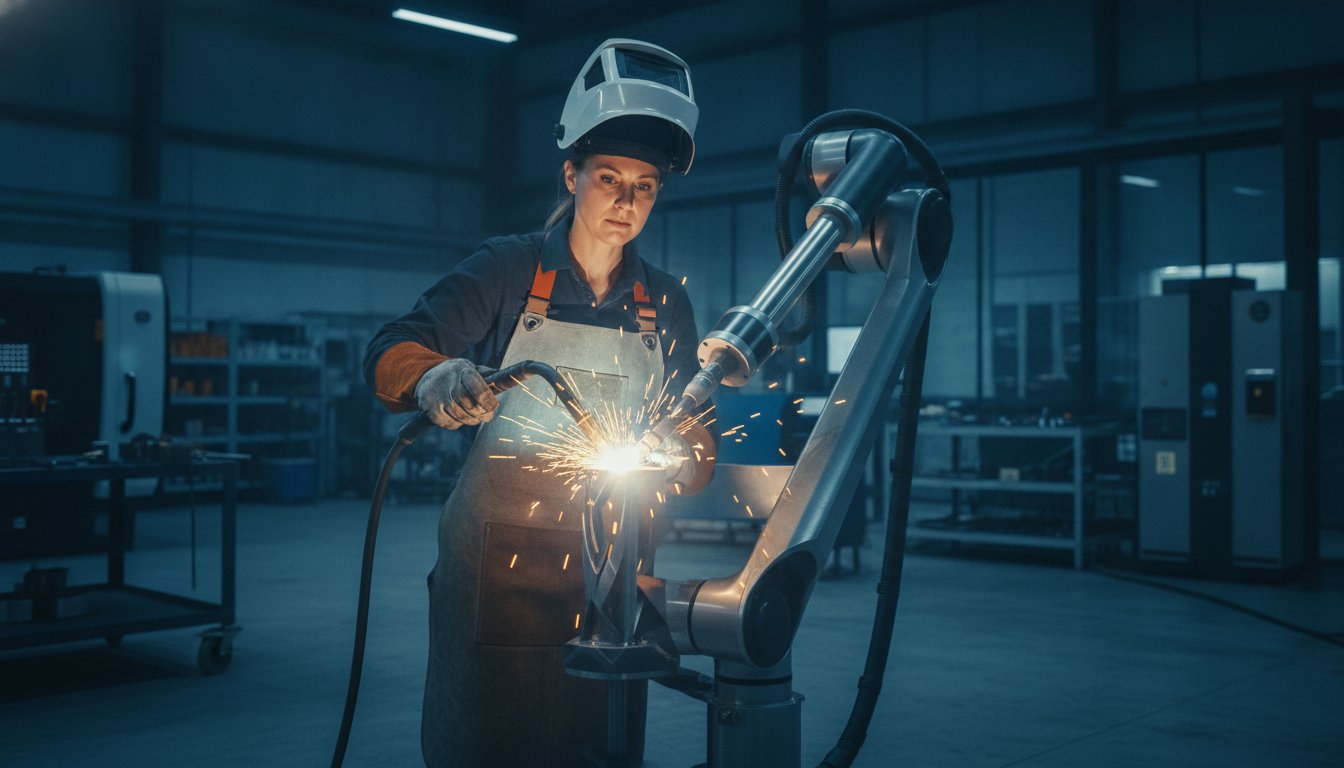
What if the solution to your workshop's labour shortage isn't hiring a robotics engineer, but simply handing your best welder a different kind of torch? Many Australian fabricators feel the pinch of the current skills gap, and with the July 2026 Code of Practice making fume safety more critical than ever, upskilling welders for automation is no longer just an option. You might worry that high-tech gear is too complex for a busy floor or that training will stall production. We understand those hurdles because we see them every day on the workshop floor.
This guide shows you how this transition can be a seamless process rather than a technical headache. You'll learn how to use a practical, no-code framework to turn your experienced team into confident cobot operators without needing a computer science degree. We'll walk through a strategy designed specifically for Australian fabrication to ensure rapid ROI, consistent weld quality, and full compliance with AS/NZS safety standards. By the end, you'll see how to empower your workforce to produce more while staying safe and focused on their craft.
Key Takeaways
- Learn why upskilling welders for automation focuses on translating manual craftsmanship into digital precision using your existing team's expertise.
- Discover how no-code teaching software allows operators to program complex welds by simply moving the cobot arm, cutting training time from weeks to hours.
- Understand the specific AS/NZS 4024.1 safety requirements for collaborative zones to ensure a safe and compliant workshop environment.
- Follow a structured two-phase onboarding programme that moves from basic startup procedures to path teaching for production-ready welds.
- Explore how tailored integration and ongoing support from local experts can bridge the gap between initial setup and long-term workshop productivity.
The Shift from Manual Welding to Collaborative Automation
In many Australian workshops, the daily grind is defined by a persistent challenge: finding and keeping skilled tradespeople. With the average annual salary for a welder now sitting between $75,000 and $85,000, and a significant shortage of experienced hands, the pressure to maintain output is immense. Upskilling welders for automation is the practical answer to this bottleneck. It isn't about replacing the human element; it's about refining how that human skill is applied to the production line.
We define upskilling as the process of taking a tradesperson's existing knowledge of metal, heat, and fusion and applying it through a digital interface. In a typical fabrication setting, manual welders might only spend 25% to 35% of their day actually striking an arc. The rest of the time is often lost to setup, material handling, and repetitive tasks that don't require high-level problem solving. By introducing collaborative systems, you shift the operator's role from manual dexterity to process management. They become the master of the cell, overseeing a tool that performs the repetitive work with relentless precision. This targeted approach to upskilling welders for automation ensures your best people stay on the tasks that matter most.
Why Traditional Welding Expertise is Your Greatest Asset
The biggest misconception about Robot welding is that the machine knows how to weld. It doesn't. A cobot is simply a mechanical arm that follows a path. The real intelligence comes from the welder who understands gas flow, wire speed, and how heat affects different thicknesses of steel. An experienced tradesperson can look at a weld pool and know instantly if the travel speed is too fast or if the torch angle is slightly off. This deep trade knowledge is what allows them to optimise collaborative robot welding cells far more effectively than a generic programmer ever could. They aren't just pushing buttons; they are translating their craftsmanship into a repeatable digital sequence.
Overcoming the 'Tech Fear' on the Workshop Floor
It's natural for staff to feel a sense of technostress when a robot arrives on the floor. The most common myth is that automation marks the end of the craft. We find that the best way to dismantle this fear is through hands-on demonstration. When a welder sees that they can move the arm by hand and teach a path in minutes, the technology stops being intimidating. Appointing a Lead Operator to champion the system is a proven strategy. This person isn't usually the most tech-savvy youngster, but rather the respected senior welder who sees the value in offloading the boring work. When the team sees a peer succeeding, the culture of innovation takes root naturally.
Mastering No-Code Teaching: Training Without the Technical Jargon
For decades, the barrier to entry for robotic welding was a steep learning curve involving complex code and cumbersome teach pendants. If you wanted to automate a simple fillet weld, you often needed a specialised programmer to spend days writing lines of logic. Today, no-code robot welding software has flipped the script. It makes upskilling welders for automation a matter of hours rather than weeks of classroom study. Instead of typing coordinates into a terminal, your team interacts with the robot just like they would with a new apprentice; by showing it exactly where to go.
This shift is vital for the typical Australian job shop. Our local industry thrives on high-mix, low-volume production. If it takes three days to program a job that only takes four hours to weld manually, the automation stays in the corner gathering dust. No-code interfaces allow an operator to swap between different parts and jigs in minutes. By removing the "tech-heavy" jargon, we return the focus to what actually matters: the quality of the weld and the efficiency of the workshop floor. If you want to see how this works on your specific parts, our mobile demo system provides a hands-on look at the process in your own environment.
The 'Lead-Through' Method: Teaching by Doing
The core of no-code training is the lead-through method. An operator simply puts the cobot into a "free-drive" mode and physically guides the arm along the desired weld path. As they move the torch, they save waypoints at critical junctions, such as the start point, corners, and the final retract movement. This intuitive approach allows the welder to set perfect approach angles and work points based on their years of manual experience. They can even fine-tune the path in real-time, making micro-adjustments to the torch position while watching the arc to ensure optimal penetration and bead profile.
Software Interface Training for Non-Programmers
Training moves from a keyboard to a touch-screen interface that uses clear icons instead of abstract code. Operators learn to manage a "Weld Library," which stores successful parameters like voltage, wire speed, and weave patterns for specific materials. This professionalises the role, aligning with modern standards like the Welding Automation Specialist Apprenticeship, which recognises the value of these digital skills. Most common path errors can be fixed with a few taps on the screen, allowing the welder to troubleshoot and keep production moving without ever needing to call in an IT specialist. This autonomy is the ultimate goal of upskilling welders for automation, as it gives your team full control over their new tools.
Safety and Compliance: Training for Australian Workshop Standards
Integrating a cobot into your production line isn't just about achieving a perfect bead; it's about doing so within the strict framework of Australian industrial law. From July 1, 2026, the "Code of Practice: Welding Processes" from Safe Work Australia is legally binding. This means upskilling welders for automation must now include a comprehensive understanding of how to manage a robotic cell as a safe, compliant workspace. We don't just teach your team how to move the arm; we teach them how to identify hazards and maintain the high safety standards expected in local manufacturing.
The term "collaborative" refers to the robot's ability to work alongside humans without traditional safety fencing, thanks to advanced force-sensing technology. However, the robot arm is only one part of the equation. The welding arc, the hot workpiece, and the sharp edges of a jig still pose significant risks. Training focuses on teaching operators to perform thorough risk assessments, identifying potential pinch points where the arm might trap a limb against a fixture. Upskilling welders for automation ensures that your staff can confidently execute emergency stop protocols and recovery procedures, returning the system to a safe state without needing a technician to reset the logic.
The Collaborative Workspace: Shared Floor Etiquette
Effective training defines the boundaries of the collaborative zone. Operators learn to calibrate sensors and set speed limits that align with AS/NZS 4024.1, the Australian standard for the safety of machinery. While the cobot is designed to stop upon contact, the team must still trust the technology while maintaining a disciplined floor environment. Standard Personal Protective Equipment (PPE) remains a non-negotiable requirement. Even though the robot handles the torch, the operator still needs protection against arc flash, sparks, and the reduced 1 mg/m³ workplace exposure limit for welding fumes now enforced across the country.
Compliance Documentation and Record Keeping
A safe workshop is a documented workshop. Your team will learn to maintain a dedicated safety log for the robotic cell, capturing daily pre-start checks and any maintenance performed. This level of detail is essential for meeting local insurance requirements and demonstrating a duty of care under the new regulations. As formal pathways like the Welding Automation Specialist Apprenticeship become more common, having a structured approach to safety documentation becomes a valuable asset for the business. Ensuring your on-site cobot welder training covers these administrative essentials is the best way to protect both your workers and your company's liability.
Designing Your In-House Cobot Onboarding Programme
Success in upskilling welders for automation relies on a structured, phased approach that respects the workshop's production schedule. You don't need to pull your best staff off the floor for a week-long seminar. Instead, a modular training programme allows for gradual skill acquisition while keeping the arc struck on your high-priority jobs. By breaking the learning process into manageable stages, you ensure that the technology becomes a natural extension of the welder's toolkit rather than a foreign intrusion.
- Phase 1 (Day 1): Focus on basic operation. This includes safe startup and shutdown procedures, understanding the interface, and basic torch positioning. The goal is to build initial confidence without the pressure of a perfect weld.
- Phase 2 (Day 2-3): Move into simple jigging and path teaching for straight-line welds. This is where the operator learns to set their first real production paths on basic fillet or butt welds.
- Phase 3 (Week 1-2): Tackle multi-pass welds and complex geometry. The welder uses their trade expertise to manage heat input and weave patterns on more demanding parts.
- Phase 4 (Ongoing): Focus on continuous improvement. This involves refining paths and setup times to maximise welding productivity with cobots as the team becomes more proficient.
Selecting Your 'Cobot Champions'
Identifying the right people to lead the charge is critical. Look for staff members who show a natural aptitude for process improvement or those who are always looking for a better way to set up a jig. These "Cobot Champions" don't necessarily need to be your most tech-savvy youngsters; often, your most experienced senior welders make the best mentors because they understand the fundamentals of a good weld. Using a "Train the Trainer" model allows you to scale knowledge across multiple shifts efficiently. Recognising this new skill set as a career milestone can also boost morale and retention in a competitive labour market.
Practical Exercises for Rapid Skill Acquisition
We recommend starting with the "Ghost Run" exercise. This involves running the cobot through a newly taught path with the power source turned off. It allows the operator to check for collisions or awkward torch angles without wasting gas or wire. Once the path is verified, they can master the "Tack and Weld" sequence, where they manually tack the parts before letting the cobot perform the final run. This method ensures consistency across the team, as every operator follows the same proven digital path. If you're ready to start building your team's capability, you can enquire about our operator training and onboarding packages to get your workshop moving.
Partnering for Success: TME Systems' Operator Support and Integration
A successful transition to automation requires more than just unboxing a robot arm. Professional integration is the bedrock of effective training because it ensures the technology fits your specific workshop layout and existing power sources. When upskilling welders for automation, the goal is to remove friction. If the software doesn't talk to your current MIG or TIG setup, the training process stalls before it even begins. We focus on bridging that gap, ensuring your team spends their time welding rather than troubleshooting hardware incompatibilities.
Our support model is built for the realities of Australian manufacturing. We offer a mix of on-site assistance and remote diagnostics to ensure that if a production line stops, it's back up and running quickly. Unlike global providers who might direct you to a US-based call centre, our local team understands the specific regional hurdles you face. This ongoing partnership includes software updates and advanced technique workshops, keeping your team at the forefront of the industry long after the initial install. By future-proofing your workforce, you ensure that your investment continues to deliver a high ROI as your production needs evolve.
The TME Systems Onboarding Experience
What can you expect in the first 48 hours? We don't just drop off a crate and leave you to it. We work alongside your staff to integrate the cobot cell into your actual production flow. We've seen local Aussie shops transition from manual operations to automated production in less than a week by focusing on their highest-volume parts first. We bridge the gap between your legacy equipment and new technology, making the learning curve feel like a natural extension of the day-to-day job. This hands-on approach ensures that the "practical mentor" relationship starts on day one.
Booking Your Proof of Concept
Seeing is believing, but doing is even better. A mobile welding robot demonstration serves as the ultimate training taster for your crew. It allows your staff to handle the torch and weld your own parts on your own floor before any financial commitment is made. This hands-on proof of concept demystifies the technology and proves that upskilling welders for automation is an achievable goal for every member of your team. It's the most effective way to gain staff buy-in and see the immediate impact on your workshop's consistency and output. Enquire about a mobile demo for your workshop today.
Empowering Your Workforce for the Future of Fabrication
The transition from traditional manual work to a modern, automated floor doesn't have to be a leap into the unknown. By focusing on no-code teaching methods and a structured, phased onboarding programme, you can turn your most trusted tradespeople into expert cobot operators in just a few days. We've seen that the most successful workshops are those that respect the welder's craft while giving them the high-precision tools they need to stay safe and productive.
Successfully upskilling welders for automation ensures your business remains compliant with the latest Australian safety standards while addressing the persistent skilled labour shortage. It's about giving your team the autonomy to manage their own production cells without needing an IT degree. With no-code software designed for the workshop floor and expert local support from Australian automation specialists, the path to a more efficient workshop is clearer than ever.
Upskill your team with TME Systems - Explore our training and integration services. We provide on-site training tailored to your specific fabrication needs, ensuring your transition is as smooth as a perfect root bead. Innovation is within reach, and your team is ready to lead the way.
Frequently Asked Questions
Do my welders need to know how to code to use a cobot?
No, your welders don't need to learn a single line of code to operate these systems. Modern interfaces use "teach-by-guiding" software, which allows the operator to physically move the robot arm to the required points. This approach respects the tradesperson's existing skills while removing the technical barriers often associated with traditional industrial programming.
How long does it take to train an experienced welder on a cobot?
Most manual welders can learn the basics of operating a no-code cobot in just a few hours. According to industry data, they are typically confident enough for daily production after about one day of hands-on training. This rapid timeline makes upskilling welders for automation a practical solution for busy workshops that can't afford long periods of downtime.
What is the most important skill for a cobot operator?
The most critical skill remains a deep understanding of welding fundamentals. A cobot is simply a high-precision tool; it doesn't know how to read a weld pool or adjust for heat distortion. An operator who understands wire speed, gas flow, and metal behaviour will always produce better results than a programmer who lacks traditional trade experience.
Is cobot welding training different for MIG vs TIG applications?
While the software interface is similar, the training focus shifts between processes. MIG automation is generally more straightforward for initial upskilling. TIG applications require more detailed training on torch angles and arc length management. This ensures the robot can replicate the delicate touch and precision required for high-quality TIG fusion on thinner materials.
Does a cobot welder require a specialised safety officer on-site?
You don't need a dedicated safety officer, but your operators must be trained on AS/NZS 4024.1 standards. The training empowers your existing team to conduct risk assessments and manage the collaborative zone safely. This ensures your workshop remains compliant with Australian regulations while maintaining a high level of productivity without adding unnecessary overhead costs.
Can we train our staff on-site, or do they need to go to a facility?
On-site training is highly recommended because it allows your team to learn using your actual parts, jigs, and workshop layout. This practical approach ensures the skills learned are immediately applicable to your specific production requirements. It also helps to minimise disruption by keeping your staff in their familiar environment where they feel most comfortable.
What happens if we hire new staff? Is retraining difficult?
Retraining is straightforward thanks to the intuitive nature of no-code interfaces. Many Australian workshops adopt a "Train the Trainer" model, where your initial "Cobot Champions" pass their knowledge to new hires. This internal knowledge transfer makes upskilling welders for automation a sustainable, long-term strategy that protects your workshop from the impacts of the skilled labour shortage.
How does no-code software handle complex welding patterns like weaving?
No-code software handles complex patterns like weaving through simple, icon-based menus on a touch screen. Instead of writing complex logic, the operator selects a weave pattern from a pre-set library and adjusts the width and frequency. This allows for high-precision, repeatable results on difficult joints without the need for any manual coding or IT support.