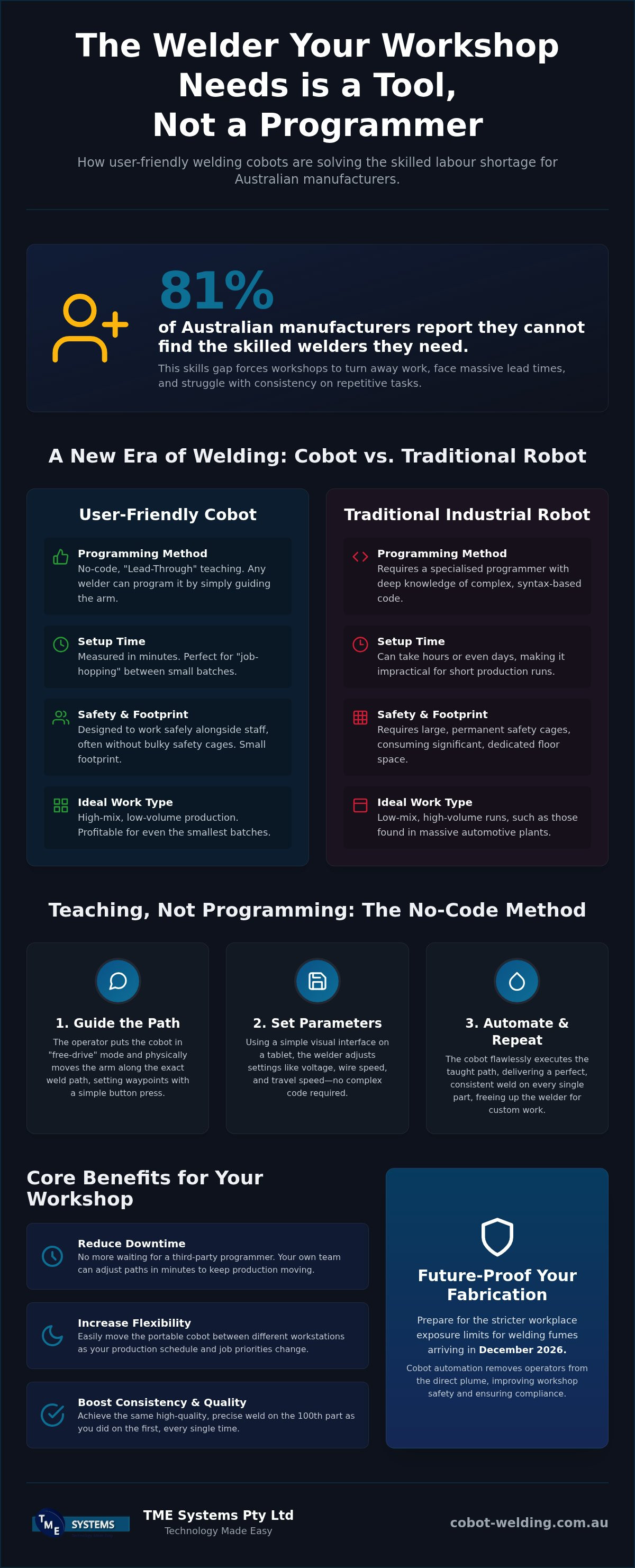

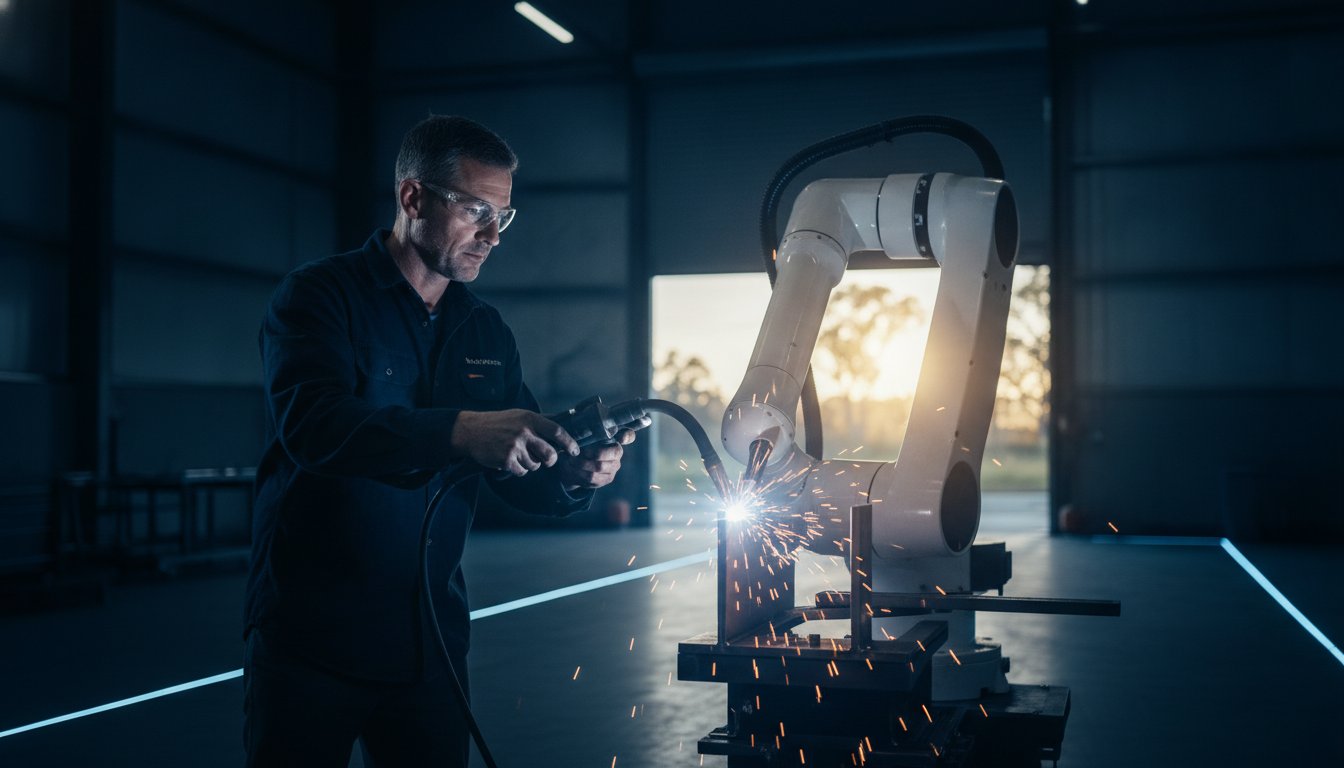
What if the solution to your welder shortage isn't finding a new staff member, but giving your current team a tool that learns as fast as they do? With 81% of manufacturers reporting they can't find skilled welders, the pressure on Australian workshops is reaching a breaking point. You've likely looked at traditional industrial robots and walked away, worried about the massive upfront costs and the need for a specialised programmer just to run a small batch of parts. This guide shows you how a user-friendly welding cobot equipped with no-code software can change that dynamic, allowing your best fabricators to automate repetitive tasks without writing a single line of computer code.
We understand that technology only works if it's actually on the floor making parts, not sitting idle in a corner. You're looking for consistency and higher throughput without losing the craftsmanship your business is built on. This article explores how these collaborative systems integrate into your daily workflow and help you navigate the transition to stricter workplace exposure limits for welding fumes arriving in December 2026. You'll discover how to empower your existing staff to do more while maintaining the high-quality standards your customers expect.
Key Takeaways
- Learn how no-code software allows your experienced welders to program complex paths simply by moving the arm, removing the need for specialised computer skills.
- Understand the safety and space advantages of a user-friendly welding cobot, which can often operate alongside your team without the need for bulky safety cages.
- Identify the "low-hanging fruit" in your production line to ensure your automation investment delivers a fast return through improved throughput.
- Discover how to organise your workshop floor and fixtures to support the robotic precision required for high-quality, repetitive welds.
- See why local integration and hands-on operator training are the keys to making sure your new technology becomes a permanent asset rather than an idle expense.
Why User-Friendly Welding Cobots are Vital for Australian Workshops
The skilled welder shortage in Australia isn't a future problem; it's a current crisis. When 81% of manufacturers report they can't find the tradespeople they need, local workshops are forced to turn away work or face massive lead times. This is where a user-friendly welding cobot becomes essential. It doesn't replace the expertise of your senior fabricators. Instead, it acts as a force multiplier, taking on the repetitive, soul-destroying runs so your team can focus on complex, custom work that requires a human touch.
For a long time, automation was the domain of massive car plants. Those systems required dedicated programmers and permanent floor space. However, a collaborative robot (cobot) is designed to be different. It's smaller, portable, and built to work safely in the same space as your staff. By 2026, the definition of accessibility has evolved. It’s no longer enough for a robot to be safe; it must be simple enough for a welder to program without needing an IT degree. This shift keeps Australian manufacturing competitive against cheap imports by allowing us to produce high-quality goods with lower overheads.
Overcoming the Skills Gap with Accessible Tech
Traditional automation often fails because it feels intimidating. If your team is worried about "breaking the robot" or needs to call a specialist every time a weld path needs a 2mm tweak, the machine will end up gathering dust. Accessible technology removes this friction. By using systems that speak the language of a welder rather than a coder, you empower your existing staff to take ownership of the technology. This bridges the gap between manual craftsmanship and robotic consistency, ensuring every part that leaves the shop meets your quality standards.
The Reality of Australian High-Mix Production
Australian workshops typically thrive on high-mix, low-volume work. We don't often see production runs of 50,000 identical parts. Instead, we see 50 brackets today and 20 frames tomorrow. Traditional robots are too rigid for this. The time spent programming a new part often exceeds the time saved during the weld. A user-friendly welding cobot allows for "job-hopping" throughout the shift. Because setup times are measured in minutes rather than hours, you can automate even the smallest batches profitably.
- Reduce Downtime: No more waiting days for a third-party programmer to arrive to adjust a simple path.
- Increase Flexibility: Move the cobot between different workstations as production needs change.
- Boost Consistency: Achieve the same high-quality weld on the 100th part as you did on the first.
Defining User-Friendliness: No-Code Software vs. Traditional Programming
Traditional industrial robots often gather dust in the corner of a workshop because they are too difficult to program for small, varied jobs. If you need a specialist programmer every time a part design changes, the automation becomes a bottleneck rather than a benefit. A user-friendly welding cobot solves this by using no-code software. No-code software allows a tradesperson to direct a robot's path using physical guidance and visual menus instead of syntax-based programming. It turns the robot into a versatile tool that responds to the welder's expertise rather than a computer scientist's code.
The "Lead-Through" method is the cornerstone of this accessibility. Instead of typing coordinates into a terminal, the operator simply puts the cobot into a "free-drive" mode and physically moves the arm along the desired weld path. The software records these points instantly. This eliminates the "pendant headache" where operators once had to navigate hundreds of buttons on a bulky controller. Today, visual interfaces allow for real-time parameter adjustment. You can tweak voltage or travel speed on the fly, ensuring the weld pool behaves exactly as it should without restarting the entire sequence.
Teaching vs. Programming: A Paradigm Shift
This movement towards accessible, no-code technology is also being reflected in how we prepare the next generation of technicians; those looking to explore modular hardware platforms can discover Maker & Coder and their specialised STEM education ecosystem.
There is a fundamental difference between writing code and demonstrating a weld path. Programming usually involves cryptic commands and rigid logic. In contrast, teaching is about demonstration. This shift is vital as these technologies continue to transform Australian workplaces by making high-tech tools accessible to the trades. A welder’s hand is naturally better at teaching a robot than a coder’s keyboard. They understand torch angles, arc gaps, and heat management. The software simply captures that manual skill and repeats it with robotic precision.
Key Features of Intuitive Robot Teaching Software
Modern teaching software uses visual logic that feels more like using a smartphone app than operating heavy machinery. You don't need to worry about brackets or semicolons; you just focus on the weld. Most systems now include:
- Drag-and-drop logic: Easily build complex sequences for multi-run welds or skip-welding patterns.
- Pre-set libraries: Access proven parameters for Aluminium, Stainless Steel, and Mild Steel to get started faster.
- Path Visualisation: See the planned movement on a screen to check for collisions before the arc ever starts.
This level of control ensures your workshop maintains high throughput even with a high-mix of different parts. If you want to see how quickly your team can pick up these skills, booking a mobile demo system to visit your site is a practical way to test the software on your own components.
Comparing User-Friendly Cobots to Traditional Industrial Robot Welding
Traditional industrial robots are built for speed and power, which usually means they must be bolted to the floor behind heavy steel cages. If an operator steps inside that perimeter while the machine is moving, the results can be disastrous. A user-friendly welding cobot is designed for a completely different environment. These systems use force-limited joints and advanced sensors to detect contact, stopping safely if they touch a person or an obstruction. This fundamental shift in design allows you to move the robot to the work rather than reconfiguring your entire workshop to accommodate a fixed, caged cell.
When you look at the footprint of these systems, the difference is stark. A traditional robot cell might take up 20 square metres of valuable floor space. A cobot system, often mounted on a mobile cart, requires little more room than a manual welding station. This portability means you can wheel the cobot to a large frame one day and move it to a bench for small brackets the next. It makes automation a flexible asset rather than a permanent fixture.
Safety and Collaborative Workspaces
In Australia, the "Safety of Machinery" standard AS/NZS 4024.1 provides the legal framework for operating these machines under the national Work Health and Safety framework. Because cobots are built to be collaborative, they often eliminate the need for expensive safety fencing and light curtains. This doesn't just save money on hardware; it changes the atmosphere of the workshop. Staff tend to view the cobot as a collaborative partner or a helpful tool rather than a dangerous machine that needs to be cordoned off. It's a psychological shift that makes the adoption of automation far smoother for your existing team.
Setup and Integration Timelines
The time it takes to see a return on your investment depends heavily on how quickly the system gets to work. Installing a traditional industrial robot can involve weeks of site preparation and complex programming. In contrast, a user-friendly cobot can often be making production parts on day one. This flexibility is vital for Australian fabricators who need to move between different projects. You can find more detail on this in The Australian Guide to Collaborative Robot Welding Cells in 2026.
When looking at the Total Cost of Ownership (TCO), remember that the purchase price is only the beginning. While a traditional robot might seem competitively priced, the integration and programming costs often reach two to three times the base system price. A cobot's "Ease of Use" ROI comes from the fact that your own staff handle the path teaching and adjustments. This reduces the typical payback period to between 12 and 24 months, ensuring the technology pays for itself through increased throughput and consistency.
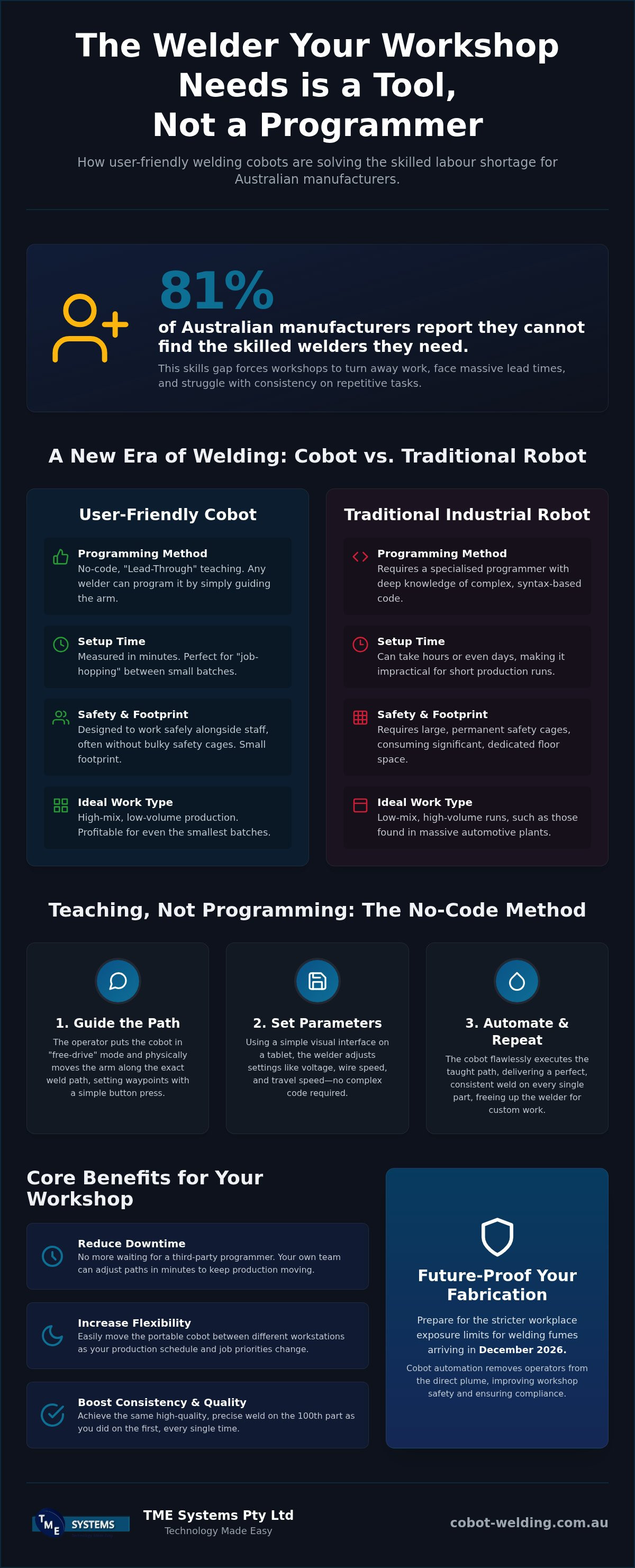
Organising Your Workshop for a Seamless Cobot Integration
Integrating a user-friendly welding cobot isn't just about the machine. It's about the environment around it. You need to ensure your jigs and fixtures are up to the task. Unlike a manual welder who can compensate for a slightly bent bracket or a 1mm gap, a robot expects every part to be in the exact same spot. Investing time in robust, repeatable fixturing is the single best way to ensure your automation succeeds. If the part doesn't move, the weld won't either.
Don't try to automate your most complex, custom job first. Look for the "low-hanging fruit". These are the high-volume, repetitive parts that bore your skilled staff. If you have a run of 100 simple base plates or small brackets, that's where you'll see the quickest return. Once your team is comfortable with the system, you can move on to more intricate work. Starting small builds confidence and allows you to refine your workflow without the pressure of a high-stakes project.
Your workshop's infrastructure also plays a role. Robotic MIG and TIG welding require clean, stable power and a consistent supply of compressed air. Voltage drops or moisture in the air lines can cause porosity and arc instability. It's a good idea to have an electrician check your circuits before the cell arrives to prevent avoidable downtime. Stable inputs lead to stable outputs, which is the cornerstone of robotic consistency.
Every successful installation needs a "Cobot Champion". This isn't necessarily your most senior manager. It's the person on the floor who is curious about technology and respected by their peers. By letting them lead the transition, you reduce the "intimidation factor" and ensure the team feels ownership over the new tool. They become the local expert who can help others, ensuring the technology is embraced rather than ignored.
The Integration Plan: From Delivery to First Weld
While the hardware is designed for ease of use, professional integration is often worth the investment for first-time adopters. Specialists can help align the cobot with your existing welding power source and set up the initial safety protocols. This ensures you aren't guessing during the setup phase. For more detail, read our Welding System Integration Specialists: A Guide for Australian Fabricators.
Training and Onboarding for Long-Term Success
Success isn't just about the first day; it's about the first year. Developing in-house expertise through operator-led onboarding ensures your team can troubleshoot and refine paths independently. This reduces the risk of the machine sitting idle if a minor issue arises. We offer On-Site Cobot Welder Training: A Practical Guide for Australian Fabricators (2026) to help your staff master the software quickly.
Ready to see the technology in action? You can book a mobile demo system to visit your workshop and test these systems on your actual production parts.
Future-Proofing Your Fabrication with Cobot Welding Australia
At TME Systems Pty Ltd (Cobot Welding Australia), we believe that automation should adapt to your workshop, not the other way around. Our approach is grounded in providing practical, turnkey solutions that address the specific hurdles of the Australian manufacturing sector. We aren't just delivering a robotic arm; we're providing a complete collaborative welding cell that is ready to work from day one. Because we are an Australian-owned partner, we understand the local standards and expectations that define our industry. We act as a practical mentor, ensuring you have the tools and the knowledge to succeed without the complexity of traditional robotics.
The heartbeat of these systems is our specialised no-code software. While the hardware provides the physical capability, the software provides the accessibility. It is the bridge that allows a manual welder to become a robot operator in a single afternoon. By keeping the interface simple and visual, we ensure that the "brain" of your welding operation stays on your workshop floor, not in an external consultant's office. This internal control is what truly future-proofs your business against fluctuating market demands. When you own the process, you can pivot your production as fast as you can move the cobot arm.
Innovation Without the Ego
Our philosophy is built on "innovation without the ego". We don't care about flashy tech for the sake of it; we care about weld quality, operator satisfaction, and your bottom line. We support Australian manufacturers through every stage of the journey, providing the integration and technical support needed to keep your production lines moving. This supportive relationship ensures that a user-friendly welding cobot becomes a permanent, high-performing member of your team. For a deeper look at how this technology works for the person under the hood, check out our No-Code Robot Welding Software: The Fabricator’s Guide to Accessible Automation.
Taking the Next Step
The best way to understand the value of a user-friendly welding cobot is to see it running your own parts. We offer a mobile demo system that brings the technology directly to your door for a practical proof of concept. This allows your team to handle the torch and test the software in their own environment. It removes the guesswork and proves the ROI before you make a commitment. You can Book a Mobile Welding Robot Demonstration: The Fabricator’s Guide to On-Site Proof of Concept to get started. Don't wait for the skills gap to close on its own. Automate the solution today and give your team the tools they need to lead the way in 2026.
Empowering Your Workshop with Accessible Automation
Adopting a user-friendly welding cobot is no longer a leap into the unknown for Australian fabricators; it's a practical step toward securing your workshop's future. By putting the power of no-code software directly into the hands of your experienced tradespeople, you solve the persistent skilled welder shortage while maintaining the high quality your customers expect. This technology doesn't replace the craftsman; it gives them a more efficient tool to handle the repetitive tasks that often bottleneck production.
You don't have to navigate this transition alone. With Australian-based integration specialists and mobile demo units available nationwide, you can see exactly how these collaborative cells fit into your specific workflow before making a commitment. Testing the system on your own parts provides the certainty you need to move forward with confidence. It's about making innovation feel attainable and grounded in the reality of your shop floor.
Ready to see the results for yourself? Book a Mobile Welding Robot Demonstration for Your Workshop and test the technology on your own production parts today. Taking control of your workshop's throughput starts with a single step, and we're here to help you make it a successful one.
Frequently Asked Questions
Is a user-friendly welding cobot actually as strong as an industrial robot?
Cobots are built for precision and repeatability rather than the raw speed of heavy industrial robots. While a large industrial robot can swing a heavy torch at high speeds, a cobot is optimised for standard MIG and TIG applications. It's plenty strong for the welding tasks found in most Australian workshops. The focus is on consistency and safety rather than high-speed bulk movement in a caged environment.
How long does it take for a welder to learn the no-code software?
Most experienced welders can pick up the basics of no-code software in a single afternoon. Because the interface uses visual menus and physical lead-through teaching, there's no syntax to memorise. After about four to eight hours of hands-on training, an operator is usually comfortable setting up new paths and adjusting parameters. It's designed to feel like a natural extension of their existing trade skills.
Can I use my existing MIG or TIG welder with a cobot cell?
Yes, you can often integrate your current professional-grade MIG or TIG power source into a cobot cell. However, a digital interface is required for the robot to control parameters like voltage and wire speed. We specialise in welding system integration to ensure your existing gear communicates seamlessly with the new automation. This approach helps reduce the initial investment while upgrading your workshop's overall capacity.
What happens if the cobot hits something or someone during operation?
If a user-friendly welding cobot makes contact with an object or person, its force-limited joints detect the resistance and stop the machine instantly. This built-in safety mechanism is a core requirement of the AS/NZS 4024.1 standard used across Australia. It eliminates the need for physical cages in many applications. The robot remains stationary until an operator clears the obstruction and resets the program, preventing injuries or equipment damage.
Do I need to know how to code to adjust the weld path for a new job?
No, you don't need any coding knowledge to adjust a weld path or start a new job. The no-code software uses a drag-and-drop interface where you select points and paths visually. If a part design changes, you simply move the arm to the new positions and save the update. It’s a purely graphical process that removes the technical barriers traditionally associated with robotic programming.
How much floor space does a collaborative welding cell require?
A typical collaborative welding cell requires roughly the same footprint as a standard manual welding bench, about 2 to 4 square metres. Unlike traditional robots that need large safety perimeters and fencing, cobots can sit right next to other workstations. This compact design makes them ideal for smaller Australian shops where floor space is at a premium and moving heavy machinery is difficult.
What is the typical ROI for a small Australian fabrication shop?
The typical payback period for a user-friendly welding cobot in a small Australian shop is between 12 and 24 months. This ROI is driven by increased throughput and the ability to run repetitive jobs without tying up your most skilled staff. For multi-shift operations or high-utilisation workshops, some owners see the system pay for itself in as little as 6 to 12 months through consistent weld quality.
Can a cobot handle complex welds like circular paths or aluminium?
Cobots excel at complex paths, including circular welds, multi-axis movements, and weaving patterns. When paired with a high-quality power source, they handle aluminium and stainless steel with the same precision as mild steel. The software includes pre-set libraries for different materials, making it easy to dial in the correct pulse or spray transfer settings for tricky non-ferrous metals that usually require a very steady hand.