
What if the Australian government covered half the cost of putting a robotic welding cell on your workshop floor? It's a question more fabricators are asking as the search for certified welders becomes an expensive, uphill battle. You're likely feeling the squeeze from rising labour rates and the constant pressure to drop your margins just to compete with overseas shops. It's frustrating when the technology you need feels out of reach because the paperwork for welding automation grants australia feels like a dark art.
We understand that you're a specialist in fabrication, not a professional grant writer. This guide cuts through the complexity to show you how to secure funding for no-code robotic solutions that your existing team can actually use. You'll learn about active 2026 programs like the Defence Industry Development Grants and the Sovereign Industrial Capability Priority. We'll also explain how to frame your application around technical uplift to improve your chances of success. By the end, you'll have a clear roadmap to modernise your workshop and protect your future margins.
Key Takeaways
- Understand how the Australian government's focus on sovereign capability in 2026 has opened new funding pools for local fabrication workshops.
- Identify which welding automation grants australia, such as the Defence Industry Development Grants (DIDG), offer up to 50% matched funding for your project.
- Learn why no-code teaching software is a "secret weapon" for grant applications by proving you can upskill your existing workforce without external consultants.
- Discover the specific steps to quantify your current manual welding costs and build a high-ROI business case that reviewers can't ignore.
- Find out how to use mobile demos and turnkey integration to provide the "proof of concept" required to de-risk your application and secure approval.
Navigating the 2026 Australian Manufacturing Grant Landscape
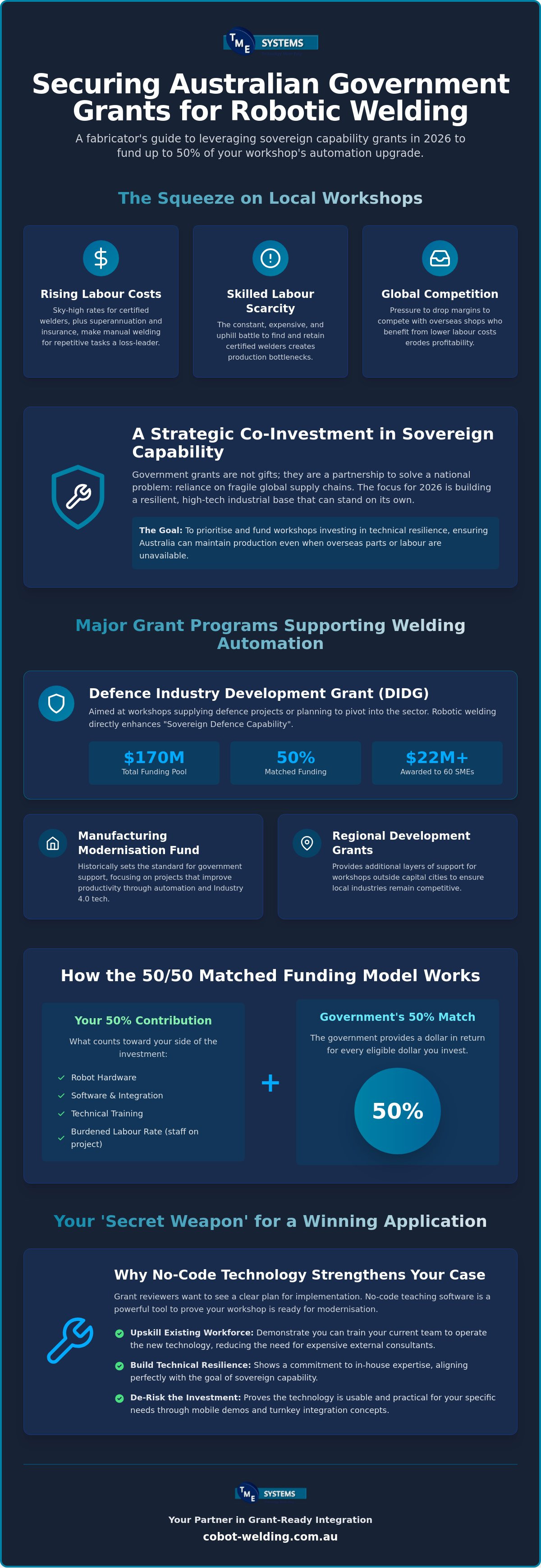
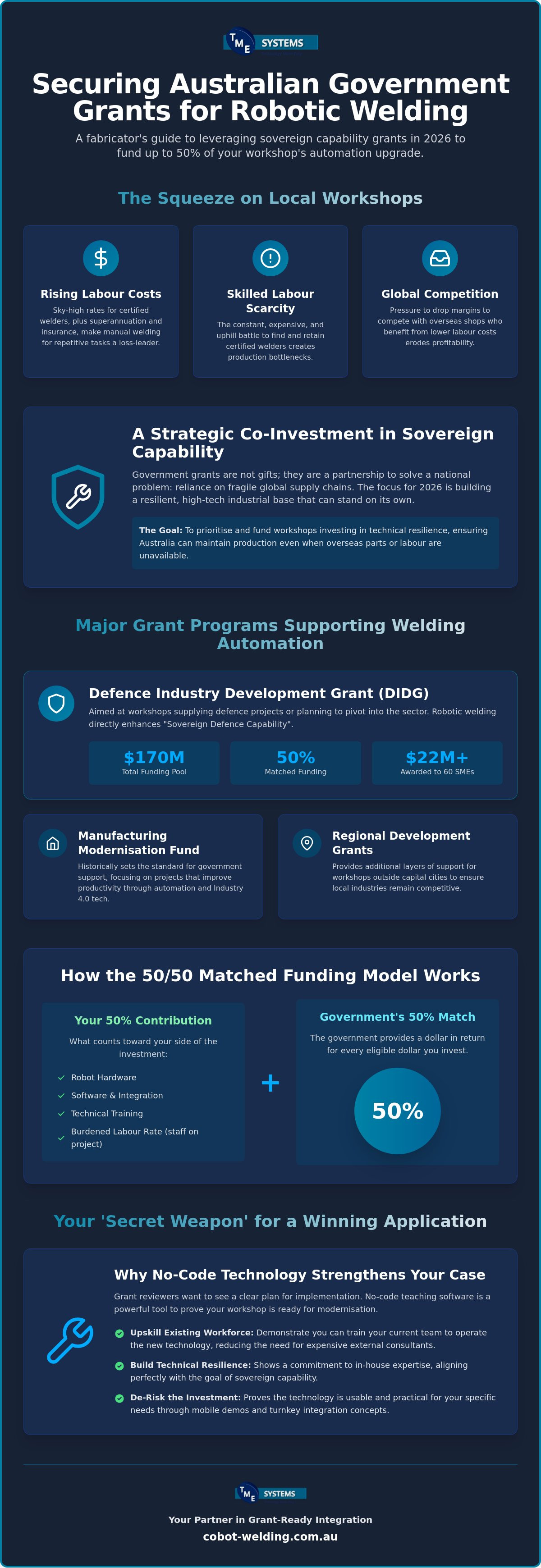
A government grant isn't a gift; it's a strategic co-investment. When you apply for welding automation grants australia, the Commonwealth is looking for a partner to help solve a national problem. In 2026, that problem is our reliance on fragile global supply chains. The days of funding mass-production facilities for the sake of it are gone. Instead, the focus has shifted toward building a resilient, high-tech industrial base that can stand on its own feet.
Adopting Robot welding technology is now viewed as a critical step in this journey. If your workshop is struggling with the sky-high cost of certified labour, you aren't alone. The cost of doing nothing is becoming the heaviest burden on your balance sheet. By the time you factor in superannuation, insurance, and the scarcity of skilled tradespeople, manual welding for repetitive tasks often becomes a loss-leader. Collaborative robots, or cobots, bridge this gap by allowing your best welders to focus on complex jobs while the machine handles the grunt work.
Sovereign Capability and the Australian Fabricator
The term sovereign capability might sound like corporate jargon, but it has practical implications for your workshop. Large-scale projects like the AUKUS program have created a massive demand for local components. Government bodies are prioritising workshops that can prove they are grant-ready by investing in technical resilience. This means showing that you can maintain production even when overseas parts or labour are unavailable. If you want to understand how this fits into your long-term strategy, check out our guide on Future-Proofing Welding Workshops to see how automation builds local strength.
Matching Grants: How the 50/50 Model Works
Most welding automation grants australia operate on a matching basis, typically a 50/50 split. This means for every dollar you invest, the government provides a dollar in return. It's vital to understand what counts toward your contribution. While the hardware, software, and integration services are usually eligible, business as usual expenses like rent or existing staff salaries often aren't. However, the technical training required to get your team using no-code software is frequently covered. When calculating your side of the investment, remember to include the fully burdened labour rate of the staff dedicated to the project, as this reflects the true cost of the technical uplift.
Major Grant Programs Supporting Welding Automation
Identifying the right funding stream is the first step toward reducing your workshop's overheads. While many fabricators believe government support is reserved for massive car plants, the reality in 2026 is quite different. Current welding automation grants australia are designed to help small and medium enterprises (SMEs) adopt Industry 4.0 technologies. Whether you're based in a metro hub or a regional area, there's likely a program that matches your specific modernisation goals.
The Manufacturing Modernisation Fund has historically set the standard for this support, focusing on projects that improve productivity through automation. While specific rounds open and close, the underlying strategy remains the same: the government wants to see you move away from low-value manual tasks toward high-value technical roles. For workshops outside the capital cities, Regional Development Grants provide additional layers of support to ensure local industries remain competitive against international players who benefit from lower labour costs.
The Defence Industry Development Grant (DIDG)
If your workshop supplies parts for defence projects, or if you're planning to pivot into this sector, the DIDG program is a significant opportunity. This program targets a $170 million pool specifically for technical skills development and sovereign capability. In the latest round, over $22 million was awarded to 60 Australian businesses to help them scale their operations. A great example of this in action is Micca Holdings, which recently secured $62,419 to acquire advanced laser welding and cutting equipment.
The DIDG provides matching grants of up to 50 per cent for eligible project costs. Because robotic welding cells directly enhance "Sovereign Defence Capability" by ensuring we can build and repair equipment locally, they are viewed favourably by reviewers. These grants are currently open year-round until 2028, giving you the time to prepare a thorough application that proves your technical readiness.
R&D Tax Incentive for Welding Innovation
Not every project requires a direct grant to be affordable. The R&D Tax Incentive offers a different path by providing tax offsets for "novel" fabrication processes. If you're using no-code software to develop a unique way of welding difficult alloys or creating complex geometries that haven't been automated before, you might qualify. This isn't just for scientists in lab coats; it's for the foreman who finds a better way to join metal on the shop floor.
Using no-code software allows you to experiment with these new processes without the high cost of external programmers. To see how these systems fit into a modern workshop, you can read The Australian Guide to Collaborative Robot Welding Cells in 2026. If you're unsure if your project qualifies as innovation, you might want to speak with an automation specialist who understands the technical requirements of the incentive.
How 'No-Code' Technology Strengthens Your Grant Application
Grant assessors aren't just looking at the hardware you want to buy. They're looking at how that investment will improve the technical skills of your team. This is where no-code technology becomes a significant advantage for welding automation grants australia. In the past, industrial robots required specialised programmers, which often meant thousands of dollars in external consulting fees before the first arc was even struck. This "programming penalty" often made projects look too risky or expensive for government co-investment.
By choosing no-code systems, you prove that your project is viable from day one. You aren't relying on a third-party expert who might be hard to find in six months. Instead, you're building knowledge transfer directly into your workshop. When an assessor sees that your existing staff can manage the technology, they see a project with high long-term value and low delivery risk. It demonstrates that the "accessibility dividend" stays within your business, rather than leaking out to external consultants.
Empowering the Existing Workforce
A common fear in Australian manufacturing is that automation replaces people. To win a grant, you need to flip this narrative. You should frame the collaborative robot as a sophisticated tool for the trade, much like a high-end power source or a CNC plasma table. No-code software allows a qualified welder to transition into a robotics supervisor role in just a few hours. They use their existing trade knowledge to "teach" the robot, ensuring the machine performs to the workshop's standards.
This approach satisfies the "technical skills development" requirements found in many 2026 grant streams. You're not just buying a machine; you're upskilling a local worker to handle Industry 4.0 tools. For a deeper look at how this works on the workshop floor, see our No-Code Robot Welding Software: The Fabricator’s Guide. This type of operator-led teaching is exactly what government bodies want to fund because it protects local jobs while increasing competitiveness.
Reducing Integration Risk
Reviewers love certainty. They prefer turnkey collaborative welding cells over high-risk, custom R&D projects because the outcomes are predictable. When you can demonstrate a fast "Time to First Weld," you show that the government's money will lead to immediate productivity gains. Custom-built systems often suffer from long commissioning delays, which can be a red flag during the due diligence phase of a grant application.
We often suggest using a mobile demo system as a pre-grant proof of concept. It provides on-site evidence that the solution works for your specific parts and materials. This level of preparation makes your application stand out because it replaces theoretical promises with physical proof. It shows you've done the hard work to ensure the integration won't stall after the funding is approved, making you a much safer bet for a 50/50 matching grant.
Preparing a Winning Business Case: ROI as a Grant Requirement
A successful application for welding automation grants australia depends on more than just technical specifications. It requires a hard-nosed business case that proves the investment will pay for itself and grow your bottom line. Grant reviewers aren't looking for a "cool robot" project; they are looking for a smart investment of taxpayer funds that results in a more competitive Australian business.
To build this case, start by quantifying the fully burdened cost of manual welding in your shop. This includes the hourly rate plus superannuation, leave entitlements, workers' compensation, and the cost of recruitment. When you compare this to the estimated throughput increase of a collaborative welding cell, the financial gap becomes clear. A cobot can maintain a consistent arc-on time that manual welding simply cannot match over an eight-hour shift. You should also calculate the reduction in rework and scrap. Automated precision means fewer parts end up in the bin, which directly improves your margins.
Finally, factor in the "Accessibility Dividend." Because you are using no-code software, you save the significant expense of hiring a specialist robotics programmer. Align these projections with the grant's commercialisation goals by showing how this increased efficiency will allow you to lower your lead times and bid for larger, more complex contracts. This shows the government that their co-investment is a catalyst for your business growth.
The ROI Formula for Grant Bodies
Reviewers want to see a pragmatic payback period, typically under 18 months for SME projects. Moving beyond "faster welds," your business case should highlight improved quoting accuracy. When a machine performs the task, your cycle times are fixed, which removes the guesswork from your tenders. This consistency allows you to scale your operations and take on work that was previously too risky or low-margin. For more details on boosting your workshop's output, read our guide on How to Improve Welding Productivity with Cobots.
Addressing the Skills Shortage Financially
The most persuasive argument in 2026 is the reality of labour scarcity. Frame your automation project as a solution to unfilled positions rather than a replacement for workers. Calculate the lost revenue from jobs you had to turn down because you couldn't find enough certified welders. Additionally, highlight the safety (WHS) benefits. Cobots handle the repetitive, dull tasks that lead to strain injuries and reduce operator exposure to fumes and arc flash. These long-term health and safety savings are a vital part of a comprehensive ROI model. If you need help crunching these numbers, contact our technical team for a workshop-ready ROI template.
Partnering with TME Systems Pty Ltd for Grant-Ready Integration
TME Systems Pty Ltd acts as more than a supplier; we're a technical partner for your grant journey. When you apply for welding automation grants australia, the government requires high-quality technical documentation and a clear proof of concept. Our team provides the specific details you need to fill out the technical sections of your application, from cycle time estimates to safety integration plans. By providing turnkey Collaborative Robot Welding Cells, we significantly reduce the "integration risk" that often causes grant reviewers to hesitate. They want to see a system that's ready to work, not a science experiment that might fail during commissioning.
One of the most effective ways to de-risk your application is through a Mobile Welding Robot Demonstration. This on-site proof of concept allows you to show grant assessors that the technology is already vetted for your specific workshop environment. It takes the guesswork out of the due diligence process. Once the funding is secured, our operator training and onboarding programs ensure you meet the "Skills Development" criteria head-on. We don't just drop off a machine; we stay on-site to make sure your team is comfortable and productive.
Local Support, National Coverage
Choosing an Australian-owned and operated partner is a major advantage for "Sovereign Capability" grants. Programs like the DIDG and SICP are specifically designed to build up local industry. Working with TME Systems Pty Ltd shows that you're investing back into the Australian economy and that you'll have access to local technical support when you need it. We've helped fabricators across the country modernise their workshops, moving them from manual bottlenecks to automated efficiency. This local presence ensures your grant-funded project remains a long-term success rather than a short-term trial.
Your Next Steps to Funding
The funding landscape moves quickly, but the opportunities for 2026 are substantial. Your first step should be a thorough review of currently open rounds, such as the Defence Industry Development Grants, which are open year-round until 2028. Once you've identified a potential stream, we recommend booking a technical assessment. This helps define your project scope and provides the data needed for your ROI model. It's about making sure your application is as robust as the welds your new system will produce.
Ready to build your business case and secure your workshop's future? Contact TME Systems Pty Ltd for a Mobile Demo and let's get your application moving.
Take the Next Step Toward a Modernised Workshop
Securing welding automation grants australia is about more than just filling out forms; it's about making a strategic play for your workshop's longevity. By leveraging programs like the DIDG and focusing on technical uplift, you're building a shop that can outcompete international fabricators. You now have the roadmap to turn the "programming penalty" into a skills dividend while de-risking your application with proven, turnkey technology that reviewers trust.
As an Australian-owned and operated partner, TME Systems Pty Ltd provides the practical support you need to succeed. Our no-code software reduces training costs, ensuring your existing team can lead the transition without needing external programmers. We've found that the most effective way to strengthen your application is with a physical proof of concept that proves the technology works for your specific parts and materials.
Book a Mobile Demo with TME Systems Pty Ltd to kickstart your Grant Business Case and see how easily automation fits into your workflow. The funding is available; you just need the right technical partner to help you claim it. Let's build a more resilient future for your workshop together.
Frequently Asked Questions
What is the most common grant for welding automation in Australia?
The Defence Industry Development Grant (DIDG) is currently the most accessible option for welding automation grants australia because it accepts applications year-round until 2028. While the Manufacturing Modernisation Fund is a staple for many fabricators, its rounds open and close periodically. The DIDG remains a reliable path for workshops looking to build technical resilience and contribute to local supply chains.
Can a small workshop with only 5 staff qualify for manufacturing grants?
Yes, most Australian grants are specifically designed to help small-to-medium enterprises (SMEs) scale their operations. You don't need a massive headcount to qualify; instead, the focus is on your turnover and the potential for the project to increase your productivity. Even a shop with five staff can prove a significant "technical uplift" by showing how automation allows the team to handle higher-value contracts.
Do I need to be in the Defence industry to get a DIDG grant?
You don't need to be a prime defence contractor to be eligible. Many successful applicants are general fabricators who supply parts to the defence supply chain or produce "dual-use" items that have both commercial and defence applications. If your workshop can prove it supports a Sovereign Industrial Capability Priority, such as local maintenance or repair, you're a strong candidate for funding.
How much of the cobot cost can I expect a grant to cover?
Most 2026 programs offer a 50 per cent co-contribution model. This means the grant covers half of the eligible project costs, which includes the collaborative welding cell, the no-code software, and the necessary integration services. It's important to remember that you must have the other 50 per cent of the funding ready to go, either through cash reserves or a pre-approved business loan.
Is the R&D Tax Incentive better than a direct grant for my welding robot?
The R&D Tax Incentive is a retrospective tax offset, whereas a direct grant provides upfront capital for your purchase. If you are developing a completely unique fabrication process, the tax incentive can provide long-term relief. However, for most workshops, a direct grant is better for cash flow because it reduces the initial debt required to get the robotic cell onto the floor.
What are the common reasons grant applications for automation are rejected?
Applications are often rejected if they lack technical detail or fail to show a clear return on investment. Reviewers are wary of custom-built systems that carry a high risk of failure. Using a turnkey system with no-code software mitigates this risk because it proves the project is viable and that your existing staff can operate the equipment without needing expensive external consultants.
How long does the grant application process typically take in Australia?
The process usually takes between three and six months from the time you submit your application to receiving the final approval. This includes a thorough due diligence phase where the government assesses your business's financial health and the technical merits of your project. Starting your business case early ensures you have all your data ready when the application window is most favourable.
Does TME Systems Pty Ltd help with the technical data for my grant application?
Yes, TME Systems Pty Ltd provides the necessary technical specifications, cycle time estimates, and safety data required for your application. We act as a technical partner to ensure your project scope is clearly defined for the reviewers. By providing physical proof of concept through our mobile demos, we help you present a robust, low-risk case to the government bodies.