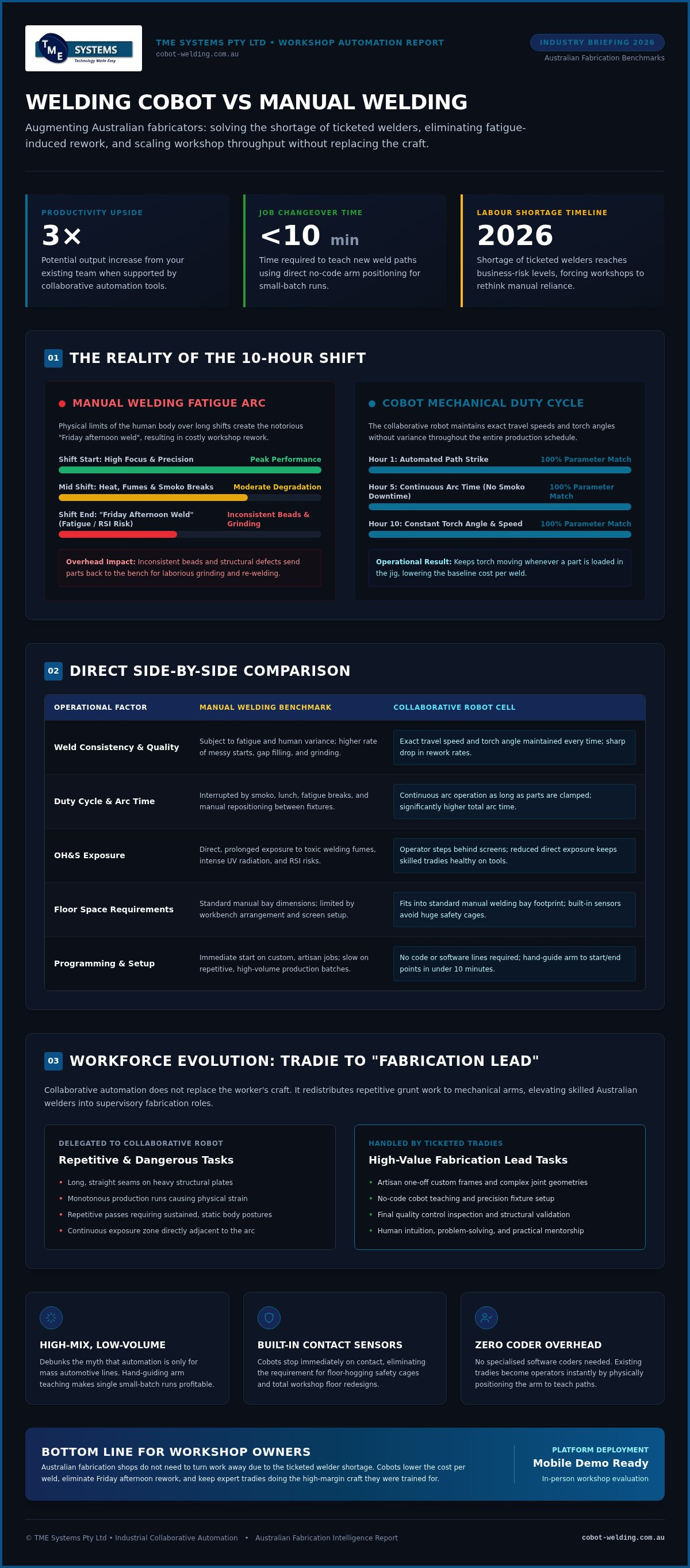

What if the solution to your missing ticketed welders wasn't another recruit, but a tool that makes your existing team three times more productive? Finding reliable staff in Australia has become a constant headache, and rising labour costs continue to squeeze workshop margins. When weighing up the benefits of a welding cobot vs manual welding, it's clear that your best tradies shouldn't be bogged down with repetitive, low-value runs that lead to fatigue and inconsistency by the end of a long shift.
We understand that technology should support the worker, not replace the craft. This guide explores how collaborative automation can protect your bottom line and improve workshop safety. We'll look at how no-code software and integrated cells lower your cost per weld while keeping your team engaged. By the end, you'll understand how to use this technology to augment your team's skills, finally freeing up your experts for the complex, high-value projects they were truly trained for.
Key Takeaways
- Discover how collaborative automation solves the 2026 labour shortage by augmenting your current team's output instead of replacing their craft.
- Compare the consistency and duty cycles of a welding cobot vs manual welding to see how to maintain high-quality results without welder fatigue.
- Learn how no-code teaching software makes automation accessible for small-batch work; this allows your team to set up new paths in minutes.
- Understand how to reposition your skilled tradies as "Fabrication Leads," which frees them from repetitive runs to focus on high-value, complex jobs.
- Gain insights into future-proofing your workshop and scaling production without the constant struggle of finding new ticketed welders.
The Evolution of the Australian Workshop Floor: Manual vs Automated
Australian fabrication shops are facing a crunch. By 2026, the shortage of ticketed welders has moved from a nuisance to a genuine business risk. Many local owners find themselves turning away work because they simply can't find the hands to do it. This isn't just about headcounts; it's about the physical limits of the human body. Traditional manual welding relies on a level of consistency that is hard to maintain across a ten-hour shift, especially when the heat and fumes start taking a toll on your team.
The Real Cost of Manual Welding in 2026
When you look at the debate of welding cobot vs manual welding, you have to look beyond the hourly wage. In Australia, high labour rates are only part of the story. You also need to factor in rework costs and the overheads of managing a tired workforce. Fatigue leads to inconsistent beads and potential structural failures, which means parts end up back on the bench for grinding and re-welding. This creates a productivity ceiling. Your best welders are often stuck doing dull, dirty, and dangerous tasks like long, straight seams on heavy plate. This wastes their talent and increases the risk of repetitive strain injuries (RSI).
Enter the Collaborative Robot (Cobot)
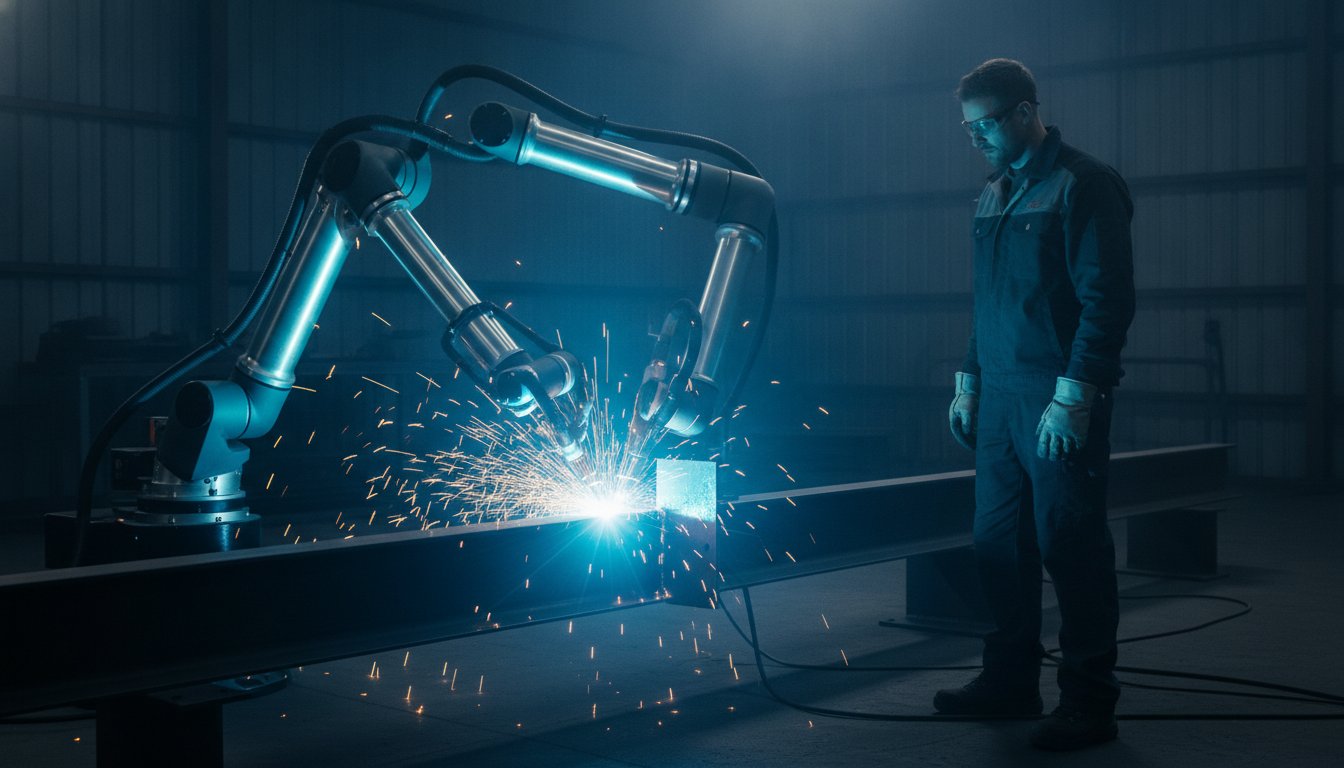
This is where collaborative robots (cobots) change the game. Unlike the massive, caged industrial robots that require a specialised programmer, cobots are designed to work safely alongside your team. They act as a sophisticated extension of the tradie’s hand. We see them as a tool for the practical mentor, offering a way to pass the grunt work to a machine while the human focuses on the setup and the complex joins.
The shift from complex coding to simple teaching is the real breakthrough for Aussie shops. Instead of writing lines of software, an operator physically moves the arm to the start and end points. This no-code approach means you can swap between different jobs in minutes. For high-mix, low-volume production, the choice between a welding cobot vs manual welding becomes clear. The cobot handles the repetitive volume, while your skilled welders handle the high-value custom work.
Cobot Welding vs Manual Welding: A Side-by-Side Comparison
Deciding between a welding cobot vs manual welding often comes down to the repetitive nature of your current contracts. While a manual welder brings an artisan's touch to one-off custom frames, the cobot excels at the high-volume, repetitive runs that usually drain a worker's energy. It's about finding the balance between human intuition and mechanical endurance.
Consistency and Quality Control
We've all seen the 'Friday afternoon' weld. It's the natural result of a long week and physical exhaustion. A cobot eliminates this variance by maintaining exact travel speeds and torch angles every single time it strikes an arc. This level of precision means your rework rates drop significantly. Instead of spending hours grinding back messy starts or filling gaps, your manual welders can focus on performing final quality control and tackling the complex joints that require human problem-solving. This partnership ensures the machine handles the precision while the human handles the craft.
Operational Footprint and Safety
Space is at a premium in most Aussie workshops. A traditional industrial robot requires a massive safety cage and a fixed position, but a collaborative robot welding cell fits into a footprint similar to a standard manual welding bay. Because they are designed with built-in sensors to stop on contact, they often don't require the expensive safety fencing that eats up floor space. This makes them much easier to integrate into an existing workflow without a total shop floor redesign.
Beyond the physical footprint, there's a significant health benefit. By allowing the machine to handle the bulk of the arc time, you're reducing your team's direct exposure to harmful fumes and UV radiation. This keeps your best staff healthy and on the tools for longer. If you're curious about how this fits into your specific layout, our mobile demo system can show you the setup in person.
The duty cycle is another area where the machine pulls ahead. A manual welder needs a smoko, a lunch break, and time to reset between jigs. A cobot keeps the torch moving as long as there is a part in front of it. Some might worry that this lacks flexibility, but modern no-code systems allow you to switch between different jobs in under ten minutes. When comparing a welding cobot vs manual welding, this ability to maintain a high pace across a high-mix of parts is what truly transforms workshop productivity.
The Small Batch Myth: Why Cobots Aren’t Just for Mass Production
A common misconception in Australian workshops is that automation only makes sense for massive production runs. If you aren't making thousands of the same bracket, why bother? This logic is outdated and rooted in the era of old industrial robots. Modern cobots are specifically designed for the high-mix, low-volume reality of local job shops. When weighing up the value of a welding cobot vs manual welding for a batch of only ten units, the deciding factor is how quickly you can get the machine running.
The Power of No-Code Path Teaching
Traditional robots required a specialist programmer to spend a full day writing code for a single part. That simply doesn't work for a small shop. Today, no-code robot welding software allows a welder to physically lead the arm through the required path. You lead the torch to the start and end points, and the software handles the trajectory. It takes minutes, not hours. This makes it viable to automate even a handful of components before switching to a completely different job. You keep the arc burning instead of staring at a computer screen, which is essential for maintaining a profitable flow in a diverse workshop.
Augmenting the Skilled Welder
Think of the cobot as a tool that handles the repetitive base of a bespoke project. While the machine runs long, straight seams on a custom frame, your skilled welder can be at the next bench tackling intricate pipework or complex tacks. To improve welding productivity with cobots, you need to reorganise how work moves through the shop. Many owners now use a "Multi-Bay" approach. One operator manages two stations, loading a jig in one bay while the cobot finishes a weld in the other. This setup effectively doubles the output of a single tradesperson without adding to their physical load.
Calculating ROI in a job shop isn't just about raw speed; it's about flexibility and reducing downtime. If you can switch from a batch of gate hinges to a set of custom brackets in under fifteen minutes, the machine is earning its keep. In the ongoing comparison of welding cobot vs manual welding, the cobot wins on small batches because it never gets bored and never loses focus, even on the sixth different job of the day. This allows your team to maintain a high output across a varied product line, ensuring you can say "yes" to more contracts without needing to find more staff.
Safety and Staff Integration: Moving Beyond the Welding Screen
We need to talk about the elephant in the workshop. When workshop owners bring up the topic of a welding cobot vs manual welding, the first question from the floor is usually: "Is this thing going to take my job?" It's a fair concern, but the reality is quite the opposite. In an environment where we can't find enough ticketed welders to keep up with demand, automation is about protecting your team's longevity and craftsmanship, not replacing their presence.
Winning the Hearts and Minds of Your Team
By offloading the repetitive, high-heat runs to a machine, you are actively reducing the risk of welder fatigue and repetitive strain injuries (RSI). This shift allows your best people to step into roles as "Fabrication Leads" or "Cobot Operators," where they use their expertise to oversee the process rather than just pulling a trigger for eight hours. We've found that on-site cobot welder training is the most effective way to build this confidence. It turns a piece of technology into a trusted workshop tool. Plus, showing apprentices that your shop invests in modern gear makes the trade far more attractive to the next generation of Aussie tradies.
A Step-by-Step Integration Plan
Integrating a cobot doesn't happen overnight, but it doesn't have to be complicated. Success comes from a methodical approach that respects both the machine's capabilities and the human's experience. When comparing a welding cobot vs manual welding during a trial phase, focus on how much more "arc-on" time your team achieves without increasing their physical effort.
- Step 1: Identify your highest-volume, lowest-complexity parts. These are the quick wins that prove the return on investment early and build team momentum.
- Step 2: Conduct a thorough risk assessment for the collaborative workspace. Ensure compliance with Australian workshop safety regulations by managing UV flash and fume extraction.
- Step 3: Run an on-site mobile welding robot demonstration to prove the concept in your specific environment and get staff buy-in.
- Step 4: Gradually phase in more complex parts as the team's skill and comfort with the software grow.
This staged approach ensures that the technology adapts to your workshop culture, rather than forcing your team to change how they work. If you're ready to start the conversation with your team and see the tech in action, book your on-site proof of concept today.
Future-Proofing Your Business with Collaborative Automation
The divide between Australian workshops that embrace automation and those that stick solely to traditional methods is growing. It isn't just about who has the flashiest gear; it's about who can scale their production when the next big contract arrives. When you look at the long-term outlook of a welding cobot vs manual welding, the real winner is the shop that can increase its throughput without needing to find ten new skilled welders in a market that simply doesn't have them.
Looking beyond the initial purchase price is essential for any savvy owner. While the upfront cost of a cell is a consideration, the true metric for success is the cost-per-part over the next five years. By reducing rework and increasing arc-on time, the machine pays for itself through sheer reliability. This shift allows you to move your focus from daily firefighting to long-term business strategy.
The Competitive Advantage in Tendering
Winning bigger contracts in 2026 requires more than just a competitive price. Clients now demand guaranteed lead times and absolute weld consistency across every single unit. Automation allows you to quote for jobs with a level of accuracy that manual-only shops struggle to match. You know exactly how long a run will take, and you know the quality will be identical from the first part to the five-hundredth. This positions your workshop as a modern, tech-forward partner that can be trusted with high-stakes projects.
Taking the Next Step
Moving into automation shouldn't feel like a leap into the unknown. Success depends on having the right partner to guide the transition. Working with a welding system integration specialist ensures that the technology actually fits your specific workflow. It isn't just about the hardware; it's about the ongoing support, software updates, and operator training that keep the system productive for years to come.
TME Systems Pty Ltd supports this end-to-end journey for Australian fabricators. We start with a pragmatic assessment of your needs and stay with you through the onboarding process. The transition from a manual-heavy shop to an augmented, high-output facility is a steady process of refinement. By starting with your most repetitive tasks today, you're building a foundation that allows your skilled tradespeople to do what they do best. They can solve complex fabrication challenges while the machine handles the volume, ensuring your business remains competitive for the long haul.
Scaling Your Workshop with Confidence
The choice between a welding cobot vs manual welding isn't about replacing the artisan. It's about giving your best tradies a sophisticated tool that handles the repetitive grunt work so they can focus on high-value, complex fabrication. We've explored how no-code software removes the traditional barriers to entry, making automation a practical reality for Aussie job shops managing diverse product lines. By integrating collaborative cells, you aren't just solving a temporary labour shortage; you're building a more consistent, safer, and highly competitive business.
As an Aussie-owned and operated partner, TME Systems Pty Ltd is here to support your transition with proven ROI and specialised operator onboarding. Our no-code software is designed specifically for tradies, ensuring your team feels empowered rather than intimidated by new technology. If you want to see exactly how this technology fits onto your workshop floor, Book a Mobile Welding Robot Demonstration to see a cobot in your own workshop.
Taking that first step toward automation is a pragmatic move that protects your team's health and ensures your workshop remains the preferred choice for clients in 2026 and beyond. We're ready to help you refine your process and scale your output with confidence.
Frequently Asked Questions
Will a welding cobot replace my skilled welders?
No, a cobot is designed to support your team rather than replace it. In the context of the 2026 skills shortage, these systems take over the repetitive, high-volume runs that lead to fatigue. This allows your ticketed welders to focus on complex, bespoke fabrication that requires human intuition. It's about increasing your total output per head, not reducing your headcount.
How much time does it take to learn no-code welding software?
Most operators feel comfortable with no-code teaching software within a single shift. Because you are physically leading the arm through the weld path instead of typing lines of code, the learning curve is very shallow. Our operator training and onboarding programmes focus on practical, hands-on skills. You don't need a computer science degree; you just need your existing knowledge of what makes a good weld.
Can a cobot handle both MIG and TIG welding processes?
Yes, collaborative systems are highly versatile and can be integrated with both MIG and TIG equipment. While MIG is often the first choice for high-speed production, TIG integration is perfect for precision work on thinner materials. TME Systems Pty Ltd handles the welding system integration to ensure your cobot works seamlessly with your preferred power source and torch setup, regardless of the specific process you use.
What is the typical ROI period for a cobot welding cell in Australia?
The ROI for a collaborative robot welding cell depends on your current labour costs and rework rates, but many Australian job shops see a return within 12 to 18 months. By reducing the cost per weld and eliminating the need for expensive rework, the system starts paying for itself from the first day of production. It allows you to quote more aggressively for large contracts without increasing your fixed overheads.
Is it safe for a cobot to work right next to a human operator?
Safety is a core feature of collaborative robots, which are designed with force-sensing technology to stop immediately upon contact. Unlike traditional industrial robots that require massive cages, cobots can often work alongside your team in a standard bay. When comparing a welding cobot vs manual welding setup, you'll find the cobot actually improves overall shop safety by reducing human exposure to intense UV and harmful fumes.
Does the cobot require a perfectly clean environment to operate?
Not at all; these systems are built specifically for the realities of the Australian workshop floor. They are rugged enough to handle the dust, heat, and vibration typical of a busy fabrication environment. While keeping your equipment in good condition is always a smart move, you don't need a laboratory-clean space. The focus is on practicality and ensuring the technology survives where the work actually happens.
What happens if I need to change my product design frequently?
Frequent design changes are exactly why no-code software is so valuable. If you need to adjust a part or switch to a completely new product, you simply "teach" the robot the new path by hand. This process takes minutes, making it highly profitable for small batches and custom jobs. You can maintain a high-mix production schedule without the downtime usually associated with re-programming traditional automation.
Do I need an industrial programmer on staff to manage the system?
You definitely don't need a specialist programmer on your payroll. The no-code software we provide is designed for tradies to use directly on the workshop floor. Your existing welders become the operators, using their trade knowledge to set the parameters and paths. This removes the barrier to entry for small-to-medium businesses and ensures you have full control over your production without relying on external software experts.