

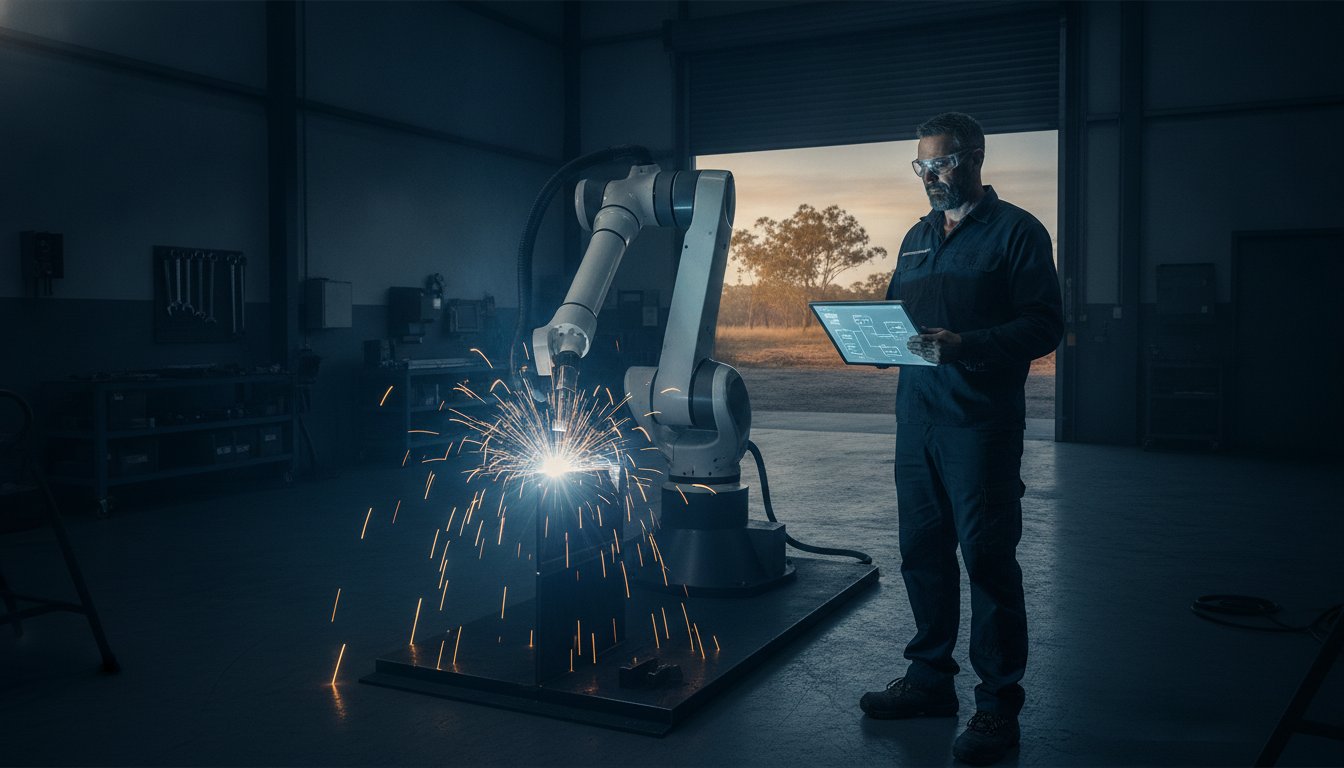
If your welding bay is sitting empty because you can't find a reliable apprentice, or your best senior fabricator is spending half their week on repetitive 20-unit runs, you're likely feeling the squeeze of the current Australian labour market. It's a common frustration for many business owners. You know that scaling up requires flexible welding automation for job shops, but the fear of investing in a complex robot that sits idle because it's too hard to program is a very real barrier for most local fabricators.
The good news is that 2026 has brought a practical shift in how we approach workshop technology. This guide will show you how no-code collaborative robots are turning small-batch welding into a high-margin powerhouse without needing a dedicated computer programmer on the payroll. These tools are designed to work alongside your team, not replace the years of experience your senior welders bring to the floor.
We'll look at how these systems reduce the physical strain on your staff and ensure consistent weld quality across every shift. You'll learn how to increase throughput for those 10 to 50 unit batches and finally get the most out of your workshop, regardless of the skills shortage. By the end of this article, you'll understand how to make automation a reliable partner in your shop's growth.
Key Takeaways
- Understand why traditional industrial robots often fail in high-mix environments and how collaborative technology is specifically designed for small-batch flexibility.
- Discover how no-code teaching software allows your existing welders to program new parts in minutes by simply leading the robot arm by hand.
- Learn how flexible welding automation for job shops can be integrated into your current floor plan without the need for bulky safety fencing or expensive infrastructure changes.
- Identify which parts in your workshop are the "low-hanging fruit" for automation by assessing upstream repeatability and part consistency.
- Explore a practical roadmap for a stress-free implementation, from on-site mobile demos to customising a turnkey cell for your specific power source.
The Job Shop Dilemma: Why Traditional Welding Robots Often Fail Small Runs
Most Australian workshops are built on the backbone of versatility. You might be welding stainless brackets in the morning and heavy structural beams by the afternoon. This "High Mix, Low Volume" (HMLV) environment is where traditional Robot welding systems often struggle to earn their keep. While these machines are impressive in a high-volume car factory, they often become a "white elephant" in a local job shop because they weren't designed for the constant changeovers we deal with every day. If a piece of equipment is too difficult to set up, it inevitably ends up tucked in a corner gathering dust.
The 2026 manufacturing market has reached a tipping point. With rising costs and tighter deadlines, the risk of buying expensive technology that sits idle is a genuine concern for business owners. The goal is to find flexible welding automation for job shops that actually fits the workflow of a busy floor, rather than forcing the shop to change how it operates just to suit the machine.
The Problem with Traditional Robot Programming
The real killer for small runs isn't the speed of the arm; it's the downtime between jobs. Traditional industrial robots require complex G-code or cumbersome teach pendants that usually demand a specialist programmer. If it takes four hours to set up a job that only takes two hours to weld, the math simply doesn't work for a 20-unit batch. Small shops can't afford to have expensive tech sitting idle, nor can they easily compete for the handful of robotics engineers available in the market. This is why flexible welding automation for job shops has shifted away from rigid code and toward intuitive, hand-taught systems that any welder can master in a few hours.
Labour Shortages in the Australian Fabrication Sector
We're also facing a chronic shortage of skilled boilermakers and apprentices across Australia. Many senior welders are nearing retirement, and the younger generation is often deterred by the "dull, dirty, and dangerous" reputation of traditional fabrication. This labour gap makes it harder to maintain consistent quality when the pressure is on. Using technology to handle the repetitive, soul-destroying runs allows your best people to focus on complex, high-value tasks. It turns the robot into a power tool that augments human skill rather than trying to replace it. This approach makes the workshop a more attractive place for the next generation of tradespeople who expect to work with modern, efficient tools.
What is a No-Code Welding Robot? Automation for the Everyday Welder
For decades, the term "robotic welding" meant a room full of computers and a team of specialists writing thousands of lines of complex code. For a local workshop, that simply isn't practical. No-code welding is a system where the operator sets the path without typing a single line of syntax. It changes the entire dynamic of the workshop floor, moving the responsibility from a computer programmer back to the person who actually knows how to weld. This technology acts as the great equaliser for Australian SMEs, allowing smaller shops to produce the same consistent quality as massive Tier 1 manufacturers without the overhead of a dedicated IT department.
By removing the technical barriers, flexible welding automation for job shops becomes a reality rather than a futuristic concept. Instead of staring at a screen, your team can spend their time refining the weld parameters and ensuring the penetration is perfect. It's about using technology to support human craft, not replace it. If you're curious about how this looks in practice, you can book a mobile demo to see the software in action on your own floor.
How No-Code Teaching Software Works
The core of this system is "lead-through" teaching. To program a new part, a welder physically moves the robot arm along the desired joint, pressing a button to save waypoints as they go. The software then joins these dots to create a smooth, repeatable path. There's no need to calculate coordinates or understand G-code. Once the path is set, the operator uses a simple tablet interface to adjust essential weld parameters like volts, wire speed, and travel speed. These programmes can be saved and recalled in seconds. If a recurring batch of 20 brackets comes back next month, the setup time is virtually zero, making it profitable to automate even the smallest runs.
The Operator-Centric Design
This approach treats the robot as a sophisticated power tool, much like a CNC mill or a high-end pulse welder. The goal is to reduce the cognitive load on your staff. Instead of worrying about syntax errors, they can focus on what they do best: achieving high-quality welds. This shift is so significant that industry bodies are now recognising the need for formal training, such as the Welding Automation Specialist Apprenticeship, to help the workforce transition. By using intuitive no-code robot welding software, you empower your existing tradespeople to become automation leaders. They maintain control over the process, ensuring that the machine follows the correct technique for the specific material and joint type at hand.
Cobots vs. Industrial Robots: Which is Right for Your Workshop?
Choosing between a traditional industrial robot and a collaborative robot (cobot) usually comes down to your production volume. If you're running the same part 24 hours a day for years, a high-speed industrial robot is a solid choice. However, for most Aussie fabricators, the priority is flexible welding automation for job shops. You need a system that can handle a pallet of brackets today and a custom frame tomorrow without requiring a week of downtime for reprogramming. Industrial robots are fast, but they are rigid. Cobots are designed for the reality of a changing workload.
Industrial robots are also blind to their surroundings. Because they can't detect a human in their path, they must be housed behind heavy steel fencing or light curtains. This creates a permanent "dead zone" on your floor that can't be used for anything else. In contrast, Collaborative robotic welding systems use advanced sensors to work safely alongside your team. This allows you to maintain a natural flow in the workshop while still meeting strict Australian safety standards.
Safety and the Australian Workshop Floor
The main advantage of a cobot is the removal of the cage. These machines are built with internal force-sensing technology. If the arm touches an object or a person, it stops instantly. This means you can integrate automation into an existing welding bay without walling off a massive section of your shop. It meets AS/NZS safety requirements while keeping the operator close enough to monitor the weld pool or swap out parts. It's a pragmatic solution for shops where space is at a premium and workers need to move freely around the equipment.
Space Constraints and Portability
Many Australian job shops can't afford to lose 20 square metres to a fenced-off robot. Space is money. This is where collaborative robot welding cells offer a distinct edge. These cells are often compact enough to fit into a standard welding bay. Some models are even mounted on heavy-duty casters or designed to be moved with a pallet jack. If your production needs change, you can simply move the robot to a different station. This level of portability ensures your investment stays active, even if you rearrange your floor layout to accommodate a new contract. You don't need a total floor redesign; you just need a power point and a flat surface.
Assessing Shop Readiness: Is Your Business Ready to Automate?
Before you sign a purchase order, you need to be sure your workshop is actually prepared for the change. It starts with an honest evaluation of your part mix. The "low-hanging fruit" for flexible welding automation for job shops usually consists of parts with straight runs or simple circular welds that come in batches of 10 to 50 units. If your work is entirely bespoke, one-off structural repairs, automation might not be the right fit just yet. However, if you have recurring jobs that tie up your best welders on repetitive tasks, you're a prime candidate for a cobot.
Another critical factor is the "Repeatability Test." A robot is only as good as the parts you give it. If your upstream processes, like laser cutting or folding, have high variance, the robot will struggle to find the joint consistently. Accurate fit-up is essential. Ensuring your parts are within a tight tolerance before they reach the welding bay is the first step toward successful automation. If your parts are jumping around by 2mm or 3mm every time, you'll need to refine your jigging or your cutting accuracy first.
Don't forget the human element. Introducing a robot can cause "replacement anxiety" among your team. It's vital to frame the technology as a tool that handles the monotonous, back-breaking work, allowing your skilled tradespeople to focus on more complex, high-value tasks. When staff see the robot as a partner that reduces their physical strain, adoption is much smoother. It's about augmenting their skill, not replacing their years of experience.
The ROI of Consistency and Rework Reduction
Calculating your return on investment involves more than just measuring metres of weld per hour. You have to account for the massive reduction in rework and scrap. By improving welding productivity with cobots, you also optimise gas and consumable usage. The robot follows the exact same path with the same parameters every time, which eliminates the waste associated with over-welding or human error. For simple, repetitive components, there is even "lights-out" potential, where the robot continues to work while the team is on a break or focused on other production tasks. This consistency directly impacts your bottom line by making your margins more predictable.
The Importance of a Proof of Concept
You shouldn't have to guess if a system will work for your specific parts. Brochures and polished videos can only tell you so much about the reality of a busy workshop. The most reliable way to de-risk your investment is through a mobile welding robot demonstration. This allows you to see the no-code software in action on your own floor, using your own jigs and parts. It's the ultimate reality check. If the system can't handle your specific 20-unit run during the demo, you'll know before you spend a cent. This hands-on approach ensures that the flexible welding automation for job shops you choose is truly fit for purpose.
If you are ready to see how these systems handle your specific workshop challenges, you can request an on-site workshop assessment to get started.
Implementing Your First Welding Robot with TME Systems Pty Ltd
The path to adopting flexible welding automation for job shops doesn't have to be a leap into the unknown. TME Systems Pty Ltd provides a pragmatic, "no-stress" integration plan that takes you from the initial floor assessment right through to your first automated weld. This process isn't about dropping off a crate and leaving you to figure it out. It's about customising the collaborative cell to work with the MIG or TIG power sources you already own and trust. By integrating with your existing gear, we ensure the transition feels like a natural upgrade to your current capability rather than a total replacement of your established methods.
Turnkey Solutions vs. Bespoke Integration
For many Aussie workshops, a pre-configured turnkey cell is the fastest way to get sparks flying. These units are designed for rapid deployment and can be operational in a matter of days. However, if your workshop has a unique layout or specific material handling requirements, working with welding system integration specialists ensures the hardware and software are perfectly synced for your specific conditions. This level of tailoring is what makes flexible welding automation for job shops so effective; the technology adapts to your workflow, not the other way around.
The success of any new tool depends on the people using it. That’s why on-site cobot welder training is a core part of the implementation process. TME Systems Pty Ltd doesn't just teach your team which buttons to press. We show them how to translate their welding expertise into the digital path, ensuring they feel confident and in control from day one. Having a local Australian partner also means you have ongoing support when you need it. This is vital for maintaining uptime and resolving technical queries without waiting for an overseas time zone to wake up.
Building a Long-Term Automation Strategy
Implementing your first robot is often just the beginning of a broader shift in how your shop operates. As your team grows more confident, they'll start to identify new ways to use the robot, moving senior staff into the role of "Process Managers" while the machine handles the repetitive execution. You don't need to automate the whole shop at once. Starting with a single cell allows you to refine your processes and see the immediate impact on your 10 to 50 unit batches.
The future of Australian fabrication relies on this blend of human craftsmanship and smart execution. If you're ready to take that first step, a site visit or a mobile demonstration is the best way to see the potential for yourself. It’s a chance to ask the hard questions on your own turf and see exactly how a cobot can turn your small-batch welding into a high-margin powerhouse.
Future-Proofing Your Workshop with Practical Automation
The shift toward flexible welding automation for job shops is no longer a luxury reserved for large-scale manufacturers. By embracing no-code technology, you can turn those repetitive 10 to 50 unit runs into high-margin work while freeing up your best tradespeople for complex fabrication. We've seen how collaborative robots solve the space and safety constraints of the typical Aussie workshop, providing a tool that works alongside your team rather than replacing them.
Success comes down to choosing a partner that understands the local landscape. TME Systems Pty Ltd provides proven results across the Australian metal fabrication sector, backed by local technical support and operator training. Our no-code software is built specifically for tradespeople, not computer programmers, ensuring your investment never sits idle. If you're ready to see how this technology handles your actual parts, it's time to take the next step.
Book a Mobile Welding Robot Demonstration for Your Workshop to see the system in action on your own floor. It's the most practical way to de-risk your transition and ensure your shop remains competitive in a changing market. Let's get your workshop moving toward a more efficient, productive future.
Frequently Asked Questions
Do I need a computer programmer to run a welding robot in my job shop?
No, you don't need a specialist programmer or IT expert on staff. Modern collaborative systems use no-code software that allows your existing welders to teach the robot by simply leading the arm by hand along the weld path. If your team can weld a joint, they can show the robot how to do it. It's designed to be a tool for tradespeople, not coders.
Can a welding robot handle small batches of 10 or 20 parts profitably?
Yes, small-batch runs are now highly viable thanks to flexible welding automation for job shops. Because the setup and programming time for a new part has been reduced from hours to just a few minutes, you can profitably automate runs as small as 10 to 20 units. This flexibility allows you to swap between different jobs throughout the day without significant downtime.
Will a welding cobot work with my existing MIG or TIG welder?
In most cases, yes. These systems are designed to be brand-agnostic and can be integrated with the professional MIG or TIG power sources you already have on your floor. This approach allows you to keep using the weld settings and consumables your team is already comfortable with, which helps keep the initial transition costs much lower for your business.
How long does it take for a welder to learn the no-code software?
Most welders can pick up the basics of no-code teaching in just a few hours. Because the interface is tablet-based and uses intuitive icons rather than complex syntax, the learning curve is very shallow. After a single day of on-site training, your operators will typically be confident enough to set up new parts and manage production runs independently.
Is it safe to have a welding robot working right next to my staff?
Collaborative robots are specifically designed to work safely alongside humans without the need for bulky safety cages. They feature advanced sensors that detect any physical contact and stop the arm instantly to prevent injury. While you still need to manage standard welding risks like flash and fumes, the robot itself meets strict Australian safety standards for collaborative operation.
What happens if my parts are not perfectly consistent for the robot?
Robots thrive on repeatability, so if your parts vary significantly, you'll likely see issues with weld quality. Successful flexible welding automation for job shops relies on accurate upstream processes like laser cutting and folding. If your part fit-up is inconsistent, you may need to refine your jigging or adjust your cutting tolerances to ensure the robot can find the joint every time.
How much floor space does a collaborative welding cell actually need?
A typical collaborative welding cell fits within the footprint of a standard welding bay, usually around 2.4 by 2.4 metres. Because you don't need to install large safety fences or light curtains, you don't lose valuable floor space to "dead zones." This compact design makes it easy to integrate automation into your existing shop layout without a major reshuffle.
What is the typical return on investment (ROI) for a job shop welding robot?
Most well-specified robotic welding installations achieve a full payback within 12 to 24 months. This ROI is driven by a combination of increased throughput, reduced rework, and lower consumable waste. By allowing the robot to handle the repetitive runs, your senior welders can focus on higher-value custom work, which significantly improves the overall profitability of your workshop.