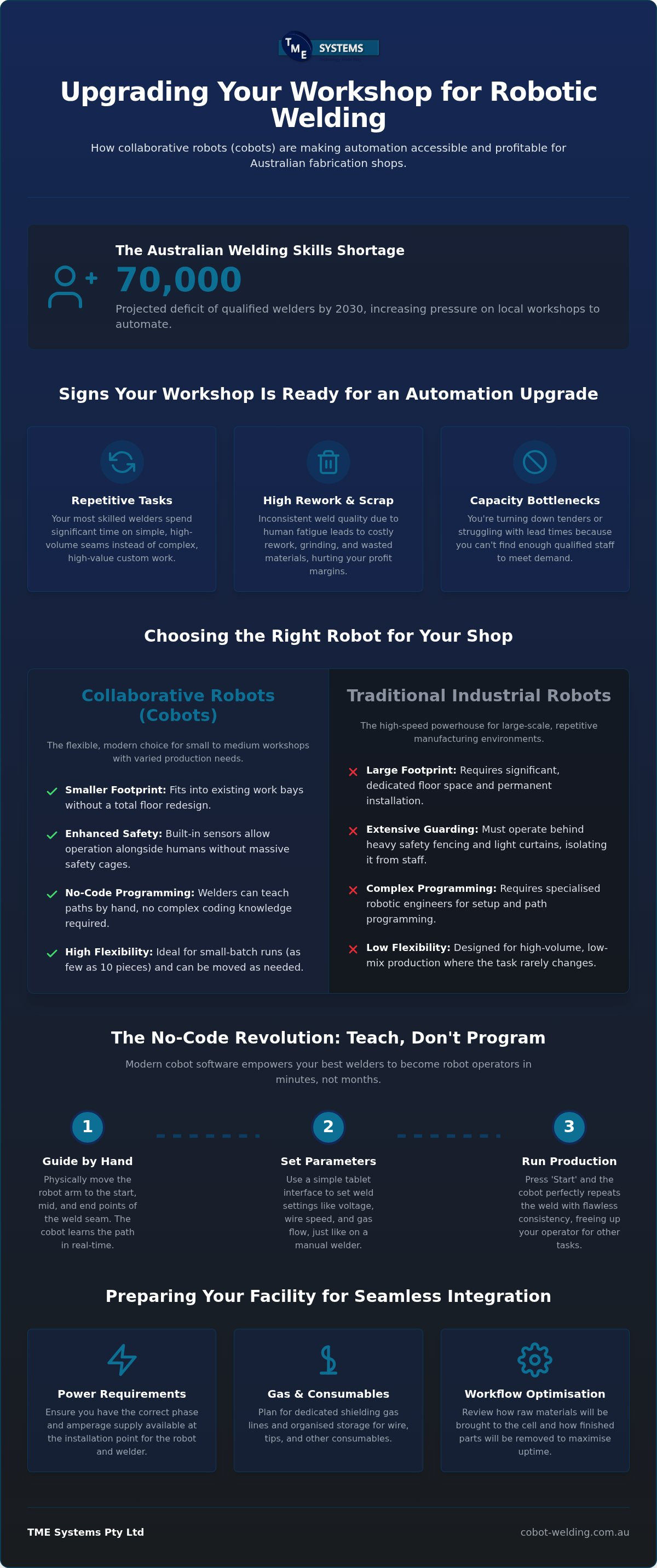

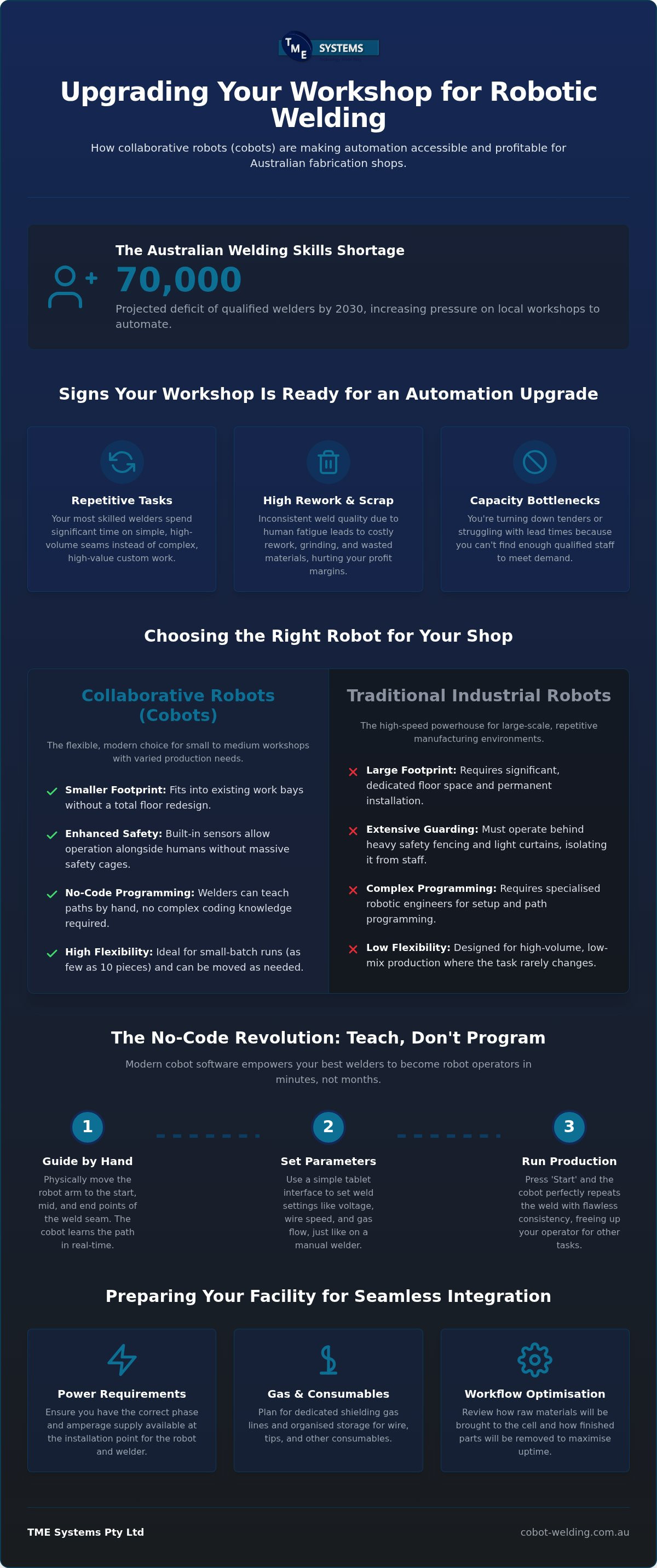
With Australia projected to face a deficit of 70,000 welders by 2030, the pressure on local fabrication shops has never been higher. You've likely felt the strain of trying to find reliable staff while keeping up with demanding production schedules. Planning a robotic welding workshop upgrade used to feel like a move reserved only for massive industrial plants, but the arrival of collaborative robots, or cobots, has changed the game for smaller teams. It's no longer about replacing your people; it's about giving your skilled tradespeople better tools to handle repetitive tasks.
You know that consistent weld quality and reduced rework are the keys to a profitable floor, yet the fear of complex coding often stalls progress. This guide shows you how to transition your workshop to automated welding using no-code software that lets your best welders lead the way. We'll explore how these systems boost your daily throughput, help you meet the strict new 2026 safety standards, and create a future-proof environment that attracts the next generation of tech-savvy tradespeople. From mobile demos to full operator onboarding, here is how you can modernise your production without the technical headache.
Key Takeaways
- Identify the tipping point for automation by tracking how much time your skilled tradespeople spend on repetitive seams and high-volume rework.
- Learn why collaborative cells are often the best fit for local workshops, offering a smaller footprint and easier safety integration than traditional industrial robots.
- Discover how a robotic welding workshop upgrade no longer requires complex programming thanks to no-code software that lets you set paths by hand.
- Prepare your facility for a seamless transition by understanding the specific power, gas, and workflow requirements needed for automated welding integration.
- Ensure long-term success by focusing on operator onboarding and specialised training that empowers your current team to master new technology.
Signs Your Workshop Is Ready for a Robotic Welding Upgrade
If your most experienced fabricators are spending half their shift running the same three-inch fillet weld on a hundred identical brackets, you're losing money. It's a waste of their talent and your workshop's potential. A robotic welding workshop upgrade isn't about replacing these people; it's about freeing them up for the complex, high-value custom work that requires a human touch. When your best welders are stuck on the "grunt work" of repetitive seams, you aren't just paying for their time, you're paying for the opportunity cost of the specialised jobs they could be finishing instead.
Look at your scrap bins. If they're frequently full or if your team spends hours every afternoon grinding back inconsistent beads, your margins are taking a hit. Human fatigue is a reality, especially on repetitive tasks where focus naturally slips. For those looking for a comprehensive overview of robot welding, it's clear the technology has evolved from rigid car-factory setups into flexible tools for any floor. If you're knocking back tenders because you can't find qualified staff in the current Australian market, the bottleneck is your capacity, not your sales.
The Cost of Sticking to Manual-Only Processes
Manual welding involves hidden variables that eat into your bottom line. Heat distortion, gas coverage issues, and simple tiredness lead to rework that shouldn't happen. In 2026, with stricter safety codes and a projected national deficit of 70,000 welders by 2030, sticking solely to manual processes is a significant business risk. Relying on "the way we've always done it" often leads to stagnant lead times. Your competitors are likely already looking at how to stabilise their output, and manual-only shops risk being left behind as labour costs continue to climb and availability drops.
Assessing Your Current Batch Variety and Volume
You don't need to be running thousands of parts to justify a robotic welding workshop upgrade. Modern technology makes automation viable for runs as small as ten pieces. Start by identifying your "low-hanging fruit". These are the simple, straight seams or circular welds that don't require complex manipulation. When evaluating your floor, consider that modern collaborative cells fit into much tighter spaces than traditional industrial robots. If small-batch orders are becoming too expensive to quote manually because of the setup time involved, automation can often make those jobs profitable again by providing a fixed, predictable cost per part and reducing the need for post-weld clean-up.
Cobots vs Industrial Robots: Choosing the Right Cell for Your Shop
The hardware you select defines how your floor operates for the next decade. A robotic welding workshop upgrade often comes down to a choice between the raw speed of traditional industrial robots and the flexibility of collaborative robots, or cobots. While industrial units have dominated large scale manufacturing for years, they require significant real estate and heavy safety guarding. Cobots are built for the modern, agile Australian workshop where space is at a premium and versatility is king.
Understanding the "collaborative" in collaborative robot welding cells is about more than just safety sensors. It's about a tool that works with your staff rather than behind a fence. This shift allows you to place automation into existing bays without a total floor redesign. It changes the robot from a distant machine into a direct assistant for your welding team.
The Collaborative Advantage in a Busy Workshop
Cobots eliminate the need for massive safety fencing and light curtains. They use advanced force-sensing technology to detect human contact and stop instantly, which helps your workshop meet the AS/NZS 4024:2019 machinery safety standards without building a cage. Because they don't always require permanent floor bolting and extensive guarding, these cells can often be moved between different work bays as your production needs change. This flexibility is a massive plus for shops handling a mix of small batches and custom projects. It ensures your robotic welding workshop upgrade stays useful even if your product mix changes next year.
When to Stick with Traditional Industrial Robots
There are still scenarios where traditional industrial robots are the right call. If your facility runs 24/7 high-speed production with heavy payloads, an industrial unit might offer a better total cost of ownership. These machines are built for maximum throughput at speeds cobots cannot safely match without adding the very fencing you were trying to avoid. However, the barrier to entry is higher. Programming these units often requires specialised skills that go beyond the basic national training standards for robotic welding. Most local fabricators find that the ease of use offered by cobots outweighs the raw speed of industrial alternatives. If you want to see how these systems handle real world tasks, you can view our range of integrated welding solutions to find the right fit for your payload and reach requirements.
The No-Code Revolution: Teaching Your Robot Without Jargon
The biggest hurdle for any robotic welding workshop upgrade used to be the "black box" of programming. In the past, you needed a specialised engineer to spend days writing lines of code just to move a torch an inch to the left. That era is over. Today, no-code robot welding software has turned the complex language of automation into a simple, visual interface that any experienced welder can master in a few hours. It's a tool designed for the workshop floor, not the IT department.
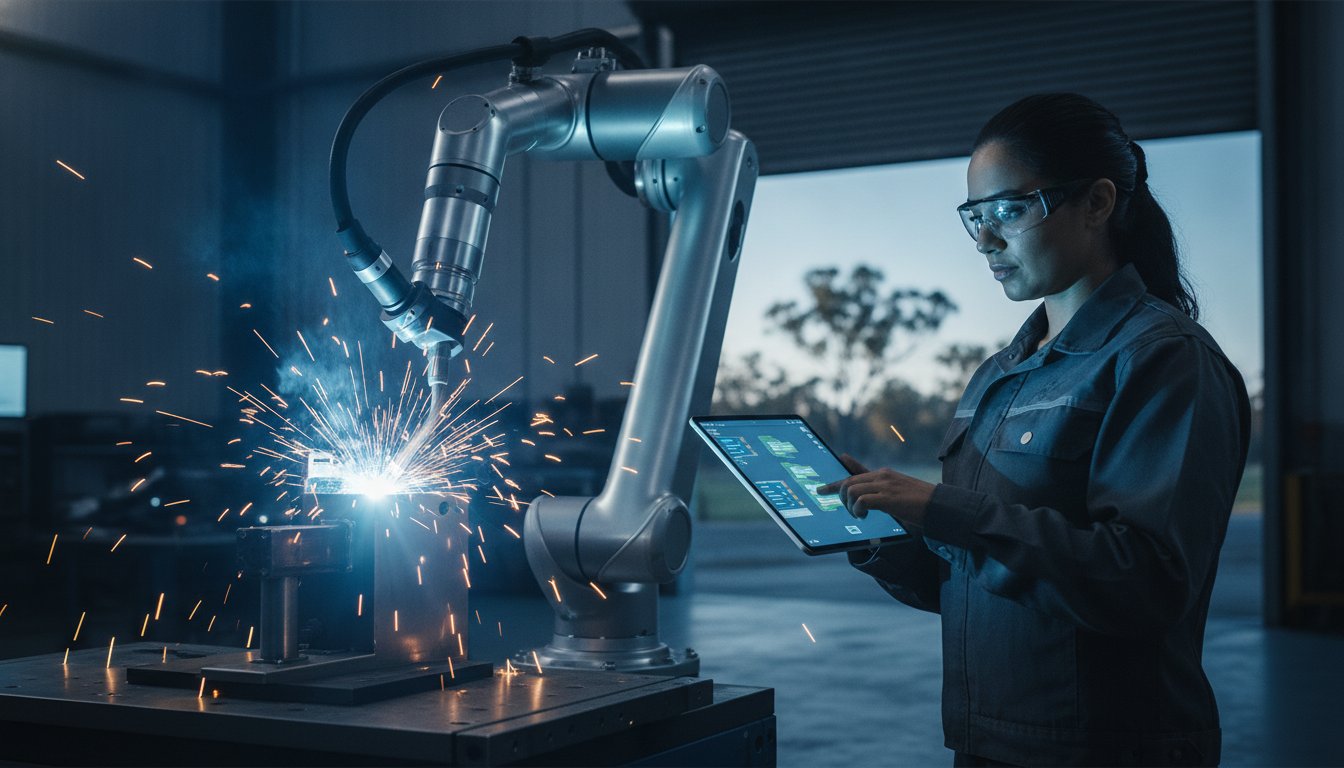
Instead of typing commands, you teach the robot by physically moving the arm. You lead the torch along the weld path, hitting a button to set "waypoints" at the start, middle, and end of the seam. The software records your movement exactly. If you need to adjust the volts, wire speed, or travel angle, you do it on a touch-screen tablet that looks more like a smartphone app than a computer terminal. It's a pragmatic approach that keeps the control in the hands of the person who actually knows how to weld.
Turning Tradesmen into Robot Operators
You don't need a university degree or a background in IT to run a modern cobot. The hand-guiding method relies on the "muscle memory" of your existing staff. If your welder knows how to maintain a consistent stick-out and travel angle, they already have the skills to program the cell. The software is smart enough to handle the technical heavy lifting, like maintaining complex weave patterns or managing multi-pass welds on thick plates. It follows the welder's lead, acting as a high-precision extension of their own hands. This empowers your team rather than making them feel replaced.
Reducing Setup Time for Small Batches
The real profit killer in traditional automation was the setup time. If a job only had ten parts, it wasn't worth the effort to program a robot. No-code changes that math. You can now swap between different parts in under five minutes by recalling saved jobs from a digital library. This makes robotic welding for small batches not just possible, but highly profitable. You can even simulate the path on the screen first to check for torch clearances, ensuring your first part is right every single time. It's about making your robotic welding workshop upgrade work for the reality of a busy Australian job shop, where variety is the daily norm.
Planning the Physical Upgrade: Integration and Workflow
A robot is only as productive as the workflow surrounding it. While the software handles the path, the physical layout of your floor determines how many parts actually move through the door each shift. Designing a successful robotic welding workshop upgrade involves more than just finding a spare corner. It requires a logical approach to material handling, utility placement, and repeatability. Working with cobot welding integration specialists helps you avoid common pitfalls, like placing the cell in a bottleneck or forgetting about the reach of your fume extraction arms.
Repeatability is the secret to automation. Unlike a human welder who can adjust for a slightly misplaced part on the fly, a robot follows its programmed path exactly. This means your jig and fixture design must be robust enough to hold every component in the same position every time. Simple, modular clamping systems are usually the best starting point for local shops. They allow you to swap between different jobs quickly while ensuring the robot hits its marks without fail.
Workshop Layout and Material Handling
Designing the cell for maximum operator efficiency keeps the robot welding while the human preps the next batch. You should position your material "in" and "out" zones to minimise unnecessary movement. It's also vital to consider fume extraction. With the new Australian Workplace Exposure Limits (WELs) for welding fumes coming into full effect on December 1, 2026, managing air quality is a legal requirement. Stricter limits of 1 mg/m³ mean your automated environment needs dedicated extraction that stays effective throughout the robot's entire range of motion. Position your welding power source where it's easy to access for wire spool changes and routine maintenance without entering the robot's workspace.
Ensuring Equipment Compatibility
You don't always need to buy a brand-new welder to automate. Many modern cobots can interface directly with your existing high-quality MIG or TIG power sources. However, you must ensure your torch and lead package are rated for robotic duty cycles. A robot doesn't need to stop for a coffee or a stretch, so your equipment will likely run hotter for longer periods than it would during manual use. Integration specialists play a key role here, providing the "plug-and-play" cables and digital interfaces that allow the robot to control your welder's parameters. To get your floor ready for a seamless transition, you can contact our integration specialists to discuss your current equipment and utility requirements.
Onboarding Your Team for a Successful Transition
A robotic welding workshop upgrade succeeds or fails based on how your team accepts the new technology. If staff feel threatened or overwhelmed, they won't use the tool to its full potential. You need to frame the robot as a high-precision assistant that takes over the dull, repetitive tasks. This shift allows your skilled welders to focus on custom fabrication and complex assemblies where their expertise really shines. It's about augmenting their talent, not replacing their hands.
Investing in on-site cobot welder training is the most effective way to build this confidence. We recommend identifying "Cobot Champions" within your existing team. These are often your most curious or tech-savvy tradespeople who can lead the transition and support their peers. Having a local Australian partner for ongoing support is critical for maintaining uptime. You need a partner who understands the local industry and can provide help when you're refining a new process or troubleshooting a specific part.
The First 30 Days: From Setup to Production
Setting realistic productivity goals for the initial rollout prevents frustration. Don't expect peak throughput on day one. Expect some teething issues while you refine your jigs and paths. Use this time to encourage your team to experiment with the no-code interface. When the team finishes that first "perfect" automated run without needing manual rework, celebrate it. This win proves the technology works and builds the momentum needed for long-term success on the workshop floor.
Upskilling Your Workforce for 2027 and Beyond
Upskilling your workforce makes your business more resilient and your employees more valuable. As we move into 2027, having staff who can operate and "teach" robots will be a significant competitive advantage. It builds a culture of continuous improvement where automation is seen as a career opportunity rather than a threat. To get the whole team involved early, consider booking a mobile welding robot demonstration. This allows your welders to see the system in action on your own floor and provides a practical proof-of-concept before you commit to the full upgrade.
Securing Your Workshop’s Future
The move to automated welding is a pragmatic response to the labour shortages and strict safety standards defining 2026. By investing in a robotic welding workshop upgrade focused on collaborative technology, you provide your team with high-precision tools that eliminate the "grunt work" without requiring a background in IT. You've seen how no-code software and flexible cell layouts can turn repetitive seams into consistent, high-quality results that protect your profit margins.
Real success depends on choosing a partner that understands the Australian fabrication reality. Local technical support and hands-on operator training ensure your system remains an asset rather than a headache. It's about empowering your skilled staff to do more with their expertise while future-proofing your business against industry shifts. The technology is now accessible, reliable, and ready to work alongside your best people.
Book a Mobile Welding Robot Demonstration for your workshop today to see our no-code software in action on your own parts. It is the easiest way to prove the concept on your floor and get your team involved in the transition from the start.
Frequently Asked Questions
How much space does a robotic welding cell actually need in a workshop?
A standard collaborative cell usually occupies a footprint similar to a traditional manual welding station, approximately 2 metres by 2 metres. Unlike industrial robots that require extensive safety cages and light curtains, a cobot's compact design allows it to sit within your existing floor layout. This makes a robotic welding workshop upgrade feasible even in smaller job shops where floor space is at a premium. You can often integrate these units into current work bays without moving heavy machinery.
Can I use my existing MIG welder with a new cobot system?
Yes, you can often interface a cobot with your current high-quality MIG or TIG power source. Integration specialists use digital interfaces and specific cable packages to allow the robot to control your welder’s parameters. It's important to ensure your existing torch is rated for the higher duty cycles of automation. If your power source is modern and supports digital communication, it can usually be adapted for a seamless "plug-and-play" setup on your floor.
Is robotic welding really profitable for small batches of 10-20 items?
Automation is highly profitable for batches as small as 10 to 20 items due to the rapid setup times of no-code software. In the past, programming took hours, making small runs expensive. Today, you can swap between different parts in under five minutes. This predictability in weld time and the total elimination of rework on repetitive parts ensure that even short production runs deliver a strong return on your investment.
What kind of maintenance does a welding cobot require compared to manual gear?
A welding cobot requires similar daily maintenance to your manual gear, such as cleaning the torch nozzle and checking the wire liner. The robot arm itself is a sealed unit designed for industrial environments, requiring very little mechanical upkeep beyond periodic inspections. You'll need to keep the software updated and ensure the safety sensors are clear of heavy dust or debris. Most workshops find the overall maintenance schedule is no more demanding than their standard equipment.
How long does it take to train an experienced welder to use no-code software?
Most experienced welders can learn the basics of no-code software in just a few hours. Because the "programming" involves physically leading the robot arm through the weld path, it relies on their existing trade knowledge rather than computer skills. By the end of a single day of on-site training, an operator is typically comfortable setting waypoints, adjusting weld parameters on the touch-screen, and saving new jobs into the digital library for future recall.
Do I need a specialised safety officer to oversee the robotic upgrade?
You don't usually need a full-time safety officer, but you must comply with the AS/NZS 4024:2019 machinery safety standards. Every robotic welding workshop upgrade should include a thorough risk assessment of the specific application. While cobots are designed to be collaborative, the welding process itself still involves hazards like heat, light, and fumes. Your integration partner can help you document these safety protocols to ensure your workshop remains compliant with Australian workplace health and safety laws.
What happens if the robot hits something or someone during operation?
If a cobot detects an unexpected obstruction or contact with a person, its internal force sensors trigger an immediate emergency stop. These safety systems are designed to limit the force of any impact to well below the thresholds required by Australian safety standards. Once the obstruction is cleared, the operator can simply reset the system and resume the weld. This allows the robot to work safely alongside your team without the need for physical barriers.
Is there government support or grants for Australian workshops upgrading to automation?
Government support is frequently available through various federal and state-based manufacturing modernisation funds. Programs like the R&D Tax Incentive or specific industry growth grants often support businesses investing in automation to solve labour shortages. Because grant cycles change regularly, it's best to check current listings on the official business.gov.au portal or consult with your local state manufacturing department to see which incentives apply to your specific upgrade project.