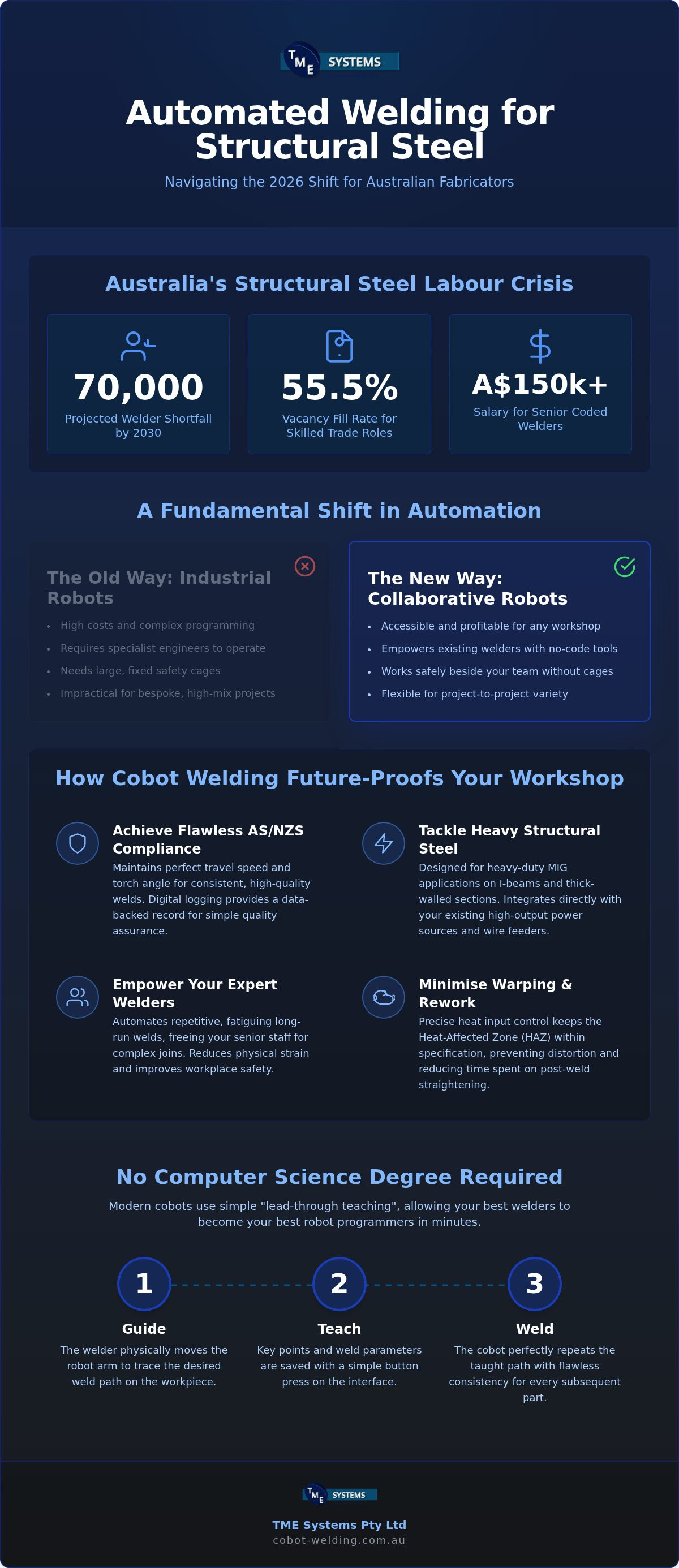

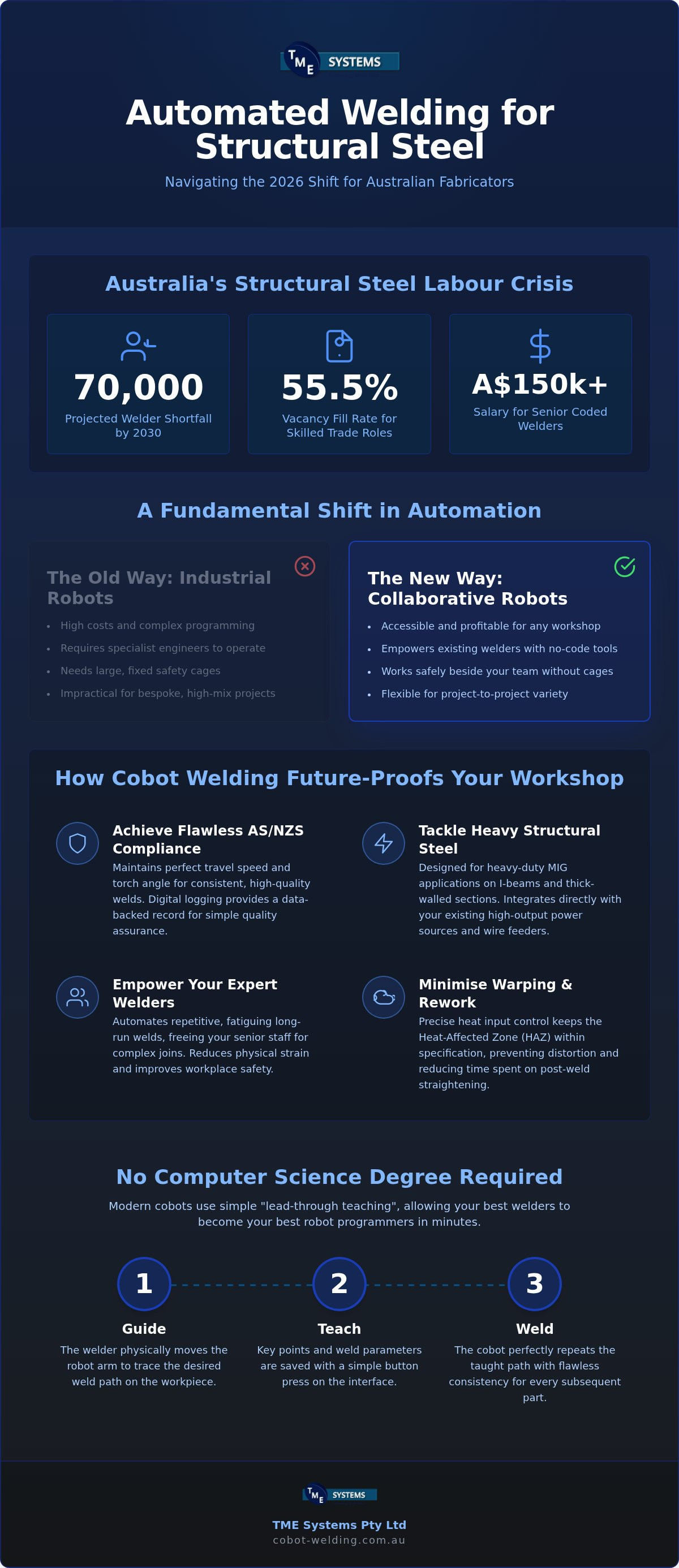
Did you know Australia is projected to face a deficit of at least 70,000 welders by 2030? With the vacancy fill rate for trade roles sitting at just 55.5% in 2026, the pressure on your workshop floor has never been higher. You're likely feeling the squeeze of trying to maintain AS/NZS standards on long runs while your best staff are stretched thin. This is exactly why automated welding for structural steel is no longer a luxury for the big players; it's becoming a vital tool for local fabricators to stay competitive.
It's understandable if you've avoided traditional robotics because of the high costs and complex programming requirements. You need a solution that works with your current team, not one that requires hiring a specialist software engineer. This guide will show you how modern collaborative robots and no-code software make automation accessible and profitable for Australian workshops. We'll look at the 2026 welding fume regulations, available government grants like the National Reconstruction Fund, and how to increase your capacity without the headache of traditional robotic setups.
Key Takeaways
- Understand how to address the 2026 welder shortage and new fume exposure limits by empowering your current staff with collaborative technology.
- See why automated welding for structural steel is now a practical choice for heavy-duty MIG applications on I-beams and thick-walled sections.
- Learn how no-code software and lead-through teaching allow your experienced welders to program complex paths without needing a computer science degree.
- Identify the essential floor space, power, and gas requirements for a seamless transition to a robotic welding setup in your workshop.
- Discover the fastest way to achieve a return on investment through turnkey cells and on-site mobile demonstrations tailored to your specific projects.
Why Structural Steel Fabricators are Shifting to Automation in 2026
The concept of automated welding is often associated with high-volume automotive lines where the same part is made a thousand times. However, for an Australian fabricator in 2026, the reality is quite different. Modern automated welding for structural steel now focuses on flexibility. It's about handling bespoke I-beams, base plates, and complex trusses that vary from one project to the next.
Traditional industrial robots often fail in this environment. They require expensive safety cages and specialised programmers who don't understand the realities of a workshop floor. This is why collaborative robots, or cobots, have emerged as a pragmatic tool. They work alongside your existing team, taking over the repetitive, long-run welds that drain your staff's energy and focus.
The Structural Steel Labour Crisis
The numbers are stark. Australia is projected to face a shortfall of at least 70,000 welders by 2030. In 2026, we're already seeing trade vacancy fill rates at just 55.5%. With experienced structural welders now commanding salaries between A$95,000 and A$115,000, and senior coded welders often exceeding A$150,000, the cost of manual labour is rising alongside the difficulty of finding it.
Automation isn't about replacing your people; it's about keeping your workshop productive. By letting a machine handle standard fillet welds on long beams, your senior welders can focus on the complex joins that require true human craftsmanship. This shift also reduces the physical toll on your staff. It cuts down on the repetitive strain and awkward positioning that lead to long-term injuries and fatigue.
Consistency and Compliance with AS/NZS Standards
Meeting AS/NZS standards is non-negotiable in structural fabrication. Manual welding on a 12-metre beam often leads to slight inconsistencies as an operator fatigues. A collaborative robot maintains the exact travel speed, wire feed, and torch angle from the first centimetre to the last. This level of precision ensures consistent penetration and bead quality that easily meets strict Australian building codes.
Modern automated welding for structural steel systems also include digital logging of weld parameters. Instead of relying on manual checklists, you get a data-backed record of every weld for your quality assurance files. This makes compliance straightforward and provides your clients with the confidence that every structural connection is built to last.
How Collaborative Robots Tackle Heavy Structural Steel Challenges
If you've looked at automation before, you might've assumed it was only for light-gauge sheet metal work. Structural steel is a different beast entirely; it involves thick-walled sections, heavy MIG setups, and high duty cycles. Modern automated welding for structural steel has evolved to meet these demands by integrating directly with the high-output power sources and wire feeders you already use on the shop floor. You don't need to scrap your existing equipment to make the leap to automation.
Managing heat input is one of the biggest headaches when dealing with large assemblies. Manual welding often leads to inconsistent heat distribution, which causes warping and distortion in long beams. A collaborative robot maintains a precise travel speed and consistent arc length, which helps keep the heat-affected zone (HAZ) within specification. It's a reliable way to ensure your I-beams and columns stay straight, reducing the time your team spends on post-weld straightening and correction.
Welding Beams, Plates, and Cleats
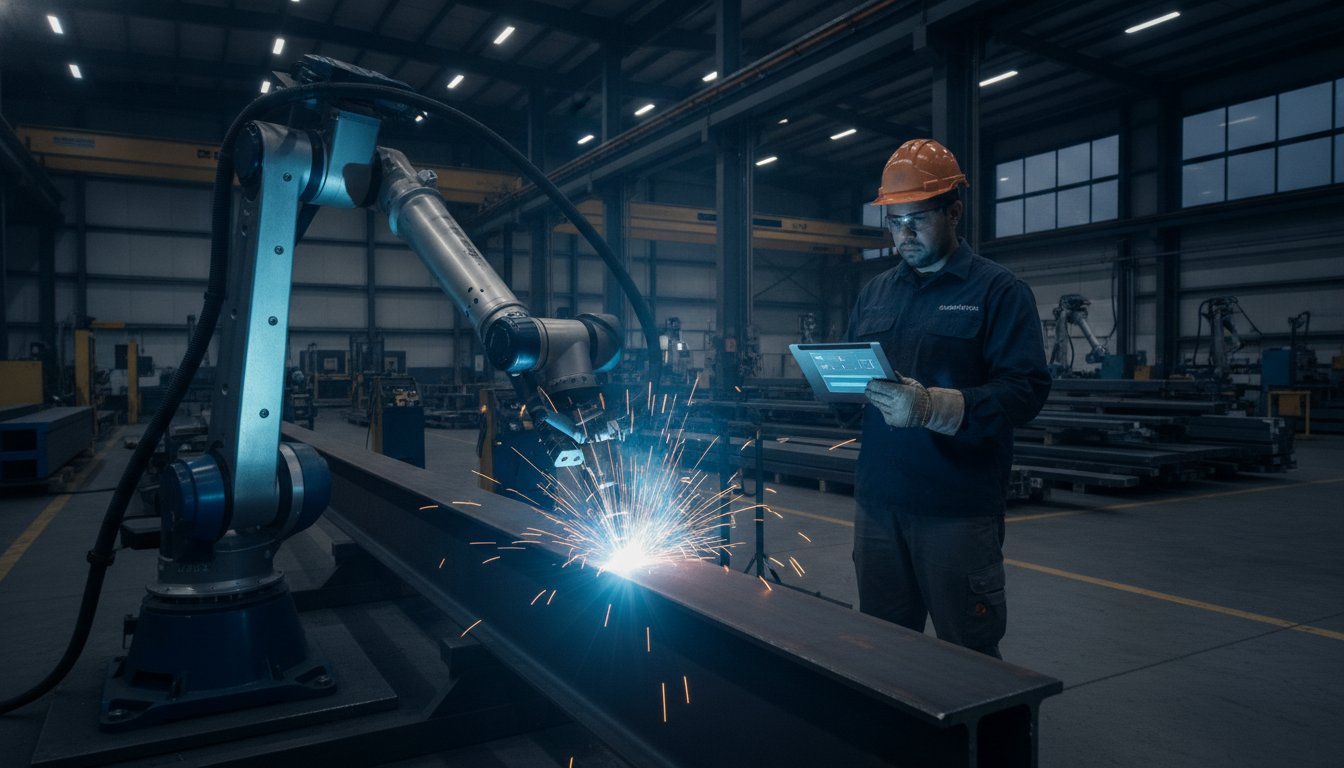
Most structural projects involve hundreds of repetitive fillet welds on base plates, stiffeners, and cleats. These are often the most tedious parts of a build, but they're critical for structural integrity. A cobot can be programmed to handle these standard components with high repeatability. It navigates the geometry of a structural section with ease, adjusting for slight variations in fit-up. This frees your team to focus on tacking the next assembly or handling complex multi-pass butt welds.
- Optimise cycle times for repetitive base plate attachments.
- Ensure consistent throat thickness on every fillet weld.
- Reduce the need for rework caused by human fatigue on long shifts.
Mobile and Flexible Workshop Layouts
One of the main reasons Aussie fabricators are choosing collaborative welding cells over traditional industrial robots is the footprint. You don't need to sacrifice 20 square metres of floor space for a permanent safety cage. Because cobots are designed to work safely near people, you can often integrate them into your existing workflow without major renovations. This is a game-changer for smaller workshops where floor space is at a premium.
For oversized members like 18-metre bridge girders, you can even move the robot to the work. Mobile bases allow the unit to be rolled along the length of a beam, providing the reach of a much larger system without the massive price tag. It’s a practical way to scale up your capacity and handle larger contracts without moving to a bigger facility.
No-Code Teaching: Simplifying Complex Structural Welds
Many workshop owners worry that automated welding for structural steel requires a dedicated IT department. In the past, industrial robots were "black boxes" that needed complex code to move even a few millimetres. By 2026, no-code software has flipped this model on its head. Now, the person who knows the weld best-your experienced boilermaker-is the one who teaches the machine exactly how to perform.
This shift to lead-through teaching means you can switch from welding I-beam stiffeners to complex roof trusses in minutes. Instead of typing coordinates into a terminal, your staff physically guide the robot arm along the desired path. It's a hands-on process that respects the craft of welding while removing the repetitive strain of the job. Your senior staff don't just watch a machine; they become robot supervisors who oversee the quality and output of multiple cells.
How to Teach a Weld Path Without Coding
The process is designed to be as straightforward as tacking a joint. It generally follows three simple steps that any competent welder can master in a single afternoon:
- Step 1: Manual Guidance. You move the robot arm by hand to the start and end points of the weld. The software records these positions instantly without any manual data entry.
- Step 2: Parameter Selection. Using a touch-screen interface, you select the voltage, wire speed, and weave patterns. Most systems include pre-loaded libraries for common Australian steel grades and thicknesses.
- Step 3: Path Simulation. Before the arc strikes, you run a dry simulation. This allows you to check for torch clearance and ensure the lead and work angles are perfect for the specific joint geometry.
Adjusting for Material Variance
In a perfect world, every structural section would be perfectly straight. In a real Australian workshop, you're dealing with mill tolerances, slight bows in long beams, and variations in fit-up. No-code software allows for real-time path adjustments to account for these realities. If a batch of beams is slightly out of spec, the operator can refine the path on the fly using intuitive touch controls.
Once a path is perfected for a recurring structural design, you can save it to a digital library. Recalling a job for a second or third production run takes seconds. This repeatability is what makes automated welding for structural steel a tactical advantage for bespoke workshops. You get the speed of a production line with the flexibility of a manual bay, all while maintaining the high standards your clients expect.
Key Considerations for Integrating Automated Welding in Your Workshop
Moving towards automated welding for structural steel is a strategic step that requires more than just a capital investment. It involves looking at your workshop through a new lens. You need to consider how a robot fits into your physical floor plan, your power infrastructure, and most importantly, your team's daily routine. Because collaborative robots don't require the massive safety footprints of traditional industrial arms, you can often place them exactly where your manual bays are currently located.
Before the equipment arrives, check your power and gas supply. High-duty cycle robotic welding demands a stable power source to maintain arc consistency. If you're planning to run the system for multiple shifts to clear a backlog of I-beams, ensure your gas manifold and wire delivery systems are up to the task. It's often the small details, like having enough space for a bulk wire drum, that make the difference between a smooth rollout and a frustrated start.
Safety and Australian Standards
Safety in 2026 is about more than just physical barriers. While cobots are designed with sensors to stop on contact, you still need to conduct a thorough risk assessment for your specific open-plan environment. A major driver for automation this year is the updated Workplace Exposure Standard for welding fumes. From 1 December 2026, the allowable limit drops from 5mg/m3 to a much stricter 1mg/m3 over an eight-hour period.
Integrating automated welding for structural steel allows you to centralise fume extraction more effectively than in a manual setup. By mounting high-vacuum extraction directly to the robot torch, you can capture hazardous substances like manganese at the source. This ensures your workshop stays compliant with the new AS/NZS ISO 21904 standards while protecting your staff from long-term health risks.
The Onboarding Process
The transition to automation is as much about culture as it is about technology. Your team might initially worry about job security, so it's vital to frame the robot as a tool that handles the "dull, dirty, and dangerous" work. Most workshops see a significant boost in morale once staff realise they no longer have to spend eight hours a day bent over repetitive fillet welds.
To ensure a successful transition, consider the following steps:
- Enrol your key staff in collaborative robot welder training to build internal confidence.
- Set realistic productivity goals for the first 90 days rather than expecting peak output on day one.
- Work with welding system integration specialists to tailor the software and hardware to your specific beam profiles.
Calculating the real ROI involves looking beyond just the hourly labour rate. Consider the savings from reduced weld defects, lower wire waste, and the ability to take on larger structural contracts that were previously out of reach. If you are ready to see how these systems fit into your specific workshop layout, you can explore our range of automated welding solutions designed for the Australian market.
Future-Proofing Your Business with Turnkey Cobot Welding Cells
The Australian fabrication industry is moving quickly. With major infrastructure projects and defense contracts on the horizon, the ability to scale your output is what will separate the leaders from the rest. Turnkey automated welding for structural steel provides the fastest route to this increased capacity. Unlike custom-engineered robotic lines that can take months to design and install, a turnkey cell is a pre-configured, proven system that can be integrated into your workshop in a fraction of the time.
Choosing a turnkey approach means you aren't reinventing the wheel. These systems are designed specifically for the heavy-duty cycles required in structural work. They come ready to handle the MIG welding of thick plates and beams right out of the box. For many local workshops, the best way to see if this technology fits their specific needs is through a mobile welding robot demonstration. This allows you to test the system on your own shop floor, using your own parts, providing a practical proof of concept before any major commitment is made.
Turnkey vs. Bespoke Integration
Bespoke robotic integration often involves a long cycle of consultancy, custom programming, and site-specific engineering that can stall your production for months. In contrast, collaborative robot welding cells are built for rapid deployment. A standard structural package typically includes the robot arm, a high-performance power source, the no-code interface, and integrated fume extraction capabilities.
This "all-in-one" model reduces the risk of compatibility issues between different components. It also simplifies your support network. When you need assistance or a software update to handle a new AS/NZS welding standard, you have a single point of contact who understands the entire system. This reliability is essential for maintaining consistent production schedules and meeting tight project deadlines across the country.
Taking the Next Step
Scaling your business doesn't have to happen all at once. Many fabricators start with a single cell to handle their most repetitive base plate or cleat work. Once the ROI is proven and the staff are comfortable, it's easy to add more units to create a fleet of automated stations. This modular growth allows you to manage your cash flow while steadily improving welding productivity with cobots.
If you're ready to evaluate how automated welding for structural steel can change your workshop's trajectory, the first step is a site assessment. A local expert can look at your current workflow, identify the bottlenecks in your manual bays, and suggest the most effective placement for a collaborative cell. By investing in this technology today, you're not just solving the labour shortage; you're building a more resilient, profitable, and safer fabrication business for the years ahead.
Take the Lead in Australian Structural Fabrication
The industry is shifting rapidly. With the 2026 fume exposure limits approaching and the welder shortage continuing to grow, waiting is no longer a viable strategy for local workshops. You've seen how modern collaborative robots handle the heavy lifting of MIG welding on I-beams while your skilled team focuses on high-value tasks. By adopting automated welding for structural steel, you're securing your capacity and ensuring your workshop meets the highest AS/NZS standards without the need for complex programming.
Our specialised structural steel configurations and no-code teaching software are designed to get you up and running in days, not months. We provide full Australian-based integration and support to ensure your transition is seamless and profitable. Ready to see the technology in action on your own shop floor? Book a Mobile Welding Robot Demonstration at Your Workshop today. It's the most practical way to prove the concept and see exactly how automation fits your workflow. The future of fabrication is collaborative; let's make sure your business is part of it.
Frequently Asked Questions
Is automated welding suitable for small-batch structural steel jobs?
Yes, it's highly effective for small-batch work because the setup time is so low. In a bespoke workshop, you aren't making the same part thousands of times. No-code software allows your team to program a new path for a unique beam in under ten minutes. This flexibility means you can automate the repetitive fillet welds on a one-off project without the programming overhead that used to make robotics impractical for smaller Australian fabricators.
Do I need a robotic engineer to operate a no-code welding cobot?
You don't need a specialised engineer or a computer programmer on staff. Modern automated welding for structural steel is designed to be operated by the people who already know how to weld. Your senior boilermakers can guide the robot arm manually to set points and select parameters from a touch-screen interface. This empowers your existing team to supervise the technology rather than being replaced by it.
How much floor space does a collaborative welding cell actually require?
A collaborative cell typically fits within the footprint of a standard manual welding bay. Because these robots are designed to work safely alongside humans, you don't need the massive safety cages and light-curtain perimeters required by traditional industrial robots. This makes them ideal for smaller Australian workshops where floor space is at a premium. You can often roll the unit into an existing bay and start production immediately.
Can cobots handle the heavy MIG welding required for structural beams?
Yes, they are purpose-built to integrate with high-output industrial power sources and wire feeders. Whether you're dealing with thick-walled sections or long runs on heavy I-beams, the robot maintains a consistent travel speed and torch angle that manual operators often struggle to hold over long shifts. This ensures deep penetration and consistent bead quality that meets strict Australian building standards for structural integrity.
What safety precautions are necessary when using a cobot without a cage?
While cobots have built-in sensors to stop on contact, you still need to perform a site-specific risk assessment. You should consider the arc flash, hot sparks, and the new 2026 fume exposure limits. Using high-vacuum extraction at the torch is essential to stay compliant with the reduced workplace exposure standards. Some shops also use area scanners or pressure mats to slow the robot when someone enters the immediate work zone.
How long does it take to train a welder to use no-code teaching software?
Most experienced welders can learn the basics of no-code teaching in a single afternoon. The software uses a visual interface that speaks the language of welding, not computer science. Once your team understands how to set the start and end points and adjust the weave patterns, they're usually independent within a few days. It's a pragmatic learning curve that respects the trade skills your staff already possess.
What is the typical ROI for a structural steel fabrication shop?
ROI varies based on your throughput, but most fabricators see a return through increased capacity and reduced rework. By automating the standard welds, you can take on larger contracts without hiring additional staff in a tight labour market. You also save on consumables through more precise wire usage. Many shops find that the system pays for itself by allowing senior staff to focus on complex, high-margin fabrication work.
Can the robot be moved between different workstations in the shop?
Yes, mobility is a major advantage of modern automated welding for structural steel systems. Many units are mounted on heavy-duty casters or integrated into mobile bases that can be moved wherever the work is. If you have an oversized project like a bridge girder, you can move the robot along the workpiece rather than trying to reposition the steel itself. This flexibility is perfect for the varied nature of structural work.