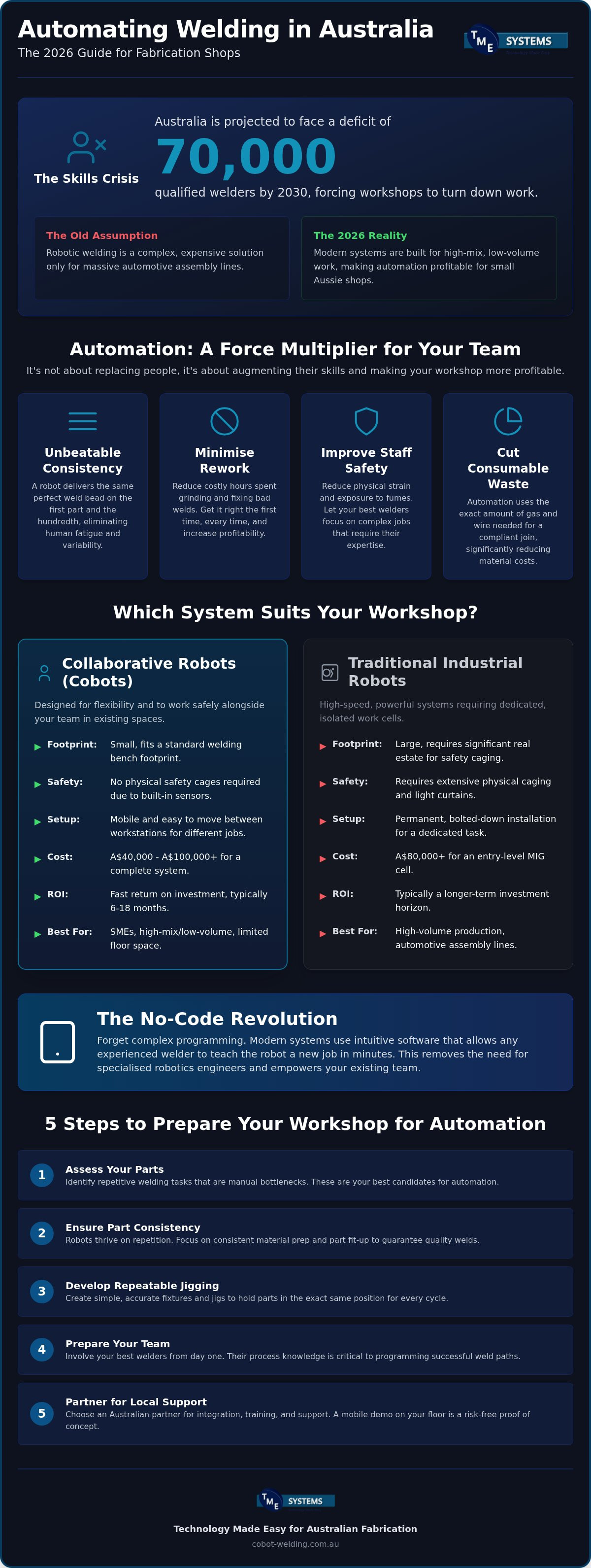

Did you know that Australia is projected to face a deficit of 70,000 qualified welders by 2030? You've likely felt this pressure on your own workshop floor, struggling to find skilled staff while managing the rising costs of rework. It's common to assume that automating welding in a fabrication shop is a complex, expensive venture reserved for massive automotive assembly lines. However, the reality of manufacturing in 2026 has changed, making precision tools more accessible for local businesses.
At TME Systems Pty Ltd, we understand that your priority is keeping the torches moving and the quality high without needing a degree in computer science. This guide will show you how to transition to automated systems that your existing team can re-teach for new jobs in minutes, removing the need for traditional robotics or coding. You'll discover how to achieve consistent weld quality and higher throughput with the staff you already have. We'll walk through the practical steps of integrating collaborative cells and no-code software, ensuring your business stays competitive and compliant with the latest Australian workplace exposure limits for welding fumes.
Key Takeaways
- Learn why the 2026 skilled welder shortage makes automation a necessity for Australian workshops looking to maintain consistent throughput.
- Discover how automating welding in a fabrication shop is now achievable for SMEs using no-code software that any experienced welder can master.
- Compare the safety and footprint benefits of collaborative robots against traditional industrial setups to find the right fit for your available floor space.
- Identify the essential steps to prepare your workshop for success, focusing on part fit-up consistency and repeatable jigging.
- Understand the value of local integration and how a mobile demo provides a risk-free proof of concept on your own workshop floor.
The Case for Automating Welding in Australian Fabrication Shops
The Australian manufacturing sector is at a crossroads. By 2030, our industry is projected to face a deficit of 70,000 qualified welders. In 2026, we're already seeing the effects; workshops are turning down lucrative contracts because they simply don't have the hands to pull the trigger. Automating welding in a fabrication shop isn't about replacing your people. It's about making sure your business survives the shortage. Traditionally, robotic welding was seen as a tool for high-volume automotive plants. Today, the tech has evolved to handle high-mix, low-volume work. This allows smaller Aussie shops to automate batches of ten or twenty parts profitably.
Many owners hesitate because they see automation as a "big factory" solution. But manual welding consistency is becoming a major bottleneck. When a skilled welder spends four hours on repetitive fillet welds, fatigue sets in. This leads to variability and the hidden costs of rework. Every minute spent grinding out a bad weld or fixing a distorted plate is profit straight out of your pocket. Automating these tasks mitigates these risks, turning your workshop into a more predictable and profitable operation.
Addressing the Skilled Labour Shortage
Automation is often misunderstood as a threat to tradespeople. In reality, automating welding in a fabrication shop acts as a force multiplier for your existing team. It allows your best welders to step away from the mind-numbing, repetitive joins and focus on the complex, specialised work that requires their years of experience. By augmenting your staff with collaborative robots, you're not just increasing output; you're improving the daily life of your workers.
By moving the heavy lifting and repetitive arcs to a machine, you reduce the physical strain on your staff. This is a critical factor for retention in an aging workforce. When your team sees that you're investing in tools that make their jobs easier and safer, they're more likely to stay. It's about using technology to support human skill, not replace it.
Consistency as a Competitive Advantage
Manual welding naturally involves variability. Even the best welder will produce slightly different beads at 7:00 am compared to 3:30 pm. This inconsistency can make it difficult to meet strict Australian standards for structural integrity every time without constant inspection. A robot doesn't get tired or distracted. It delivers the same depth of penetration and bead profile on the hundredth part as it did on the first.
Precision control also means less waste. Manual operators often over-weld to be "safe," which leads to excessive gas and wire consumption. Automation uses exactly what's needed for a compliant join. Over a year of production, the savings on consumables and the reduction in post-weld clean-up can significantly impact your bottom line. In a market where margins are tight, this level of consistency becomes a powerful competitive advantage.
Cobots vs. Industrial Robots: Which Suits Your Workshop?
Choosing between a cobot and a traditional industrial robot is a decision that dictates how you'll use your floor space for the next decade. For many owners, the process of automating welding in a fabrication shop starts with a look at the available square metres. Traditional industrial robots are fast and powerful, but they require significant real estate for safety cages and light curtains to protect staff. In contrast, collaborative robots are designed with internal sensors to work safely alongside your team, often fitting into the same footprint as a standard manual welding bench.
The Australian market for welding automation shows a strong shift toward collaborative systems, especially for shops that can't afford to lose half their floor to a fenced-off robot cell. While an entry-level industrial MIG cell can cost upwards of A$80,000, a complete cobot system often ranges from A$40,000 to A$100,000+. More importantly, the return on investment for cobots is typically seen within 6 to 18 months. This is driven by lower setup costs and the flexibility to wheel the unit between different workstations as your production schedule changes.
Collaborative Robot Welding Cells
The collaborative nature of "cobots" makes them a pragmatic choice for small to medium enterprises (SMEs). These systems don't require a permanent, bolted-down installation. Instead, collaborative robot welding cells are often delivered as turnkey units that can be operational within a day. This rapid deployment is vital for Aussie shops that need to increase throughput immediately without a six-month integration project. Because they're easy to move and re-task, they function more like a versatile power tool than a static piece of heavy machinery. If you're curious about how this would look on your floor, you can see a system in action to gauge the fit for your specific jobs.
Traditional Industrial Robot Arms
Industrial robots still have a place when high-speed, high-volume production is the only goal. If you're running the same part 24 hours a day for three years, the speed of an industrial arm justifies the cost of the safety cages and permanent floor mounting. However, these systems come with a "hidden" complexity. They usually require a dedicated programmer to make even minor adjustments to the weld path. For a typical Australian fabrication shop handling a high mix of different jobs, the downtime required to reprogram an industrial robot can quickly erase any gains made in cycle time.
The No-Code Revolution: Teaching Robots Without Programming
For years, the biggest barrier to automating welding in a fabrication shop wasn't the cost of the robot arm; it was the cost of the person needed to program it. If you have to hire a specialised software engineer every time you change a part, the investment rarely makes sense for small-batch work. This is where no-code robot welding software changes the game. It removes the layer of complex syntax and replaces it with intuitive, physical actions that any experienced welder can grasp in an afternoon.
The industry is moving away from typing lines of code toward "lead-through" teaching. This shift democratises automation, making it a viable tool for workshops that handle a high mix of different jobs. Given the projected shortfall of 70,000 welders by 2030, we can't afford to keep technology locked behind a wall of specialised programming. By making the robot easy to teach, you reduce job changeover time from hours to just a few minutes, allowing you to automate even the smallest production runs profitably.
How No-Code Software Works
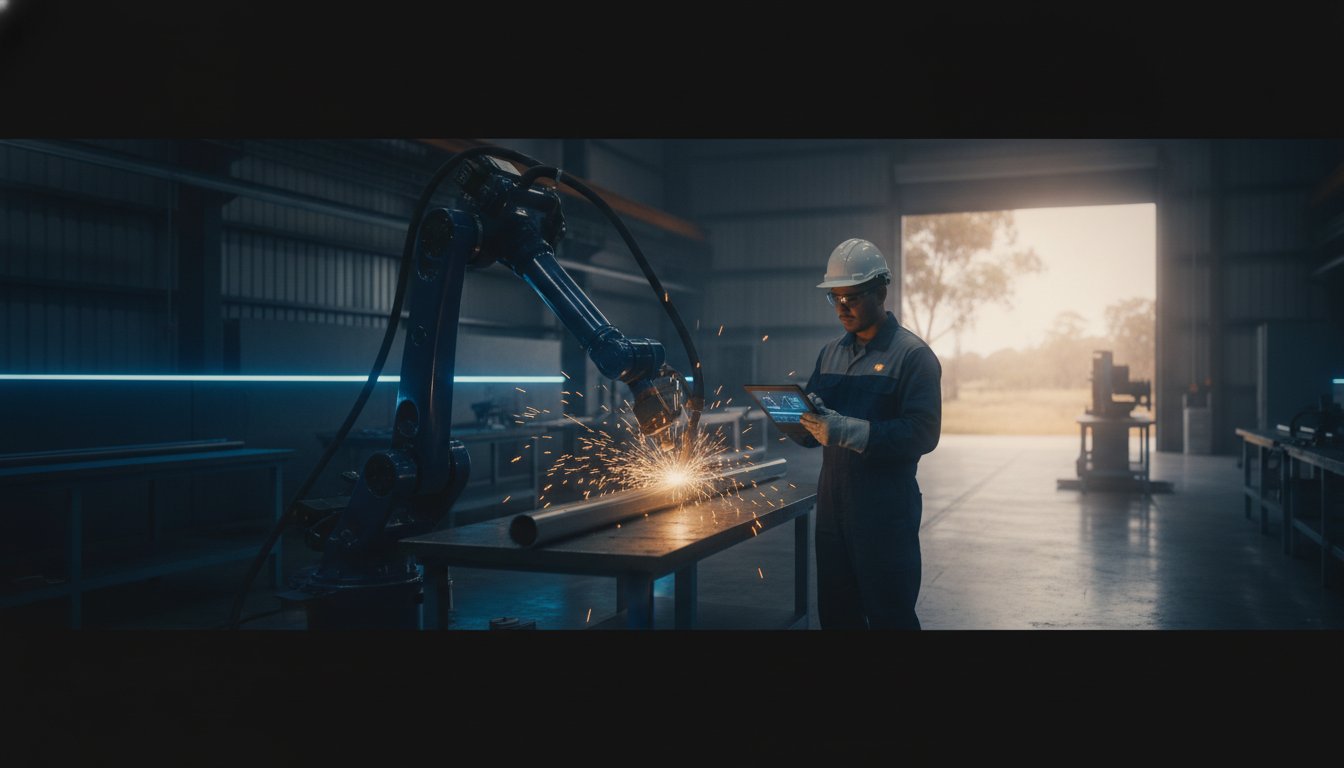
Instead of entering coordinates into a terminal, the operator physically moves the robot arm to the start and end of the joint. By pressing a button on the torch, they set "waypoints" that define the weld path. The software then calculates the motion automatically. You adjust parameters like voltage, wire speed, and travel speed via an intuitive tablet interface that feels more like a smartphone app than industrial software. These settings are stored as "recipes" for recurring jobs. When that specific bracket or frame comes back into the shop next month, your team simply recalls the recipe and hits start.
Empowering the Shop Floor Welder
This approach removes the "fear of the machine" that often stalls new technology rollouts. When the interface is user-friendly, your staff see the robot as a helpful tool rather than a complicated burden. It's a pragmatic reality that your best welder is actually your best robot teacher. They already understand puddle control, torch angles, and heat management; they just need a way to communicate that knowledge to the machine. No-code teaching serves as a practical bridge between traditional trade skill and modern technological efficiency. It puts the power of automation directly into the hands of the people who know the craft best.
5 Steps to Prepare Your Workshop for Welding Automation
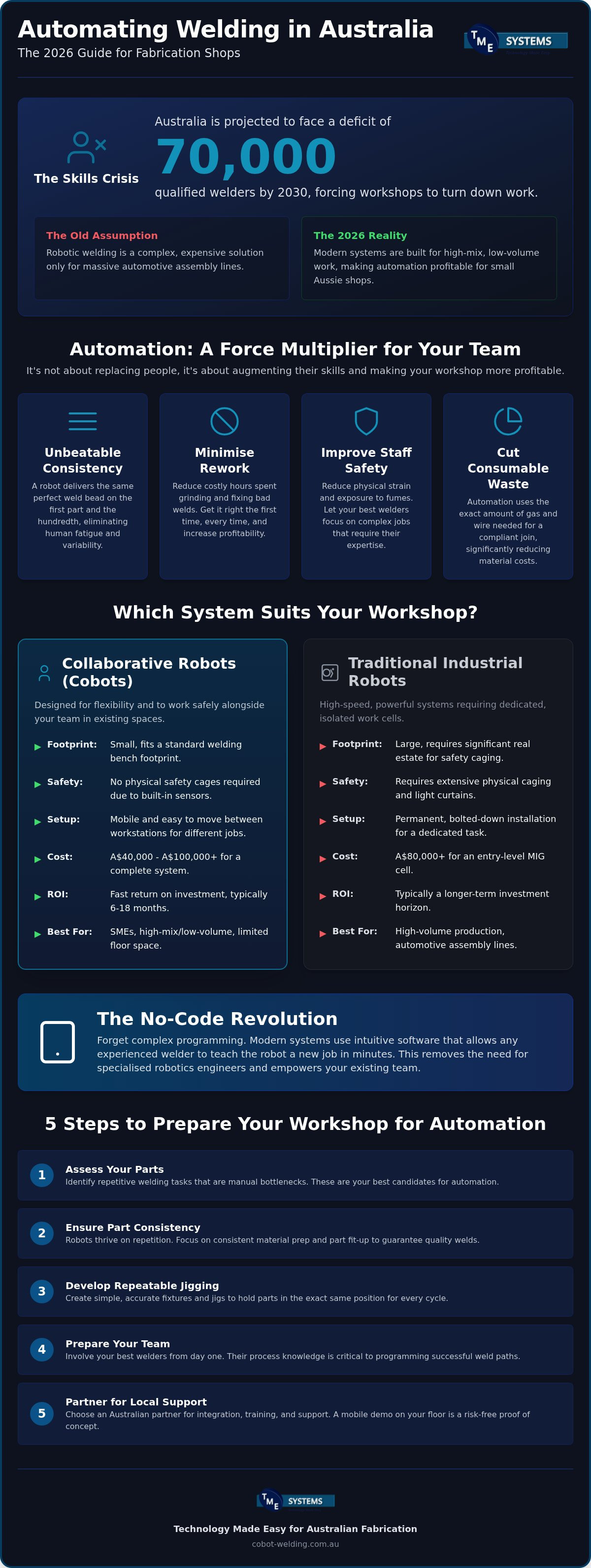
Successful implementation of a robot isn't just about the hardware; it's about the environment you create for it. Automating welding in a fabrication shop requires a shift in how you think about part preparation and floor organisation. If you treat the robot like a magic wand, you'll be disappointed. Treat it like a high-precision tool, and the results will follow. Here are five practical steps to get your workshop ready for the transition.
- Step 1: Audit your parts for fit-up consistency. Take a hard look at your current cutting and bending tolerances. A robot follows a programmed path perfectly, which means it cannot "eye off" a variable gap the way a human can.
- Step 2: Invest in repeatable jigging and fixturing. You need to ensure every part sits in the exact same 3D space every single time. Simple, robust fixtures are the backbone of any automated cell.
- Step 3: Organise your workspace for efficient material flow. Position the cell so that raw parts arrive easily and finished goods move out without creating a bottleneck.
- Step 4: Upskill your team. Invest in on-site cobot welder training to ensure your staff feel confident operating and teaching the new system.
- Step 5: Define clear KPIs for the first 90 days. Track metrics like arc-on time, gas consumption, and rework rates to measure your success.
The Importance of Fit-Up and Jigging
When you're automating welding in a fabrication shop, your upstream processes become more important than ever. While a skilled welder can compensate for poor fit-up by slowing their travel speed or adding more filler, a robot is less forgiving of inconsistent gaps. This doesn't mean you need aerospace precision. It means you need to standardise part preparation. Designing simple, repeatable fixtures for your batch runs ensures that the robot hits the joint every time, reducing the need for manual intervention and rework.
Workflow and Material Handling
Think about where the cell lives on your floor. You want to minimise "dead time" between cycles. If the operator has to walk across the shop to find the next pallet, the robot sits idle. Ensure your "sparky" has the right power requirements ready before the unit arrives; most cobot systems run off standard 240V power, but it pays to check. Creating a "culture of efficiency" helps your team embrace the change. When they see the robot handling the repetitive work, they can focus on higher-value tasks. If you're ready to see how a system fits into your workflow, you can book a demonstration for your workshop today.
Partnering for Success: Integration and Support in Australia
Investing in automation is a significant step for any workshop, but the hardware is only half of the equation. Many fabricators fall into the trap of purchasing "self-service" kits from overseas, only to find themselves stranded when a technical glitch occurs or a specific weld profile proves difficult to program. Choosing local cobot welding integration ensures that you have expert support in your own time zone. It's about having a partner who understands the local manufacturing landscape and can help you navigate the transition without the usual headaches.
Proof of concept is vital before you sign off on a major capital expenditure. A mobile welding robot demonstration allows you to see the technology working on your own parts, under your own roof. This removes the guesswork and gives your team a chance to interact with the system before it becomes a permanent fixture. When you're automating welding in a fabrication shop, this hands-on trial is the most pragmatic way to ensure the system meets your specific production requirements.
The Value of Hands-On Onboarding
The first week of integration is where the real transformation happens. A trusted partner doesn't just drop off a crate and leave; they provide structured training that builds confidence among your staff. During this time, the cell is customised for your specific materials, whether you're working with mild steel, stainless, or aluminium. Fine-tuning the pulse settings and travel speeds for your typical joint designs ensures that the system is productive from day one. This collaborative approach turns a technical installation into a long-term relationship, giving you a point of contact for ongoing maintenance and future-proofing your shop as you take on more complex jobs in 2027 and beyond.
Calculating Your ROI and Next Steps
The financial case for automation becomes clear when you look at the total cost of production over a twelve-month period. By improving welding productivity with cobots, workshops can significantly lower their cost per part while maintaining a level of consistency that manual welding simply cannot match. If you're ready to stop struggling with labour shortages and start growing your output, the next step is a practical one. Book a mobile demo to see the tech in your own workshop environment. For the pragmatic fabricator, there's no substitute for seeing the arc-on time increase with your own eyes. It's time to empower your best welders with the tools they need to lead your shop into the future.
Future-Proofing Your Workshop with Accessible Automation
The path to automating welding in a fabrication shop has never been more straightforward for Australian manufacturers. We've seen how the combination of collaborative robot cells and intuitive no-code teaching software removes the traditional barriers of high costs and complex programming. By focusing on repeatable jigging and consistent part preparation, you can empower your existing team to produce high-quality welds with minimal downtime.
Success in 2026 depends on choosing a partner who provides more than just hardware. With Australian-based technical support and hands-on training, you can ensure your system is customised for your specific materials and production needs. Taking that first step doesn't have to be a leap into the unknown. We're here to help you demystify the process and see the results for yourself on your own workshop floor.
If you're ready to improve your workshop's throughput and protect your bottom line, it's time to see the technology in action. Book a Mobile Welding Robot Demonstration for your workshop today and discover how practical automation can support your business growth. We're ready to help you build a more resilient and productive future.
Frequently Asked Questions
Is automating welding in a small fabrication shop actually cost-effective?
Yes, automating welding in a fabrication shop is highly cost-effective for local businesses due to the rapid return on investment, which typically occurs within 6 to 18 months. By increasing throughput by 50% to 150% and virtually eliminating the high cost of rework, the system pays for itself quickly. Small shops also benefit from reduced consumable waste and the ability to take on more contracts without hiring additional staff.
Do I need a computer science degree to program a welding cobot?
You don't need any programming experience or a specialised degree to operate these systems. Modern no-code teaching software allows experienced welders to program the robot by physically moving the arm to set waypoints. If you can use a smartphone or a tablet, you can learn to set up a new weld path in minutes. This approach keeps the control in the hands of the tradespeople who know the craft best.
What is the difference between a cobot and a traditional welding robot?
The main differences lie in safety features and workspace requirements. Traditional industrial robots require large safety cages and light curtains because they cannot detect human presence. Collaborative robots, or cobots, have internal sensors that allow them to stop instantly if they contact a person. This means they can work safely alongside your team in a much smaller footprint, often taking up no more room than a standard manual welding bench.
Can a welding robot handle small batches of 10-20 parts?
Yes, collaborative systems are specifically designed for high-mix, low-volume production. Because the no-code software allows for job changeovers in just a few minutes, it's perfectly viable to automate batches as small as 10 or 20 parts. You can store recipes for recurring small jobs, meaning you only need to teach the path once and can recall it instantly whenever that specific bracket or frame returns to your workshop floor.
What kind of maintenance do collaborative welding cells require?
Maintenance is similar to your existing manual equipment but with a few extra checks for the robot arm. You'll need to perform routine tasks such as:
- Cleaning the torch and replacing contact tips
- Checking the wire feeder and liner
- Inspecting robot cables and joints
Most Australian workshops find the ongoing running costs manageable, typically ranging from A$12,000 to A$25,000 per year covering consumables, electricity, and shielding gas.
Will automating welding lead to staff redundancies in my workshop?
Automation is a tool to support your staff, not replace them. With Australia facing a projected deficit of 70,000 welders by 2030, automating welding in a fabrication shop helps you manage the workload that you currently can't find staff to cover. By handling repetitive fillet welds, your experienced tradespeople can focus on complex joins and high-value tasks. This shift often leads to higher job satisfaction and reduced physical strain.
How long does it take to set up a turnkey welding cell?
A turnkey collaborative welding cell can be operational on your workshop floor within a single day. Because these units are delivered pre-assembled and integrated, the setup process involves positioning the cell, connecting power and gas, and performing basic calibration. Our integration specialists guide your team through the initial onboarding, ensuring that your first automated parts are being welded before the end of the very first shift.
Does no-code software work for both MIG and TIG welding?
Yes, the intuitive no-code interface is designed to support both MIG and TIG applications. The software allows you to adjust specific parameters for each process, such as pulse settings for aluminium or precise heat control for thin stainless steel. Switching between different welding processes is straightforward, making the system a versatile asset for fabrication shops that handle a diverse range of materials and strict structural integrity requirements.