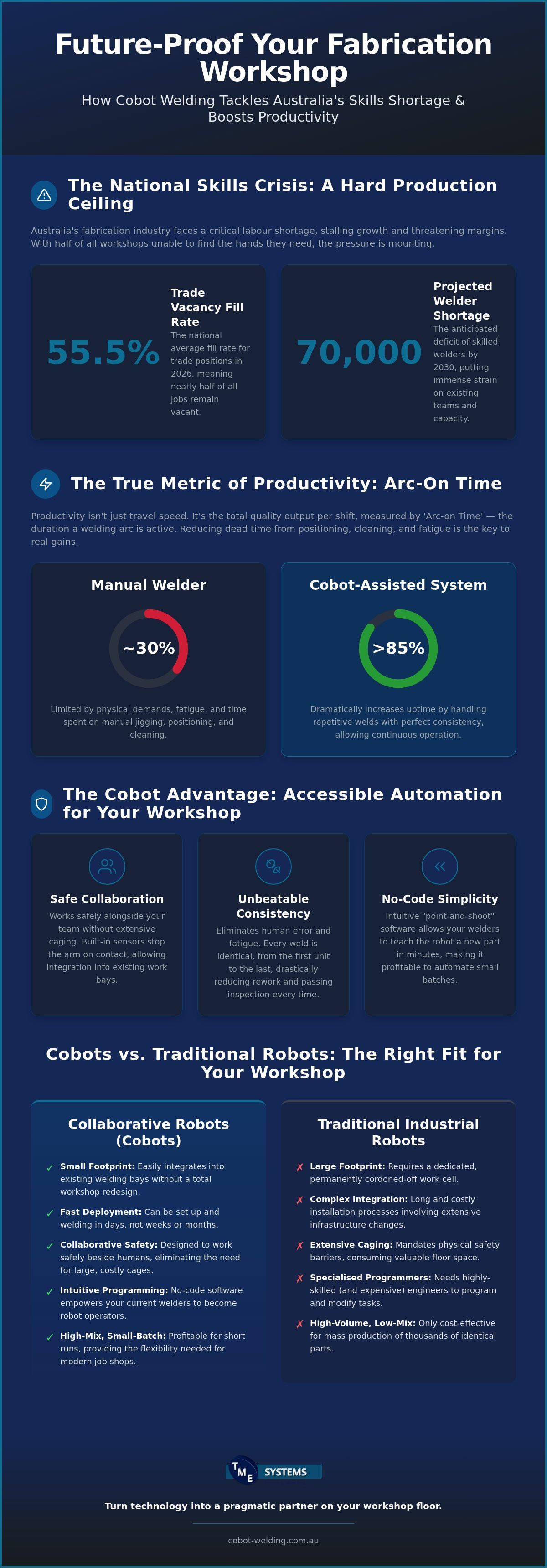

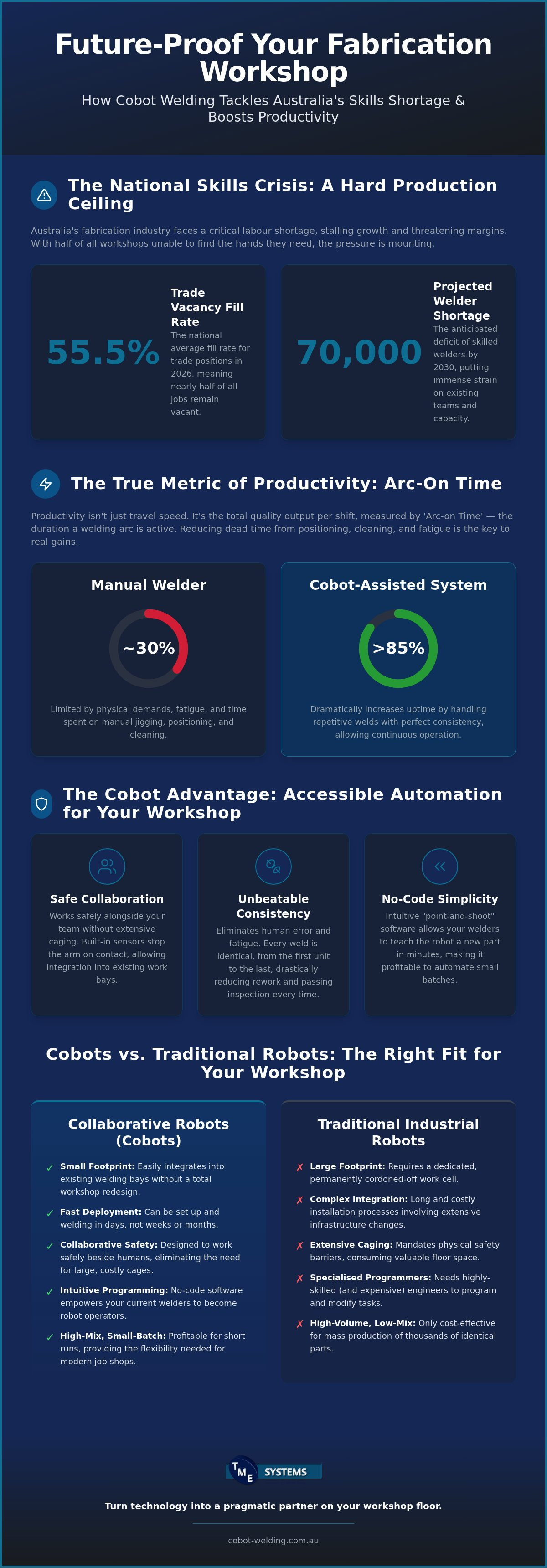
With Australia’s trade vacancy fill rate sitting at just 55.5% in 2026, half of the nation’s fabrication workshops are effectively stalled because they cannot find the hands to do the work. You likely feel this pressure every day, whether it’s turning away lucrative contracts or managing the high rework rates that come when a stretched team faces human fatigue. It is a tough spot to be in when traditional automation feels too complex or expensive for the high-mix, small batch runs that make up your weekly schedule.
The good news is that you don't need a team of programmers to improve welding productivity and reclaim your capacity. This guide explores how collaborative robots and no-code software are helping Australian manufacturers eliminate bottlenecks and maximise arc-on time. We will look at practical ways to upskill your existing labourers into confident robot operators, ensuring every weld passes inspection the first time. From navigating the strict new 1mg/m³ fume exposure limits to achieving a reliable payback period, we’ll show you how to turn technology into a pragmatic partner on your workshop floor.
Key Takeaways
- Shift your focus from travel speed to total quality output per shift to better manage the 2026 national skills crisis.
- Learn how no-code software and collaborative robots can improve welding productivity by automating repetitive joins without needing specialised programmers.
- Compare the footprint and deployment times of cobots versus industrial robots to find the most practical fit for your existing workshop floor.
- Apply a two-step framework to audit your current arc-on time and identify the 20% of parts that cause 80% of your production delays.
- Understand why turnkey systems and local operator training are essential for a seamless transition from manual fabrication to assisted welding.
The Productivity Bottleneck in Australian Fabrication
True productivity in a local workshop isn't measured by how fast a torch moves along a joint. Instead, we should define it as Total Quality Output per Shift. To improve welding productivity, you have to look at the entire cycle, from the moment a part hits the bench to the moment it passes final inspection. Many Australian firms focus on travel speed, but the real gains are found by reducing the dead time spent on positioning, cleaning spatter, and manual jigging. Historically, traditional automation failed small Aussie job shops because it was too rigid, expensive, and required specialised programmers that most small businesses simply don't have on the payroll.
The current market conditions in 2026 have made these old bottlenecks even more painful. With a national trade vacancy fill rate of just 55.5%, most fabrication owners are facing a hard production ceiling. You can't take on more work if you can't find the staff to weld it. This labour shortage, combined with a projected deficit of 70,000 welders by 2030, means that every hour a skilled tradesperson spends on a basic, repetitive fillet weld is an hour of lost opportunity for your business.
The Skills Gap: A National Challenge
The lack of senior ticketed welders is no longer just a recruitment headache; it's a direct threat to your margins. When you're forced to use less experienced labourers for critical paths, rework rates often climb due to inconsistency or fatigue. This rework is the silent killer of profitability in Australian manufacturing. To manage this, we must track Arc-on Time, which is defined as the actual duration the welding power source is producing an arc during a shift. While a manual welder might only achieve 25 to 35% arc-on time due to the physical demands of the job, a systematised approach aims much higher.
Why Manual Optimisation Only Goes So Far
You can only squeeze so much more out of a manual process. Better ergonomic tables, high-end filler metals, and refined gas mixes help, but they don't solve the core issue of human variability. There is a clear point where manual tradespeople should be moved away from "grunt work" and onto higher-value tasks like complex custom builds, quality assurance, or overseeing automated systems. Transitioning from working harder to systematising the weld allows your best people to do what they do best. To understand how this works in practice, many owners are asking What is a Cobot? and how these flexible tools can handle the repetitive 20% of parts that typically consume 80% of a workshop's floor time. By offloading these tasks, you improve welding productivity without needing to find another elusive ticketed welder in a crowded market.
Why Collaborative Robots are the Key to Workshop Uptime
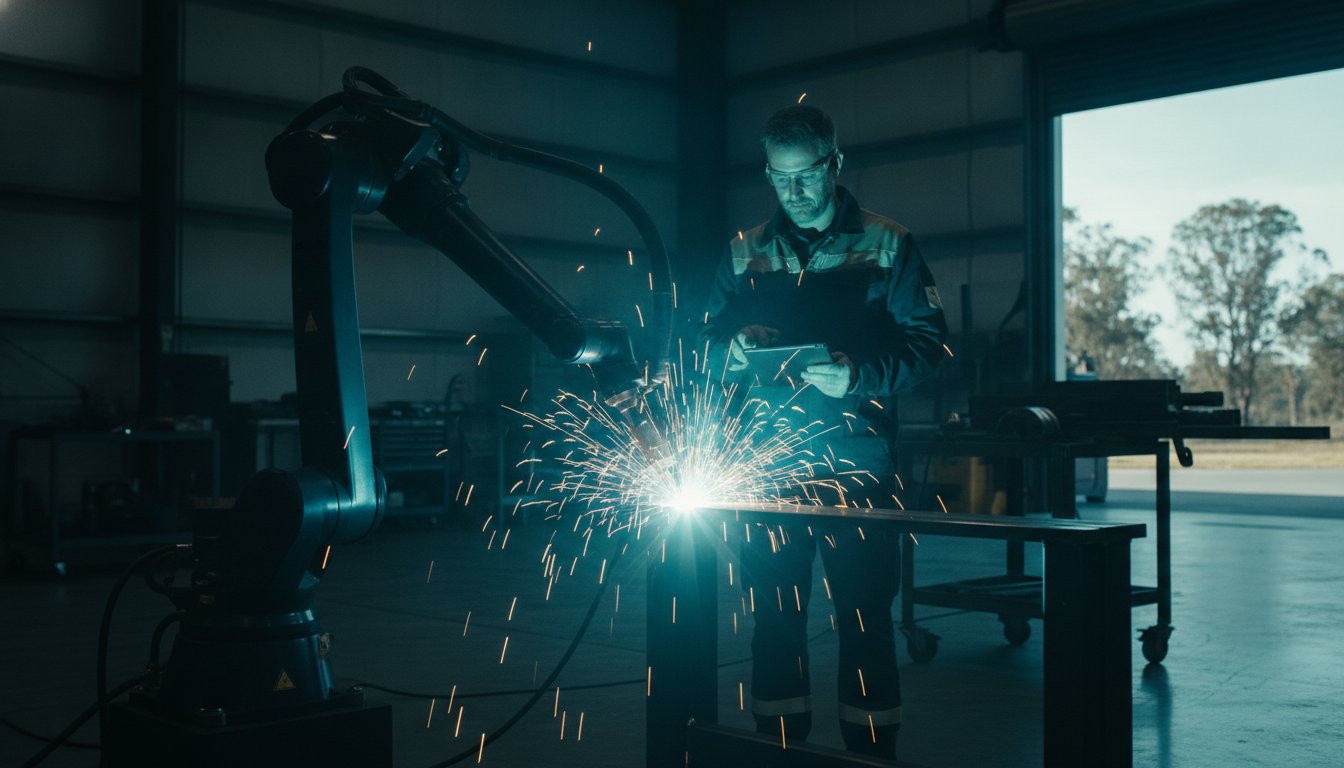
The biggest shift in 2026 isn't just the robot arm itself; it's the fact that it works safely right next to your team. Unlike traditional industrial robots that require extensive safety caging and dedicated floor space, collaborative robots (cobots) use built-in sensors to detect human contact and stop instantly. This safety profile allows you to drop a unit into an existing welding bay without a total workshop redesign. By taking over the repetitive "grunt work," cobots ensure that unit 100 looks identical to unit 1. This level of consistency is impossible for a human operator to maintain over an eight-hour shift as fatigue sets in. When the robot handles the long, straight runs, your experts are free to tackle the intricate joins that require a master’s touch, which helps you improve welding productivity across the whole shift.
No-Code Software: Removing the Programming Barrier
For most small Australian job shops, the biggest hurdle to automation hasn't been the cost; it’s been the complexity. If you need a computer scientist to change a part program, the system stays idle. Modern no-code robot welding software has changed the game. It uses a "point-and-shoot" interface where a tradesperson manually leads the robot arm through the required path. It’s an intuitive process that allows a traditional welder to "teach" a new part in minutes. This speed makes it profitable to automate even small batches of five or ten units, providing the flexibility needed to improve welding productivity even when your production schedule changes daily.
Maximising Arc-On Time
The most honest metric of workshop health is arc-on time. A manual welder typically achieves an arc-on rate of 20% to 30%, with the rest of the shift spent on part positioning, tacking, and cleaning. In contrast, a well-integrated cobot cell can reach 60% to 80% arc-on time. By maximizing welding efficiency with cobots, you are effectively doubling the output of a single welding bay. This is often achieved through dual-station cells, which allow an operator to safely load and unload parts on one side while the robot continues welding on the other. If you want to see how this fits into your specific workflow, you can book a mobile demo system to test the technology on your own workshop floor.
Comparing Industrial Robots and Cobots for Small-Batch Efficiency
Choosing between an industrial robot and a cobot depends entirely on your production floor's reality. Industrial robots are the heavy lifters of manufacturing, but they come with a significant footprint penalty. Because they lack internal safety sensors, they must be housed behind physical guarding or light curtains. For a typical Australian SME, finding an extra 20 square metres of floor space is often impossible. Cobots are designed to fit into your existing workflow. They occupy roughly the same space as a manual welding table and don't require massive safety cages to operate safely alongside your team.
Deployment speed is another critical factor. Setting up an industrial robot often takes weeks of specialised integration and PLC programming. In contrast, collaborative robot welding cells can be operational within days. This rapid turnaround is essential when you need to improve welding productivity without shutting down production for a month. You also avoid the hidden cost of a dedicated programmer, who in 2026 can command a salary well over A$150,000. Instead, your current tradespeople manage the system, keeping your overheads predictable and your staff engaged.
Flexibility is the final piece of the puzzle. An industrial robot is usually bolted to the floor in a permanent cell. A cobot system is often mounted on a mobile base, allowing it to be moved between different welding bays as your workload changes. This mobility ensures that your investment isn't sitting idle when a specific job finishes, helping you maintain a high arc-on percentage across the entire workshop.
The High-Mix, Low-Volume Reality
Australian fabrication is rarely about making one part for a year. Most local shops need to change jobs three times a day. If it takes four hours to program a robot for a two-hour run, the "Programming Penalty" wipes out your profit. Cobots excel here because the setup time is measured in minutes. This makes them the clear winner for ROI on any batch size under 50 units. It allows you to improve welding productivity on the small, fiddly jobs that usually clog up your manual bays and delay your larger projects.
Safety and Australian Standards
The backbone of collaborative safety is force-sensing technology. These systems monitor every movement, stopping the arm instantly if it encounters an unexpected obstacle. While the technology is intuitive, maintaining a safe workshop centre requires proper implementation. This is why on-site cobot welder training is a non-negotiable part of the process. It ensures your team understands the safety limits and knows how to maximise throughput while staying compliant with Australian standards. By focusing on the human-machine interface, you create a workshop that is both faster and safer for everyone.
A Practical Framework for Scaling Your Welding Output
Scaling up your workshop doesn't require a massive hiring spree. Instead, it requires a methodical look at your current workflow to remove friction. Start by auditing your "Arc-on" time per bay. If your tradespeople are only welding for two hours in an eight-hour shift, you've found your first bottleneck. Once you have this baseline, identify the 20% of parts that take up 80% of your production time. These repetitive components are the perfect candidates for automation. By moving these to a dedicated cell, you immediately improve welding productivity by freeing up your manual bays for high-margin, custom work.
Standardising for Success
Consistency starts with the table. Modular welding tables and standardised fixtures are essential for rapid part changeover. When you design simple jigs that a labourer can load accurately every time, you eliminate the "hunt and peck" time usually spent searching for clamps or measuring offsets. This standardisation ensures that the robot always finds the joint exactly where it expects it. It turns a complex fabrication task into a repeatable process that maintains high quality without constant supervision.
Upskilling Your Existing Workforce
The goal of automation is to empower your team, not replace them. When you introduce a cobot, you can upskill a second-year apprentice into a high-output production lead. They stop being just a pair of hands and start being a "Cobot Supervisor," managing the workflow and ensuring the cell stays fed with parts. We often see that overcoming "Robot Anxiety" takes less than a day of hands-on use. Once your team sees the robot as a tool that handles the boring, back-breaking tasks, job satisfaction actually increases.
Finally, you must measure and iterate. Use real-time weld data to see exactly how many parts are being completed per shift. This feedback loop allows you to refine your jigs or adjust your paths to squeeze more value out of every hour. To see how these steps work in a real-world Australian workshop, you can read our detailed breakdown on how to improve welding productivity with cobots. Ready to see the results for yourself? Book a mobile demo system and let us prove the ROI on your own floor.
Future-Proofing Your Workshop with Integrated Cobot Solutions
Investing in automation is a significant decision, but a common mistake is buying a "naked" robot arm without considering the total system. A standalone arm is just hardware; it requires a power source, a high-quality torch, and, most importantly, the right software to be useful. To truly improve welding productivity, you need a turnkey solution that is ready to work from day one. This is where welding system integration specialists become vital. They ensure that the robot, the welder, and the software talk to each other seamlessly, preventing the technical friction that often stalls DIY automation projects. They also help navigate the physical challenges of fitting new technology into established, often cluttered floor plans, ensuring the cell is positioned for optimal workflow and operator safety.
Mobile Demos: Seeing is Believing
The best way to validate ROI is to see the system in action on your own floor. When you book a mobile welding robot demonstration, you aren't just looking at a brochure. You are testing your own parts under your workshop’s specific conditions. This "Proof of Concept" eliminates the guesswork, allowing you to see exactly how the no-code interface handles your high-mix production runs. TME Systems Pty Ltd provides these mobile demos across Australia, bringing the technology directly to regional and metropolitan workshops to prove it can handle the grit and reality of a local production line.
Long-Term Support and Maintenance
Automation isn't a "set and forget" purchase. As software evolves, your system should stay updated with the latest no-code features to keep your competitive edge. Relying on local Australian technical support is the best way to minimise downtime. If a question arises on a Tuesday morning, you need a partner who understands the local industry and can provide immediate assistance. This ongoing relationship ensures your cell continues to improve welding productivity as your business grows and your part list expands.
By late 2026, automation will no longer be an optional luxury for Australian fabricators. With the new 1mg/m³ welding fume exposure limits now in force and the skilled labour deficit projected to reach 70,000 by 2030, the ability to automate repetitive tasks is a matter of survival. Those who integrate collaborative solutions now will be the ones who can maintain margins, protect their workers, and take on the large-scale infrastructure projects that define the Australian manufacturing landscape. An automated workshop isn't just faster; it's more resilient, predictable, and ready for the challenges of the next decade.
Ready to Reclaim Your Workshop Capacity?
The pressure on Australian fabrication in 2026 is undeniable, but it doesn't have to be a ceiling on your growth. We've seen how shifting the focus to Total Quality Output and addressing the programming penalty allows even small shops to compete. By empowering your current team with no-code tools, you can improve welding productivity without the constant hunt for hard-to-find ticketed staff. It is about working smarter with the talent you already have on the floor.
The most practical way to validate these gains is to see the system in action. TME Systems Pty Ltd offers mobile demonstrations Australia-wide, specifically designed to help local SMEs prove the ROI on their own floor. It’s about making innovation feel attainable and ensuring your workshop is ready for the tighter regulations and higher output demands of the next decade. You already have the craftsmanship; we simply provide the force multiplier to help you scale.
Book an On-Site Mobile Demo to see how a cobot handles your parts and start your transition toward a more resilient production line today. We are here to support you at every step of the journey.
Frequently Asked Questions
How much does a welding cobot actually improve productivity?
A welding cobot can double or even triple your output by achieving arc-on times of up to 80%, compared to the 25% to 35% typical of manual welding. This allows your skilled tradespeople to focus on complex, high-value joins while the robot handles the repetitive runs. It effectively removes the physical fatigue bottleneck that usually limits manual production rates over a full shift.
Do I need a robotic programmer to run a cobot in my workshop?
No, you don't need a specialised programmer because no-code software allows your existing welders to teach the robot manually. By leading the arm through the desired path, a tradesperson can set up a new job without writing a single line of code. This shift from complex programming to intuitive teaching makes automation accessible for small Australian workshops without hiring extra staff.
Can a cobot weld small batches and one-off items profitably?
Yes, cobots are designed specifically for high-mix, low-volume production where batches might be as small as five units. Because the setup time is measured in minutes rather than hours, the programming penalty is eliminated. This flexibility ensures you can improve welding productivity on the varied, small-run jobs that usually cause manual bottlenecks and delay your larger projects.
What is the typical ROI for a collaborative welding cell in Australia?
Most Australian fabricators see a full return on investment within 12 to 24 months for a single-shift operation. This payback period is driven by increased arc-on time, reduced rework, and the ability to take on more contracts without finding new ticketed welders. For workshops running multiple shifts, the ROI timeline is often significantly shorter due to the higher machine utilisation.
Is a cobot safe to use in a small, crowded fabrication shop?
Cobots are highly suitable for tight spaces because they use force-sensing technology to operate safely alongside humans without bulky safety cages. If the arm encounters an unexpected obstacle, it stops instantly to prevent injury. This small footprint allows you to integrate automation into an existing welding bay without a major workshop overhaul or losing valuable floor space.
What welding processes can be automated with a cobot?
Most common processes, including MIG, TIG, and plasma cutting, can be fully integrated into a collaborative cell. The system manages the wire feed, gas flow, and travel speed with precision that human hands struggle to match over long periods. This ensures consistent, high-quality results across different materials and thicknesses, from thin gauge sheet metal to heavy structural steel.
How long does it take to train a welder to use no-code software?
Most experienced welders become proficient with no-code teaching software in less than a day. Because the interface is designed to match their existing trade knowledge, the learning curve is very shallow. Basic operator training usually takes only a few hours, allowing your team to improve welding productivity almost immediately after the system is installed on your floor.
Do I need to change my existing welding power source to use a cobot?
It depends on the age and digital compatibility of your current unit, but many modern power sources can be integrated into a collaborative system. However, we typically recommend a turnkey cell with a matched power source to ensure the software can control all welding parameters accurately. This integrated approach provides the most reliable performance and simplifies your long-term technical support.