
If you're struggling to find skilled welders, the idea of a 'pay-as-you-go' robot might seem like the perfect fix for a busy Australian workshop. It's a tempting proposition to skip the capital expense and simply rent a solution to get those small batches moving, especially when you're trying to calculate the true welding robot cost australia fabricators face today. We understand the pressure you're under; the shortage of tradespeople is a constant headache, and high rework rates are eating into your margins. You need a system that your current staff can actually use, not something that requires a software engineering degree just to lay a simple bead.
In this guide, we compare the BotX packaged rental model against locally integrated turnkey cobot cells to help you find the most productive path for your business. While a rental offers a low barrier to entry, it's vital to look at the long-term ROI and the value of having a local partner who understands your specific floor layout. We'll help you weigh up these two paths so you can increase your production capacity and achieve consistent weld quality for 2026, all without the fear of complex programming holding your team back.
Key Takeaways
- Understand the operational differences between the BotX rental model and locally integrated turnkey cells to find the best fit for your production volume.
- Learn how no-code teaching software empowers your existing team to handle path adjustments and new parts without needing specialised programming knowledge.
- Evaluate the long-term welding robot cost australia workshops encounter by weighing monthly rental fees against the ROI and tax benefits of owning your equipment.
- Discover the importance of local on-site training and meeting Australian safety standards to ensure your staff are confident and compliant from day one.
- Identify how the hardware flexibility of a custom-integrated cell can offer more versatility for diverse fabrication tasks than a fixed-package rental.
Understanding the BotX Welding Robot System in 2026
The Australian manufacturing landscape is facing a persistent challenge: a critical shortage of skilled welders that shows no sign of slowing down. For many local fabricators, this means turning away work or dealing with long lead times. BotX was developed in the United States to bridge this gap by making robotic welding simpler and more flexible than traditional industrial setups. BotX is a subscription-based automation tool for manufacturers. By offering a collaborative robot (cobot) system primarily through a rental model, it aims to lower the barrier for workshops that aren't ready for a full capital purchase.
In 2026, the system is often marketed as a "workforce multiplier." It's designed to handle the repetitive, standard MIG welding tasks that take up your best tradespeople's time. When you start investigating the welding robot cost australia offers, the rental approach stands out because it shifts the expense from a capital investment to an operational one. This can be a game-changer for businesses trying to manage cash flow while still increasing their throughput. It's a pragmatic way to test the waters of automation without committing to a permanent fixture on the workshop floor.
The Core Components of a BotX Setup
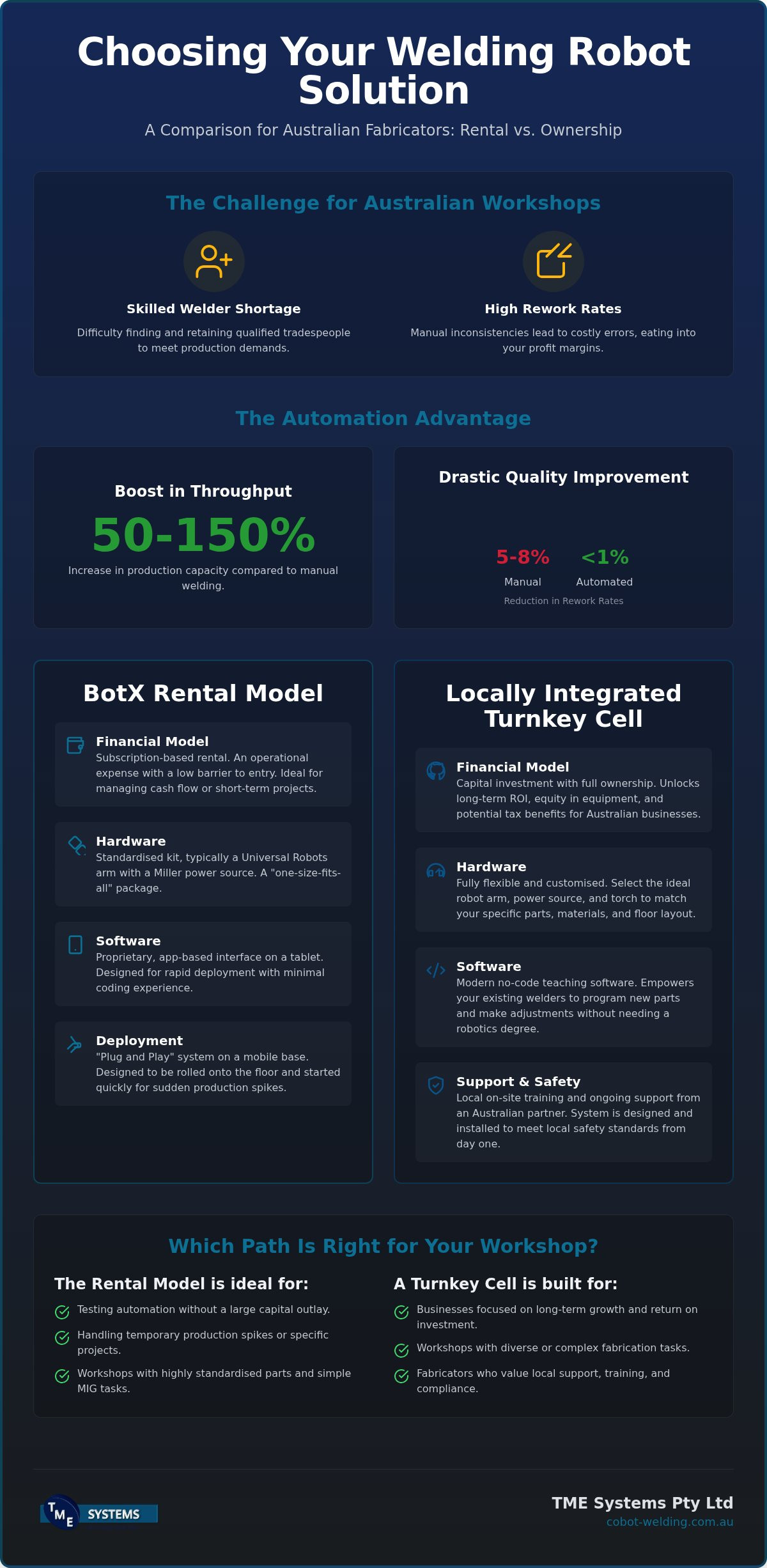
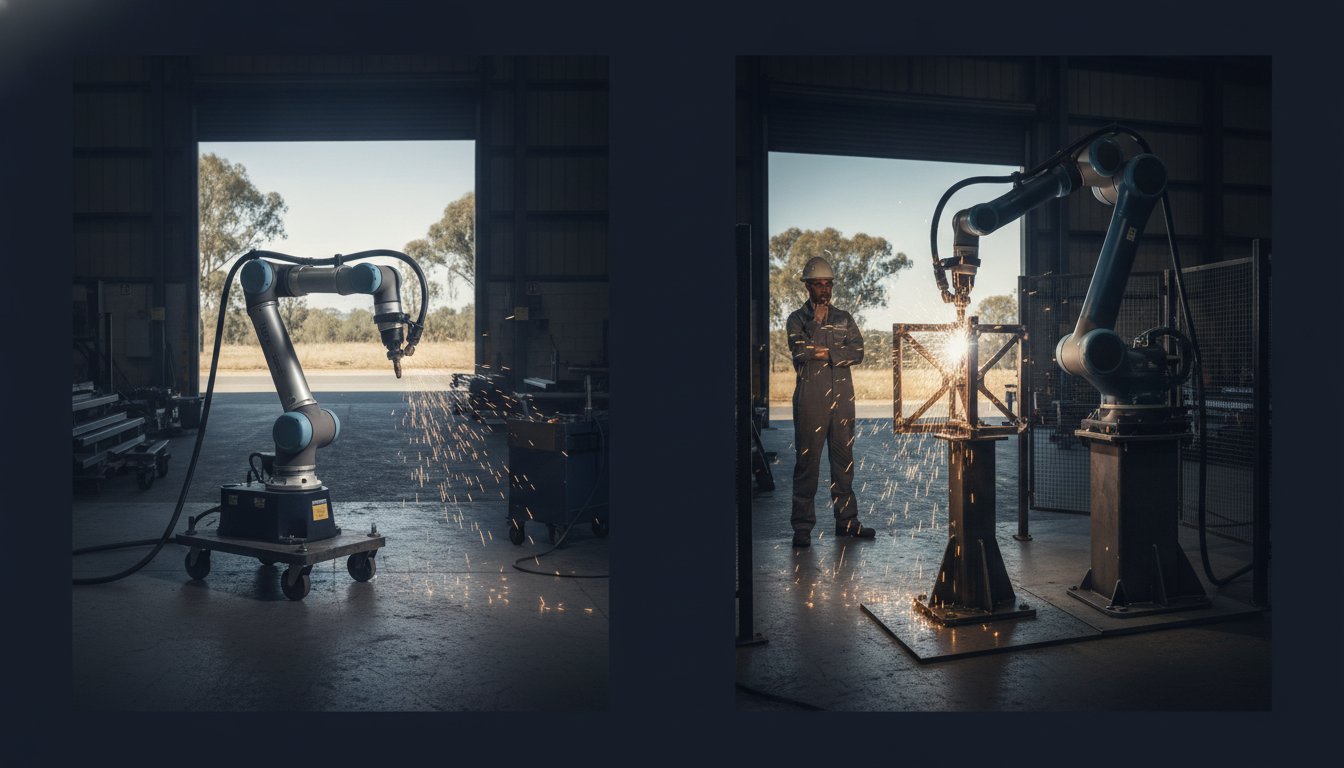
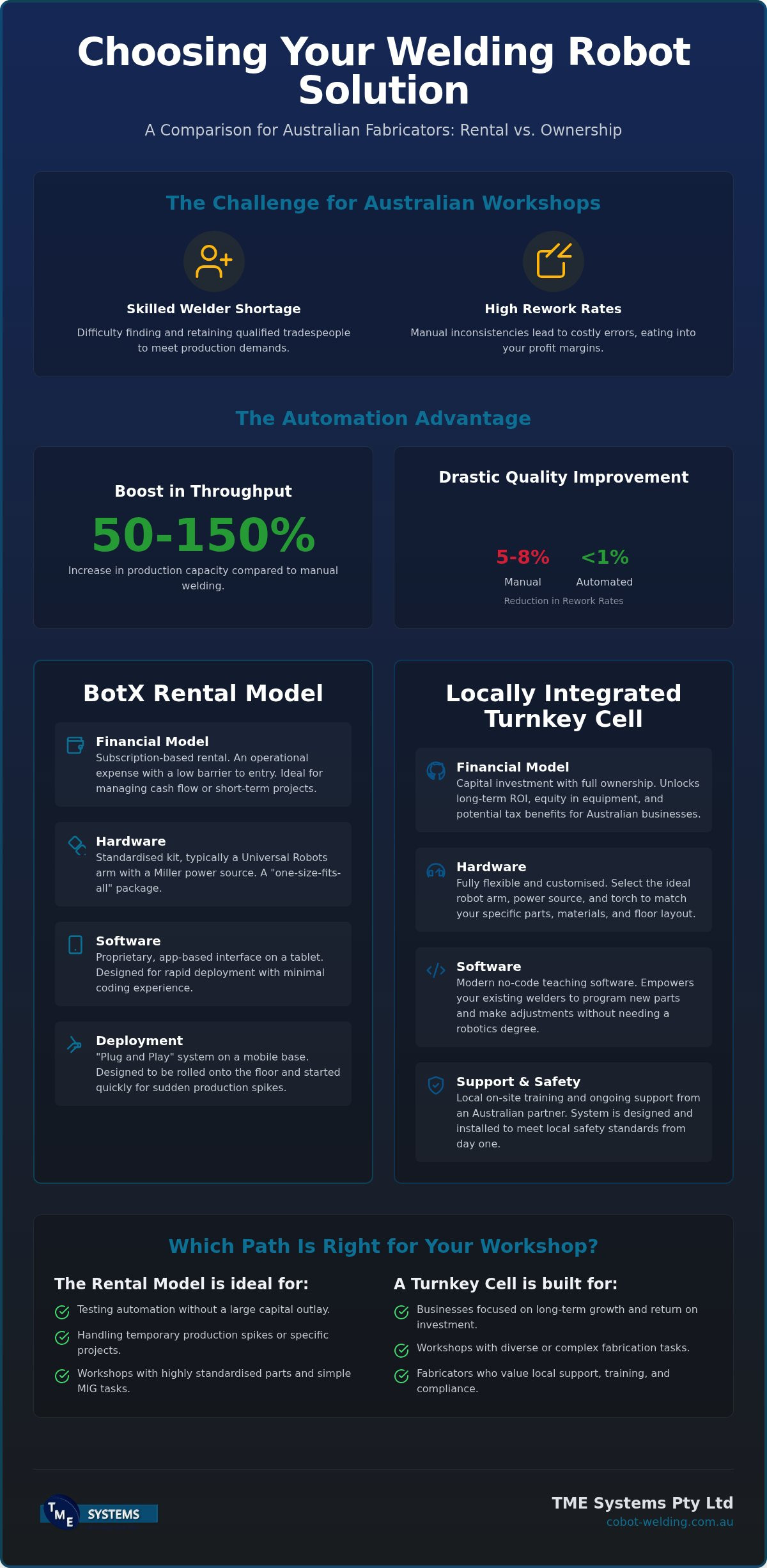
The physical setup is built for mobility. It typically features a Universal Robots arm integrated with a Miller power source, all sitting on a heavy-duty mobile base. This allows you to move the unit around the workshop floor as production needs change. On the software side, BotX uses a proprietary app-based interface. Instead of traditional coding, operators use a tablet to "teach" the robot by moving the arm to specific weld points. It's designed for accessibility, meaning a welder with zero robotics experience can often get the system running in a single shift.
Why Australian Fabricators Search for BotX
The primary draw for local workshops is the "no capital investment" promise. For many, the idea of renting a robot for a specific project or a busy season is less intimidating than a six-figure purchase. There is also a strong interest in rapid deployment. Because it's a pre-packaged cell, it's often viewed as a "plug and play" solution that can be rolled onto the floor and started almost immediately. This speed is attractive when you're facing a sudden production spike and can't find extra staff. It offers a way to clear backlogs without the long-term commitment of owning the hardware, though it's worth considering how a one-size-fits-all package handles the unique jigs and parts of a bespoke Australian workshop.
BotX vs Locally Integrated Turnkey Cells: A Performance Comparison
When you compare raw performance, both systems offer a massive leap over manual welding. A cobot can increase throughput by 50% to 150%, and rework rates often drop from around 5% to 8% in manual setups to under 1% with automation. However, the difference lies in how that performance is sustained across different types of work. BotX is a standardised kit, which is excellent for standard parts and straightforward MIG tasks. But if your workshop handles a variety of complex geometries or heavy-duty cycles, collaborative robot welding cells designed for your specific floor provide more room to move.
A significant part of the welding robot cost australia fabricators consider is the ability to adapt as the business grows. Reach and payload are often the "make or break" factors on a production line. A standard BotX arm has a set reach, which might be perfect for small brackets but restrictive for larger frames. Local integrators can assess your specific parts and suggest an arm with the right reach or even a gantry system if required. This ensures you aren't paying for a system that only does half the job. If you're curious about how a tailored setup looks in action, you can check out our mobile demo system to see the difference for yourself.
Hardware Flexibility and Customisation
BotX typically uses a fixed hardware list, usually pairing a Universal Robots arm with a Miller power source. This works well for a "plug and play" model, but it lacks the flexibility to choose the best torch or power source for specialised tasks. Local integration allows you to select equipment from various brands like Fronius or Kemppi, ensuring the tool matches the job. You can also integrate the cell with existing workshop equipment like rotators or positioners. This turns the robot into a seamless part of your production line rather than a standalone island that requires manual part-flipping.
Consistency and Quality Control
Consistency isn't just about the machine's movement; it's about the procedure. Effective cobot welding integration ensures the system is tuned to your specific Weld Procedure Specifications (WPS). This is vital for meeting Weld Australia quality standards, which protect your reputation and ensure safety compliance. While BotX offers a standard weld profile, a locally tuned turnkey cell allows for data logging and precise parameter adjustments. You can refine the travel speed and wire feed to match the exact material and gas mix you use every day, resulting in a higher quality finish and less spatter.
Software and Ease of Use: No-Code Teaching vs Packaged Apps
The fear of complex programming is often the biggest hurdle for workshops looking into automation. You don't want to hire a software engineer just to run a welder. This is where the "no-code" revolution has changed the game for local fabricators. Instead of typing lines of G-code, operators can now teach a robot by simply moving its arm. When you're calculating the welding robot cost australia businesses face, you have to factor in the time saved by this intuitive approach. If your current team can pick up the basics in a few hours, your return on investment starts almost immediately.
Comparing the two, BotX uses a proprietary app interface that's designed to be as simple as a smartphone. It's effective for standard tasks, but it's worth looking at the advantages of standalone no-code robot welding software. While a packaged app is easy to start with, standalone platforms often provide more flexibility as your needs evolve. The goal is to improve welding productivity without hitting a technical ceiling. Most manual welders can transition to being cobot operators within a day or two of hands-on training, provided the software speaks their language.
The Power of Intuitive Teaching
Hand-guiding is usually faster than tablet-based jogging for small batches. You physically move the torch to the start and end points, press a button to save the position, and the robot remembers the path. Modern visual interfaces use icons and flowcharts rather than text-heavy code. This makes it easy to save jobs for repeat production runs. If a client returns six months later with the same order, you simply pull up the saved programme and start welding. It removes the guesswork and ensures that the second batch is identical to the first.
Overcoming the Black Box Limitation
Sometimes, packaged apps can feel like a "black box" where advanced users are restricted from tweaking fine parameters. This can be a frustration if you need to adjust gas flow or wire speed for a non-standard material. Open no-code platforms allow for deeper optimisation while keeping the interface simple for day-to-day use. You want a system that supports your operators as they become more confident. Choosing software that can grow with your workshop's complexity ensures that your total welding robot cost australia remains manageable even as you take on more challenging projects.
The True Cost of Ownership: Rental Models vs Capital Investment in Australia
The "no upfront cost" appeal of a rental model is undeniably strong for a workshop facing a sudden influx of work. It feels like a safe way to dip your toe into automation without a significant capital layout. However, when you dig into the long-term welding robot cost australia fabricators actually pay, the picture starts to shift. For a workshop with a steady pipeline of work, the "pay-as-you-go" approach can quickly turn into a permanent overhead that never results in an asset on your balance sheet. It's the difference between paying a mortgage and paying rent; one builds equity, while the other simply maintains the status quo.
While a two-year rental might see you spend upwards of $60,000 with no asset to show for it, owning a turnkey cell over the same period often results in a lower net cost once you factor in tax depreciation and the residual value of the hardware. For many Australian small-to-medium enterprises (SMEs), the federal government's Instant Asset Write-off schemes remain a powerful tool. These incentives allow you to reduce your taxable income by the value of the equipment, effectively lowering the real-world price of the investment from day one. If you're ready to see how an owned system fits your budget, you can request a tailored quote for a turnkey cell today.
The Hidden Costs of Rental
Subscription models often come with fine print that can impact your bottom line. Beyond the monthly fee, you might encounter usage caps or "per-hour" charges that penalise you for being busy. There is also the risk of price increases at the end of a contract term, leaving you with a choice between paying more or losing your production capacity. Logistics also play a role; shipping heavy robotic equipment back and forth for a trial or at the end of a lease adds a layer of cost and downtime that many workshops overlook. Finally, relying on a rental means you are at the mercy of the provider's software updates and hardware availability.
ROI for Small and Medium Enterprises (SMEs)
A purchased system becomes a profit centre once the initial payback period is over, which typically occurs within 6 to 18 months for a well-utilised cobot. Beyond the immediate labour savings, owning your automation increases the overall valuation of your business. It shows potential buyers or partners that you have a modern, scalable production capability. Financing options are also widely available for Australian fabricators, allowing you to spread the cost of a welding robot cost australia investment while still maintaining ownership. This approach manages your cash flow just as effectively as a rental but leaves you with a valuable asset at the end of the term.
Maintenance is another area where ownership with local support shines. If a rental system from an international provider goes down, you might be dealing with support teams in a different time zone. A locally integrated system means you have a partner who can provide on-site assistance and spare parts without the delay of international shipping or overseas call centres. This reduces the risk of expensive downtime during your most critical production runs.
Making the Right Choice: Why Local Support Matters for Australian Fabricators
Choosing between a subscription-based rental and a locally integrated system is about more than just the initial welding robot cost australia workshops must budget for. It's about who stands next to you on the workshop floor when a new part needs a custom jig or a sensor requires a quick recalibration. While a rental model like BotX offers a quick fix for a sudden production spike, a locally integrated cell from TME Systems Pty Ltd is designed to be a permanent, evolving part of your business. The difference often comes down to the quality of support and the confidence of your team.
Staff buy-in is the most critical factor in successful automation. If your welders feel the machine is a "black box" they don't understand, it will sit idle in the corner. This is why on-site cobot welder training is so valuable. It allows your team to learn in their own environment, using their own parts and fixtures. Before you commit to any system, it's a smart move to book a mobile welding robot demonstration. Seeing a cobot handle your specific welding tasks on your own floor provides a proof-of-concept that no video call or brochure can match.
On-the-Ground Integration and Training
Having a technician visit your workshop is far superior to relying on overseas support centres. Local integration means your setup is tailored to your specific floor layout and power requirements. We customise the onboarding programme to suit your workforce's skill level, ensuring everyone from the apprentice to the senior tradesperson feels capable of operating the cell. If a problem arises, you have access to rapid response and spare parts within Australia, which is vital for keeping your production lines moving and avoiding expensive downtime.
Building a Future-Proof Workshop
A locally integrated system allows you to develop internal automation champions. These are the staff members who take ownership of the technology and find new ways to apply it to your production. Unlike a fixed rental package, a TME Systems Pty Ltd cell is built to grow. As new welding technologies emerge or your production needs change, the hardware can be adjusted or upgraded. This ensures your investment remains relevant for years to come rather than being limited by a standardised subscription agreement.
When making your final decision, consider your long-term goals. If you have a one-off, three-month contract with no clear future work, a rental might be a pragmatic choice. However, if you want to solve the skilled labour shortage permanently and build a more profitable, consistent workshop, investing in a TME Systems Pty Ltd cell is the better path. You'll ensure full compliance with Australian safety standards, including ISO 10218-2 and the necessary risk assessments, providing peace of mind for both you and your team.
Take the Next Step Toward Smarter Fabrication
Choosing the right path for automation depends on your workshop's long-term goals. While a subscription model provides a quick entry point, it doesn't offer the lasting asset value or the deep customisation of a locally integrated system. By opting for a turnkey cell, you're not just renting a fix; you're building a more capable, future-proof business. Evaluating the total welding robot cost australia fabricators encounter means looking beyond the monthly fee and considering the long-term ROI of owning your equipment.
At TME Systems Pty Ltd, we act as your practical partner throughout the entire transition. We provide turnkey cells delivered and integrated on-site, ensuring your setup meets Australian safety standards. Our no-code software training is included as standard, so your current staff can start laying high-quality beads without needing a background in robotics. With local Australian technical support just a phone call away, you'll never have to worry about downtime during a critical production run.
Ready to see the difference for yourself? Book a Mobile Demo to see how a locally integrated cobot compares to the competition. It's time to empower your team and get your production moving with confidence.
Frequently Asked Questions
How does the BotX rental model work in Australia?
BotX is primarily offered as a rental or lease-to-own service through local distributors like Red-D-Arc. You pay a monthly subscription fee that covers the hardware and the proprietary software app, allowing you to scale up without a large initial capital outlay. It's an "on-demand" model where you're essentially paying for the machine's availability and usage rather than owning the asset outright from day one.
Is it better to rent or buy a welding robot for a small workshop?
Renting is often better for workshops with short-term, unpredictable contracts where you need to clear a specific backlog quickly. However, for a workshop with a steady pipeline, purchasing a system is usually the smarter financial move. Owning the machine allows you to claim tax benefits like the Instant Asset Write-off and turns the welding robot cost australia into an investment that builds business equity over time.
Can my existing welders learn to use a cobot without programming skills?
Your current team can definitely learn to operate a cobot using no-code teaching software. These systems use hand-guiding, where the welder physically moves the robot arm to the start and end points of a weld. It doesn't require any traditional computer programming or G-code knowledge. Most tradespeople are comfortable setting up new parts within a single shift after our hands-on, on-site training.
What is the difference between BotX and a turnkey cobot welding cell?
BotX is a standardised, pre-packaged rental kit that uses a specific arm and power source combination. A turnkey cobot cell is a customised system that is integrated into your workshop and owned by your business. Turnkey cells offer significantly more hardware flexibility, allowing you to choose the exact torch, power source, and table size that suits your specific fabrication tasks and floor space.
Do cobot welding robots meet Australian safety standards?
Yes, cobots are designed to work alongside humans, but they must still undergo a formal risk assessment to comply with Australian Standards like AS/NZS 4024 and ISO 15066. Local integrators handle this process during the installation phase. We ensure the system's force-limiting settings and safety zones are correctly configured for your specific workshop environment and operator proximity.
What happens if the welding robot breaks down? Is there local support?
If a locally integrated system has an issue, you get on-site support from technicians based right here in Australia. This is a major advantage over rental models that might rely on remote troubleshooting or overseas call centres. We carry local spare parts to ensure that any downtime is kept to an absolute minimum so your production schedule stays on track and your deadlines are met.
How long is the typical ROI for a collaborative welding robot in Australia?
Most Australian fabricators see a full return on investment within 6 to 18 months. This rapid payback comes from a 50% to 150% increase in welding throughput and a significant reduction in rework rates. When you calculate the true welding robot cost australia workshops face, the labour savings and increased capacity often make the system pay for itself much faster than traditional industrial machinery.
Can a cobot handle both MIG and TIG welding processes?
A cobot can handle both MIG and TIG processes, provided it's paired with the correct power source and torch. While many packaged systems like BotX focus on MIG for high-speed production, a custom-integrated turnkey cell can be set up for precision TIG welding. This flexibility is ideal if your workshop handles a mix of heavy structural work and fine stainless steel or aluminium components.