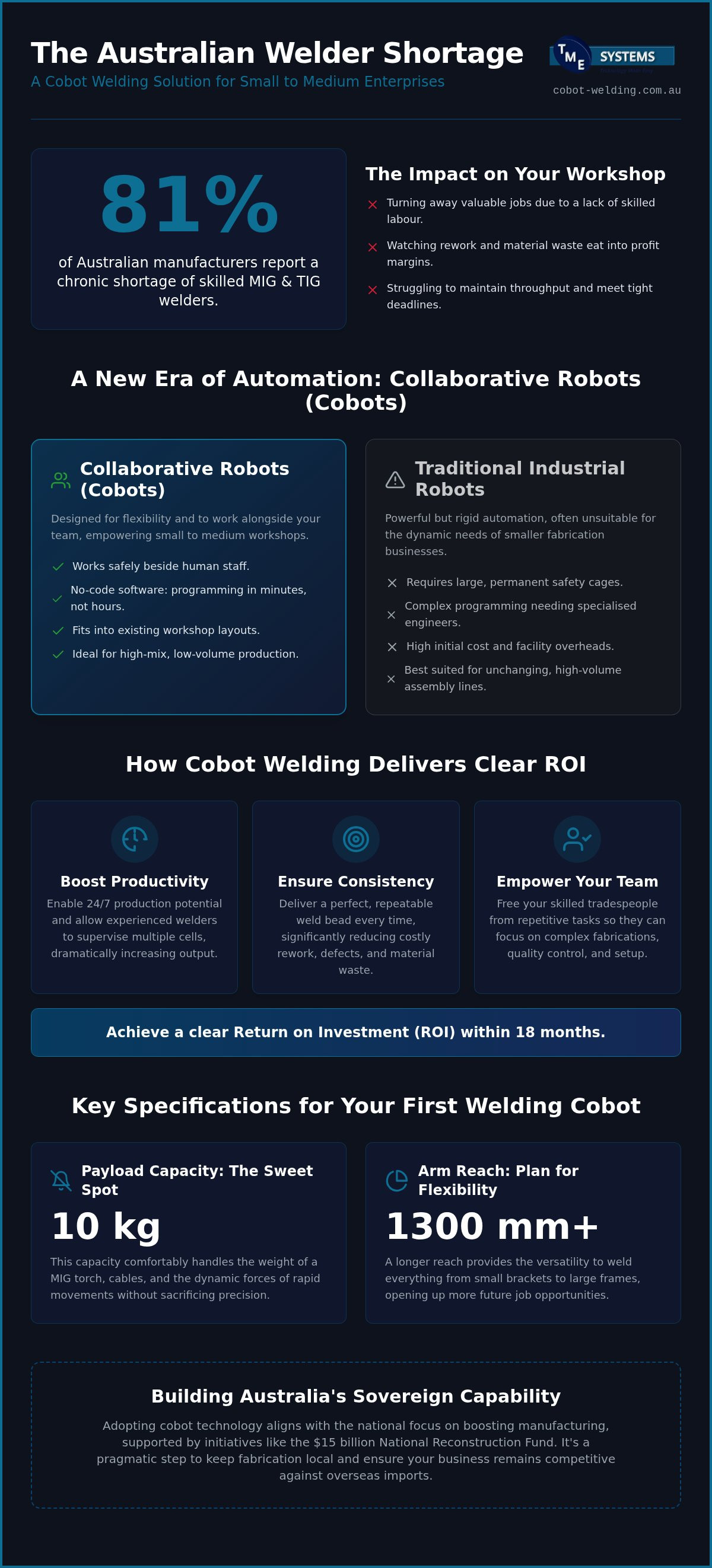

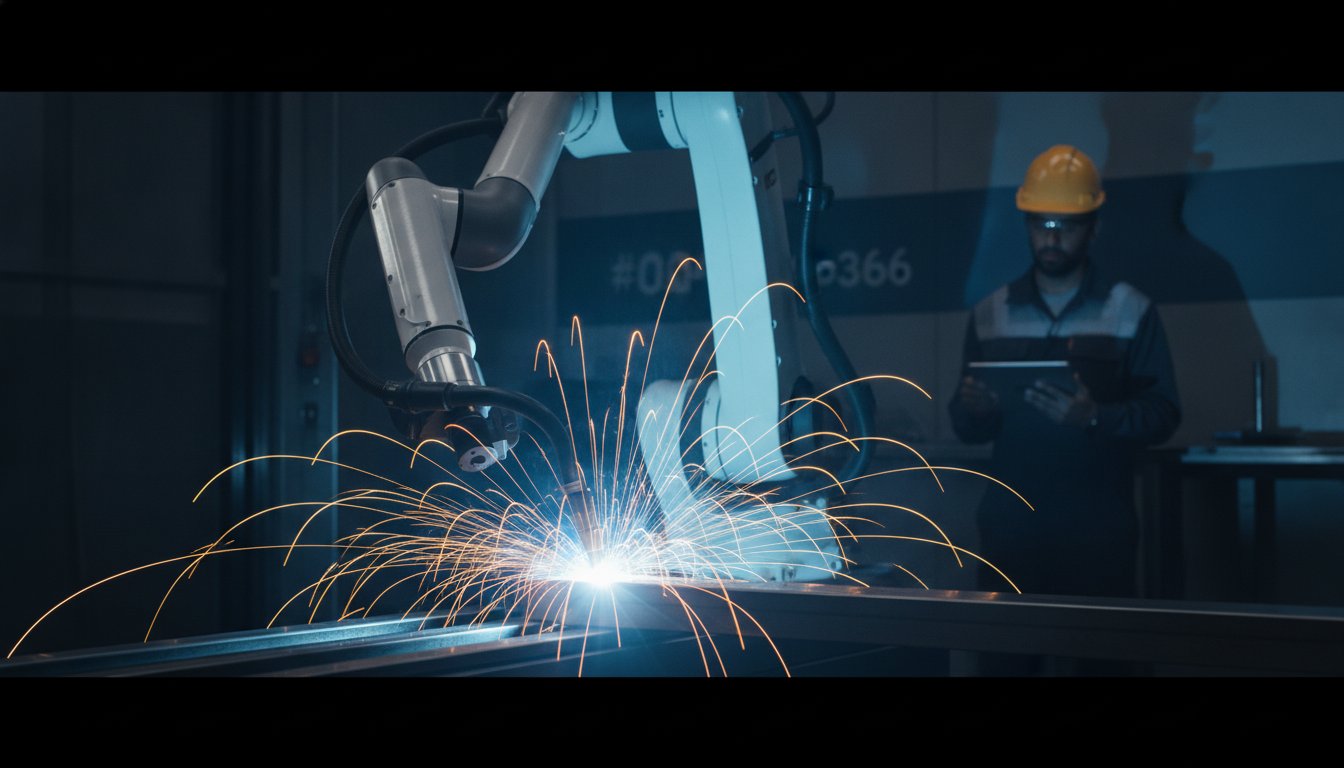
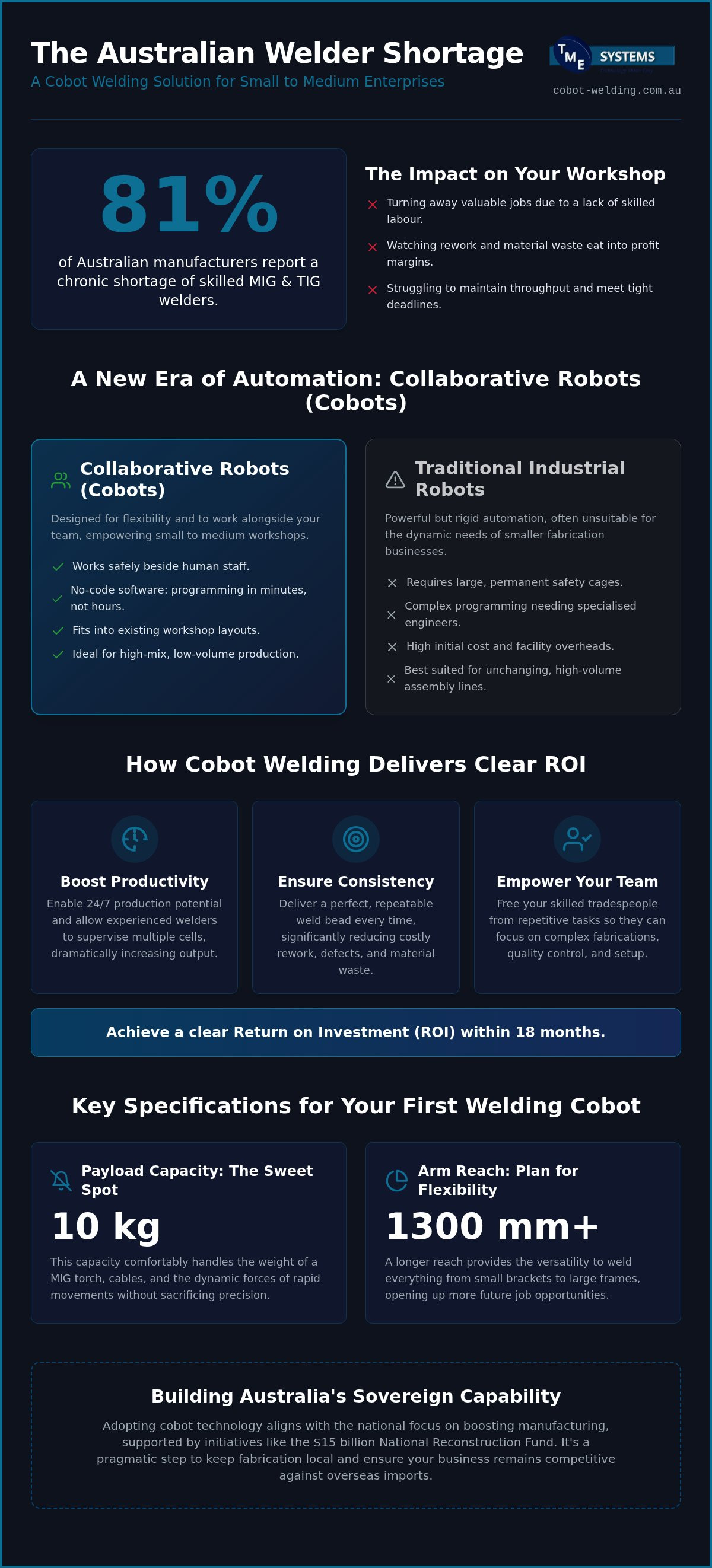
With 81% of Australian manufacturers reporting a chronic shortage of skilled MIG and TIG welders, the pressure to maintain throughput has never been higher. If you're running a workshop, you've likely felt the sting of turning away jobs or watching rework eat into your profit margins. While traditional industrial robots were once the only answer, their high costs and complex safety cages often made them a poor fit for a nimble production line. This is where cobot welding for small business australia has changed the game, offering a way to scale up your capacity without needing a degree in computer science.
We understand the hesitation that comes with adopting new technology, especially the fear of workshop downtime caused by difficult programming. It’s a valid concern, but the landscape in 2026 is different. This guide will help you select the right cobot brands and no-code software options to ensure your team stays in control. You’ll discover how to choose a system that delivers consistent weld quality and a clear ROI within 18 months, allowing your experienced tradespeople to focus on complex tasks while the cobot handles the repetitive runs.
Key Takeaways
- Learn why collaborative welding cells are the practical answer to the chronic welder shortage, allowing your best tradespeople to manage multiple machines simultaneously.
- Discover how cobot welding for small business australia has been simplified through no-code software, reducing complex programming tasks from hours to just a few minutes.
- Understand how to evaluate payload capacities and reach to ensure your new system handles MIG torches and specific fabrication tasks with ease.
- Identify the criteria for choosing a brand that integrates seamlessly with your existing workshop gear and supports a high-mix, low-volume production model.
- Gain a clear roadmap for successful implementation, from initial on-site proof of concept to full operator training and ongoing support.
Why Collaborative Welding is Redefining Australian Manufacturing
The manufacturing landscape in Australia is undergoing a significant shift. For decades, automation was synonymous with massive industrial robots bolted to the floor behind high steel fences. These systems were designed for high-volume automotive lines, not the flexible needs of a local fabrication shop. Today, collaborative robots (cobots) are bridging that gap. They offer a versatile solution that fits into existing workspaces without the need for massive safety cages or specialised robotics engineers. This flexibility is exactly why cobot welding for small business australia has become a viable path to growth.
The ongoing welder shortage is no secret. With 81% of manufacturers reporting difficulties in finding skilled staff, the pressure is on. Finding a qualified MIG or TIG welder is a major hurdle for any workshop looking to scale. Implementing collaborative cells allows your most experienced tradies to move away from repetitive, low-value beads. Instead, they can oversee multiple machines, focusing their expertise on setup, quality control, and the complex jobs that truly require a human touch. This shift doesn't replace workers. It empowers them to be more productive while keeping fabrication work on Australian shores.
The Australian Government's $15 billion National Reconstruction Fund highlights the national focus on boosting manufacturing capabilities. By adopting these tools now, small workshops aren't just buying a machine; they're building sovereign capability. It's a pragmatic step toward ensuring your business remains competitive against overseas imports that benefit from lower labour costs.
The Economic Case for Small Business Automation
Consistency is the primary driver of profit in a workshop. Human fatigue leads to variations in weld quality, which results in costly rework and wasted material. A cobot cell delivers the same bead every time, day or night. By improving welding productivity with cobots, small businesses can move toward a 24/7 production potential. Even if the machine only runs for a few hours after the team goes home, that extra throughput can be the difference between meeting a deadline and losing a contract. It's about making your operational costs predictable in an era of rising labour rates and energy prices.
Safety Standards in the Australian Workshop
Safety remains the top priority on any Australian production line. Unlike traditional robots, collaborative systems use sophisticated force-limiting sensors. If the arm makes contact with a person, it stops instantly. This allows these machines to work side-by-side with your staff, provided a proper risk assessment is conducted. In 2026, staying compliant means looking at the latest national Work Health and Safety (WHS) guidelines and ensuring your cell meets AS/NZS 4024.1 standards. These units are designed to integrate into your current layout without a total refit. You don't need to rebuild the workshop; you just need to organise it more effectively to support a collaborative workflow.
Evaluating Top Cobot Welding Brands in the Australian Market
When you start looking at cobot welding for small business australia, you'll quickly encounter offerings from several leading global manufacturers. Each brand has its strengths, but hardware specs are only one part of the puzzle. In a busy workshop, you don't just need a robot; you need a tool that works with your existing gear. Most small fabrication shops find that a 10kg payload capacity is the sweet spot. While a MIG torch might only weigh a few kilograms, the arm must also handle the weight of the cables and the forces generated during rapid movements without losing precision.
Reach is another critical factor that dictates your production flow. If you're welding small brackets, a compact arm works well. However, if you're tackling larger frames or trailer components, you'll need an arm with a reach of 1300mm or more. Choosing an arm that is too short forces your team to constantly reposition parts, which adds unnecessary time to every job. It's often better to have a slightly larger reach than you think you need, as it provides the flexibility to take on a wider variety of contracts in the future.
Hardware reliability is vital, but local support is what keeps the lights on. If a sensor fails or a cable wears out, you can't afford to wait weeks for parts to arrive from overseas. The National Robotics Strategy highlights the push for a stronger local tech ecosystem, and this includes the service technicians who support your workshop. Always prioritise brands that have a proven track record of local spare parts and on-the-ground integration support in Australia.
Hardware Durability for Rugged Environments
Australian workshops aren't clean-room environments. They're hot, dusty, and full of grinding grit. You should check the IP (Ingress Protection) rating of any arm you consider. An IP54 rating is generally the minimum required to protect the internal electronics from the fine metallic dust common in metalwork. Additionally, ensure the cobot is compatible with your current power sources. A truly flexible system should plug into your existing welding power sources without requiring a complete overhaul of your current setup.
Selecting the Right Arm for Your Jobs
Precision starts with a stable foundation. A heavy-duty welding table is essential to ensure the cobot maintains accuracy over thousands of cycles. You also need to consider cable management. High-quality torch leads can be stiff, and if they aren't managed correctly, they can pull on the arm and trigger false safety stops. If you're unsure which configuration fits your floor space, seeing a mobile demo system in action can help you visualise how the arm handles your specific torch and part sizes before you commit to a purchase.
The Software Layer: Why No-Code Teaching is a Game Changer
While hardware specs like payload and reach are important, the software interface is what your team will interact with every single day. For cobot welding for small business australia, the biggest barrier isn't usually the price of the arm; it's the fear of complex coding. Traditional industrial robots required a specialist to spend hours typing lines of code into a clunky teach pendant. In contrast, modern no-code systems allow a welder to take the lead using an interface that feels more like a smartphone than a computer.
Lead-through teaching is the standout feature that makes this possible. Instead of using a joystick or typing coordinates, your welder simply puts the robot in "free-drive" mode and moves the torch by hand to the start and end points. By clicking a button on the tool flange, they record the path. This physical interaction makes the technology feel like an extension of their existing skills. It bridges the gap between traditional craftsmanship and modern automation without requiring a career change into IT.
Industry bodies like Weld Australia on cobot benefits for SMEs highlight how this accessibility drives shop-floor productivity. It drastically reduces the "Time-to-First-Weld." For a new, one-off project, you can have the machine programmed and striking an arc in minutes. This makes automation viable for small batches that were previously too expensive or time-consuming to automate. It ensures that cobot welding for small business australia remains a practical, hands-on solution for workshops that value efficiency.
Empowering Your Existing Tradies
You don't need to hire a software engineer to run a collaborative cell. The beauty of no-code robot welding software is that it turns your best tradies into "Robot Supervisors" in just a few hours of training. It removes the back-breaking, repetitive welds from their day, allowing them to focus on high-level fabrication and assembly. This shift often improves job satisfaction because the team feels they're learning a future-proof skill without the stress of learning to code. It's about augmenting their talent, not replacing it.
Precision Control Without the Jargon
Intuitive touchscreens replace technical jargon with clear, visual controls. You can adjust voltage, travel speed, and weave patterns on the fly. Most systems allow you to save "weld recipes" for recurring jobs. If a specific bracket comes back into the shop six months later, you simply load the recipe and press start. You can even visualise the path on the screen before the arc strikes. This helps eliminate wasted material and ensures the first part is just as good as the last. If you're ready to see these tools in action, you can enquire about a mobile demo to test the software on your own parts.
How to Choose the Right Brand for Your Fabrication Needs
Selecting the right brand for cobot welding for small business australia isn't just about picking the most famous name. It's about finding a system that fits your specific product mix. If your workshop handles a high volume of identical parts, almost any industrial robot will do. However, most Australian fabrication shops thrive on high-mix, low-volume work. In this environment, the real winner is the brand that allows for the fastest changeovers. You need to look past the arm's colour and focus on how it integrates with your existing power sources and workshop flow.
A critical step in the selection process is the "Try Before You Buy" rule. It's one thing to watch a video of a robot welding a perfect seam in a lab; it's another thing entirely to see it handle your specific jigs and material thicknesses. This is why a mobile welding robot demonstration is essential. It provides an on-site proof of concept, allowing your team to interact with the hardware before any major investment is made. This hands-on approach eliminates the guesswork and ensures the system can actually do what the brochure claims.
When calculating the Total Cost of Ownership (TCO), don't just look at the initial purchase price. A cheaper arm from an overseas supplier might seem attractive, but the hidden costs of poor integration and lack of local support will quickly add up. Consider the costs of operator training, safety audits, and ongoing maintenance. While a typical cobot system might see a return on investment within 12 to 24 months, that timeline only holds true if the machine stays running. Reliability and local backup are your best defences against workshop downtime.
Small Batch Profitability and Changeover Speed
Profitability in a job shop depends on how quickly you can move from one task to the next. Some brands fail here because their software is too rigid or their hardware requires complex recalibration between jobs. You should evaluate how quickly your team can swap out jigs and load a new program. Using modular tables and flexible jigging systems can significantly reduce setup times. If it takes longer to set up the robot than it does to weld the part by hand, you've chosen the wrong system for your needs.
Local Support and Integration Expertise
You need welding system integration specialists who understand the unique requirements of cobot welding for small business australia. This includes ensuring your cell meets the AS/NZS 4024.1 safety standards and can withstand our local environmental conditions. Local expertise means having access to a technical helpdesk in your own time zone and a steady supply of spare parts. Before committing, check the brand's track record with other Australian fabricators to ensure they offer the long-term partnership your business requires.
Successful Implementation: Integration and Training
Successfully adopting cobot welding for small business australia requires more than just unboxing a robot arm. It's a structured journey that transforms your workshop floor into a more efficient, automated production line. This transition works best when treated as a partnership rather than a simple transaction. By customising collaborative robot welding cells to fit your specific workflow, you ensure the technology adapts to your team, not the other way around. It's about refining the process until it feels like a natural part of your daily operations.
The role of professional onboarding can't be overstated. It's the key to securing a fast ROI. When your staff feel confident from day one, you avoid the risk of new gear sitting idle. Providing on-site cobot welder training allows your tradespeople to learn in their own environment using their own parts. This hands-on approach builds long-term confidence. It ensures the machine is striking arcs and making money as quickly as possible, turning a technical investment into a practical workshop win.
The Integration Roadmap
Before the arm arrives, a thorough site assessment is essential. You'll need to check your power supply, shielding gas lines, and available floor space. Most collaborative systems are compact, but they still need to be positioned for maximum efficiency. Connecting the cobot to your existing MIG or TIG power source should be a seamless process. The goal is to create a cell where the operator can easily load parts and monitor the weld without disrupting the rest of the workshop's flow. Proper planning at this stage prevents headaches later.
Ongoing Support and Scaling Up
Once your first cell is running, the focus shifts to reliability. Establishing a routine maintenance schedule is the best way to avoid unexpected downtime. This usually involves simple checks on cable wear, torch alignment, and software health. As your throughput increases, you might find that one cell isn't enough. Scaling from one station to multiple automated stations becomes much easier once your team has mastered the initial setup. Modern systems also offer remote support. This allows technicians to help with troubleshooting or software updates without needing to visit the site every time. This long-term support is what makes cobot welding for small business australia a sustainable strategy for local manufacturers.
Taking the Next Step Toward Automated Fabrication
The transition to automation doesn't have to be a leap into the unknown. As we've explored, the key to successful cobot welding for small business australia lies in choosing a system that prioritises your operators over complex code. By focusing on intuitive no-code software and ensuring you have local integration support, you can turn your existing team into high-output supervisors without the need for specialised IT skills. This approach keeps your fabrication work competitive and your staff engaged.
The most reliable way to verify these benefits is to see them in action on your own workshop floor. We provide mobile demonstration units that offer a practical proof of concept before you commit to any major investment. Our specialised no-code software is built for the rugged reality of Australian fabricators, and we include full integration and on-site training to ensure your team feels supported at every stage. This ensures your new cell delivers a consistent return from the very first arc.
Don't let the fear of complex programming hold your workshop back from its full potential. Book a Mobile Demo to See No-Code Welding in Your Workshop today and discover how simple it is to boost your productivity. Your tradespeople already have the talent; we simply provide the tools to help them scale it.
Frequently Asked Questions
What are the best cobot welding brands available in Australia for 2026?
Leading brands in the Australian market for 2026 include Universal Robots, FANUC, and ABB. These manufacturers are widely supported by local integrators and offer the reliability needed for industrial use. While each has specific technical strengths, the best choice for your workshop often depends on the software interface and the availability of local spare parts. Choosing a brand with a strong Australian presence ensures your machine stays productive for the long term.
Do I need a specialised programmer to run a welding cobot?
You don't need a specialised programmer to run these systems if you use modern no-code software. These interfaces allow your existing welders to "teach" the robot by moving the arm manually to set points. This approach removes the need for complex coding knowledge. It turns your skilled tradespeople into supervisors who can set up a new job in minutes rather than hours, making automation accessible to everyone.
Can a cobot welding system work with my existing MIG or TIG welder?
Yes, most collaborative cells are designed to be "welder agnostic" and can connect to your current power source. Whether you use Fronius, Kemppi, Miller, or Lincoln Electric, the integration process involves linking the cobot's controller to the welder's interface. This flexibility is a core benefit of cobot welding for small business australia, as it prevents the need for a total and expensive equipment overhaul.
How much space does a collaborative welding cell actually require in a workshop?
A typical collaborative welding cell requires very little floor space, often occupying a footprint similar to a standard manual welding bench. Because these robots use force-limiting sensors, they usually don't need the large, fixed safety cages required by traditional industrial robots. This allows you to fit the system into your existing layout without significant structural changes or losing valuable workshop real estate that you need for other tasks.
What is the typical ROI for an Australian small business investing in a cobot?
Most Australian small businesses see a full return on investment within 12 to 24 months. This timeline is achieved by reducing rework, improving weld consistency, and allowing your team to handle larger contracts. High-utilisation shops running multiple shifts can sometimes see a return even sooner. It's a pragmatic way to scale throughput while keeping your operational costs predictable and manageable in a competitive fabrication market.
Is cobot welding safe to use without a safety cage in a busy shop?
Cobots are designed to work safely alongside humans because of their built-in force-limiting sensors. If the arm encounters an obstruction, it stops instantly to prevent injury. However, you must still conduct a thorough risk assessment for your specific application. Ensuring your setup meets the AS/NZS 4024.1 safety standards is essential for maintaining a compliant and safe workshop environment in 2026, especially in high-traffic areas.
How long does it take to train a tradie to operate a no-code cobot system?
Training a tradesperson to use a no-code system typically takes only a few hours of hands-on instruction. Because the software uses intuitive touchscreens and hand-guided teaching, the learning curve is very shallow. Most operators are striking their first automated arcs by the end of the first day. This fast onboarding is critical for minimising downtime and ensuring your team feels confident using cobot welding for small business australia immediately.
What happens if the cobot needs technical support or spare parts in Australia?
Local technical support is vital for keeping your production line moving. Choosing an Australian partner ensures you have access to a helpdesk in your time zone and a local stock of spare parts. If a component fails, you won't be left waiting for weeks for an overseas shipment to arrive. Reliable local support is the backbone of a successful transition to automated welding for any Australian fabrication shop.