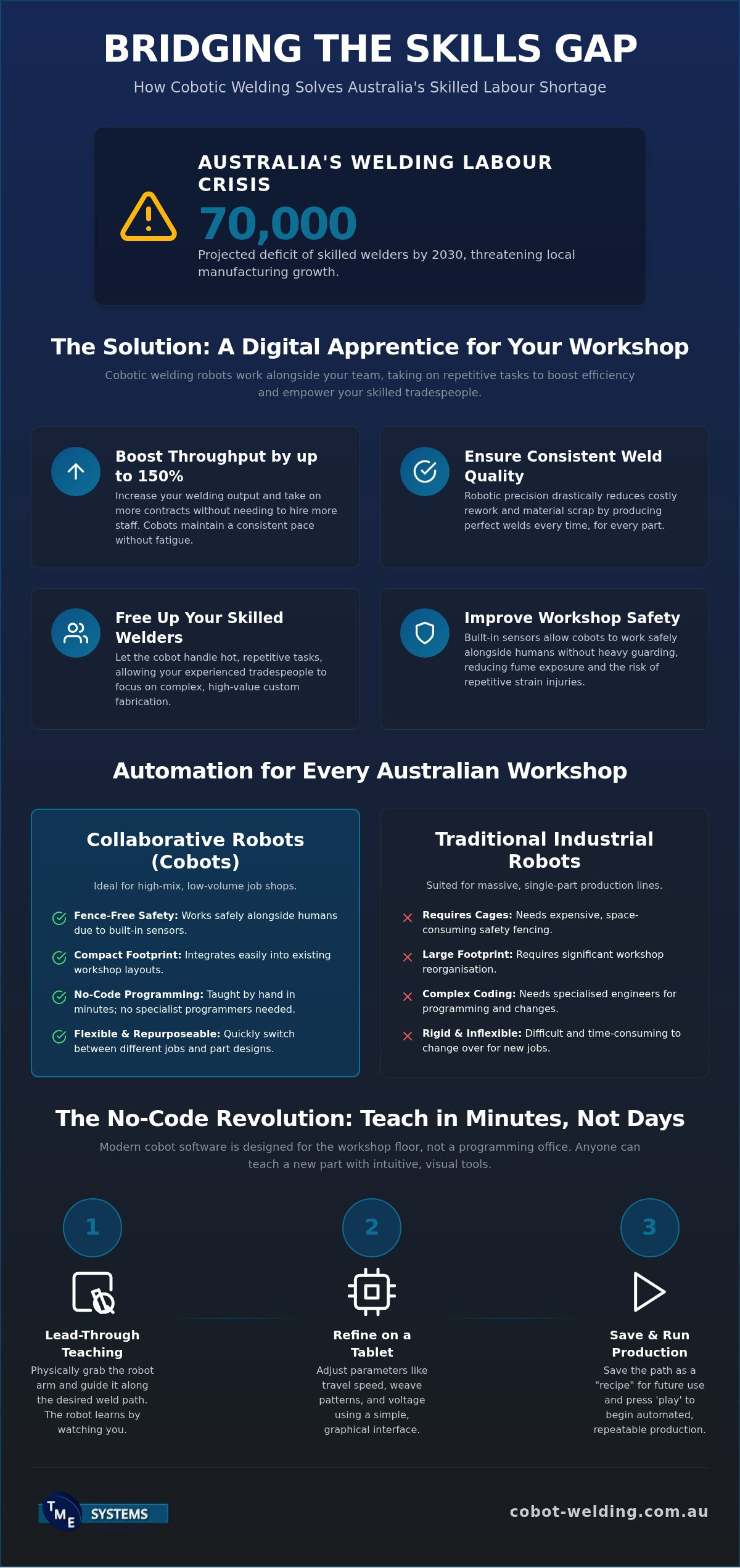

By 2030, Australia is projected to face a deficit of 70,000 welders, making the adoption of cobotic welding robots a practical necessity rather than a futuristic luxury. You've likely felt the pressure of this labour shortage first-hand, perhaps while staring at a pile of costly rework or turning away jobs because you simply don't have the hands to do them. It's a common worry that automation is only for the big players with massive budgets and dedicated programmers.
This guide will show you that modern automation is now within reach for every Australian workshop. You'll discover how no-code software allows your current team to teach a robot a new path in minutes, not hours. We'll explore how these digital apprentices boost throughput by up to 150%, ensure consistent weld quality, and help you meet the 2026 welding fume exposure limits while keeping your best tradespeople focused on the complex work they love. By bridging the gap between manual skill and robotic precision, you can scale your production without needing to hunt for staff that aren't there.
Key Takeaways
- Understand how cobotic welding robots act as digital apprentices to handle repetitive tasks, freeing up your skilled tradespeople for more complex work.
- Learn how no-code interfaces and lead-through teaching methods eliminate the need for specialised programming knowledge on the workshop floor.
- Identify the most "cobot-friendly" parts of your production line to ensure you're automating the right 80% of your workload for maximum impact.
- Discover the practical steps for organising your workshop layout and utilities to support a seamless transition to automated welding.
- See why an on-site mobile demonstration provides the clearest proof of concept for calculating your long-term return on investment.
What are Cobotic Welding Robots and Why Does Australia Need Them?
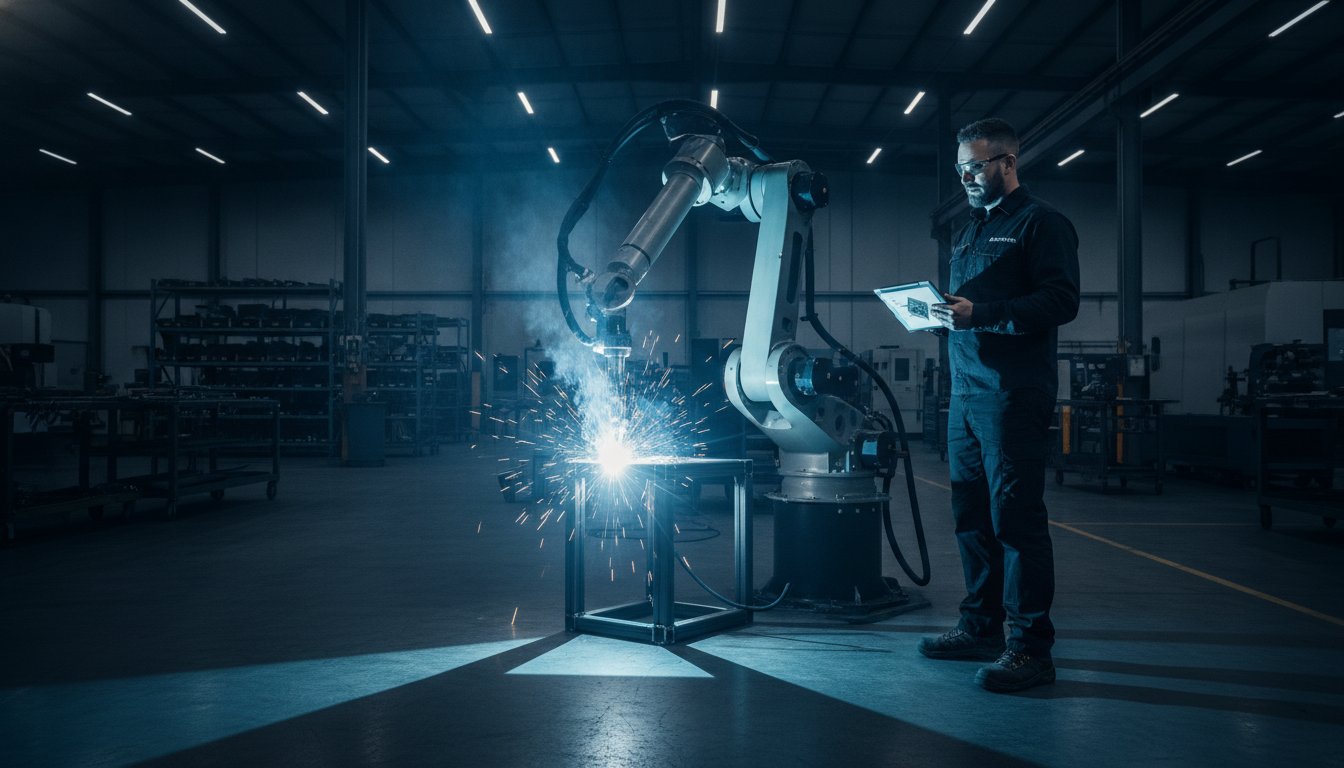
At its core, a collaborative robot (cobot) is a machine designed to work safely alongside humans in a shared workspace. Unlike traditional robots that require heavy guarding and light curtains, cobotic welding robots are built with sensitive sensors that stop the machine instantly if they detect an obstruction. Think of them as a "digital apprentice." They don't replace your experienced welders; they take over the hot, repetitive, and mundane tasks that lead to fatigue and errors. This allows your team to focus on the custom, high-value fabrication that requires a human eye and years of experience.
Australia's manufacturing sector is currently facing a unique set of hurdles. With a projected deficit of 70,000 welders by 2030, the traditional approach of "just hiring more staff" isn't a viable strategy for growth anymore. Most local workshops don't run massive production lines for a single part. Instead, they handle a "high-mix, low-volume" workload, where part designs change daily. Cobots are the perfect fit for this environment because they're flexible, easy to move, and can be repurposed for different jobs in minutes rather than days.
Collaborative vs. Traditional Industrial Robots
Traditional industrial robots are often a poor fit for the average Australian job shop. They require massive floor space, expensive safety fencing, and complex programming that usually needs an external specialist. In contrast, cobots have a compact footprint and can often be integrated into your existing layout without shifting every workbench. Their fence-free operation means your operators can stay close to the work, supervising the process and making adjustments on the fly. It's about augmenting your current workshop capacity, not rebuilding it from scratch. This makes automation accessible for workshops that previously thought it was out of reach.
The Economic Case for Australian Fabricators
The financial benefits of cobotic welding robots go well beyond just saving on labour hours. Consistent robotic precision means you drastically reduce the cost of rework and scrap, which are silent profit killers in any fabrication business. A well-integrated cobot can increase your welding throughput by up to 150%, allowing you to take on more contracts with the same number of staff. There's also a cultural win: using modern, tech-forward tools makes the trade more attractive to younger workers. By providing a cleaner, safer, and more innovative environment, you're better positioned to recruit the next generation of Australian tradespeople who expect modern tools on the workshop floor.
The No-Code Revolution: Teaching Robots Without Coding
Traditional automation often felt like a walled garden. You needed an engineer to change a single line of code just to move a weld point by two millimetres. The no-code revolution has changed that. For cobotic welding robots, the software is designed for the person on the workshop floor, not a computer scientist. This is what we call "no-code", an interface where complex logic is hidden behind simple, visual commands. It removes the fear of "breaking the robot" and puts the power back into the hands of your most experienced staff.
The standout feature for most fabricators is the lead-through method. Instead of using a joystick or coordinates to navigate 3D space, you physically grab the robot arm and guide it along the desired weld path. You're essentially showing the machine where to go, just as you'd show a new apprentice. This intuitive approach is the backbone of no-code robot welding software, making it possible to set up a new part in minutes. This speed is what allows job shops to automate even their smallest batches profitably, as job changeovers no longer eat into your production time.
Automated Welding Path Adjustment
Once a path is recorded, the software doesn't lock you in. You can refine parameters like travel speed, weave patterns, and voltage directly from the interface. If you find the heat input is too high on a specific corner, you adjust it on the fly. These settings can be saved as "recipes" for recurring jobs, ensuring that the same quality is achieved six months later. Research into the benefits of advanced robotics technology shows that this level of flexibility is what drives real-world ROI. It keeps the arc-on time high even when your product mix changes daily.
Empowering Your Existing Team
This technology doesn't sideline your skilled welders; it empowers them. Your best tradespeople become robot supervisors, using their deep knowledge of metallurgy and joint fit-up to oversee multiple cobotic welding robots. The learning curve is remarkably short. Most operators can become proficient in basic path teaching within a couple of days. By removing the barrier of complex coding, you can organise your team's workflow so that the machines handle the repetitive runs while your people tackle the bespoke projects that require a human touch.
Choosing the Right Collaborative Robot Welding Cells
Integrating cobotic welding robots into your workshop starts with selecting a system that matches your specific production profile. A complete collaborative robot welding cell typically includes the robot arm, a dedicated welding power source, a torch, and the control software. The goal is seamless communication between these parts. If the robot doesn't know exactly when the arc is established or if the wire feeder stutters, your automation will struggle. High-quality integration ensures that every component works in harmony to produce a clean, consistent bead every time.
Before you commit to a system, look at your current workload. We often suggest identifying the "cobot-friendly" 80% of your work. These are the parts with straight lines, simple curves, and repeatable fit-ups. Don't try to automate the most complex 20% of your jobs first. Start where the repetition is highest. Whether you need MIG for heavy structural work or TIG for thin-gauge stainless steel, your power source must be compatible with the robot's digital interface to allow for real-time parameter changes. This compatibility is what allows the system to adjust on the fly as conditions change.
Turnkey vs. Custom Integrated Solutions
For most Australian workshops making their first move into automation, a turnkey solution is the smartest choice. These are pre-configured units where the integration work is already done for you. You get a ready-to-use system that can start producing almost immediately after setup. Custom integration is better suited for highly specialised tasks, such as welding exotic alloys or working within non-standard jigging. However, the simplicity of a turnkey cell reduces your initial risk and gets your team up to speed much faster. It's a pragmatic way to see immediate results without a long development cycle.
Evaluating Reach and Payload for Your Workshop
You need to measure your largest parts against the cobot's working envelope. It's a common mistake to only look at the horizontal reach. Remember to account for the height of your jigs and the orientation of the torch. Payload is another critical factor. It isn't just about the weight of the torch; you must consider the tension and drag of the welding cables as the arm moves. A compact footprint is essential for many local shops where floor space is at a premium. Choosing a system that fits into your existing layout without a massive overhaul ensures a smoother transition and a faster return on investment for your cobotic welding robots.
Organising Your Workshop for Cobot Success
Success with cobotic welding robots isn't just about the machine; it's about how that machine fits into your daily rhythm. Physical placement is critical. If you tuck the cell into a dark corner far from the prep bench, you'll lose time moving parts back and forth. Ideally, the robot should be positioned between your tacking area and the outbound pallet. This creates a logical flow where a human preps the part, the robot welds it, and the finished product moves straight to the next stage without backtracking.
You also need to consider your utilities. A manual welder might only have the arc on for 30% of their shift. A robot, however, can easily reach 85% arc-on time. This means your gas supply and wire drums will empty much faster. Ensure your gas manifold can handle continuous flow and consider using bulk wire packs to reduce changeover downtime. Working with welding system integration specialists at this stage is a smart move. They help ensure your power and gas lines are sized correctly for the increased duty cycle.
Safety remains a top priority. While cobots are designed for fence-free operation under AS/NZS 4024.1, you still need a thorough risk assessment. This includes managing glare for other workers and addressing fume extraction. With new Australian exposure limits of 1 mg/m³ coming into effect on December 1, 2026, automation provides a clear advantage. It physically separates the operator from the weld plume, making it easier to maintain a healthy workshop environment. If you're unsure where to start, you can contact our team for a workshop assessment to map out your transition.
The Onboarding and Training Process
Transitioning to automation is a team effort. We've found that on-site cobot welder training is the most effective way to build confidence. Identify a "Cobot Champion" in your team; this is usually a solid welder who also has an interest in technology. They'll be the one to lead the charge. Set realistic goals for the first 30 days. Don't try to automate everything at once. Focus on getting one high-volume part running perfectly by the end of the first week.
Maintenance and Long-Term Support
Robots are reliable, but they aren't "set and forget." Daily maintenance is simple but vital. Operators should check for spatter buildup on the nozzle and ensure the wire tip is in good condition every morning. Because your business relies on this throughput, local technical support is essential. Having access to Australian-based spare parts and software updates ensures that your cell stays productive for years. Regular software updates are particularly useful, as they often unlock new welding features or path-smoothing algorithms that refine your finish even further.
Taking the First Step: Mobile Demos and ROI
Investing in cobotic welding robots is a big decision, and we know that Australian workshops prefer to see results before they commit. You shouldn't have to rely on a glossy brochure or a video filmed in a laboratory. A mobile welding robot demonstration brings the technology directly to your floor. This allows you to test your actual parts, using your own jigs and materials. It’s the ultimate proof of concept, showing exactly how the machine handles your specific joint configurations and material thicknesses before you spend a cent on a permanent installation.
When calculating your return on investment, it's vital to look beyond simple labour savings. In a market where skilled welders are increasingly hard to find, the real value lies in consistency and throughput. Industry data suggests that many Australian businesses achieve a full return on their investment within 6 to 18 months. This is driven by a massive reduction in rework and the ability to keep the arc on for up to 85% of the shift. Improving welding productivity with cobots fundamentally changes how you bid for work. You can commit to larger, more repetitive contracts with confidence, knowing your costs are fixed and your quality is guaranteed.
Seeing is Believing: The On-Site Demo
The mobile demo isn't just for the management team; it’s for the tradespeople who will be using the tool every day. Letting your team grab the robot arm and teach a path themselves breaks down the "man versus machine" barrier. It’s much easier to get buy-in from the workshop floor when they see the cobot as a tool that makes their job less strenuous and more precise. During the demo, you can identify specific bottlenecks that are slowing down your production, allowing us to tailor the integration to solve those exact problems. It’s a pragmatic, hands-on way to de-risk your automation journey.
A Pragmatic Path to Automation
You don't need to automate your entire workshop overnight. Most successful fabricators start small: one cell, one operator, and one shift. This allows you to refine your processes and build internal expertise without overwhelming the business. As you see the results, you can scale up, adding more units to handle different product lines. Partnering with TME Systems means you have a local partner for training and support every step of the way. Before you start, run through this final checklist:
- Are your parts repeatable and your jigs accurate enough for robotic consistency?
- Have you identified a "Cobot Champion" in your team to lead the transition?
- Is your workshop power and gas supply ready for high duty-cycle welding?
Building a More Resilient Workshop Floor
The path to automation in Australian fabrication no longer requires a team of programmers or a massive factory floor. By adopting cobotic welding robots, you aren't replacing your team's expertise; you're giving them a digital tool that handles the heat and repetition of high-volume runs. Our no-code software ensures your welders stay in full control of every bead, while our turnkey cells are specifically designed to withstand the realities of local industrial conditions.
Whether you're looking to overcome the chronic skills shortage or simply want to boost your workshop's throughput, the transition is more accessible than ever. We provide full on-site training and integration support across the country to ensure your investment delivers a return from day one. Seeing the technology in action on your own parts is the most practical way to de-risk the move. It allows your staff to get hands-on experience and see the results first-hand.
Ready to see how automation fits into your production line? Book a Mobile Welding Robot Demonstration for Your Workshop today. It's time to empower your team and secure your workshop's future with confidence.
Frequently Asked Questions
How hard is it to program a cobotic welding robot for short runs?
Programming for short runs is straightforward and can often be completed in under ten minutes using lead-through teaching. Instead of writing lines of script, an operator physically moves the arm to the start and end points of the weld. The software then generates the path automatically. This makes cobotic welding robots highly efficient for small batches where traditional industrial robots would be too slow to set up. It puts the control back into the hands of the welder.
Do I need a safety cage for a collaborative welding robot in Australia?
You generally don't need a physical safety cage, but a formal risk assessment is a mandatory requirement under Australian standard AS/NZS 4024.1. Because these robots have built-in collision detection, they can operate in shared spaces safely. However, you still need to account for secondary risks like welding glare, hot sparks, and fume exposure. In many cases, simple welding screens and proper extraction are enough to ensure a compliant and safe collaborative environment for your team.
Can cobots weld aluminium and stainless steel as well as mild steel?
Yes, these systems are capable of welding aluminium and stainless steel provided they are paired with a compatible power source. The robot itself is simply the delivery mechanism; the weld quality comes from the integration of the power supply and the software recipes. For aluminium, you would typically use a MIG setup with a push-pull torch. For thin stainless steel, a TIG integration might be preferred to maintain the precision and aesthetic finish required for high-end fabrication.
What is the typical ROI timeframe for an Australian fabrication shop?
Most Australian workshops see a full return on investment within 6 to 18 months of installation. This timeframe is achieved through a combination of increased arc-on time and a significant reduction in rework costs. While a manual welder might spend a large portion of their day on prep and positioning, the robot keeps the torch moving consistently. This boost in throughput allows shops to take on more contracts without needing to find additional skilled staff in a tight labour market.
Does a cobot replace a qualified welder?
A cobot does not replace a qualified welder; it acts as a digital apprentice that handles repetitive, low-skill tasks. Your experienced tradespeople are still needed to set the parameters, design the jigs, and oversee the quality of the output. By offloading the mundane work to the machine, your best staff can focus on complex, bespoke projects that require genuine human problem-solving. It's about increasing the capacity of your existing team rather than reducing your headcount.
What happens if the cobot hits something or a person walks into its path?
If a collision occurs, the robot's internal sensors detect the resistance and stop all movement instantly. This force-limiting technology is what defines cobotic welding robots and makes them safe for fence-free operation. Once the obstruction is cleared, the operator can easily reset the system and resume the weld. This provides peace of mind on a busy workshop floor where people and equipment are constantly moving in close proximity to the automated cell.
What kind of power and gas setup do I need for a welding cell?
Most cells require a standard three-phase power supply for the welder and a clean, stable 240V connection for the robot controller. Because the robot operates at a much higher duty cycle than a human, we recommend using bulk gas manifolds and large wire drums. This prevents frequent interruptions to production. Your air supply should also be dry and regulated if the system uses pneumatic cleaning stations or torch reamers to keep the nozzle clear during long runs.
Is there local technical support available for these robots in Australia?
Yes, local support is a cornerstone of a successful automation strategy. TME Systems provides national coverage for integration, operator training, and ongoing technical assistance. Having access to Australian-based spare parts and technicians means you aren't left waiting for international shipments if a component needs replacing. This local partnership ensures your workshop stays productive and any technical queries are handled by experts who understand the specific needs of the Australian manufacturing sector and its safety standards.