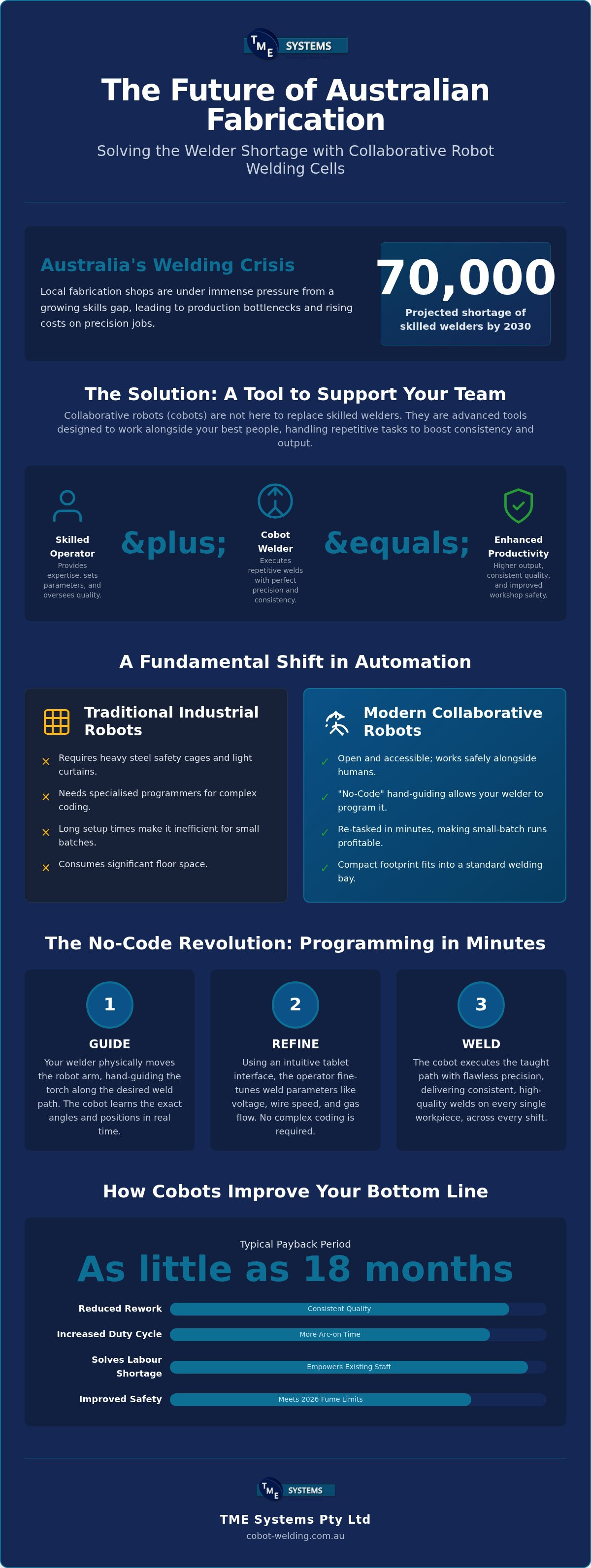

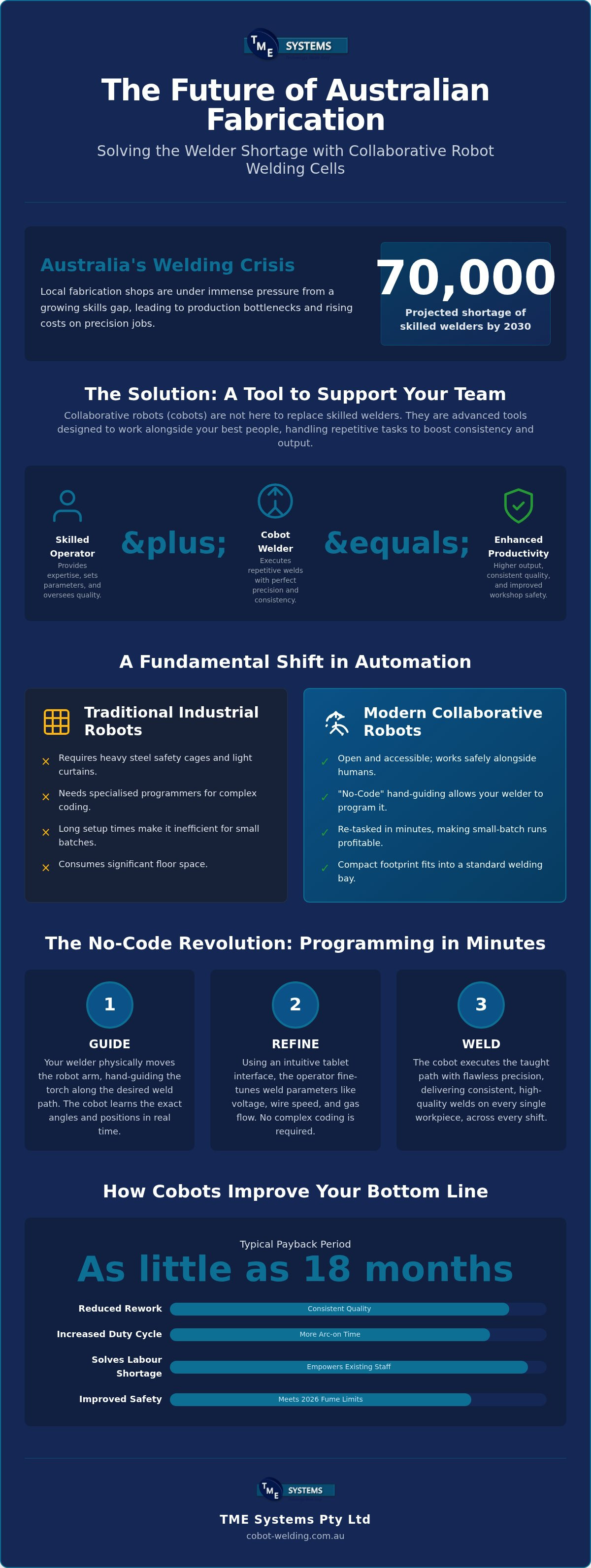
Australia is projected to face a deficit of 70,000 skilled welders by 2030, a gap that puts immense pressure on local fabrication shops to maintain output. You have likely felt this pinch firsthand, struggling to find experienced staff while watching rework costs climb on precision jobs. Traditional automation often felt out of reach for small-batch runs, but collaborative robot welding cells are changing the reality of the workshop floor. TME Systems Pty Ltd understands these systems aren't designed to replace your skilled tradespeople; they are practical tools built to support them.
We understand that the idea of "robots" often brings up concerns about complex programming and long setup times. However, by using no-code teaching software, your team can re-task a robot in minutes rather than days. In this guide, you will discover how to achieve consistent weld quality across every shift and solve labour shortages while keeping your operators safe. We will walk you through the integration process, from meeting the new 2026 welding fume exposure limits to choosing a system that delivers a payback period in as little as 18 months.
Key Takeaways
- Learn how collaborative robot welding cells bridge the gap between manual welding and high-end automation, making small-batch production profitable for local shops.
- Discover why no-code teaching software allows your existing team to program paths through simple hand-guiding, removing the need for specialised computer coding skills.
- Understand the essential Australian safety standards and risk assessment steps required to integrate cobots safely into your existing workshop layout.
- Identify how to calculate your return on investment by factoring in reduced rework, duty cycle improvements, and the current welder shortage across Australia.
- Evaluate the practical differences between turnkey units and custom systems to ensure you select the right reach and payload for your MIG or TIG requirements.
What Are Collaborative Robot Welding Cells?
In simple terms, collaborative robot welding cells are self-contained workstations where a human operator and a robotic arm work side-by-side. Unlike the massive industrial robots of the past that required heavy steel cages and light curtains for safety, these modern cells are designed to be accessible. They represent a fundamental shift in how we think about automation on the workshop floor. Instead of a "set and forget" machine tucked away in a corner, these cells act as a high-precision tool for the welder.
To understand the technology, we first need to look at What is a Cobot? and how it differs from traditional machinery. A cobot, or collaborative robot, is engineered with internal sensors that detect resistance. If the arm touches an object or person, it stops immediately. This built-in safety allows the cell to be open and integrated into your existing workflow, rather than being a barrier to it. This is why Australian fabricators are moving toward modular cells; they offer the flexibility needed for varied production schedules.
The Core Components of a Modern Welding Cell
A functional cell is more than just a robotic arm; it's a synchronised system designed for repeatable quality. The primary components include:
- The Robotic Arm: This provides the precision movement. For most Australian fabricators, reach and payload are the key factors here, ensuring the arm can cover standard workpieces without overextending.
- Welding Integration: The cell connects directly to a MIG or TIG power source. This communication allows the robot to control wire feed speeds, voltage, and gas flow in real time.
- The Workspace: Most cells use standardised welding tables with modular jigging. This setup allows for rapid part changeover, which is essential for shops handling small batches rather than long production runs.
Collaborative vs. Industrial: The Safety Difference
The most significant change for a workshop owner is how these machines manage risk. Industrial robots rely on physical separation; if you enter their zone, they are dangerous. Collaborative robot welding cells use power and force limiting technology. This means they operate within safe limits defined by international standards like ISO 10218 and ISO/TS 15066. These are essential for compliance with Australian safety standards such as AS/NZS 4024.1.
This safety profile leads to massive space-saving benefits. You can often fit a cobot cell into a standard welding bay where a caged industrial robot simply wouldn't fit. More importantly, the operator remains the "brains" of the operation. The welder sets the parameters and oversees the quality, while the robot handles the repetitive, fatiguing movements. It's a partnership that keeps your best people focused on high-value tasks while the cell maintains a consistent duty cycle.
The No-Code Revolution: Teaching Your Robot Without Coding
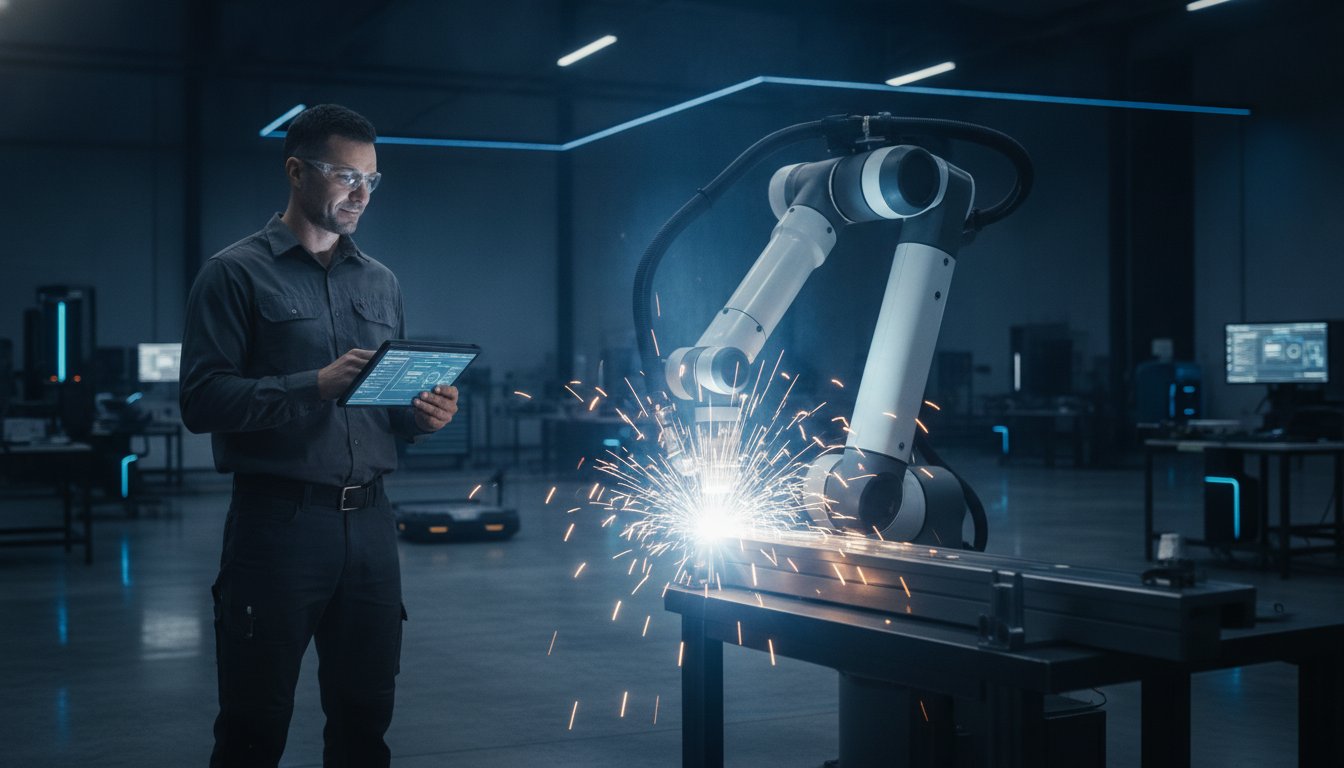
Traditional industrial robots were often a headache for small shops. You usually needed a specialised programmer to write lines of complex code just to move the torch an inch. Today, collaborative robot welding cells have turned that model on its head. Instead of typing commands, your best welder simply grabs the robot arm and shows it where to go. This process, known as hand-guiding, captures the path and the angles in real time. It means the person with decades of experience is the one "programming" the machine, not a computer technician who has never held a torch.
How No-Code Teaching Software Works
Modern systems rely on no-code robot welding software that uses intuitive, visual interfaces. You don't need to understand syntax or logic gates to get a result. If a weld looks a bit cold, the operator can adjust voltage or wire speed on the fly using a tablet or a button on the torch head. This immediate feedback loop allows for rapid refining of the weld quality. Because these machines follow Australian safety guidelines for cobots, the operator can stay close to the workpiece during the teaching phase without the fear of a sudden, dangerous movement.
Small Batch Profitability
Australian manufacturing often thrives on a high-mix, low-volume model. We don't usually make a million of the same bracket; we make fifty of one and then twenty of another. Traditional automation fails here because the setup time outweighs the production time. With no-code teaching, you can switch between jobs in minutes. If you have a five-unit run, it's now viable to automate it because the teaching takes less time than the manual welding would. No-code software slashes ROI timeframes for job shops by removing the need for dedicated programmers and reducing setup times from hours to minutes.
The transition to automation doesn't have to be a leap into the unknown. If you're curious about how this looks in practice, you can arrange a mobile demo system to see hand-guiding on your own workshop floor.
Comparing Cobot Cells: Is a Turnkey Unit Right for You?
Deciding how to bring automation into your workshop is a significant step. For most Australian fabricators, the choice usually boils down to whether a ready-made turnkey unit or a custom-integrated system fits their workflow better. It's not just about buying a piece of hardware; it's about finding a solution that matches your current production needs and your plans for growth. You need to look at your typical job mix and decide how much flexibility you really need.
Turnkey Robotic Welding Units: The Fast Track to Automation
A turnkey setup is effectively a "welding shop in a box." These collaborative robot welding cells generally arrive with everything you need: the robotic arm, a compatible power source, the torch, and a modular welding table. The primary benefit here is simplicity. Since the components are already tested to work together, you avoid the technical headaches of trying to make different brands "talk" to each other. For shops with limited engineering resources, this plug-and-play approach is often the most sensible path.
When you're evaluating these units, pay close attention to reach and payload. Most standard cells offer a reach between 900mm and 1300mm. If your workpieces are larger, you'll need to consider how the robot will access every joint. Payload is also vital. While a cobot arm is strong, adding a heavy TIG torch or a source-capture fume extraction system can push it toward its limit. Always ensure the arm has enough "muscle" left to move smoothly without triggering safety stops.
Custom Integration for Specialist Tasks
Standard cells are great for many jobs, but they aren't a one-size-fits-all solution. If you're dealing with oversized parts, complex geometries, or you want to use your existing high-end welding machines, you'll likely need to work with cobot welding integration experts. They can tailor the workspace to your specific floor plan and ensure the robot works seamlessly with your existing gear. This route is ideal for workshops that have a very specific, repeatable process that a standard table can't accommodate.
Don't overlook the importance of mobility. Many cobot cells are built on heavy-duty castors, meaning you can move the robot to the work rather than moving the work to the robot. This versatility is a game-changer for busy shops. While the upfront investment is a consideration, the ability to keep the robot busy across different bays ensures it pays for itself through consistent productivity and significantly less rework.
Setting Up for Success: Safety and Operator Training
Installing collaborative robot welding cells is a major step forward, but it's the preparation of your floor and your people that ensures a smooth transition. Technology is only as good as the team operating it. To get the most out of your investment, you need to move beyond just "buying a machine" and start thinking about a complete integration. This involves meeting strict local standards while ensuring your welders feel like the masters of the new technology, not its replacement.
Australian Standards and Workshop Safety
Safety is the first priority in any Australian workshop. All robotic installations must comply with AS/NZS 4024.1, the national standard for machinery safety. While the robot arm itself uses force-sensing technology to stop upon contact, a common misconception is that "collaborative" means "hazard-free." The robot might be safe to touch, but the welding arc still produces intense UV light, hot spatter, and dangerous fumes.
You must conduct a thorough risk assessment for your specific layout. This includes organising your floor space to account for arc flash protection and the new Workplace Exposure Limits for welding fumes. As of 2024, the general limit was reduced to 1 mg/m³, a standard that becomes even more critical as you increase your duty cycle with automation. Proper placement of source-capture extraction and light curtains ensures your workshop remains a safe, productive environment for everyone on the floor.
The Onboarding Process: Training Your Team
Winning hearts and minds is just as important as the technical setup. We find that the most successful shops take a "practical mentor" approach to staff onboarding. Instead of seeing the robot as a threat, your team should see it as a tool that takes away the back-breaking, repetitive work. Most experienced welders can transition to the role of a robot supervisor in just a few days. They already understand weld pools and travel speeds; they just need to learn how to communicate that knowledge to the machine.
Structured on-site cobot welder training is essential for building this internal confidence. Your team will learn how to troubleshoot paths, refine weld parameters, and maintain the system. This hands-on experience turns a piece of equipment into a valued member of the production line. When your staff knows how to adjust the cell for a new job in minutes, your productivity stays high and your rework stays low.
The relationship with your technology partner should not end the moment the crate is opened. Ongoing support and technical check-ins ensure your cell continues to perform as your production needs evolve. If you want to see how these systems fit into your specific workflow, you can book a mobile demo system to test the technology on your own workshop floor.
Calculating ROI: How Cobots Improve Your Bottom Line
Calculating the return on investment for collaborative robot welding cells requires looking beyond the initial invoice. For an Australian workshop, the real value lies in the reduction of "hidden" costs that leak profit every day. These include the high cost of rework on precision jobs, excessive consumable use, and the downtime associated with manual fatigue. When you move to an automated cell, you aren't just buying a machine; you are securing a predictable cost per part.
By choosing to improve welding productivity with cobots, you can often see productivity increases of 4 to 8 times compared to manual welding. This is primarily due to duty cycle improvements; a robot doesn't need to stop for breaks or reposition itself as often as a human. This consistency ensures that your output remains high even on a Friday afternoon when manual focus often dips, leading to perfect welds every time.
Reducing Rework and Consumable Waste
Robots provide precision wire delivery and gas control that a manual operator simply cannot match over an eight-hour shift. Saving a few cents on gas and wire on every centimetre of weld adds up across thousands of parts. The "human factor" is also eliminated in repetitive tasks where fatigue usually leads to errors. Maintaining a consistent travel speed reduces heat distortion in thin materials and significantly cuts down the time spent on post-weld grinding.
Solving the Labour Gap in Australian Fabrication
With a projected deficit of 70,000 welders by 2030, the ability to do more with your existing team is vital. Collaborative cells handle the repetitive welds, allowing your skilled tradespeople to focus on complex fabrication that requires their unique expertise. This shift also helps in attracting younger talent with modern, tech-forward workshop tools, positioning your business as an innovator in the local market. Using automation to handle the "boring" work keeps your best staff engaged and reduces long-term operator fatigue.
To truly understand the impact on your bottom line, you need to see the system in action. Booking a mobile welding robot demonstration allows you to prove the concept using your own parts in your own environment. This provides a clear, hands-on picture of how collaborative robot welding cells can secure your workshop's future profitability.
Securing Your Workshop's Future Performance
Adopting new technology doesn't have to be a leap into the unknown for your fabrication team. By integrating collaborative robot welding cells, you can turn the tide on labour shortages and rework costs while keeping your skilled tradespeople at the centre of the process. You have seen how no-code software removes the need for complex programming, allowing your best welders to "teach" the robot in minutes. This transition is about empowering your workforce with tools that handle repetitive, fatiguing tasks so they can focus on high-value fabrication.
Whether you choose a turnkey unit for rapid setup or a custom-integrated system for specialised jobs, the goal is consistent quality and long-term profitability. We provide complete support, from initial risk assessments to staff onboarding and technical maintenance. Seeing is believing on a busy workshop floor, which is why we offer on-site proof of concept across the country.
Book a Mobile Welding Robot Demonstration to see a cell in action at your workshop and discover how accessible automation can strengthen your business. We are here to help you refine your production and grow with confidence.
Frequently Asked Questions
Are collaborative robot welding cells safe to use without a cage?
Yes, these cells are designed for cage-free operation because the robot arm uses internal force-sensing technology to stop immediately upon contact. However, while the robot itself is safe to work alongside, you must still manage the risks of the welding process. This includes using proper screens for arc flash and meeting AS/NZS 4024.1 safety standards through a thorough workshop risk assessment.
How long does it take to learn how to program a cobot welder?
Most experienced welders can learn the basics of path teaching in just a few hours. Because the system uses no-code software and hand-guiding, your team doesn't need to learn complex computer syntax. A typical onboarding program takes one to two days to ensure your operators are fully confident in setting up new jobs, refining weld parameters, and troubleshooting the system independently.
Can a cobot welder handle both MIG and TIG welding?
Yes, these systems are highly versatile and can handle both MIG and TIG processes depending on the power source and torch integrated into the cell. While MIG is often chosen for high-speed productivity on thicker materials, TIG integration is ideal for precision jobs that require a high-quality aesthetic finish. The modular design allows you to adapt the cell as your production requirements change.
What is the typical ROI for a small Australian fabrication shop?
The average payback period for collaborative robot welding cells in Australia is typically between 18 and 36 months. This return is driven by a 4 to 8 times increase in productivity and a significant reduction in rework costs. By maintaining a consistent duty cycle and reducing consumable waste, the system pays for itself while allowing your skilled staff to focus on more complex tasks.
Do I need a software engineer to maintain the welding cell?
You don't need a software engineer or a specialist programmer to keep your cell running. The no-code interface is built specifically for tradespeople, allowing your existing welding team to manage the technology. Maintenance is straightforward and focuses on standard welding consumables and basic robotic calibrations, which your team will learn to handle during the initial operator training and onboarding process.
Can the welding cell be integrated with my existing Fronius or Miller power source?
In many cases, yes. Modern collaborative robot welding cells can be integrated with high-end power sources like Fronius or Miller through specialised communication interfaces. This allows you to continue using the brands you trust while adding the benefits of automation. We recommend a technical review of your current equipment to ensure the specific models are compatible with the robot's control system for seamless operation.
What happens if the robot hits an obstruction during a weld?
If the robot arm detects an obstruction, its internal power and force limiting sensors trigger an immediate safety stop. This protects the operator from injury and prevents damage to the torch or the workpiece. Once the workspace is cleared, the operator can usually reset the system and resume the weld path quickly, ensuring that downtime remains minimal and the workshop environment stays safe.
Is there local technical support available for these systems in Australia?
Yes, local technical support is available to ensure your automation investment stays productive. This includes on-site integration, operator training, and ongoing technical assistance tailored to Australian workshop conditions. Having a local partner means you have access to expert advice and spare parts without the delays of overseas time zones, which is essential for maintaining a consistent production schedule in a busy shop.