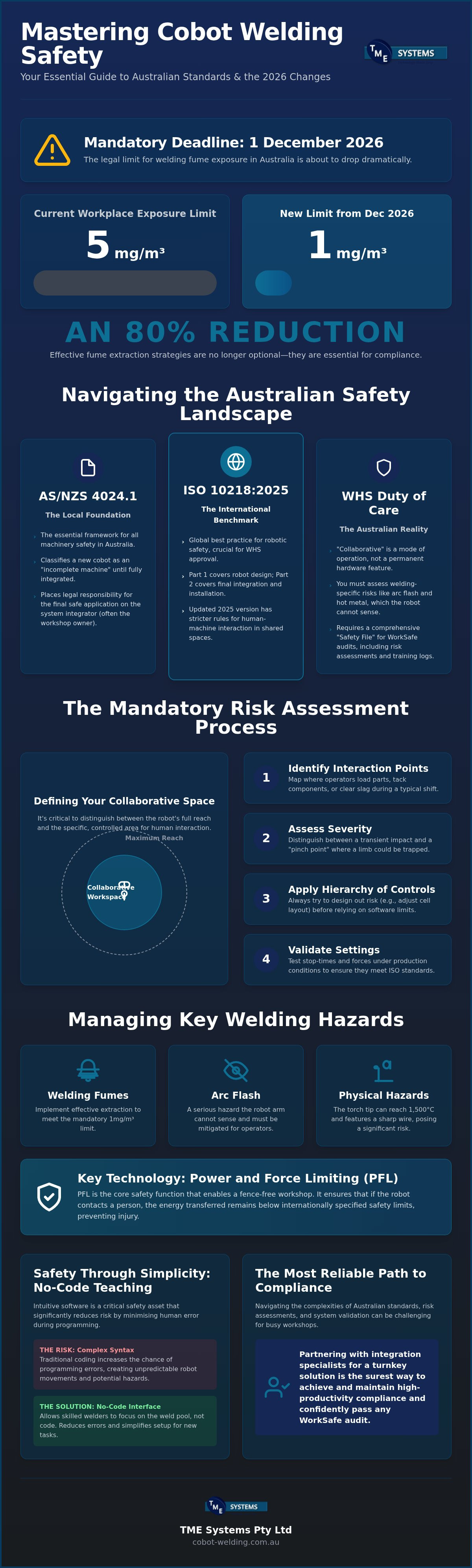

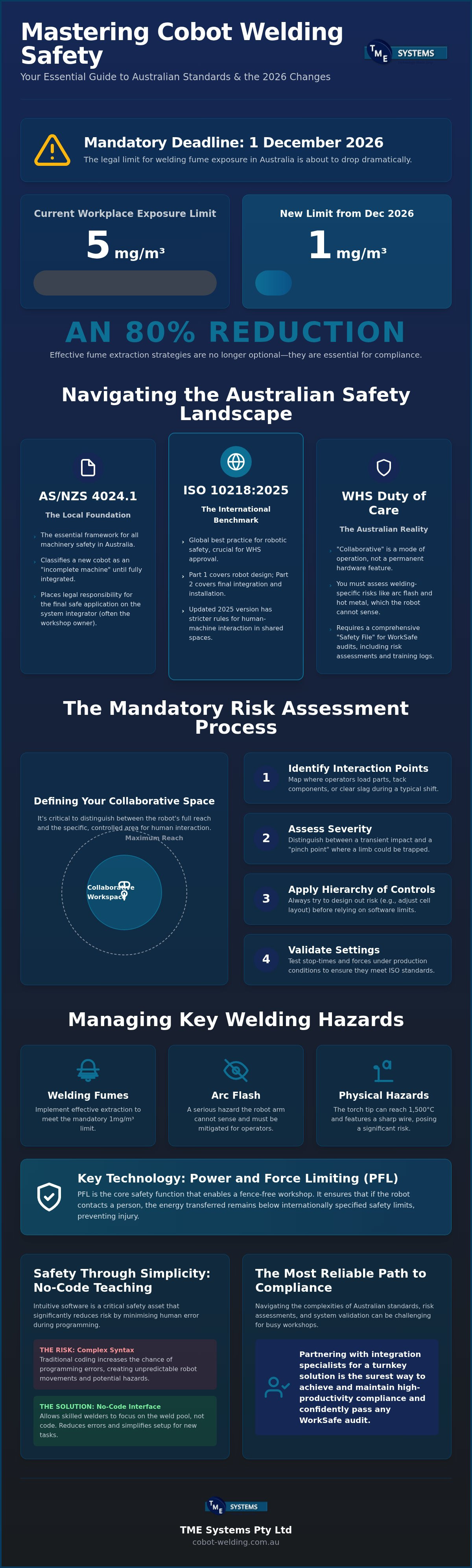
On 1 December 2026, the legal limit for welding fume exposure in your workshop drops by a staggering 80 per cent, falling from 5mg/m³ to just 1mg/m³. You've likely felt the mounting pressure of trying to decode the gap between international ISO guidelines and our local AS/NZS requirements while keeping the production line moving. Mastering the latest collaborative welding safety standards is no longer just a box-ticking exercise; it's the foundation of a modern, safe shop floor. It's frustrating when safety rules feel like they're designed for bureaucrats instead of the people holding the torch, especially when you're aiming for a productive, fence-free environment.
This guide clears the air, showing you how to master the essential protocols so your team stays protected and your business remains fully compliant. We'll provide a clear roadmap through the 2026 fume extraction mandates and the updated ISO 10218:2025 robotics standards. You'll also discover how no-code teaching software and integrated safety protocols turn compliance from a hurdle into a competitive advantage. By the end, you'll have the confidence to run a high-productivity cobot cell that prioritises your staff's health without sacrificing a single weld's quality.
Key Takeaways
- Learn how to align your workshop with AS/NZS 4024.1 and international robotics standards to ensure your cobot is legally integrated as a safe, productive tool.
- Understand the specific collaborative welding safety standards required to define a safe "collaborative workspace," moving beyond simple machine reach to true operator protection.
- Prepare for the mandatory December 2026 welding fume exposure limit of 1mg/m³ by implementing effective extraction strategies tailored for automated cells.
- Discover why no-code teaching software is a critical safety asset that reduces programming errors and keeps your skilled welders focused on the weld pool instead of complex syntax.
- Identify why partnering with integration specialists for a turnkey solution is the most reliable way to navigate WorkSafe audits and maintain high-productivity compliance.
Navigating the Australian Safety Landscape: AS/NZS 4024.1 and ISO 10218
AS/NZS 4024.1 is the foundation for all Australian machinery safety. It provides the essential framework that every local fabricator must follow to ensure their equipment is fit for purpose and safe for operators. When you introduce a collaborative robot (cobot) into your shop, it's legally classified as an "incomplete machine." This means the robot arm itself doesn't possess a final safety certificate for welding until it's integrated with a power source, a torch, and specific guarding. The manufacturer provides a safe arm, but you are responsible for the safe application in a real-world environment.
This distinction places the legal responsibility squarely on the "system integrator." In many Australian workshops, the owner or manager effectively takes on this role when they purchase a cobot and set it up on a bench. To meet collaborative welding safety standards, you must prove that the entire assembly, not just the robot, is safe for your team to work alongside. This is where international standards meet local law, creating a clear path for compliance if you follow the right steps.
The Role of ISO 10218 in Modern Fabrication
ISO 10218 is the international benchmark for robotic safety, and it's divided into two critical parts. Part 1 covers the design of the robot itself, while Part 2 focuses on the integration and the final installation requirements. The 2025 updates to ISO 10218-1 and ISO 10218-2 reflect the rapid growth in collaborative applications, introducing stricter requirements for how humans and machines interact in shared spaces. Following these international guidelines is your first step toward achieving Australian WHS approval, as local auditors look for alignment with these global best practices to verify your setup's integrity.
Why Australian WHS Laws Demand More Than a "Safe" Robot
It's a common mistake to think "collaborative" is a permanent safety feature of the hardware. In reality, collaborative is a mode of operation. A robot is only collaborative when it's running specific software and speed limits that allow it to stop safely upon contact. Australian duty of care requirements mean you must assess the specific risks of the welding process, such as arc flash and hot metal, which the robot arm cannot sense. Maintaining a comprehensive "Safety File" for every welding cell is essential. This file should include your risk assessments, software configurations, and training logs to ensure you're prepared for any future WorkSafe audits.
The Mandatory Risk Assessment: Defining Your Collaborative Space
A task-based risk assessment (TRA) isn't just a hurdle. It's the legal document that keeps your team safe and your insurance valid. When setting up your cell, you must distinguish between the robot's maximum "reach" and the actual "collaborative workspace." While the reach is the full physical envelope of the arm, the collaborative workspace is the specific zone where a person is expected to perform tasks while the robot is active. To maintain collaborative welding safety standards, you need to document the specific speed and force limits for every job. Remember that the robot arm itself is rarely the primary danger; it's the 1,500-degree arc and the sharp wire at the end of the torch that require your closest attention.
Step-by-Step: Conducting Your First Task-Based Assessment
Start by identifying every human-robot interaction point during a typical shift. Think about where the operator stands to load parts, tack components, or clear slag. Next, assess the severity of potential contact. You need to distinguish between a transient impact in open air and a "pinch point" where a limb could be trapped against a workbench or jig. Once identified, apply the hierarchy of controls. Always try to design out the risk first by adjusting the cell layout before relying on software limits. Finally, validate the settings. Test the stop-times and forces under actual production conditions to ensure they align with ISO 10218-1:2025 safety requirements.
Collaborative Safety Functions: PFL and Speed Limiting
Power and Force Limiting (PFL) is the technology that allows for a productive, fence-free workshop. It ensures that if the robot contacts a person, the energy transferred stays below specific pain and injury thresholds. For larger cells where you can't afford to slow down, Speed and Separation Monitoring (SSM) uses laser scanners to create dynamic "Safety Zones." As a person approaches the cell, the robot slows down; if they get too close, it stops instantly. Most modern systems allow you to configure these zones directly in the internal software. This makes it easy to adjust the safety envelope when you're switching between small brackets and large frames. If you're unsure how to map out your floor, seeing a mobile demo system in action can help you visualise how these zones work in a real workshop environment.
Documenting these limits for both the torch and the workpiece is vital. A robot moving a smooth part at 250mm/s might be safe, but that same speed with a sharp-edged workpiece could be hazardous. Your TRA must reflect the specific reality of the metal you're joining today.
Managing Welding Hazards: Fumes, Arc Flash, and the 2026 Limits
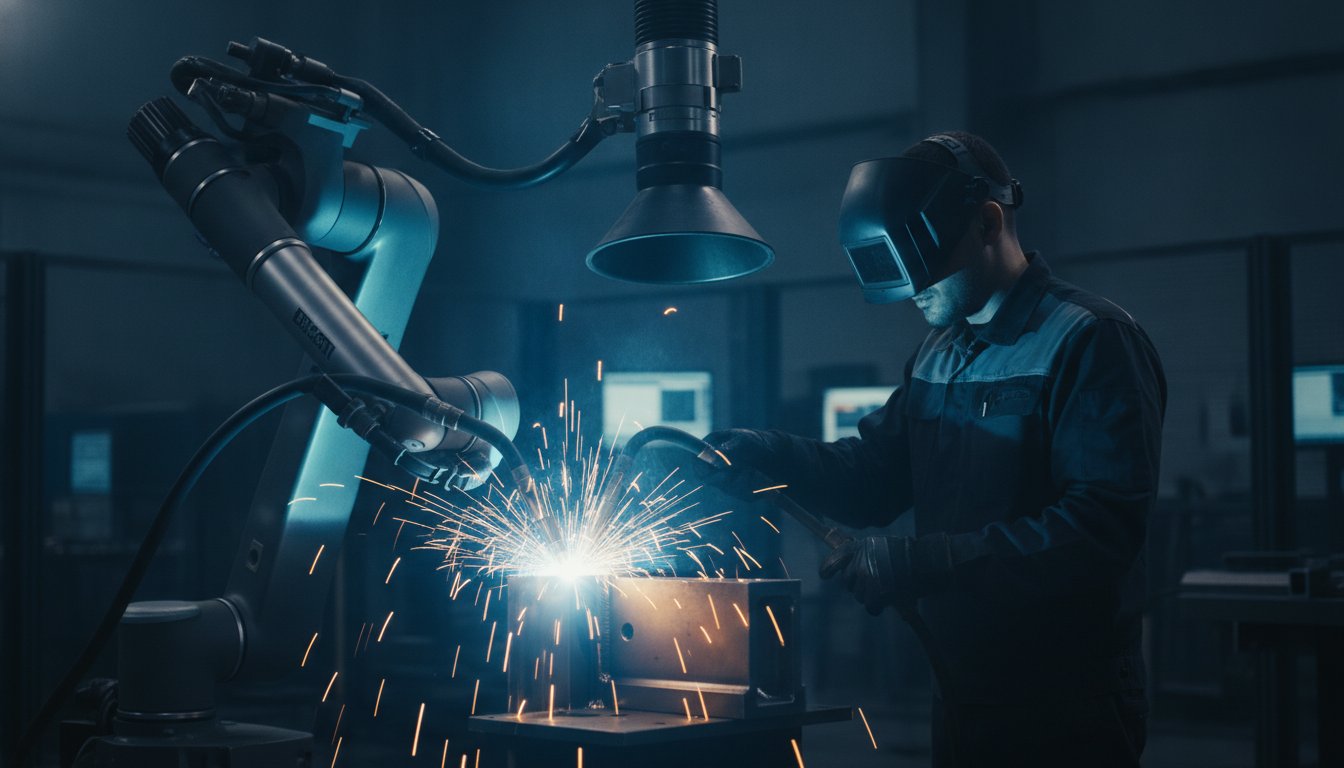
A robot arm with collision sensors is only one part of the safety equation. While the arm might stop if it bumps into an operator, the welding process itself continues to produce intense light, heat, and toxic fumes that don't respect digital boundaries. In a fence-free environment, these hazards can affect anyone walking past the cell, not just the person loading the parts. Adhering to collaborative welding safety standards means looking beyond the machine's movement and addressing the raw output of the welding arc.
Managing these risks requires a holistic approach that aligns with the Model Code of Practice: Managing the risks of plant in the workplace. Traditional workshop ventilation that relies on high ceilings and open doors is often insufficient for the concentrated output of an automated cell. Because a cobot can weld for longer periods without a break, the volume of fumes generated in a single shift is often much higher than that of a manual welder. You need a strategy that captures these hazards at the source before they migrate across the workshop floor.
Meeting the New 2026 Fume Exposure Standards
From 1 December 2026, the Workplace Exposure Limit (WEL) for welding fumes in Australia will be reduced from 5mg/m³ to 1mg/m³ over an eight-hour period. This five-fold reduction is a significant legal shift that every fabricator must prepare for now. Integrated on-torch extraction is often the most effective solution for collaborative cells, as the vacuum moves with the robot arm to capture 99 per cent of fumes directly at the weld pool. We recommend implementing a routine of regular air quality monitoring to verify that your extraction system is meeting these stricter 2026 requirements.
Protecting Staff from Arc Flash and Spatter
Without a physical cage, arc flash becomes a major concern for everyone in the vicinity. Mobile welding screens and high-quality curtains are essential for creating a safe visual barrier without sacrificing the accessibility of a cobot setup. It's a common misconception that PPE requirements are relaxed in automated environments. Operators must still wear appropriate eye protection and flame-resistant clothing. For staff working in adjacent bays, installing "Auto-Darkening" sensors on their own helmets can provide an extra layer of protection against accidental flashes from the robot's arc.
To keep your cell running safely, follow this quick checklist for managing fire and spatter risks:
- Remove all flammable materials within a 10-metre radius of the welding cell.
- Equip the cobot arm and all associated cables with fire-retardant protective sleeves.
- Perform a daily clear-out of spatter and grinding dust from the robot's base and joints.
- Ensure a dedicated fire extinguisher is mounted within 5 metres of the workstation.
Safety Through Simplicity: How No-Code Teaching Reduces Risk
Complex coding is often a hidden safety hazard in a busy workshop. When an operator is forced to navigate thousands of lines of script just to adjust a weld path, the potential for human error skyrockets. One misplaced character in a traditional script can result in a "ghost" movement or an unexpected collision. By contrast, no-code robot welding software removes this layer of abstraction. It allows your best welders to stay focused on the weld pool and the joint, rather than worrying about the underlying syntax. This transition to intuitive interfaces is a practical way to uphold collaborative welding safety standards while keeping production speeds high.
Hand-guiding and "lead-through" programming are the standout features of this approach. Instead of typing coordinates, the welder physically moves the cobot arm to the start and end points. This direct interaction ensures the operator has total control over the robot’s physical envelope at all times. In small-batch shops where jobs change over several times a day, this simplicity makes the transition faster and significantly safer.
Reducing Programming Errors with Intuitive Interfaces
Visual path teaching is a game-changer for workshop safety. It provides a clear, graphical representation of the robot's intended journey, which helps prevent unexpected movements. Most modern no-code systems include an immediate simulation mode. This allows the operator to dry-run the entire sequence without the arc struck, verifying the path is clear of jigs and clamps. Because the interface is so accessible, on-site cobot welder training becomes far more effective. Your team spends less time learning to code and more time learning how to manage the safety parameters of the cell.
Empowering the Tradesperson, Not the Programmer
Safety is highest when the person with the most experience is in control. No-code tools empower your skilled tradespeople to set and adjust safety parameters based on the specific job at hand. If a part is slightly out of alignment, they can make "on-the-fly" adjustments to the path without needing a dedicated programmer. This creates a sense of psychological safety; when an operator feels in total control of the machine, they are more confident and less likely to make panicked mistakes. You can see how this simplicity transforms a workshop floor by booking a mobile demo system to experience the software first-hand.
Implementing Your Compliant Welding Cell: The Integration Plan
Choosing the right hardware is only half the battle. To ensure your workshop meets the highest standards, you need an integration plan that accounts for every variable from floor layout to operator training. Investing in pre-engineered collaborative robot welding cells is the most reliable path to compliance. These units are designed as a complete system, which simplifies the process of meeting collaborative welding safety standards. Instead of trying to piece together separate components, you start with a platform where the safety logic is already built into the core software.
Working with welding system integration specialists significantly reduces your regulatory risk. These experts understand the nuances of Australian WHS laws and can help you document the safety file required for your workshop. They ensure that the interface between the power source, the robot, and the extraction system is seamless. This professional oversight provides peace of mind, knowing that your setup won't just pass a WorkSafe audit but will actually protect your team every day.
The Benefits of a Turnkey Collaborative Solution
Pre-engineered cells arrive with essential safety features like Power and Force Limiting (PFL) and dual-channel emergency stops already configured. This "plug-and-play" safety approach removes the guesswork from your installation. If you're still on the fence about how a cell fits into your specific workflow, booking a mobile welding robot demonstration is an excellent way to see the technology in your own environment. Local Australian experts provide ongoing support and maintenance, ensuring your safety settings remain optimised as your production needs change.
Building a Human-Centric Safety Culture
A safe workshop relies on more than just high-tech sensors; it requires operator buy-in. When your team understands why certain speed limits or zones are in place, they're more likely to follow protocols. Improving welding productivity with cobots is only possible when your staff feel confident and secure around the machinery. Regular toolbox talks focused on automated cell hazards keep safety at the front of everyone's mind. This collaborative approach ensures that the robot remains a helpful tool rather than a source of anxiety.
Use this final checklist to standardise your "Safety-First" workshop layout:
- Mark the collaborative workspace boundaries clearly with high-visibility floor tape or paint.
- Ensure all emergency stop buttons are unobstructed and reachable from any operator position.
- Install dedicated, high-efficiency fume extraction points directly above or integrated with the cell.
- Position mobile welding screens to eliminate arc flash exposure for staff in adjacent bays.
- Verify that all cables and hoses are managed in overhead booms or floor conduits to prevent trip hazards.
Safety is a journey of continuous improvement. Schedule regular internal audits to review your risk assessments and software configurations. By staying proactive, you ensure your workshop remains a leader in both productivity and operator protection through 2026 and beyond.
Securing the Future of Your Fabrication Shop
Transitioning to automated welding doesn't have to be a regulatory headache. By focusing on task-based risk assessments and preparing for the December 2026 fume exposure limits now, you're doing more than just ticking boxes; you're protecting your most valuable asset: your people. Adhering to collaborative welding safety standards ensures your workshop remains a productive, fence-free environment where human skill and robotic precision work in tandem. Remember that safety is built on simplicity. Using no-code software reduces programming errors, while a turnkey integration plan ensures every component of your cell is compliant with AS/NZS 4024.1 standards.
Our team of local experts is here to support your journey with specialised integration and ongoing operator training. If you want to see how these systems adapt to your specific floor layout, Book a Mobile Demo to see safe cobot welding in action at your workshop. It's the most practical way to verify your proof of concept before making a commitment. We're ready to help you build a safer, more efficient workshop that's fully prepared for the challenges of 2026. Let's get to work.
Frequently Asked Questions
Do I need a safety fence for a collaborative welding robot in Australia?
No, you don't always need a physical fence for a cobot cell. These robots are designed to work safely alongside humans using Power and Force Limiting (PFL) technology. However, you must perform a task-based risk assessment to prove the specific application is safe. If the robot is moving sharp workpieces or using high speeds, you might still need laser scanners or light curtains to meet collaborative welding safety standards.
What are the specific AS/NZS standards for robotic welding cells?
The primary framework is the AS/NZS 4024.1:2019 series, which covers the safety of machinery in Australian workshops. For the robotic components, Australia aligns with international ISO 10218-1:2025 and ISO 10218-2:2025 standards. Additionally, the AS/NZS ISO 21904 series is now the mandatory standard for fume extraction equipment. These documents together provide the roadmap for ensuring your automated welding cell is legally compliant and safe for your team.
How often do I need to perform a risk assessment on my cobot welder?
You must conduct a risk assessment whenever you change the robot's task, tooling, or workshop layout. Because cobots are often used for small-batch work, this means a new assessment is required for every unique job setup. We also recommend an annual safety audit to verify that software limits and emergency stops are functioning correctly. Keeping an up-to-date Safety File is a critical requirement for meeting modern collaborative welding safety standards.
What are the new 2026 welding fume exposure limits I need to know?
From 1 December 2026, the Workplace Exposure Limit (WEL) for welding fumes in Australia drops from 5mg/m³ to 1mg/m³ over an eight-hour shift. This 80 per cent reduction means traditional workshop ventilation is unlikely to be enough. You'll need high-efficiency extraction systems, such as on-torch vacuum units, that meet the W3 filtration efficiency of 99 per cent or greater to remain compliant with these strict new health regulations.
Can any welder operate a cobot, or do they need a special licence?
There is no specific "robot licence" required for operators in Australia. However, under WHS laws, you have a duty of care to provide adequate training and onboarding. Skilled welders are actually the best candidates for operating these systems because they understand weld quality and pool control. Using no-code teaching software allows your existing tradespeople to program the robot safely without needing a background in computer science or complex coding languages.
Is a cobot safer than a traditional industrial welding robot?
A cobot isn't automatically safer than a traditional robot; its safety depends on how it's integrated into your workshop. Traditional industrial robots move at high speeds and have no sensors to detect human contact, requiring heavy steel cages. Cobots include internal sensors that stop the arm upon impact. This makes them better suited for shared workspaces, provided the welding arc and hot workpieces are managed through appropriate screening and extraction.
What happens if a cobot hits a person while welding?
If a person contacts the arm, the cobot's Power and Force Limiting sensors detect the resistance and trigger an immediate stop. This prevents the crushing injuries associated with traditional automation. However, the robot cannot "feel" if someone is exposed to the welding arc or hot spatter. This is why your risk assessment must account for the secondary hazards of the welding process, not just the physical movement of the robot arm.
Do I need a separate fire suppression system for my robotic cell?
Australian standards don't usually mandate a dedicated fire suppression system for a single welding cell, but you must have appropriate fire-fighting equipment nearby. You should equip the robot with fire-retardant sleeves and ensure the workstation is clear of flammable materials within a 10-metre radius. If your cell operates unattended for long periods, your risk assessment might identify the need for automated fire detection to manage the increased hazard safely.