
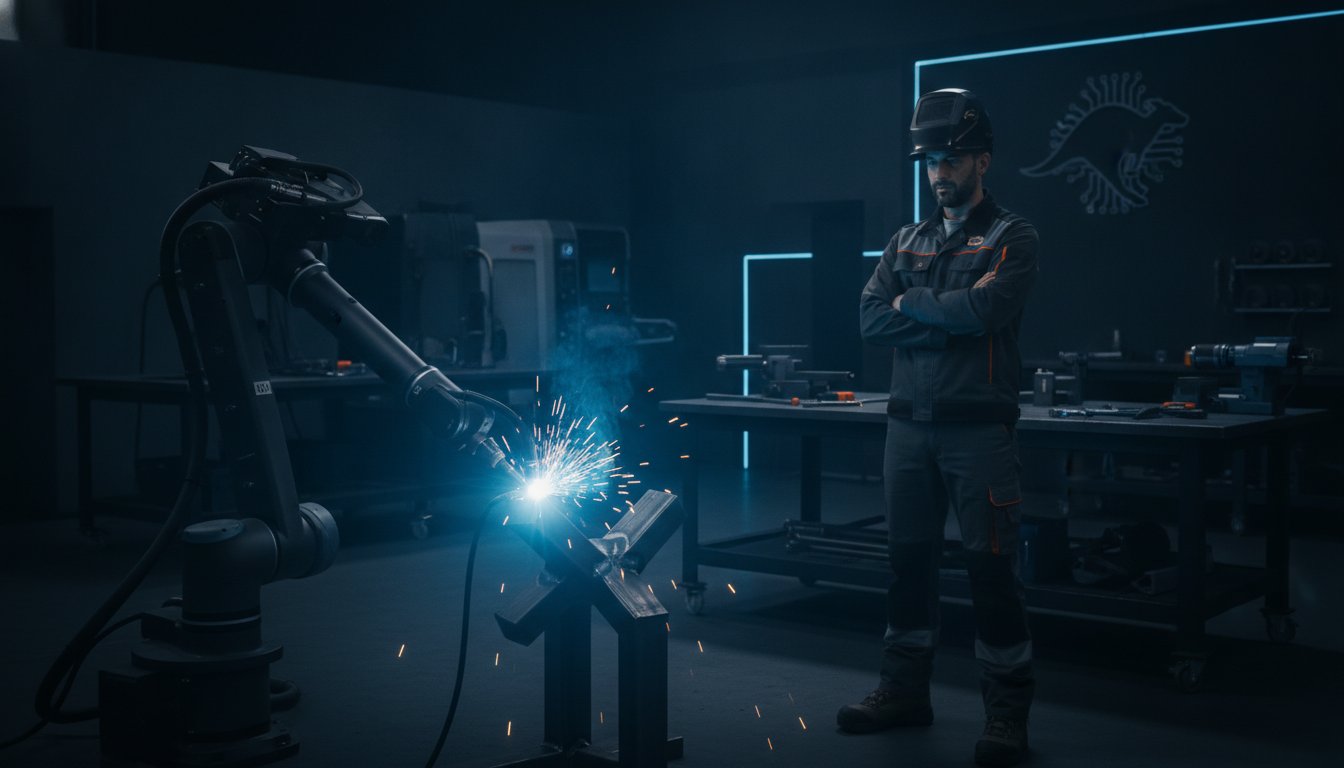
What if your workshop's most experienced welder could replicate their perfect 'golden run' on every single part, without ever feeling the strain of a ten-hour shift? It's a common headache in Australian fabrication shops. You see the variability between different welders' techniques or watch precision slip as the afternoon wears on. These inconsistencies lead to a high cost of rework and scrap, but achieving consistent welds with cobots offers a practical way to protect your bottom line.
We agree that innovation should feel attainable, not intimidating, for a busy workshop floor. This isn't about replacing your team's expertise. It's about giving them a digital partner that maintains a steady hand through every repetitive bead, ensuring your quality stays high from Monday morning to Friday afternoon.
This guide walks you through the technical and operational steps to lock in repeatable, high-quality results using collaborative automation. We'll explore how no-code teaching software and smart fixturing allow you to organise your workflow to eliminate rework and empower your tradespeople to focus on high-value tasks. You'll gain a clear roadmap to lower operational costs and zero-defect production runs.
Key Takeaways
- Learn how to eliminate "Friday afternoon syndrome" by using automation to maintain perfect torch angles and travel speeds across every shift.
- Master the technical and operational steps for achieving consistent welds with cobots by digitising your best welder’s technique into a repeatable "golden run".
- Discover how no-code teaching software allows your experienced tradespeople to program complex paths simply by hand-guiding the robot arm.
- Understand why modular jigging and precise part preparation are the keys to ensuring your robotic system delivers uniform penetration across the entire batch.
- Explore why successful automation is a long-term partnership that relies on professional system integration and ongoing training for your team.
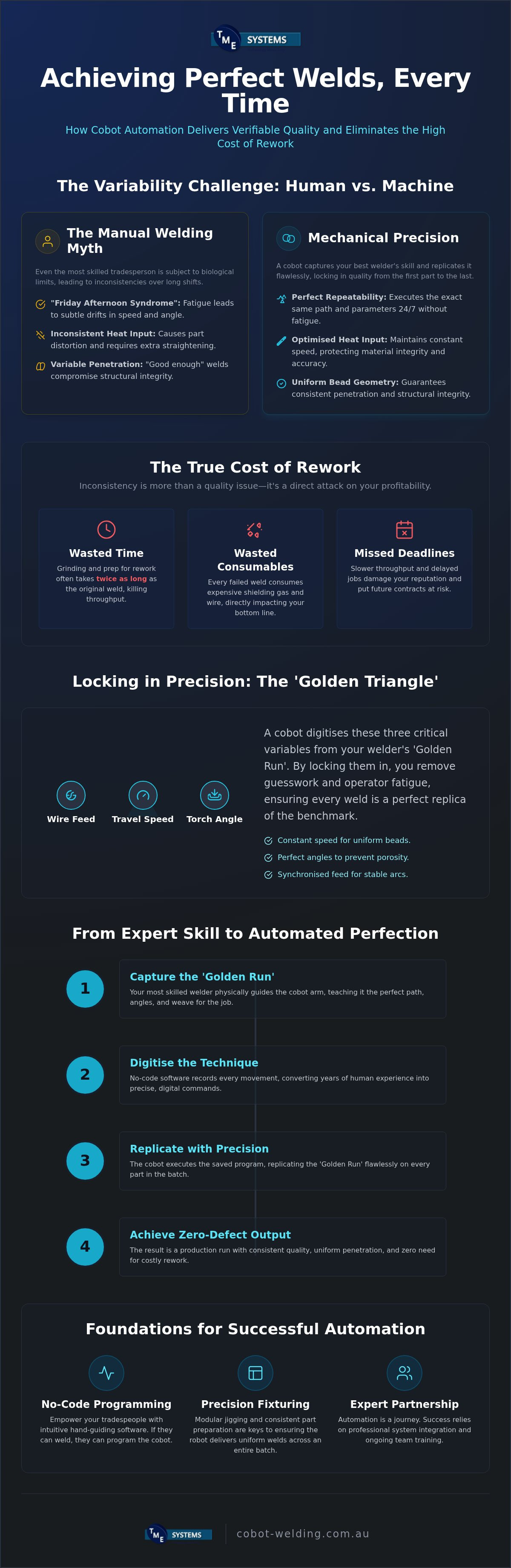
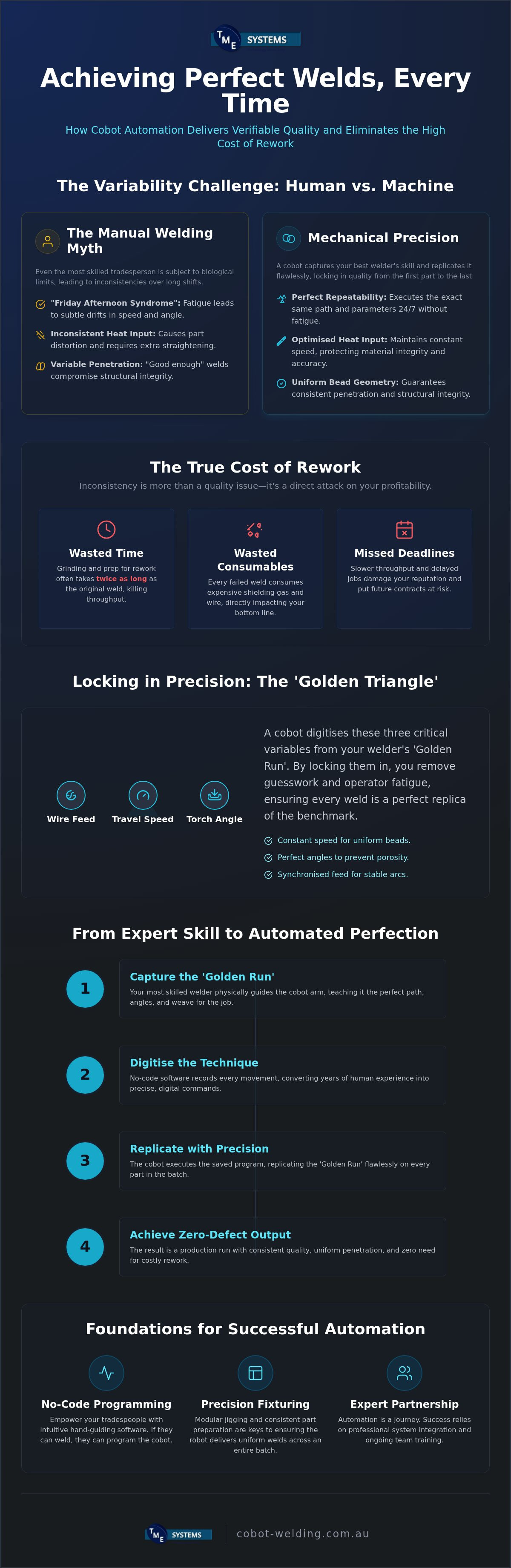
The Variability Challenge: Why Manual Welding Consistency is a Myth
Every fabricator knows the "Friday afternoon syndrome". It isn't about laziness; it's simply biology. After a long week of high-intensity work, even the most seasoned welder starts to experience subtle drifts in their torch angle or travel speed. When the temperature in an Australian workshop climbs, fatigue sets in faster. That's usually when the "good enough" welds start appearing at the end of the line. While a skilled tradesperson can produce a perfect bead, expecting them to maintain that exact precision across a 1,000-part run is asking for the impossible. Just as a professional tattoo artist relies on precision tools from Tatt Lab to maintain quality throughout a long session, fabricators must ensure their equipment can deliver consistent results regardless of human fatigue.
Consistency in welding means more than just a tidy appearance. It requires repeatable penetration, uniform bead geometry, and structural integrity across 100% of the batch. When these metrics slip, the hidden costs start mounting. Rework is a profit killer that many shops simply accept as part of the job, but it doesn't have to be that way. Achieving consistent welds with cobots allows you to move past the variability of manual labour and lock in a standard of quality that stays identical from the first part to the last.
Human Variability vs Mechanical Precision
Skilled tradespeople rely on muscle memory, but muscle memory has its limits during an eight-hour shift. A collaborative robot (cobot) doesn't get tired, distracted, or affected by the heat of the shop floor. By integrating automation, you aren't replacing the welder's skill; you're capturing it. The machine maintains a constant travel speed and torch angle without the human "wobble" that often leads to porosity or uneven penetration.
This mechanical precision has a direct impact on heat input. When a welder moves slightly too slow, heat builds up, which often leads to part distortion and extra straightening work later. A cobot eliminates this quality gap. It ensures that the heat input remains within a narrow, optimised range, protecting the integrity of the metal and the accuracy of the final assembly.
The True Cost of Rework in Australian Fabrication
Rework is about more than just lost time. It's the overhead of grinding out a bad weld, the cost of wasted consumables, and the missed opportunity of the next job waiting in the queue. In a competitive market, inconsistent welds can also damage your reputation with Tier-1 contractors who demand documented, repeatable quality for every component.
- Grinding and prep time for rework often takes twice as long as the original weld.
- Wasted shielding gas and welding wire add up quickly over large production runs.
- Inconsistent beads lead to slower throughput and missed delivery deadlines.
By moving away from the myth of manual consistency for repetitive work, you protect your margins. Faster throughput and zero-defect runs allow your team to focus on the complex, custom tasks that actually require their years of hard-earned experience.
The Mechanics of Precision: Locking in the 'Golden Triangle' of Parameters
Precision in the workshop depends on three critical factors: travel speed, torch angle, and wire feed. We call this the 'Golden Triangle'. While a human welder manages these variables through intuition and hard-earned experience, achieving consistent welds with cobots relies on digitising these physical actions into precise, repeatable commands. By locking in these parameters, you remove the guesswork and the risk of operator fatigue from your production line.
Constant travel speed is perhaps the most significant advantage of robotic automation. A cobot maintains a precise millimetre-per-second rate throughout the entire weld path. This level of control ensures uniform beads and consistent penetration, which is nearly impossible to replicate manually over a long production run. When you control the essential variables digitally, you eliminate the torch angle 'wobble' that often causes porosity or uneven penetration in manual setups.
The process starts with the 'Golden Run'. This is where your most skilled welder uses their expertise to set the initial benchmark. They guide the robot through the perfect path, and the system records every movement. From that point on, the system synchronises the wire feed with the power source to ensure perfect arc starts and stable delivery every single time.
Controlling Heat Input for Uniformity
Maintaining a steady travel speed is the most effective way to manage heat input. This is vital when working with thin-gauge aluminium or stainless steel, where even a slight slowdown can cause 'blow-through'. The cobot also executes repeatable dwell times at the start and end of every weld. These programmed pauses ensure proper crater filling and structural integrity, which significantly reduces the amount of post-weld clean-up your team needs to perform.
Digital Control of the Welding Path
A cobot doesn't just move from point A to point B. It follows complex multi-point geometries while maintaining a constant contact-tip-to-work distance (CTWD). This digital path control ensures the arc remains stable regardless of the part's shape. With a mechanical repeatability of approximately +/- 0.03mm, these systems far exceed human capability. If you want to see how this precision works on your own shop floor, a mobile demo system can provide a practical, hands-on proof of concept.
Eliminating Operator Drift with No-Code Teaching Software
Traditionally, the biggest hurdle to workshop automation wasn't the cost of the hardware; it was the "black box" of programming. You had a skilled welder who knew exactly how the metal should behave, but they couldn't speak the machine's language. This disconnect is where operator drift often starts. By using no-code robot welding software, we remove that barrier entirely. It democratises the technology, putting the power back into the hands of the tradespeople who actually understand the arc.
When your team uses no-code interfaces, they aren't typing lines of code. They are teaching the machine through direct interaction. This shift is fundamental to achieving consistent welds with cobots because it ensures the "golden run" we discussed earlier is set by someone with years of workshop experience, not a software engineer. It allows the expert to translate their manual skill into a digital format that never tires or drifts.
Hand-Guiding for Intuitive Path Creation
The most practical feature of this software is hand-guiding. Instead of using a joystick or a pendant to guess coordinates, the welder simply moves the robot arm by hand to record the path. This tactile approach allows the operator to feel the joint and set the torch angle with the same precision they would use in manual welding. It feels natural to the tradesperson because it mirrors the way they've worked for years.
Because set-up time is drastically reduced, consistency becomes profitable even for small batches. If you need to adjust a path "on the fly" to account for a slight change in part geometry, you can do it in seconds. This flexibility is a core part of optimizing cobot weld parameters while keeping production moving. You don't need to wait for a programmer to arrive; your welder simply makes the tweak and gets back to work.
Job Saving and Instant Recall
One of the most valuable assets in a modern workshop is the "Library of Excellence". Once a path is perfected, the software saves it as a digital archive. This means that six months from now, you can recall the exact same job with identical results. It turns your workshop's collective knowledge into a permanent, searchable asset.
This feature ensures that "Welder A" and "Welder B" produce the exact same high-quality output. It eliminates the subtle variations in technique that usually creep in when different staff handle the same part. As software updates are released, these saved jobs can be refined even further, ensuring your consistency only improves over the life of the machine. It’s about building a reliable, repeatable process that doesn't rely on any single person's memory or daily mood.
The Fit-Up Factor: Ensuring Consistency Before the Arc Strikes
A cobot is a master of repetition, but it isn't a mind reader. In the workshop, the "Garbage In, Garbage Out" rule reigns supreme. If your parts arrive at the welding station with inconsistent gaps or warped edges, the robot will faithfully weld exactly where it was told, regardless of whether the metal has shifted. Achieving consistent welds with cobots starts long before the arc strikes; it begins with standardising your upstream processes.
Precision in part preparation is the foundation of robotic success. While a manual welder can adjust their technique to compensate for a sloppy fit-up, a robot performs best when joint tolerances are tight. Choosing laser cutting over plasma cutting, for example, often provides the cleaner edges and repeatable dimensions needed for high-quality automation. When gap variability is unavoidable, we use 'weave' patterns. These programmed oscillations allow the arc to bridge slightly wider joins, providing a safety net for those less-than-perfect parts.
Designing for Automation
In the structural steel sector, this precision begins at the design phase. Utilising specialised engineering software like GMatrix-7 for MBS, bar joists, and LGS design ensures that components are engineered for exact fit-up, significantly reducing the gap variability that can disrupt automated welding runs.
For manufacturers like Wombat Cages that produce hot-dip galvanised security enclosures, this upstream precision is vital for ensuring that every weld point is perfectly sealed and structurally sound before the galvanising process begins.
Consistency is easier to manage when you design parts with the robot in mind. This might mean adding repeatable datum points or tabs that ensure every component sits in the jig exactly the same way. Modular jigging plays a vital role here. Because collaborative robot welding cells rely on mechanical repeatability, your fixtures must be robust enough to hold the workpiece in a fixed position across hundreds of cycles. Even a two-millimetre shift in the jig can be the difference between a pass and a fail.
Managing Material Variability
Material batches can vary, and heat from previous tacks can cause subtle movement in the metal. Modern sensing technologies, such as touch sensing, allow the cobot to "search" for the joint before starting the weld. This allows the program to shift slightly to match the actual position of the part. Achieving consistent welds with cobots is much easier when the machine can account for these real-world variations. However, technology is only half the battle. Training your team to spot pre-weld issues, like excessive mill scale or poor tacking, is essential. They act as the first line of defence in maintaining the quality of the output.
If you're unsure if your current part preparation is ready for automation, you can book an on-site mobile demo to test your specific components with a live system.
Future-Proofing Your Output: Scaling Quality with Australian Integration
Successful automation doesn't happen by accident. It requires a long-term commitment to support and technical refinement. We view cobot welding integration as a collaborative partnership rather than a simple equipment purchase. This approach is vital for achieving consistent welds with cobots over the entire life of the machine. When you have local support and on-site expertise, you can troubleshoot issues quickly and keep your production lines moving without lengthy delays.
With Australia projected to face a shortfall of 70,000 welders by 2030, scaling your workshop's capability is no longer optional. You can improve welding productivity with cobots by standardising quality across multiple cells. Once you've perfected a 'Golden Run' on one machine, you can deploy that exact same program to every other unit in your fleet. This ensures that every part meets your uncompromising standards, regardless of which machine or operator handled the job.
The Roadmap to Zero-Defect Production
Your journey starts with a mobile welding robot demonstration. This allows you to prove consistency on your own parts within your own workshop environment before making a commitment. Following the demo, on-site cobot welder training empowers your staff to take ownership of the technology. Achieving consistent welds with cobots becomes a continuous process of improvement. By monitoring weld data, you can refine your parameters and squeeze even more efficiency out of your production runs.
Meeting Australian Standards and Safety
Maintaining consistency also means maintaining safety. Every turnkey solution we integrate is designed to meet the latest ISO 10218-2:2025 safety standards. This provides the peace of mind that your workshop is compliant while producing high-quality output. Local integration ensures that your system is built for Australian manufacturing realities and supported by people who understand your industry. Ready to see the consistency for yourself? Book a demonstration today to take the first step toward a more reliable, future-proof production line.
Lock in Your Workshop's Competitive Edge
Transitioning from manual variability to robotic precision isn't about replacing your team's expertise. It's about capturing their best work and making it repeatable across every shift. By standardising your upstream prep and digitising the "Golden Run" through intuitive hand-guiding software, you protect your margins from the high cost of rework and scrap. Achieving consistent welds with cobots is the most practical way to scale your output while maintaining the high standards your clients expect.
With expert Australian integration and no-code software designed specifically for tradespeople, our systems offer a proven ROI in as little as six months. We provide the comprehensive training and local support needed to ensure your transition to automation is seamless and successful. It's time to turn your workshop's hard-earned skill into a permanent, high-performance asset that works just as hard on a Friday afternoon as it does on a Monday morning.
Book your on-site mobile cobot demonstration today to see these results on your own parts and take the first step toward a more reliable production line.
Frequently Asked Questions
Can cobots really achieve the same weld quality as a highly skilled manual welder?
Yes, cobots can match and even exceed manual consistency by removing the human fatigue factor. While a skilled tradesperson sets the initial benchmark, the machine replicates that exact path with a mechanical repeatability of +/- 0.03mm. This ensures the last weld of the day is just as precise as the first. It's about capturing your best welder's expertise and making it an automated standard for your entire workshop.
What happens to weld consistency if my part fit-up isn't perfect?
Poor fit-up is the biggest enemy of automation. If gaps vary, the robot will still weld the programmed path, potentially leading to defects. We mitigate this by using weave patterns to bridge wider joins or touch-sensing technology to locate the joint before the arc strikes. Ultimately, achieving consistent welds with cobots depends on standardising your upstream processes, like laser cutting, to ensure parts arrive with tight tolerances.
How long does it take to 'teach' a cobot a new path for a consistent run?
Teaching a new path typically takes only a few minutes thanks to no-code software. Instead of typing lines of code, your welder simply hand-guides the robot arm to record the points. This intuitive approach makes it profitable to automate even small batches. Once the path is saved in your "Library of Excellence," you can recall it six months later and get the exact same results instantly without any additional setup time.
Do I need a robotic programmer on staff to maintain weld consistency?
You don't need a specialised programmer on your payroll. Modern no-code software is designed for tradespeople, not IT experts. Your existing welders are the best people to manage the system because they already understand arc behaviour and metal characteristics. With a few days of on-site training, your team can handle the setup, path recording, and parameter adjustments themselves, keeping your production lines moving without external help.
Can a cobot maintain consistency on difficult materials like aluminium or stainless steel?
Absolutely, cobots excel with heat-sensitive materials. Aluminium and stainless steel require very precise travel speeds and heat input to prevent blow-through or distortion. Because a cobot maintains a constant millimetre-per-second rate, it manages the "Golden Triangle" of parameters far more reliably than a manual operator. This level of control is essential for achieving consistent welds with cobots when working on thin-gauge components that have very little margin for error.
Is the consistency of a cobot worth the investment for small-batch production?
It's often more valuable for small batches than high-volume runs. The high cost of rework on a small, expensive batch can quickly kill your profits. Since no-code teaching makes changeovers fast, you can switch between different jobs in minutes. This flexibility allows you to maintain an uncompromising focus on quality across a diverse range of products, ensuring every small run is profitable and meets your workshop's zero-defect goals.
How do I ensure the cobot stays consistent over years of workshop use?
Long-term consistency relies on a combination of regular maintenance and a strong integration partnership. Standard industrial robots are built for years of heavy use, but keeping them accurate requires checking fixtures for wear and ensuring software is updated. Working with a local partner for ongoing training and support ensures your team continues to refine their "Golden Runs." This proactive approach prevents the subtle drift in quality that can occur in unsupported systems.
What safety standards govern consistent robotic welding in Australia?
In Australia, collaborative applications must comply with ISO 10218 and ISO/TS 15066. Specifically, ISO 10218-2:2025 is the current standard that integrators and end-users must follow for the safety of the entire cell. These regulations ensure that the robot, workpiece, and operator can work together safely. Following these standards doesn't just protect your staff; it also provides a framework for maintaining a reliable, documented, and professional production environment.