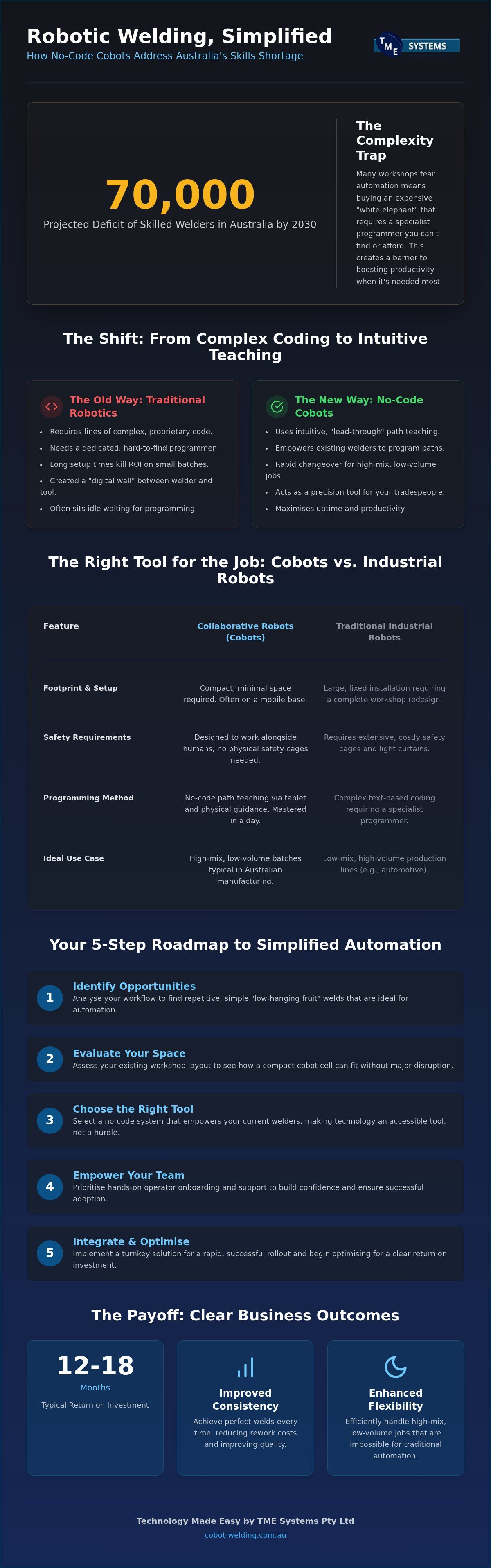

With Australia projected to face a deficit of 70,000 skilled welders by 2030, the pressure to maintain production has never been higher. You've likely considered how to simplify robotic welding to bridge this gap, but the fear of buying an expensive "white elephant" that no one knows how to use is a major hurdle. It's a common worry that automation will lead to high rework costs or require a specialist programmer you simply can't find in the current market.
The reality is that modern technology has moved away from complex coding and toward practical, workshop-ready tools. By using no-code teaching software and collaborative robots, you can empower your existing welders to program paths themselves without any prior IT experience. This article explores how these intuitive systems allow for better consistency across small and medium batches, providing a clear path to a return on investment within 12 to 18 months. We'll show you how to turn automation into a supportive tool for your team rather than a technical burden.
Key Takeaways
- Modern no-code software removes the digital barrier, allowing your tradespeople to "teach" a robot through lead-through paths instead of writing complex code.
- Discover how to simplify robotic welding by focusing on high-mix, low-volume batches that traditional automation often fails to handle efficiently.
- Compare the compact footprint of collaborative robot cells against caged industrial units to find the best fit for your existing workshop layout.
- Follow a 5-step roadmap to identify repetitive "low-hanging fruit" welds and prepare your site for a rapid, successful rollout.
- Learn the value of turnkey integration and operator onboarding to ensure your team feels supported and the system delivers a clear return on investment.
What Does it Mean to Simplify Robotic Welding in 2026?
In 2026, to simplify robotic welding means removing the digital wall between your best tradespeople and the equipment they use. For years, automation felt like an "all or nothing" gamble. You either stuck with manual work or invested heavily into a system that required a full-time programmer. That old model failed many local workshops because it didn't account for the reality of Australian manufacturing: small batches, diverse parts, and limited floor space. Modern simplification is about making the machine speak the language of the welder, not the other way around.
Unlike the "black-box" industrial units of the past, modern robotic welding systems are designed to be open and collaborative. They don't hide behind thousands of lines of code. Instead, they act as a high-precision tool that supports the welder, ensuring that their expertise remains the core of the operation. This shift toward "accessible automation" is the only practical way to address the national skills shortage, allowing workshops to maintain output even when they can't find extra hands.
The Complexity Trap of Traditional Robotics
Traditional robotics often created a "complexity trap" for small businesses. Hiring a dedicated programmer is expensive, and these specialists are just as hard to find as the welders themselves. There is also a significant "down-time penalty" when you try to use old-school robots for small batches. If it takes two days to program a new path for a job that only lasts four hours, the machine stays idle and your ROI vanishes. Beyond the software, the physical complexity of safety cages and light curtains often forces a complete workshop redesign, adding hidden costs and logistical headaches that many owners would rather avoid.
Why Simplicity is Now a Business Necessity
With labour costs rising and the industry facing a massive deficit of skilled workers, adopting smarter tools is the only way to stay competitive. Most local fabricators have moved toward a "high-mix, low-volume" model. You need to be able to switch from welding trailer frames to stainless brackets in minutes, not days. Simplified welding is a system that a qualified welder can master in a single shift. By making the technology approachable, you ensure your existing team can keep the arcs on without waiting for an external specialist to fix a "white elephant" machine. It's about giving your tradespeople the power to scale their own productivity.
The No-Code Advantage: How Software Simplifies Robotic Welding Paths
The biggest breakthrough in modern fabrication isn't just the robot arm itself; it's the software that controls it. In the past, "programming" a robot meant sitting in front of a screen for hours, typing lines of proprietary code that only a specialist could understand. Today, the shift toward no-code robot welding software has completely changed the workflow. Instead of writing code, your team "teaches" the machine by moving it through the required steps. This transition is a core part of how we simplify robotic welding for workshops that don't have the time or budget for dedicated IT staff.
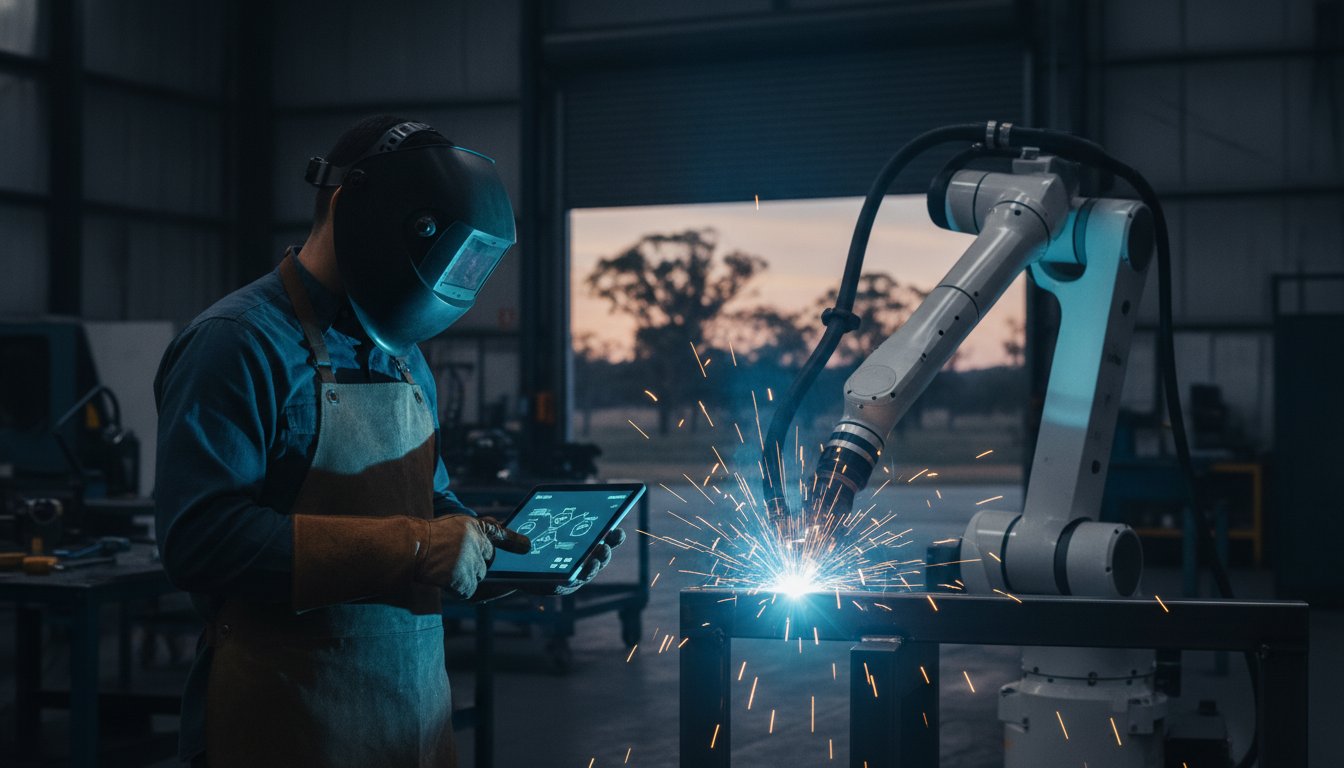
One of the most practical features of this technology is the "lead-through" method. A welder simply grabs the robot arm and physically moves it along the desired weld path. The software records these movements in real-time, handling all the complex trigonometry and joint speed calculations behind the scenes. If a path needs a slight adjustment due to a change in part fit-up, the operator can tweak it on the fly. You don't have to stop production for half a day to call in a technician; your welder just makes the change and hits start.
From Programming to Path Teaching
Traditional teach pendants were bulky, keyboard-heavy devices that felt more like 1990s computers than modern tools. Modern interfaces have replaced these with intuitive, tablet-based screens. Visual icons and "drag-and-drop" blocks replace lines of C++ or proprietary code, making the process feel as familiar as using a smartphone. This user-friendly approach aligns with the National Robotics Strategy, which encourages the adoption of accessible technology to boost local manufacturing. You get a "what you see is what you get" simulation of the weld before the arc even strikes, which drastically reduces the risk of expensive errors.
Precision Without the PhD
Even the best-prepared parts can have minor inconsistencies. Modern software can compensate for these variations automatically, ensuring the torch stays on the seam even if the part is slightly out of alignment. You can also build "weld libraries" that store the perfect settings for specific MIG or TIG tasks. Once a senior welder identifies the ideal voltage, wire speed, and travel angle for a job, those settings are locked in. This allows junior staff to produce senior-level quality consistently, effectively multiplying the expertise of your most valuable workers. If you want to see how these interfaces look in action, you can see our guide to accessible automation for more details.
Cobots vs. Industrial Robots: Choosing the Path of Least Resistance
Deciding between a traditional industrial robot and a collaborative robot (cobot) is often where fabricators get stuck. To simplify robotic welding, you need to look at how much friction each system introduces to your workshop floor. Industrial robots are incredibly fast and precise, but they are designed for high-volume production where the same part is welded thousands of times. They require extensive safety cages, light curtains, and often a permanent concrete plinth. For many Australian SMEs, this rigid setup is the opposite of simple.
In contrast, collaborative robot welding cells offer a more flexible entry point. Because they are designed to work alongside people, they don't always need the same heavy guarding that a traditional cell does. This reduces the setup time from weeks to just a few days. When you factor in the total cost of ownership, cobots often come out ahead for local shops because you don't need to hire a specialised robotics engineer just to keep the machine running safely. You save on the physical footprint and the ongoing overhead of expert staff.
Safety and Spatial Flexibility
Modern cobots use force-limiting sensors that can detect a collision and stop the arm instantly. This simplifies the safety audit process, as you aren't always forced to build a 20-square-metre cage around the machine. In a typical Aussie fabrication shop where space is at a premium, this spatial flexibility is a game-changer. Some cells are even mobile, allowing you to wheel the robot to a large workpiece instead of trying to fit the work into a restricted cage. It's about making the technology fit your existing workflow rather than forcing your workshop to adapt to the machine.
Versatility for Small Batch Runs
Industrial robots excel at repetitive tasks, but they struggle when you need to switch jobs frequently. Improving welding productivity with cobots starts with reducing changeover time. If you have a batch of ten trailer frames followed by five stainless tanks, a cobot allows you to swap jigs and load a new program in minutes. This versatility is why collaborative systems are winning in high-mix environments. You get the consistency of automation without losing the agility that allows your workshop to take on diverse, custom projects. It turns the robot into a tool that your team can use for almost any job that comes through the door.
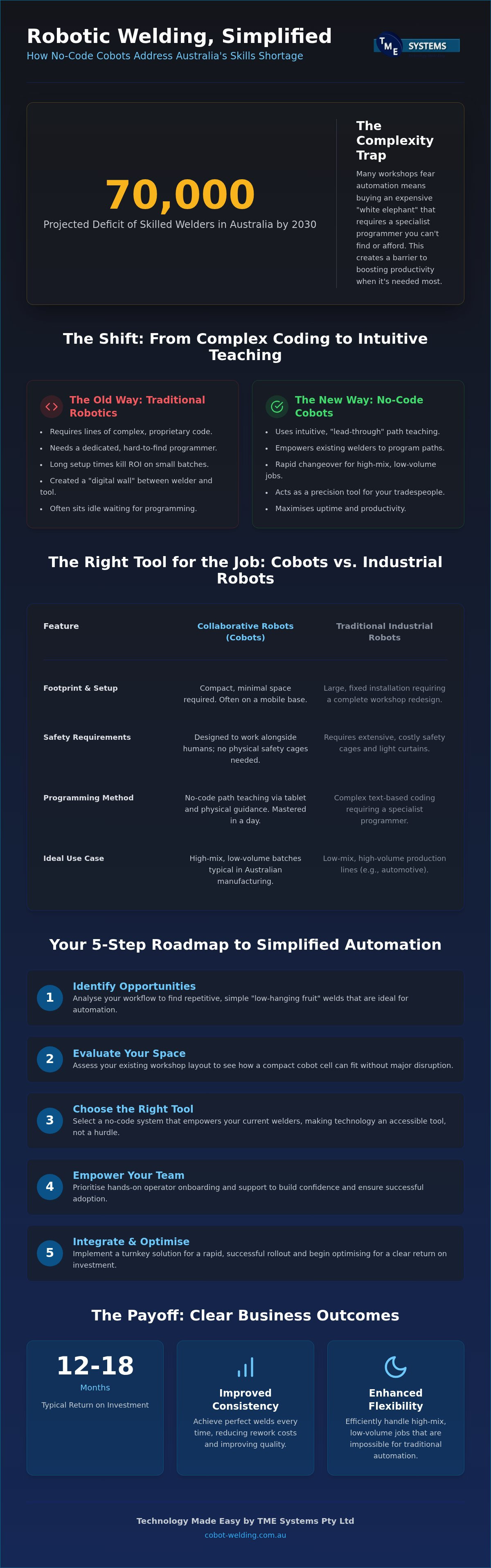
Your 5-Step Roadmap to Simplify Robotic Welding Adoption
Transitioning to automation doesn't have to be a disruptive overhaul of your entire operation. By following a structured approach, you can integrate technology that supports your team and delivers results quickly. The goal is to simplify robotic welding by starting with manageable changes that build confidence on the workshop floor.
- Step 1: Identify "low-hanging fruit." Look for the repetitive, simple welds that take up your skilled welders' time. These high-volume, straightforward tasks are perfect first candidates for automation.
- Step 2: Audit your site. Check your available floor space and power requirements. While cobots have a small footprint, you still need to ensure you have stable power and adequate fume extraction in place to meet Australian safety standards.
- Step 3: Involve your team early. Your welders are the ones who will use the tool every day. Getting their input on which parts are most frustrating to weld manually ensures they feel a sense of ownership over the new system.
- Step 4: Prove the concept. Before committing to a full installation, utilise a mobile welding robot demonstration. Seeing the system weld your actual parts in your own environment removes the guesswork.
- Step 5: Focus on incremental gains. Don't try to automate your most complex custom job on day one. Aim for steady improvements in consistency and throughput on your core product lines first.
Assessing Your Existing Workflow
Success starts with identifying where the real bottlenecks live. If your team is spending hours on repetitive fillet welds for standard brackets, that's where a robot provides the most relief. However, automation won't fix poor preparation. You must ensure your part consistency and jigging are accurate before the robot arrives. To truly simplify robotic welding, you should follow the "simplify then automate" philosophy; refine the manual process first to ensure the robot has a reliable path to follow.
Upskilling Your Current Team
One of the most effective ways to introduce technology is to frame the robot as a "welding assistant." It takes on the physically straining, monotonous work, allowing your tradespeople to focus on complex assemblies. Providing on-site cobot welder training is essential to this transition. By turning your experienced welders into "Robot Supervisors," you retain their deep institutional knowledge while giving them a tool that extends their productive years. If you're ready to see how this fits your shop, you can book an on-site assessment to evaluate your specific needs.
How TME Systems Simplifies the Automation Journey
At TME Systems Pty Ltd, we aim to simplify robotic welding by providing more than just a piece of hardware. We understand that for an Australian workshop, the transition to automation is about reliability and local support. Our approach focuses on delivering systems that are ready to work from day one, backed by a partnership that continues long after the initial setup. By removing the technical guesswork, we help you focus on what you do best: producing high-quality metalwork without the stress of complex programming.
Beyond the installation, our ongoing support model includes operator onboarding and dedicated training. We don't just drop off a machine and leave; we ensure your team is confident in adjusting paths and maintaining the system. This collaborative relationship turns a technical transition into a steady improvement of your workshop's capabilities. You aren't just buying a machine, you're gaining a partner invested in your long-term ROI.
Turnkey Solutions vs. DIY Integration
Many workshops fall into the trap of trying to piece together a robotic system from various suppliers to save on initial costs. While this DIY approach might seem cheaper on paper, the hidden costs of troubleshooting, software glitches, and safety compliance often spiral out of control. Turnkey welding cells arrive pre-configured and tested, which significantly reduces the risk of implementation failure. Our welding system integration specialists customise each cell to fit your specific workflow, ensuring the torch, software, and safety sensors work in perfect harmony. This professional integration provides peace of mind, especially when backed by Australian-based technical support that understands local standards and production pressures.
The Value of a Practical Demonstration
Complexity is often the biggest deterrent to innovation. To overcome this, we offer a mobile demo system that brings the technology directly to your production line. Seeing a robot weld your specific parts is the ultimate complexity-killer. It removes the "guesswork" from the capital expenditure process, allowing you to see the actual weld quality and cycle times before making a financial commitment. This hands-on trial is often the turning point for manufacturers who were previously hesitant about automation. It's time to take the first step toward a simpler, more productive workshop by seeing the results for yourself on your own workshop floor. Taking this step allows you to verify the ROI and ensure the system fits your team's needs before the installation begins.
Future-Proof Your Workshop with Accessible Automation
Adopting robotics in your fabrication shop no longer requires a degree in computer science or a massive workshop overhaul. The shift toward no-code software has removed the old programming bottlenecks, allowing your best welders to "teach" the robot rather than write lines of code. These turnkey cells are designed for immediate use on the workshop floor, ensuring that your investment starts paying off from day one.
When you choose to simplify robotic welding, you gain more than just hardware. You get a partnership backed by Australian-based integration and technical support that understands the unique pressures of local manufacturing. This supportive approach ensures your team feels confident and your production stays consistent, even as the industry faces ongoing skills shortages. It's a practical, grounded way to scale your business while valuing the craftsmanship your team already possesses.
Ready to take the next step? Book a Mobile Welding Robot Demonstration to see how we simplify your workshop and discover the difference that accessible automation can make for your production line.
Frequently Asked Questions
Is robotic welding really simple enough for a small workshop?
Yes. Modern systems are designed specifically for the high-mix, low-volume production typical of small Australian shops. Collaborative robots have compact footprints and don't require massive safety cages, making them easy to fit into existing layouts. This technology is built to simplify robotic welding for businesses that don't have the space or staff for traditional industrial units. It turns automation into a flexible workshop tool rather than a rigid production line.
Do I need a computer science degree to operate a no-code welding robot?
No. No-code software uses intuitive tablet-based interfaces and visual icons instead of complex programming languages. Operators "teach" the robot by physically moving the arm through the weld path or using simple drag-and-drop commands. If you can use a smartphone or a modern CNC controller, you can master these systems. The goal is to empower your tradespeople, not replace them with expensive IT specialists.
What is the actual setup time for a collaborative welding cell?
A turnkey collaborative cell can typically be operational within a few days. Unlike traditional industrial robots that take weeks of installation and safety guarding construction, these units arrive pre-configured. Once the cell is on your floor and connected to power and gas, the primary task is operator onboarding. This rapid deployment ensures your production remains steady and you start seeing productivity gains almost immediately without long periods of downtime.
Can a simplified robotic system handle complex weld geometries?
Yes. Simplified doesn't mean less capable. Modern no-code software handles the complex trigonometry required for circular welds, multi-axis movements, and intricate corners behind the scenes. You simply define the start, end, and waypoints, and the system calculates the optimal torch angle and travel speed. This allows you to achieve high-precision results on complex parts without needing to understand the underlying mathematical code or proprietary software languages.
How does simplifying the welding process affect my ROI?
Simplification accelerates your return on investment by reducing the high costs associated with specialist programmers and long setup times. By enabling your existing team to manage the system, you lower operational overheads significantly. Increased consistency also drops rework rates from industry averages of 5 to 8 percent down to under 1 percent. Most workshops see a clear ROI within 12 to 18 months through improved throughput and reduced material waste.
Is it easy to switch the robot between MIG and TIG welding tasks?
Yes. The integration process allows for quick changes between different welding processes. While the physical torch and power source may need swapping, the no-code software stores specific weld libraries for both MIG and TIG tasks. This means you can store perfect voltage and wire speed settings for various materials and thicknesses. You simply select the relevant program and ensure the hardware is configured, making high-mix production much more manageable.
What happens if the robot breaks down; is support available in Australia?
Yes, TME Systems provides national technical support across Australia. Because these systems are integrated locally, you have access to technicians who understand the specific requirements of the Australian market. We provide ongoing maintenance and troubleshooting to ensure your workshop avoids long periods of unproductive downtime. You aren't just buying a machine; you're entering a partnership that includes reliable, local assistance whenever technical issues or maintenance needs arise.
Will my experienced welders find the no-code software easy to use?
Most experienced welders pick up the system in a single shift. The software is designed to leverage their existing trade knowledge, such as torch angles and travel speeds, rather than forcing them to learn a new discipline. By using the lead-through method to simplify robotic welding, the robot becomes a supportive tool that reduces their physical strain. It allows them to focus on high-value work while the robot handles the repetitive tasks.