
What if your next tax decision could directly clear your workshop's production bottlenecks? Upgrading fabrication capacity often feels like a tense compromise between protecting working capital and securing multi-year productivity gains. Yet, leveraging the instant asset write-off welding equipment rules isn't merely about lowering an end-of-year tax bill. When approached strategically, tax allowances reward genuine workshop modernisation, making high-yield technology far more accessible than passive machinery.
Balancing cash outlays against tight margins is challenging enough without having to decipher evolving depreciation thresholds or worry about persistent skilled labour shortages. In this guide, you'll learn how Australian capital write-offs apply to advanced fabrication tools, which equipment investments deliver the fastest operational payback, and how to offset costs effectively. We'll examine current ATO guidelines, compare write-off pathways, and map out how to have productive systems installed ready for use before tax deadlines without disrupting your workshop floor.
Key Takeaways
- Discover how current rules for the instant asset write-off welding equipment scheme let fabricators reduce tax liabilities while modernising workshop capability.
- Understand the operational distinction between immediate deductions and simplified depreciation pooling to make informed capital expenditure choices.
- See why pairing capital allowances with collaborative robot welding cells generates far higher multi-year returns than simply replacing standard manual machinery.
- Master practical procurement timelines to guarantee new assets are delivered, commissioned, and installed ready for use before the 30 June deadline.
- Learn how turnkey integration, intuitive no-code software, and focused operator onboarding eliminate downtime during new technology rollouts.
Understanding the Instant Asset Write-Off for Australian Welding Equipment
For fabrication business owners, balancing machinery acquisition against quarterly cash flow is a constant reality. Broad tax legislation often feels disconnected from physical workshop floors, yet tax provisions directly influence how quickly you can expand workshop capacity. Leveraging provisions for the instant asset write-off welding equipment scheme allows eligible Australian manufacturers to claim deductions on depreciating assets, reducing taxable profit while bringing modern capabilities into production bays.
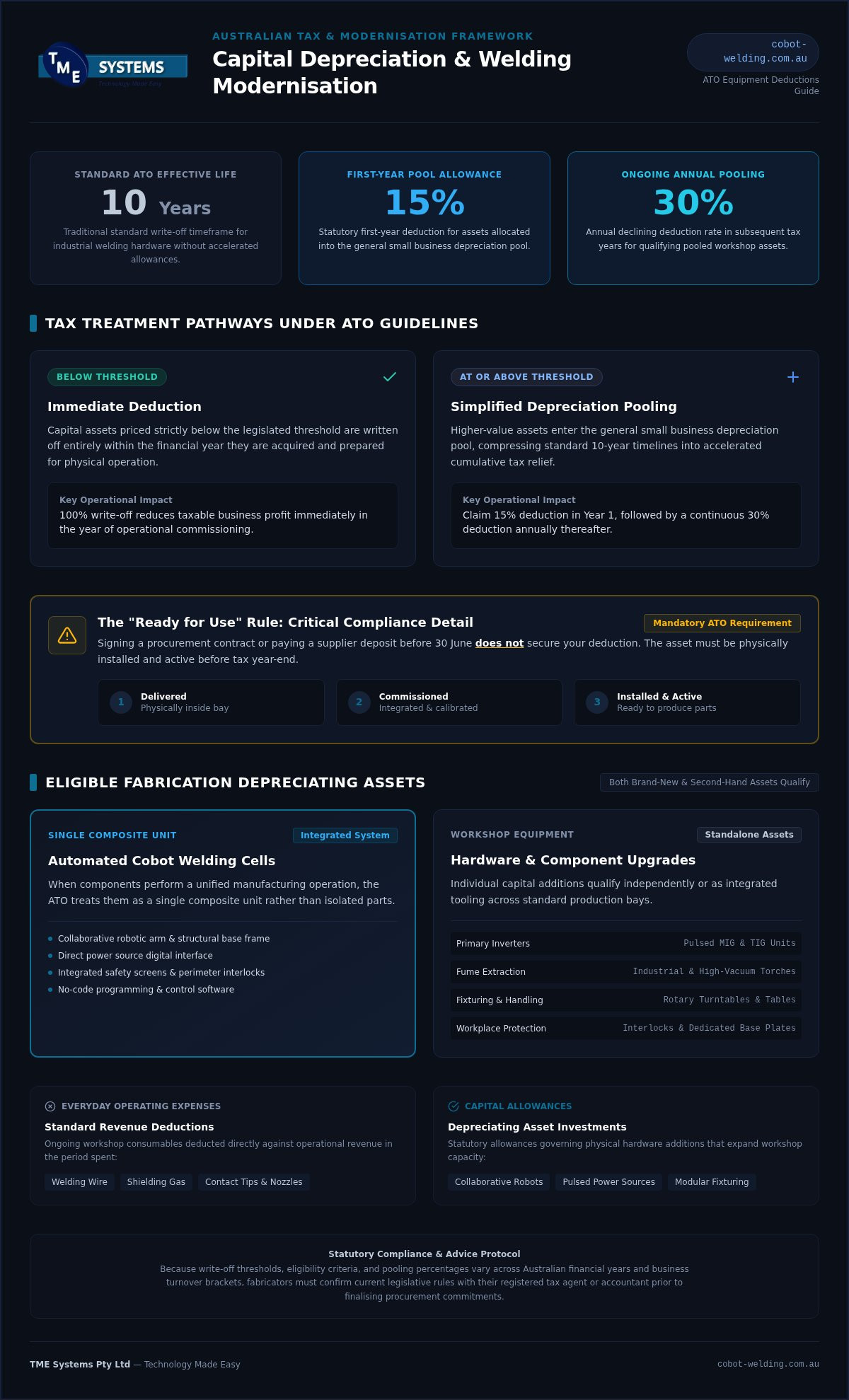
Under Australian Taxation Office rules, capital equipment fits into two main tax treatment paths depending on cost thresholds and business turnover:
- Immediate Deduction: Assets priced below the legislated threshold are written off entirely within the financial year they are acquired and prepared for work.
- Simplified Depreciation Pooling: Assets at or above the threshold enter a general small business depreciation pool, deducted at 15% in their first year and 30% annually thereafter.
How Capital Allowances Work for Industrial Fabricators
Differentiating between everyday operating expenses like wire, gas, and consumables and capital machinery upgrades is essential. When you invest in physical hardware, statutory capital allowances govern how that expense offsets revenue. Instead of waiting ten years across the ATO standard effective life for welding assets, accelerated allowances compress that tax relief. Because thresholds and eligibility criteria change across financial years, fabricators must confirm current rules with their registered tax agent or accountant before finalising commitments.
Ready for Use: The Key Procurement Requirement
A critical detail frequently caught out during audits is timing. Simply signing a procurement contract or paying a supplier deposit before 30 June doesn't secure the tax deduction. The ATO requires machinery to be physically delivered, fully commissioned, and installed ready for use on the production floor within that tax period.
Lead-time delays or complex integration cycles can postpone deductions into the next financial year. Selecting turnkey setups, such as integrated collaborative robot welding cells, significantly reduces this deployment risk. Pre-configured systems with focused on-site onboarding ensure the technology produces parts and meets the operational readiness test well before year-end deadlines arrive.
Evaluating Eligible Welding Equipment for Capital Depreciation
Determining which workshop upgrades qualify under capital depreciation rules requires looking closely at how assets function on your floor. Both brand-new and second-hand machinery are eligible depreciating assets under Australian tax legislation. However, fabricators often trip over how the tax office defines individual assets versus bundled systems. When multiple components are acquired together to perform a single, unified manufacturing operation, the tax authority generally treats them as a composite unit rather than isolated parts.
Understanding these classifications helps you identify how the instant asset write-off welding equipment rules apply across your workshop floor. If an acquisition exceeds immediate write-off thresholds, it transitions into the general small business pool, steadily depreciating across consecutive tax returns.
Eligible Hardware and Workshop Additions
Standalone workshop components routinely qualify for capital allowances. Common eligible assets include:
- Primary power sources such as pulsed MIG and TIG inverters
- Industrial fume extraction systems and high-vacuum torches
- Heavy-duty rotary turntables, positioners, and modular fixturing tables
- Automated fabrication setups, including turnkey collaborative robot welding cells
- Integrated safety screens, interlocks, and dedicated structural base plates
A cobot welding cell operates as an integrated manufacturing asset. Its robotic arm, power source interface, base frame, and safety fixtures function together to deliver structural welds, making the entire assembly a single depreciating piece of capital equipment.
Software, Integration, and Associated Installation Costs
Bringing modern machinery into an operational bay involves more than uncrating hardware. Costs directly associated with putting the machine into service, such as delivery freight, electrical tie-ins, and foundational engineering, form part of the asset's initial cost base. This treatment also extends to embedded no-code teaching software and control licences supplied with the equipment.
Partnering with welding system integration specialists packages equipment integration, software configuration, and initial operator onboarding into a compliant capital deployment. If you're weighing workshop modernisation options before the next tax cut-off, you can explore practical cell configurations at cobot-welding.com.au to see how integrated automation fits your workflow.
Manual Equipment vs Automated Cobot Systems: Maximising Capital Returns
Claiming a deduction provides immediate tax relief, but the machinery you select dictates your workshop's earning power for years to come. Many fabrication businesses look at the instant asset write-off welding equipment provisions and default to buying like-for-like manual power sources. Replacing an ageing inverter reduces taxable income today. It doesn't, however, fix the broader commercial pressures facing Australian fabrication: rising input costs, unpredictable supply chains, and persistent shortages of experienced boilermakers.
Capital allowances should fund equipment that acts as a productivity multiplier. When capital expenditure goes toward high-yield automation, the tax savings offset an asset that genuinely transforms shop-floor economics.
The Limitations of Upgrading Only Manual Plant
Buying another manual welding bay often leaves existing bottlenecks untouched. A skilled operator using manual equipment rarely achieves more than 20% to 30% arc-on time over a full shift. The rest of the day is consumed by part preparation, fitting, tacking, repositioning, and post-weld clean-up.
Manual welding also leaves workshops vulnerable to joint inconsistency and costly rework, particularly when fatigue sets in on repetitive runs. Simply dropping a new manual power source into that environment changes very little. If your experienced welders spend their shifts running straight seams on basic assemblies, your skilled labour capacity remains locked away from complex, high-margin structural jobs.
The Strategic Payback of Collaborative Welding Cells
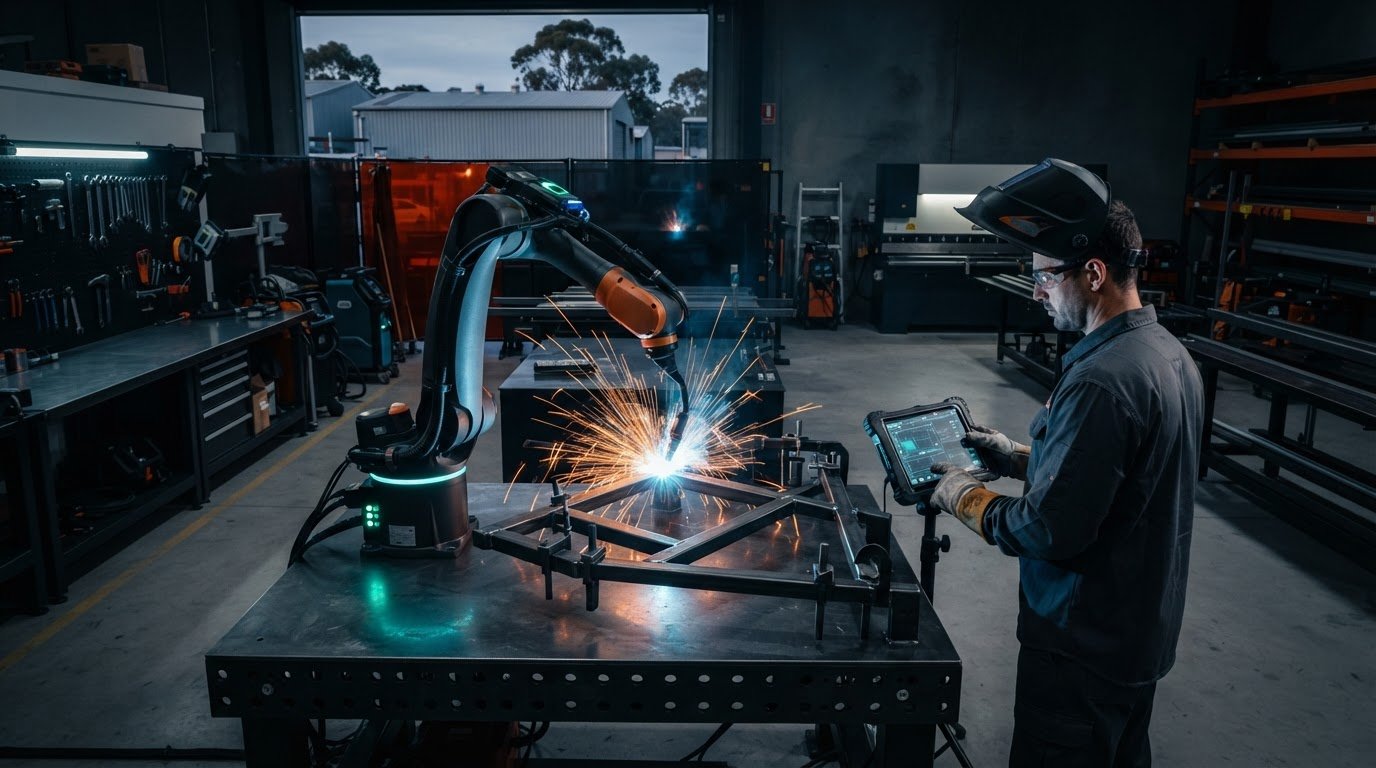
Collaborative automation breaks this cycle. Deploying collaborative robot welding cells lets you multiply workshop throughput without knocking down walls or leasing extra industrial space. These units take on repetitive, time-heavy components, producing precise, repeatable welds shift after shift.
Reviewing our guide to improving welding productivity with cobots details how automated arc-on times quickly double or triple manual rates on standard assemblies. The primary financial benefit isn't just the initial tax deduction or depreciation pool allocation. It's the compounding return on investment delivered through compressed turnaround times and minimal rework.
Equally important is usability. Modern cobot systems feature intuitive no-code teaching software, meaning operators don't need computer programming credentials to set up a run. A trade-qualified welder guides the robotic torch along the joint by hand, records the path in minutes, and runs the job. Your tradespeople shift from performing monotonous tasks to overseeing productive, multi-station output.
Procurement and Commissioning Timelines for End-of-Year Claims
Meeting the 30 June deadline requires backward planning from physical handover, not payment processing. A common trap during end-of-financial-year planning is ordering machinery in mid-June and assuming the tax invoice suffices. Under the instant asset write-off welding equipment criteria, if equipment sits in a freight depot or remains crated on your floor on 30 June, the deduction rolls into the next tax period. Accounting for Australian freight corridors and practical setup times protects your capital deduction strategy. The same operational readiness principle applies across broader industrial and construction plant investments, where partnering with established machinery specialists like Equipcon helps businesses coordinate delivery and commissioning schedules well before year-end deadlines.
Step-by-Step Workshop Implementation Schedule
To avoid tax-time surprises, follow a structured four-stage rollout schedule:
- Phase One (Shop Floor Assessment): Review three-phase power availability, compressed air drops, floor space, and current fabrication bottlenecks well before end-of-year rush periods.
- Phase Two (Procurement & Logistics): Finalise machinery specifications early to account for national freight transit times, avoiding late-June courier bottlenecks.
- Phase Three (Mechanical Installation): Position hardware, anchor fixturing tables, wire utility interfaces, and run initial weld parameter verifications.
- Phase Four (Operator Handover): Complete practical training so trade staff run production jobs, establishing that the machinery is fully operational before the tax year closes.
Mitigating Commissioning Risk with Intuitive Automation
Deployment speed depends heavily on system complexity. Traditional industrial robotic cells often require weeks of civil anchoring, light-curtain wiring, and specialized PLC coding. That lengthy timeline introduces serious delivery risk when racing against end-of-year tax deadlines.
Turnkey collaborative cells remove these friction points. Pairing accessible hardware with intuitive no-code robot welding software compresses programming curves from weeks into hours. Operators direct the torch through the required weld path using handheld lead-through controls, setting parameters directly on an interface built for fabricators rather than software engineers.
Backing that accessible software with hands-on, structured on-site cobot welder training ensures your workshop team starts running live production parts right away. That immediate productivity provides rock-solid documentation that the system is fully operational before year-end. If you want to secure an operational welding cell before the upcoming tax deadline, book an on-site consultation and demonstration to evaluate your workshop footprint and lock in your delivery schedule early.
Partnering with Australian Specialists for Modern Welding Upgrades
Investing in capital machinery should build lasting operational capability, not add technical headaches. Sourcing equipment from a catalogue supplier often leaves your team to sort through mechanical mounting, interface cabling, and process settings alone. When claiming allowances under the instant asset write-off welding equipment framework, partnering with dedicated Australian automation specialists ensures every component connects seamlessly from day one.
Working alongside local specialists turns an otherwise stressful machinery rollout into a clear, methodical transition. You gain direct access to engineering support grounded in local manufacturing conditions, keeping your production schedule intact while meeting statutory requirements.
Turnkey Integration Tailored to Workshop Needs
Successful automation must adapt to your current operations rather than demanding a complete overhaul of your shop. Purpose-built turnkey packages integrate collaborative arms with your preferred industrial welding power sources, torches, and wire feed units. This tailored approach avoids costly operational teething problems and ensures the system handles your specific material thicknesses and joint designs.
Complete integration packages combine hardware, intuitive software, safety controls, and structured onboarding into a single capital asset. Having direct access to responsive Australian technical support means any post-commissioning questions get resolved quickly, keeping arc-on time high and preventing costly downtime.
Validating the Solution on Your Workshop Floor
Committing capital expenditure to advanced machinery is a major business decision. You shouldn't have to rely on glossy brochures or sterile showroom videos to judge whether automated equipment will perform on your jobs. Testing actual production assemblies provides undeniable proof of joint quality, weld cycle times, and operator usability.
Arranging a mobile welding robot demonstration brings the technology directly onto your production floor. Your trade staff can test the torch positioning, evaluate weld penetration on standard production components, and see how simple programming really is using hand-guided controls. This hands-on validation de-risks your investment, pairing tax depreciation benefits with tangible, proven increases in fabrication capacity.
Modernise Your Workshop Floor Before the Next Tax Deadline
Tax incentives deliver genuine value only when the machinery you choose solves practical workshop bottlenecks. Navigating the instant asset write-off welding equipment provisions gives your business the opportunity to pair tax relief with long-term earning power. Rather than settling for like-for-like manual replacements, directing capital allowances into scalable automation protects your working capital while addressing skilled labour shortages and boosting arc-on time.
Capturing these gains requires reliable technology and dependable deployment. Turnkey collaborative welding cells engineered specifically for Australian fabricators keep installation fast and predictable. With an intuitive no-code software interface that lets your existing operators weld parts without programming, alongside end-to-end integration and on-site training to ensure immediate operational readiness, your team can start producing quality welds well before 30 June. Explore turnkey cobot welding cells for your workshop and build lasting fabrication capacity with confidence.
Frequently Asked Questions
What qualifies welding equipment for the Australian instant asset write-off?
Qualifying for the instant asset write-off welding equipment scheme requires your business to hold an aggregated turnover below statutory limits while purchasing depreciating manufacturing hardware. The machinery must cost less than the active per-asset threshold and be fully ready for use within that tax year. Assets meeting these criteria range from basic power sources to extraction benches. Items exceeding the single-asset limit enter the simplified depreciation pool instead.
Does equipment need to be installed and working before 30 June to claim?
Yes, the machinery must be physically delivered, fully commissioned, and operating on your workshop floor before 30 June. Paying an invoice or signing a purchase order isn't enough to satisfy the Australian Taxation Office. If hardware sits in transit or remains crated in your bay when midnight strikes on 30 June, the claim moves into the next tax period. Turnkey deployments avoid this risk by getting equipment working quickly.
Can small fabrication businesses write off collaborative robotic welding cells?
Small fabrication businesses can claim collaborative robotic welding cells as depreciating assets under small business tax provisions. Depending on the overall package cost relative to current threshold limits, the system either qualifies for an immediate write-off or enters the simplified depreciation pool. In the depreciation pool, it claims 15% in the first financial year and 30% each year after, delivering steady tax deductions alongside immediate, substantial gains in production capacity.
Are integration costs and software included in the capital asset deduction?
Yes, delivery freight, electrical connection, engineering integration, and embedded software form part of the asset's total first-element cost base. Under capital allowance rules, any expenditure required to bring machinery into an operational state qualifies alongside the physical hardware. This means turnkey systems that package the robotic arm, power interface, no-code teaching software, and initial operator onboarding are treated as a unified, depreciating capital asset on your tax balance sheet.
How does an instant asset write-off differ from standard equipment depreciation?
The main difference lies in the deduction timeline. Standard depreciation spreads the cost of welding equipment across its official effective life, which the ATO typically sets at ten years. In contrast, the instant asset write-off welding equipment provision allows eligible businesses to deduct the full asset cost in the first year. Assets above the threshold use the simplified pool, claiming 15% upfront and 30% annually, which still outpaces standard schedules.
Can our workshop claim tax deductions on second-hand welding machinery?
Yes, second-hand welding equipment qualifies under current Australian small business depreciation rules. The tax framework treats used plant and machinery as depreciating assets, provided they meet standard turnover and threshold limits. While buying second-hand reduces initial outlay, fabricators must weigh potential risks. Older units often carry hidden maintenance issues, lack manufacturer backing, and miss out on modern efficiency gains that newer, automated systems deliver from the first shift.
What happens if ordered welding equipment arrives after the financial year ends?
If your machinery arrives after 30 June, the deduction cannot be claimed in that financial year, even if payment cleared beforehand. The tax office strictly enforces the ready-for-use rule. Your workshop will simply claim the deduction or pool the asset in the subsequent tax year once installation is complete. To lock in deductions for a specific financial period, order well ahead to account for freight schedules and setup requirements.