
Imagine it's 3:30 PM on a Friday and your welding robot suddenly stops. You're staring at a red error light while a critical job sits half-finished, knowing the only person who can help is a technician in a time zone ten hours behind ours. It's a common fear for many Australian fabricators, but having reliable local robotic welding support means you're never left stranded when a deadline is looming. We understand the pressure of a busy workshop floor where every minute of downtime directly impacts your bottom line.
You'll discover how a combination of no-code technical support and local expertise ensures your workshop stays productive and your team remains in total control of your automation. We will explore why empowering your own welders to handle most issues is the fastest way to minimise disruptions. From fast access to spare parts to hands-on training that actually makes sense, this guide shows you how a local partnership keeps your business moving forward without the technical headaches.
Key Takeaways
- Understand why reliable local robotic welding support within Australian time zones is the only way to avoid the high cost of waiting for overseas technicians when a system stops.
- Discover how no-code teaching software shifts the focus from complex programming to refining the weld, putting the control back in the hands of your tradespeople.
- Learn how to balance the speed of remote diagnostics with the necessity of on-site visits to ensure your system integration remains seamless and reliable.
- Get a practical 5-point checklist to evaluate potential partners, focusing on whether they provide expert welders or just IT staff to support your workshop.
- Explore the "practical mentor" approach to onboarding that ensures your team is fully trained and confident in maintaining your own robotic welding cells.
Why Local Robotic Welding Support is Vital for Australian Workshops
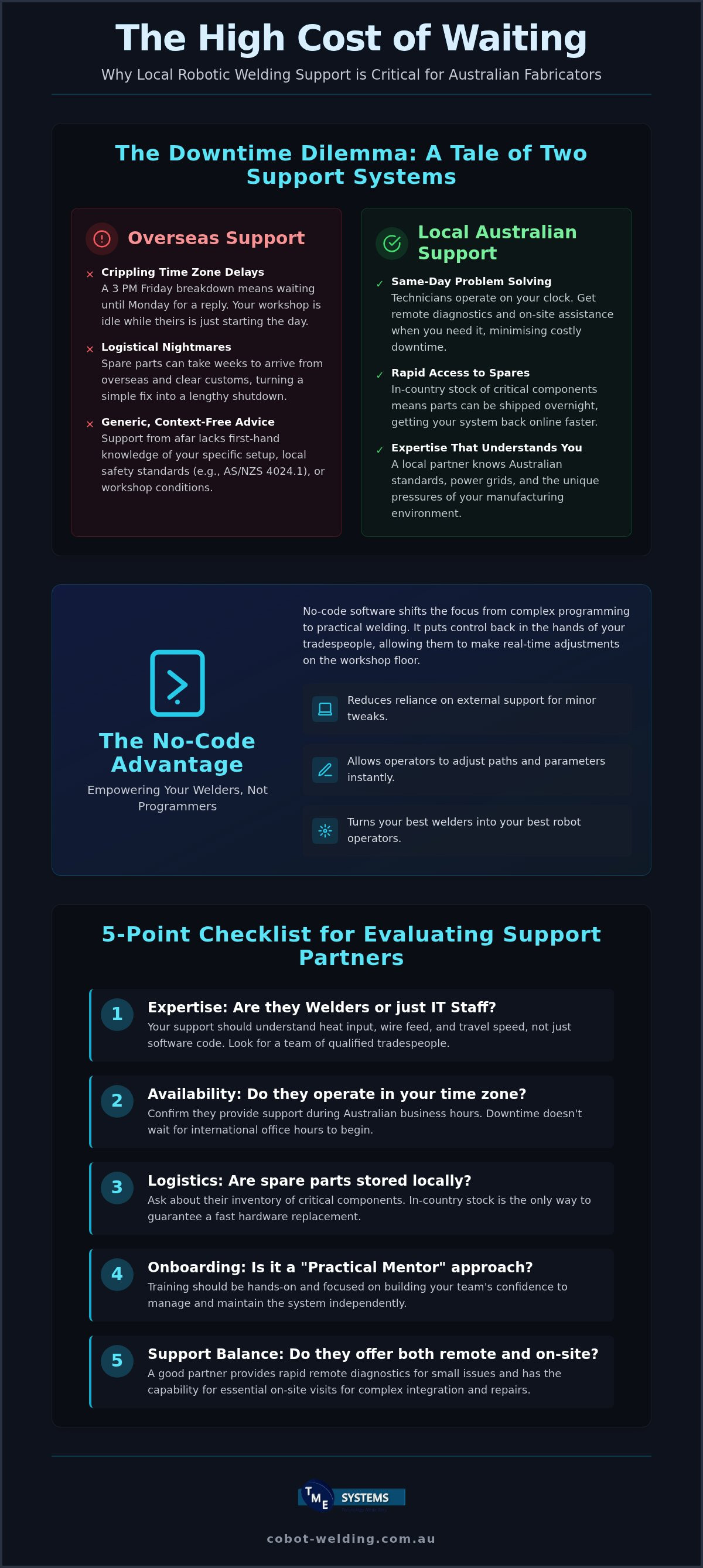
Local support isn't just a marketing slogan; it's the difference between a productive shift and a wasted day. For many Australian fabricators, the excitement of installing new automation can quickly turn to anxiety when a technical hiccup occurs. If your system relies on a technician sitting in a different time zone, you aren't just waiting for a fix; you're waiting for the world to wake up while your production schedule slips. True local robotic welding support means having a partner who operates on your clock and understands the specific pressures of the Australian manufacturing landscape.
The high cost of downtime is a reality that manual workshops know all too well. When a machine sits idle, you lose more than just "arc on" time. You lose the ability to meet deadlines and the confidence of your clients. Robot welding is designed to increase throughput, but that advantage vanishes the moment a system becomes unresponsive. Relying on overseas support often involves long delays, language barriers, and a lack of accountability. Moving toward a long-term operational partnership with local experts ensures that your investment continues to deliver value long after the initial sale is finalised.
Avoiding the "Silent Paperweight" Risk
Many smaller workshops hesitate to adopt automation because they fear ending up with an expensive "silent paperweight" in the corner of the shed. This psychological barrier is real. If your team doesn't feel they have a safety net, they may revert to manual processes at the first sign of trouble. The support gap in the Australian market is the distance between a business owner's desire to innovate and their actual access to the technical confidence required to maintain that innovation. Without local robotic welding support, complex technology often stays abandoned because the path to a solution feels too difficult to navigate.
The Advantage of Australian-Based Technical Knowledge
Working with local integrators means your support team understands the exact standards your workshop must meet, such as the AS/NZS 4024.1:2019 safety requirements. They know our local power grids, our safety regulations, and the unique environmental conditions of an Australian workshop floor. There's also the undeniable benefit of logistics. Having spare parts stored in-country and ready for overnight shipping beats waiting weeks for a component to clear customs. You get direct access to the people who configured your cell, ensuring that troubleshooting is based on first-hand knowledge of your specific setup rather than a generic manual.
The No-Code Advantage: Solving Problems on the Workshop Floor
Traditional automation often creates a bottleneck where only a handful of specialised programmers can make changes to a system. This setup forces workshops to rely on external help for even the smallest adjustments, turning a minor tweak into a day of downtime. The introduction of no-code robot welding software completely flips this dynamic. By removing the need for complex syntax and terminal commands, the software moves the focus away from "fixing code" and back toward refining the weld process itself. It's about giving the tools to the person who actually knows how to weld.
When your team can troubleshoot issues directly on the workshop floor, the nature of local robotic welding support changes. Instead of calling a technician every time a part fit-up varies slightly, your operators can adjust the robot's path or parameters in real time. This empowerment reduces the frequency of support tickets and ensures that when you do need to reach out for expert help, it's for significant system optimisations rather than basic operational hurdles. If you want to see this technology in action, you can book a mobile demo to experience the interface firsthand.
Operator-Led Troubleshooting
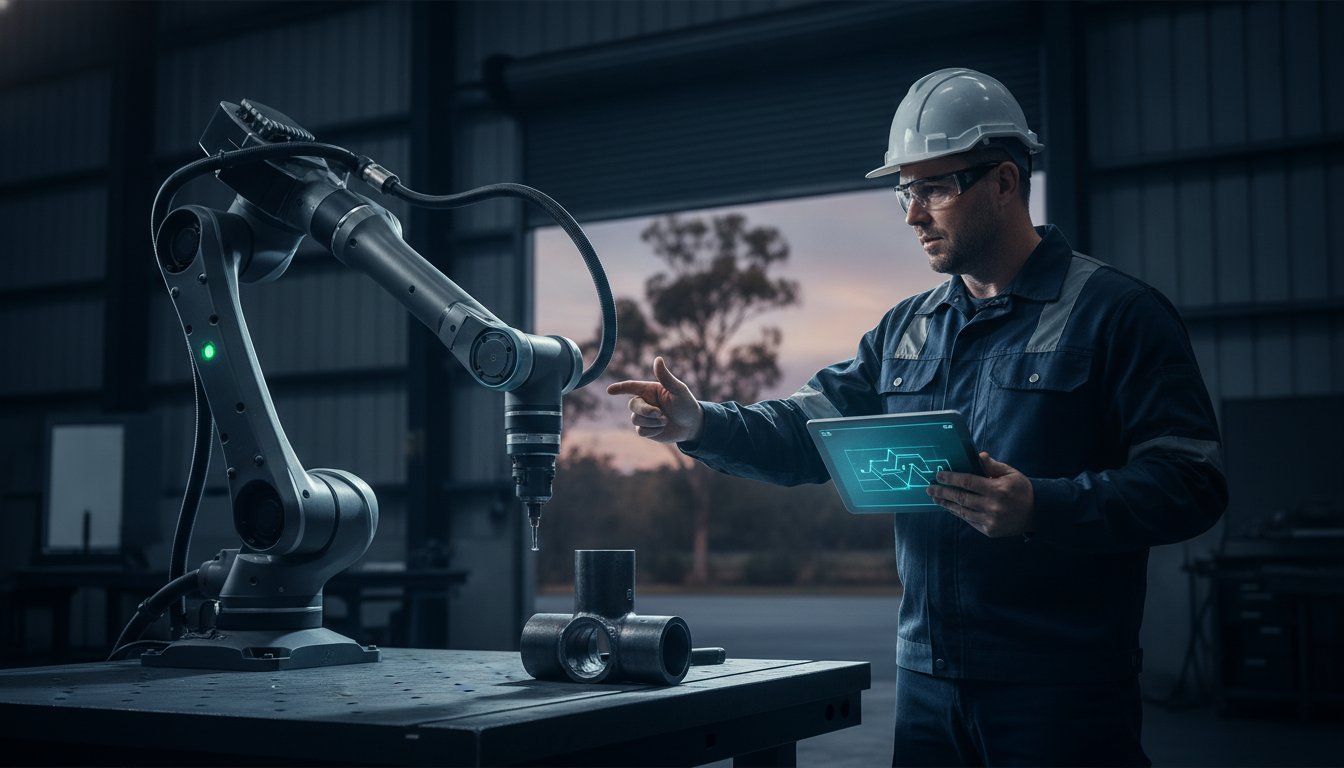
Your best welders are naturally the best people to support your cobot because they understand the relationship between travel speed, wire feed, and heat input. No-code interfaces use intuitive touchscreens and "lead-through" teaching, where the operator physically moves the robot arm to the correct position. Imagine a production run where the base plates are slightly out of spec. Instead of scrapping the batch or waiting for a programmer, a welder can simply "nudge" the weld path and resume production in seconds. This immediate flexibility is what keeps a workshop profitable during high-mix production cycles.
Reducing the Need for External Software Engineers
Hiring a specialised software engineer for every new job is a hidden cost that many Australian fabricators don't account for initially. By using no-code teaching software, you keep the intellectual property of your welding processes inside your own business. Your tradespeople retain the "brains" of the operation, ensuring that your workshop isn't held hostage by a third-party's schedule. This simplified transition is particularly helpful for staff who are new to automation; it feels less like learning a new language and more like using a digital version of the tools they've used for decades. It makes the transition to a collaborative robot welding cell feel like a natural progression rather than a daunting technical leap.
Comparing Support Models: Remote Diagnostics vs. On-Site Visits
Not all technical hitches require a service van in the driveway. Sometimes, the fastest fix happens through a screen. Effective local robotic welding support relies on a tiered approach that balances immediate digital assistance with hands-on physical expertise. Choosing the right model depends on whether you're refining a digital path or dealing with a physical hardware shift on the workshop floor. Understanding when to use each can save your business thousands in unnecessary call-out fees and avoidable downtime.
Modern collaborative robots often come equipped with cloud-based diagnostics that allow for real-time data sharing. This means a technician can look at the same telemetry and error logs your operator sees, identifying the root cause of a software glitch in minutes rather than days. For regional Australian fabricators, this digital bridge is a lifeline. It bypasses the logistical delays of long-distance travel and ensures that your production line doesn't stay idle while a technician is stuck in transit.
The Power of Remote Assistance
Troubleshooting software glitches or minor pathing issues via secure remote links is now the standard for high-performing workshops. This isn't just a simple phone call; it involves a secure connection where a specialist can adjust parameters or update software remotely. The role of video calls and augmented reality has also grown, allowing a technician to "see" your setup through an operator's smartphone. They can point out a loose cable or a misaligned sensor as if they were standing right there next to the machine. It’s a pragmatic way to get back to work quickly without waiting for a physical visit.
When On-Site Integration and Training Matter
While digital tools are powerful, certain milestones require a physical presence. This is where cobot welding integration becomes non-negotiable. During the initial setup or when adding complex new workflows, having a specialist on your floor ensures that the hardware is perfectly aligned with your jigs and fixtures. You can't verify physical safety compliance or the nuances of your workshop's specific power supply purely through a webcam. Hands-on training during these visits is also where your team builds the most confidence, as they get to ask questions in the moment while physically handling the equipment. Ensuring the system is integrated correctly from day one prevents the kind of hardware misalignments that remote support can't always fix.
Balancing cost and speed is about having a support plan that scales with your needs. You want the reassurance that a digital fix is only a few minutes away, but you also need the peace of mind that a local expert can be on-site if the situation demands it. This hybrid approach ensures your automation remains an asset rather than a burden, keeping your workshop's productivity as high as possible.
A 5-Point Checklist for Evaluating Local Support Partners
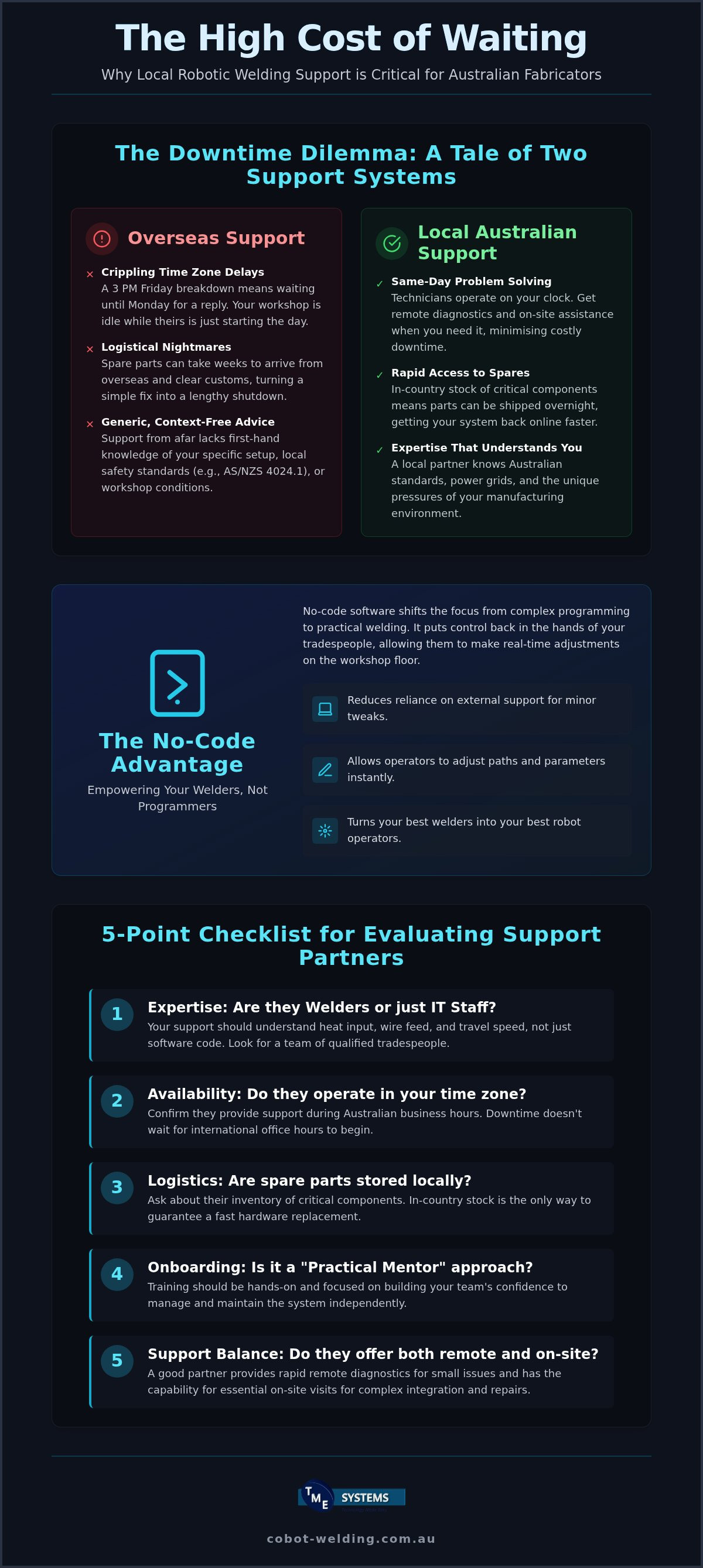
Selecting the right partner for your automation journey is just as critical as the hardware you choose. You need more than a supplier; you need a team that understands the grit and reality of a fabrication shop. High-quality local robotic welding support should feel like an extension of your own team, providing the confidence to push your production limits without the fear of being left in the lurch. Use this 5-point checklist to ensure your potential partner meets the 2026 standards for Australian manufacturing.
- Verify Technical Depth: Are you speaking to a software developer or a qualified welder? A support team should understand penetration, shielding gas, and wire stick-out, not just programming syntax.
- Onboarding Quality: Does their programme include your operators from day one? Effective support starts with comprehensive training that empowers your staff to own the process.
- Parts and Logistics: Confirm they have a local inventory of critical spares. Waiting for a shipping container from Europe or Asia is a luxury your production schedule cannot afford.
- Weld-First Mentality: The priority should always be the quality of the finished part. Look for partners who focus on how to improve welding productivity with cobots by refining the actual welding parameters.
- Proven Track Record: Evaluate their specific experience with collaborative robot welding cells in similar high-mix environments.
Beyond the Sales Pitch: Testing the Support Loop
It's easy to promise support during a sales meeting, but you need to see it in action. Ask for references from other local fabricators who have been using the system for at least twelve months. Ring their technical help desk before you sign a contract to see how quickly a real person answers the phone. You also want to understand their roadmap for the future. A reliable partner will have a clear plan for software updates and new features that keep your workshop competitive as technology evolves.
The Importance of Continuous Training
One-off training sessions are rarely enough for a growing workshop. As you take on more complex jobs or hire new staff, your support needs will change. Reliable local robotic welding support includes access to on-site cobot welder training that evolves with your business. This ongoing education ensures your team isn't just using the robot, but constantly finding new ways to optimise it for better results. If you’re ready to partner with a team that values your craft as much as the technology, explore our collaborative welding solutions today and see how we can keep your workshop moving.
Partnering with TME Systems Pty Ltd for Reliable Workshop Support
At TME Systems Pty Ltd, we recognise that the purchase of a collaborative robot is just the start of a much larger operational shift within your business. We act as a practical mentor, ensuring that your transition to automation is grounded in the reality of your specific workshop floor. Our goal is to move beyond the transactional nature of machinery sales by offering a collaborative partnership that prioritises your long-term output. This ensures that your investment in local robotic welding support translates into consistent, high-quality results for your customers, shift after shift.
We understand that the Australian manufacturing landscape requires a unique level of agility. Whether you are dealing with high-mix, low-volume production or scaling up for a major contract, TME Systems Pty Ltd provides the steady hand needed to navigate technical transitions. By focusing on the "weld" rather than just the "robot," we bridge the skills gap for local shops, providing the specialised knowledge required to maintain these systems without the need for an in-house programming department. This approach keeps your team in control and your production lines moving with confidence.
The TME Systems Pty Ltd Support Philosophy
Our philosophy is built on the idea that technology should adapt to the skilled worker, not the other way around. While we have discussed the technical benefits of no-code software, the human element is where TME Systems Pty Ltd truly adds value. We provide direct access to integration specialists who speak the language of fabrication, ensuring you aren't stuck explaining weld penetration or shielding gas to a generic IT help desk. This is a dedicated national team committed to the long-term success of Australian manufacturing, moving away from a purely transactional feel toward a truly collaborative one.
Book a Mobile Demo to Experience Our Support
One of the unique ways we support local fabricators is through our national mobile demonstration system. This allows you to see the technology—and meet the support team—in your own environment before making a final decision. The mobile welding robot demonstration is more than a simple sales tool; it is a physical proof of concept. It allows your team to handle the equipment, test the no-code interface, and verify that the system integrates seamlessly with your existing jigs and floor layout.
Taking this first step helps you visualise a more productive, automated future without the guesswork or the fear of expensive machinery sitting idle. TME Systems Pty Ltd is here to ensure that every step of that journey is backed by the expertise, training, and parts availability your workshop deserves. We invite you to explore our collaborative welding solutions and see how a trusted local partner can transform your workshop's capabilities while keeping your team in the driver's seat.
Secure Your Workshop's Future with Reliable Support
Investing in automation is a significant step for any Australian fabricator. It's about more than just the hardware; it's about ensuring your workshop has the resilience to handle whatever comes its way. By prioritising local robotic welding support, you ensure that technical hitches don't turn into expensive bottlenecks. We've explored how no-code software empowers your tradespeople and how a tiered support model provides the fastest path back to production.
TME Systems is dedicated to the long-term success of local workshops. Our national team of integration experts understands that you need results, not just code. With no-code software designed specifically for tradespeople and proven results in local fabrication workshops, we're here to act as your practical mentor. Don't let the fear of downtime hold your business back from the benefits of collaborative technology.
Ready to see how these systems perform on your own floor? Book your on-site mobile welding robot demonstration today and take the first step toward a more productive future. We look forward to helping your team stay in control and your workshop stay ahead of the curve.
Frequently Asked Questions
What does local robotic welding support actually include?
Comprehensive local robotic welding support includes everything from initial integration and on-site training to remote troubleshooting and hardware maintenance. You get access to technicians who understand Australian workshop conditions and safety standards. This support ensures your system remains productive and your team has a direct line to experts when issues arise. It's about having a partner who supports the weld, not just the robot, to keep your workshop moving.
Do I need to hire a programmer to manage my welding cobot?
No, you don't need a specialised programmer because our no-code teaching software is designed for tradespeople. Your existing welders can program and adjust the robot by physically guiding the arm and using an intuitive interface. This keeps the technical control inside your workshop and removes the need for expensive external software experts. It turns your welders into automation operators without requiring a computer science degree.
How fast can I expect a response if my robotic welding cell has an issue?
We prioritise rapid response times to ensure your downtime is kept to an absolute minimum. Digital diagnostics often allow us to identify and fix software-related issues within minutes through secure remote links. If a physical visit is required, being a provider of local robotic welding support means we can get a technician to your site much faster than an overseas provider. We work on your time zone to keep your production schedule on track.
Is remote support secure for my workshop’s internal network?
Yes, remote assistance uses encrypted, secure connections that only allow authorised technicians to access the robot's control system. You have full control over when the connection is active, ensuring your internal network remains protected. These modern cloud-based systems are built with industrial-grade security protocols to prevent unauthorised access. It's a safe way to get expert help without compromising your workshop's digital security.
What happens if a spare part for my welding robot is not in stock in Australia?
We maintain a comprehensive inventory of critical spare parts within Australia to prevent long delays. In the rare case that a specific component isn't immediately available, we use our global supply network to expedite shipping. Our goal is always to avoid the weeks of waiting often associated with clearing international customs. Having a local partner means we handle the logistics so you can focus on fabrication.
Does TME Systems Pty Ltd provide training for my existing welding staff?
Yes, we provide a comprehensive operator onboarding and training programme as part of our integration process. We believe your tradespeople are the best people to run the technology, so we focus on making them confident with the no-code software. This training is hands-on and takes place in your own environment. TME Systems Pty Ltd acts as a practical mentor to ensure your team can handle most day-to-day adjustments themselves.
Can I get support for a cobot system I bought from another integrator?
We specialise in supporting the specific collaborative robot welding cells and software we integrate to ensure the highest quality results. While our primary focus is on our own systems, we're always happy to discuss how our no-code software or training might improve your existing setup. If you're struggling with a system from another provider, it's worth a chat to see if our local expertise can help get your production back on track.
How often does the no-code teaching software require updates?
Software updates are released periodically to introduce new features and improve system performance. These updates are designed to be seamless and don't require complex manual installations. We keep you informed about any changes that could enhance your welding productivity. Because the software is built for ease of use, staying current with the latest version is a straightforward process that doesn't disrupt your daily workshop operations.