
What if your robot could switch from a one-off bracket to a complex frame in the time it takes to grab a coffee? For many Australian workshops, quick changeover robotic welding has often felt like a pipe dream reserved for massive automotive plants, but the reality on the ground in 2026 is very different. You likely know the frustration of watching an expensive machine sit idle for half a day while someone puzzles over complex programming for a small batch. It's a common headache, especially when you're already struggling to find enough skilled welders to keep the floor moving.
We understand that for a local fabricator, flexibility is everything. This guide will show you how to slash those setup times to mere minutes and turn your high-mix, low-volume production into a major profit centre. We'll walk through the latest no-code teaching software and modular cell strategies that empower your existing staff to manage automation with confidence. You'll discover how to maintain high weld quality across every part without needing a specialised technician to get the job done. By treating your robot as a flexible tool rather than a fixed asset, you can finally make automation work for your specific workshop reality.
Key Takeaways
- Learn how to reduce job switching to under 10 minutes, making automation a viable option for small batches and one-off parts.
- Discover how no-code teaching software removes the need for specialised programmers by allowing your existing staff to hand-guide the robot.
- Understand the practical differences between traditional industrial robots and flexible cobot systems in a high-mix workshop environment.
- Master the use of modular tooling and digital 'recipes' to ensure consistent weld quality across every different job.
- Find out how a mobile demo can prove the value of quick changeover robotic welding on your own workshop floor before you commit to an investment.
Why Quick Changeover Robotic Welding is Essential for Australian Job Shops
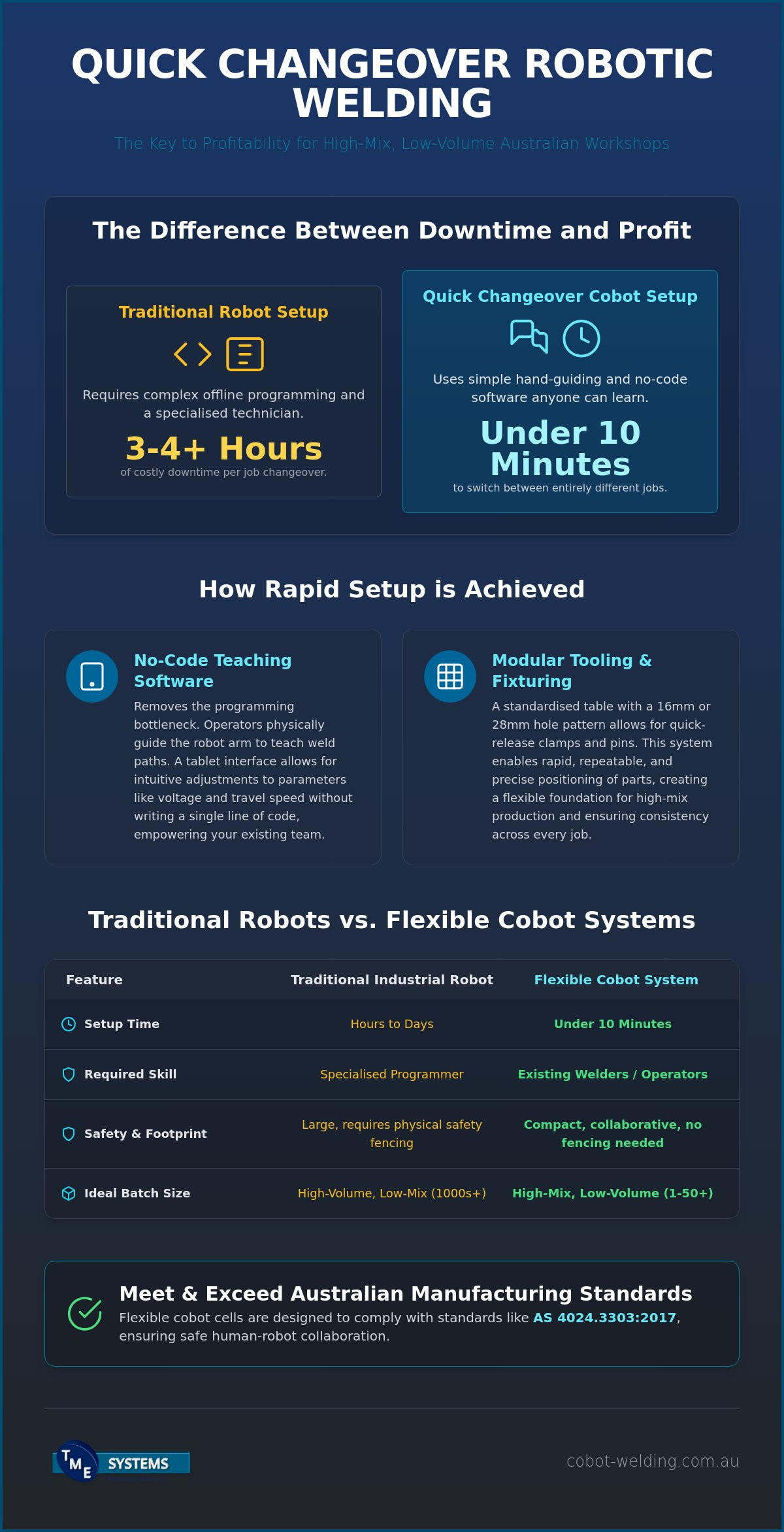
In the Australian fabrication industry, the term "quick changeover" has evolved from a buzzword into a critical operational standard. We define it as the ability to switch between entirely different welding jobs in under 10 minutes. For a local job shop, this is the difference between a profitable afternoon and a wasted shift. Historically, robotic welding was the domain of mass production, where a machine might run the same part for months. But the Australian market is built on variety. Most of our SMEs operate in a High-Mix, Low-Volume (HMLV) environment. Here, the goal isn't just to weld faster; it's to reduce the friction between different jobs so you can compete with larger offshore manufacturers who benefit from lower overheads.
The True Cost of Downtime in Fabrication
Downtime in an Australian workshop is incredibly expensive because of our high labour rates. When a robot sits idle for three hours while a technician struggles with complex re-programming, you aren't just losing machine time; you're burning through your margins. Many workshop managers still feel that manual welding is faster for batches of 5 to 10 units. It's an understandable perspective. If it takes four hours to code a robot for a job that a skilled person can weld in two, the manual path wins every time. This "programmer bottleneck" also creates a psychological barrier. If the staff sees automation as a hassle that requires a degree in computer science, they’ll revert to the old ways as soon as you turn your back. Quick changeover robotic welding solves this by making the machine as easy to set up as a manual torch.
Meeting the 2026 Australian Manufacturing Standards
Safety is another piece of the puzzle. By 2026, local workshops must adhere to strict safety requirements for collaborative spaces, specifically standards like AS 4024.3303:2017. These regulations ensure that robots and humans can work in proximity without traditional, bulky fencing. Flexible welding cells help businesses stay compliant without sacrificing the floor space needed for productivity. Turnkey solutions that integrate these safety features from the start allow you to meet local industry benchmarks without the stress of a custom, ground-up build. It’s about creating a workspace where technology supports the operator’s skill rather than getting in their way.
The Mechanics of Rapid Setup: No-Code Software and Modular Tooling
Achieving quick changeover robotic welding requires more than just a fast arm. It's about a total system where the software and the physical fixtures work together to strip away wasted time. In a typical Australian job shop, you don't have the luxury of a dedicated robotics engineer on the floor. You need a system that your best welder can set up between their morning tea and lunch break. This is where the combination of no-code interfaces and modular hardware changes the game for local fabricators.
No-Code Teaching: The Key to Switching Jobs in Minutes
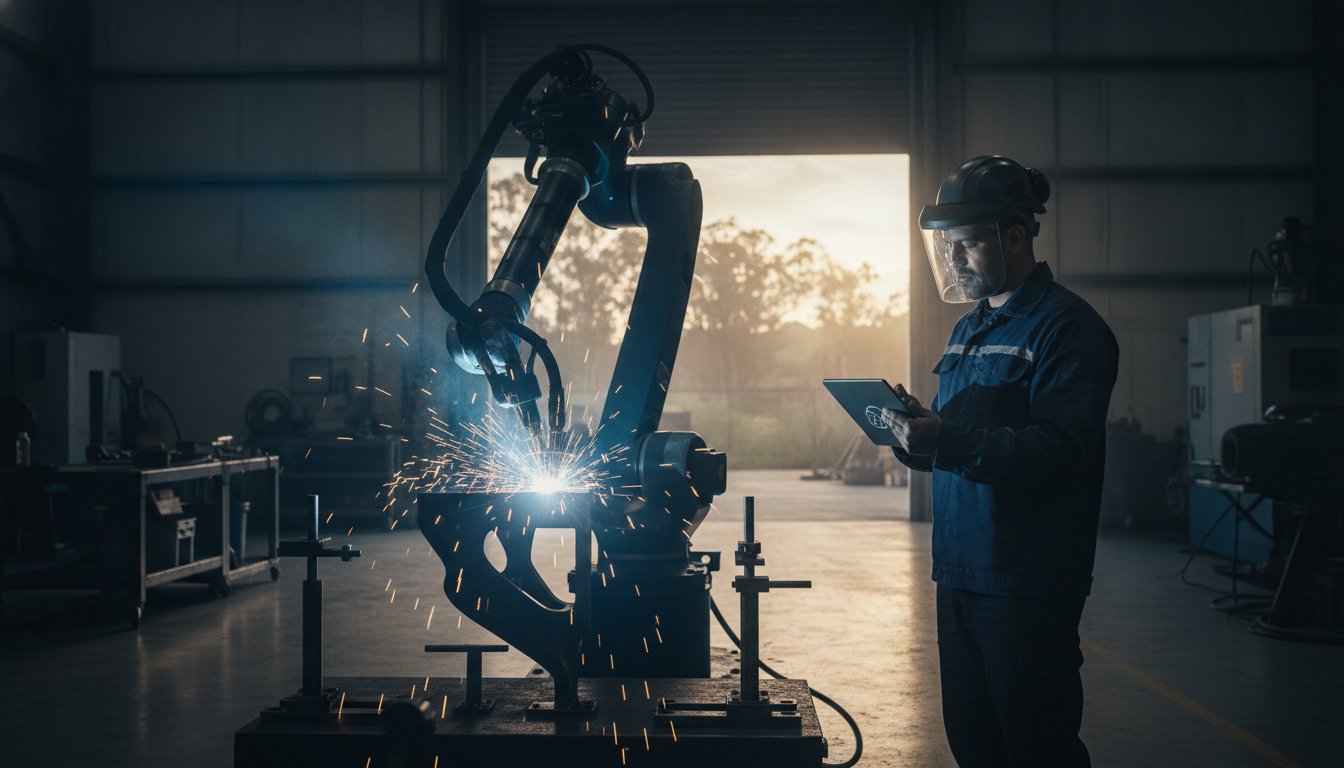
Traditional programming involves lines of code and a pendant that feels like a 90s video game controller. No-code teaching software replaces this with a point-and-click or hand-guiding approach. Instead of typing coordinates, an operator physically moves the robot arm to the start and end points of a weld. The software records these positions instantly. No-code robot welding software serves as the bridge between manual skill and automated precision. It allows operators to adjust parameters like weave patterns, voltage, and travel speed on a tablet interface without stopping the workflow. This level of control means your staff can refine a path in seconds, ensuring the first part of a new batch is as perfect as the last.
Modular Fixturing: Preparing the Physical Workspace
Even the smartest software can't fix a messy workspace. Rapid setup relies on a foundation of modular tables, usually featuring a standard 16mm or 28mm hole pattern. These tables allow for the use of quick-release clamps and pins that can be repositioned in moments. For businesses managing high-mix production, standardising your tooling is non-negotiable. You can develop "Smart Jigs" that the robot recognises or aligns to automatically, which removes the need for manual measurements during every changeover. This approach doesn't just save time; it also reduces the physical strain on your team. When you simplify the heavy lifting of setup, you create a safer, more efficient environment that workers actually want to use.
A successful system ensures the robot, power source, and software all speak the same language from day one. If you're curious about how this looks in a real workshop, our team can help you explore integrated welding solutions tailored for local conditions. When the hardware and software are in sync, your team spends less time fiddling with settings and more time keeping the arc on.
Comparing Traditional Industrial Robots with Flexible Cobot Systems
Traditional industrial robots are impressive machines. They offer high speeds and extreme precision, which is perfect if you’re welding ten thousand identical car chassis. However, for most Australian fabricators, these systems come with significant baggage. They require large, permanent footprints and heavy safety fencing that can eat up half your workshop floor. Moving them is a major project involving forklifts and re-levelling. In contrast, collaborative systems are often mounted on castors, allowing you to wheel the cell to where the work is. This portability is a cornerstone of quick changeover robotic welding because it lets you adapt your floor layout to the job at hand rather than being stuck with a static monument to automation.
The skill gap is where the two systems diverge most sharply. An industrial robot typically demands a specialised robotic engineer or a staff member with extensive coding training. Programming a new part can easily take four hours or more. If your batch size is only twenty parts, the machine is basically a paperweight. Cobots change this dynamic. By using hand-guiding, a welder can "teach" the robot a new path in about ten minutes. You don't need to hire a new department; you just need to empower the people you already trust on the tools. This transition from complex coding to intuitive teaching is what makes automation accessible for the average Aussie job shop.
When to Choose a Cobot Over an Industrial Robot
The decision usually comes down to the "Batch Size" rule of thumb. If your production runs are in the thousands, the raw speed of an industrial robot might justify the long setup time. But for the typical Aussie steel fabricator, flexibility is the priority. Collaborative robot welding cells are becoming the standard because they handle the variety of a job shop without the programmer bottleneck. This shift toward digitalization also enables manufacturers to pivot between projects instantly, keeping the workshop productive even when the order book changes. If your day involves switching from gates to trailers to custom brackets, the cobot is the clear winner.
The ROI of Flexibility
Calculating your return on investment requires looking beyond the initial purchase price. You have to factor in the ongoing cost of downtime and specialised labour. If you have to pay an external contractor every time you need a new program, your payback period stretches into years. With a flexible system, your existing welders handle the changes. Improving welding productivity with cobots relies more on uptime than raw welding speed. When your setup time drops from hours to minutes, the machine starts paying for itself from day one, regardless of how small the batch is.
Best Practices for Optimising Your Welding Cell for High-Mix Production
Optimising your workshop for quick changeover robotic welding is as much about physical discipline as it is about software. If your team has to hunt for a specific clamp or a 16mm pin for twenty minutes, the speed of your no-code software becomes irrelevant. We recommend a "Shadow Board" approach for every cell. Every tool, nozzle cleaner, and fixture component should have a dedicated, labelled spot. This keeps the workspace clear and ensures that the transition between a trailer frame and a small bracket is seamless and predictable.
A digital library of weld "recipes" is your best asset for recurring small batches. Once you've taught the robot a specific path, save it with a clear name and a photo of the jig setup. This turns a complex task into a simple retrieval process for the next time that order comes through. Over time, your team can build a culture of continuous improvement. Encourage them to look for ways to shave seconds off every changeover by refining the physical layout of the cell or standardising the way parts are presented to the robot arm.
Standardising the 'Zero Point'
Establishing a consistent "home position" or zero point is vital for rapid jig switching. By using locating pins on your modular table, you ensure that the jig sits in the exact same coordinate space every single time. This means the robot doesn't need to re-learn where the part is located. If you're using a mobile cell, accuracy depends on solid floor indexing. A few well-placed floor markers or docking pins ensure that when you wheel the cell back into position, your saved programs still line up perfectly without the need for tedious manual adjustments.
Upskilling Your Existing Team
The most advanced hardware in the world won't perform if your team is hesitant to use it. On-site cobot welder training is the final piece of the changeover puzzle. It's common for senior welders to feel a bit of "technostress" when a robot first arrives on the floor. You can overcome this by showing them that the robot is just another tool, like a high-end power source or a new bandsaw. When operators understand they are the ones in control of the "teaching" process, they often start competing to find the most efficient setup. This shift in mindset turns automation into a point of pride for the whole workshop.
If you're ready to see how these practices work in a real-world environment, you can view our integrated welding solutions to find a system that fits your workshop's specific needs.
Future-Proofing Your Business with TME Systems Pty Ltd
Adopting automation is a significant step for any local workshop, but it doesn't have to be an intimidating one. TME Systems Pty Ltd focuses on making this transition as seamless as possible by integrating specialised no-code teaching software with world-class welding hardware. This combination is the "secret sauce" that allows your team to master quick changeover robotic welding without needing a background in computer science. We see our role as a practical mentor, ensuring the technology adapts to your existing craftsmanship rather than forcing you to change how you work. As your business grows and your batch variety increases, these modular cells allow you to scale your production without the growing pains typically associated with complex industrial setups.
Seeing is Believing: The Mobile Demonstration
We know that every workshop has that one "nightmare" part that seems impossible to automate efficiently. That's why TME Systems Pty Ltd offers a "Try Before You Buy" advantage. When you book a mobile welding robot demonstration, we bring the technology directly to your floor. You can test your own parts and bring your most difficult quick changeover challenges to the demo for a real-world assessment. Seeing the robot handle your specific jigs and materials provides a clear proof-of-concept. This hands-on approach reduces investment risk and gives your operators a chance to feel the intuitive nature of the controls before a single piece of permanent equipment is installed.
Partnering with Australian Integration Specialists
Reliability in a workshop depends on more than just the robot arm; it depends on the support behind it. Working with welding system integration specialists who understand Australian power grids and safety standards ensures your cell is compliant and productive from day one. The team at TME Systems Pty Ltd is just a phone call away, providing the technical support and operator training needed to keep your arcs on. We're invested in your long-term success, moving beyond a simple transaction to become a trusted partner in your workshop's progress. Contact TME Systems Pty Ltd today to see how we can help you revolutionise your workshop's throughput and reclaim your margins.
Take the Lead in Flexible Fabrication
Mastering quick changeover robotic welding isn't about replacing your team's expertise; it's about giving them the tools to work smarter. We've seen how combining intuitive no-code software with modular fixturing allows even the smallest job shops to handle complex batches with the same efficiency as long production runs. This shift ensures your workshop remains competitive and responsive in an ever-changing local market. When your best welders can "teach" a robot in minutes, automation becomes a flexible asset rather than a rigid burden.
TME Systems is here to support you through every stage of this transition. With our specialised no-code software integration and dedicated local Australian technical support, we focus on making modern technology feel like a natural extension of your workbench. You don't have to take our word for it or rely on theoretical specs. You can see the results for yourself with a mobile on-site proof-of-concept that uses your own parts and jigs. It's a risk-free way to ensure the system meets your specific workshop standards.
Ready to see the difference in person? Book a mobile robot welding demo on your workshop floor and start your transition to a more flexible future today. We look forward to helping you reclaim your margins and lead the way in Australian manufacturing.
Frequently Asked Questions
What is considered a 'quick changeover' in robotic welding?
A quick changeover robotic welding process is generally defined as switching between different jobs in under 10 minutes. This includes swapping the physical jig on a modular table and loading the next digital program. For Australian job shops, this speed is essential to keep the arc on during high-mix production. It ensures that the machine spends its time welding rather than sitting idle while an operator puzzles over a complex setup.
Do I need a computer programmer to change the robot's tasks?
You don't need a specialised programmer to manage daily tasks. Modern systems use no-code software that allows your existing welders to "teach" the robot by hand-guiding the arm. If your team can weld a bead manually, they can likely learn to program a path in a matter of hours. This approach removes the "programmer bottleneck" and puts the control back into the hands of your skilled tradespeople.
Can a welding cobot handle different materials like aluminium and stainless steel in the same shift?
Yes, a cobot can switch between materials like aluminium and stainless steel quite easily. The robot itself doesn't care about the material; it simply follows the path and trigger commands you've set. You'll just need to ensure your power source and wire feeder are set up for the change. Saving specific "weld recipes" in your digital library makes switching gas and wire settings a straightforward process for the operator.
How much floor space does a quick-changeover welding cell actually require?
A standard collaborative welding cell typically requires a footprint similar to a traditional manual welding bench. Because cobots are designed to work safely alongside humans, you often don't need the massive safety cages required by industrial robots. This compact design is perfect for crowded Australian workshops where floor space is at a premium. You can even mount the entire system on castors to move it between stations as needed.
Is it worth automating if my average batch size is only 10 pieces?
Automating small batches of 10 pieces is absolutely worth it if you have a quick changeover robotic welding strategy. In the past, the hours spent programming made small runs unviable for robots. With no-code software, you can teach a new part in 10 minutes or less. When the setup time is shorter than the manual welding time, even your smallest orders become more profitable and consistent.
What safety standards apply to collaborative welding in Australia in 2026?
In 2026, the primary safety standard for collaborative robots in Australia remains AS 4024.3303:2017. While cobots have built-in force-sensing features, you still need to conduct a thorough risk assessment for the entire application. This includes managing risks like arc flash, welding fumes, and sharp edges on your workpieces. Turnkey cells are designed to help you meet these local standards while maintaining a high level of productivity.
Can I use my existing MIG or TIG power source with a cobot?
You can often integrate your existing power source, but it depends on the specific model and its communication capabilities. Many fabricators find that a modern digital power source provides a much smoother experience because it can "talk" directly to the robot software. This allows the operator to adjust settings like voltage and wire speed directly from the robot's tablet interface, which is a key part of a seamless setup.
How long does it take to train a manual welder to operate a no-code cobot?
Most manual welders can learn the basics of operating a no-code cobot in just a few hours. Because the software is designed for tradespeople rather than coders, the learning curve is very shallow. After a day of hands-on training, an operator is usually confident enough to teach new paths and manage daily production. This rapid upskilling ensures that your investment starts delivering value almost immediately after installation.