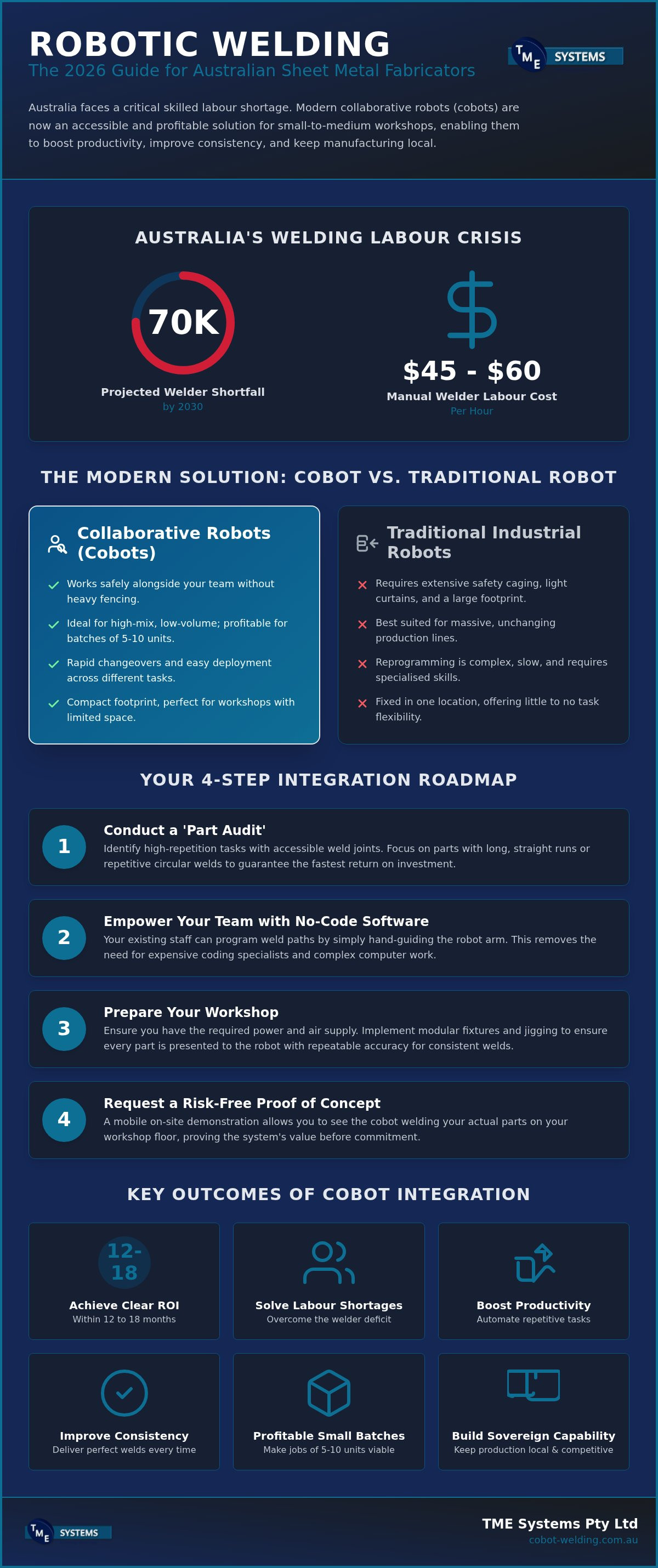

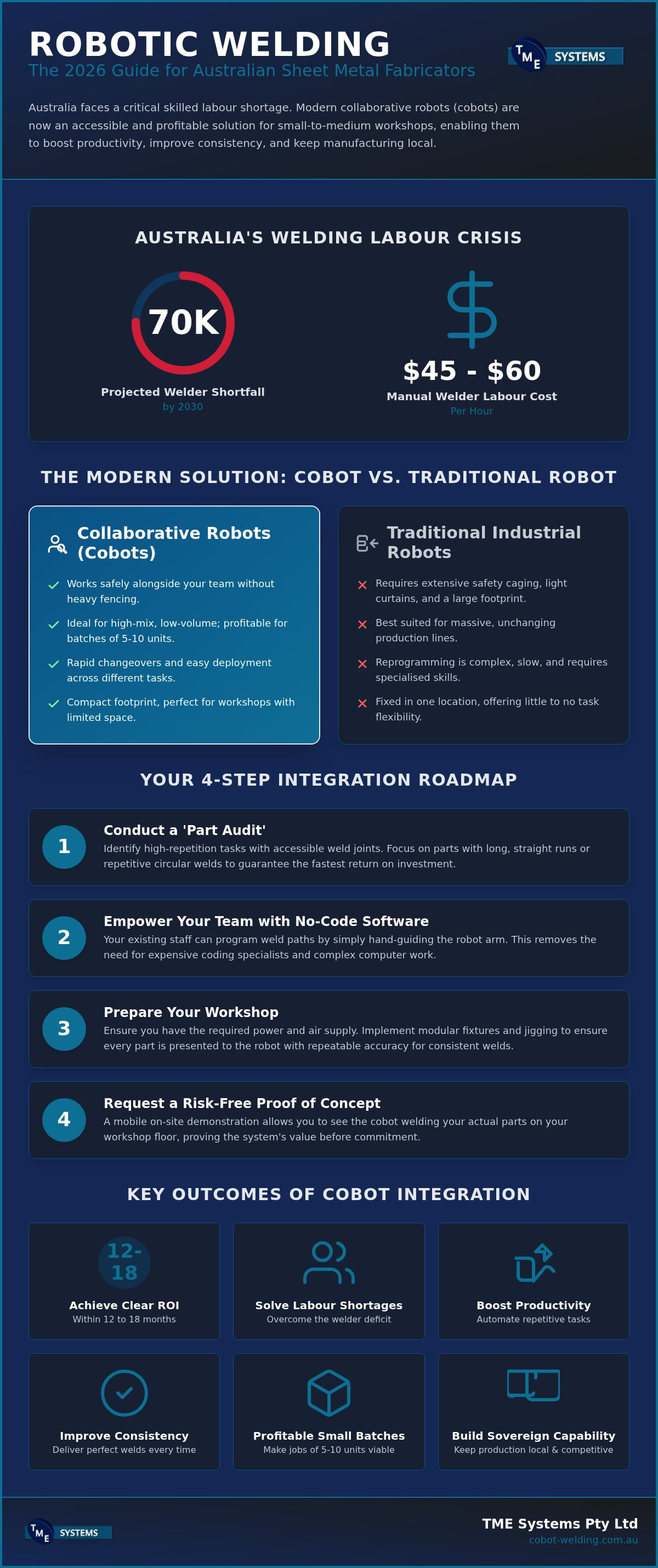
Australia is facing a projected deficit of 70,000 welders by 2030, a figure that highlights the growing strain on local workshops. You've likely felt this pressure while trying to recruit skilled MIG or TIG specialists, only to find the talent pool is dry or the costs are unsustainable for your smaller batches. It's easy to assume that robotic welding for sheet metal fabrication is a luxury reserved for massive automotive plants, but that's simply not the case in 2026.
We understand the hesitation around high programming costs and the fear of "tech-heavy" systems that feel out of place on a busy floor. However, modern collaborative robots are designed to support your team, not replace their craftsmanship. This guide will show you how to successfully integrate these systems to solve labour shortages and boost productivity without writing a single line of code. We'll explore how your existing staff can operate these tools confidently; ensuring you see a clear ROI within 12 to 18 months while maintaining the consistency your clients expect.
Key Takeaways
- Discover how no-code teaching software allows your current team to program paths by hand, removing the need for expensive computer coding or specialised programmers.
- Learn how to conduct a "Part Audit" to pinpoint high-repetition tasks that offer the fastest path to a clear return on investment.
- Explore why robotic welding for sheet metal fabrication is now a profitable solution for small batches of five to ten units, rather than just large-scale production.
- Understand the essential workshop utility requirements, including power and air supply standards, needed to support a seamless collaborative robot setup.
- Find out how a mobile on-site demonstration can provide a risk-free proof of concept by welding your actual parts on your own workshop floor.
The State of Robotic Welding for Sheet Metal Fabrication in Australia
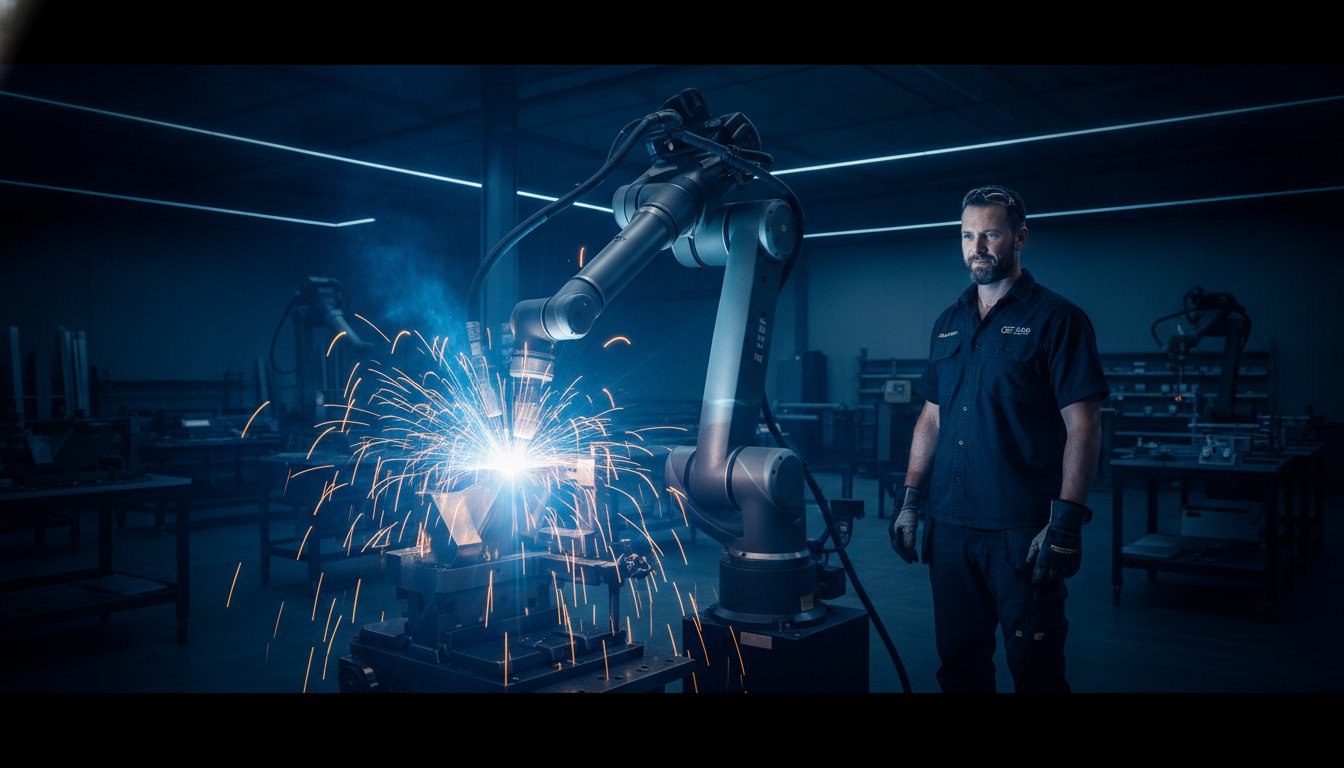
The Australian fabrication landscape has shifted. We're no longer looking at automation as something only the big players in heavy industry can afford. In 2026, the local industry has reached a tipping point where small-to-medium enterprises (SMEs) are leading the charge in adoption. Modern robotic welding for sheet metal fabrication is now defined by collaborative robots, or "cobots," which are designed to work with your team rather than tucked away behind impenetrable barriers.
For decades, robotic welding was synonymous with massive production lines and complex coding. Today, the focus has moved to accessibility. These systems act as a force multiplier for your existing tradespeople, allowing them to oversee high-quality output without the physical strain of repetitive manual tasks. It's a pragmatic shift that values human expertise while using technology to handle the "grunt work" of the workshop floor.
Why Australian Fabricators are Turning to Cobots
The numbers tell a clear story. With manual welder labour costs currently ranging between $45 and $60 per hour, the financial pressure on local shops is immense. When you factor in the projected national deficit of 70,000 welders by 2030, finding and keeping staff isn't just expensive; it's becoming nearly impossible. Automation has become a vital tool for building sovereign capability, ensuring that Australian workshops can compete with overseas imports by keeping production local and efficient.
Most Australian shops operate on a high-mix, low-volume model. You aren't making 10,000 of the same bracket; you're likely making fifty of one and ten of another. Cobots are built for this exact reality. They allow for rapid changeovers that were previously unthinkable with older automation tech, making even the smallest batches profitable again.
Cobots vs Traditional Industrial Robots
The most striking difference you'll notice on the floor is the lack of safety cages. While traditional robots require heavy fencing and light curtains to protect staff, cobots are built with sensitive sensors. Under the AS/NZS 4024.1 machinery safety standards, these systems can often be integrated into your existing workflow with a much smaller footprint. This is a game-changer for workshops where floor space is at a premium.
Flexibility is the other major win. A traditional industrial robot is usually bolted to the floor, dedicated to one task for its entire life. In contrast, a collaborative robotic welding for sheet metal fabrication cell can be redeployed across different tasks in minutes. If your production needs change by lunchtime, your cobot can be adjusted to suit, keeping your workflow steady and your machines earning their keep.
The Integration Roadmap: Moving from Manual to Automated Welding
Moving from manual torches to robotic welding for sheet metal fabrication doesn't happen by accident. It requires a methodical approach that starts with your existing inventory. We recommend conducting a "Part Audit" to filter your current jobs. You're looking for high-repetition tasks with accessible weld joints. While the Australian manufacturing robotics market is expanding rapidly, success on your floor depends on picking the right "low-hanging fruit" first.
Assessing Your Current Fabrication Workflow
Evaluating suitability isn't just about volume; it's about geometry. Can the robot reach every joint without colliding with the fixture? Are the fit-ups consistent? If your upstream processes like laser cutting and folding are precise, you're halfway there. Identifying parts that deliver the fastest ROI means looking for items with long, straight runs or repetitive circular welds. Consulting with cobot welding integration specialists early can prevent you from over-complicating your first cell setup.
Accuracy in robotic welding for sheet metal fabrication is only as good as the jigging. Modular fixtures are essential. They ensure every part sits in the exact same spot, every single time. Without repeatable accuracy, you'll spend more time adjusting paths than actually welding; defeating the purpose of automation.
Installation and Safety Compliance
When setting up collaborative robot welding cells, your utilities must be up to scratch. Robots don't like voltage drops or "dirty" compressed air. You'll need a stable power supply and high-quality filtration for your air lines to prevent solenoid failures. Integrating your cobot with industry-standard power sources like Fronius, Kemppi, or Miller ensures that arc characteristics remain familiar to your team.
Physical installation is often surprisingly quick, sometimes taking just a few days. However, commissioning isn't complete without a thorough safety audit to ensure compliance with AS/NZS 4024.1. Even though cobots are designed to work alongside people, the welding arc and fumes still require management. If you're unsure where a cell would fit in your shop, seeing a mobile demo system in your own environment can clarify the physical requirements and safety boundaries.
No-Code Software: The Key to Successful Sheet Metal Automation
To maintain a stable power supply and prevent the voltage drops that can disrupt sensitive robotic components, Tesla Electrical Company provides specialised design and supply of industrial electrical systems and custom switchboards tailored for automated workshops.
Beyond electrical and air utilities, workshops that supply the resources sector often require robust fluid handling infrastructure; Liquimech offers industrial-grade standpipes and liquid management systems designed for these demanding environments.
The biggest hurdle to adopting robotic welding for sheet metal fabrication has historically been the "black box" of programming. If you need a specialised engineer every time you change a part, the system becomes a bottleneck rather than a benefit. This is where no-code robot welding software changes the game. It shifts the control from a computer keyboard back to the person who actually knows how to weld.
Instead of typing complex lines of code, your team uses a method called "lead-through" or "teaching." By physically moving the robot arm to the start and end points of a seam, the operator "shows" the machine the path. It's an intuitive process that feels natural to a tradesperson. This approach reduces setup times for new jobs to near-zero, making it finally profitable to automate small runs of only five or ten units. It transforms your existing welders into "Robot Leads" who can oversee multiple machines without needing a computer science degree.
How Lead-Through Programming Works
Programming a modern cobot is more like using a smartphone than a mainframe computer. Once the arm is guided into position, the operator uses a ruggedised tablet to refine the details. You can adjust parameters like voltage, wire speed, and travel speed on the fly through an intuitive interface. If a weld needs more penetration, you simply tap the screen to adjust the settings. The system then saves this specific "recipe." When the same order comes back months later, you recall the saved path and hit start, ensuring identical quality across every batch.
Eliminating the Need for External Programmers
One of the hidden costs of traditional automation is the reliance on third-party engineers. Every time a part design changes, you'd typically have to pay for a contractor to visit your site. With no-code interfaces, that expertise stays inside your workshop. Your best tradespeople can improve welding productivity with cobots because they're the ones making the technical decisions. This keeps your intellectual property secure and your overheads predictable. It empowers your staff to focus on quality control and process improvement, rather than fighting with complex software.
Maximising ROI in High-Mix, Low-Volume Environments
Calculating the real return on investment for an Australian shop involves more than just comparing arc speeds. You have to look at the total cost of ownership and the hidden expenses of manual production. For instance, manual rework rates of 5% to 8% are common in complex sheet metal jobs. When you implement robotic welding for sheet metal fabrication, that figure typically drops below 1%. This reduction in scrap and grinding time, combined with arc-on times that can reach 95%, creates a compelling financial case for shops of all sizes. To gain even better visibility over your material efficiency, you can visit Independent Scale Service to learn about industrial weighing solutions that track waste and production output.
Transitioning your crew is a human challenge, not just a technical one. Many experienced tradespeople worry that automation is a threat to their livelihood. It's vital to frame the cobot as a sophisticated tool that removes the dull, repetitive tasks that cause physical strain. Through on-site cobot welder training, your team learns to lead the process rather than just pulling a trigger. We recommend setting realistic productivity goals for the first 90 days. Focus on weld quality and setup consistency first; the speed will naturally follow as your operators gain confidence with the software.
Efficiency for Small Batch Production
High-mix, low-volume work is the standard for the Australian market. To make a batch of only five or ten units pay off, your changeover time must be minimal. Modular fixturing is the secret to this flexibility. If you can swap a jig and recall a saved program in under five minutes, the robot stays productive and earns its keep. You can also use the cobot for "tack and weld" sequences, which significantly reduces the manual handling time required between different stages of fabrication. Small-batch profitability is achieved through reduced setup times and consistent arc-on time.
Continuous improvement becomes much easier when you have data to back up your decisions. Every job the robot completes provides a clear picture of cycle times and consumable usage. This allows you to refine your processes and quote more accurately for future contracts. If you're ready to see how these efficiencies look in your own workshop, you can arrange a mobile demo to test your actual parts under real-world conditions.
Choosing an Australian Integration Partner: The TME Systems Pty Ltd Approach
Selecting the right technology is only half the battle. Successful robotic welding for sheet metal fabrication depends heavily on the partner you choose to stand behind the equipment. In the Australian market, where time zones and shipping distances can delay critical support, having local technical expertise is non-negotiable. TME Systems Pty Ltd acts as a practical mentor to help you navigate the transition from manual processes to a more automated, Industry 4.0-ready workshop.
The Mobile Demonstration Advantage
We've found that the biggest barrier to adoption is often the uncertainty of how a robot will handle your specific parts. It's one thing to watch a generic video; it's another to see a machine working on your own shop floor. The TME Systems Pty Ltd Mobile Demo System is designed to remove this investment risk entirely. We bring the collaborative cell to your facility, allowing you to see the cobot weld your actual production parts under real-world conditions. This provides an immediate proof of concept that no brochure can match.
This hands-on experience is also the best way to get your team on board. When your welders see how simple the no-code software is to use, the "fear of the new" quickly evaporates. By booking a mobile welding robot demonstration, you can engage your stakeholders early. This ensures that the people who will actually operate the system feel confident in its value before any financial commitment is made.
Long-Term Partnership and Support
Integration doesn't end when the robot is commissioned and the first arc is struck. The TME Systems Pty Ltd approach focuses on the entire lifecycle of the system. This means providing Australian-based technical support and ensuring spare parts are readily available when you need them. To maintain the strong data links required for remote diagnostics and software updates, you might check out Telco Antennas for specialised signal boosting solutions. We understand that downtime on a production line is a direct hit to your bottom line, so our support structures are built for reliability and steady performance.
We've explored how accessible technology and collaborative systems are making robotic welding for sheet metal fabrication a viable reality for local SMEs. By removing the need for complex programming, you empower your existing team to handle high-mix, low-volume production with confidence. This shift isn't about replacing the skill of your tradespeople; it's about giving them the tools to work more efficiently while maintaining the high standards your clients demand.
As an Australian-owned and operated partner, we understand the unique pressures of the local manufacturing landscape. We provide the grounded technical support and specialised training required to ensure your transition is seamless. The best way to evaluate the impact on your own workshop floor is to see the technology in action. You can book a mobile demonstration to see a cobot weld your parts on-site and test the no-code software with your own production jobs. Modernising your workflow is a practical step toward long-term growth, and we're here to support you at every stage of that journey.
Frequently Asked Questions
What is the typical ROI for a collaborative welding robot in Australia?
Most Australian fabricators see a full return on investment within 18 to 24 months when adopting robotic welding for sheet metal fabrication to replace single-shift manual operations. If you run double shifts, this period often drops to between 10 and 14 months. These figures are driven by the massive increase in arc-on time, which jumps from a manual average of 30% to nearly 90%. Reducing rework rates also saves significant material costs.
Do I need a specialised computer programmer to operate a welding cobot?
No, you don't need a computer programmer or an IT degree to run these systems. Modern collaborative robots use intuitive no-code software that allows your existing welders to "teach" the arm by hand-guiding it. If your staff can use a smartphone or a tablet, they can learn to set up new weld paths in minutes. This keeps the technical control on the workshop floor where the actual welding expertise lives. This intuitive approach to skill-building is similar to the methods used at Rising Tones Music, where professional guidance helps students of all ages master complex techniques through accessible instruction.
Yes, collaborative systems are highly versatile and can be integrated with both MIG and TIG power sources. While MIG is more common for high-speed production, TIG setups are excellent for precision work on thinner gauges. The robot provides the steady hand required for consistent TIG beads, which is often the hardest skill to recruit. Switching between processes usually involves changing the torch and updating the software parameters on your control tablet.
Is a collaborative robot safe to use without a safety cage in my workshop?
Collaborative robots are designed with internal sensors that stop movement immediately upon contact with a person. This often allows them to operate without bulky safety cages, saving valuable floor space. However, you must still comply with AS/NZS 4024.1 standards. This involves a risk assessment of the entire application; including the welding arc, heat, and fumes; to ensure the workspace remains safe for everyone on the floor. For comprehensive facility protection and monitoring of high-value equipment, Jobcam provides solar-powered security cameras and surveillance towers ideal for industrial sites and remote projects.
Physical installation of a collaborative welding cell typically takes just a few days. The total integration time, including operator training and path teaching for your first batch of parts, usually spans one to two weeks. Because these systems are designed for high-mix environments, they don't require the months of planning associated with traditional industrial automation. Your team can often be producing high-quality parts within their first week of hands-on operation.
What happens if my welding staff are resistant to using robotic technology?
Resistance usually stems from a fear of replacement, so it's vital to frame the technology as a tool that supports the welder. By handling the repetitive, physically taxing seams, the robot allows your tradespeople to focus on more complex, custom fabrication. We find that once operators see how no-code software simplifies their day, they quickly embrace the role of a "Robot Lead" who oversees multiple high-output cells.
Can cobots weld aluminium and stainless steel for precision fabrication?
Robotic welding for sheet metal fabrication is particularly effective for non-ferrous metals like aluminium and stainless steel. These materials require precise heat control to prevent warping or burn-through, which a robot handles with far greater consistency than a manual operator. Whether you are working with thin-gauge cabinets or structural aluminium frames, the system maintains steady travel speeds and wire feed rates to ensure clean, repeatable welds across every batch.
What kind of maintenance does a collaborative welding cell require?
Maintenance requirements are similar to your existing manual setups but with a few extra checks. You'll need to manage standard consumables like contact tips, shrouds, and liners as usual. The robot arm itself is designed for industrial use and requires minimal intervention, mostly consisting of occasional software updates. Choosing an Australian partner ensures you have local technical support and readily available spare parts to keep your production moving without long delays.