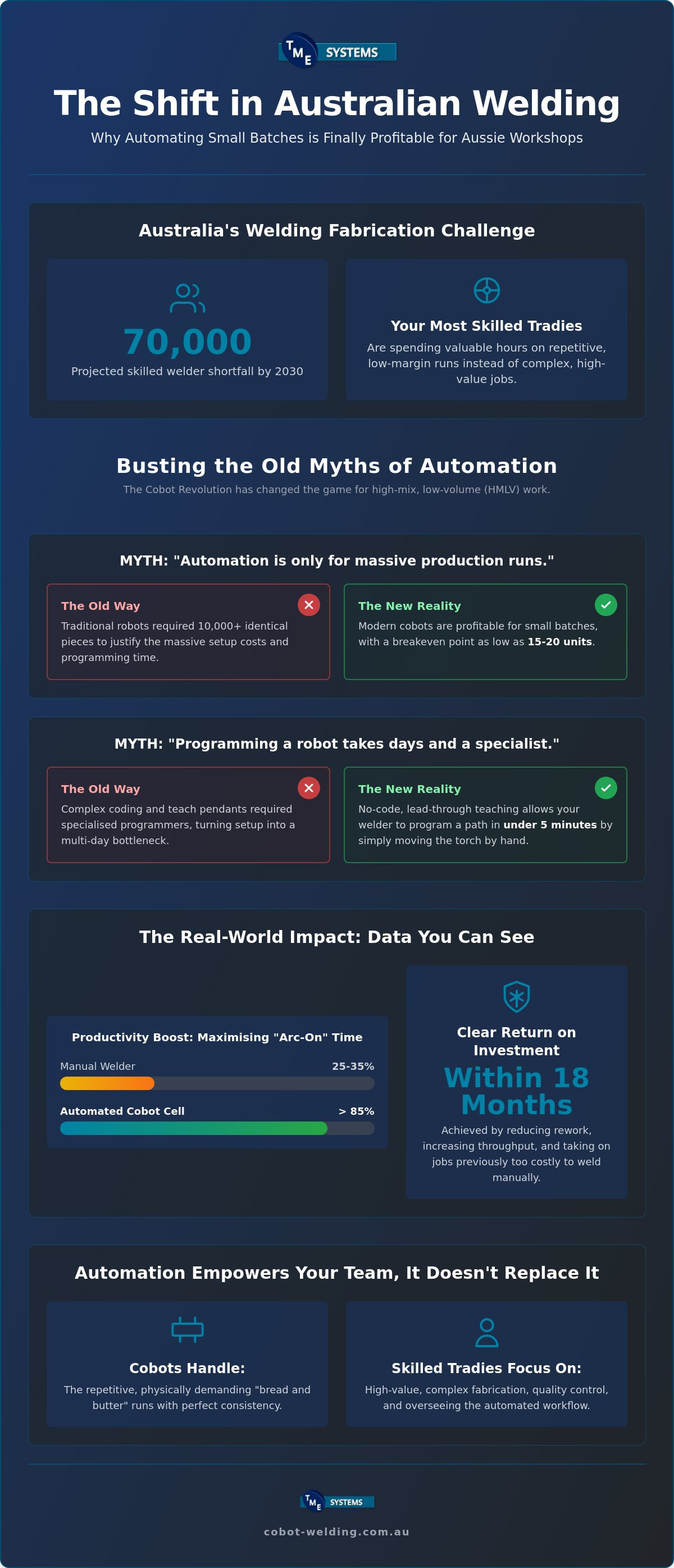

Is it actually worth automating your production line if you only run 20 or 50 pieces at a time? For years, the answer for most Australian fabricators was a firm no. You've likely felt the frustration of watching your most skilled tradies spend hours on repetitive small runs while the backlog of complex jobs grows; yet the idea of robotic welding for small batches often felt like a recipe for expensive jigs and endless programming headaches. With Australia facing a projected shortfall of 70,000 welders by 2030, the pressure to find a better way to manage these high-mix orders has never been higher.
We understand that you can't afford to let technology get in the way of getting the job done. This article will show you why low-volume welding automation is finally profitable for local workshops in 2026. We are going to bust five common myths that hold Aussie fabricators back, from the fear of complex software to the worry about high rework costs. You will discover how to reduce lead times and improve weld consistency, achieving a clear ROI within 18 months without needing to hire a single software engineer. It's about giving your team a tool that works as hard as they do.
Key Takeaways
- Learn why you no longer need massive production runs to justify automation and how "high-mix, low-volume" work is the new profit centre for Australian workshops.
- Discover how no-code teaching software makes robotic welding for small batches as simple as moving the torch by hand, reducing programming time from hours to minutes.
- Understand how modular welding tables and flexible tooling eliminate the massive capital outlay traditionally required for specialised, permanent jigs.
- See how collaborative robots empower your team by handling the repetitive, "bread and butter" runs, allowing your skilled tradies to focus on high-value, complex fabrication.
- Find out how to achieve a clear ROI within 18 months by accounting for reduced rework and the opportunity to bid on small jobs that were previously too costly to weld manually.
The "High Volume Only" Myth: Why Small Batch Welding is the New Frontier
For a long time, the common wisdom in Australian workshops was that automation only made sense for the big players. If you weren't churning out 10,000 identical brackets for a multi-year contract, a robot was seen as an expensive paperweight. This belief stems from the early days of Robot welding, where massive industrial arms required permanent safety cages and weeks of specialised programming just to move an inch. For a typical Aussie fabricator dealing with a high-mix of different jobs every week, that fixed setup cost was a dealbreaker.
In 2026, the landscape has shifted entirely. We have moved into an era of High-Mix, Low-Volume (HMLV) production. This means your workshop is likely handling dozens of different parts in small quantities rather than one part in massive quantities. The "Cobot Revolution" has turned the old logic on its head. Because these collaborative systems are designed to be nimble, robotic welding for small batches of just 10 to 50 pieces isn't just possible; it is the most logical way to stay competitive.
The Economic Shift in Australian Fabrication
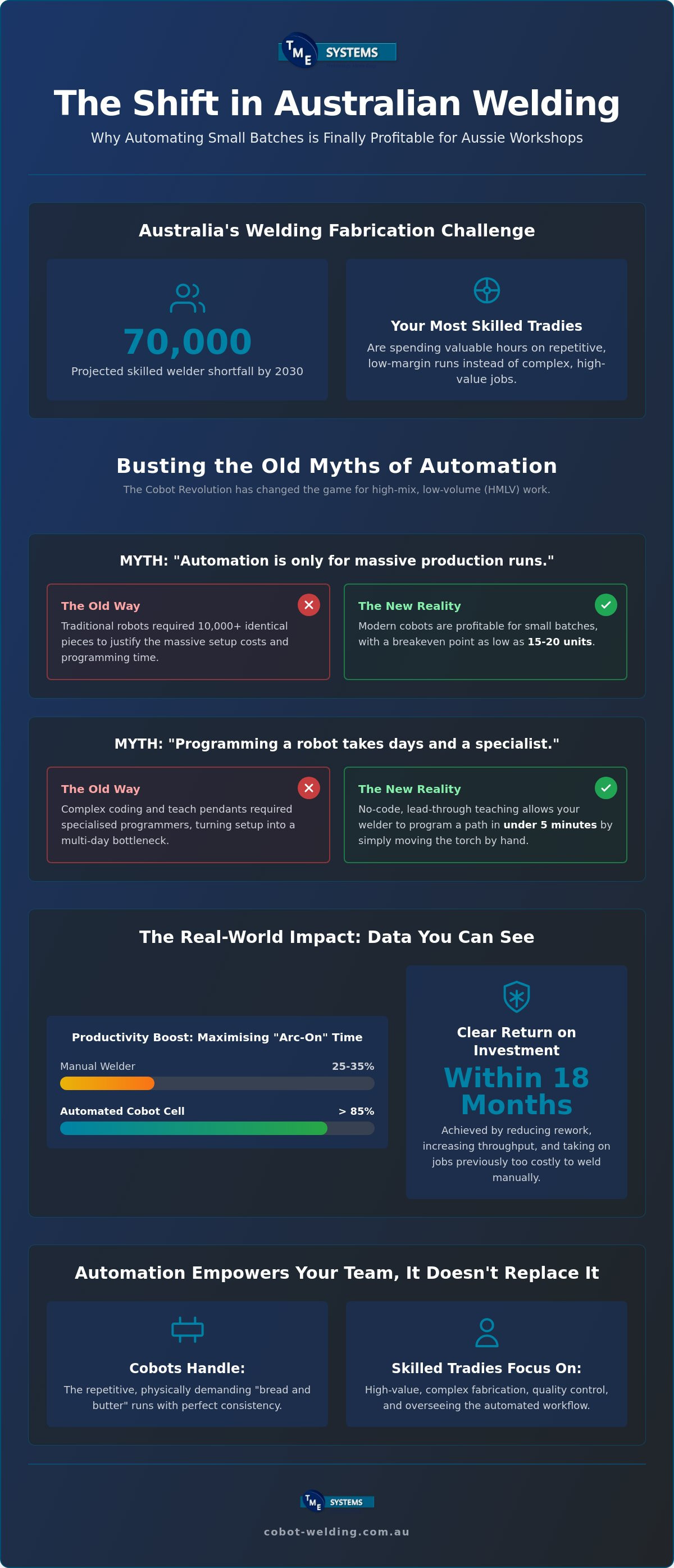
Manual welding is becoming a luxury that many businesses can no longer afford for repetitive work. With Australian labour rates continuing to climb and a projected shortfall of 70,000 welders by 2030, every hour a skilled tradie spends on a basic fillet weld is an hour lost on a complex, high-margin project. Research shows manual welders often have an "arc-on" time of only 25-35% due to the physical demands of the job. Automated cells can push that to over 85%. When you factor in the cost of grinding back inconsistent welds or fixing rework on a small run, the financial drain of staying manual becomes clear.
Defining the New Breakeven Point
In 2026, robotic welding for small batches is often profitable for runs as low as 15-20 units. This is a massive departure from the days when you needed thousands of units to see a return. Hardware costs have stabilised, but the real change is how fast you can get the system running. Because setup takes minutes instead of days, the "teaching" time no longer eats your profit margin on a 20-piece order. Adopting this flexibility is a core part of future proofing welding workshops, ensuring you can say yes to small, profitable jobs that your competitors are still trying to figure out how to quote.
Busting the Programming Bottleneck: From Days to Minutes with No-Code Tech
The biggest roadblock for most Australian workshops isn't the cost of the robot itself. It's the belief that programming takes longer than the actual weld. If you're running 30 pieces, spending half a day with a complex teach pendant just doesn't make sense. This is where many traditional systems fail. They're built for massive factories and require a level of coding knowledge that most fabricators don't have on the floor. For robotic welding for small batches to be viable, the setup time has to be negligible.
Modern no-code robot welding software has replaced lines of code with lead-through teaching. Instead of typing coordinates, you simply grab the robot arm and move it through the desired weld path. If you can move a torch, you can program the robot. This shift turns a day-long setup into a five-minute task. It puts the power back in the hands of the people who actually know how to weld.
Traditional Coding vs. No-Code Teaching
Old-school industrial robots rely on bulky tablets filled with complex menus and coordinate systems. This often requires an external specialist or a dedicated programmer. In contrast, hand-guided setup allows your best welder to be the one in control. They already know the angles, the travel speed, and the heat required. By physically showing the robot where to go, they're transferring their trade skills directly to the machine. They're the experts. This aligns with the National Robotics Strategy, which focuses on making advanced tech accessible to the existing workforce. It's about empowering your team rather than replacing them with IT experts.
- Traditional Setup: 2–6 hours for a simple part.
- No-Code Setup: 5–15 minutes for the same part.
Adjusting Weld Paths on the Fly
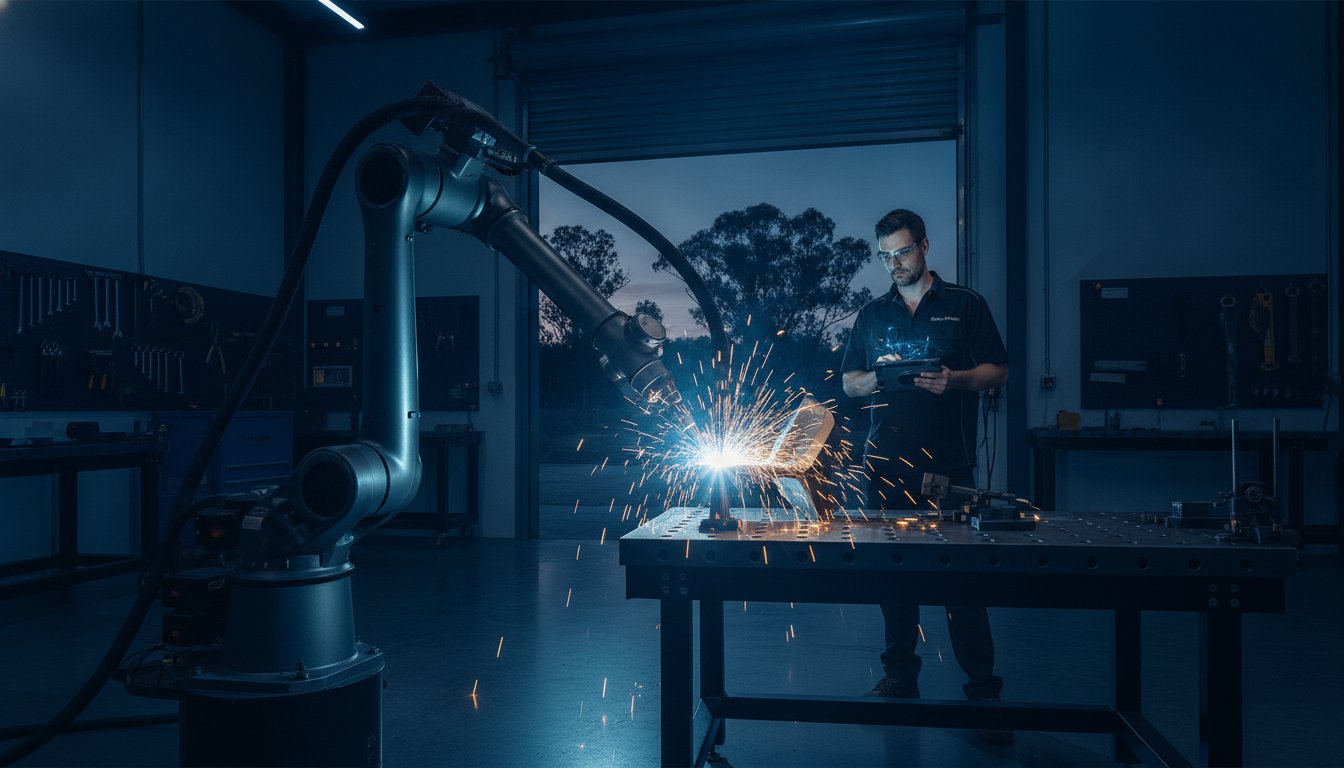
We all know that part fit-up isn't always perfect. If a batch of laser-cut parts is slightly off, a rigid program will fail. Modern interfaces are designed to be intuitive, allowing operators to refine a path in seconds. You don't have to rewrite the whole job; you just nudge a point or adjust a parameter on a touch screen. This "teach and refine" approach is the 2026 standard for robotic welding for small batches. It removes the frustration of "set and forget" systems that can't handle real-world variations. It just works. If you want to see how this works on your own floor, our mobile demo system can show you the difference in person.
The "Expensive Jigs" Misconception: Flexible Fixturing for High-Mix
One of the biggest hurdles for Aussie shops is the idea that you need a $20,000 custom jig for every part you want to automate. If you're coming from a background of traditional manufacturing, this fear makes sense. In high-volume factories, dedicated jigs are the norm because they're built to stay in place for years. However, for robotic welding for small batches, that approach is a relic of the past. It's too slow, too expensive, and it kills your flexibility.
In 2026, the standard for small runs is modularity. Instead of building a permanent home for every part, we use 3D welding tables and "D-Series" tooling. These systems use a precision grid of holes (usually 16mm or 28mm) that allow you to swap clamps, stops, and supports in seconds. This flexibility is a major factor driving the Australian market for welding robots. Local shops are finding that they can automate a new job with zero additional spend on tooling by simply rearranging the kit they already have.
Modular vs. Dedicated Fixturing
Dedicated jigs are a "volume-only" solution. If you're only running 15 or 20 pieces, you can't justify the cost of a toolmaker's time. Modular tables allow your team to set up a part, weld the batch, and then clear the table for the next job in under 10 minutes. For parts with unusual geometries, don't be afraid to use workshop-built temporary fixtures. Tacking a few scrap blocks to a base plate is a perfectly valid way to hold a small run in place. It’s about being pragmatic, not pretty.
Standardising Your Part Families
The secret to keeping your machine running across multiple shifts is a "Universal Fixture" strategy. Group your jobs into part families based on their size or how they're held. If you have five different brackets that all share a common base, you only need one setup. Modern collaborative robot welding cells use software "recipes" that remember the offsets for each part. When you switch from Part A to Part B, the robot already knows where the new weld paths are relative to the fixture. This reduces your changeover time to a few clicks on a screen, keeping your arc-on time high even when the job list is constantly changing.
Robots vs. Tradies: Why Automation Empowers Your Skilled Team
Whenever we talk about automation in an Aussie shed, the elephant in the room is always job security. It's a fair concern, but the reality on the ground is quite different. Robotic welding for small batches isn't about replacing the person; it's about replacing the repetitive, soul-crushing part of their day. Think of a cobot less like a replacement and more like a high-end power tool. Just as you wouldn't use a hand saw if you had a precision cold saw, you shouldn't have your best tradies stuck doing a hundred identical fillet welds when a machine can handle the grunt work.
This shift allows your senior welders to focus on the bespoke, high-value fabrication where their years of experience actually matter. There is also a massive ergonomic benefit to consider. Every hour a cobot spends under the hood is an hour your staff isn't bent over a bench, dealing with arc flash exposure and repetitive strain. It keeps your best people in the trade for longer by reducing the physical toll that manual welding takes on the body over decades. It's about supporting the health of your team as much as your production numbers.
Solving the Australian Welder Shortage
Finding qualified MIG and TIG welders is harder than ever across Australia. When you do find them, they don't want to spend their entire week welding simple base plates or small brackets. By integrating automation, one skilled operator can oversee three automated cells at once. This doesn't just increase output; it makes the workshop a more attractive place for younger talent. Apprentices today are digital natives. They're far more likely to stick around if they're learning to manage advanced tech alongside traditional craftsmanship. It turns a dusty workshop into a tech-forward environment that people actually want to work in.
Upskilling Your Current Workforce
Moving from a manual welder to a robotic cell operator is a natural progression. It’s about taking that trade knowledge—knowing how the pool should look and how the metal reacts—and applying it to a larger scale. We've found that hands-on, shop-floor learning is always more effective than sitting in a classroom. Our approach to on-site cobot welder training focuses on getting your team comfortable with the interface in their own environment. It turns a standard job into a specialised career path, giving your staff a reason to stay invested in the business long-term.
If you're ready to see how this technology can support your team on the floor, book a mobile demo with TME Systems Pty Ltd and let your welders try the system for themselves.
Calculating the Real ROI: Making the Case for Small Run Automation
Many workshop owners look only at the hourly rate of a welder when they calculate return on investment. That's a mistake. To see the true value of robotic welding for small batches, you have to look at the hours spent on rework and grinding. Manual welding typically sees defect rates between 5% and 8%, but a robotic system can bring that down to below 1%. When you stop paying your team to fix mistakes, your profit per part jumps immediately. You also need to consider the "opportunity cost" of the jobs you currently turn down. If a 30-piece run isn't profitable to weld by hand, you likely say no to it. Automation turns those "no" jobs into "yes" jobs.
Government support can also drastically shorten your path to profitability. In 2026, programs like the Modern Manufacturing Initiative (MMI) and the Manufacturing Modernisation Fund offer co-funding for businesses investing in automation. If you're based in NSW, the Advanced Manufacturing Fund provides up to $300,000 for adopting Industry 4.0 tech. Meanwhile, the Transforming Queensland Manufacturing Grant offers matched funding for small-to-medium shops. These incentives mean a system that looks like a two-year payback on paper could actually reach its breakeven point much sooner.
Hard Savings vs. Soft Benefits
Direct labour savings are easy to track, but the indirect wins are just as vital. Precise control over wire feed and gas flow reduces consumable waste, while the consistent heat input of a robot prevents the warping that often leads to scrapped parts. Beyond the ledger, improving welding productivity with cobots becomes a powerful marketing tool. Being able to guarantee "robot-perfect" consistency allows you to bid for higher-tier contracts that demand strict quality standards. It changes how customers perceive your workshop's capabilities.
Your 90-Day Automation Roadmap
You don't need to automate your entire floor overnight. A steady, methodical approach works best for local fabricators. Start with these three steps to get moving:
- Step 1: Identify your top 3 most repetitive small-batch parts. Look for the jobs that your team finds the most tedious or those with the highest rework rates.
- Step 2: Book a mobile welding robot demonstration to test your specific parts on your own workshop floor. This "proof of concept" ensures the tech works for your geometry before you commit.
- Step 3: Evaluate how the cell integrates with your existing gear. Modern collaborative systems are designed to work seamlessly with high-end power sources like Fronius or Kemppi, so you don't always need to buy a new welder.
The transition to robotic welding for small batches is about making your shop more resilient. By handling the repetitive work with precision, you free up your skilled people to grow the business. It’s a pragmatic move that pays off in both your bank balance and your workshop culture.
Future-Proofing Your Workshop Floor
The days of automation being reserved for high-volume factories are over. By embracing robotic welding for small batches, your workshop can finally break free from the bottleneck of repetitive manual runs and the constant search for skilled labour. As we have explored, no-code teaching software and modular fixturing remove the traditional barriers to entry, turning a complex technical transition into a practical workshop improvement.
Automation doesn't replace your tradies; it gives them a better way to work. With a system that is designed and supported by Australian welding experts, you can achieve a clear ROI while keeping your current staff focused on high-value fabrication. These collaborative cells are built to work with your existing welding power source, ensuring the upgrade is as seamless as possible.
If you're ready to see the results for yourself, we'll bring the technology to you. See a Cobot Weld Your Parts: Book an On-Site Demo and discover how no-code software can be set up in minutes on your own floor. It's time to stop turning down small orders and start scaling your productivity with confidence.
Frequently Asked Questions
What is the minimum batch size that makes robotic welding worthwhile?
In 2026, robotic welding for small batches is often profitable for runs as small as 15 to 20 units. Because setup times are now measured in minutes rather than hours, you don't need thousands of parts to justify the investment. This flexibility allows your workshop to automate the repetitive "bread and butter" jobs that were previously only viable for manual welding.
Do I need a software engineer or programmer to run a welding cobot?
You don't need a programmer or an IT degree to operate a modern collaborative system. No-code teaching software allows your existing trade-qualified welders to "teach" the robot by physically moving the arm through the weld path. If your team can handle a torch and a touchscreen, they can manage the automation without external help.
Can cobots handle both MIG and TIG welding for small batches?
Collaborative robots are highly versatile and can handle both MIG and TIG processes effectively. While MIG is the standard for most general fabrication, precision TIG systems are available for stainless steel or aluminium work that requires a high-quality aesthetic finish. The robot provides the consistency while your welder provides the trade expertise.
How long does it take to change over from one small batch job to another?
Switching between different part numbers typically takes under 10 minutes. Once a "recipe" for a part is saved in the software, the operator simply adjusts the modular fixturing and selects the new job on the interface. This rapid changeover is the key to keeping your arc-on time high in a high-mix production environment.
Will a welding robot work with my existing jigs and tables?
Most collaborative cells are designed to work with your current workshop equipment. While modular 3D welding tables offer the most flexibility for rapid setups, a cobot can work with your existing shop-built jigs as long as they provide consistent part positioning. It's about refining your current process rather than throwing everything away.
What happens if my parts have poor fit-up or gaps?
Modern interfaces allow operators to refine weld paths in seconds to account for slight variations in fit-up. While automation performs best with consistent parts, intuitive software lets your welders nudge the torch path or adjust parameters on the fly. This "teach and refine" approach handles real-world workshop conditions without needing to rewrite code.
Are there Australian safety standards I need to follow for cobot welding?
Yes, you must comply with Australian safety standards, specifically AS 4024.3303:2017. Because cobots are designed to work alongside humans, they also follow international standards like ISO 10218 and ISO/TS 15066. These regulations ensure the system is safe for your team to use on a busy production floor without traditional safety cages.
How much floor space does a small-batch welding cell actually require?
A standard collaborative welding cell has a very compact footprint, often requiring only about 4 square metres of space. Unlike traditional industrial robots, they don't need massive safety enclosures or permanent foundations. This makes it easy to integrate robotic welding for small batches into crowded Australian workshops without a major floor plan overhaul.