

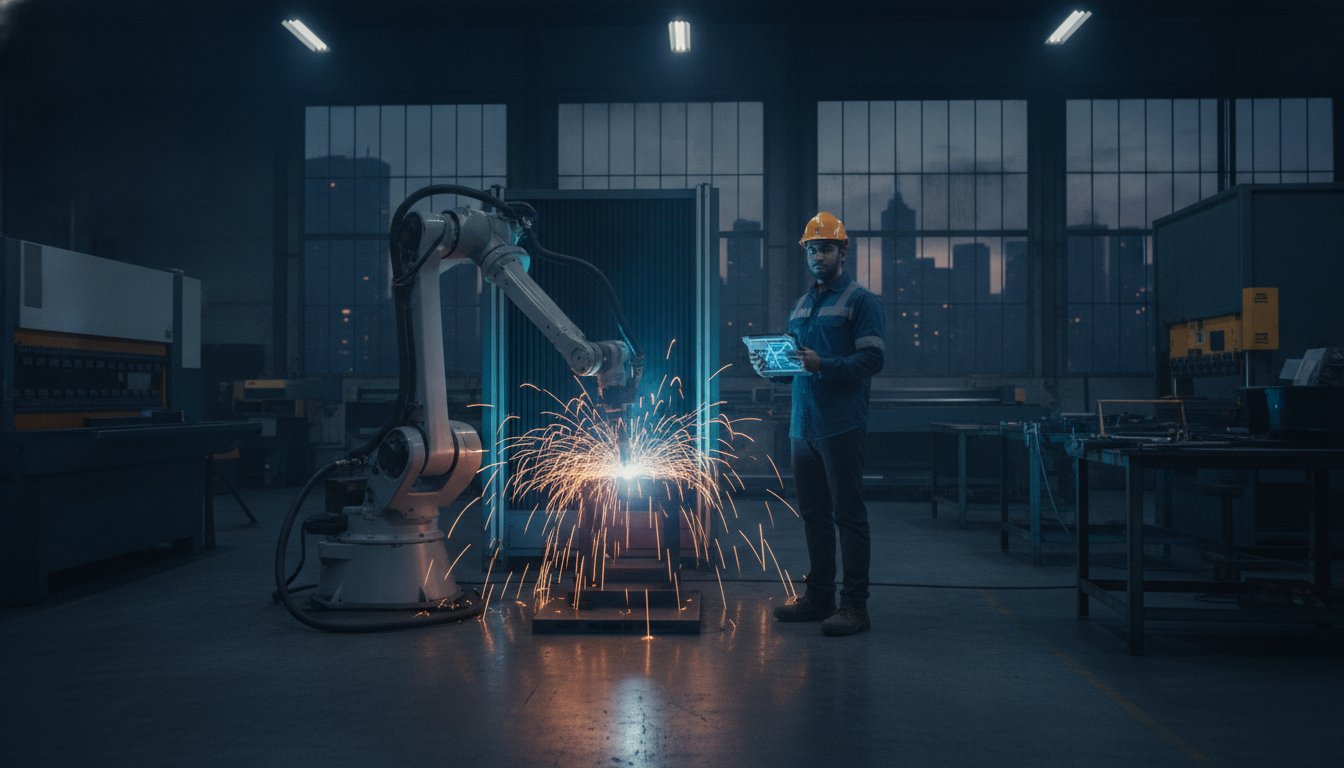
What if the solution to your chronic welder shortage isn't finding a rare new hire, but giving your current team a tool that handles the repetitive heavy lifting? Most Melbourne fabricators are feeling the squeeze of a shrinking pool of ticketed tradespeople and the mounting costs of manual rework. It's a common struggle to maintain consistent quality when your best staff are stretched thin across every batch. You know the frustration of turning away profitable work simply because you don't have the hands on deck to guarantee the deadline.
The good news is that adopting robotic welding solutions in Melbourne no longer requires a degree in computer science or a massive overhaul of your workshop floor. This 2026 guide will show you how collaborative robots act as a practical partner for your welders rather than a complex replacement. You'll discover how no-code software allows your existing staff to set up new jobs in minutes, helping you increase daily output and achieve a fast ROI even on small-to-medium production runs. We'll walk through the latest in turnkey integration and operator training to ensure your transition to automation is grounded, steady, and successful.
Key Takeaways
- Learn how robotic welding solutions melbourne are bridging the skills gap by allowing your existing team to produce more without needing extra ticketed welders.
- Understand the practical differences between traditional industrial robots and collaborative cells, including why cobots are better suited for compact Australian workshop floors.
- Discover how no-code teaching software removes the need for complex programming, letting your operators set weld paths simply by moving the robot arm.
- Find out how to audit your current workflow to identify the best MIG or TIG applications for automation and ensure a smooth integration process.
- See why a mobile on-site demonstration is the most reliable way to prove the concept for your specific batch runs before you commit.
Why Australian Manufacturers are Shifting to Robotic Welding Solutions
By 2026, the Australian fabrication landscape has reached a turning point. Rising operational costs and a persistent shortage of skilled labour have created a dual pressure that manual welding alone can't solve. For many local workshops, relying strictly on traditional methods is becoming a bottleneck for growth. This is the primary reason we are seeing a rapid uptake of robotic welding solutions melbourne. It is no longer just about moving faster. It is about creating a stable, predictable production line in an unpredictable market.
The shift is particularly visible in small-to-medium enterprises (SMEs). Previously, automation was the domain of massive car plants with "caged" industrial robots and dedicated programming teams. Modern systems have changed that. We've moved toward flexible, workshop-ready units that fit into existing floor plans without requiring a total workshop redesign. These systems allow robots to act as a collaborative partner, handling the high-volume, repetitive work while your best tradespeople focus on the high-value, bespoke joins that require a human eye.
The True Cost of Manual Welding Rework
Every time a weld fails inspection or requires significant grinding and re-welding, your profit margin takes a direct hit. Inconsistent beads in repetitive batches are a common drain on workshop resources. Automation provides a level of repeatability that even the steadiest human hands struggle to maintain over a full shift. By integrating robotic welding solutions melbourne, you gain precision control over gas flow and wire delivery. This consistency reduces material waste and virtually eliminates the hidden costs of rework that often plague manual production runs.
Solving the Skilled Labour Shortage
Finding ticketed welders in the current market is harder than ever. Instead of competing for a shrinking pool of talent, smart fabricators are using technology to empower the staff they already have. Collaborative robots, or "cobots," are designed to take over the repetitive "grunt work" that leads to fatigue and injury. This doesn't replace the welder; it augments their talent. Your skilled staff can set the parameters and oversee the process, essentially multiplying their own output without increasing their physical workload.
There is also a significant health and safety benefit to this transition. Removing your team from hazardous positions and constant exposure to welding fumes improves workplace morale and long-term staff retention. When the robot handles the most taxing parts of the job, your workshop becomes a cleaner, safer, and more attractive place to work. It turns a high-pressure environment into a modern manufacturing hub where technology and craftsmanship work side by side.
Collaborative Robot (Cobot) Cells vs. Traditional Industrial Robots
Traditional industrial robots have been a staple in manufacturing for decades, but they often feel like a mismatch for the average Australian workshop. They're undeniably fast and powerful, yet they require massive safety cages and specialised engineers to program. If you're looking for robotic welding solutions melbourne, you've likely realised that floor space is at a premium. A traditional robot cell can take up a huge chunk of your production area just to meet safety regulations. This makes them difficult to justify for anyone outside of high-volume automotive plants.
Collaborative robots, or cobots, take a completely different approach. They're designed to work alongside your team rather than being locked away behind steel fencing. This is made possible by Power and Force Limiting (PFL) technology. If the robot arm senses any unexpected contact, it stops instantly. This safety feature allows for a much smaller footprint. You can often deploy a cobot in a space not much larger than a standard manual welding bench, making it a far more practical choice for compact Melbourne workshops.
Safety and Workshop Integration
Modern robotic welding solutions melbourne rely on a combination of built-in sensors and external safety scanners. These tools create a virtual safety zone around the robot. Instead of heavy fencing, you use area scanners that slow or stop the robot if a person enters the workspace. This makes collaborative robot welding cells much easier to integrate into an existing workflow. You don't need to rebuild your shop floor to accommodate the machine. It simply becomes another station on the line that your team can interact with naturally.
Flexibility for Job Shops and Small Batches
Traditional robots are excellent for high-volume production where the task never changes. However, they're notoriously difficult to repurpose for small runs. If you have a batch of ten frames to weld today and twenty brackets tomorrow, the programming time for an industrial robot often outweighs the benefits. Cobots are built for this kind of variety. Because they're lightweight and often mounted on mobile bases, you can move them between different welding stations as your workload shifts.
This flexibility is the key to how you can improve welding productivity with cobots without losing the agility that defines a successful job shop. You can keep your skilled welders on the complex, one-off projects while the cobot handles the repetitive parts of the mix. If you're curious about how this might look in your own bay, you can explore the various turnkey integration options available for local fabricators.
Overcoming the 'Coding Barrier' with No-Code Teaching Software
For many Melbourne shop owners, the biggest hurdle isn't the cost of the hardware. It's the fear of the software. You shouldn't have to hire a computer scientist just to run a welding bay. Modern robotic welding solutions melbourne have moved past the era of complex G-code and clunky teach pendants. Instead, we've entered the age of no-code teaching software, which is designed specifically for the people who actually know how to weld. It turns the robot into a tool that follows the welder's lead, rather than a computer that needs constant debugging.
This shift means your ticketed welders remain the experts. They don't need to learn a new language; the robot learns from them. By physically moving the robot arm to the start and end points of a joint, the operator sets the path in real time. It's a pragmatic approach that values the craftsman's intuition over a programmer's keyboard. You can adjust weld parameters like voltage and wire speed on the fly through an intuitive interface, making fine-tuning as simple as turning a dial on a standard power source.
Teaching Robot Paths by Hand
The "lead-through" method is the cornerstone of accessible automation. It allows an operator to grab the robot's torch and guide it along the desired seam. This process is as natural as manual welding. You set approach points, weld starts, and crater fills in seconds. This hands-on interface is exactly why no-code robot welding software is such a game changer for local workshops. It empowers your best staff to take ownership of the technology, ensuring the robot performs exactly how a human professional would.
Rapid Job Changeovers
In a typical job shop, you might need to switch from a simple t-joint to a complex circular weld several times a day. With traditional automation, this would involve hours of downtime and code adjustments. With a no-code system, you can manage these transitions in under five minutes. Because there is no G-code to write or verify, the "down-time" between batches is virtually eliminated. This speed allows robotic welding solutions melbourne to remain profitable even for small-run jobs that were previously restricted to manual welding only.
Once a job is perfected, the "Save and Repeat" workflow allows you to build a digital library of your shop's regular projects. The next time that specific bracket or frame comes through the door, your operator simply selects the file, and the robot is ready to go. This creates a repository of workshop knowledge that stays with your business, ensuring that high-quality beads are achieved every single time, regardless of which staff member is managing the cell that day.
Implementing Robotic Welding: A Step-by-Step Integration Framework
Implementing robotic welding solutions melbourne isn't a "set and forget" purchase. It requires a methodical framework to ensure the technology actually delivers on the promised ROI. You need a plan. The first step is always a workflow audit. Look for the parts in your shop that are repetitive, high-volume, and relatively simple in terms of geometry. These are your "low-hanging fruit" candidates for automation. If a job involves long, straight runs or circular seams on a turntable, it's a perfect fit for a cobot.
Selecting the right process is equally critical. Most Australian fabricators opt for MIG applications due to the speed and ability to bridge slight gaps in fit-up. However, if your workshop specialises in thin-gauge stainless steel or aluminium where aesthetics are paramount, a TIG-capable cobot cell might be the better choice. Once you've identified the jobs, you must consider the physical layout. This includes ensuring your workshop has the correct three-phase power and a dedicated fume extraction system that covers the robot's entire range of motion.
The Role of an Integration Specialist
Buying a robot arm is only half the battle. Bringing it all together requires technical insight. An "off-the-shelf" robot rarely arrives ready to weld your specific parts. This is where cobot welding integration becomes essential. A specialist ensures your existing power sources and torches play nicely with the new software. They also help you design or customise the jigs and fixtures needed for robotic repeatability. Without accurate fixturing, the robot's precision is wasted on parts that aren't where they're supposed to be.
Operator Onboarding and Culture
Technical setup is one thing, but your team's mindset is another. It's natural for staff to feel uneasy when a robot arrives on the floor. Address the "robots will take my job" fear early by showing them how the tool actually makes their day easier. Focus on on-site cobot welder training to turn your staff into "Robot Super-Users." When they realise the robot handles the fumes and the awkward positions while they manage the process, the culture shifts from suspicion to ownership.
Once the system is live, establish a clear maintenance schedule. Keep the liners clean, check the contact tips, and ensure the sensors are free of spatter. Consistent maintenance leads to a consistent arc. If you're ready to see how these steps apply to your workshop, you can explore our turnkey integration options to get started on the right foot with robotic welding solutions melbourne.
Maximising Workshop Productivity with TME Systems’ Collaborative Solutions
TME Systems doesn't just supply hardware; we provide a bridge for workshops looking to modernise without losing their trade roots. Our focus on robotic welding solutions melbourne is built around the concept of accessible automation. This means we prioritise systems that your current team can pick up and use within a day. We understand that every workshop has its own rhythm, which is why we don't push a one-size-fits-all approach. Whether you need a standard turnkey cell for rapid deployment or a more customised integration for unique parts, our goal is to find the sweet spot that maximises your specific ROI.
One of the most effective ways to de-risk this transition is through a mobile welding robot demonstration. It's one thing to read about no-code software; it's another to see the robot welding your actual parts in your own bay. This on-site proof of concept allows you to verify quality and cycle times before making a commitment. Having a local Australian partner means you aren't waiting for tech support from a different time zone. We're on the ground, providing the operator training and ongoing support needed to keep your production line moving.
The TME Systems Approach: Practical Mentors
We see ourselves as practical mentors rather than just equipment suppliers. Our team is just as comfortable on the workshop floor as we are in a technical briefing. We've seen how the right interface between a person and a machine can transform a business. By focusing on the human operator, we ensure the technology adapts to your existing skills. This supportive relationship doesn't end once the cell is installed. We remain an active partner in your progress, refining your processes and supporting your staff as they become more confident with automation.
Taking the First Step Toward Automation
The transition to a more productive workshop starts with a simple conversation. You don't need a fully mapped-out strategy to begin. We help you develop a long-term automation roadmap that grows with your business, starting with the jobs that offer the fastest return. Testing your specific parts on our system is the best way to clear up any lingering doubts about batch sizes or weld quality. Ready to see the future of your workshop? Organise a mobile demonstration today and find out how easy it is to bring robotic welding solutions melbourne into your daily operations.
Future-Proofing Your Workshop Floor
Adopting robotic welding solutions melbourne is no longer a distant possibility reserved for automotive giants. It's a practical, immediate answer to the skilled labour shortages and rising rework costs that local fabricators face today. By choosing collaborative systems, you empower your existing team to handle repetitive batches with precision. No-code software ensures that your ticketed welders remain the experts in control, removing the need for external programmers or complex training cycles.
This transition is about giving your staff a smarter tool to help them succeed. With turnkey cells designed for rapid deployment and local Australian support, the path to automation is grounded and manageable. Ready to see how this technology handles your specific parts? You can Book a Mobile Robot Welding Demonstration on your workshop floor to see the results firsthand. It's a straightforward way to prove the concept before you commit, ensuring your workshop is ready for the demands of 2026 and beyond.
Frequently Asked Questions
Is robotic welding suitable for small batch production or only high-volume jobs?
Robotic welding is absolutely suitable for small batch runs. Because these collaborative systems use no-code software, the time required to set up a new job is drastically reduced compared to traditional industrial robots. This flexibility allows Australian job shops to automate batches as small as ten or twenty pieces while still seeing a clear benefit in consistency and speed.
Do my staff need to know how to code to operate a welding cobot?
Your staff don't need any coding knowledge to operate our systems. We use intuitive no-code teaching software that allows a welder to set the path by simply guiding the robot arm by hand. If they can weld manually, they can learn to manage a cobot in a matter of hours, keeping the expertise in the hands of your tradespeople.
How much floor space does a typical collaborative welding cell require?
A typical collaborative welding cell requires very little floor space, often occupying an area similar to a standard 2.4-metre welding table. Because they don't always require bulky safety fencing, they fit easily into tight Melbourne workshop layouts without disrupting the existing flow of work or requiring a total shop redesign.
Can a robotic welding solution handle different materials like aluminium and stainless steel?
Yes, these robotic welding solutions melbourne are highly versatile and can handle aluminium, stainless steel, and mild steel with ease. The robot is integrated with high-quality power sources that allow you to switch between MIG and TIG processes depending on the specific material and aesthetic requirements of your project.
What is the expected ROI for an Australian fabricator investing in a cobot?
Most Australian fabricators see a fast ROI by increasing their daily weld output and reducing the cost of manual rework. While the exact timeline depends on your shop's volume, the ability to run repetitive parts through the robot while your skilled welders focus on complex jobs usually leads to a significant boost in profitability within the first year of operation.
Are collaborative robots safe to use without a protective cage?
Collaborative robots are designed to be safe for use without a traditional protective cage. They use Power and Force Limiting technology and safety scanners to detect human presence. If the arm makes contact with an object or person, it stops instantly, satisfying strict Australian safety standards for 2026 workshop environments.
What happens if our welding requirements change; can the robot be repurposed?
One of the biggest advantages of a cobot is how easily it can be repurposed for different tasks. If your production requirements change, you can simply move the robot to a new station or teach it a different path using the software. This flexibility ensures the machine remains a productive asset even as your product lines evolve over time.
Does TME Systems provide on-site training for our existing welders?
TME Systems provides comprehensive on-site training as part of our turnkey integration service. We don't just drop off the equipment; we work with your existing welders to ensure they are comfortable managing the robot and adjusting weld parameters. This hands-on support is designed to make the transition to automation seamless and successful for your entire team.