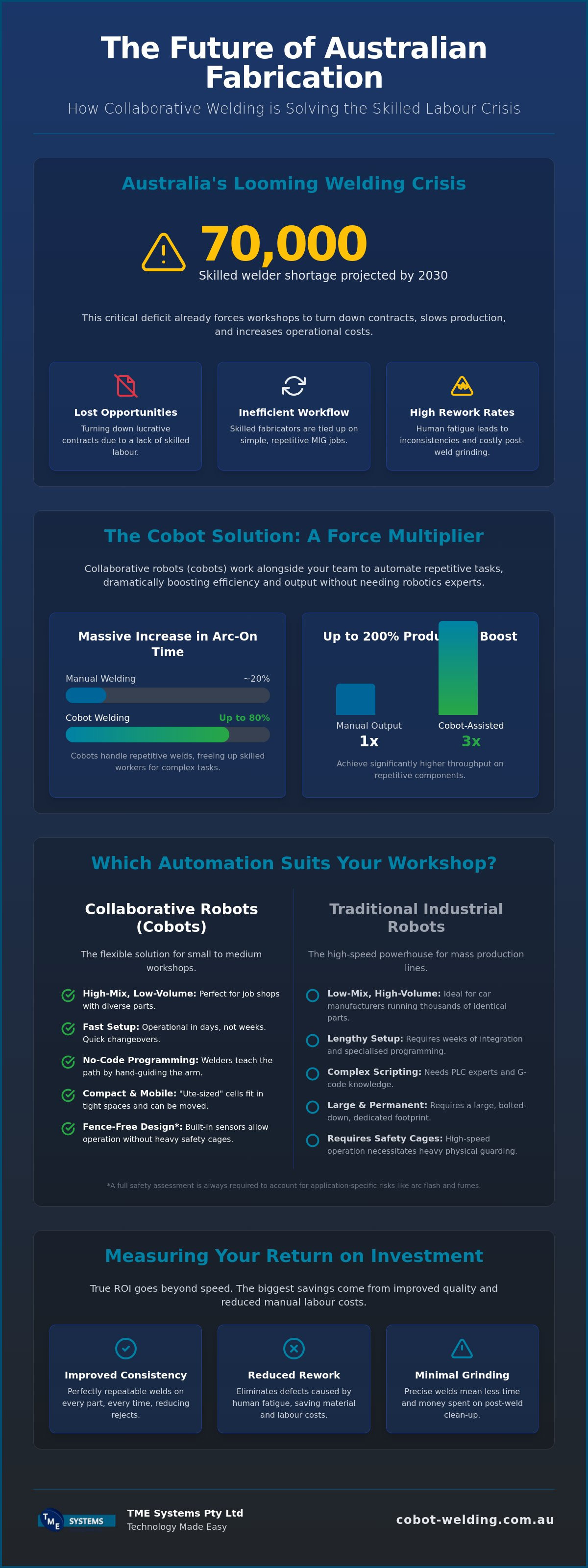

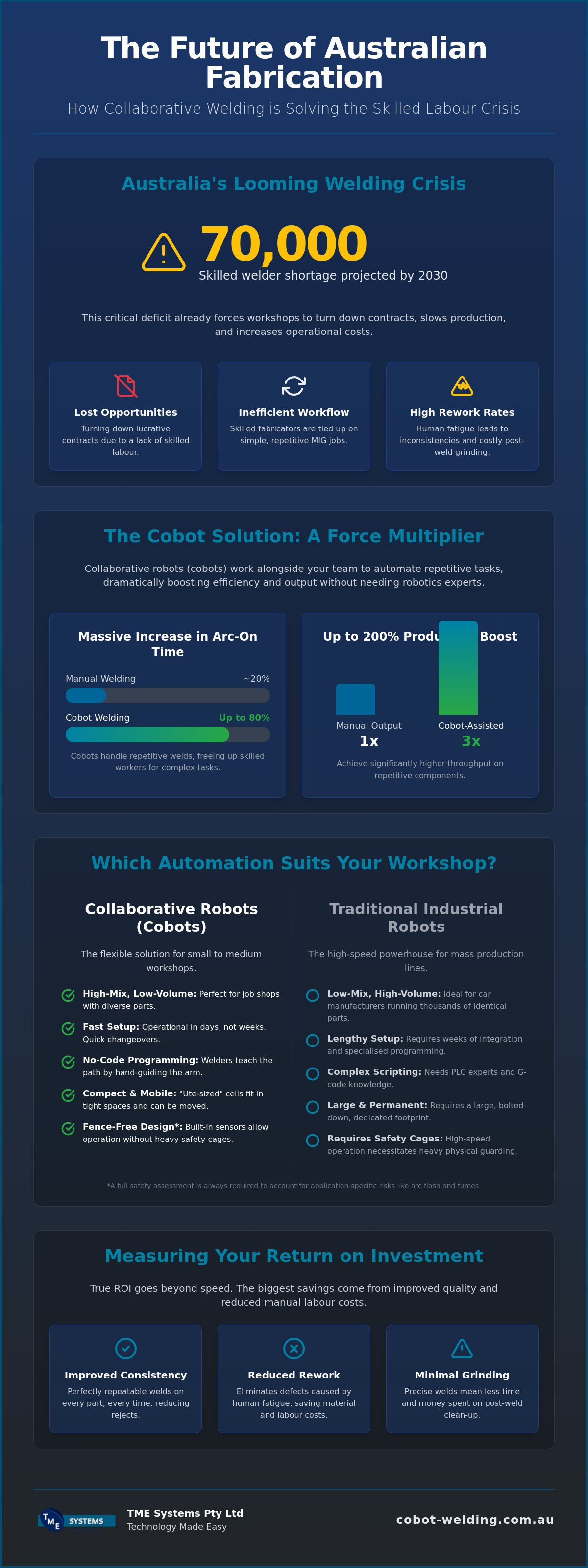
Australia is projected to face a deficit of 70,000 welders by 2030, a reality that's already forcing local workshops to turn down lucrative contracts. You likely know the frustration of watching a repetitive MIG job tie up your most skilled fabricator for days, especially when you can't find a reliable offsider to help with the backlog. This is why small business welding automation has moved from being a high-tech dream for car manufacturers to a practical tool for the local Australian workshop. It's exhausting to manage high rework rates on simple components just because of human fatigue, but there's a grounded way forward.
We promise to show you how cobots and no-code software allow your existing staff to "teach" a weld path by hand, increasing production by up to 200% on repetitive tasks. You don't need a degree in robotics to make this work. We'll explore how to integrate these systems to improve consistency, reduce grinding, and future-proof your business against a volatile labour market without replacing the tradespeople who make your business run.
Key Takeaways
- Understand the shift from fixed industrial cages to flexible collaborative cells that can be set up in days rather than weeks.
- Discover why no-code teaching software is the real engine behind small business welding automation, letting your tradespeople lead the robot by hand instead of typing code.
- Learn how to boost your workshop's arc-on time from 20% to 80% by automating repetitive components with your current team.
- Follow a practical 5-step checklist to audit your parts for the best results and ensure your workshop centre is ready for integration.
- Measure your return on investment by looking beyond speed to the massive savings found in reduced rework and minimal post-weld grinding.
What is Small Business Welding Automation in 2026?
Small business welding automation isn't about replacing your team with a massive, bolted-down assembly line. In 2026, it refers to flexible, compact systems designed specifically for workshops with 2 to 20 staff. These systems handle the repetitive, high-frequency tasks that often clog up your production flow. For a long time, traditional automation was the domain of car manufacturers because the setup costs and programming time only made sense for thousands of identical parts. If you run a job shop, that model never worked. You need to switch between different parts quickly, and that's exactly what modern small business welding automation allows.
To understand how far we've come, a quick robot welding overview shows that the industry used to rely on rigid G-code and complex scripting. Today, the "no-code" revolution has flipped the script. Instead of a technician spending hours behind a keyboard, a welder can now set up a new job in minutes. This shift is the tipping point for Aussie fabricators who need to stay competitive while managing a diverse range of projects. It's about making the technology fit the workshop, not the other way around.
The Labour Crisis in Australian Fabrication
The shortage of certified welders in Australia isn't just a headline; it's a daily hurdle. With a projected deficit of 70,000 tradespeople by 2030, finding and keeping staff is harder than ever. Rising labour costs mean you can't afford to have your most senior fabricators stuck on basic sub-assemblies. Automation steps in as a tool for your existing team. It takes over the "boring" repetitions, which frees up your experienced tradespeople to focus on the complex, bespoke work that requires a human touch. This doesn't just improve throughput; it makes the job more engaging for your staff by removing the strain of repetitive MIG or TIG runs.
From Industrial Robots to Collaborative Cobots
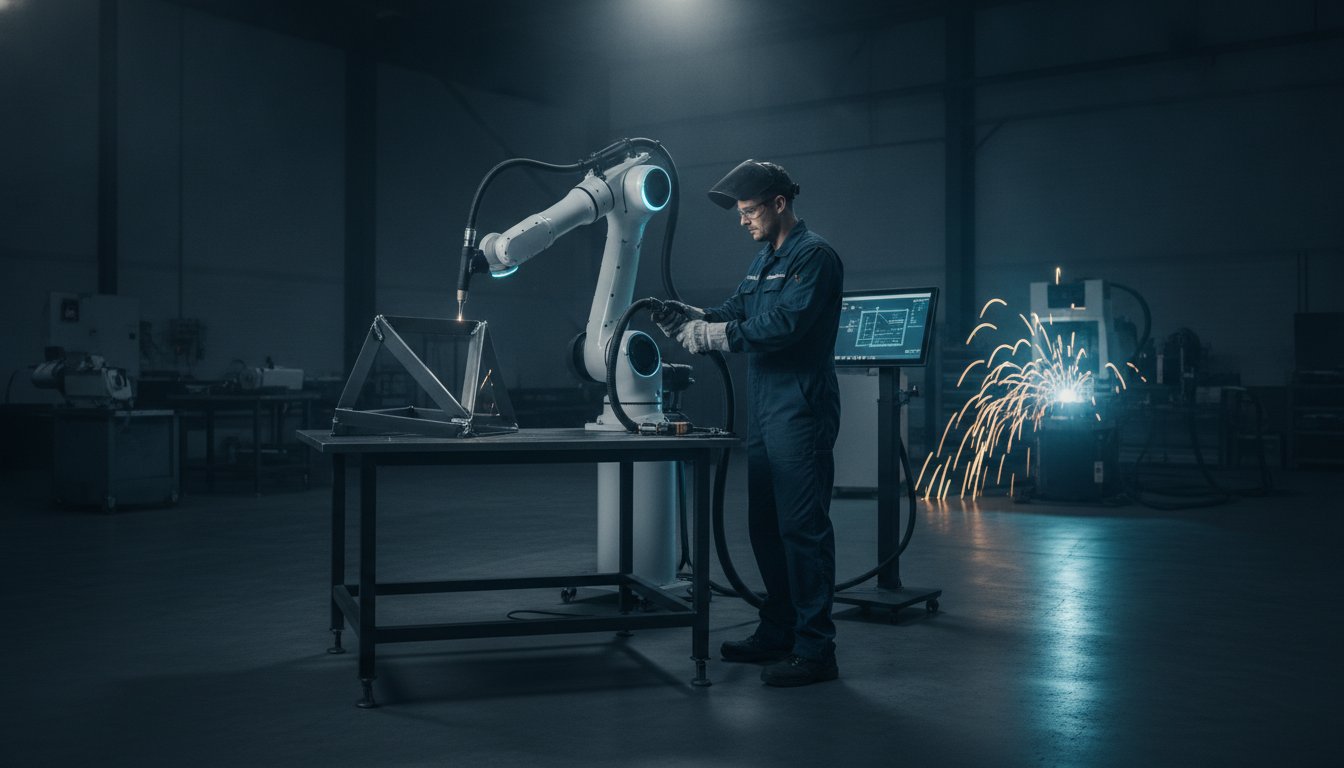
The physical difference between old-school industrial robots and modern cobots is stark. Traditional robots require heavy safety fencing and a large, permanent footprint. In contrast, collaborative robot welding cells are built with force-limiting sensors. They don't need cages because they're designed to stop instantly if they touch an operator. These units are "ute-sized" solutions that fit into tight corners of a workshop. They're mobile, easy to move around the floor, and integrate seamlessly with your existing benches. It's about adding a versatile tool to your arsenal rather than rebuilding your entire shop around a machine. For a small business, this mobility means you can deploy small business welding automation exactly where the bottleneck is on any given day.
Cobots vs. Industrial Robots: Which Suits Your Workshop?
Choosing the right hardware is a decision that dictates your workshop's rhythm for years. Industrial robots are high-speed powerhouses, but they come with a heavy "setup tax". It often takes weeks of specialised programming and a permanent, bolted-down footprint to get them running. For small business welding automation, this rigid approach is usually a dealbreaker. Collaborative robots, or cobots, can be operational in days because they don't require complex PLC experts. You can simply hand-guide the arm to teach it a path. This portability is one of the key drivers for welding automation in Australia as workshops look to maximise every square metre of their floor space.
The difference in flexibility is where the cobot really shines for the local job shop. An industrial robot is fixed in place, but a cobot can be mounted on a mobile base and wheeled to different stations. One day it's welding brackets; the next, it's moved to a different bench to handle sub-assemblies. If you aren't sure which path fits your specific parts, seeing a mobile demo system in action on your own floor can quickly clarify the choice.
Safety Standards and the 'Fence-Free' Myth
It's a mistake to think "collaborative" means zero risk. While cobots use force-limiting sensors to stop on contact, you still need to conduct a proper safety assessment. This involves looking at the welding arc itself, the heat, and the fumes produced. Australian safety standards still apply, but the lack of a heavy safety cage makes the system far more accessible. For a deeper look at the technical trade-offs between these systems, check out our guide on cobot vs industrial robot welding.
Total Cost of Ownership for Small Business
Total Cost of Ownership is the sum of initial capital, integration, and ongoing operator training. For a small shop, the smaller footprint of a cobot is a major win. You don't need to sacrifice 20 square metres of floor space to a massive safety enclosure. In many Australian industrial hubs where rental costs are climbing, saving that space is a direct boost to your bottom line. When you factor in the reduced need for external programmers, small business welding automation through collaborative cells often provides a much faster path to profitability.
The High-Mix, Low-Volume Challenge: Why No-Code is King
The biggest hurdle for the average Aussie job shop isn't the robot itself; it's the time it takes to tell the robot what to do. If you have to spend three hours programming a part that only takes ten minutes to weld, the maths just doesn't stack up. This is why no-code software has become the backbone of small business welding automation. It transforms the robot from a complex computer into a versatile shop tool that any of your welders can use without a background in computer science.
The "teaching" process is remarkably straightforward. Instead of typing lines of code on a clunky pendant, your operator simply moves the robot arm by hand to the start and end points of the weld. The software records these positions and calculates the path automatically. Because this setup happens in minutes, you can handle "batch of one" scenarios profitably. If a customer returns six months later with the same order, you just recall the saved "recipe" and hit start. This ability to store and repeat perfect welds is what allows a small workshop to punch well above its weight.
Eliminating the Programming Bottleneck
Traditional industrial robots often sit idle because the programming bottleneck is too tight. By switching to intuitive, tablet-based interfaces, you put the power back in the hands of your tradespeople. A welder with 20 years of experience knows exactly how a bead should lay; no-code tools allow them to translate that skill directly to the machine. This shift aligns with the National Robotics Strategy, which aims to make advanced tech more accessible to the broader manufacturing sector. For a deeper dive into the mechanics, our guide on no-code robot welding software covers the technical specifics of how these interfaces work.
Managing Variety in the Job Shop
Success in a high-mix environment relies on how quickly you can switch between projects. Organising your workspace with modular welding tables allows you to centre different jigs and fixtures in the same spot every time. By using parameter libraries, you can store specific settings for different aluminium grades or steel thicknesses. This means the robot isn't just repeating a path; it's applying the correct heat and wire speed for the specific job at hand. It turns your small business welding automation cell into a flexible station that handles whatever project walks through the door next.
Preparing Your Workshop: A 5-Step Automation Checklist
Before you commit to small business welding automation, you need a clear-eyed look at your workshop's current state. It's easier than you might think, but jumping in without a plan is a recipe for downtime. You don't need to rebuild your shed; you just need to organise it. Use this checklist to gauge your readiness for a collaborative cell.
- Step 1: Audit your parts. Identify the high-frequency "low hanging fruit". These are the simple, repetitive components that eat up your team's time but don't require complex, bespoke fabrication.
- Step 2: Check your power and air. Ensure your workshop centre has stable 3-phase power if your specific welder requires it. Modern cobots are efficient, but they need a consistent feed to maintain weld quality.
- Step 3: Evaluate your floor space. Clear a 2m x 2m area. This is usually enough for a standard cell, including the robot, the table, and enough room for an operator to move safely around it.
- Step 4: Identify your "Cobot Champion". Pick a staff member who is keen on technology to lead the adoption. This isn't necessarily your most senior person; it's the one who's most excited to learn the no-code interface.
- Step 5: Plan your integration. Work with a specialist to map out your robotic welding cell setup. They'll help you ensure the robot's reach and the table height are perfectly dialled in for your specific parts.
Infrastructure Requirements for Aussie Shops
Older Australian industrial units often have electrical setups that haven't been touched in decades. You'll want an electrician to verify your circuits can handle the combined load of the robot and the power source under full load. Compressed air quality is another common pitfall. Automated torches rely on clean, dry air to prevent internal damage and ensure consistent arc starts. If your current compressor is spitting moisture, a simple inline dryer is a vital investment. You should also consider how to integrate your existing weld fume extraction. Most cobot cells are open, so positioning them near your current extraction arms or hoods is the most cost-effective way to keep the air clear.
The Human Element: Training and Onboarding
It's natural for a team to feel some "robot anxiety" when a new machine arrives on the floor. Address this early by framing the cobot as a tool that handles the grunt work, not a replacement for their trade. Set realistic expectations for the first 30 days. The goal isn't 100% uptime on day one; it's about getting your "champion" comfortable with the teaching process. Operator onboarding is the structured process of transitioning a manual welder to a robotic system supervisor. If you're ready to see how these steps look in your own shop, booking a mobile demo system is a great way to get the team involved from the start.
Calculating ROI: When Does Small Business Automation Pay Off?
Investing in small business welding automation is a significant financial decision, and you've got to be sure the numbers stack up. In most Australian workshops, a collaborative system typically pays for itself within 18 to 24 months through a combination of reduced labour costs and increased throughput. The most dramatic shift happens in your "Arc-On Time". While a manual welder might only spend 20% of their day actually laying a bead due to positioning and prep, an automated cell can often push that figure to 80%. This allows for a massive productivity boost on repetitive sub-assemblies, letting you get more work out the door with the same number of staff.
Then there's the "Grinding Factor". We all know that post-weld cleanup is a profit killer. Because a robot maintains a consistent travel speed and arc length, you see a massive reduction in spatter and rework. This consistency doesn't just save time; it increases your workshop's capacity. You can start quoting on larger contracts that you previously had to turn away due to capacity limits. Choosing a turnkey robotic welding unit accelerates this time-to-value because the system arrives ready to work, minimising the downtime often associated with custom builds.
The 'Hidden' ROI of Quality Consistency
Financial gains also come from tighter control over your consumables. Optimised wire and gas usage might seem small per part, but it adds up over a year of production. There's also a marketing advantage. When you're pitching for high-end architectural or medical contracts, being able to guarantee perfect weld consistency is a powerful selling point. Beyond the books, automation lowers the physical toll on your team. By letting the robot handle the repetitive, awkward positions, you reduce the risk of long-term strain injuries and keep your best tradespeople on the tools for longer.
Taking the First Step: The Proof of Concept
You should never buy a robot based on a brochure alone. It's vital to see the system weld your specific parts in a real-world environment. This is why we recommend a mobile welding robot demonstration. It provides a risk-free proof of concept on your own shop floor, ensuring the reach and access are exactly what you need. If you're ready to see how small business welding automation can transform your workshop's bottom line, contact the TME Systems Pty Ltd team to discuss your workshop's automation potential.
Future-Proofing Your Workshop Floor
The shift toward small business welding automation is about more than just keeping up with technology; it's about protecting your workshop against the persistent skilled labour shortage. By choosing collaborative cells with no-code software as standard, you're giving your tradespeople a tool that amplifies their existing expertise rather than making it obsolete. We've seen how these systems can turn a 20% arc-on time into 80%, allowing you to quote on larger contracts with total confidence in your consistency and capacity.
Transitioning to automation shouldn't be a leap of faith. As an Australian-owned and operated partner, the team at TME Systems Pty Ltd focuses on providing the local support and specialised training you need to succeed from day one. The best way to understand the impact on your bottom line is to see the technology in action on your own floor with your own components. Book a Mobile Demonstration to see a cobot weld your parts on-site and discover how our nationwide mobile demonstrations can clarify your path forward. Your workshop has the craft and the experience; we're here to help you scale it. Let's get to work.
Frequently Asked Questions
Is my workshop too small for a welding robot?
Your workshop is likely the perfect size for a collaborative system; most cells only require a footprint of approximately 2m x 2m. Unlike massive industrial robots that need permanent safety cages, these units are designed for workshops with as few as two or three staff. If you have enough room for a standard welding bench and a bit of clearance for an operator, you have enough room for automation.
Do I need to hire a programmer to run a welding cobot?
You don't need to hire any specialised IT staff or programmers to operate a modern cobot. The no-code software included with these systems allows your existing tradespeople to "teach" the robot by hand. If a welder can lead a bead, they can lead the robot arm through a path. This keeps the control in the hands of your experienced fabricators who understand weld quality best.
What is the typical payback period for small business welding automation?
Most Australian fabricators see a full return on investment within 18 to 24 months. This timeline is driven by moving your arc-on time from a typical 20% up to 80% on repetitive sub-assemblies. When you factor in the massive reduction in post-weld grinding and the ability to quote on larger contracts, the system often pays for itself much faster than traditional machinery.
Can a cobot handle both MIG and TIG welding?
Yes, collaborative cells are versatile enough to handle both MIG and TIG processes depending on the power source you integrate. While MIG is the most common choice for small business welding automation due to its speed on repetitive parts, TIG is increasingly popular for stainless steel and architectural work. The software allows you to store specific parameter libraries for each process to ensure consistency.
How long does it take to 'teach' a robot a new weld path?
Teaching a new weld path typically takes between five and fifteen minutes for most standard components. Because the operator simply moves the arm to the start and end points of each joint, the setup is incredibly fast. This speed makes it profitable to automate even small batches or "one-off" orders that you expect to see again in the future.
Is a collaborative robot safe to use without a safety cage?
Cobots are designed to work safely alongside humans because they feature built-in force-limiting sensors that stop the arm instantly on contact. While this removes the need for a bulky safety cage, you still need to conduct a risk assessment for your specific shop. You must manage the standard risks of the welding process, such as arc flash, heat, and fumes, just as you would for a manual welder.
What happens if my workshop power supply is unstable?
Unstable power can lead to inconsistent weld penetration and potential electronic faults in the robot controller. It's vital to ensure your workshop centre has a stable feed, preferably on a dedicated circuit. If you're in an older industrial unit, having an electrician verify your 3-phase supply before integration is a simple step that prevents quality issues down the line.
Can I move the welding cell around my workshop easily?
Mobility is a core advantage of modern small business welding automation. Most collaborative cells are mounted on heavy-duty mobile bases with locking castors, allowing you to wheel the unit to different stations as your production needs change. This flexibility is perfect for job shops where the bottleneck might move from one project to another on a weekly basis.